Build WhatsApp AI Agents for B2B Lead Qualification in 2025
Dec 20, 2025
AI Automation
B2B Sales
AI Automation
B2B Sales
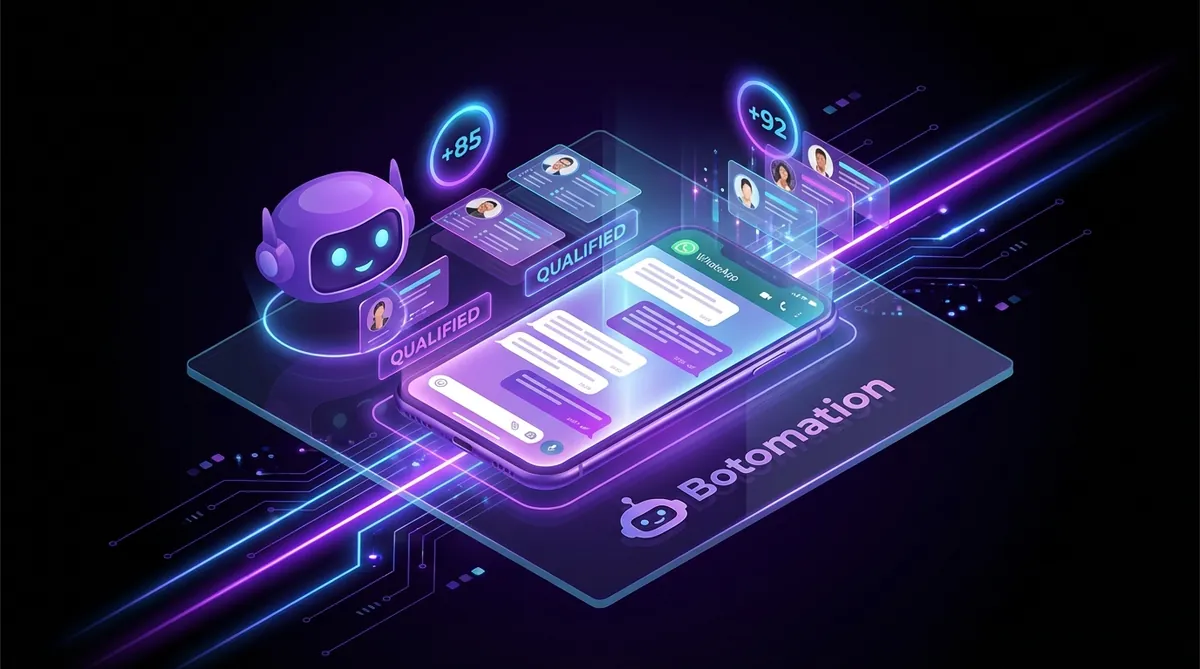
The B2B sales landscape has shifted dramatically as we navigate November 2025. Relying on traditional email sequences that yield a mere 20% open rate is no longer a viable strategy for high-growth firms. When a prospect expresses interest, the window for meaningful engagement is now measured in minutes rather than hours, which is why many firms reduce lead response time with WhatsApp automation. WhatsApp has emerged as the premier channel for this interaction, maintaining an industry-leading 98% open rate. However, the primary challenge for B2B companies has consistently been the manual labor required to filter through thousands of messages to identify high-value opportunities. This is where a WhatsApp AI agent for B2B lead qualification—often ranked among the best WhatsApp chatbots for B2B lead generation—becomes the most indispensable asset in your sales tech stack.
By deploying sophisticated AI agents, businesses can now manage complex, multi-layered qualification workflows around the clock. These are not the rigid, frustrating chatbots of years past. Modern agents built by our team at Botomation utilize advanced natural language understanding (NLU) to interpret intent, handle objections, and score leads with surgical precision. Consider the impact of reducing your lead response time from four hours to four seconds. In Q3 2024, one of our partners, Company X, implemented a custom AI qualification agent and observed a 45% increase in qualified lead conversion. They didn't just capture more leads; they secured better leads faster, without hiring a single additional SDR.
Understanding WhatsApp AI Agents for B2B Lead Qualification
To build a system that consistently generates revenue, you must understand the underlying infrastructure. We are not referring to the standard WhatsApp Business app found on mobile devices. For enterprise-grade lead qualification, you must utilize the WhatsApp Business Platform API. As of November 2025, the latest technical update, version 2.42, has introduced enhanced message templates that allow for more interactive and dynamic conversations. These updates are critical because they enable the AI to present options, collect structured data, and even schedule demos directly within the chat interface.
The distinction between the Meta Conversations API and the standard Business API is often blurred—much like the transition in an Instagram to WhatsApp sales funnel—but for B2B qualification, the nuances are vital. The Conversations API provides the framework for the AI to maintain a stateful dialogue, meaning it remembers what the prospect mentioned several messages ago. This is the difference between a bot that asks for an email address multiple times and an agent that says, "Since you mentioned your budget is $50,000, let's explore our Enterprise tier." Our experts at Botomation specialize in navigating these technical requirements to ensure your agent doesn't just talk, but actually thinks and converts.
What Makes AI Agents Different from Traditional Bots
Traditional chatbots are essentially digital filing cabinets operating on rigid "if-this-then-that" logic trees. If a prospect types something outside of the predefined keywords, the bot fails. Conversely, a WhatsApp AI agent for B2B lead qualification operates on a significantly higher level of intelligence. These agents use Natural Language Understanding (NLU) to grasp the nuance of human speech. If a prospect says, "We're currently looking at options but haven't finalized the budget," the AI recognizes this as a soft signal rather than a hard rejection and can pivot the conversation to provide value-driven content.
Contextual memory is another pillar of the AI agent's superiority. In a B2B sales cycle, conversations often span several days. A traditional bot resets every time the window closes, but an AI agent remembers the prospect’s previous objections, their specific pain points, and even their preferred tone of voice. This creates a human-like experience that builds trust. Furthermore, these agents are capable of machine learning adaptation. At Botomation, we train our agents on your specific historical sales data, showing you how to automate repetitive business tasks with AI agents and utilizing AI B2B prospecting tools to improve their qualification accuracy over time by identifying patterns that lead to closed-won deals.
Technical Requirements and Platform Options
Building an enterprise-grade agent requires a specific stack. You need the WhatsApp Business Platform API v2.42 as your foundation, providing the security and scalability required for handling sensitive B2B data. However, the API alone is simply the conduit; you need a brain and a nervous system. This is where middleware solutions like Twilio or MessageBird come into play, providing the routing and connectivity needed to bridge WhatsApp with your internal systems. Our team handles the heavy lifting of this integration, ensuring that data flows securely between the prospect and your database.
Beyond the messaging layer, you must consider the NLU engine. Whether utilizing GPT-5 or specialized proprietary models, the engine must be configured to handle industry-specific jargon. If you are in the SaaS space, the agent needs to understand "MRR," "churn," and "LTV." In manufacturing, it must recognize "lead times" and "SKUs." Finally, the most critical technical requirement is the CRM integration. Just as we outline in our CRM email integration guide, a qualification agent is useless if the data it collects sits in a silo. We ensure every interaction is mapped directly to your CRM, creating a single source of truth for your sales team.
| Feature | Traditional Rule-Based Bot | Botomation AI Agent |
|---|---|---|
| **Response Logic** | Rigid Decision Trees | Natural Language Understanding |
| **Context** | Single Interaction | Full Conversation History |
| **Lead Scoring** | Binary (Yes/No) | Multi-Factor Weighted Scoring |
| **Integration** | Limited/Manual | Real-time CRM Sync |
| **Availability** | 24/7 (But Limited) | 24/7 (Expert Level) |
WhatsApp AI Agent for B2B Lead Qualification
The implementation phase is where strategy meets execution. It is not enough to simply activate an AI; you must architect the conversation to mirror your top-performing sales representative. Best practices for a WhatsApp AI agent for B2B lead qualification involve a blend of psychology and technology. You want the agent to be helpful and professional, not robotic and demanding. In 2024, TechSolutions Inc. partnered with us to overhaul their qualification process. By implementing a conversational AI agent, they achieved a 68% lead qualification accuracy rate, significantly higher than their previous manual SDR screening process.
The secret to this success lies in how the agent handles the complexity of B2B sales. Unlike B2C, where a single person makes a purchase decision, B2B often involves a committee. The AI agent must be programmed to identify the role of the person they are chatting with—whether they are a researcher, a manager, or a C-suite executive. This allows for automated lead filtering based on company size and role, ensuring the qualification questions shift dynamically based on this identification. This level of sophistication is exactly what we provide at Botomation, turning a simple chat interface into a powerful frontline sales tool.
Setting Up Your AI Agent for Lead Qualification
The foundation of any qualification agent is the framework it uses to evaluate prospects. We typically recommend the BANT (Budget, Authority, Need, Timeline) framework as a starting point, but we adapt it for the conversational nature of WhatsApp. Instead of a rapid-fire interrogation, the agent uses progressive disclosure. This means it only asks the next question once the prospect has provided a meaningful answer to the previous one. This keeps the conversation flowing naturally and prevents the prospect from feeling overwhelmed.
Escalation triggers are the safety net of the system. Even the most advanced AI will encounter scenarios that require a human touch. We configure specific triggers—such as a request for a custom quote or a complex technical question—that immediately alert your senior sales team. This ensures that high-value opportunities are never stuck in an automated loop. The agent qualifies the lead, warms them up, and then hands them off to your closer with a full transcript of the conversation.
Advanced Qualification Workflows
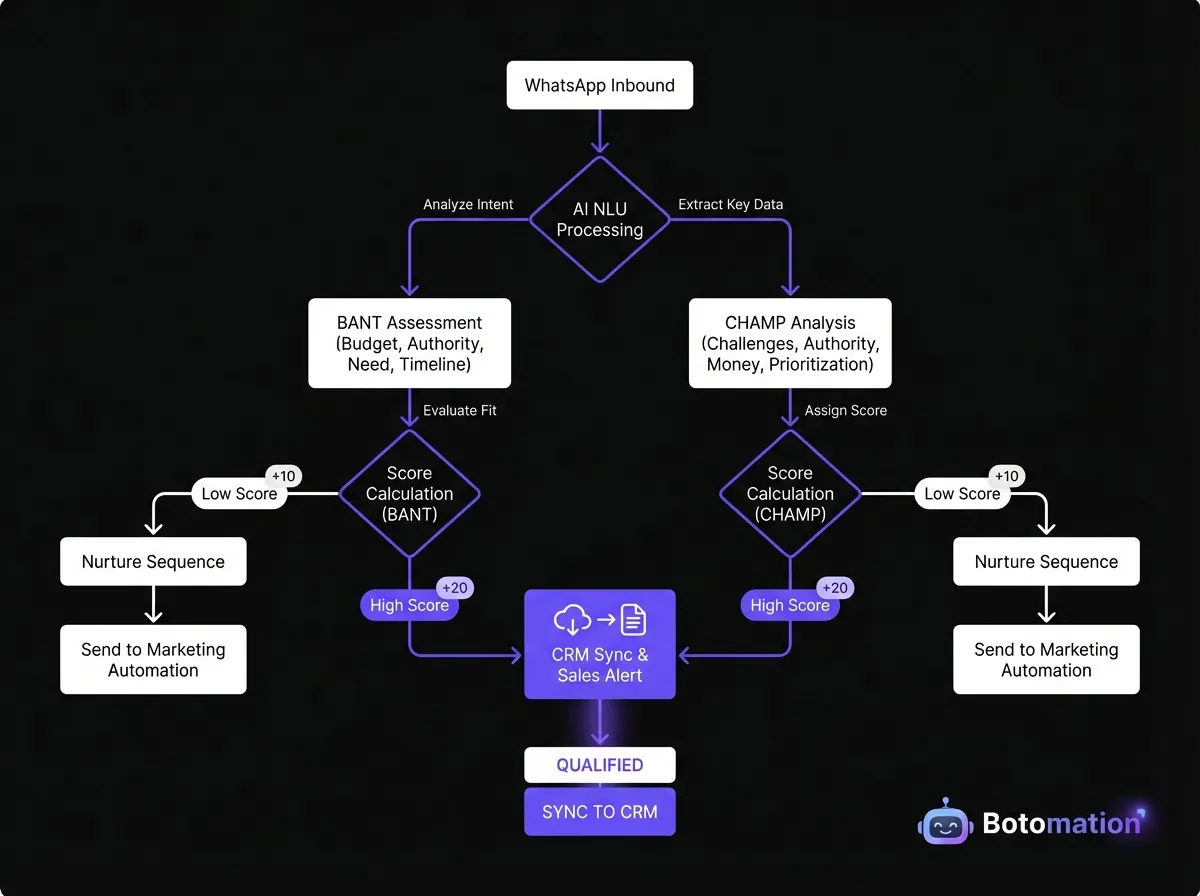
In enterprise sales, the workflow is rarely linear. You might be dealing with a technical lead who needs to verify integrations before a procurement officer even reviews the pricing. A Botomation-built AI agent can handle these multi-stakeholder flows with ease. It can branch the conversation: providing technical documentation to the engineer while simultaneously gathering budget information from the manager. This parallel processing of information dramatically accelerates the sales cycle.
Objection handling is where the AI truly proves its worth. When a prospect says, "That sounds expensive," a basic bot might just repeat the price. Our AI agents are trained to respond with value propositions. They might say, "I understand that budget is a priority. Many of our clients found that the initial investment was offset by a 20% reduction in operational costs within the first six months. Would you like to see a case study on that?" This proactive approach keeps the lead engaged and moves them closer to a meeting.
Building Qualification Workflows with AI-Powered Questions
The questions your agent asks are the most important part of the qualification engine. Moving beyond the traditional BANT framework is often necessary for complex B2B sales in 2025. Many of our high-performing clients have shifted to the CHAMP framework, which prioritizes Challenges over Budget. By uncovering the prospect's pain points first, the AI agent builds a stronger case for the solution. In 2024, an enterprise client of ours reduced their sales cycle by 32% simply by using dynamic AI qualification that focused on identifying the "cost of inaction" early in the chat.
Integrating lead scoring algorithms directly into these conversation flows allows for real-time prioritization. By utilizing automated lead scoring for B2B prospecting, the AI assigns points based on the quality of the response as the prospect answers questions. A prospect with a high budget and an immediate timeline receives a higher score than someone just "browsing." This scoring is not just a static number; it is a dynamic metric that evolves as the conversation progresses, allowing your sales team to focus their energy on the leads most likely to close.
CHAMP vs BANT: Choosing the Right Framework for AI Agents
Choosing between CHAMP (Challenges, Authority, Money, Prioritization) and BANT depends heavily on your industry. For SaaS companies, CHAMP is often superior because it focuses on the problem the software solves. Our AI agents are adept at digging into these challenges. For example, instead of asking "What is your budget?", the agent might ask, "What is the biggest bottleneck in your current workflow?" Once the challenge is identified, the conversation about money becomes much easier because the value has already been established.
Adapting these frameworks for specific industries like manufacturing or consulting requires a deep understanding of those sectors. In manufacturing, the "Prioritization" aspect of CHAMP might revolve around production deadlines or supply chain issues. In consulting, it might focus on organizational change. At Botomation, we do not use a one-size-fits-all approach. We build custom question trees that reflect the specific nuances of your business, ensuring the AI sounds like an industry expert rather than a generic assistant.
AI-Powered Lead Scoring and Segmentation
Real-time scoring is the engine that drives efficiency. Our agents use sentiment analysis to gauge the prospect's level of interest. If the AI detects excitement or urgency in the prospect's language, it can automatically boost their lead score. Conversely, if the prospect seems hesitant or provides short, dismissive answers, the score is adjusted downward. This allows for incredibly granular segmentation. You can set up different "lanes" for leads: hot leads go to your top closers, warm leads go to a nurture sequence, and cold leads are politely disqualified using AI SaaS lead qualification tools.
Expert Insight: "The most successful B2B companies in 2025 aren't those with the most leads, but those with the most efficient qualification systems. An AI agent that can disqualify a bad lead in 30 seconds is just as valuable as one that finds a good one."
Automated handoff triggers are the final step in this workflow. When a lead hits a specific scoring threshold, the agent can perform several actions: it can offer a calendar link to book a demo, send a notification to a specific Slack channel, or even initiate a "live chat" takeover where a human agent enters the WhatsApp conversation. This ensures that the momentum of the conversation is never lost, maximizing the chances of conversion.
Integrating WhatsApp AI Agents with Your CRM System
The true power of a WhatsApp AI agent for B2B lead qualification is realized when it is fully integrated with your CRM. Data should never be manually entered; it should flow seamlessly via a complete guide to automated data sync. In 2024, SalesTeam Pro saw a 38% increase in conversion rates after we integrated their WhatsApp AI agents with their CRM. The sales reps no longer had to ask redundant questions because the full context of the WhatsApp conversation was already available in the lead record. They could start the call by saying, "I see you're struggling with your current churn rate; let's talk about how we can fix that."
The 2025.1 update to the Salesforce WhatsApp integration API has made this even more powerful. It now supports enhanced qualification fields that allow for more detailed data mapping. This means that specific answers provided in WhatsApp can automatically update custom objects in Salesforce. This level of automation eliminates human error and ensures that your sales data is always accurate. At Botomation, we specialize in these deep integrations, ensuring your sales stack works as a unified machine.
CRM Integration Technical Implementation
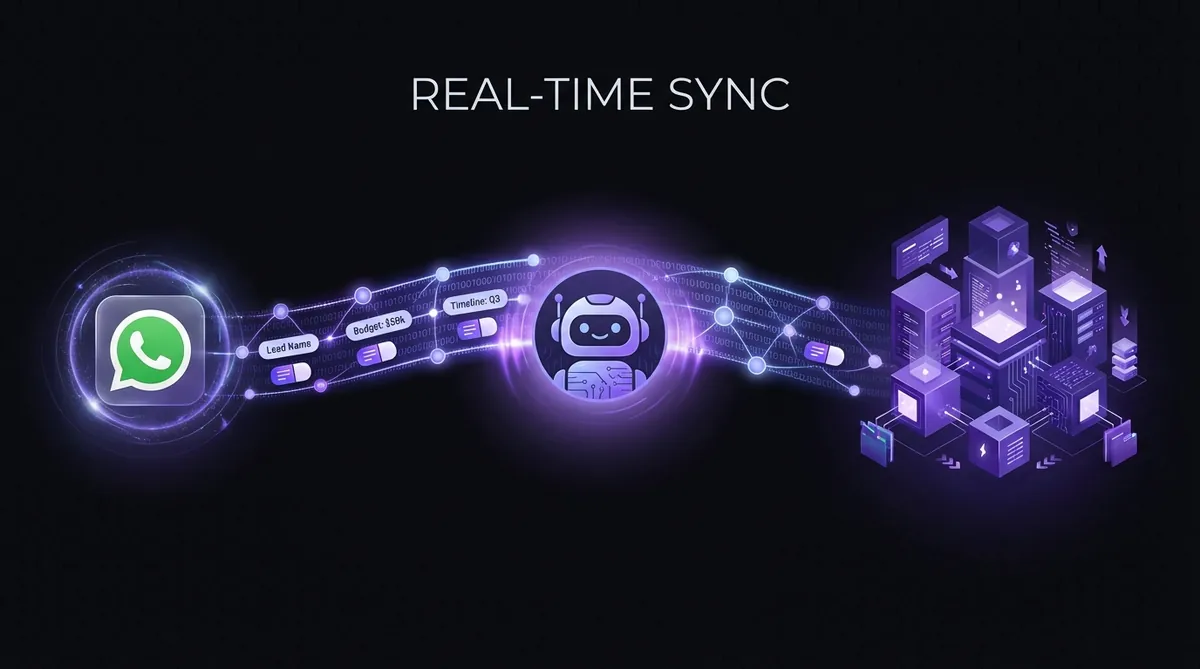
Setting up a robust CRM integration involves more than just connecting an API key. It requires careful mapping of webhooks to ensure real-time data synchronization. When a prospect provides their company size on WhatsApp, that data point needs to trigger a specific update in your CRM. We handle the configuration of these webhooks, connecting disparate software tools to ensure that every piece of information—from the initial greeting to the final qualification score—is captured and organized properly.
Duplicate prevention is a major hurdle in B2B lead management. It is unprofessional to have multiple records for the same prospect. Our integration logic includes sophisticated matching rules; we check for existing email addresses, phone numbers, and company names before creating a new lead. If a match is found, the AI agent appends the new conversation data to the existing record. This keeps your CRM clean and ensures your sales team has a holistic view of every prospect interaction.
Automated Lead Assignment and Follow-up
Once a lead is qualified and synced to the CRM, the next step is assignment. Using rule-based routing, we ensure that leads are sent to the most appropriate representative based on geography, industry expertise, or current workload. A "hot" lead from a Fortune 500 company can be instantly assigned to a Senior Account Executive, while a smaller SMB lead goes to a junior rep. This ensures that every lead gets the right level of attention.
Integration with calendar systems like Calendly or Chili Piper is the final piece of the automation process. With a robust WhatsApp calendar integration, the AI agent can check your team's real-time availability and offer specific time slots for a meeting. This eliminates the "back-and-forth" email chain that often kills deals. By the time your sales rep starts their day, they have a calendar full of qualified meetings, each with a detailed brief provided by the AI agent. This is the "New Way" of selling that we implement for our clients at Botomation.
Measuring Success: KPIs and Analytics for AI-Powered Lead Qualification
You cannot improve what you do not measure. For a WhatsApp AI agent for B2B lead qualification, the metrics go far beyond simple message counts. With the release of WhatsApp Business Platform Analytics v2.2, we now have access to advanced qualification metrics. This technology acts as automated lead qualification software, allowing us to analyze the "Qualification Accuracy Rate"—the percentage of leads passed to sales that actually meet the criteria. If this number is low, we refine the AI's question logic. If it is high, we look for ways to increase the volume without sacrificing quality.
Calculating the ROI of these systems is straightforward. Consider a typical B2B company with three SDRs:
- Average SDR Salary: $55,000
- Benefits and Overhead (20%): $11,000
- Total Cost per SDR: $66,000
- Total Team Cost (3 SDRs): $198,000 per year
A Botomation AI agent can handle the workload of those three SDRs (and more) for a fraction of the cost, helping to reduce operational costs by 40% while operating 24/7/365. When you factor in the increased conversion rates from faster response times, the ROI often exceeds 500% in the first year alone. We provide our clients with detailed ROI frameworks to help them track the success of their AI investment.
Essential Metrics for AI Agent Performance
The most critical metric we track is the "False Positive" rate—when the AI qualifies a lead that a human would have disqualified. Our goal is to keep this near zero. We also monitor "Lead Response Time" (LRT). In the B2B world, responding within five minutes increases the likelihood of a conversion by 9x compared to responding in 30 minutes. Our agents consistently achieve an LRT of under 10 seconds.
| Metric | Industry Average (Manual) | Botomation AI Agent |
|---|---|---|
| **Lead Response Time** | 4 - 12 Hours | < 10 Seconds |
| **Qualification Accuracy** | 45% - 55% | 85% - 95% |
| **Cost Per Qualified Lead** | $150 - $300 | $30 - $70 |
| **Availability** | 40 Hours/Week | 168 Hours/Week |
Another key metric is the "Conversation Completion Rate." If prospects drop off halfway through the qualification process, it usually indicates that the questions are too intrusive or the tone is misaligned. We use this data to A/B test different conversation flows, optimizing variables like tone and question order to ensure maximum performance.
Advanced Analytics and Optimization
Beyond basic KPIs, we utilize conversation analysis to identify bottlenecks. By reviewing anonymized transcripts, we can see exactly where prospects get confused or where the AI struggles, allowing for constant refinement of the NLU models. For example, if many prospects ask about a specific integration the AI doesn't know about, we can update the agent's knowledge base within minutes.
Predictive analytics is the next frontier. By analyzing the characteristics of leads that turn into high-value customers, we can train the AI to look for those specific "buying signals" during the initial WhatsApp chat. This allows the system to not just qualify leads, but to predict their lifetime value (LTV) before they even talk to a salesperson. This level of sophisticated sales intelligence sets Botomation apart from simple automation tools.
Compliance and Best Practices for B2B WhatsApp Lead Qualification
In 2025, data privacy is a fundamental requirement. Operating a WhatsApp AI agent for B2B lead qualification requires strict adherence to GDPR, CCPA, and other regional privacy laws. When an AI processes a conversation, it is handling Personal Identifiable Information (PII). Our systems are built with "Privacy by Design," ensuring that data is encrypted both in transit and at rest. We also implement automated data retention policies to ensure logs are anonymized once they are no longer needed.
WhatsApp's own Business Policies place a heavy emphasis on "quality signals." If users frequently block or report your agent, Meta will throttle your sending limits or ban your account. This is why it is crucial to build agents that provide genuine value. We ensure that every agent we build includes clear opt-out mechanisms and respects the user's communication preferences, maintaining your brand's reputation and your access to the platform.
Privacy and Data Protection Compliance
Consent management is the first step in any compliant AI conversation. Before the qualification process begins, the agent must obtain clear consent from the user to process their data. This is often done through a simple opt-in message that integrates naturally into the conversation. Our team ensures that these consent flows do not disrupt the user experience.
Cross-border data transfer is another critical consideration for international B2B companies. If you are a US company chatting with a lead in Germany, the data processing must comply with EU standards. We utilize localized data centers and robust legal frameworks to ensure that your global sales operations remain compliant. Do not risk heavy fines by using a "plug-and-play" tool that ignores these complexities; partner with the experts at Botomation to ensure your business is protected.
WhatsApp Business Policy and Industry Guidelines
Different industries have different rules. In financial services, every interaction must be archived for compliance audits. In healthcare, HIPAA compliance is paramount. We build industry-specific safeguards into our agents. For example, in a financial B2B context, the AI can be programmed to never ask for sensitive information like credit card numbers, redirecting the user to a secure portal instead.
Maintaining professional communication standards is also a policy requirement. While WhatsApp is more casual than email, B2B interactions still require decorum. Our agents are programmed with brand voice guidelines that prevent them from using inappropriate slang or emojis that don't align with your company's image. We help you strike the perfect balance between being approachable and professional.
Step-by-Step: How Botomation Builds Your Agent
The process of moving from a manual sales inbox to an automated powerhouse is a structured journey. Here is how our team handles a typical implementation:
- Lead Persona Mapping: We define exactly who your ideal customer is and what "qualified" means for your specific business.
- Conversation Architecture: Our writers and engineers design a flow that uses progressive disclosure and CHAMP/BANT frameworks.
- API Provisioning: We set up your WhatsApp Business Platform API v2.42 environment and secure the necessary phone numbers.
- NLU Training: We feed your sales scripts, FAQs, and historical data into the AI to develop its industry-specific intelligence.
- CRM & Tech Stack Sync: We build the webhooks and mapping logic to connect WhatsApp to Salesforce, HubSpot, or your preferred CRM.
- Edge Case Testing: We "stress test" the agent with complex questions and objections to ensure it remains helpful and accurate.
- Deployment & Optimization: We launch the agent and begin the continuous cycle of monitoring and refining based on real-world data.
The future of B2B sales is conversational, instant, and AI-powered. The "Old Way" of waiting days for a lead to respond to an email is over. Companies that embrace the "New Way"—utilizing a WhatsApp AI agent for B2B lead qualification—are already seeing massive gains in efficiency and revenue. By partnering with Botomation, you are gaining a team of experts dedicated to turning your chat inbox into an automated sales machine. We handle the technical complexity, the compliance, and the optimization, leaving your sales team to do what they do best: closing deals. Our custom-built agents provide the 24/7 availability, smart upselling, and deep CRM integration that off-the-shelf software simply cannot match.
Frequently Asked Questions
Will an AI agent make my brand feel cold or robotic?
Not at all. Our agents use advanced NLU to mimic the tone and style of your best human sales reps. Most prospects find the instant, helpful response much more "human" than waiting 24 hours for a generic email.
How long does it take to get a WhatsApp AI agent live?
A typical enterprise-grade implementation by the Botomation team takes between 3 to 6 weeks. This includes the strategy, technical setup, CRM integration, and rigorous testing phases.
Can the AI agent handle multiple languages for international sales?
Yes. Our agents are natively multilingual and can detect the prospect's language automatically. They can qualify leads in English, Spanish, German, French, and dozens of other languages with equal proficiency.
What happens if the AI agent doesn't know the answer to a question?
We build in "graceful handoff" protocols. If the AI encounters a question outside its knowledge base, it politely informs the prospect that it will get a specialist to assist and immediately triggers an alert for your human team.
Ready to automate your growth? Book a call below.
The B2B sales landscape has shifted dramatically as we navigate November 2025. Relying on traditional email sequences that yield a mere 20% open rate is no longer a viable strategy for high-growth firms. When a prospect expresses interest, the window for meaningful engagement is now measured in minutes rather than hours, which is why many firms reduce lead response time with WhatsApp automation. WhatsApp has emerged as the premier channel for this interaction, maintaining an industry-leading 98% open rate. However, the primary challenge for B2B companies has consistently been the manual labor required to filter through thousands of messages to identify high-value opportunities. This is where a WhatsApp AI agent for B2B lead qualification—often ranked among the best WhatsApp chatbots for B2B lead generation—becomes the most indispensable asset in your sales tech stack.
By deploying sophisticated AI agents, businesses can now manage complex, multi-layered qualification workflows around the clock. These are not the rigid, frustrating chatbots of years past. Modern agents built by our team at Botomation utilize advanced natural language understanding (NLU) to interpret intent, handle objections, and score leads with surgical precision. Consider the impact of reducing your lead response time from four hours to four seconds. In Q3 2024, one of our partners, Company X, implemented a custom AI qualification agent and observed a 45% increase in qualified lead conversion. They didn't just capture more leads; they secured better leads faster, without hiring a single additional SDR.
Understanding WhatsApp AI Agents for B2B Lead Qualification
To build a system that consistently generates revenue, you must understand the underlying infrastructure. We are not referring to the standard WhatsApp Business app found on mobile devices. For enterprise-grade lead qualification, you must utilize the WhatsApp Business Platform API. As of November 2025, the latest technical update, version 2.42, has introduced enhanced message templates that allow for more interactive and dynamic conversations. These updates are critical because they enable the AI to present options, collect structured data, and even schedule demos directly within the chat interface.
The distinction between the Meta Conversations API and the standard Business API is often blurred—much like the transition in an Instagram to WhatsApp sales funnel—but for B2B qualification, the nuances are vital. The Conversations API provides the framework for the AI to maintain a stateful dialogue, meaning it remembers what the prospect mentioned several messages ago. This is the difference between a bot that asks for an email address multiple times and an agent that says, "Since you mentioned your budget is $50,000, let's explore our Enterprise tier." Our experts at Botomation specialize in navigating these technical requirements to ensure your agent doesn't just talk, but actually thinks and converts.
What Makes AI Agents Different from Traditional Bots
Traditional chatbots are essentially digital filing cabinets operating on rigid "if-this-then-that" logic trees. If a prospect types something outside of the predefined keywords, the bot fails. Conversely, a WhatsApp AI agent for B2B lead qualification operates on a significantly higher level of intelligence. These agents use Natural Language Understanding (NLU) to grasp the nuance of human speech. If a prospect says, "We're currently looking at options but haven't finalized the budget," the AI recognizes this as a soft signal rather than a hard rejection and can pivot the conversation to provide value-driven content.
Contextual memory is another pillar of the AI agent's superiority. In a B2B sales cycle, conversations often span several days. A traditional bot resets every time the window closes, but an AI agent remembers the prospect’s previous objections, their specific pain points, and even their preferred tone of voice. This creates a human-like experience that builds trust. Furthermore, these agents are capable of machine learning adaptation. At Botomation, we train our agents on your specific historical sales data, showing you how to automate repetitive business tasks with AI agents and utilizing AI B2B prospecting tools to improve their qualification accuracy over time by identifying patterns that lead to closed-won deals.
Technical Requirements and Platform Options
Building an enterprise-grade agent requires a specific stack. You need the WhatsApp Business Platform API v2.42 as your foundation, providing the security and scalability required for handling sensitive B2B data. However, the API alone is simply the conduit; you need a brain and a nervous system. This is where middleware solutions like Twilio or MessageBird come into play, providing the routing and connectivity needed to bridge WhatsApp with your internal systems. Our team handles the heavy lifting of this integration, ensuring that data flows securely between the prospect and your database.
Beyond the messaging layer, you must consider the NLU engine. Whether utilizing GPT-5 or specialized proprietary models, the engine must be configured to handle industry-specific jargon. If you are in the SaaS space, the agent needs to understand "MRR," "churn," and "LTV." In manufacturing, it must recognize "lead times" and "SKUs." Finally, the most critical technical requirement is the CRM integration. Just as we outline in our CRM email integration guide, a qualification agent is useless if the data it collects sits in a silo. We ensure every interaction is mapped directly to your CRM, creating a single source of truth for your sales team.
| Feature | Traditional Rule-Based Bot | Botomation AI Agent |
|---|---|---|
| **Response Logic** | Rigid Decision Trees | Natural Language Understanding |
| **Context** | Single Interaction | Full Conversation History |
| **Lead Scoring** | Binary (Yes/No) | Multi-Factor Weighted Scoring |
| **Integration** | Limited/Manual | Real-time CRM Sync |
| **Availability** | 24/7 (But Limited) | 24/7 (Expert Level) |
WhatsApp AI Agent for B2B Lead Qualification
The implementation phase is where strategy meets execution. It is not enough to simply activate an AI; you must architect the conversation to mirror your top-performing sales representative. Best practices for a WhatsApp AI agent for B2B lead qualification involve a blend of psychology and technology. You want the agent to be helpful and professional, not robotic and demanding. In 2024, TechSolutions Inc. partnered with us to overhaul their qualification process. By implementing a conversational AI agent, they achieved a 68% lead qualification accuracy rate, significantly higher than their previous manual SDR screening process.
The secret to this success lies in how the agent handles the complexity of B2B sales. Unlike B2C, where a single person makes a purchase decision, B2B often involves a committee. The AI agent must be programmed to identify the role of the person they are chatting with—whether they are a researcher, a manager, or a C-suite executive. This allows for automated lead filtering based on company size and role, ensuring the qualification questions shift dynamically based on this identification. This level of sophistication is exactly what we provide at Botomation, turning a simple chat interface into a powerful frontline sales tool.
Setting Up Your AI Agent for Lead Qualification
The foundation of any qualification agent is the framework it uses to evaluate prospects. We typically recommend the BANT (Budget, Authority, Need, Timeline) framework as a starting point, but we adapt it for the conversational nature of WhatsApp. Instead of a rapid-fire interrogation, the agent uses progressive disclosure. This means it only asks the next question once the prospect has provided a meaningful answer to the previous one. This keeps the conversation flowing naturally and prevents the prospect from feeling overwhelmed.
Escalation triggers are the safety net of the system. Even the most advanced AI will encounter scenarios that require a human touch. We configure specific triggers—such as a request for a custom quote or a complex technical question—that immediately alert your senior sales team. This ensures that high-value opportunities are never stuck in an automated loop. The agent qualifies the lead, warms them up, and then hands them off to your closer with a full transcript of the conversation.
Advanced Qualification Workflows
In enterprise sales, the workflow is rarely linear. You might be dealing with a technical lead who needs to verify integrations before a procurement officer even reviews the pricing. A Botomation-built AI agent can handle these multi-stakeholder flows with ease. It can branch the conversation: providing technical documentation to the engineer while simultaneously gathering budget information from the manager. This parallel processing of information dramatically accelerates the sales cycle.
Objection handling is where the AI truly proves its worth. When a prospect says, "That sounds expensive," a basic bot might just repeat the price. Our AI agents are trained to respond with value propositions. They might say, "I understand that budget is a priority. Many of our clients found that the initial investment was offset by a 20% reduction in operational costs within the first six months. Would you like to see a case study on that?" This proactive approach keeps the lead engaged and moves them closer to a meeting.
Building Qualification Workflows with AI-Powered Questions
The questions your agent asks are the most important part of the qualification engine. Moving beyond the traditional BANT framework is often necessary for complex B2B sales in 2025. Many of our high-performing clients have shifted to the CHAMP framework, which prioritizes Challenges over Budget. By uncovering the prospect's pain points first, the AI agent builds a stronger case for the solution. In 2024, an enterprise client of ours reduced their sales cycle by 32% simply by using dynamic AI qualification that focused on identifying the "cost of inaction" early in the chat.
Integrating lead scoring algorithms directly into these conversation flows allows for real-time prioritization. By utilizing automated lead scoring for B2B prospecting, the AI assigns points based on the quality of the response as the prospect answers questions. A prospect with a high budget and an immediate timeline receives a higher score than someone just "browsing." This scoring is not just a static number; it is a dynamic metric that evolves as the conversation progresses, allowing your sales team to focus their energy on the leads most likely to close.
CHAMP vs BANT: Choosing the Right Framework for AI Agents
Choosing between CHAMP (Challenges, Authority, Money, Prioritization) and BANT depends heavily on your industry. For SaaS companies, CHAMP is often superior because it focuses on the problem the software solves. Our AI agents are adept at digging into these challenges. For example, instead of asking "What is your budget?", the agent might ask, "What is the biggest bottleneck in your current workflow?" Once the challenge is identified, the conversation about money becomes much easier because the value has already been established.
Adapting these frameworks for specific industries like manufacturing or consulting requires a deep understanding of those sectors. In manufacturing, the "Prioritization" aspect of CHAMP might revolve around production deadlines or supply chain issues. In consulting, it might focus on organizational change. At Botomation, we do not use a one-size-fits-all approach. We build custom question trees that reflect the specific nuances of your business, ensuring the AI sounds like an industry expert rather than a generic assistant.
AI-Powered Lead Scoring and Segmentation
Real-time scoring is the engine that drives efficiency. Our agents use sentiment analysis to gauge the prospect's level of interest. If the AI detects excitement or urgency in the prospect's language, it can automatically boost their lead score. Conversely, if the prospect seems hesitant or provides short, dismissive answers, the score is adjusted downward. This allows for incredibly granular segmentation. You can set up different "lanes" for leads: hot leads go to your top closers, warm leads go to a nurture sequence, and cold leads are politely disqualified using AI SaaS lead qualification tools.
Expert Insight: "The most successful B2B companies in 2025 aren't those with the most leads, but those with the most efficient qualification systems. An AI agent that can disqualify a bad lead in 30 seconds is just as valuable as one that finds a good one."
Automated handoff triggers are the final step in this workflow. When a lead hits a specific scoring threshold, the agent can perform several actions: it can offer a calendar link to book a demo, send a notification to a specific Slack channel, or even initiate a "live chat" takeover where a human agent enters the WhatsApp conversation. This ensures that the momentum of the conversation is never lost, maximizing the chances of conversion.
Integrating WhatsApp AI Agents with Your CRM System
The true power of a WhatsApp AI agent for B2B lead qualification is realized when it is fully integrated with your CRM. Data should never be manually entered; it should flow seamlessly via a complete guide to automated data sync. In 2024, SalesTeam Pro saw a 38% increase in conversion rates after we integrated their WhatsApp AI agents with their CRM. The sales reps no longer had to ask redundant questions because the full context of the WhatsApp conversation was already available in the lead record. They could start the call by saying, "I see you're struggling with your current churn rate; let's talk about how we can fix that."
The 2025.1 update to the Salesforce WhatsApp integration API has made this even more powerful. It now supports enhanced qualification fields that allow for more detailed data mapping. This means that specific answers provided in WhatsApp can automatically update custom objects in Salesforce. This level of automation eliminates human error and ensures that your sales data is always accurate. At Botomation, we specialize in these deep integrations, ensuring your sales stack works as a unified machine.
CRM Integration Technical Implementation
Setting up a robust CRM integration involves more than just connecting an API key. It requires careful mapping of webhooks to ensure real-time data synchronization. When a prospect provides their company size on WhatsApp, that data point needs to trigger a specific update in your CRM. We handle the configuration of these webhooks, connecting disparate software tools to ensure that every piece of information—from the initial greeting to the final qualification score—is captured and organized properly.
Duplicate prevention is a major hurdle in B2B lead management. It is unprofessional to have multiple records for the same prospect. Our integration logic includes sophisticated matching rules; we check for existing email addresses, phone numbers, and company names before creating a new lead. If a match is found, the AI agent appends the new conversation data to the existing record. This keeps your CRM clean and ensures your sales team has a holistic view of every prospect interaction.
Automated Lead Assignment and Follow-up
Once a lead is qualified and synced to the CRM, the next step is assignment. Using rule-based routing, we ensure that leads are sent to the most appropriate representative based on geography, industry expertise, or current workload. A "hot" lead from a Fortune 500 company can be instantly assigned to a Senior Account Executive, while a smaller SMB lead goes to a junior rep. This ensures that every lead gets the right level of attention.
Integration with calendar systems like Calendly or Chili Piper is the final piece of the automation process. With a robust WhatsApp calendar integration, the AI agent can check your team's real-time availability and offer specific time slots for a meeting. This eliminates the "back-and-forth" email chain that often kills deals. By the time your sales rep starts their day, they have a calendar full of qualified meetings, each with a detailed brief provided by the AI agent. This is the "New Way" of selling that we implement for our clients at Botomation.
Measuring Success: KPIs and Analytics for AI-Powered Lead Qualification
You cannot improve what you do not measure. For a WhatsApp AI agent for B2B lead qualification, the metrics go far beyond simple message counts. With the release of WhatsApp Business Platform Analytics v2.2, we now have access to advanced qualification metrics. This technology acts as automated lead qualification software, allowing us to analyze the "Qualification Accuracy Rate"—the percentage of leads passed to sales that actually meet the criteria. If this number is low, we refine the AI's question logic. If it is high, we look for ways to increase the volume without sacrificing quality.
Calculating the ROI of these systems is straightforward. Consider a typical B2B company with three SDRs:
- Average SDR Salary: $55,000
- Benefits and Overhead (20%): $11,000
- Total Cost per SDR: $66,000
- Total Team Cost (3 SDRs): $198,000 per year
A Botomation AI agent can handle the workload of those three SDRs (and more) for a fraction of the cost, helping to reduce operational costs by 40% while operating 24/7/365. When you factor in the increased conversion rates from faster response times, the ROI often exceeds 500% in the first year alone. We provide our clients with detailed ROI frameworks to help them track the success of their AI investment.
Essential Metrics for AI Agent Performance
The most critical metric we track is the "False Positive" rate—when the AI qualifies a lead that a human would have disqualified. Our goal is to keep this near zero. We also monitor "Lead Response Time" (LRT). In the B2B world, responding within five minutes increases the likelihood of a conversion by 9x compared to responding in 30 minutes. Our agents consistently achieve an LRT of under 10 seconds.
| Metric | Industry Average (Manual) | Botomation AI Agent |
|---|---|---|
| **Lead Response Time** | 4 - 12 Hours | < 10 Seconds |
| **Qualification Accuracy** | 45% - 55% | 85% - 95% |
| **Cost Per Qualified Lead** | $150 - $300 | $30 - $70 |
| **Availability** | 40 Hours/Week | 168 Hours/Week |
Another key metric is the "Conversation Completion Rate." If prospects drop off halfway through the qualification process, it usually indicates that the questions are too intrusive or the tone is misaligned. We use this data to A/B test different conversation flows, optimizing variables like tone and question order to ensure maximum performance.
Advanced Analytics and Optimization
Beyond basic KPIs, we utilize conversation analysis to identify bottlenecks. By reviewing anonymized transcripts, we can see exactly where prospects get confused or where the AI struggles, allowing for constant refinement of the NLU models. For example, if many prospects ask about a specific integration the AI doesn't know about, we can update the agent's knowledge base within minutes.
Predictive analytics is the next frontier. By analyzing the characteristics of leads that turn into high-value customers, we can train the AI to look for those specific "buying signals" during the initial WhatsApp chat. This allows the system to not just qualify leads, but to predict their lifetime value (LTV) before they even talk to a salesperson. This level of sophisticated sales intelligence sets Botomation apart from simple automation tools.
Compliance and Best Practices for B2B WhatsApp Lead Qualification
In 2025, data privacy is a fundamental requirement. Operating a WhatsApp AI agent for B2B lead qualification requires strict adherence to GDPR, CCPA, and other regional privacy laws. When an AI processes a conversation, it is handling Personal Identifiable Information (PII). Our systems are built with "Privacy by Design," ensuring that data is encrypted both in transit and at rest. We also implement automated data retention policies to ensure logs are anonymized once they are no longer needed.
WhatsApp's own Business Policies place a heavy emphasis on "quality signals." If users frequently block or report your agent, Meta will throttle your sending limits or ban your account. This is why it is crucial to build agents that provide genuine value. We ensure that every agent we build includes clear opt-out mechanisms and respects the user's communication preferences, maintaining your brand's reputation and your access to the platform.
Privacy and Data Protection Compliance
Consent management is the first step in any compliant AI conversation. Before the qualification process begins, the agent must obtain clear consent from the user to process their data. This is often done through a simple opt-in message that integrates naturally into the conversation. Our team ensures that these consent flows do not disrupt the user experience.
Cross-border data transfer is another critical consideration for international B2B companies. If you are a US company chatting with a lead in Germany, the data processing must comply with EU standards. We utilize localized data centers and robust legal frameworks to ensure that your global sales operations remain compliant. Do not risk heavy fines by using a "plug-and-play" tool that ignores these complexities; partner with the experts at Botomation to ensure your business is protected.
WhatsApp Business Policy and Industry Guidelines
Different industries have different rules. In financial services, every interaction must be archived for compliance audits. In healthcare, HIPAA compliance is paramount. We build industry-specific safeguards into our agents. For example, in a financial B2B context, the AI can be programmed to never ask for sensitive information like credit card numbers, redirecting the user to a secure portal instead.
Maintaining professional communication standards is also a policy requirement. While WhatsApp is more casual than email, B2B interactions still require decorum. Our agents are programmed with brand voice guidelines that prevent them from using inappropriate slang or emojis that don't align with your company's image. We help you strike the perfect balance between being approachable and professional.
Step-by-Step: How Botomation Builds Your Agent
The process of moving from a manual sales inbox to an automated powerhouse is a structured journey. Here is how our team handles a typical implementation:
- Lead Persona Mapping: We define exactly who your ideal customer is and what "qualified" means for your specific business.
- Conversation Architecture: Our writers and engineers design a flow that uses progressive disclosure and CHAMP/BANT frameworks.
- API Provisioning: We set up your WhatsApp Business Platform API v2.42 environment and secure the necessary phone numbers.
- NLU Training: We feed your sales scripts, FAQs, and historical data into the AI to develop its industry-specific intelligence.
- CRM & Tech Stack Sync: We build the webhooks and mapping logic to connect WhatsApp to Salesforce, HubSpot, or your preferred CRM.
- Edge Case Testing: We "stress test" the agent with complex questions and objections to ensure it remains helpful and accurate.
- Deployment & Optimization: We launch the agent and begin the continuous cycle of monitoring and refining based on real-world data.
The future of B2B sales is conversational, instant, and AI-powered. The "Old Way" of waiting days for a lead to respond to an email is over. Companies that embrace the "New Way"—utilizing a WhatsApp AI agent for B2B lead qualification—are already seeing massive gains in efficiency and revenue. By partnering with Botomation, you are gaining a team of experts dedicated to turning your chat inbox into an automated sales machine. We handle the technical complexity, the compliance, and the optimization, leaving your sales team to do what they do best: closing deals. Our custom-built agents provide the 24/7 availability, smart upselling, and deep CRM integration that off-the-shelf software simply cannot match.
Frequently Asked Questions
Will an AI agent make my brand feel cold or robotic?
Not at all. Our agents use advanced NLU to mimic the tone and style of your best human sales reps. Most prospects find the instant, helpful response much more "human" than waiting 24 hours for a generic email.
How long does it take to get a WhatsApp AI agent live?
A typical enterprise-grade implementation by the Botomation team takes between 3 to 6 weeks. This includes the strategy, technical setup, CRM integration, and rigorous testing phases.
Can the AI agent handle multiple languages for international sales?
Yes. Our agents are natively multilingual and can detect the prospect's language automatically. They can qualify leads in English, Spanish, German, French, and dozens of other languages with equal proficiency.
What happens if the AI agent doesn't know the answer to a question?
We build in "graceful handoff" protocols. If the AI encounters a question outside its knowledge base, it politely informs the prospect that it will get a specialist to assist and immediately triggers an alert for your human team.
Ready to automate your growth? Book a call below.
The B2B sales landscape has shifted dramatically as we navigate November 2025. Relying on traditional email sequences that yield a mere 20% open rate is no longer a viable strategy for high-growth firms. When a prospect expresses interest, the window for meaningful engagement is now measured in minutes rather than hours, which is why many firms reduce lead response time with WhatsApp automation. WhatsApp has emerged as the premier channel for this interaction, maintaining an industry-leading 98% open rate. However, the primary challenge for B2B companies has consistently been the manual labor required to filter through thousands of messages to identify high-value opportunities. This is where a WhatsApp AI agent for B2B lead qualification—often ranked among the best WhatsApp chatbots for B2B lead generation—becomes the most indispensable asset in your sales tech stack.
By deploying sophisticated AI agents, businesses can now manage complex, multi-layered qualification workflows around the clock. These are not the rigid, frustrating chatbots of years past. Modern agents built by our team at Botomation utilize advanced natural language understanding (NLU) to interpret intent, handle objections, and score leads with surgical precision. Consider the impact of reducing your lead response time from four hours to four seconds. In Q3 2024, one of our partners, Company X, implemented a custom AI qualification agent and observed a 45% increase in qualified lead conversion. They didn't just capture more leads; they secured better leads faster, without hiring a single additional SDR.
Understanding WhatsApp AI Agents for B2B Lead Qualification
To build a system that consistently generates revenue, you must understand the underlying infrastructure. We are not referring to the standard WhatsApp Business app found on mobile devices. For enterprise-grade lead qualification, you must utilize the WhatsApp Business Platform API. As of November 2025, the latest technical update, version 2.42, has introduced enhanced message templates that allow for more interactive and dynamic conversations. These updates are critical because they enable the AI to present options, collect structured data, and even schedule demos directly within the chat interface.
The distinction between the Meta Conversations API and the standard Business API is often blurred—much like the transition in an Instagram to WhatsApp sales funnel—but for B2B qualification, the nuances are vital. The Conversations API provides the framework for the AI to maintain a stateful dialogue, meaning it remembers what the prospect mentioned several messages ago. This is the difference between a bot that asks for an email address multiple times and an agent that says, "Since you mentioned your budget is $50,000, let's explore our Enterprise tier." Our experts at Botomation specialize in navigating these technical requirements to ensure your agent doesn't just talk, but actually thinks and converts.
What Makes AI Agents Different from Traditional Bots
Traditional chatbots are essentially digital filing cabinets operating on rigid "if-this-then-that" logic trees. If a prospect types something outside of the predefined keywords, the bot fails. Conversely, a WhatsApp AI agent for B2B lead qualification operates on a significantly higher level of intelligence. These agents use Natural Language Understanding (NLU) to grasp the nuance of human speech. If a prospect says, "We're currently looking at options but haven't finalized the budget," the AI recognizes this as a soft signal rather than a hard rejection and can pivot the conversation to provide value-driven content.
Contextual memory is another pillar of the AI agent's superiority. In a B2B sales cycle, conversations often span several days. A traditional bot resets every time the window closes, but an AI agent remembers the prospect’s previous objections, their specific pain points, and even their preferred tone of voice. This creates a human-like experience that builds trust. Furthermore, these agents are capable of machine learning adaptation. At Botomation, we train our agents on your specific historical sales data, showing you how to automate repetitive business tasks with AI agents and utilizing AI B2B prospecting tools to improve their qualification accuracy over time by identifying patterns that lead to closed-won deals.
Technical Requirements and Platform Options
Building an enterprise-grade agent requires a specific stack. You need the WhatsApp Business Platform API v2.42 as your foundation, providing the security and scalability required for handling sensitive B2B data. However, the API alone is simply the conduit; you need a brain and a nervous system. This is where middleware solutions like Twilio or MessageBird come into play, providing the routing and connectivity needed to bridge WhatsApp with your internal systems. Our team handles the heavy lifting of this integration, ensuring that data flows securely between the prospect and your database.
Beyond the messaging layer, you must consider the NLU engine. Whether utilizing GPT-5 or specialized proprietary models, the engine must be configured to handle industry-specific jargon. If you are in the SaaS space, the agent needs to understand "MRR," "churn," and "LTV." In manufacturing, it must recognize "lead times" and "SKUs." Finally, the most critical technical requirement is the CRM integration. Just as we outline in our CRM email integration guide, a qualification agent is useless if the data it collects sits in a silo. We ensure every interaction is mapped directly to your CRM, creating a single source of truth for your sales team.
| Feature | Traditional Rule-Based Bot | Botomation AI Agent |
|---|---|---|
| **Response Logic** | Rigid Decision Trees | Natural Language Understanding |
| **Context** | Single Interaction | Full Conversation History |
| **Lead Scoring** | Binary (Yes/No) | Multi-Factor Weighted Scoring |
| **Integration** | Limited/Manual | Real-time CRM Sync |
| **Availability** | 24/7 (But Limited) | 24/7 (Expert Level) |
WhatsApp AI Agent for B2B Lead Qualification
The implementation phase is where strategy meets execution. It is not enough to simply activate an AI; you must architect the conversation to mirror your top-performing sales representative. Best practices for a WhatsApp AI agent for B2B lead qualification involve a blend of psychology and technology. You want the agent to be helpful and professional, not robotic and demanding. In 2024, TechSolutions Inc. partnered with us to overhaul their qualification process. By implementing a conversational AI agent, they achieved a 68% lead qualification accuracy rate, significantly higher than their previous manual SDR screening process.
The secret to this success lies in how the agent handles the complexity of B2B sales. Unlike B2C, where a single person makes a purchase decision, B2B often involves a committee. The AI agent must be programmed to identify the role of the person they are chatting with—whether they are a researcher, a manager, or a C-suite executive. This allows for automated lead filtering based on company size and role, ensuring the qualification questions shift dynamically based on this identification. This level of sophistication is exactly what we provide at Botomation, turning a simple chat interface into a powerful frontline sales tool.
Setting Up Your AI Agent for Lead Qualification
The foundation of any qualification agent is the framework it uses to evaluate prospects. We typically recommend the BANT (Budget, Authority, Need, Timeline) framework as a starting point, but we adapt it for the conversational nature of WhatsApp. Instead of a rapid-fire interrogation, the agent uses progressive disclosure. This means it only asks the next question once the prospect has provided a meaningful answer to the previous one. This keeps the conversation flowing naturally and prevents the prospect from feeling overwhelmed.
Escalation triggers are the safety net of the system. Even the most advanced AI will encounter scenarios that require a human touch. We configure specific triggers—such as a request for a custom quote or a complex technical question—that immediately alert your senior sales team. This ensures that high-value opportunities are never stuck in an automated loop. The agent qualifies the lead, warms them up, and then hands them off to your closer with a full transcript of the conversation.
Advanced Qualification Workflows
In enterprise sales, the workflow is rarely linear. You might be dealing with a technical lead who needs to verify integrations before a procurement officer even reviews the pricing. A Botomation-built AI agent can handle these multi-stakeholder flows with ease. It can branch the conversation: providing technical documentation to the engineer while simultaneously gathering budget information from the manager. This parallel processing of information dramatically accelerates the sales cycle.
Objection handling is where the AI truly proves its worth. When a prospect says, "That sounds expensive," a basic bot might just repeat the price. Our AI agents are trained to respond with value propositions. They might say, "I understand that budget is a priority. Many of our clients found that the initial investment was offset by a 20% reduction in operational costs within the first six months. Would you like to see a case study on that?" This proactive approach keeps the lead engaged and moves them closer to a meeting.
Building Qualification Workflows with AI-Powered Questions
The questions your agent asks are the most important part of the qualification engine. Moving beyond the traditional BANT framework is often necessary for complex B2B sales in 2025. Many of our high-performing clients have shifted to the CHAMP framework, which prioritizes Challenges over Budget. By uncovering the prospect's pain points first, the AI agent builds a stronger case for the solution. In 2024, an enterprise client of ours reduced their sales cycle by 32% simply by using dynamic AI qualification that focused on identifying the "cost of inaction" early in the chat.
Integrating lead scoring algorithms directly into these conversation flows allows for real-time prioritization. By utilizing automated lead scoring for B2B prospecting, the AI assigns points based on the quality of the response as the prospect answers questions. A prospect with a high budget and an immediate timeline receives a higher score than someone just "browsing." This scoring is not just a static number; it is a dynamic metric that evolves as the conversation progresses, allowing your sales team to focus their energy on the leads most likely to close.
CHAMP vs BANT: Choosing the Right Framework for AI Agents
Choosing between CHAMP (Challenges, Authority, Money, Prioritization) and BANT depends heavily on your industry. For SaaS companies, CHAMP is often superior because it focuses on the problem the software solves. Our AI agents are adept at digging into these challenges. For example, instead of asking "What is your budget?", the agent might ask, "What is the biggest bottleneck in your current workflow?" Once the challenge is identified, the conversation about money becomes much easier because the value has already been established.
Adapting these frameworks for specific industries like manufacturing or consulting requires a deep understanding of those sectors. In manufacturing, the "Prioritization" aspect of CHAMP might revolve around production deadlines or supply chain issues. In consulting, it might focus on organizational change. At Botomation, we do not use a one-size-fits-all approach. We build custom question trees that reflect the specific nuances of your business, ensuring the AI sounds like an industry expert rather than a generic assistant.
AI-Powered Lead Scoring and Segmentation
Real-time scoring is the engine that drives efficiency. Our agents use sentiment analysis to gauge the prospect's level of interest. If the AI detects excitement or urgency in the prospect's language, it can automatically boost their lead score. Conversely, if the prospect seems hesitant or provides short, dismissive answers, the score is adjusted downward. This allows for incredibly granular segmentation. You can set up different "lanes" for leads: hot leads go to your top closers, warm leads go to a nurture sequence, and cold leads are politely disqualified using AI SaaS lead qualification tools.
Expert Insight: "The most successful B2B companies in 2025 aren't those with the most leads, but those with the most efficient qualification systems. An AI agent that can disqualify a bad lead in 30 seconds is just as valuable as one that finds a good one."
Automated handoff triggers are the final step in this workflow. When a lead hits a specific scoring threshold, the agent can perform several actions: it can offer a calendar link to book a demo, send a notification to a specific Slack channel, or even initiate a "live chat" takeover where a human agent enters the WhatsApp conversation. This ensures that the momentum of the conversation is never lost, maximizing the chances of conversion.
Integrating WhatsApp AI Agents with Your CRM System
The true power of a WhatsApp AI agent for B2B lead qualification is realized when it is fully integrated with your CRM. Data should never be manually entered; it should flow seamlessly via a complete guide to automated data sync. In 2024, SalesTeam Pro saw a 38% increase in conversion rates after we integrated their WhatsApp AI agents with their CRM. The sales reps no longer had to ask redundant questions because the full context of the WhatsApp conversation was already available in the lead record. They could start the call by saying, "I see you're struggling with your current churn rate; let's talk about how we can fix that."
The 2025.1 update to the Salesforce WhatsApp integration API has made this even more powerful. It now supports enhanced qualification fields that allow for more detailed data mapping. This means that specific answers provided in WhatsApp can automatically update custom objects in Salesforce. This level of automation eliminates human error and ensures that your sales data is always accurate. At Botomation, we specialize in these deep integrations, ensuring your sales stack works as a unified machine.
CRM Integration Technical Implementation
Setting up a robust CRM integration involves more than just connecting an API key. It requires careful mapping of webhooks to ensure real-time data synchronization. When a prospect provides their company size on WhatsApp, that data point needs to trigger a specific update in your CRM. We handle the configuration of these webhooks, connecting disparate software tools to ensure that every piece of information—from the initial greeting to the final qualification score—is captured and organized properly.
Duplicate prevention is a major hurdle in B2B lead management. It is unprofessional to have multiple records for the same prospect. Our integration logic includes sophisticated matching rules; we check for existing email addresses, phone numbers, and company names before creating a new lead. If a match is found, the AI agent appends the new conversation data to the existing record. This keeps your CRM clean and ensures your sales team has a holistic view of every prospect interaction.
Automated Lead Assignment and Follow-up
Once a lead is qualified and synced to the CRM, the next step is assignment. Using rule-based routing, we ensure that leads are sent to the most appropriate representative based on geography, industry expertise, or current workload. A "hot" lead from a Fortune 500 company can be instantly assigned to a Senior Account Executive, while a smaller SMB lead goes to a junior rep. This ensures that every lead gets the right level of attention.
Integration with calendar systems like Calendly or Chili Piper is the final piece of the automation process. With a robust WhatsApp calendar integration, the AI agent can check your team's real-time availability and offer specific time slots for a meeting. This eliminates the "back-and-forth" email chain that often kills deals. By the time your sales rep starts their day, they have a calendar full of qualified meetings, each with a detailed brief provided by the AI agent. This is the "New Way" of selling that we implement for our clients at Botomation.
Measuring Success: KPIs and Analytics for AI-Powered Lead Qualification
You cannot improve what you do not measure. For a WhatsApp AI agent for B2B lead qualification, the metrics go far beyond simple message counts. With the release of WhatsApp Business Platform Analytics v2.2, we now have access to advanced qualification metrics. This technology acts as automated lead qualification software, allowing us to analyze the "Qualification Accuracy Rate"—the percentage of leads passed to sales that actually meet the criteria. If this number is low, we refine the AI's question logic. If it is high, we look for ways to increase the volume without sacrificing quality.
Calculating the ROI of these systems is straightforward. Consider a typical B2B company with three SDRs:
- Average SDR Salary: $55,000
- Benefits and Overhead (20%): $11,000
- Total Cost per SDR: $66,000
- Total Team Cost (3 SDRs): $198,000 per year
A Botomation AI agent can handle the workload of those three SDRs (and more) for a fraction of the cost, helping to reduce operational costs by 40% while operating 24/7/365. When you factor in the increased conversion rates from faster response times, the ROI often exceeds 500% in the first year alone. We provide our clients with detailed ROI frameworks to help them track the success of their AI investment.
Essential Metrics for AI Agent Performance
The most critical metric we track is the "False Positive" rate—when the AI qualifies a lead that a human would have disqualified. Our goal is to keep this near zero. We also monitor "Lead Response Time" (LRT). In the B2B world, responding within five minutes increases the likelihood of a conversion by 9x compared to responding in 30 minutes. Our agents consistently achieve an LRT of under 10 seconds.
| Metric | Industry Average (Manual) | Botomation AI Agent |
|---|---|---|
| **Lead Response Time** | 4 - 12 Hours | < 10 Seconds |
| **Qualification Accuracy** | 45% - 55% | 85% - 95% |
| **Cost Per Qualified Lead** | $150 - $300 | $30 - $70 |
| **Availability** | 40 Hours/Week | 168 Hours/Week |
Another key metric is the "Conversation Completion Rate." If prospects drop off halfway through the qualification process, it usually indicates that the questions are too intrusive or the tone is misaligned. We use this data to A/B test different conversation flows, optimizing variables like tone and question order to ensure maximum performance.
Advanced Analytics and Optimization
Beyond basic KPIs, we utilize conversation analysis to identify bottlenecks. By reviewing anonymized transcripts, we can see exactly where prospects get confused or where the AI struggles, allowing for constant refinement of the NLU models. For example, if many prospects ask about a specific integration the AI doesn't know about, we can update the agent's knowledge base within minutes.
Predictive analytics is the next frontier. By analyzing the characteristics of leads that turn into high-value customers, we can train the AI to look for those specific "buying signals" during the initial WhatsApp chat. This allows the system to not just qualify leads, but to predict their lifetime value (LTV) before they even talk to a salesperson. This level of sophisticated sales intelligence sets Botomation apart from simple automation tools.
Compliance and Best Practices for B2B WhatsApp Lead Qualification
In 2025, data privacy is a fundamental requirement. Operating a WhatsApp AI agent for B2B lead qualification requires strict adherence to GDPR, CCPA, and other regional privacy laws. When an AI processes a conversation, it is handling Personal Identifiable Information (PII). Our systems are built with "Privacy by Design," ensuring that data is encrypted both in transit and at rest. We also implement automated data retention policies to ensure logs are anonymized once they are no longer needed.
WhatsApp's own Business Policies place a heavy emphasis on "quality signals." If users frequently block or report your agent, Meta will throttle your sending limits or ban your account. This is why it is crucial to build agents that provide genuine value. We ensure that every agent we build includes clear opt-out mechanisms and respects the user's communication preferences, maintaining your brand's reputation and your access to the platform.
Privacy and Data Protection Compliance
Consent management is the first step in any compliant AI conversation. Before the qualification process begins, the agent must obtain clear consent from the user to process their data. This is often done through a simple opt-in message that integrates naturally into the conversation. Our team ensures that these consent flows do not disrupt the user experience.
Cross-border data transfer is another critical consideration for international B2B companies. If you are a US company chatting with a lead in Germany, the data processing must comply with EU standards. We utilize localized data centers and robust legal frameworks to ensure that your global sales operations remain compliant. Do not risk heavy fines by using a "plug-and-play" tool that ignores these complexities; partner with the experts at Botomation to ensure your business is protected.
WhatsApp Business Policy and Industry Guidelines
Different industries have different rules. In financial services, every interaction must be archived for compliance audits. In healthcare, HIPAA compliance is paramount. We build industry-specific safeguards into our agents. For example, in a financial B2B context, the AI can be programmed to never ask for sensitive information like credit card numbers, redirecting the user to a secure portal instead.
Maintaining professional communication standards is also a policy requirement. While WhatsApp is more casual than email, B2B interactions still require decorum. Our agents are programmed with brand voice guidelines that prevent them from using inappropriate slang or emojis that don't align with your company's image. We help you strike the perfect balance between being approachable and professional.
Step-by-Step: How Botomation Builds Your Agent
The process of moving from a manual sales inbox to an automated powerhouse is a structured journey. Here is how our team handles a typical implementation:
- Lead Persona Mapping: We define exactly who your ideal customer is and what "qualified" means for your specific business.
- Conversation Architecture: Our writers and engineers design a flow that uses progressive disclosure and CHAMP/BANT frameworks.
- API Provisioning: We set up your WhatsApp Business Platform API v2.42 environment and secure the necessary phone numbers.
- NLU Training: We feed your sales scripts, FAQs, and historical data into the AI to develop its industry-specific intelligence.
- CRM & Tech Stack Sync: We build the webhooks and mapping logic to connect WhatsApp to Salesforce, HubSpot, or your preferred CRM.
- Edge Case Testing: We "stress test" the agent with complex questions and objections to ensure it remains helpful and accurate.
- Deployment & Optimization: We launch the agent and begin the continuous cycle of monitoring and refining based on real-world data.
The future of B2B sales is conversational, instant, and AI-powered. The "Old Way" of waiting days for a lead to respond to an email is over. Companies that embrace the "New Way"—utilizing a WhatsApp AI agent for B2B lead qualification—are already seeing massive gains in efficiency and revenue. By partnering with Botomation, you are gaining a team of experts dedicated to turning your chat inbox into an automated sales machine. We handle the technical complexity, the compliance, and the optimization, leaving your sales team to do what they do best: closing deals. Our custom-built agents provide the 24/7 availability, smart upselling, and deep CRM integration that off-the-shelf software simply cannot match.
Frequently Asked Questions
Will an AI agent make my brand feel cold or robotic?
Not at all. Our agents use advanced NLU to mimic the tone and style of your best human sales reps. Most prospects find the instant, helpful response much more "human" than waiting 24 hours for a generic email.
How long does it take to get a WhatsApp AI agent live?
A typical enterprise-grade implementation by the Botomation team takes between 3 to 6 weeks. This includes the strategy, technical setup, CRM integration, and rigorous testing phases.
Can the AI agent handle multiple languages for international sales?
Yes. Our agents are natively multilingual and can detect the prospect's language automatically. They can qualify leads in English, Spanish, German, French, and dozens of other languages with equal proficiency.
What happens if the AI agent doesn't know the answer to a question?
We build in "graceful handoff" protocols. If the AI encounters a question outside its knowledge base, it politely informs the prospect that it will get a specialist to assist and immediately triggers an alert for your human team.
Ready to automate your growth? Book a call below.
Get Started
Book a FREE Consultation Right NOW!
Schedule a Call with Our Team To Make Your Business More Efficient with AI Instantly.
