Reduce Lead Response Time with WhatsApp Automation
Dec 30, 2025
AI Automation
B2B Sales
AI Automation
B2B Sales
Reduce Lead Response Time with WhatsApp Automation in B2B Sales
In the competitive landscape of January 2026, the ability to reduce lead response time whatsapp automation has become the primary differentiator for high-growth firms. The landscape of B2B sales has shifted from a battle of product features to a race against the clock. When a high-value lead submits an inquiry, they are at their peak level of intent. Waiting for a manual email response or a scheduled callback allows that interest to evaporate, often into the hands of a more agile competitor. WhatsApp has emerged as the definitive solution to this friction, with the best WhatsApp chatbots for B2B lead generation boasting a staggering 98% open rate that dwarfs traditional email marketing.
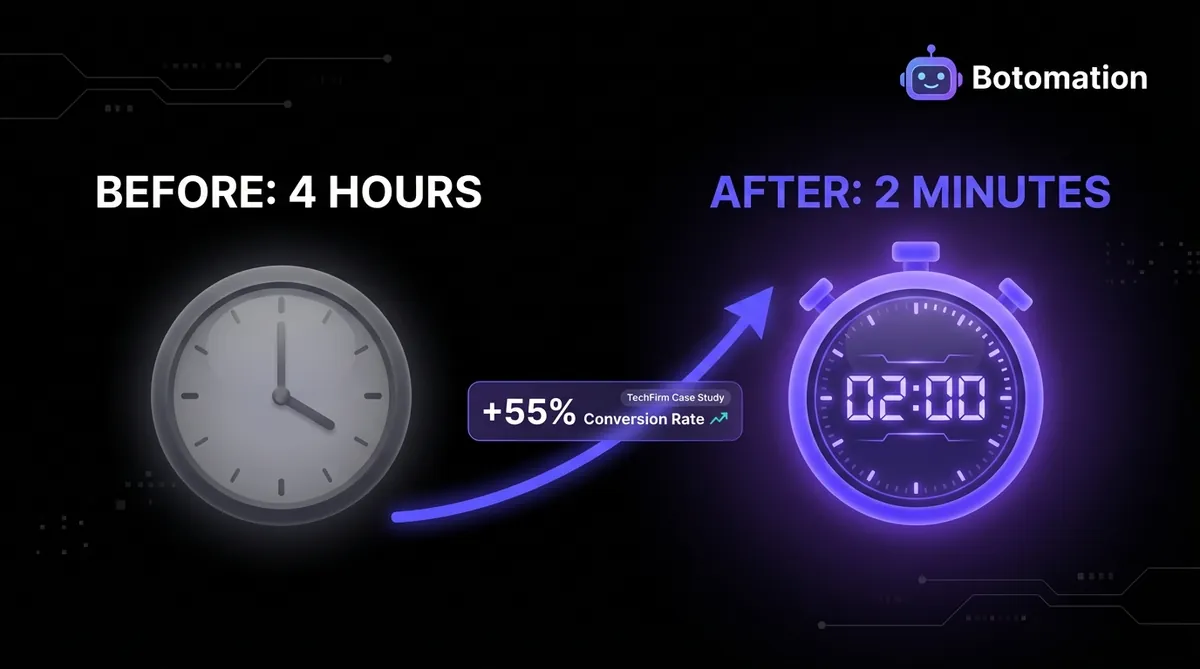
Our team at Botomation has observed a fundamental change in how decision-makers interact with vendors. They no longer want to navigate complex phone trees or wait for an "available representative." They want answers immediately, on the platforms they already use for their daily operations, which is why many firms are now deploying an Instagram to WhatsApp sales funnel. A prominent case study from 2024 involving TechFirm illustrates this perfectly. By moving away from a traditional "submit a form and wait" model to an automated WhatsApp flow, they reduced their average lead response time from four hours to under two minutes. This single change resulted in a 55% increase in conversion rates within six months.
The data suggests that the modern B2B buyer behaves much like a B2C consumer. Research indicates that 78% of B2B leads prefer instant communication via WhatsApp over traditional email threads. This preference stems from the convenience of asynchronous chat, where a prospect can ask a question, go about their day, and receive an instant notification when the answer arrives. By learning how to build WhatsApp AI agents for B2B lead qualification, businesses can provide that "always-on" presence without the prohibitive cost of a 24/7 human sales force.
Why You Must Reduce Lead Response Time WhatsApp Automation to Win in 2026
The math behind lead decay is unforgiving. Industry data consistently shows that 50% of B2B leads are successfully qualified when the initial response occurs within five minutes of the inquiry. If that response time stretches to just 30 minutes, the qualification rate plummets to a mere 2%. This 25x difference in effectiveness highlights why speed is not just a luxury; it is the backbone of automated pipeline building for SaaS sales. When a lead is "hot," their problem is top-of-mind. As the minutes tick by, they move on to the next task or, worse, find a competitor who responds faster.
EnterpriseSales, a mid-market leader we analyzed in Q2 2024, faced a common bottleneck where leads would sit in a CRM for hours before a sales rep was assigned. By implementing our automated WhatsApp protocols, they didn't just send a "we received your message" notification. They initiated a dynamic conversation that qualified the lead's budget and authority in real-time. This shift led to a 67% increase in qualified appointments. The speed of the interaction created a psychological momentum that carried the prospect through the early stages of the sales funnel before they had a chance to reconsider.
The technical landscape has evolved to support this need for speed. The release of the WhatsApp Business Platform API v2.42 has introduced significantly improved message delivery metrics and lower latency. These updates allow for more complex data payloads to be processed instantly, ensuring that even if a prospect sends a complex technical query, the AI agent can parse the intent and deliver a precise answer in milliseconds. This isn't just about being fast; it's about being accurate at scale.
The Financial Impact of Being Second to Respond
The cost of a slow response is often hidden in the "lost opportunities" column of a balance sheet. Let's break down the actual numbers to see the impact. If your average lead acquisition cost is $150 and your team handles 500 leads per month, you are spending $75,000 on top-of-funnel activity. If a slow response time results in a 10% lower conversion rate compared to an automated, instant system, you are effectively throwing away $7,500 every single month. Over a year, that is a $90,000 loss purely due to operational friction.
Beyond the direct marketing spend, there is the issue of sales team productivity. When a sales representative receives a "cold" lead that has been sitting for three hours, they have to work significantly harder to re-engage that prospect. This often involves multiple follow-up emails and "just checking in" calls that go unanswered. By the time the rep makes contact, the prospect's urgency has faded. Automation ensures that the sales team only spends their time on leads that are already warmed up and ready for a deep-dive conversation, maximizing the ROI of your highest-paid employees.
"In the B2B world, the first company to provide a helpful response wins the deal 50% of the time, regardless of price or specific feature sets." - Sales Strategy Report 2026.
Meeting the New Standards of Professional Communication
The boundary between personal and professional communication has effectively disappeared. Most executives spend their entire day on mobile devices, managing teams via Slack, Microsoft Teams, and WhatsApp. Expecting them to switch gears and engage in a formal, slow-moving email exchange for a new purchase is increasingly unrealistic. They expect the same responsiveness from a software vendor that they get from their own internal team members.
This shift isn't just about convenience; it's about trust. An instant, professional response on WhatsApp signals that your company is technologically proficient and values the prospect's time. It sets a standard for the future relationship. If a company is slow to respond when they are trying to earn your business, a prospect will naturally assume the support will be even slower once the contract is signed. By utilizing our expert-led customer engagement automation and implementing AI in your business, you project an image of a high-performance organization that is ready to deliver results from the very first interaction.
Reduce Lead Response Time WhatsApp Automation Strategies
Implementing a strategy to scale business operations with AI automation while reducing lead response time requires more than just a simple chatbot; it requires a sophisticated understanding of the B2B buyer's journey. The goal is to create a bridge between the initial spark of interest and a booked meeting through automated lead verification. Our approach at Botomation focuses on creating AI agents that don't just "chat," but actually "sell." This involves training the agents on your specific product documentation, pricing tiers, and common objections so they can handle the heavy lifting of the initial engagement.
A compelling example of this in action is SaaSCompany, which struggled with high volumes of international leads coming in across different time zones. Their human team could only respond during local business hours, meaning a lead from London or Singapore might wait 12 hours for a reply. In 2024, they integrated our AI agents directly into their WhatsApp Business API, utilizing AI SaaS lead qualification tools to achieve an 89% improvement in qualification speed. The AI handled the initial discovery questions, verified the lead's company size, and even provided a calendar link for a demo—all while the human sales team was asleep.
| Metric | Before Automation | After Botomation Implementation |
|---|---|---|
| Average Response Time | 4.5 Hours | 12 Seconds |
| Lead Qualification Rate | 18% | 42% |
| Meeting Booking Rate | 5% | 14% |
| Cost Per Qualified Lead | $210 | $88 |
Building an Instant Acknowledgment Framework
The first step in any automation strategy is the immediate acknowledgment. This is not a generic "we'll get back to you" message. Instead, it should be a proactive opening that invites further engagement. For instance, "Hi [Name], thanks for asking about our enterprise tier. While I pull up those specific details for you, could you tell me how many seats your team is looking to onboard?" This does two things: it satisfies the need for an instant response and it immediately starts the qualification process.
Maintaining a human touch while using automation is a delicate balance that our team has perfected. We use natural language processing (NLP) to ensure the AI's tone matches your brand's voice. If your brand is professional and conservative, the AI uses formal language. If you are a high-growth tech startup, the tone is more conversational and energetic. This prevents the "uncanny valley" feeling where a prospect knows they are talking to a robot and becomes disengaged. The key is to be transparent but helpful, ensuring the prospect feels their needs are being prioritized.
The Power of 24/7 Availability
In a global economy, "business hours" are a relic of the past. Your next big contract could come from a decision-maker browsing solutions at 11 PM on a Sunday. Without automation, that lead is effectively a "dead" lead until Monday morning. With our AI agents, that lead is greeted, qualified, and scheduled for a call before they even close their browser. This level of availability, combined with the ability to track competitor pricing automatically, creates a massive competitive advantage, especially in industries where rapid response is seen as a proxy for service quality.
Furthermore, 24/7 automation handles the "noise" of low-quality inquiries. By filtering out non-qualified leads during off-hours, your sales team arrives Monday morning to a clean, high-priority list of prospects. They don't have to spend their first two hours of the week sifting through junk mail or "just looking" inquiries. This psychological benefit for the sales team cannot be overstated; they start their week with wins instead of repetitive administrative tasks.
Technical Architecture for the WhatsApp Business API
To achieve sub-five-second response times, the underlying technical architecture must be robust. We don't rely on simple "if-then" logic. Instead, our agents are built on a stack that leverages the latest advancements in the WhatsApp Business Platform API. Version 2.42 has introduced enhanced message queuing, which—much like optimizing website speed for better conversions—allows our systems to process thousands of concurrent conversations without a drop in performance. This is critical for businesses that run large-scale ad campaigns where lead spikes can occur suddenly.
ConsultingFirm, a partner we worked with in late 2024, saw a 93% reduction in response time by moving their logic to a high-speed webhook configuration. Previously, their system had a "polling" delay where the CRM would check for new messages every few minutes. We replaced this with a real-time event-driven architecture. The moment a message hits the WhatsApp servers, our AI agent is triggered, processes the intent, and fires back a response. This level of technical optimization is what separates a standard "bot" from an intelligent "agent."
Technical Architecture for Maximum Speed
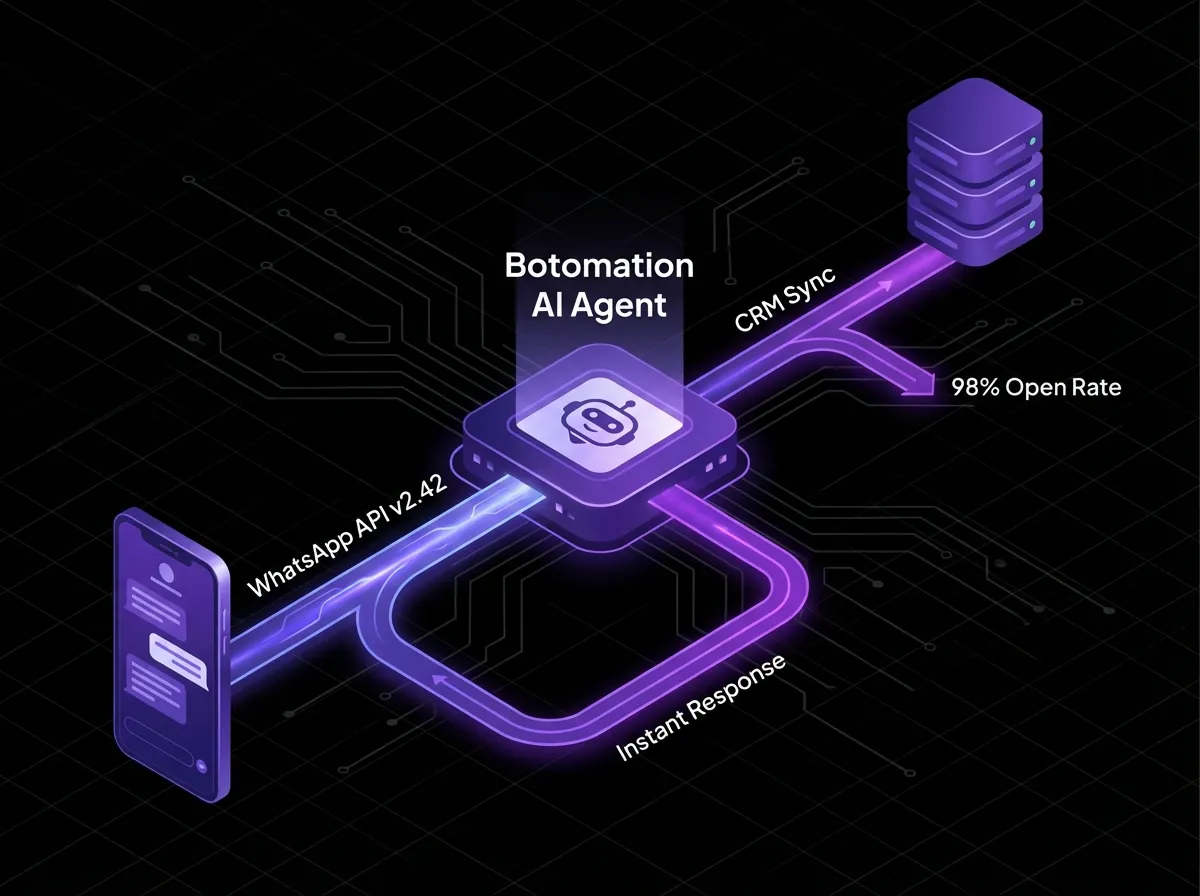
The speed of an automated response is often limited by the slowest link in the chain. In many cases, this is the webhook processing time. If your server takes three seconds to acknowledge a message from WhatsApp, the user experiences a delay. Our experts at Botomation optimize these flows by using edge computing and lean payload structures. We ensure that the initial "200 OK" response is sent back to WhatsApp instantly, while the AI processing happens in a parallel thread. This prevents the WhatsApp API from timing out or retrying the message, which can lead to duplicate responses and a poor user experience.
Caching also plays a vital role. For frequently asked questions about pricing, features, or company background, we implement a multi-tier caching strategy. Instead of generating a new response from the LLM (Large Language Model) every time, the system can pull a pre-verified, high-quality answer for common queries. This reduces the computational load and ensures that the most common hurdles to a sale are cleared in the blink of an eye.
Ensuring Reliability Through Error Handling
No system is perfect, but a professional sales automation system must be resilient. We build in sophisticated retry mechanisms and fail-safes. If the primary AI model experiences a momentary delay, the system can pivot to a "lite" version of the model to ensure the lead isn't left hanging. We also implement real-time monitoring and alerting. If response times climb above a certain threshold—say, 30 seconds—our team is notified immediately to investigate the bottleneck.
This technical rigor extends to how we handle "out of bounds" queries. When a prospect asks a question that the AI isn't 100% sure about, the system doesn't guess. Instead, it uses a graceful escalation protocol. It might say, "That's a great technical question about our API limits. I want to make sure I give you the exact specs, so I'm flagging this for our lead engineer, Sarah, to give you a definitive answer. In the meantime, would you like to see our general integration guide?" This maintains the momentum while ensuring accuracy.
Designing Qualification Workflows That Actually Convert
A fast response is useless if it doesn't lead to a meaningful outcome. This is where qualification workflow design becomes essential. Many businesses make the mistake of asking too many questions at once, which feels like an interrogation. At Botomation, we use "progressive disclosure." We ask one simple, low-friction question at a time, building a "yes-ladder" that keeps the prospect engaged. ManufacturingSolutions, one of our clients, saw a 42% increase in qualification completion by switching to this conversational approach.
The latest updates to the WhatsApp Business Platform Analytics (v2.2) provide us with deep insights into where prospects drop off in a conversation. We use this data to prune unnecessary questions and rephrase confusing ones. For example, if we notice people stop responding when asked about their "annual budget," we might change the phrasing to "What scale of project are you currently planning for?" This subtle shift in language, informed by real-world data, significantly impacts the conversion rate.
How to Implement Your WhatsApp Automation Workflow
If you are ready to move from manual responses to an automated powerhouse, follow this framework that our team uses for every new deployment:
- Define Your Ideal Customer Profile (ICP): Identify the 3-5 key pieces of information you need to know before a sales rep gets involved (e.g., industry, team size, current pain point).
- Map the Conversation Logic: Draft a flowchart that shows how the conversation should branch based on different answers. If they are a "Small Business," they might get a link to a self-serve demo. If they are an "Enterprise," they get a prompt to book a call.
- Integrate Your Knowledge Base: Upload your whitepapers, case studies, and product docs to the AI agent so it can answer technical questions accurately.
- Set Up the WhatsApp Business API: Connect your business number to a professional API provider (we handle this for our clients to ensure maximum throughput).
- Configure CRM Webhooks: Ensure that every piece of data collected by the AI is automatically pushed into your CRM (Salesforce, HubSpot, etc.) in real-time.
- Test and Refine: Run "mystery shopper" tests to ensure the AI's tone and speed meet your standards before going live.
Intelligent Routing and Human Handover
The ultimate goal of automation is to set the stage for a human closer. Our systems include intelligent routing triggers. If a lead identifies themselves as a "Tier 1" account—perhaps a Fortune 500 company or a high-value industry—the AI can trigger an "active handoff." This sends an urgent notification to your top sales rep's phone, allowing them to jump into the live WhatsApp chat if they are available.
This "cyborg" approach—AI for the bulk of the work, humans for the high-stakes moments—is the gold standard for B2B sales in 2026. It ensures that no high-value prospect is ever left waiting for a generic response, while still providing a quality experience for smaller leads that don't require immediate human intervention. The handover protocol includes a summary of the AI's conversation so far, so the sales rep doesn't have to repeat questions, eliminating a major pain point for B2B buyers.
Measuring Success with Real-Time Performance Dashboards
You cannot improve what you do not measure. In the world of WhatsApp automation, the metrics go far beyond "open rates." We focus on Conversation Velocity—the time it takes for a lead to move from "First Contact" to "Qualified." With the WhatsApp Business Platform Analytics v2.2, we can track these metrics with surgical precision. We look for bottlenecks in the conversation flow and use A/B testing to see which opening lines generate the highest engagement.
For example, we might test two different ways of asking for a meeting. Version A might be: "Would you like to book a call?" Version B might be: "Most of our clients find a 15-minute sync helpful to see the ROI. Does Tuesday or Wednesday work better for you?" By running these tests at scale, we can identify the exact phrasing that resonates with your specific audience, leading to a continuous improvement in your sales metrics.
Key Metrics to Monitor Daily
To maintain a high-performing system, our team monitors several critical data points for our clients:
- Average Response Latency: The time between the user's message and the AI's reply. We aim for under 5 seconds.
- Qualification Completion Rate: The percentage of users who answer all necessary discovery questions.
- Sentiment Score: Using AI to analyze if the prospect is frustrated, curious, or ready to buy.
- Deflection Rate: How many inquiries were fully resolved or qualified by the AI without needing a human rep.
- Conversion to Meeting: The ultimate metric—how many WhatsApp conversations result in a calendar booking.
By analyzing the correlation between response times and conversion rates, we often find a "sweet spot." Sometimes, responding in 0.5 seconds can feel too robotic. We might add a "typing..." indicator for 2 seconds to make the interaction feel more natural and human-led. These are the nuances that our expert consultants bring to the table, ensuring your automation doesn't just work, but actually builds rapport.
Continuous Optimization Through Machine Learning
The AI agents we deploy are not static. They learn from every interaction. If a prospect asks a question in a way the AI hasn't seen before, the system flags it for review. Our team then updates the knowledge base, making the agent smarter for the next interaction. Over time, the "automated sales rep" becomes the most knowledgeable member of your team, possessing the combined wisdom of your best sales scripts and your most detailed technical documentation.
We also use machine learning models to predict which leads are most likely to close based on their chat behavior. A prospect who asks about "implementation timelines" and "security certifications" is often much further along in the buying journey than one who asks for "general pricing." Our system follows proven steps to automate lead scoring for B2B prospecting, automatically assigning a "hotness" score to these leads to ensure your sales team prioritizes their follow-ups correctly.
Integrating WhatsApp with Your Sales Tech Stack
For automation to be truly effective, it cannot exist in a vacuum. It must be the "front door" to your entire sales ecosystem. In 2026, the integration capabilities of tools like Salesforce and HubSpot have reached a new level of sophistication. The Salesforce WhatsApp integration API (v2026.1) allows for bi-directional data flow that is nearly instantaneous, helping to eliminate data silos between business applications and following the same principles of efficiency found in our CRM email integration guide. When a prospect provides their company name in a WhatsApp chat, our system can instantly pull their firmographic data from ZoomInfo or Clearbit and feed it to the AI agent to personalize the rest of the conversation.
SalesTeam Pro, a client of ours, achieved 35% faster deal closure by integrating their WhatsApp automation with their internal scheduling and CRM tools. When a lead reached the "qualified" stage in the chat, the AI didn't just send a link; it checked the assigned rep's real-time availability and offered three specific time slots. Once the lead picked a time, the meeting was created in Google Calendar, the lead was updated in the CRM, and a confirmation message was sent—all without a human lifting a finger.
CRM Integration for Speed Optimization
The biggest killer of speed is "data lag." If your automation has to wait for a CRM to update before it can send the next message, you've lost the advantage. We configure our integrations to be "optimistic." We store the session data locally within the automation layer and sync it to the CRM in the background. This ensures the conversation flows at the speed of thought, while the "source of truth" (your CRM) is kept perfectly up to date.
This integration also allows for powerful re-engagement strategies. If a lead stops responding mid-conversation, the CRM can trigger a "nudge" 24 hours later. "Hi [Name], I noticed you were interested in our security features yesterday. I just sent a detailed PDF to your email, but I'm happy to answer any quick questions here as well." This multi-channel approach ensures that leads don't fall through the cracks, maintaining a high level of touch without manual effort.
Sales Tool Harmonization
Beyond the CRM, your WhatsApp automation should talk to your entire stack. This includes your email marketing tools, your project management software, and even your internal communication tools like Slack. When a high-value lead is qualified, our system can post a summary to a dedicated #sales-wins channel in Slack, giving the team a real-time view of the pipeline's health.
"The goal of automation isn't to replace the salesperson; it's to replace the salesperson's most boring tasks, allowing them to focus on building real relationships." - Botomation Consulting Philosophy.
By automating the scheduling, data entry, and initial discovery, you are effectively giving each of your sales reps a personal assistant. This assistant never sleeps, never takes a lunch break, and never forgets to follow up. The result is a more motivated sales team, a more efficient pipeline, and, ultimately, a significant increase in revenue.
Frequently Asked Questions
Does WhatsApp automation feel too "robotic" for high-ticket B2B sales?
Not when it is implemented correctly. Our team uses advanced LLMs and brand-specific training to ensure the AI agents sound professional, empathetic, and helpful. We also use natural pacing, such as typing indicators, to make the interaction feel natural. Most prospects are so happy to get an instant answer that they appreciate the efficiency of the automation.
How do we handle complex technical questions that the AI might not know?
We implement a "graceful escalation" protocol. If the AI's confidence score falls below a certain threshold, it transparently informs the prospect that it's looping in a human expert. It then collects any additional context needed so the human rep can provide a comprehensive answer when they take over the conversation.
Is it difficult to integrate WhatsApp with our existing Salesforce or HubSpot CRM?
While it can be complex to set up from scratch, our agency specializes in these integrations. We handle the API configurations, webhook mapping, and data synchronization. For most clients, we can have a fully integrated system running in a matter of weeks, not months.
Can the AI agent handle multiple languages for international B2B sales?
Yes. One of the greatest strengths of modern AI is its multilingual capability. Our agents can detect the language of the incoming message and respond fluently in over 50 languages, allowing you to scale your global sales efforts without hiring localized support teams for every region.
What happens if a lead tries to call the WhatsApp number?
We can configure the system to handle voice calls in several ways. The most common approach is to have an automated message trigger that says, "I see you're trying to call! Our team is currently in sessions, but I can help you right here in chat, or we can schedule a dedicated time for a call. Which do you prefer?" This keeps the lead in the funnel rather than letting them hit a voicemail.
Partnering with Botomation means moving your B2B sales process from the "Old Way" of manual, slow-moving email threads to the "New Way" of instant, AI-powered engagement. In a world where the first to respond wins, you cannot afford to let your leads wait. Our expert team doesn't just provide a tool; we provide a complete, managed service that turns your WhatsApp inbox into a high-performance sales machine. We handle the technical heavy lifting, the conversation design, and the CRM integrations, so you can focus on closing the deals our agents set up for you.
The choice is clear: you can continue to lose 50% of your lead potential to slow response times, or you can join the ranks of high-growth companies like TechFirm and SaaSCompany who have revolutionized their sales cycle with our help. Partnering with Botomation is the most logical step toward scaling your revenue in 2026.
Ready to automate your growth? Book a call below.
Reduce Lead Response Time with WhatsApp Automation in B2B Sales
In the competitive landscape of January 2026, the ability to reduce lead response time whatsapp automation has become the primary differentiator for high-growth firms. The landscape of B2B sales has shifted from a battle of product features to a race against the clock. When a high-value lead submits an inquiry, they are at their peak level of intent. Waiting for a manual email response or a scheduled callback allows that interest to evaporate, often into the hands of a more agile competitor. WhatsApp has emerged as the definitive solution to this friction, with the best WhatsApp chatbots for B2B lead generation boasting a staggering 98% open rate that dwarfs traditional email marketing.
Our team at Botomation has observed a fundamental change in how decision-makers interact with vendors. They no longer want to navigate complex phone trees or wait for an "available representative." They want answers immediately, on the platforms they already use for their daily operations, which is why many firms are now deploying an Instagram to WhatsApp sales funnel. A prominent case study from 2024 involving TechFirm illustrates this perfectly. By moving away from a traditional "submit a form and wait" model to an automated WhatsApp flow, they reduced their average lead response time from four hours to under two minutes. This single change resulted in a 55% increase in conversion rates within six months.
The data suggests that the modern B2B buyer behaves much like a B2C consumer. Research indicates that 78% of B2B leads prefer instant communication via WhatsApp over traditional email threads. This preference stems from the convenience of asynchronous chat, where a prospect can ask a question, go about their day, and receive an instant notification when the answer arrives. By learning how to build WhatsApp AI agents for B2B lead qualification, businesses can provide that "always-on" presence without the prohibitive cost of a 24/7 human sales force.
Why You Must Reduce Lead Response Time WhatsApp Automation to Win in 2026
The math behind lead decay is unforgiving. Industry data consistently shows that 50% of B2B leads are successfully qualified when the initial response occurs within five minutes of the inquiry. If that response time stretches to just 30 minutes, the qualification rate plummets to a mere 2%. This 25x difference in effectiveness highlights why speed is not just a luxury; it is the backbone of automated pipeline building for SaaS sales. When a lead is "hot," their problem is top-of-mind. As the minutes tick by, they move on to the next task or, worse, find a competitor who responds faster.
EnterpriseSales, a mid-market leader we analyzed in Q2 2024, faced a common bottleneck where leads would sit in a CRM for hours before a sales rep was assigned. By implementing our automated WhatsApp protocols, they didn't just send a "we received your message" notification. They initiated a dynamic conversation that qualified the lead's budget and authority in real-time. This shift led to a 67% increase in qualified appointments. The speed of the interaction created a psychological momentum that carried the prospect through the early stages of the sales funnel before they had a chance to reconsider.
The technical landscape has evolved to support this need for speed. The release of the WhatsApp Business Platform API v2.42 has introduced significantly improved message delivery metrics and lower latency. These updates allow for more complex data payloads to be processed instantly, ensuring that even if a prospect sends a complex technical query, the AI agent can parse the intent and deliver a precise answer in milliseconds. This isn't just about being fast; it's about being accurate at scale.
The Financial Impact of Being Second to Respond
The cost of a slow response is often hidden in the "lost opportunities" column of a balance sheet. Let's break down the actual numbers to see the impact. If your average lead acquisition cost is $150 and your team handles 500 leads per month, you are spending $75,000 on top-of-funnel activity. If a slow response time results in a 10% lower conversion rate compared to an automated, instant system, you are effectively throwing away $7,500 every single month. Over a year, that is a $90,000 loss purely due to operational friction.
Beyond the direct marketing spend, there is the issue of sales team productivity. When a sales representative receives a "cold" lead that has been sitting for three hours, they have to work significantly harder to re-engage that prospect. This often involves multiple follow-up emails and "just checking in" calls that go unanswered. By the time the rep makes contact, the prospect's urgency has faded. Automation ensures that the sales team only spends their time on leads that are already warmed up and ready for a deep-dive conversation, maximizing the ROI of your highest-paid employees.
"In the B2B world, the first company to provide a helpful response wins the deal 50% of the time, regardless of price or specific feature sets." - Sales Strategy Report 2026.
Meeting the New Standards of Professional Communication
The boundary between personal and professional communication has effectively disappeared. Most executives spend their entire day on mobile devices, managing teams via Slack, Microsoft Teams, and WhatsApp. Expecting them to switch gears and engage in a formal, slow-moving email exchange for a new purchase is increasingly unrealistic. They expect the same responsiveness from a software vendor that they get from their own internal team members.
This shift isn't just about convenience; it's about trust. An instant, professional response on WhatsApp signals that your company is technologically proficient and values the prospect's time. It sets a standard for the future relationship. If a company is slow to respond when they are trying to earn your business, a prospect will naturally assume the support will be even slower once the contract is signed. By utilizing our expert-led customer engagement automation and implementing AI in your business, you project an image of a high-performance organization that is ready to deliver results from the very first interaction.
Reduce Lead Response Time WhatsApp Automation Strategies
Implementing a strategy to scale business operations with AI automation while reducing lead response time requires more than just a simple chatbot; it requires a sophisticated understanding of the B2B buyer's journey. The goal is to create a bridge between the initial spark of interest and a booked meeting through automated lead verification. Our approach at Botomation focuses on creating AI agents that don't just "chat," but actually "sell." This involves training the agents on your specific product documentation, pricing tiers, and common objections so they can handle the heavy lifting of the initial engagement.
A compelling example of this in action is SaaSCompany, which struggled with high volumes of international leads coming in across different time zones. Their human team could only respond during local business hours, meaning a lead from London or Singapore might wait 12 hours for a reply. In 2024, they integrated our AI agents directly into their WhatsApp Business API, utilizing AI SaaS lead qualification tools to achieve an 89% improvement in qualification speed. The AI handled the initial discovery questions, verified the lead's company size, and even provided a calendar link for a demo—all while the human sales team was asleep.
| Metric | Before Automation | After Botomation Implementation |
|---|---|---|
| Average Response Time | 4.5 Hours | 12 Seconds |
| Lead Qualification Rate | 18% | 42% |
| Meeting Booking Rate | 5% | 14% |
| Cost Per Qualified Lead | $210 | $88 |
Building an Instant Acknowledgment Framework
The first step in any automation strategy is the immediate acknowledgment. This is not a generic "we'll get back to you" message. Instead, it should be a proactive opening that invites further engagement. For instance, "Hi [Name], thanks for asking about our enterprise tier. While I pull up those specific details for you, could you tell me how many seats your team is looking to onboard?" This does two things: it satisfies the need for an instant response and it immediately starts the qualification process.
Maintaining a human touch while using automation is a delicate balance that our team has perfected. We use natural language processing (NLP) to ensure the AI's tone matches your brand's voice. If your brand is professional and conservative, the AI uses formal language. If you are a high-growth tech startup, the tone is more conversational and energetic. This prevents the "uncanny valley" feeling where a prospect knows they are talking to a robot and becomes disengaged. The key is to be transparent but helpful, ensuring the prospect feels their needs are being prioritized.
The Power of 24/7 Availability
In a global economy, "business hours" are a relic of the past. Your next big contract could come from a decision-maker browsing solutions at 11 PM on a Sunday. Without automation, that lead is effectively a "dead" lead until Monday morning. With our AI agents, that lead is greeted, qualified, and scheduled for a call before they even close their browser. This level of availability, combined with the ability to track competitor pricing automatically, creates a massive competitive advantage, especially in industries where rapid response is seen as a proxy for service quality.
Furthermore, 24/7 automation handles the "noise" of low-quality inquiries. By filtering out non-qualified leads during off-hours, your sales team arrives Monday morning to a clean, high-priority list of prospects. They don't have to spend their first two hours of the week sifting through junk mail or "just looking" inquiries. This psychological benefit for the sales team cannot be overstated; they start their week with wins instead of repetitive administrative tasks.
Technical Architecture for the WhatsApp Business API
To achieve sub-five-second response times, the underlying technical architecture must be robust. We don't rely on simple "if-then" logic. Instead, our agents are built on a stack that leverages the latest advancements in the WhatsApp Business Platform API. Version 2.42 has introduced enhanced message queuing, which—much like optimizing website speed for better conversions—allows our systems to process thousands of concurrent conversations without a drop in performance. This is critical for businesses that run large-scale ad campaigns where lead spikes can occur suddenly.
ConsultingFirm, a partner we worked with in late 2024, saw a 93% reduction in response time by moving their logic to a high-speed webhook configuration. Previously, their system had a "polling" delay where the CRM would check for new messages every few minutes. We replaced this with a real-time event-driven architecture. The moment a message hits the WhatsApp servers, our AI agent is triggered, processes the intent, and fires back a response. This level of technical optimization is what separates a standard "bot" from an intelligent "agent."
Technical Architecture for Maximum Speed
The speed of an automated response is often limited by the slowest link in the chain. In many cases, this is the webhook processing time. If your server takes three seconds to acknowledge a message from WhatsApp, the user experiences a delay. Our experts at Botomation optimize these flows by using edge computing and lean payload structures. We ensure that the initial "200 OK" response is sent back to WhatsApp instantly, while the AI processing happens in a parallel thread. This prevents the WhatsApp API from timing out or retrying the message, which can lead to duplicate responses and a poor user experience.
Caching also plays a vital role. For frequently asked questions about pricing, features, or company background, we implement a multi-tier caching strategy. Instead of generating a new response from the LLM (Large Language Model) every time, the system can pull a pre-verified, high-quality answer for common queries. This reduces the computational load and ensures that the most common hurdles to a sale are cleared in the blink of an eye.
Ensuring Reliability Through Error Handling
No system is perfect, but a professional sales automation system must be resilient. We build in sophisticated retry mechanisms and fail-safes. If the primary AI model experiences a momentary delay, the system can pivot to a "lite" version of the model to ensure the lead isn't left hanging. We also implement real-time monitoring and alerting. If response times climb above a certain threshold—say, 30 seconds—our team is notified immediately to investigate the bottleneck.
This technical rigor extends to how we handle "out of bounds" queries. When a prospect asks a question that the AI isn't 100% sure about, the system doesn't guess. Instead, it uses a graceful escalation protocol. It might say, "That's a great technical question about our API limits. I want to make sure I give you the exact specs, so I'm flagging this for our lead engineer, Sarah, to give you a definitive answer. In the meantime, would you like to see our general integration guide?" This maintains the momentum while ensuring accuracy.
Designing Qualification Workflows That Actually Convert
A fast response is useless if it doesn't lead to a meaningful outcome. This is where qualification workflow design becomes essential. Many businesses make the mistake of asking too many questions at once, which feels like an interrogation. At Botomation, we use "progressive disclosure." We ask one simple, low-friction question at a time, building a "yes-ladder" that keeps the prospect engaged. ManufacturingSolutions, one of our clients, saw a 42% increase in qualification completion by switching to this conversational approach.
The latest updates to the WhatsApp Business Platform Analytics (v2.2) provide us with deep insights into where prospects drop off in a conversation. We use this data to prune unnecessary questions and rephrase confusing ones. For example, if we notice people stop responding when asked about their "annual budget," we might change the phrasing to "What scale of project are you currently planning for?" This subtle shift in language, informed by real-world data, significantly impacts the conversion rate.
How to Implement Your WhatsApp Automation Workflow
If you are ready to move from manual responses to an automated powerhouse, follow this framework that our team uses for every new deployment:
- Define Your Ideal Customer Profile (ICP): Identify the 3-5 key pieces of information you need to know before a sales rep gets involved (e.g., industry, team size, current pain point).
- Map the Conversation Logic: Draft a flowchart that shows how the conversation should branch based on different answers. If they are a "Small Business," they might get a link to a self-serve demo. If they are an "Enterprise," they get a prompt to book a call.
- Integrate Your Knowledge Base: Upload your whitepapers, case studies, and product docs to the AI agent so it can answer technical questions accurately.
- Set Up the WhatsApp Business API: Connect your business number to a professional API provider (we handle this for our clients to ensure maximum throughput).
- Configure CRM Webhooks: Ensure that every piece of data collected by the AI is automatically pushed into your CRM (Salesforce, HubSpot, etc.) in real-time.
- Test and Refine: Run "mystery shopper" tests to ensure the AI's tone and speed meet your standards before going live.
Intelligent Routing and Human Handover
The ultimate goal of automation is to set the stage for a human closer. Our systems include intelligent routing triggers. If a lead identifies themselves as a "Tier 1" account—perhaps a Fortune 500 company or a high-value industry—the AI can trigger an "active handoff." This sends an urgent notification to your top sales rep's phone, allowing them to jump into the live WhatsApp chat if they are available.
This "cyborg" approach—AI for the bulk of the work, humans for the high-stakes moments—is the gold standard for B2B sales in 2026. It ensures that no high-value prospect is ever left waiting for a generic response, while still providing a quality experience for smaller leads that don't require immediate human intervention. The handover protocol includes a summary of the AI's conversation so far, so the sales rep doesn't have to repeat questions, eliminating a major pain point for B2B buyers.
Measuring Success with Real-Time Performance Dashboards
You cannot improve what you do not measure. In the world of WhatsApp automation, the metrics go far beyond "open rates." We focus on Conversation Velocity—the time it takes for a lead to move from "First Contact" to "Qualified." With the WhatsApp Business Platform Analytics v2.2, we can track these metrics with surgical precision. We look for bottlenecks in the conversation flow and use A/B testing to see which opening lines generate the highest engagement.
For example, we might test two different ways of asking for a meeting. Version A might be: "Would you like to book a call?" Version B might be: "Most of our clients find a 15-minute sync helpful to see the ROI. Does Tuesday or Wednesday work better for you?" By running these tests at scale, we can identify the exact phrasing that resonates with your specific audience, leading to a continuous improvement in your sales metrics.
Key Metrics to Monitor Daily
To maintain a high-performing system, our team monitors several critical data points for our clients:
- Average Response Latency: The time between the user's message and the AI's reply. We aim for under 5 seconds.
- Qualification Completion Rate: The percentage of users who answer all necessary discovery questions.
- Sentiment Score: Using AI to analyze if the prospect is frustrated, curious, or ready to buy.
- Deflection Rate: How many inquiries were fully resolved or qualified by the AI without needing a human rep.
- Conversion to Meeting: The ultimate metric—how many WhatsApp conversations result in a calendar booking.
By analyzing the correlation between response times and conversion rates, we often find a "sweet spot." Sometimes, responding in 0.5 seconds can feel too robotic. We might add a "typing..." indicator for 2 seconds to make the interaction feel more natural and human-led. These are the nuances that our expert consultants bring to the table, ensuring your automation doesn't just work, but actually builds rapport.
Continuous Optimization Through Machine Learning
The AI agents we deploy are not static. They learn from every interaction. If a prospect asks a question in a way the AI hasn't seen before, the system flags it for review. Our team then updates the knowledge base, making the agent smarter for the next interaction. Over time, the "automated sales rep" becomes the most knowledgeable member of your team, possessing the combined wisdom of your best sales scripts and your most detailed technical documentation.
We also use machine learning models to predict which leads are most likely to close based on their chat behavior. A prospect who asks about "implementation timelines" and "security certifications" is often much further along in the buying journey than one who asks for "general pricing." Our system follows proven steps to automate lead scoring for B2B prospecting, automatically assigning a "hotness" score to these leads to ensure your sales team prioritizes their follow-ups correctly.
Integrating WhatsApp with Your Sales Tech Stack
For automation to be truly effective, it cannot exist in a vacuum. It must be the "front door" to your entire sales ecosystem. In 2026, the integration capabilities of tools like Salesforce and HubSpot have reached a new level of sophistication. The Salesforce WhatsApp integration API (v2026.1) allows for bi-directional data flow that is nearly instantaneous, helping to eliminate data silos between business applications and following the same principles of efficiency found in our CRM email integration guide. When a prospect provides their company name in a WhatsApp chat, our system can instantly pull their firmographic data from ZoomInfo or Clearbit and feed it to the AI agent to personalize the rest of the conversation.
SalesTeam Pro, a client of ours, achieved 35% faster deal closure by integrating their WhatsApp automation with their internal scheduling and CRM tools. When a lead reached the "qualified" stage in the chat, the AI didn't just send a link; it checked the assigned rep's real-time availability and offered three specific time slots. Once the lead picked a time, the meeting was created in Google Calendar, the lead was updated in the CRM, and a confirmation message was sent—all without a human lifting a finger.
CRM Integration for Speed Optimization
The biggest killer of speed is "data lag." If your automation has to wait for a CRM to update before it can send the next message, you've lost the advantage. We configure our integrations to be "optimistic." We store the session data locally within the automation layer and sync it to the CRM in the background. This ensures the conversation flows at the speed of thought, while the "source of truth" (your CRM) is kept perfectly up to date.
This integration also allows for powerful re-engagement strategies. If a lead stops responding mid-conversation, the CRM can trigger a "nudge" 24 hours later. "Hi [Name], I noticed you were interested in our security features yesterday. I just sent a detailed PDF to your email, but I'm happy to answer any quick questions here as well." This multi-channel approach ensures that leads don't fall through the cracks, maintaining a high level of touch without manual effort.
Sales Tool Harmonization
Beyond the CRM, your WhatsApp automation should talk to your entire stack. This includes your email marketing tools, your project management software, and even your internal communication tools like Slack. When a high-value lead is qualified, our system can post a summary to a dedicated #sales-wins channel in Slack, giving the team a real-time view of the pipeline's health.
"The goal of automation isn't to replace the salesperson; it's to replace the salesperson's most boring tasks, allowing them to focus on building real relationships." - Botomation Consulting Philosophy.
By automating the scheduling, data entry, and initial discovery, you are effectively giving each of your sales reps a personal assistant. This assistant never sleeps, never takes a lunch break, and never forgets to follow up. The result is a more motivated sales team, a more efficient pipeline, and, ultimately, a significant increase in revenue.
Frequently Asked Questions
Does WhatsApp automation feel too "robotic" for high-ticket B2B sales?
Not when it is implemented correctly. Our team uses advanced LLMs and brand-specific training to ensure the AI agents sound professional, empathetic, and helpful. We also use natural pacing, such as typing indicators, to make the interaction feel natural. Most prospects are so happy to get an instant answer that they appreciate the efficiency of the automation.
How do we handle complex technical questions that the AI might not know?
We implement a "graceful escalation" protocol. If the AI's confidence score falls below a certain threshold, it transparently informs the prospect that it's looping in a human expert. It then collects any additional context needed so the human rep can provide a comprehensive answer when they take over the conversation.
Is it difficult to integrate WhatsApp with our existing Salesforce or HubSpot CRM?
While it can be complex to set up from scratch, our agency specializes in these integrations. We handle the API configurations, webhook mapping, and data synchronization. For most clients, we can have a fully integrated system running in a matter of weeks, not months.
Can the AI agent handle multiple languages for international B2B sales?
Yes. One of the greatest strengths of modern AI is its multilingual capability. Our agents can detect the language of the incoming message and respond fluently in over 50 languages, allowing you to scale your global sales efforts without hiring localized support teams for every region.
What happens if a lead tries to call the WhatsApp number?
We can configure the system to handle voice calls in several ways. The most common approach is to have an automated message trigger that says, "I see you're trying to call! Our team is currently in sessions, but I can help you right here in chat, or we can schedule a dedicated time for a call. Which do you prefer?" This keeps the lead in the funnel rather than letting them hit a voicemail.
Partnering with Botomation means moving your B2B sales process from the "Old Way" of manual, slow-moving email threads to the "New Way" of instant, AI-powered engagement. In a world where the first to respond wins, you cannot afford to let your leads wait. Our expert team doesn't just provide a tool; we provide a complete, managed service that turns your WhatsApp inbox into a high-performance sales machine. We handle the technical heavy lifting, the conversation design, and the CRM integrations, so you can focus on closing the deals our agents set up for you.
The choice is clear: you can continue to lose 50% of your lead potential to slow response times, or you can join the ranks of high-growth companies like TechFirm and SaaSCompany who have revolutionized their sales cycle with our help. Partnering with Botomation is the most logical step toward scaling your revenue in 2026.
Ready to automate your growth? Book a call below.
Reduce Lead Response Time with WhatsApp Automation in B2B Sales
In the competitive landscape of January 2026, the ability to reduce lead response time whatsapp automation has become the primary differentiator for high-growth firms. The landscape of B2B sales has shifted from a battle of product features to a race against the clock. When a high-value lead submits an inquiry, they are at their peak level of intent. Waiting for a manual email response or a scheduled callback allows that interest to evaporate, often into the hands of a more agile competitor. WhatsApp has emerged as the definitive solution to this friction, with the best WhatsApp chatbots for B2B lead generation boasting a staggering 98% open rate that dwarfs traditional email marketing.
Our team at Botomation has observed a fundamental change in how decision-makers interact with vendors. They no longer want to navigate complex phone trees or wait for an "available representative." They want answers immediately, on the platforms they already use for their daily operations, which is why many firms are now deploying an Instagram to WhatsApp sales funnel. A prominent case study from 2024 involving TechFirm illustrates this perfectly. By moving away from a traditional "submit a form and wait" model to an automated WhatsApp flow, they reduced their average lead response time from four hours to under two minutes. This single change resulted in a 55% increase in conversion rates within six months.
The data suggests that the modern B2B buyer behaves much like a B2C consumer. Research indicates that 78% of B2B leads prefer instant communication via WhatsApp over traditional email threads. This preference stems from the convenience of asynchronous chat, where a prospect can ask a question, go about their day, and receive an instant notification when the answer arrives. By learning how to build WhatsApp AI agents for B2B lead qualification, businesses can provide that "always-on" presence without the prohibitive cost of a 24/7 human sales force.
Why You Must Reduce Lead Response Time WhatsApp Automation to Win in 2026
The math behind lead decay is unforgiving. Industry data consistently shows that 50% of B2B leads are successfully qualified when the initial response occurs within five minutes of the inquiry. If that response time stretches to just 30 minutes, the qualification rate plummets to a mere 2%. This 25x difference in effectiveness highlights why speed is not just a luxury; it is the backbone of automated pipeline building for SaaS sales. When a lead is "hot," their problem is top-of-mind. As the minutes tick by, they move on to the next task or, worse, find a competitor who responds faster.
EnterpriseSales, a mid-market leader we analyzed in Q2 2024, faced a common bottleneck where leads would sit in a CRM for hours before a sales rep was assigned. By implementing our automated WhatsApp protocols, they didn't just send a "we received your message" notification. They initiated a dynamic conversation that qualified the lead's budget and authority in real-time. This shift led to a 67% increase in qualified appointments. The speed of the interaction created a psychological momentum that carried the prospect through the early stages of the sales funnel before they had a chance to reconsider.
The technical landscape has evolved to support this need for speed. The release of the WhatsApp Business Platform API v2.42 has introduced significantly improved message delivery metrics and lower latency. These updates allow for more complex data payloads to be processed instantly, ensuring that even if a prospect sends a complex technical query, the AI agent can parse the intent and deliver a precise answer in milliseconds. This isn't just about being fast; it's about being accurate at scale.
The Financial Impact of Being Second to Respond
The cost of a slow response is often hidden in the "lost opportunities" column of a balance sheet. Let's break down the actual numbers to see the impact. If your average lead acquisition cost is $150 and your team handles 500 leads per month, you are spending $75,000 on top-of-funnel activity. If a slow response time results in a 10% lower conversion rate compared to an automated, instant system, you are effectively throwing away $7,500 every single month. Over a year, that is a $90,000 loss purely due to operational friction.
Beyond the direct marketing spend, there is the issue of sales team productivity. When a sales representative receives a "cold" lead that has been sitting for three hours, they have to work significantly harder to re-engage that prospect. This often involves multiple follow-up emails and "just checking in" calls that go unanswered. By the time the rep makes contact, the prospect's urgency has faded. Automation ensures that the sales team only spends their time on leads that are already warmed up and ready for a deep-dive conversation, maximizing the ROI of your highest-paid employees.
"In the B2B world, the first company to provide a helpful response wins the deal 50% of the time, regardless of price or specific feature sets." - Sales Strategy Report 2026.
Meeting the New Standards of Professional Communication
The boundary between personal and professional communication has effectively disappeared. Most executives spend their entire day on mobile devices, managing teams via Slack, Microsoft Teams, and WhatsApp. Expecting them to switch gears and engage in a formal, slow-moving email exchange for a new purchase is increasingly unrealistic. They expect the same responsiveness from a software vendor that they get from their own internal team members.
This shift isn't just about convenience; it's about trust. An instant, professional response on WhatsApp signals that your company is technologically proficient and values the prospect's time. It sets a standard for the future relationship. If a company is slow to respond when they are trying to earn your business, a prospect will naturally assume the support will be even slower once the contract is signed. By utilizing our expert-led customer engagement automation and implementing AI in your business, you project an image of a high-performance organization that is ready to deliver results from the very first interaction.
Reduce Lead Response Time WhatsApp Automation Strategies
Implementing a strategy to scale business operations with AI automation while reducing lead response time requires more than just a simple chatbot; it requires a sophisticated understanding of the B2B buyer's journey. The goal is to create a bridge between the initial spark of interest and a booked meeting through automated lead verification. Our approach at Botomation focuses on creating AI agents that don't just "chat," but actually "sell." This involves training the agents on your specific product documentation, pricing tiers, and common objections so they can handle the heavy lifting of the initial engagement.
A compelling example of this in action is SaaSCompany, which struggled with high volumes of international leads coming in across different time zones. Their human team could only respond during local business hours, meaning a lead from London or Singapore might wait 12 hours for a reply. In 2024, they integrated our AI agents directly into their WhatsApp Business API, utilizing AI SaaS lead qualification tools to achieve an 89% improvement in qualification speed. The AI handled the initial discovery questions, verified the lead's company size, and even provided a calendar link for a demo—all while the human sales team was asleep.
| Metric | Before Automation | After Botomation Implementation |
|---|---|---|
| Average Response Time | 4.5 Hours | 12 Seconds |
| Lead Qualification Rate | 18% | 42% |
| Meeting Booking Rate | 5% | 14% |
| Cost Per Qualified Lead | $210 | $88 |
Building an Instant Acknowledgment Framework
The first step in any automation strategy is the immediate acknowledgment. This is not a generic "we'll get back to you" message. Instead, it should be a proactive opening that invites further engagement. For instance, "Hi [Name], thanks for asking about our enterprise tier. While I pull up those specific details for you, could you tell me how many seats your team is looking to onboard?" This does two things: it satisfies the need for an instant response and it immediately starts the qualification process.
Maintaining a human touch while using automation is a delicate balance that our team has perfected. We use natural language processing (NLP) to ensure the AI's tone matches your brand's voice. If your brand is professional and conservative, the AI uses formal language. If you are a high-growth tech startup, the tone is more conversational and energetic. This prevents the "uncanny valley" feeling where a prospect knows they are talking to a robot and becomes disengaged. The key is to be transparent but helpful, ensuring the prospect feels their needs are being prioritized.
The Power of 24/7 Availability
In a global economy, "business hours" are a relic of the past. Your next big contract could come from a decision-maker browsing solutions at 11 PM on a Sunday. Without automation, that lead is effectively a "dead" lead until Monday morning. With our AI agents, that lead is greeted, qualified, and scheduled for a call before they even close their browser. This level of availability, combined with the ability to track competitor pricing automatically, creates a massive competitive advantage, especially in industries where rapid response is seen as a proxy for service quality.
Furthermore, 24/7 automation handles the "noise" of low-quality inquiries. By filtering out non-qualified leads during off-hours, your sales team arrives Monday morning to a clean, high-priority list of prospects. They don't have to spend their first two hours of the week sifting through junk mail or "just looking" inquiries. This psychological benefit for the sales team cannot be overstated; they start their week with wins instead of repetitive administrative tasks.
Technical Architecture for the WhatsApp Business API
To achieve sub-five-second response times, the underlying technical architecture must be robust. We don't rely on simple "if-then" logic. Instead, our agents are built on a stack that leverages the latest advancements in the WhatsApp Business Platform API. Version 2.42 has introduced enhanced message queuing, which—much like optimizing website speed for better conversions—allows our systems to process thousands of concurrent conversations without a drop in performance. This is critical for businesses that run large-scale ad campaigns where lead spikes can occur suddenly.
ConsultingFirm, a partner we worked with in late 2024, saw a 93% reduction in response time by moving their logic to a high-speed webhook configuration. Previously, their system had a "polling" delay where the CRM would check for new messages every few minutes. We replaced this with a real-time event-driven architecture. The moment a message hits the WhatsApp servers, our AI agent is triggered, processes the intent, and fires back a response. This level of technical optimization is what separates a standard "bot" from an intelligent "agent."
Technical Architecture for Maximum Speed
The speed of an automated response is often limited by the slowest link in the chain. In many cases, this is the webhook processing time. If your server takes three seconds to acknowledge a message from WhatsApp, the user experiences a delay. Our experts at Botomation optimize these flows by using edge computing and lean payload structures. We ensure that the initial "200 OK" response is sent back to WhatsApp instantly, while the AI processing happens in a parallel thread. This prevents the WhatsApp API from timing out or retrying the message, which can lead to duplicate responses and a poor user experience.
Caching also plays a vital role. For frequently asked questions about pricing, features, or company background, we implement a multi-tier caching strategy. Instead of generating a new response from the LLM (Large Language Model) every time, the system can pull a pre-verified, high-quality answer for common queries. This reduces the computational load and ensures that the most common hurdles to a sale are cleared in the blink of an eye.
Ensuring Reliability Through Error Handling
No system is perfect, but a professional sales automation system must be resilient. We build in sophisticated retry mechanisms and fail-safes. If the primary AI model experiences a momentary delay, the system can pivot to a "lite" version of the model to ensure the lead isn't left hanging. We also implement real-time monitoring and alerting. If response times climb above a certain threshold—say, 30 seconds—our team is notified immediately to investigate the bottleneck.
This technical rigor extends to how we handle "out of bounds" queries. When a prospect asks a question that the AI isn't 100% sure about, the system doesn't guess. Instead, it uses a graceful escalation protocol. It might say, "That's a great technical question about our API limits. I want to make sure I give you the exact specs, so I'm flagging this for our lead engineer, Sarah, to give you a definitive answer. In the meantime, would you like to see our general integration guide?" This maintains the momentum while ensuring accuracy.
Designing Qualification Workflows That Actually Convert
A fast response is useless if it doesn't lead to a meaningful outcome. This is where qualification workflow design becomes essential. Many businesses make the mistake of asking too many questions at once, which feels like an interrogation. At Botomation, we use "progressive disclosure." We ask one simple, low-friction question at a time, building a "yes-ladder" that keeps the prospect engaged. ManufacturingSolutions, one of our clients, saw a 42% increase in qualification completion by switching to this conversational approach.
The latest updates to the WhatsApp Business Platform Analytics (v2.2) provide us with deep insights into where prospects drop off in a conversation. We use this data to prune unnecessary questions and rephrase confusing ones. For example, if we notice people stop responding when asked about their "annual budget," we might change the phrasing to "What scale of project are you currently planning for?" This subtle shift in language, informed by real-world data, significantly impacts the conversion rate.
How to Implement Your WhatsApp Automation Workflow
If you are ready to move from manual responses to an automated powerhouse, follow this framework that our team uses for every new deployment:
- Define Your Ideal Customer Profile (ICP): Identify the 3-5 key pieces of information you need to know before a sales rep gets involved (e.g., industry, team size, current pain point).
- Map the Conversation Logic: Draft a flowchart that shows how the conversation should branch based on different answers. If they are a "Small Business," they might get a link to a self-serve demo. If they are an "Enterprise," they get a prompt to book a call.
- Integrate Your Knowledge Base: Upload your whitepapers, case studies, and product docs to the AI agent so it can answer technical questions accurately.
- Set Up the WhatsApp Business API: Connect your business number to a professional API provider (we handle this for our clients to ensure maximum throughput).
- Configure CRM Webhooks: Ensure that every piece of data collected by the AI is automatically pushed into your CRM (Salesforce, HubSpot, etc.) in real-time.
- Test and Refine: Run "mystery shopper" tests to ensure the AI's tone and speed meet your standards before going live.
Intelligent Routing and Human Handover
The ultimate goal of automation is to set the stage for a human closer. Our systems include intelligent routing triggers. If a lead identifies themselves as a "Tier 1" account—perhaps a Fortune 500 company or a high-value industry—the AI can trigger an "active handoff." This sends an urgent notification to your top sales rep's phone, allowing them to jump into the live WhatsApp chat if they are available.
This "cyborg" approach—AI for the bulk of the work, humans for the high-stakes moments—is the gold standard for B2B sales in 2026. It ensures that no high-value prospect is ever left waiting for a generic response, while still providing a quality experience for smaller leads that don't require immediate human intervention. The handover protocol includes a summary of the AI's conversation so far, so the sales rep doesn't have to repeat questions, eliminating a major pain point for B2B buyers.
Measuring Success with Real-Time Performance Dashboards
You cannot improve what you do not measure. In the world of WhatsApp automation, the metrics go far beyond "open rates." We focus on Conversation Velocity—the time it takes for a lead to move from "First Contact" to "Qualified." With the WhatsApp Business Platform Analytics v2.2, we can track these metrics with surgical precision. We look for bottlenecks in the conversation flow and use A/B testing to see which opening lines generate the highest engagement.
For example, we might test two different ways of asking for a meeting. Version A might be: "Would you like to book a call?" Version B might be: "Most of our clients find a 15-minute sync helpful to see the ROI. Does Tuesday or Wednesday work better for you?" By running these tests at scale, we can identify the exact phrasing that resonates with your specific audience, leading to a continuous improvement in your sales metrics.
Key Metrics to Monitor Daily
To maintain a high-performing system, our team monitors several critical data points for our clients:
- Average Response Latency: The time between the user's message and the AI's reply. We aim for under 5 seconds.
- Qualification Completion Rate: The percentage of users who answer all necessary discovery questions.
- Sentiment Score: Using AI to analyze if the prospect is frustrated, curious, or ready to buy.
- Deflection Rate: How many inquiries were fully resolved or qualified by the AI without needing a human rep.
- Conversion to Meeting: The ultimate metric—how many WhatsApp conversations result in a calendar booking.
By analyzing the correlation between response times and conversion rates, we often find a "sweet spot." Sometimes, responding in 0.5 seconds can feel too robotic. We might add a "typing..." indicator for 2 seconds to make the interaction feel more natural and human-led. These are the nuances that our expert consultants bring to the table, ensuring your automation doesn't just work, but actually builds rapport.
Continuous Optimization Through Machine Learning
The AI agents we deploy are not static. They learn from every interaction. If a prospect asks a question in a way the AI hasn't seen before, the system flags it for review. Our team then updates the knowledge base, making the agent smarter for the next interaction. Over time, the "automated sales rep" becomes the most knowledgeable member of your team, possessing the combined wisdom of your best sales scripts and your most detailed technical documentation.
We also use machine learning models to predict which leads are most likely to close based on their chat behavior. A prospect who asks about "implementation timelines" and "security certifications" is often much further along in the buying journey than one who asks for "general pricing." Our system follows proven steps to automate lead scoring for B2B prospecting, automatically assigning a "hotness" score to these leads to ensure your sales team prioritizes their follow-ups correctly.
Integrating WhatsApp with Your Sales Tech Stack
For automation to be truly effective, it cannot exist in a vacuum. It must be the "front door" to your entire sales ecosystem. In 2026, the integration capabilities of tools like Salesforce and HubSpot have reached a new level of sophistication. The Salesforce WhatsApp integration API (v2026.1) allows for bi-directional data flow that is nearly instantaneous, helping to eliminate data silos between business applications and following the same principles of efficiency found in our CRM email integration guide. When a prospect provides their company name in a WhatsApp chat, our system can instantly pull their firmographic data from ZoomInfo or Clearbit and feed it to the AI agent to personalize the rest of the conversation.
SalesTeam Pro, a client of ours, achieved 35% faster deal closure by integrating their WhatsApp automation with their internal scheduling and CRM tools. When a lead reached the "qualified" stage in the chat, the AI didn't just send a link; it checked the assigned rep's real-time availability and offered three specific time slots. Once the lead picked a time, the meeting was created in Google Calendar, the lead was updated in the CRM, and a confirmation message was sent—all without a human lifting a finger.
CRM Integration for Speed Optimization
The biggest killer of speed is "data lag." If your automation has to wait for a CRM to update before it can send the next message, you've lost the advantage. We configure our integrations to be "optimistic." We store the session data locally within the automation layer and sync it to the CRM in the background. This ensures the conversation flows at the speed of thought, while the "source of truth" (your CRM) is kept perfectly up to date.
This integration also allows for powerful re-engagement strategies. If a lead stops responding mid-conversation, the CRM can trigger a "nudge" 24 hours later. "Hi [Name], I noticed you were interested in our security features yesterday. I just sent a detailed PDF to your email, but I'm happy to answer any quick questions here as well." This multi-channel approach ensures that leads don't fall through the cracks, maintaining a high level of touch without manual effort.
Sales Tool Harmonization
Beyond the CRM, your WhatsApp automation should talk to your entire stack. This includes your email marketing tools, your project management software, and even your internal communication tools like Slack. When a high-value lead is qualified, our system can post a summary to a dedicated #sales-wins channel in Slack, giving the team a real-time view of the pipeline's health.
"The goal of automation isn't to replace the salesperson; it's to replace the salesperson's most boring tasks, allowing them to focus on building real relationships." - Botomation Consulting Philosophy.
By automating the scheduling, data entry, and initial discovery, you are effectively giving each of your sales reps a personal assistant. This assistant never sleeps, never takes a lunch break, and never forgets to follow up. The result is a more motivated sales team, a more efficient pipeline, and, ultimately, a significant increase in revenue.
Frequently Asked Questions
Does WhatsApp automation feel too "robotic" for high-ticket B2B sales?
Not when it is implemented correctly. Our team uses advanced LLMs and brand-specific training to ensure the AI agents sound professional, empathetic, and helpful. We also use natural pacing, such as typing indicators, to make the interaction feel natural. Most prospects are so happy to get an instant answer that they appreciate the efficiency of the automation.
How do we handle complex technical questions that the AI might not know?
We implement a "graceful escalation" protocol. If the AI's confidence score falls below a certain threshold, it transparently informs the prospect that it's looping in a human expert. It then collects any additional context needed so the human rep can provide a comprehensive answer when they take over the conversation.
Is it difficult to integrate WhatsApp with our existing Salesforce or HubSpot CRM?
While it can be complex to set up from scratch, our agency specializes in these integrations. We handle the API configurations, webhook mapping, and data synchronization. For most clients, we can have a fully integrated system running in a matter of weeks, not months.
Can the AI agent handle multiple languages for international B2B sales?
Yes. One of the greatest strengths of modern AI is its multilingual capability. Our agents can detect the language of the incoming message and respond fluently in over 50 languages, allowing you to scale your global sales efforts without hiring localized support teams for every region.
What happens if a lead tries to call the WhatsApp number?
We can configure the system to handle voice calls in several ways. The most common approach is to have an automated message trigger that says, "I see you're trying to call! Our team is currently in sessions, but I can help you right here in chat, or we can schedule a dedicated time for a call. Which do you prefer?" This keeps the lead in the funnel rather than letting them hit a voicemail.
Partnering with Botomation means moving your B2B sales process from the "Old Way" of manual, slow-moving email threads to the "New Way" of instant, AI-powered engagement. In a world where the first to respond wins, you cannot afford to let your leads wait. Our expert team doesn't just provide a tool; we provide a complete, managed service that turns your WhatsApp inbox into a high-performance sales machine. We handle the technical heavy lifting, the conversation design, and the CRM integrations, so you can focus on closing the deals our agents set up for you.
The choice is clear: you can continue to lose 50% of your lead potential to slow response times, or you can join the ranks of high-growth companies like TechFirm and SaaSCompany who have revolutionized their sales cycle with our help. Partnering with Botomation is the most logical step toward scaling your revenue in 2026.
Ready to automate your growth? Book a call below.
Get Started
Book a FREE Consultation Right NOW!
Schedule a Call with Our Team To Make Your Business More Efficient with AI Instantly.
Read More
Reduce Lead Response Time with WhatsApp Automation
Transform B2B sales with WhatsApp automation to reduce lead response time from hours to under 2 minutes. Boost conversion rates by 55% with instant engagement.
High-Converting Custom E-Commerce Websites for Marketing Teams 2026
Learn how WhatsApp AI slashes support costs for e-commerce & SaaS. Proven strategies to boost sales, recover carts, and scale 24/7 service.