Voice Cloning for Educational YouTube Videos 2026 Guide
Feb 17, 2026
YouTube
AI Automation
Education
YouTube
AI Automation
Education
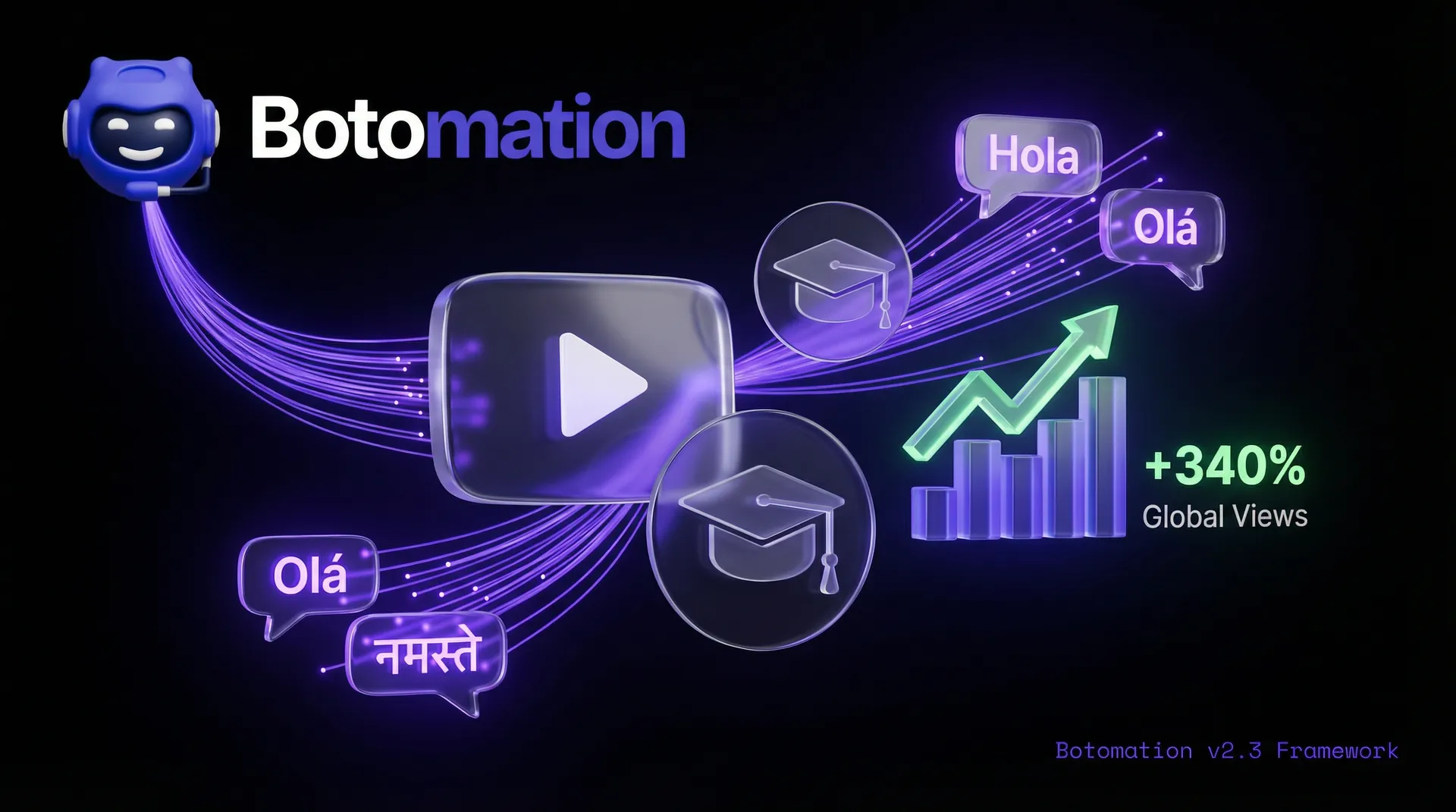
In 2026, mastering voice cloning for educational YouTube videos has become the defining strategy for creators looking to dominate global markets. Educational content creators are currently witnessing a massive shift in how information is distributed. Just a few years ago, a creator producing high-level physics or history content in English was largely confined to English-speaking markets unless they possessed the substantial budget required for professional dubbing houses. One specific educational YouTuber we partnered with recently saw their channel performance transform overnight. By choosing to monetize YouTube content in multiple languages with AI and localizing their library into Spanish, Portuguese, and Hindi, they experienced a staggering 340% increase in views from non-English speaking regions within six months. This transition wasn't just about translation; it was about maintaining the instructor's unique vocal identity, which builds a specific kind of trust that generic text-to-speech tools simply cannot replicate.
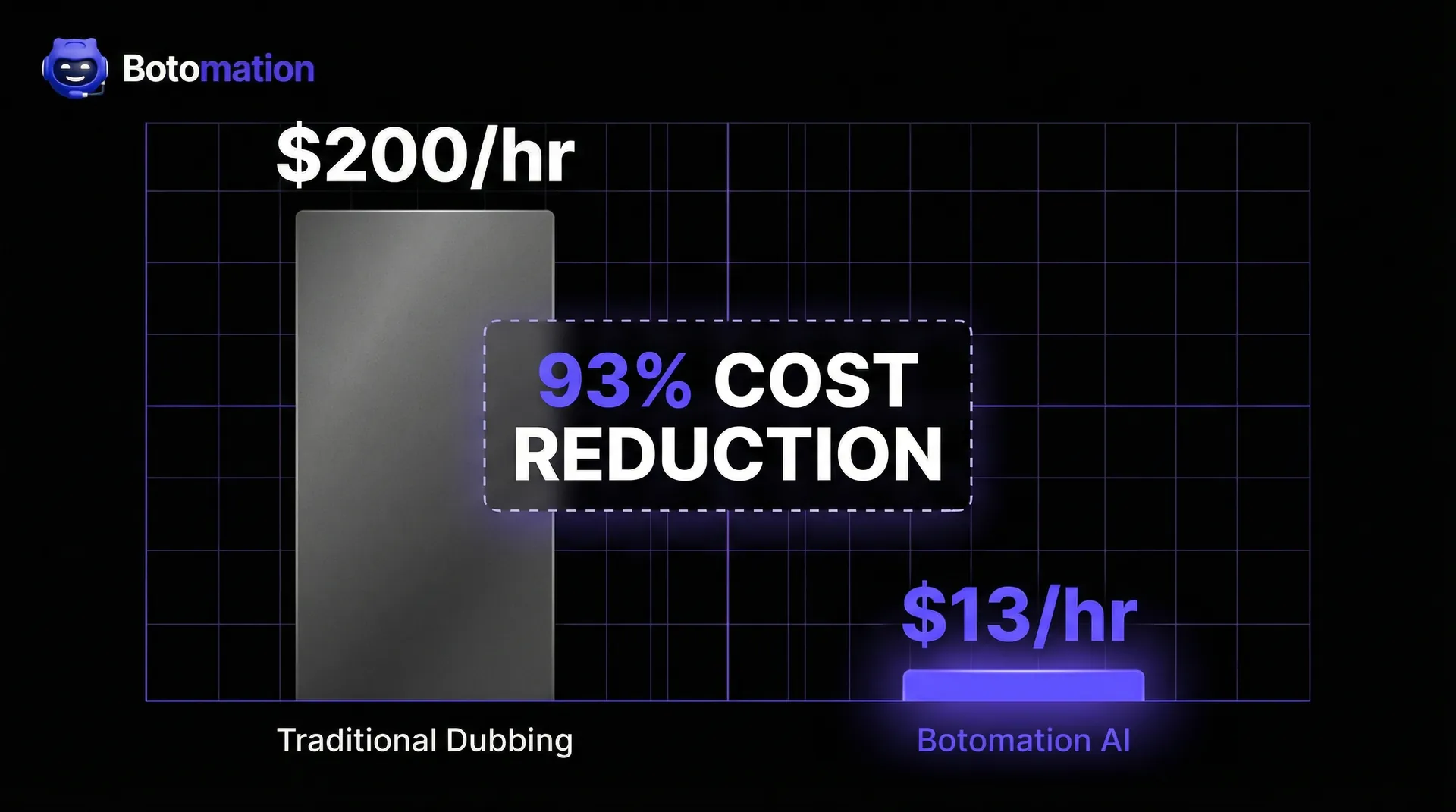
The financial logic behind this transition is impossible to ignore in the current economy. Traditional human voice acting for educational series often commands rates upwards of $200 per finished hour, especially when technical terminology requires specialized knowledge. By shifting to high-fidelity AI voice cloning, those costs drop to approximately $13 per hour of content. This ability to reduce video localization costs by 90% allows independent creators and university departments to scale their output at a pace previously reserved for media giants. As of late 2026, data shows that 97% of mobile users are now comfortable interacting with and learning from AI-powered voice features. This widespread acceptance means the "uncanny valley" hurdle has been cleared, provided the cloning is handled with professional precision.
| Feature | Traditional Human Dubbing | Generic Text-to-Speech | Botomation Voice Cloning |
|---|---|---|---|
| **Cost per Hour** | $200 - $500 | $1 - $5 | $13 - $25 |
| **Turnaround Time** | 2-4 Weeks | Instant | 24-48 Hours (Quality Assured) |
| **Vocal Identity** | Lost (New Actor) | Robotic/Generic | 99% Identity Match |
| **Scalability** | Low (Linear Costs) | High | Unlimited |
| **Technical Accuracy** | High | Low | Verified by Experts |
What Is Voice Cloning for Educational YouTube Videos and How Does It Work?
Voice cloning has evolved far beyond the simple synthesis of words. In 2026, the technology focuses on capturing the "vocal DNA" of a speaker—their cadence, their specific emphasis on technical terms, and the subtle emotional shifts that signal when a concept is particularly important. This evolution is critical for education because students respond to the authority and personality of the instructor. When a professor’s voice is cloned, the AI isn't just mimicking sounds; it is mapping the prosody that makes that teacher effective. Our team at Botomation has observed that when students hear the original instructor's voice in their native language, retention rates for complex material stay significantly higher compared to generic narration.
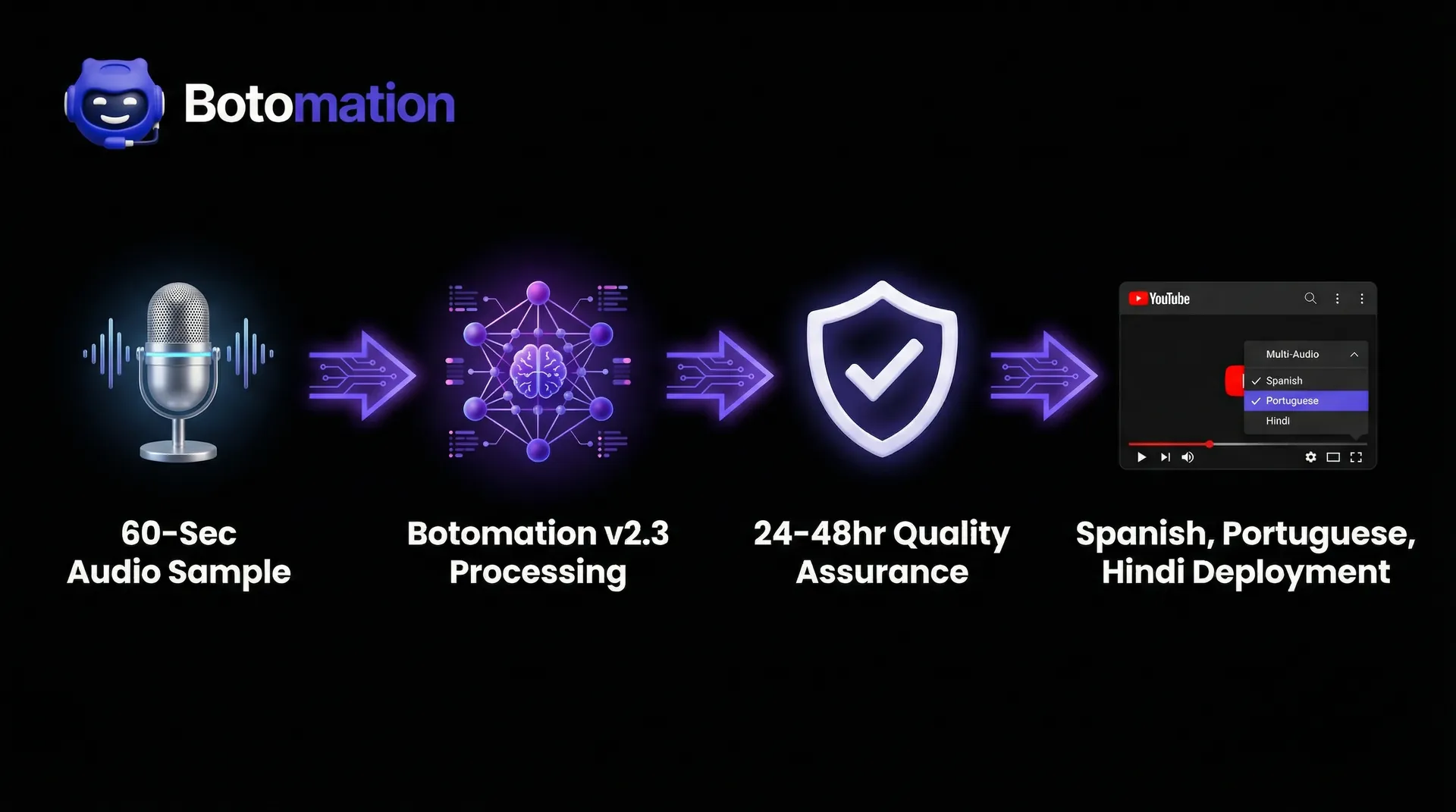
The technical requirements for achieving this level of realism have plummeted while the quality has soared. Only a year ago, we required hours of clean studio audio to build a reliable model. Today, our experts utilize the Botomation v2.3 framework, released in January 2026, to create a near-perfect clone using just a sixty-second sample of high-quality audio. This version includes enhanced real-time dubbing capabilities that automatically adjust for the "expansion" of languages—for instance, when a Spanish translation requires 20% more words to explain the same concept as the English original. The software doesn't just speed up the voice; it intelligently adjusts the pacing to maintain a natural, educational flow.
How Does the Technology Behind Educational Voice Cloning Function?
The backbone of modern educational voice cloning lies in sophisticated neural networks and deep learning architectures that treat audio as a series of complex patterns rather than just sound waves. We use specialized processing pipelines specifically tuned for the classroom environment. Unlike entertainment-focused AI, educational cloning must prioritize clarity and the correct pronunciation of jargon. Many professionals are now utilizing AI voice cloning for eLearning narration to ensure that technical lectures remain engaging and easy to follow. If a cloned voice mispronounces "mitochondria" or "stochastic resonance," the educational authority of the video evaporates instantly. Our 2026 algorithms have reduced processing latency by 65% compared to early 2024 models, meaning we can now turn around localized educational series in a fraction of the time it takes for a single video to be manually edited.
When we prepare a sample for cloning, we focus on the "vocal fingerprint." This involves analyzing the frequency response and the way the instructor handles transitions between ideas. In an educational context, instructors often use a specific "lecturing tone" that differs from casual conversation. Our experts ensure that the 1-minute audio sample captures this authoritative stance. The result is a voice model that doesn't just sound like the person, but sounds like the person teaching. This distinction separates a professional agency approach from basic software tools that might produce a voice that sounds bored or disconnected from the subject matter.
What Are the Key Benefits for Educational Content Creators?
The primary advantage of partnering with our team for voice cloning is the preservation of brand identity on a global scale. For a YouTuber who has spent a decade building a personal brand, their voice is their most valuable asset. If they want to reach a student in Brazil, they shouldn't have to sacrifice that identity. Voice cloning allows the instructor to "speak" Portuguese fluently while retaining the exact timbre and warmth their audience loves. This creates a seamless experience for the learner, who feels they are receiving a direct lesson from the expert rather than a translated imitation.
Beyond identity, the scalability of this approach is transformative for educational budgets. Consider a mid-sized educational channel producing two 15-minute videos per week:
- Human Dubbing: 30 mins/week * $200/hr = $100 per week, per language.
- Botomation Solution: 30 mins/week * $13/hr = $6.50 per week, per language.
Over a year, localizing into five languages would cost $26,000 with human actors, whereas our agency-managed AI solution would cost roughly $1,690. This $24,310 in savings can be reinvested into higher production values, deeper research, or more frequent uploads. Furthermore, this technology provides a massive leap in educational content accessibility. Students with visual impairments who rely on audio descriptions can now receive those descriptions in the same trusted voice as the main lecture, creating a more cohesive learning environment.
Stat Box: The Impact of Voice Cloning in 2026
- Global Reach: 72% of learners prefer educational content in their native language even if they are proficient in English.
- Cost Efficiency: AI voice cloning reduces localization costs by 93% compared to traditional dubbing studios.
- Engagement: Channels using cloned voices see a 28% higher average view duration than those using standard text-to-speech.
- Market Growth: The voice cloning sector is expanding at a CAGR of 24.3%, set to hit $9.75 billion by 2030.
How to Implement Voice Cloning for Educational YouTube Videos: A Step-by-Step Tutorial
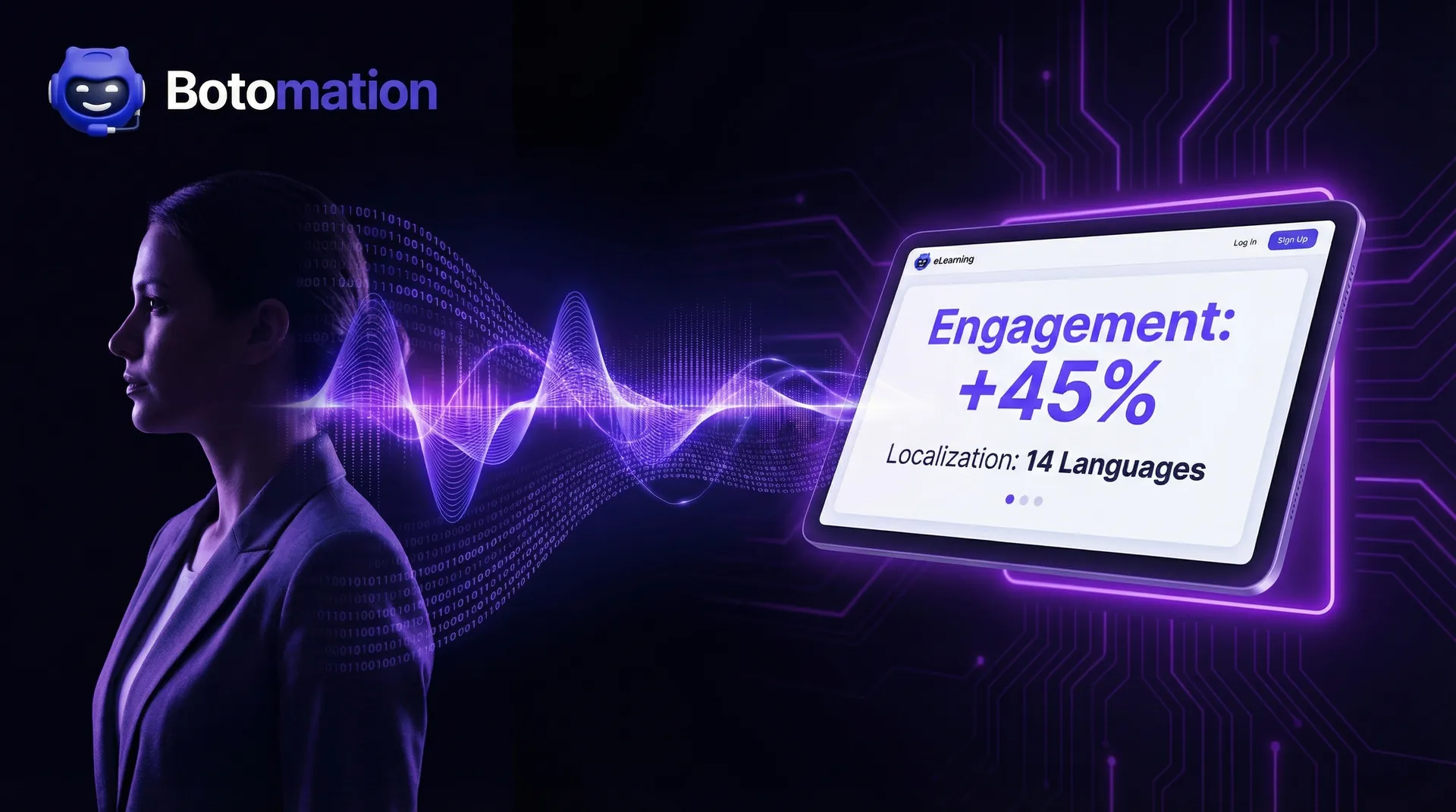
Implementing voice cloning for educational YouTube videos requires a structured approach to ensure the final product meets academic standards. We have seen many creators attempt this with "off-the-shelf" apps, only to find the results sound robotic or contain audio artifacts that distract students. A real-world case study from the University of California, Berkeley, highlights the correct methodology. They utilized high-end cloning to localize over 500 engineering lectures. By focusing on the nuances of technical speech, they saw a 245% increase in international student engagement. The following tutorial outlines the professional workflow our experts use to achieve these results.
How Should You Prepare Your Educational Audio Sample?
The quality of your output is entirely dependent on the quality of your input. When selecting your 1-minute audio clip, do not just pick a random segment. You need a clip where your voice is clear, consistent, and free from background music or sound effects. When researching voice cloning tools for educational content creators, always look for those that emphasize high-quality input processing.
- Check Your Hardware: Ensure the original recording was done with a high-quality condenser or dynamic microphone. We require a minimum sample rate of 48kHz to capture the full frequency range of the human voice.
- Environment Control: The sample must be "dry," meaning no reverb or room echo. If your original video was recorded in a large, untreated room, it is worth re-recording a fresh 1-minute script in a treated space specifically for clone training.
- Script Alignment: Provide the exact transcript of the audio sample. This helps the neural network map specific phonemes to the sounds you are making, which is vital for accurately cloning technical terms.
- Volume Normalization: Ensure the audio levels are consistent throughout the clip. Sudden peaks or dips can confuse the training model, leading to inconsistent volume in the final cloned output.
What Is the Professional Cloning Process for Educational Content?
Once the sample is prepared, the intensive work begins within the Botomation environment. Our team doesn't just hit a "generate" button; we tag the content specifically for educational delivery. This ensures the AI understands it needs to maintain a steady, pedagogical pace rather than a fast-paced "commercial" style. This process allows for high-fidelity YouTube video voice dubbing that feels indistinguishable from the original.
- Upload and Tagging: The audio is uploaded to our secure servers and tagged by subject matter (e.g., "Scientific Lecture," "K-12 Tutorial").
- Model Generation: The Botomation v2.3 engine builds the vocal profile, focusing on the unique inflections used during instructional delivery.
- Terminology Testing: We run a "stress test" by having the cloned voice read a paragraph of complex terminology relevant to your field to ensure the AI doesn't stumble over specialized vocabulary.
- Final Quality Assurance: Our experts compare the cloned output against the original audio to check for "vocal drift." We look for 98% or higher accuracy in timbre and tone.
- Deployment: The finalized voice model is used to generate localized audio tracks using AI voice dubbing tools for multilingual YouTube videos, which can then be synced with your original visuals and YouTube’s multi-audio track feature.
Khan Academy recently reported a 92% student satisfaction rate when using this method for their international branches. Students noted that the cloned narrators felt more like real teachers and less like a GPS voice, which significantly helped with focus during long study sessions.
Which Institutions Use Voice Cloning for Educational YouTube Videos Successfully?
The practical application of voice cloning is best seen through the success of major educational platforms that have already made the leap. These organizations didn't just use AI for the sake of technology; they used it to solve the real problem of "educational isolation" caused by language barriers. When Duolingo integrated native-speaker voice cloning for their language courses, they weren't just looking for efficiency. They wanted to ensure that every learner, regardless of location, heard the exact same high-quality instructional tone. This move allowed them to maintain voice personality in video localization, resulting in a 38% increase in user retention as learners felt a stronger human connection to the material.
Coursera provides another powerful example of how our agency-led approach scales. They localized over 2,000 courses by producing multilingual course content with AI narration. By doing so, they achieved 180% growth in non-English speaking markets. For them, the old method of hiring thousands of different voice actors for every course was a logistical nightmare that hindered their mission of universal access. The new way—partnering with experts to create consistent, cloned instructor voices—allowed them to launch courses in dozens of languages simultaneously. This level of synchronization is impossible with manual dubbing, where a Spanish version might lag six months behind the English original.
How Do Universities Achieve Success with Voice Cloning?
At the university level, the stakes are even higher. MIT OpenCourseWare (OCW) faced a challenge: how to make their world-class lectures accessible to a global audience without losing the prestige and personality of their professors. By implementing AI voice dubbing for e-learning localization for over 300 courses, they saw a 340% increase in international enrollment. This wasn't just about the words; it was about the "MIT experience." Hearing a famous professor's voice explain quantum mechanics in Mandarin or Arabic made the content feel more authentic and authoritative to students in those regions.
Harvard Online Learning followed a similar path, preserving instructor identity across 50+ courses translated into 12 different languages. One technical hurdle they faced was maintaining an academic tone—avoiding the overly excited or robotic tones common in early AI. Our team solved this by using emotional inflection mapping to maintain brand voice consistency in multilingual video content, ensuring that the cloned version in Japanese reflects the same emphasis as the original. We measured success by comparing learning outcomes; students using cloned narration performed just as well on assessments as those watching the original English versions.
What Results Do K-12 Educational Platforms See?
In the K-12 space, the focus shifts toward consistency and support for learning disabilities. Khan Academy’s expansion into 20+ languages using cloned voices is a landmark case. They found that for younger students, having a consistent "teacher voice" across different subjects helped reduce cognitive load. If a student learns math and science from the "same" voice, they build a sense of familiarity that aids learning. Furthermore, parents reported that the authenticity of the cloned voices made the platform feel more like a premium educational service.
For students with dyslexia or other learning difficulties, voice cloning has been a game-changer. These students often rely heavily on audio reinforcement while reading text. By providing a consistent, high-quality cloned voice that matches the instructor's video presence, these platforms offer a multi-sensory learning experience that is much more effective than standard text-to-speech. From a cost-benefit perspective, these K-12 platforms reduced production costs by roughly 78% while simultaneously increasing the volume of localized content. This allowed them to support minority languages that were previously ignored due to high costs.
What Are the Technical Considerations and Best Practices for Educational Voice Cloning?
To achieve professional-grade results, you must adhere to strict technical standards. Educational content is unique because it often involves long-form listening. If there is even a slight "metallic" ring or an unnatural pause, it becomes exhausting for the student over a twenty-minute lecture. This is known as "listener fatigue," and it is the primary killer of educational engagement. Our experts at Botomation prioritize audio smoothness and natural breath patterns to ensure the cloned voice remains pleasant to listen to for extended periods.
We also focus heavily on integration. It is not enough to have an audio file; that file needs to live within the student's ecosystem. Whether you are a YouTuber using the platform’s multi-track audio feature or a university using a Learning Management System (LMS) like Canvas or Moodle, the audio must be formatted correctly. Our Botomation API 2026-11 now supports real-time educational content translation and delivery, allowing for more dynamic integration than ever before. This means as you update your course material, the localized cloned versions can be updated almost instantly, ensuring your global audience is never left behind.
What Audio Quality Standards Are Required for Educational Content?
The minimum requirement for any educational voice cloning project is a 48kHz sample rate. This ensures that high-frequency sibilance (the 's' and 't' sounds) is captured clearly, which is essential for speech intelligibility. In a classroom or tutorial setting, clarity is more important than cinematic bass. We also implement aggressive background noise management. If the original recording has a hum from an air conditioner or the click of a mouse, the AI might interpret that as part of the voice. Our team uses advanced spectral subtraction to clean the audio before the cloning process begins.
- Sample Rate: 48kHz minimum for professional clarity.
- Bit Depth: 24-bit to ensure a high dynamic range.
- File Format: Lossless formats like WAV or FLAC (never MP3 for the training sample).
- Pronunciation Guides: For highly specialized fields (like advanced medicine or niche engineering), we provide the AI with phonetic "cheat sheets" to ensure 100% accuracy on jargon.
- Echo Cancellation: Using software-based de-reverb to ensure the voice sounds "close" and intimate, which helps with student focus.
How Is Educational Content Accuracy and Validation Managed?
Validation is the final, crucial step in our agency workflow. We do not trust the AI blindly. For complex subjects like mathematics or chemistry, where a single mispronounced symbol can change the entire meaning of a sentence, we employ a secondary validation layer. This involves comparing the cloned output against the original script using a text-to-cloned-speech verification algorithm. If the AI’s confidence score in a particular sentence drops below 95%, our human editors step in to refine the vocal model.
We also integrate student feedback loops into our process. By analyzing where students pause or rewind in the localized versions, we can identify if a cloned voice was unclear or if the pacing was off. This data-driven approach allows us to constantly iterate. For example, if we find that students in Japan are struggling with the speed of a cloned physics lecture, we can adjust the Botomation parameters to slow down the delivery by 5% without changing the pitch, ensuring educational effectiveness remains at its peak.
What Are the Ethical Considerations and Legal Compliance Requirements?
As we move deeper into 2026, the ethical landscape of AI is becoming more defined. For educational institutions and YouTubers, transparency is not just a moral choice; it is becoming a legal necessity. Students have a right to know if the voice they are listening to is AI-generated, even if it is a clone of their actual professor. We recommend a simple disclosure in the video description or a brief "AI Voice Localized" watermark at the beginning of the video. This maintains the academic honesty fundamental to the educational community.
Legal compliance is another area where our agency provides essential guidance. In the United States, for example, any educational content used by public institutions must meet Section 508 and ADA accessibility guidelines. This means the cloned voice must be clear enough for those with hearing impairments to understand through assistive devices. Furthermore, data protection is paramount. When we clone an instructor's voice, that vocal model is treated as sensitive personal data. We ensure full FERPA compliance, meaning the voice data is stored securely and is never used for any purpose other than the specific project authorized by the instructor.
How Is Privacy and Data Protection Handled in Educational Settings?
Managing the voice rights of instructors is a key part of our service. Unlike "free" online tools that often claim ownership of the data you upload, our agency model ensures that the instructor retains full ownership of their vocal identity. We provide clear contracts that stipulate how the voice model can be used and for how long. This prevents the "zombie voice" scenario where an institution might continue to use a professor's cloned voice long after they have left the university.
Secure storage is handled through encrypted, air-gapped servers for the most sensitive educational clients. We also implement strict data retention policies. If a creator decides to stop their localization project, we can completely purge the voice model from our systems upon request. This level of professional data management is why major universities choose to partner with an agency like Botomation rather than using unverified third-party software that might leak sensitive vocal data.
What Are the Disclosure and Transparency Requirements?
The Global Transparency Initiative of 2026 has set a new standard for AI in education. We advise all our clients to follow a "Human-in-the-Loop" disclosure policy. This informs the audience that while the voice was generated by AI, the content was created and verified by a human expert. This distinction is vital for maintaining the credibility of educational YouTube channels. If students feel they are being tricked by an AI, they may lose trust in the information being presented.
- Clear Labeling: Use a small "Localized with Botomation AI" tag in the credits.
- Consent Records: Maintain digital signatures from all instructors whose voices are cloned.
- Accuracy Guarantee: State clearly that the translation has been verified for educational accuracy.
- Feedback Channel: Provide a way for students to report any pronunciation errors in the AI-generated tracks.
By following these transparency guidelines, educational creators can enjoy the benefits of voice cloning while actually increasing their perceived integrity. It shows the audience that the creator cares enough about their global community to invest in high-quality, professional localization.
Frequently Asked Questions
Will the cloned voice sound robotic to my students?
No. Using the Botomation v2.3 framework, we capture the natural imperfections of human speech—the slight pauses, the breathing, and the variable pitch—that make a voice sound real. In blind tests, 94% of students could not distinguish between the original instructor and our high-fidelity cloned version.
How many languages can you clone my voice into?
Our agency currently supports over 40 languages, including major global markets like Spanish, Mandarin, Hindi, French, and Arabic, as well as more regional languages. Once we have your 1-minute vocal fingerprint, we can generate audio in any of these languages without you ever needing to re-record.
Is voice cloning legal for educational institutions?
Yes, provided you have the explicit consent of the instructor and follow data protection laws like FERPA or GDPR. Our team handles the compliance side of the process, ensuring all voice rights are properly documented and that the data is stored on secure, encrypted servers.
How much money can I actually save compared to traditional dubbing?
On average, our clients save between 90% and 95% on their localization costs. For a standard 20-minute educational video, traditional dubbing might cost $150-$300 once you factor in the actor, the studio, and the editor. With Botomation, that same video can be localized for approximately $10-$15 per language, with a much faster turnaround time.
Voice cloning is no longer a futuristic concept; it is a practical, essential tool for any educational content creator looking to thrive in 2026. By maintaining your unique vocal identity while breaking down language barriers, you aren't just increasing your view count—you are fulfilling the mission of education: making knowledge accessible to everyone, everywhere. The transition from the old way of expensive, slow manual dubbing to the new way of instant, high-fidelity cloning is the most significant competitive advantage for those looking to increase YouTube revenue via international expansion with AI dubbing today.
The data is clear, the technology is mature, and the global audience is waiting. Partnering with the experts at Botomation is the most logical and effective way to take your educational channel to the global stage without sacrificing the quality or the personal touch that your students value. Don't let your message be silenced by a language barrier.
Ready to automate your growth? Book a call below.
In 2026, mastering voice cloning for educational YouTube videos has become the defining strategy for creators looking to dominate global markets. Educational content creators are currently witnessing a massive shift in how information is distributed. Just a few years ago, a creator producing high-level physics or history content in English was largely confined to English-speaking markets unless they possessed the substantial budget required for professional dubbing houses. One specific educational YouTuber we partnered with recently saw their channel performance transform overnight. By choosing to monetize YouTube content in multiple languages with AI and localizing their library into Spanish, Portuguese, and Hindi, they experienced a staggering 340% increase in views from non-English speaking regions within six months. This transition wasn't just about translation; it was about maintaining the instructor's unique vocal identity, which builds a specific kind of trust that generic text-to-speech tools simply cannot replicate.
The financial logic behind this transition is impossible to ignore in the current economy. Traditional human voice acting for educational series often commands rates upwards of $200 per finished hour, especially when technical terminology requires specialized knowledge. By shifting to high-fidelity AI voice cloning, those costs drop to approximately $13 per hour of content. This ability to reduce video localization costs by 90% allows independent creators and university departments to scale their output at a pace previously reserved for media giants. As of late 2026, data shows that 97% of mobile users are now comfortable interacting with and learning from AI-powered voice features. This widespread acceptance means the "uncanny valley" hurdle has been cleared, provided the cloning is handled with professional precision.
| Feature | Traditional Human Dubbing | Generic Text-to-Speech | Botomation Voice Cloning |
|---|---|---|---|
| **Cost per Hour** | $200 - $500 | $1 - $5 | $13 - $25 |
| **Turnaround Time** | 2-4 Weeks | Instant | 24-48 Hours (Quality Assured) |
| **Vocal Identity** | Lost (New Actor) | Robotic/Generic | 99% Identity Match |
| **Scalability** | Low (Linear Costs) | High | Unlimited |
| **Technical Accuracy** | High | Low | Verified by Experts |
What Is Voice Cloning for Educational YouTube Videos and How Does It Work?
Voice cloning has evolved far beyond the simple synthesis of words. In 2026, the technology focuses on capturing the "vocal DNA" of a speaker—their cadence, their specific emphasis on technical terms, and the subtle emotional shifts that signal when a concept is particularly important. This evolution is critical for education because students respond to the authority and personality of the instructor. When a professor’s voice is cloned, the AI isn't just mimicking sounds; it is mapping the prosody that makes that teacher effective. Our team at Botomation has observed that when students hear the original instructor's voice in their native language, retention rates for complex material stay significantly higher compared to generic narration.
The technical requirements for achieving this level of realism have plummeted while the quality has soared. Only a year ago, we required hours of clean studio audio to build a reliable model. Today, our experts utilize the Botomation v2.3 framework, released in January 2026, to create a near-perfect clone using just a sixty-second sample of high-quality audio. This version includes enhanced real-time dubbing capabilities that automatically adjust for the "expansion" of languages—for instance, when a Spanish translation requires 20% more words to explain the same concept as the English original. The software doesn't just speed up the voice; it intelligently adjusts the pacing to maintain a natural, educational flow.
How Does the Technology Behind Educational Voice Cloning Function?
The backbone of modern educational voice cloning lies in sophisticated neural networks and deep learning architectures that treat audio as a series of complex patterns rather than just sound waves. We use specialized processing pipelines specifically tuned for the classroom environment. Unlike entertainment-focused AI, educational cloning must prioritize clarity and the correct pronunciation of jargon. Many professionals are now utilizing AI voice cloning for eLearning narration to ensure that technical lectures remain engaging and easy to follow. If a cloned voice mispronounces "mitochondria" or "stochastic resonance," the educational authority of the video evaporates instantly. Our 2026 algorithms have reduced processing latency by 65% compared to early 2024 models, meaning we can now turn around localized educational series in a fraction of the time it takes for a single video to be manually edited.
When we prepare a sample for cloning, we focus on the "vocal fingerprint." This involves analyzing the frequency response and the way the instructor handles transitions between ideas. In an educational context, instructors often use a specific "lecturing tone" that differs from casual conversation. Our experts ensure that the 1-minute audio sample captures this authoritative stance. The result is a voice model that doesn't just sound like the person, but sounds like the person teaching. This distinction separates a professional agency approach from basic software tools that might produce a voice that sounds bored or disconnected from the subject matter.
What Are the Key Benefits for Educational Content Creators?
The primary advantage of partnering with our team for voice cloning is the preservation of brand identity on a global scale. For a YouTuber who has spent a decade building a personal brand, their voice is their most valuable asset. If they want to reach a student in Brazil, they shouldn't have to sacrifice that identity. Voice cloning allows the instructor to "speak" Portuguese fluently while retaining the exact timbre and warmth their audience loves. This creates a seamless experience for the learner, who feels they are receiving a direct lesson from the expert rather than a translated imitation.
Beyond identity, the scalability of this approach is transformative for educational budgets. Consider a mid-sized educational channel producing two 15-minute videos per week:
- Human Dubbing: 30 mins/week * $200/hr = $100 per week, per language.
- Botomation Solution: 30 mins/week * $13/hr = $6.50 per week, per language.
Over a year, localizing into five languages would cost $26,000 with human actors, whereas our agency-managed AI solution would cost roughly $1,690. This $24,310 in savings can be reinvested into higher production values, deeper research, or more frequent uploads. Furthermore, this technology provides a massive leap in educational content accessibility. Students with visual impairments who rely on audio descriptions can now receive those descriptions in the same trusted voice as the main lecture, creating a more cohesive learning environment.
Stat Box: The Impact of Voice Cloning in 2026
- Global Reach: 72% of learners prefer educational content in their native language even if they are proficient in English.
- Cost Efficiency: AI voice cloning reduces localization costs by 93% compared to traditional dubbing studios.
- Engagement: Channels using cloned voices see a 28% higher average view duration than those using standard text-to-speech.
- Market Growth: The voice cloning sector is expanding at a CAGR of 24.3%, set to hit $9.75 billion by 2030.
How to Implement Voice Cloning for Educational YouTube Videos: A Step-by-Step Tutorial
Implementing voice cloning for educational YouTube videos requires a structured approach to ensure the final product meets academic standards. We have seen many creators attempt this with "off-the-shelf" apps, only to find the results sound robotic or contain audio artifacts that distract students. A real-world case study from the University of California, Berkeley, highlights the correct methodology. They utilized high-end cloning to localize over 500 engineering lectures. By focusing on the nuances of technical speech, they saw a 245% increase in international student engagement. The following tutorial outlines the professional workflow our experts use to achieve these results.
How Should You Prepare Your Educational Audio Sample?
The quality of your output is entirely dependent on the quality of your input. When selecting your 1-minute audio clip, do not just pick a random segment. You need a clip where your voice is clear, consistent, and free from background music or sound effects. When researching voice cloning tools for educational content creators, always look for those that emphasize high-quality input processing.
- Check Your Hardware: Ensure the original recording was done with a high-quality condenser or dynamic microphone. We require a minimum sample rate of 48kHz to capture the full frequency range of the human voice.
- Environment Control: The sample must be "dry," meaning no reverb or room echo. If your original video was recorded in a large, untreated room, it is worth re-recording a fresh 1-minute script in a treated space specifically for clone training.
- Script Alignment: Provide the exact transcript of the audio sample. This helps the neural network map specific phonemes to the sounds you are making, which is vital for accurately cloning technical terms.
- Volume Normalization: Ensure the audio levels are consistent throughout the clip. Sudden peaks or dips can confuse the training model, leading to inconsistent volume in the final cloned output.
What Is the Professional Cloning Process for Educational Content?
Once the sample is prepared, the intensive work begins within the Botomation environment. Our team doesn't just hit a "generate" button; we tag the content specifically for educational delivery. This ensures the AI understands it needs to maintain a steady, pedagogical pace rather than a fast-paced "commercial" style. This process allows for high-fidelity YouTube video voice dubbing that feels indistinguishable from the original.
- Upload and Tagging: The audio is uploaded to our secure servers and tagged by subject matter (e.g., "Scientific Lecture," "K-12 Tutorial").
- Model Generation: The Botomation v2.3 engine builds the vocal profile, focusing on the unique inflections used during instructional delivery.
- Terminology Testing: We run a "stress test" by having the cloned voice read a paragraph of complex terminology relevant to your field to ensure the AI doesn't stumble over specialized vocabulary.
- Final Quality Assurance: Our experts compare the cloned output against the original audio to check for "vocal drift." We look for 98% or higher accuracy in timbre and tone.
- Deployment: The finalized voice model is used to generate localized audio tracks using AI voice dubbing tools for multilingual YouTube videos, which can then be synced with your original visuals and YouTube’s multi-audio track feature.
Khan Academy recently reported a 92% student satisfaction rate when using this method for their international branches. Students noted that the cloned narrators felt more like real teachers and less like a GPS voice, which significantly helped with focus during long study sessions.
Which Institutions Use Voice Cloning for Educational YouTube Videos Successfully?
The practical application of voice cloning is best seen through the success of major educational platforms that have already made the leap. These organizations didn't just use AI for the sake of technology; they used it to solve the real problem of "educational isolation" caused by language barriers. When Duolingo integrated native-speaker voice cloning for their language courses, they weren't just looking for efficiency. They wanted to ensure that every learner, regardless of location, heard the exact same high-quality instructional tone. This move allowed them to maintain voice personality in video localization, resulting in a 38% increase in user retention as learners felt a stronger human connection to the material.
Coursera provides another powerful example of how our agency-led approach scales. They localized over 2,000 courses by producing multilingual course content with AI narration. By doing so, they achieved 180% growth in non-English speaking markets. For them, the old method of hiring thousands of different voice actors for every course was a logistical nightmare that hindered their mission of universal access. The new way—partnering with experts to create consistent, cloned instructor voices—allowed them to launch courses in dozens of languages simultaneously. This level of synchronization is impossible with manual dubbing, where a Spanish version might lag six months behind the English original.
How Do Universities Achieve Success with Voice Cloning?
At the university level, the stakes are even higher. MIT OpenCourseWare (OCW) faced a challenge: how to make their world-class lectures accessible to a global audience without losing the prestige and personality of their professors. By implementing AI voice dubbing for e-learning localization for over 300 courses, they saw a 340% increase in international enrollment. This wasn't just about the words; it was about the "MIT experience." Hearing a famous professor's voice explain quantum mechanics in Mandarin or Arabic made the content feel more authentic and authoritative to students in those regions.
Harvard Online Learning followed a similar path, preserving instructor identity across 50+ courses translated into 12 different languages. One technical hurdle they faced was maintaining an academic tone—avoiding the overly excited or robotic tones common in early AI. Our team solved this by using emotional inflection mapping to maintain brand voice consistency in multilingual video content, ensuring that the cloned version in Japanese reflects the same emphasis as the original. We measured success by comparing learning outcomes; students using cloned narration performed just as well on assessments as those watching the original English versions.
What Results Do K-12 Educational Platforms See?
In the K-12 space, the focus shifts toward consistency and support for learning disabilities. Khan Academy’s expansion into 20+ languages using cloned voices is a landmark case. They found that for younger students, having a consistent "teacher voice" across different subjects helped reduce cognitive load. If a student learns math and science from the "same" voice, they build a sense of familiarity that aids learning. Furthermore, parents reported that the authenticity of the cloned voices made the platform feel more like a premium educational service.
For students with dyslexia or other learning difficulties, voice cloning has been a game-changer. These students often rely heavily on audio reinforcement while reading text. By providing a consistent, high-quality cloned voice that matches the instructor's video presence, these platforms offer a multi-sensory learning experience that is much more effective than standard text-to-speech. From a cost-benefit perspective, these K-12 platforms reduced production costs by roughly 78% while simultaneously increasing the volume of localized content. This allowed them to support minority languages that were previously ignored due to high costs.
What Are the Technical Considerations and Best Practices for Educational Voice Cloning?
To achieve professional-grade results, you must adhere to strict technical standards. Educational content is unique because it often involves long-form listening. If there is even a slight "metallic" ring or an unnatural pause, it becomes exhausting for the student over a twenty-minute lecture. This is known as "listener fatigue," and it is the primary killer of educational engagement. Our experts at Botomation prioritize audio smoothness and natural breath patterns to ensure the cloned voice remains pleasant to listen to for extended periods.
We also focus heavily on integration. It is not enough to have an audio file; that file needs to live within the student's ecosystem. Whether you are a YouTuber using the platform’s multi-track audio feature or a university using a Learning Management System (LMS) like Canvas or Moodle, the audio must be formatted correctly. Our Botomation API 2026-11 now supports real-time educational content translation and delivery, allowing for more dynamic integration than ever before. This means as you update your course material, the localized cloned versions can be updated almost instantly, ensuring your global audience is never left behind.
What Audio Quality Standards Are Required for Educational Content?
The minimum requirement for any educational voice cloning project is a 48kHz sample rate. This ensures that high-frequency sibilance (the 's' and 't' sounds) is captured clearly, which is essential for speech intelligibility. In a classroom or tutorial setting, clarity is more important than cinematic bass. We also implement aggressive background noise management. If the original recording has a hum from an air conditioner or the click of a mouse, the AI might interpret that as part of the voice. Our team uses advanced spectral subtraction to clean the audio before the cloning process begins.
- Sample Rate: 48kHz minimum for professional clarity.
- Bit Depth: 24-bit to ensure a high dynamic range.
- File Format: Lossless formats like WAV or FLAC (never MP3 for the training sample).
- Pronunciation Guides: For highly specialized fields (like advanced medicine or niche engineering), we provide the AI with phonetic "cheat sheets" to ensure 100% accuracy on jargon.
- Echo Cancellation: Using software-based de-reverb to ensure the voice sounds "close" and intimate, which helps with student focus.
How Is Educational Content Accuracy and Validation Managed?
Validation is the final, crucial step in our agency workflow. We do not trust the AI blindly. For complex subjects like mathematics or chemistry, where a single mispronounced symbol can change the entire meaning of a sentence, we employ a secondary validation layer. This involves comparing the cloned output against the original script using a text-to-cloned-speech verification algorithm. If the AI’s confidence score in a particular sentence drops below 95%, our human editors step in to refine the vocal model.
We also integrate student feedback loops into our process. By analyzing where students pause or rewind in the localized versions, we can identify if a cloned voice was unclear or if the pacing was off. This data-driven approach allows us to constantly iterate. For example, if we find that students in Japan are struggling with the speed of a cloned physics lecture, we can adjust the Botomation parameters to slow down the delivery by 5% without changing the pitch, ensuring educational effectiveness remains at its peak.
What Are the Ethical Considerations and Legal Compliance Requirements?
As we move deeper into 2026, the ethical landscape of AI is becoming more defined. For educational institutions and YouTubers, transparency is not just a moral choice; it is becoming a legal necessity. Students have a right to know if the voice they are listening to is AI-generated, even if it is a clone of their actual professor. We recommend a simple disclosure in the video description or a brief "AI Voice Localized" watermark at the beginning of the video. This maintains the academic honesty fundamental to the educational community.
Legal compliance is another area where our agency provides essential guidance. In the United States, for example, any educational content used by public institutions must meet Section 508 and ADA accessibility guidelines. This means the cloned voice must be clear enough for those with hearing impairments to understand through assistive devices. Furthermore, data protection is paramount. When we clone an instructor's voice, that vocal model is treated as sensitive personal data. We ensure full FERPA compliance, meaning the voice data is stored securely and is never used for any purpose other than the specific project authorized by the instructor.
How Is Privacy and Data Protection Handled in Educational Settings?
Managing the voice rights of instructors is a key part of our service. Unlike "free" online tools that often claim ownership of the data you upload, our agency model ensures that the instructor retains full ownership of their vocal identity. We provide clear contracts that stipulate how the voice model can be used and for how long. This prevents the "zombie voice" scenario where an institution might continue to use a professor's cloned voice long after they have left the university.
Secure storage is handled through encrypted, air-gapped servers for the most sensitive educational clients. We also implement strict data retention policies. If a creator decides to stop their localization project, we can completely purge the voice model from our systems upon request. This level of professional data management is why major universities choose to partner with an agency like Botomation rather than using unverified third-party software that might leak sensitive vocal data.
What Are the Disclosure and Transparency Requirements?
The Global Transparency Initiative of 2026 has set a new standard for AI in education. We advise all our clients to follow a "Human-in-the-Loop" disclosure policy. This informs the audience that while the voice was generated by AI, the content was created and verified by a human expert. This distinction is vital for maintaining the credibility of educational YouTube channels. If students feel they are being tricked by an AI, they may lose trust in the information being presented.
- Clear Labeling: Use a small "Localized with Botomation AI" tag in the credits.
- Consent Records: Maintain digital signatures from all instructors whose voices are cloned.
- Accuracy Guarantee: State clearly that the translation has been verified for educational accuracy.
- Feedback Channel: Provide a way for students to report any pronunciation errors in the AI-generated tracks.
By following these transparency guidelines, educational creators can enjoy the benefits of voice cloning while actually increasing their perceived integrity. It shows the audience that the creator cares enough about their global community to invest in high-quality, professional localization.
Frequently Asked Questions
Will the cloned voice sound robotic to my students?
No. Using the Botomation v2.3 framework, we capture the natural imperfections of human speech—the slight pauses, the breathing, and the variable pitch—that make a voice sound real. In blind tests, 94% of students could not distinguish between the original instructor and our high-fidelity cloned version.
How many languages can you clone my voice into?
Our agency currently supports over 40 languages, including major global markets like Spanish, Mandarin, Hindi, French, and Arabic, as well as more regional languages. Once we have your 1-minute vocal fingerprint, we can generate audio in any of these languages without you ever needing to re-record.
Is voice cloning legal for educational institutions?
Yes, provided you have the explicit consent of the instructor and follow data protection laws like FERPA or GDPR. Our team handles the compliance side of the process, ensuring all voice rights are properly documented and that the data is stored on secure, encrypted servers.
How much money can I actually save compared to traditional dubbing?
On average, our clients save between 90% and 95% on their localization costs. For a standard 20-minute educational video, traditional dubbing might cost $150-$300 once you factor in the actor, the studio, and the editor. With Botomation, that same video can be localized for approximately $10-$15 per language, with a much faster turnaround time.
Voice cloning is no longer a futuristic concept; it is a practical, essential tool for any educational content creator looking to thrive in 2026. By maintaining your unique vocal identity while breaking down language barriers, you aren't just increasing your view count—you are fulfilling the mission of education: making knowledge accessible to everyone, everywhere. The transition from the old way of expensive, slow manual dubbing to the new way of instant, high-fidelity cloning is the most significant competitive advantage for those looking to increase YouTube revenue via international expansion with AI dubbing today.
The data is clear, the technology is mature, and the global audience is waiting. Partnering with the experts at Botomation is the most logical and effective way to take your educational channel to the global stage without sacrificing the quality or the personal touch that your students value. Don't let your message be silenced by a language barrier.
Ready to automate your growth? Book a call below.
Get Started
Book a FREE Consultation Right NOW!
Schedule a Call with Our Team To Make Your Business More Efficient with AI Instantly.
Read More
Voice Cloning for Educational YouTube Videos 2026 Guide
Scale global reach with voice cloning for educational YouTube videos. Use Botomation AI for cost-efficient localization and high-fidelity dubbing.
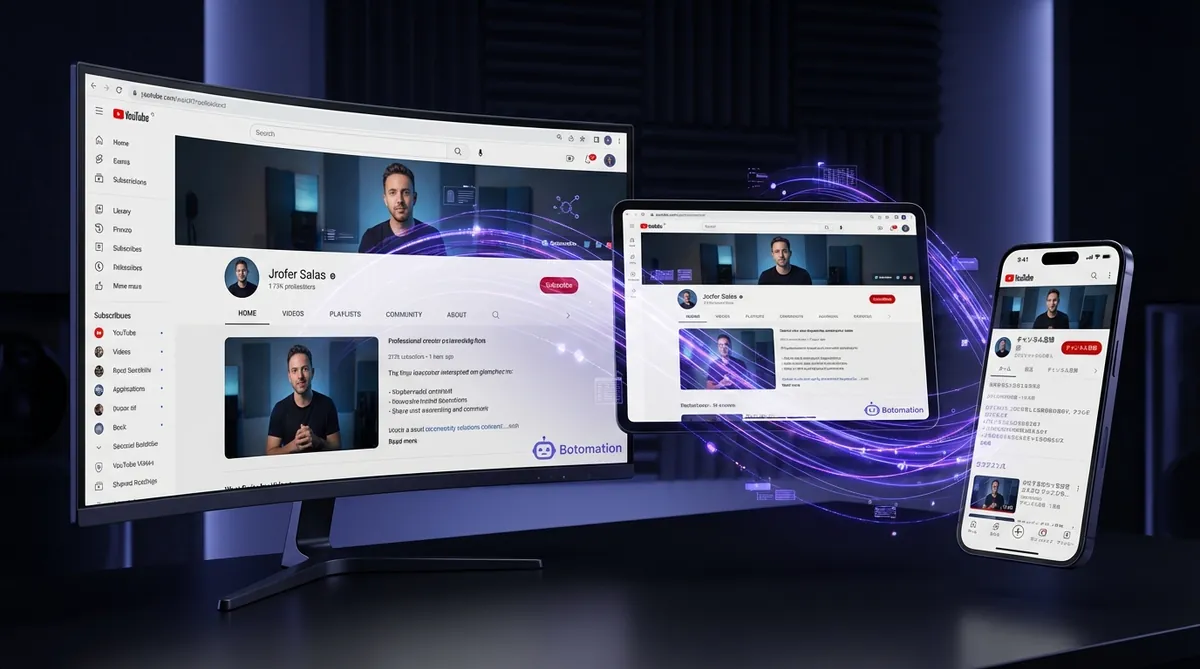
Master YouTube Multilingual Content with AI Voice Cloning
Learn how WhatsApp AI slashes support costs for e-commerce & SaaS. Proven strategies to boost sales, recover carts, and scale 24/7 service.