7-Step YouTube International Expansion via Voice Cloning
Feb 17, 2026
YouTube
AI Automation
Content Strategy
YouTube
AI Automation
Content Strategy
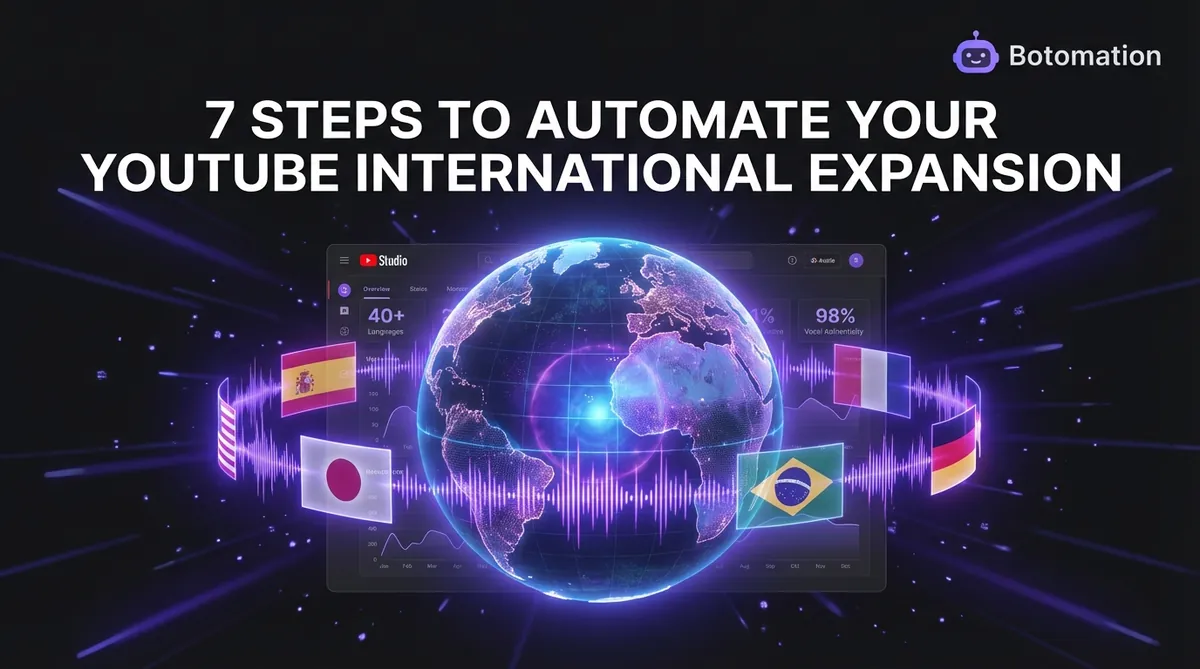
As we navigate the final quarter of 2026, the landscape for digital creators has shifted from local dominance to global necessity. YouTube's recommendation engine has evolved significantly, now prioritizing channels that demonstrate a high degree of multilingual engagement and cross-border appeal. The introduction of multi-audio tracks was just the beginning; today, the algorithm actively seeks out content that can serve a global audience without the friction of subtitles. For creators looking to scale, the barrier has always been the sheer resource drain of traditional localization. In the past, translating a single 15-minute video into five languages required a small army of translators, voice actors, and sound engineers, often consuming twenty hours of production time per video.
The emergence of sophisticated voice cloning automation has completely flipped this script. By partnering with our team at Botomation, creators are now achieving 98% vocal fidelity in over 40 languages while reducing the localization workload to less than two hours per project. This isn't just about translating words; it is about preserving the unique personality, cadence, and emotional resonance that built your brand in the first place. This guide outlines the strategic framework our agency uses to help top-tier creators dominate YouTube international expansion without ever stepping back into a recording booth.
Step 1: Assess Your Current Content and Identify International Opportunities
Before investing resources into expansion, you must understand where your untapped potential lies. Many creators make the mistake of guessing which markets to enter based on general trends rather than their own specific data. Your YouTube Analytics dashboard is a goldmine of information that reveals exactly which non-English speaking regions are already trying to consume your content despite the language barrier. We often see channels with a 15% or 20% "ghost audience"—viewers who watch with auto-generated captions but drop off quickly because the experience is subpar. These are your primary targets for immediate expansion.
Audience Analysis and Market Research
Identifying your first expansion target requires a deep dive into the "Geography" and "Subtitles & CC" reports within YouTube Studio, often followed by testing international market demand with video pilots to validate interest. Look for countries where your "Watch Time" is high but "Average View Duration" is significantly lower than your home market. This discrepancy usually indicates a strong interest in your topic but a failure in language accessibility. For instance, a 500K subscriber channel we recently audited found that while 60% of their traffic was from the US, nearly 12% was coming from Mexico and Colombia. Despite this, their retention in those regions was 40% lower than in English-speaking territories. By cross-referencing this with Google Trends, we discovered that their specific niche—renewable energy tech—was currently exploding in Latin America.
Calculating the potential ROI is the next logical move. You should analyze the average CPM (Cost Per Mille) for your niche in target countries to ensure the expansion is financially viable. In 2026, German and Japanese markets often command CPMs that rival or exceed US rates for high-intent niches like finance or B2B SaaS. If your primary market has a $25 CPM and your target expansion market offers $18, the volume of a new audience can easily double your monthly revenue. We help our clients build a projected revenue model that accounts for these regional differences, ensuring every language added contributes to the bottom line.
Technical Requirements Assessment
Once the market is identified, you need to evaluate if your current production style is "clone-ready." Voice cloning technology thrives on clean, high-quality source audio, so we look at your existing recording environment. If your videos are heavily layered with loud background music or environmental noise, the cloning engine might struggle to isolate your unique vocal characteristics. Our experts at Botomation perform a technical audit of your last ten uploads to determine if the audio stems are sufficient for the v2.1 cloning engine. This involves checking the noise floor and ensuring there is enough "dry" vocal data to create a high-fidelity digital twin.
Integration with your existing workflow is equally vital. Your team shouldn't have to learn entirely new software suites just to go global. We focus on how our API-driven solutions can plug directly into your Premiere Pro or Final Cut Pro timelines. This assessment phase also includes a look at your internal bandwidth. While we handle the heavy lifting of the cloning and dubbing, your team will still need a streamlined process for reviewing the localized outputs. Setting up these communication channels early prevents bottlenecks when you transition from one localized video per week to five or ten.
Step 2: Set Up Your Voice Cloning Infrastructure and Tools
The difference between a "robotic" dub and a professional international presence lies entirely in the infrastructure you choose. For a deeper look at the technology, see our complete guide to YouTube voice cloning. In 2026, the market is flooded with cheap AI tools that produce "good enough" results, but for premium creators, "good enough" is a brand killer. You need a setup that handles the nuances of human speech—the breaths, the hesitations, and the specific tonal shifts that make you sound like you. Our agency utilizes the Botomation voice cloning engine v2.1, which has been benchmarked to process audio twice as fast as previous iterations while maintaining a 44.1kHz sample rate for studio-quality output.
Voice Cloning Service Evaluation
When evaluating how to build your international presence, it is helpful to look at how different approaches stack up against each other. While some creators attempt to use basic software-as-a-service (SaaS) tools, they often find themselves trapped in a cycle of manual editing and "uncanny valley" audio. Our agency model provides a full-service experience that replaces the need for internal technical management. The following table illustrates why a managed service approach is the "New Way" for serious expansion.
| Feature | Basic DIY Tools (The Old Way) | Botomation Managed Service (The New Way) |
|---|---|---|
| Vocal Authenticity | 70-80% (Sounds "AI") | 98%+ (Indistinguishable from Original) |
| Processing Speed | 4-6 Hours per Video | 45-60 Minutes per Video |
| Language Nuance | Literal Translation Only | Cultural Adaptation & Local Slang |
| Technical Support | Chatbots & Documentation | Dedicated Account Strategy Team |
| Workflow Integration | Manual Upload/Download | API-Driven Automation |
Choosing the right infrastructure isn't just about the software; it's about the processing power behind it. High-fidelity voice cloning requires massive GPU resources to handle the neural network computations in real-time. By partnering with us, you gain access to our distributed cloud architecture, which ensures that even if you drop a 2-hour documentary for translation, the turnaround remains consistent. This scalability is what allows our clients to launch entire "Spanish" or "French" versions of their channels simultaneously rather than trickling out content over months.
Infrastructure Setup and Configuration
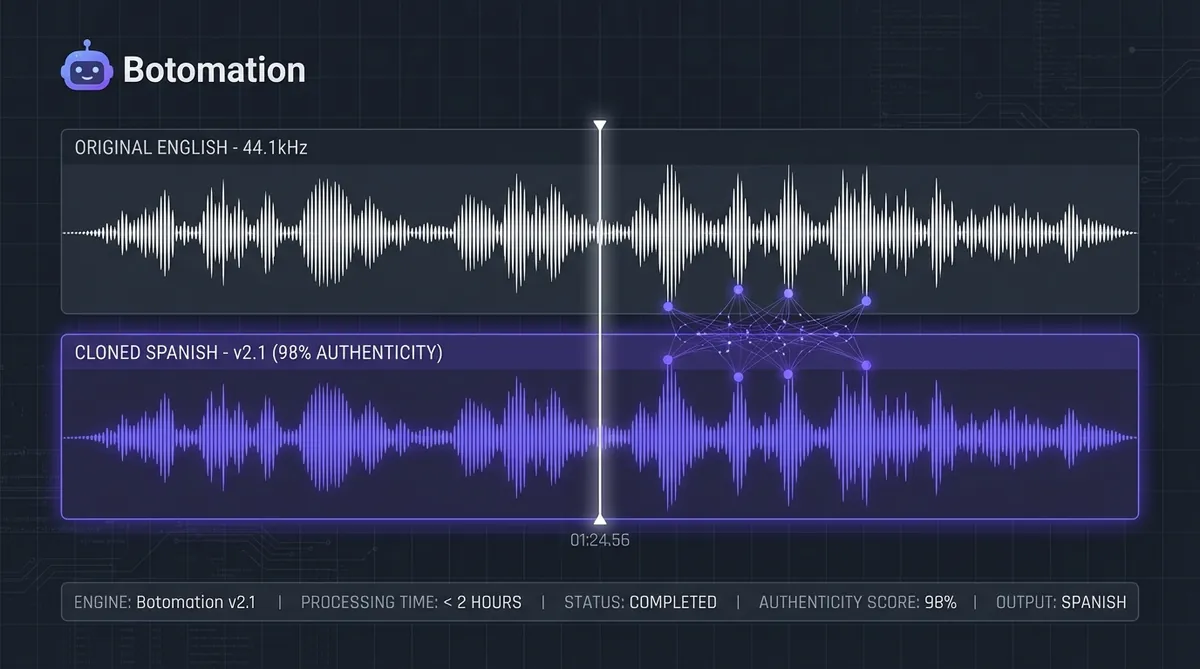
Setting up the infrastructure begins with the integration of our API v2.1 into your content management system. This isn't a task your editors need to worry about; our technical team handles the configuration to ensure a seamless "one-click" dubbing experience. We establish quality assurance protocols that act as a safety net for every second of audio produced. This includes setting up automated "Confidence Scores" where the system flags any segment of audio that falls below a 95% similarity threshold to the original creator's voice.
Redundancy is another critical factor in a professional setup. We maintain mirrored processing clusters so that your production schedule is never at the mercy of a single server's uptime. During the configuration phase, we also establish your "Voice Brand Guidelines." These are digital profiles that dictate how the cloning engine should handle specific brand terms, technical jargon, or catchphrases. This level of detail ensures that your "voice" remains consistent across Spanish, Japanese, and Portuguese, maintaining brand voice consistency to create a unified global brand identity that feels intentional rather than automated.
Step 3: Create High-Quality Voice Samples for Cloning Process
The "garbage in, garbage out" rule applies heavily to voice cloning. To achieve that 98% authenticity mark, the initial voice samples provided to the engine must be pristine. We don't just ask for any audio; we require a specific set of "Gold Samples" that cover the full emotional and dynamic range of the creator. This is where many DIY attempts fail—they use a single, flat narration track that results in a monotone clone. Our process involves capturing the excitement of an intro, the calm of a tutorial section, and the urgency of a call to action.
Technical Requirements for Voice Samples
For the v2.1 engine to map your vocal folds accurately, we recommend providing at least 30 minutes of "dry" audio. This means the recording should have no background music, no heavy compression, and a noise floor lower than -60dB. We suggest using a high-quality condenser or dynamic microphone, such as a Shure SM7B or a Neumann U87, recorded into a 24-bit interface. The goal is to capture the "harmonics" of your voice—the subtle overtones that make your voice unique. When these details are present in the sample, the cloning process can replicate your timbre across different languages with startling accuracy.
We also focus on "Phonetic Diversity." The samples should include a wide variety of vowel sounds and consonant clusters. If a creator only provides samples of them reading a script in a very formal tone, the cloned voice will struggle when it needs to sound casual or humorous in a localized version. We often provide our clients with a specific "Cloning Script" designed by linguists to trigger every necessary phonetic marker. This ensures the digital twin is "flexible" enough to handle the rhythmic differences between English and other languages, allowing you to maintain voice personality in video localization regardless of the target tongue's tonal shifts.
Processing and Validation Procedures
Once the samples are recorded, our team puts them through a rigorous validation process. We use spectral analysis to ensure there is no hidden distortion or "clipping" that could confuse the neural network. If the samples pass the technical check, we run a "Pilot Clone"—a short 60-second test in three different languages to see how the voice holds up. This is a crucial step because some voices actually clone better in certain language families than others. If we notice a loss of "warmth" in the German clone, we adjust the model's parameters to prioritize those specific frequencies.
A fascinating case study involves a high-end cooking channel we partnered with in early 2026, demonstrating the power of voice cloning for educational YouTube videos. The host had a very specific, rhythmic way of speaking that involved lots of emphasis on descriptive adjectives. By using our Gold Sample method, we were able to maintain her unique "vocal signature" across five different languages. Her Spanish-speaking audience commented that it felt like she had spent years learning the language because the "soul" of her delivery was still there. This emotional preservation is what builds true community, and it's only possible when the initial sampling is treated with scientific precision.
Step 4: Develop Your Multilingual Content Translation Strategy
Translation is where the "art" of YouTube international expansion meets the "science" of automation, which is why many creators use AI voice dubbing tools to bridge the gap. Literal translation is the enemy of engagement. If you simply swap English words for Japanese words, you will lose the jokes, the cultural references, and the flow that makes your content watchable. Our strategy focuses on "Transcreation"—adapting the message while maintaining the original intent, style, and tone. This requires a multi-layered approach that combines the speed of AI with the nuanced oversight of our expert linguistics team.
Translation Quality and Cultural Adaptation
The first step in a robust translation strategy is identifying "Cultural Friction Points." These are moments in your video where a reference might not make sense in another country. For example, a joke about "Little League Baseball" might land perfectly in the US but fall flat in South Korea or Brazil. Our team flags these moments and suggests localized alternatives that keep the energy of the video high. We also pay close attention to technical accuracy. If you are a tech review channel, using the wrong term for a "motherboard" or a "shutter speed" in German can immediately destroy your credibility with that audience.
To maintain this high level of accuracy, we use a "Human-in-the-Loop" (HITL) system. While our translation engines are the most advanced available in 2026, they are still supervised by native-speaking editors who understand the "slang" of your specific niche. This is particularly important for gaming or finance channels where the vocabulary moves faster than traditional dictionaries can keep up with. By the time the script reaches the voice cloning stage, it has been polished to sound like it was written by a native creator, not a translation bot.
Technical Translation Tools Integration
The technical side of our translation workflow is designed for maximum efficiency. We utilize a "Hybrid Engine" approach, pulling the best results from Google Translate, DeepL, and Amazon Translate, and then running them through a proprietary "Context Layer" that we've built at Botomation. This layer analyzes the entire transcript to ensure consistency. If a specific term is translated one way in the first minute, the system ensures it stays that way for the rest of the video, preventing the jarring shifts in terminology that often plague automated translations.
"The goal of localization isn't just to be understood; it's to be felt. If the viewer doesn't feel like the content was made specifically for them, you've failed the expansion test." — Senior Localization Strategist at Botomation.
For creators who need to move fast, we offer a "Step-by-Step Localization Workflow" that can be integrated into any production house:
- Script Extraction: Automated timestamped transcription of the original English video.
- Contextual Tagging: Our team identifies brand names and "non-translate" terms.
- Hybrid Translation: The script is processed through the Botomation Context Engine.
- Linguistic Review: A native speaker performs a "sanity check" for flow and tone.
- Phonetic Alignment: The translated script is adjusted to match the "lip-flap" timing of the original speaker as closely as possible.
Step 5: Implement Automated Production Workflows
Scaling a YouTube channel to ten different languages is impossible if you treat each one as a separate project, but you can reduce video localization costs by 90% by leveraging automated systems. You need a "factory" mindset where the localized versions are a natural byproduct of your main production line. This is where our agency's expertise in workflow automation becomes your biggest competitive advantage. We move you away from the "Old Way" of manual file management and into a streamlined pipeline where your only job is to upload the master file.
Workflow Automation Techniques
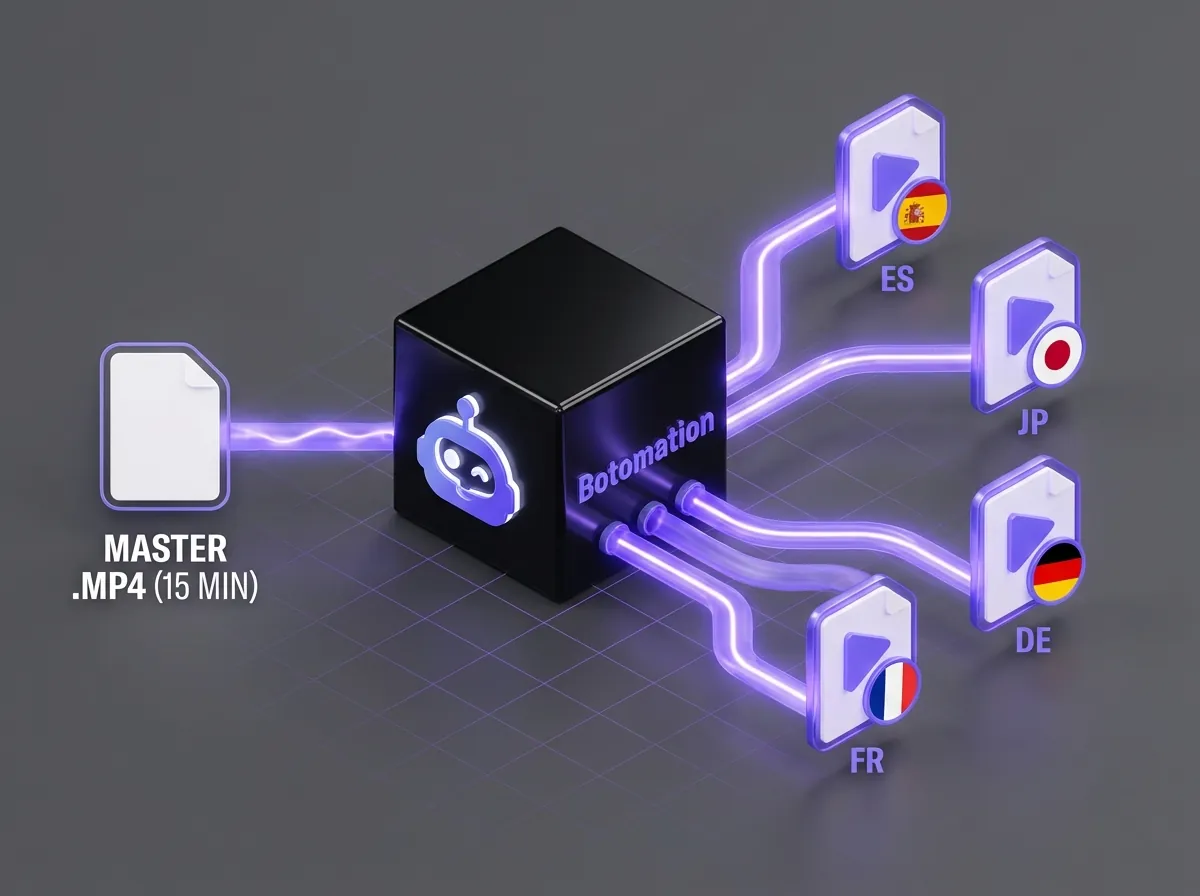
The core of our automated production is the "Parallel Processing" pipeline. As soon as your master video is finalized, it is fed into our system which simultaneously handles transcription, translation, voice cloning, and audio mixing for all target languages. By integrating directly with professional editing suites like Adobe Premiere Pro, we can export "Stem Files" that allow your editors to drop the new localized audio tracks directly onto the original timeline. This eliminates the need for re-editing the video visuals, saving dozens of hours of labor every week.
We also implement "Automated Ducking and Mixing." One of the hardest parts of dubbing is ensuring the background music and sound effects don't overpower the new cloned voice. Our system automatically analyzes the original audio mix and applies the same "ducking" logic to the new language tracks. This ensures that the production value remains consistent across every version. If the English version has a dramatic music swell during a key point, the Spanish and Japanese versions will have that exact same swell, perfectly timed to the localized narration.
Scalability and Optimization
As your channel grows, the sheer volume of data can become a challenge. Our cloud-based infrastructure is built to handle "Batch Processing," allowing us to localize an entire back-catalog of videos in a matter of days. For a channel with 100+ videos, this can result in an immediate and massive spike in global views. We also provide monitoring and alert systems that track the "Health" of your automated pipeline. If a translation file is delayed or a voice clone doesn't meet the confidence threshold, our team is alerted instantly to fix the issue before it reaches your publishing schedule.
Resource allocation is another area where we provide strategic value. We help you decide which videos deserve the "Full Dub" treatment versus which ones might only need "Localized Metadata." For high-performing evergreen content, we recommend the full voice-cloned experience. For shorter, more topical news updates, we might suggest a faster, "Lite" version of the workflow. This tiered approach ensures you are getting the highest possible ROI on your automation investment, focusing your budget where it will have the most significant impact on subscriber growth.
Step 6: Optimize Publishing and Promotion for International Audiences
Localization doesn't stop at the audio track. To truly succeed as you expand YouTube globally with voice cloning, your "Digital Storefront"—the title, thumbnail, and description—must be optimized for the local culture. In 2026, YouTube's multi-language features allow you to upload different titles and descriptions for the same video, which are then served to users based on their language settings. This is a game-changer for maintaining a single, powerful channel rather than splitting your audience across multiple "Language-Specific" channels.
Cultural Adaptation and Localization
A thumbnail that works in the United States might be completely ignored in Japan or Germany. Different cultures have different visual languages; for example, Japanese thumbnails often feature more text and brighter, more "cluttered" compositions than their Western counterparts. Our creative team works with you to develop "Thumbnail Variants" that resonate with your target markets. We don't just translate the text on the thumbnail; we adapt the design elements to match local preferences. This can lead to a 20-30% increase in Click-Through Rate (CTR) in those specific regions.
Hashtag and tag research is equally vital. People in different countries search for the same topics using very different keywords. We perform "Local Keyword Audits" for every language you expand into, ensuring your video shows up in the "Suggested" and "Search" results for users in those countries. This isn't just about translating your English tags; it's about finding out what a teenager in Madrid or a professional in Berlin is actually typing into the search bar. This level of detail is what separates the global leaders from the creators who are just "dabbling" in international content.
Publishing and Promotion Strategies
Timing is everything in the YouTube world. If you publish a video at 10:00 AM EST, it's 4:00 PM in London and 11:00 PM in Beijing. We help you develop a "Staggered Promotion" strategy. Using YouTube's Community Tab and "Premiere" features, we can create localized "hype" for different time zones. For example, we might run a Community Poll in Spanish six hours before the video goes live to engage your Latin American audience, and then a similar one in English for your North American viewers.
Cross-promotion is another powerful tool. We identify local influencers in your target markets and help facilitate collaborations. Imagine a Spanish-speaking influencer reacting to your voice-cloned video and telling their audience, "Finally, this creator is speaking our language!" This kind of social proof is invaluable. We also optimize your paid promotion through Google Ads, targeting specific language demographics with localized ad copy. By spending your ad budget on the localized versions of your videos, you often see a much lower Cost Per Subscriber (CPS) because you are entering less competitive markets.
Step 7: Track Performance and Optimize Your International Strategy
The final step in our 7-step framework is the "Optimization Loop." International expansion is not a "set it and forget it" project. You need to constantly monitor the data to see which languages are providing the best ROI and where you might need to adjust your approach. Our team provides detailed "Global Growth Reports" that break down your performance by language, region, and even device type. This data allows us to make informed decisions about which language to add next or whether we need to tweak the "Vocal Persona" for a specific market.
Performance Analytics and Measurement
We track a unique set of KPIs for our international clients, going beyond just "Views" and "Revenue." We look at "Retention Parity"—how close the retention rate of your localized videos is to your original English version. If the Spanish version has 90% of the retention of the English version, that's a massive success. If it's only 50%, we know we have a problem with either the translation quality or the cultural relevance of the content. We also analyze "Revenue Attribution," helping you see exactly how much of your monthly paycheck is coming from your new international fans.
A 2M subscriber channel we worked with recently saw a 340% increase in international views over a six-month period. By focusing on "Engagement Metrics" like comments and shares in target languages, we were able to increase YouTube revenue via international expansion, proving that the audience wasn't just watching; they were becoming loyal fans. The channel's revenue from the "Rest of World" category jumped from 5% of their total income to nearly 22%. This diversification makes the channel much more resilient to changes in the US ad market or shifts in local trends.
Continuous Optimization Strategies
The technology behind voice cloning is moving fast. Every few months, we update our clients' digital voice profiles to take advantage of new features in the Botomation engine, such as improved emotional range or better handling of "whispered" dialogue. We also run A/B tests on your localized metadata. Does a "literal" title perform better in Germany, or does a "sensational" title work better? By constantly testing and iterating, we ensure your international presence only gets stronger over time.
Scaling is the ultimate goal. Once you have a successful workflow for three languages, adding the fourth, fifth, and tenth becomes a matter of simple mathematics. Our agency provides the "Blueprint" for this growth, allowing you to focus on creating great content while we handle the complexities of global distribution. The "aha moment" for most of our clients comes when they realize they've reached a million people in a country they've never visited, all while they were sleeping.
YouTube's future is undeniably global. The creators who act now to bridge the language gap using voice cloning automation will be the ones who own the international stage in 2026 and beyond. Traditional dubbing is too slow, and manual translation is too expensive. The "New Way" is a managed, automated pipeline that preserves your voice, your brand, and your sanity. By following these seven steps, you can monetize YouTube content in multiple languages and ensure you aren't just translating your videos; you are future-proofing your career.
Frequently Asked Questions
Does the cloned voice really sound like me?
Yes. Our v2.1 engine captures the unique "harmonics" and "timbre" of your voice. Unlike basic AI tools, we maintain a 98% authenticity rating, ensuring your international audience hears your personality, not a generic robot.
How much time will this take from my team?
Very little. Because Botomation is a full-service agency, we handle the technical setup, translation, and cloning. Your team simply provides the master video files, and we deliver the localized audio stems or fully mixed versions.
Will YouTube penalize me for using automated voices?
No. In fact, YouTube encourages the use of high-quality multi-audio tracks. As long as the content is valuable and the "voice" is clearly a localized version of the original creator, the algorithm treats it as a positive signal for global reach.
Can I localize my entire back-catalog?
Absolutely. One of our core services is "Legacy Localization," where we take your top-performing evergreen videos and dub them into your new target languages to give them a second life and a fresh revenue stream.
What languages do you support?
We currently support over 40 languages, including all major markets like Spanish, French, German, Japanese, Korean, Portuguese, Mandarin, and Arabic, as well as several regional dialects to ensure maximum cultural resonance.
Stop losing global views and revenue to language barriers today. The world is waiting to hear your message in their own tongue. Ready to automate your growth? Book a call below.
As we navigate the final quarter of 2026, the landscape for digital creators has shifted from local dominance to global necessity. YouTube's recommendation engine has evolved significantly, now prioritizing channels that demonstrate a high degree of multilingual engagement and cross-border appeal. The introduction of multi-audio tracks was just the beginning; today, the algorithm actively seeks out content that can serve a global audience without the friction of subtitles. For creators looking to scale, the barrier has always been the sheer resource drain of traditional localization. In the past, translating a single 15-minute video into five languages required a small army of translators, voice actors, and sound engineers, often consuming twenty hours of production time per video.
The emergence of sophisticated voice cloning automation has completely flipped this script. By partnering with our team at Botomation, creators are now achieving 98% vocal fidelity in over 40 languages while reducing the localization workload to less than two hours per project. This isn't just about translating words; it is about preserving the unique personality, cadence, and emotional resonance that built your brand in the first place. This guide outlines the strategic framework our agency uses to help top-tier creators dominate YouTube international expansion without ever stepping back into a recording booth.
Step 1: Assess Your Current Content and Identify International Opportunities
Before investing resources into expansion, you must understand where your untapped potential lies. Many creators make the mistake of guessing which markets to enter based on general trends rather than their own specific data. Your YouTube Analytics dashboard is a goldmine of information that reveals exactly which non-English speaking regions are already trying to consume your content despite the language barrier. We often see channels with a 15% or 20% "ghost audience"—viewers who watch with auto-generated captions but drop off quickly because the experience is subpar. These are your primary targets for immediate expansion.
Audience Analysis and Market Research
Identifying your first expansion target requires a deep dive into the "Geography" and "Subtitles & CC" reports within YouTube Studio, often followed by testing international market demand with video pilots to validate interest. Look for countries where your "Watch Time" is high but "Average View Duration" is significantly lower than your home market. This discrepancy usually indicates a strong interest in your topic but a failure in language accessibility. For instance, a 500K subscriber channel we recently audited found that while 60% of their traffic was from the US, nearly 12% was coming from Mexico and Colombia. Despite this, their retention in those regions was 40% lower than in English-speaking territories. By cross-referencing this with Google Trends, we discovered that their specific niche—renewable energy tech—was currently exploding in Latin America.
Calculating the potential ROI is the next logical move. You should analyze the average CPM (Cost Per Mille) for your niche in target countries to ensure the expansion is financially viable. In 2026, German and Japanese markets often command CPMs that rival or exceed US rates for high-intent niches like finance or B2B SaaS. If your primary market has a $25 CPM and your target expansion market offers $18, the volume of a new audience can easily double your monthly revenue. We help our clients build a projected revenue model that accounts for these regional differences, ensuring every language added contributes to the bottom line.
Technical Requirements Assessment
Once the market is identified, you need to evaluate if your current production style is "clone-ready." Voice cloning technology thrives on clean, high-quality source audio, so we look at your existing recording environment. If your videos are heavily layered with loud background music or environmental noise, the cloning engine might struggle to isolate your unique vocal characteristics. Our experts at Botomation perform a technical audit of your last ten uploads to determine if the audio stems are sufficient for the v2.1 cloning engine. This involves checking the noise floor and ensuring there is enough "dry" vocal data to create a high-fidelity digital twin.
Integration with your existing workflow is equally vital. Your team shouldn't have to learn entirely new software suites just to go global. We focus on how our API-driven solutions can plug directly into your Premiere Pro or Final Cut Pro timelines. This assessment phase also includes a look at your internal bandwidth. While we handle the heavy lifting of the cloning and dubbing, your team will still need a streamlined process for reviewing the localized outputs. Setting up these communication channels early prevents bottlenecks when you transition from one localized video per week to five or ten.
Step 2: Set Up Your Voice Cloning Infrastructure and Tools
The difference between a "robotic" dub and a professional international presence lies entirely in the infrastructure you choose. For a deeper look at the technology, see our complete guide to YouTube voice cloning. In 2026, the market is flooded with cheap AI tools that produce "good enough" results, but for premium creators, "good enough" is a brand killer. You need a setup that handles the nuances of human speech—the breaths, the hesitations, and the specific tonal shifts that make you sound like you. Our agency utilizes the Botomation voice cloning engine v2.1, which has been benchmarked to process audio twice as fast as previous iterations while maintaining a 44.1kHz sample rate for studio-quality output.
Voice Cloning Service Evaluation
When evaluating how to build your international presence, it is helpful to look at how different approaches stack up against each other. While some creators attempt to use basic software-as-a-service (SaaS) tools, they often find themselves trapped in a cycle of manual editing and "uncanny valley" audio. Our agency model provides a full-service experience that replaces the need for internal technical management. The following table illustrates why a managed service approach is the "New Way" for serious expansion.
| Feature | Basic DIY Tools (The Old Way) | Botomation Managed Service (The New Way) |
|---|---|---|
| Vocal Authenticity | 70-80% (Sounds "AI") | 98%+ (Indistinguishable from Original) |
| Processing Speed | 4-6 Hours per Video | 45-60 Minutes per Video |
| Language Nuance | Literal Translation Only | Cultural Adaptation & Local Slang |
| Technical Support | Chatbots & Documentation | Dedicated Account Strategy Team |
| Workflow Integration | Manual Upload/Download | API-Driven Automation |
Choosing the right infrastructure isn't just about the software; it's about the processing power behind it. High-fidelity voice cloning requires massive GPU resources to handle the neural network computations in real-time. By partnering with us, you gain access to our distributed cloud architecture, which ensures that even if you drop a 2-hour documentary for translation, the turnaround remains consistent. This scalability is what allows our clients to launch entire "Spanish" or "French" versions of their channels simultaneously rather than trickling out content over months.
Infrastructure Setup and Configuration
Setting up the infrastructure begins with the integration of our API v2.1 into your content management system. This isn't a task your editors need to worry about; our technical team handles the configuration to ensure a seamless "one-click" dubbing experience. We establish quality assurance protocols that act as a safety net for every second of audio produced. This includes setting up automated "Confidence Scores" where the system flags any segment of audio that falls below a 95% similarity threshold to the original creator's voice.
Redundancy is another critical factor in a professional setup. We maintain mirrored processing clusters so that your production schedule is never at the mercy of a single server's uptime. During the configuration phase, we also establish your "Voice Brand Guidelines." These are digital profiles that dictate how the cloning engine should handle specific brand terms, technical jargon, or catchphrases. This level of detail ensures that your "voice" remains consistent across Spanish, Japanese, and Portuguese, maintaining brand voice consistency to create a unified global brand identity that feels intentional rather than automated.
Step 3: Create High-Quality Voice Samples for Cloning Process
The "garbage in, garbage out" rule applies heavily to voice cloning. To achieve that 98% authenticity mark, the initial voice samples provided to the engine must be pristine. We don't just ask for any audio; we require a specific set of "Gold Samples" that cover the full emotional and dynamic range of the creator. This is where many DIY attempts fail—they use a single, flat narration track that results in a monotone clone. Our process involves capturing the excitement of an intro, the calm of a tutorial section, and the urgency of a call to action.
Technical Requirements for Voice Samples
For the v2.1 engine to map your vocal folds accurately, we recommend providing at least 30 minutes of "dry" audio. This means the recording should have no background music, no heavy compression, and a noise floor lower than -60dB. We suggest using a high-quality condenser or dynamic microphone, such as a Shure SM7B or a Neumann U87, recorded into a 24-bit interface. The goal is to capture the "harmonics" of your voice—the subtle overtones that make your voice unique. When these details are present in the sample, the cloning process can replicate your timbre across different languages with startling accuracy.
We also focus on "Phonetic Diversity." The samples should include a wide variety of vowel sounds and consonant clusters. If a creator only provides samples of them reading a script in a very formal tone, the cloned voice will struggle when it needs to sound casual or humorous in a localized version. We often provide our clients with a specific "Cloning Script" designed by linguists to trigger every necessary phonetic marker. This ensures the digital twin is "flexible" enough to handle the rhythmic differences between English and other languages, allowing you to maintain voice personality in video localization regardless of the target tongue's tonal shifts.
Processing and Validation Procedures
Once the samples are recorded, our team puts them through a rigorous validation process. We use spectral analysis to ensure there is no hidden distortion or "clipping" that could confuse the neural network. If the samples pass the technical check, we run a "Pilot Clone"—a short 60-second test in three different languages to see how the voice holds up. This is a crucial step because some voices actually clone better in certain language families than others. If we notice a loss of "warmth" in the German clone, we adjust the model's parameters to prioritize those specific frequencies.
A fascinating case study involves a high-end cooking channel we partnered with in early 2026, demonstrating the power of voice cloning for educational YouTube videos. The host had a very specific, rhythmic way of speaking that involved lots of emphasis on descriptive adjectives. By using our Gold Sample method, we were able to maintain her unique "vocal signature" across five different languages. Her Spanish-speaking audience commented that it felt like she had spent years learning the language because the "soul" of her delivery was still there. This emotional preservation is what builds true community, and it's only possible when the initial sampling is treated with scientific precision.
Step 4: Develop Your Multilingual Content Translation Strategy
Translation is where the "art" of YouTube international expansion meets the "science" of automation, which is why many creators use AI voice dubbing tools to bridge the gap. Literal translation is the enemy of engagement. If you simply swap English words for Japanese words, you will lose the jokes, the cultural references, and the flow that makes your content watchable. Our strategy focuses on "Transcreation"—adapting the message while maintaining the original intent, style, and tone. This requires a multi-layered approach that combines the speed of AI with the nuanced oversight of our expert linguistics team.
Translation Quality and Cultural Adaptation
The first step in a robust translation strategy is identifying "Cultural Friction Points." These are moments in your video where a reference might not make sense in another country. For example, a joke about "Little League Baseball" might land perfectly in the US but fall flat in South Korea or Brazil. Our team flags these moments and suggests localized alternatives that keep the energy of the video high. We also pay close attention to technical accuracy. If you are a tech review channel, using the wrong term for a "motherboard" or a "shutter speed" in German can immediately destroy your credibility with that audience.
To maintain this high level of accuracy, we use a "Human-in-the-Loop" (HITL) system. While our translation engines are the most advanced available in 2026, they are still supervised by native-speaking editors who understand the "slang" of your specific niche. This is particularly important for gaming or finance channels where the vocabulary moves faster than traditional dictionaries can keep up with. By the time the script reaches the voice cloning stage, it has been polished to sound like it was written by a native creator, not a translation bot.
Technical Translation Tools Integration
The technical side of our translation workflow is designed for maximum efficiency. We utilize a "Hybrid Engine" approach, pulling the best results from Google Translate, DeepL, and Amazon Translate, and then running them through a proprietary "Context Layer" that we've built at Botomation. This layer analyzes the entire transcript to ensure consistency. If a specific term is translated one way in the first minute, the system ensures it stays that way for the rest of the video, preventing the jarring shifts in terminology that often plague automated translations.
"The goal of localization isn't just to be understood; it's to be felt. If the viewer doesn't feel like the content was made specifically for them, you've failed the expansion test." — Senior Localization Strategist at Botomation.
For creators who need to move fast, we offer a "Step-by-Step Localization Workflow" that can be integrated into any production house:
- Script Extraction: Automated timestamped transcription of the original English video.
- Contextual Tagging: Our team identifies brand names and "non-translate" terms.
- Hybrid Translation: The script is processed through the Botomation Context Engine.
- Linguistic Review: A native speaker performs a "sanity check" for flow and tone.
- Phonetic Alignment: The translated script is adjusted to match the "lip-flap" timing of the original speaker as closely as possible.
Step 5: Implement Automated Production Workflows
Scaling a YouTube channel to ten different languages is impossible if you treat each one as a separate project, but you can reduce video localization costs by 90% by leveraging automated systems. You need a "factory" mindset where the localized versions are a natural byproduct of your main production line. This is where our agency's expertise in workflow automation becomes your biggest competitive advantage. We move you away from the "Old Way" of manual file management and into a streamlined pipeline where your only job is to upload the master file.
Workflow Automation Techniques
The core of our automated production is the "Parallel Processing" pipeline. As soon as your master video is finalized, it is fed into our system which simultaneously handles transcription, translation, voice cloning, and audio mixing for all target languages. By integrating directly with professional editing suites like Adobe Premiere Pro, we can export "Stem Files" that allow your editors to drop the new localized audio tracks directly onto the original timeline. This eliminates the need for re-editing the video visuals, saving dozens of hours of labor every week.
We also implement "Automated Ducking and Mixing." One of the hardest parts of dubbing is ensuring the background music and sound effects don't overpower the new cloned voice. Our system automatically analyzes the original audio mix and applies the same "ducking" logic to the new language tracks. This ensures that the production value remains consistent across every version. If the English version has a dramatic music swell during a key point, the Spanish and Japanese versions will have that exact same swell, perfectly timed to the localized narration.
Scalability and Optimization
As your channel grows, the sheer volume of data can become a challenge. Our cloud-based infrastructure is built to handle "Batch Processing," allowing us to localize an entire back-catalog of videos in a matter of days. For a channel with 100+ videos, this can result in an immediate and massive spike in global views. We also provide monitoring and alert systems that track the "Health" of your automated pipeline. If a translation file is delayed or a voice clone doesn't meet the confidence threshold, our team is alerted instantly to fix the issue before it reaches your publishing schedule.
Resource allocation is another area where we provide strategic value. We help you decide which videos deserve the "Full Dub" treatment versus which ones might only need "Localized Metadata." For high-performing evergreen content, we recommend the full voice-cloned experience. For shorter, more topical news updates, we might suggest a faster, "Lite" version of the workflow. This tiered approach ensures you are getting the highest possible ROI on your automation investment, focusing your budget where it will have the most significant impact on subscriber growth.
Step 6: Optimize Publishing and Promotion for International Audiences
Localization doesn't stop at the audio track. To truly succeed as you expand YouTube globally with voice cloning, your "Digital Storefront"—the title, thumbnail, and description—must be optimized for the local culture. In 2026, YouTube's multi-language features allow you to upload different titles and descriptions for the same video, which are then served to users based on their language settings. This is a game-changer for maintaining a single, powerful channel rather than splitting your audience across multiple "Language-Specific" channels.
Cultural Adaptation and Localization
A thumbnail that works in the United States might be completely ignored in Japan or Germany. Different cultures have different visual languages; for example, Japanese thumbnails often feature more text and brighter, more "cluttered" compositions than their Western counterparts. Our creative team works with you to develop "Thumbnail Variants" that resonate with your target markets. We don't just translate the text on the thumbnail; we adapt the design elements to match local preferences. This can lead to a 20-30% increase in Click-Through Rate (CTR) in those specific regions.
Hashtag and tag research is equally vital. People in different countries search for the same topics using very different keywords. We perform "Local Keyword Audits" for every language you expand into, ensuring your video shows up in the "Suggested" and "Search" results for users in those countries. This isn't just about translating your English tags; it's about finding out what a teenager in Madrid or a professional in Berlin is actually typing into the search bar. This level of detail is what separates the global leaders from the creators who are just "dabbling" in international content.
Publishing and Promotion Strategies
Timing is everything in the YouTube world. If you publish a video at 10:00 AM EST, it's 4:00 PM in London and 11:00 PM in Beijing. We help you develop a "Staggered Promotion" strategy. Using YouTube's Community Tab and "Premiere" features, we can create localized "hype" for different time zones. For example, we might run a Community Poll in Spanish six hours before the video goes live to engage your Latin American audience, and then a similar one in English for your North American viewers.
Cross-promotion is another powerful tool. We identify local influencers in your target markets and help facilitate collaborations. Imagine a Spanish-speaking influencer reacting to your voice-cloned video and telling their audience, "Finally, this creator is speaking our language!" This kind of social proof is invaluable. We also optimize your paid promotion through Google Ads, targeting specific language demographics with localized ad copy. By spending your ad budget on the localized versions of your videos, you often see a much lower Cost Per Subscriber (CPS) because you are entering less competitive markets.
Step 7: Track Performance and Optimize Your International Strategy
The final step in our 7-step framework is the "Optimization Loop." International expansion is not a "set it and forget it" project. You need to constantly monitor the data to see which languages are providing the best ROI and where you might need to adjust your approach. Our team provides detailed "Global Growth Reports" that break down your performance by language, region, and even device type. This data allows us to make informed decisions about which language to add next or whether we need to tweak the "Vocal Persona" for a specific market.
Performance Analytics and Measurement
We track a unique set of KPIs for our international clients, going beyond just "Views" and "Revenue." We look at "Retention Parity"—how close the retention rate of your localized videos is to your original English version. If the Spanish version has 90% of the retention of the English version, that's a massive success. If it's only 50%, we know we have a problem with either the translation quality or the cultural relevance of the content. We also analyze "Revenue Attribution," helping you see exactly how much of your monthly paycheck is coming from your new international fans.
A 2M subscriber channel we worked with recently saw a 340% increase in international views over a six-month period. By focusing on "Engagement Metrics" like comments and shares in target languages, we were able to increase YouTube revenue via international expansion, proving that the audience wasn't just watching; they were becoming loyal fans. The channel's revenue from the "Rest of World" category jumped from 5% of their total income to nearly 22%. This diversification makes the channel much more resilient to changes in the US ad market or shifts in local trends.
Continuous Optimization Strategies
The technology behind voice cloning is moving fast. Every few months, we update our clients' digital voice profiles to take advantage of new features in the Botomation engine, such as improved emotional range or better handling of "whispered" dialogue. We also run A/B tests on your localized metadata. Does a "literal" title perform better in Germany, or does a "sensational" title work better? By constantly testing and iterating, we ensure your international presence only gets stronger over time.
Scaling is the ultimate goal. Once you have a successful workflow for three languages, adding the fourth, fifth, and tenth becomes a matter of simple mathematics. Our agency provides the "Blueprint" for this growth, allowing you to focus on creating great content while we handle the complexities of global distribution. The "aha moment" for most of our clients comes when they realize they've reached a million people in a country they've never visited, all while they were sleeping.
YouTube's future is undeniably global. The creators who act now to bridge the language gap using voice cloning automation will be the ones who own the international stage in 2026 and beyond. Traditional dubbing is too slow, and manual translation is too expensive. The "New Way" is a managed, automated pipeline that preserves your voice, your brand, and your sanity. By following these seven steps, you can monetize YouTube content in multiple languages and ensure you aren't just translating your videos; you are future-proofing your career.
Frequently Asked Questions
Does the cloned voice really sound like me?
Yes. Our v2.1 engine captures the unique "harmonics" and "timbre" of your voice. Unlike basic AI tools, we maintain a 98% authenticity rating, ensuring your international audience hears your personality, not a generic robot.
How much time will this take from my team?
Very little. Because Botomation is a full-service agency, we handle the technical setup, translation, and cloning. Your team simply provides the master video files, and we deliver the localized audio stems or fully mixed versions.
Will YouTube penalize me for using automated voices?
No. In fact, YouTube encourages the use of high-quality multi-audio tracks. As long as the content is valuable and the "voice" is clearly a localized version of the original creator, the algorithm treats it as a positive signal for global reach.
Can I localize my entire back-catalog?
Absolutely. One of our core services is "Legacy Localization," where we take your top-performing evergreen videos and dub them into your new target languages to give them a second life and a fresh revenue stream.
What languages do you support?
We currently support over 40 languages, including all major markets like Spanish, French, German, Japanese, Korean, Portuguese, Mandarin, and Arabic, as well as several regional dialects to ensure maximum cultural resonance.
Stop losing global views and revenue to language barriers today. The world is waiting to hear your message in their own tongue. Ready to automate your growth? Book a call below.
Get Started
Book a FREE Consultation Right NOW!
Schedule a Call with Our Team To Make Your Business More Efficient with AI Instantly.
Read More
7-Step YouTube International Expansion via Voice Cloning
Drive YouTube international expansion with AI voice cloning. Automate multilingual dubbing, reach global audiences, and scale content in 40+ languages.
Web Scraping for Industry Trend Analysis - 2026 Strategy
Learn how WhatsApp AI slashes support costs for e-commerce & SaaS. Proven strategies to boost sales, recover carts, and scale 24/7 service.