Expand YouTube Globally with Voice Cloning in 2026
Jan 7, 2026
YouTube
AI Automation
Content Strategy
YouTube
AI Automation
Content Strategy
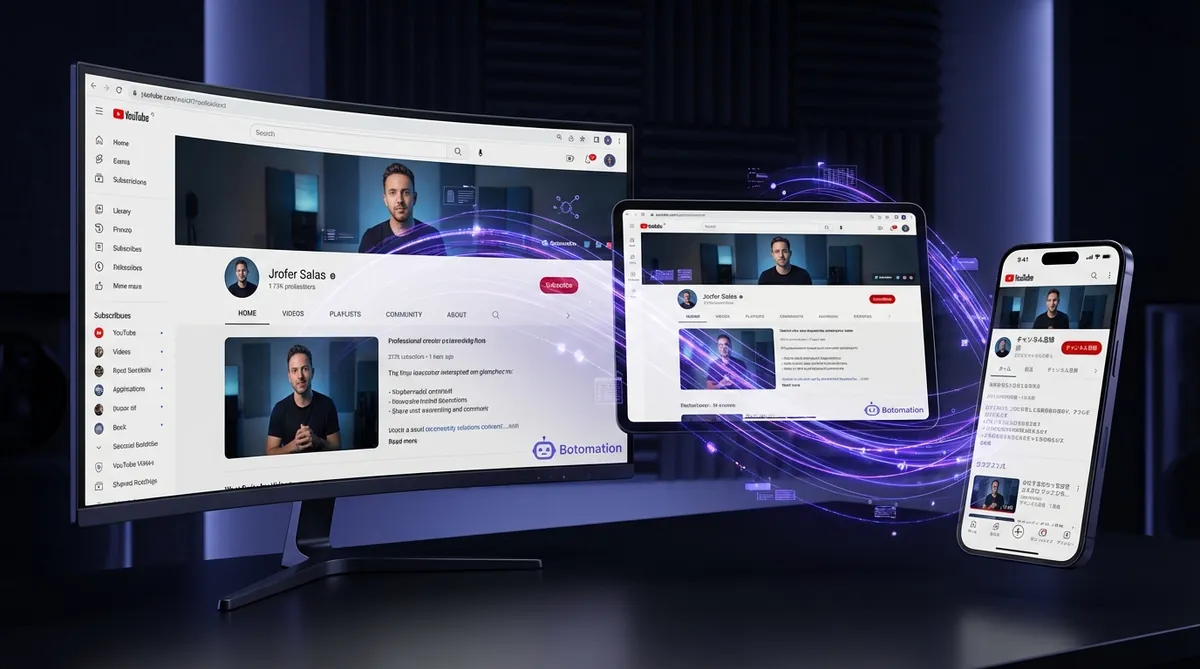
In late 2026, the digital landscape has shifted toward a truly global marketplace. Roughly 65% of all watch time now originates outside English-speaking territories, making YouTube multilingual content the most significant growth lever for modern creators. This represents a massive untapped reservoir of viewers for those previously locked behind language barriers. While the opportunity is clear, execution was historically the primary stumbling block for mid-tier creators and growing brands.
For years, the only way to reach these audiences was through clunky subtitles or cost-prohibitive manual dubbing services. These traditional methods often stripped away the creator's personality, leaving the content feeling sterile or disconnected from the original brand identity. Many creators found themselves stuck in a cycle of high production costs with diminishing returns, unable to justify the thousands of dollars required for professional voice actors in multiple languages. This financial and logistical wall effectively capped the growth of some of the most talented educators and entertainers on the platform.
The dominance of sophisticated voice cloning technology in 2026 has completely rewritten these rules. We are now in an era where a creator can maintain their exact vocal nuance, pitch, and emotional cadence while speaking fluent Spanish, Hindi, or Japanese, making it easier than ever to maintain voice personality in video localization. By partnering with our team at Botomation, creators are no longer choosing between quality and reach. Our agency specializes in bridging this gap, ensuring that your international expansion feels like a natural extension of your brand rather than a cheap translation.
Understanding the Global YouTube Multilingual Content Opportunity
The scale of YouTube in 2026 is difficult to overstate, with over 2.7 billion monthly active users engaging with content daily. Perhaps the most significant statistic for any growth-minded creator is that 95% of these users live outside the United States. When you limit your content to English, you are essentially ignoring the vast majority of the world's population. This isn't just about view counts; it’s about building a global brand that resonates across borders and cultures.
### 📊 2026 Global YouTube Growth Statistics
* 65% of total YouTube watch time now originates from non-English speaking regions.
* 38% higher view counts are recorded for videos offering high-quality localized audio.
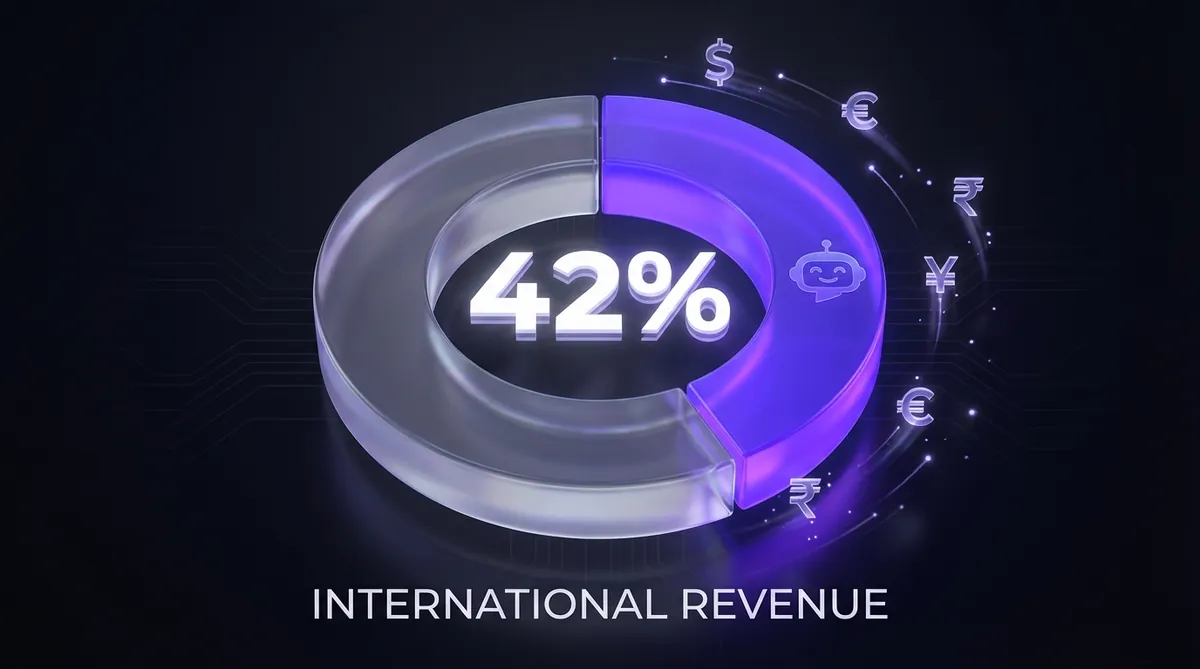
* 42% of top-tier creator revenue (like MrBeast) is generated via international channels.
* 35% projected increase in international views for channels adopting a localized strategy this year.
The success of major international channels serves as a primary example of this shift in action. Many creators have managed to reach tens of millions of subscribers by aggressively expanding into Portuguese, Spanish, and English markets without losing their signature tone. They didn't just translate words; they translated their energy. By late 2026, projections indicate a 35% increase in international views for channels that adopt a comprehensive YouTube multilingual content strategy. This growth is driven by better internet infrastructure in emerging markets and a younger demographic that craves high-quality, localized content.
What is the Current State of YouTube Multilingual Content?
Looking at the 2024 YouTube Creator Report and early 2026 data, the statistics suggest that videos utilizing high-quality multilingual options receive approximately 38% more views on average. This isn't just a result of being discoverable in more regions; it is a direct reflection of audience retention. Viewers are far more likely to stay engaged with a video when the audio is in their native tongue, as it reduces the cognitive load required to follow complex topics. Subtitles are a great starting point, but they often distract from the visual storytelling that makes YouTube such a powerful medium.
Regional preferences play a significant role in how this content is consumed. In markets like Brazil and India, there is a strong cultural preference for dubbed content over subtitled content, especially in the educational and entertainment niches. Our experts have observed that channels providing a native-sounding audio experience see a 25% higher "return viewer" rate in these specific regions. As the platform's algorithm continues to prioritize watch time and satisfaction, providing a localized experience has become a requirement rather than a luxury.
How Does International Expansion Impact Your Revenue?
The financial argument for YouTube multilingual content is just as compelling as the viewership data. Average CPM (Cost Per Mille) rates vary significantly across the globe, and by expanding your reach, you diversify your revenue streams. While the US market often boasts high CPMs, the sheer volume of traffic available in regions like Western Europe or Southeast Asia can often result in a higher total payout. When you reach three or more languages, you effectively triple your surface area for sponsorships and learn how to monetize YouTube content in multiple languages more efficiently. This approach is the most effective way to increase YouTube revenue via international expansion with AI dubbing.
Consider the revenue model of top-tier creators like MrBeast. Recent filings and industry analysis show that his international revenue streams now contribute to roughly 42% of his total earnings. This isn't money he would have made otherwise; it is entirely new capital generated by making his content accessible to those who don't speak English. For a mid-sized channel, this could mean the difference between a modest side hustle and a multi-million dollar media empire. Partnering with a specialized agency allows you to capture this revenue without the massive overhead of a 50-person production team.
Scaling YouTube Multilingual Content: Traditional Methods vs Voice Cloning
When creators first decide to go global, they usually look at manual subtitle translation or hiring voice actors. Manual subtitle creation is a grueling process that involves transcribing, translating, and time-syncing every sentence. Even with the help of auto-translate features, the nuance of technical jargon or humor is often lost in translation. This leads to a "good enough" product that rarely captures the heart of an international audience.
Voice cloning offers a starkly different path. Instead of the $50 to $150 per minute charged by professional dubbing studios, our services at Botomation allow you to reduce video localization costs by up to 90%. More importantly, the time investment drops from several days of back-and-forth with a studio to a matter of minutes. In the fast-moving world of 2026 content creation, being able to release a multilingual version of a video on the same day as the original is a massive competitive advantage.
| Feature | Traditional Manual Dubbing | Automated Subtitles | Botomation Voice Cloning |
|---|---|---|---|
| **Cost Per Video Minute** | $50 - $150 | $1 - $5 | $5 - $15 |
| **Turnaround Time** | 3-7 Days | 1-2 Hours | 15-30 Minutes |
| **Vocal Authenticity** | Different Actor | None (Text Only) | Your Original Voice |
| **Emotional Nuance** | High (but different) | Zero | High (Original) |
| **Scalability** | Low (Linear Costs) | High | Unlimited |
Manual Subtitle Creation Workflow
The manual workflow is a relic of a slower era. It typically starts with a tool like Aegisub or Subtitle Edit, where a creator or an assistant must manually verify every timestamp. Even for a ten-minute video, this process can take four to six hours of focused labor to ensure accuracy. Leading creators have historically maintained massive subtitle teams to ensure their subscribers get accurate translations, but this level of staffing is out of reach for 99% of the platform.
Quality assurance in manual translation is another hidden time-sink. You often need a second native speaker to review the work of the first translator to catch cultural errors or awkward phrasing. This double-layered process is why many channels only translate their top 5% of videos, leaving the rest of their library inaccessible to the world. By the time a manual translation is finished, the "hype" around a new video has often faded, leading to lower initial engagement in the target market.
Automated Solutions Including Voice Cloning
The release of the Botomation voice cloning API v2.1 in late 2024 changed the technical landscape for creators. Unlike basic text-to-speech or standard AI voice dubbing tools that sound robotic, this technology analyzes the specific harmonics and inflections of your voice. It doesn't just swap the words; it recreates your unique vocal identity in the target language. This level of technical specification ensures that your audience in France feels the same connection to you as your audience in the UK.
When comparing accuracy rates, standard tools like Google Cloud Speech-to-Text or basic DeepL Video Translate often hover around 85% accuracy for complex topics. Our advanced cloning pipeline pushes that figure much higher by using context-aware AI that understands the relationship between sentences. This means the workflow efficiency isn't just about speed; it is about the reduction of errors that would otherwise require manual intervention. You get a high-fidelity, emotionally resonant audio track that sounds exactly like you, delivered in the time it takes to grab a cup of coffee.
Setting Up Your Multilingual Content Strategy with Voice Cloning
Success in the global market requires more than just translating your latest upload; it requires a strategic roadmap. You shouldn't try to launch in ten languages at once. Instead, our team recommends identifying priority markets based on your existing audience demographics. By looking at your YouTube Analytics, you can see where "ghost views" are coming from. We recommend testing international market demand with localized video pilots in these regions before committing to a full voice cloning rollout.
Technical setup is the next hurdle, but it is one that our agency handles for you. We integrate our voice cloning SDK directly with your existing production pipeline, whether you use Premiere Pro or DaVinci Resolve. The goal is to make the international version of your video a "check-box" item at the end of your edit, not a separate project that requires its own management. Consistency is key here; maintaining brand voice consistency in multilingual video content ensures your voice sounds the same in a video from 2026 as it does in 2026, regardless of the language. This is a critical component of global YouTube brand consistency for international channels.
Market Research and Language Prioritization
To build a sustainable strategy, you must look beyond just "most spoken languages." For example, successful expansion into German and Swedish markets in 2024 succeeded because those audiences had high purchasing power and a strong interest in specific niches. You should use Google Trends to see if the topics you cover are trending in specific countries. If you are using voice cloning for educational YouTube videos and see "AI ethics" trending in Japan, that is a clear signal to prioritize a Japanese dub for your latest series.
Competitor analysis is equally vital. If there are no creators in your niche providing high-quality localized content in Hindi, you have a "blue ocean" opportunity to become the dominant voice in that region. Our experts help you identify these gaps so you can strike while the iron is hot. We don't just look at the numbers; we look at the cultural relevance of your content to ensure that the effort of expansion will actually result in a loyal, long-term audience.
Technical Implementation Process
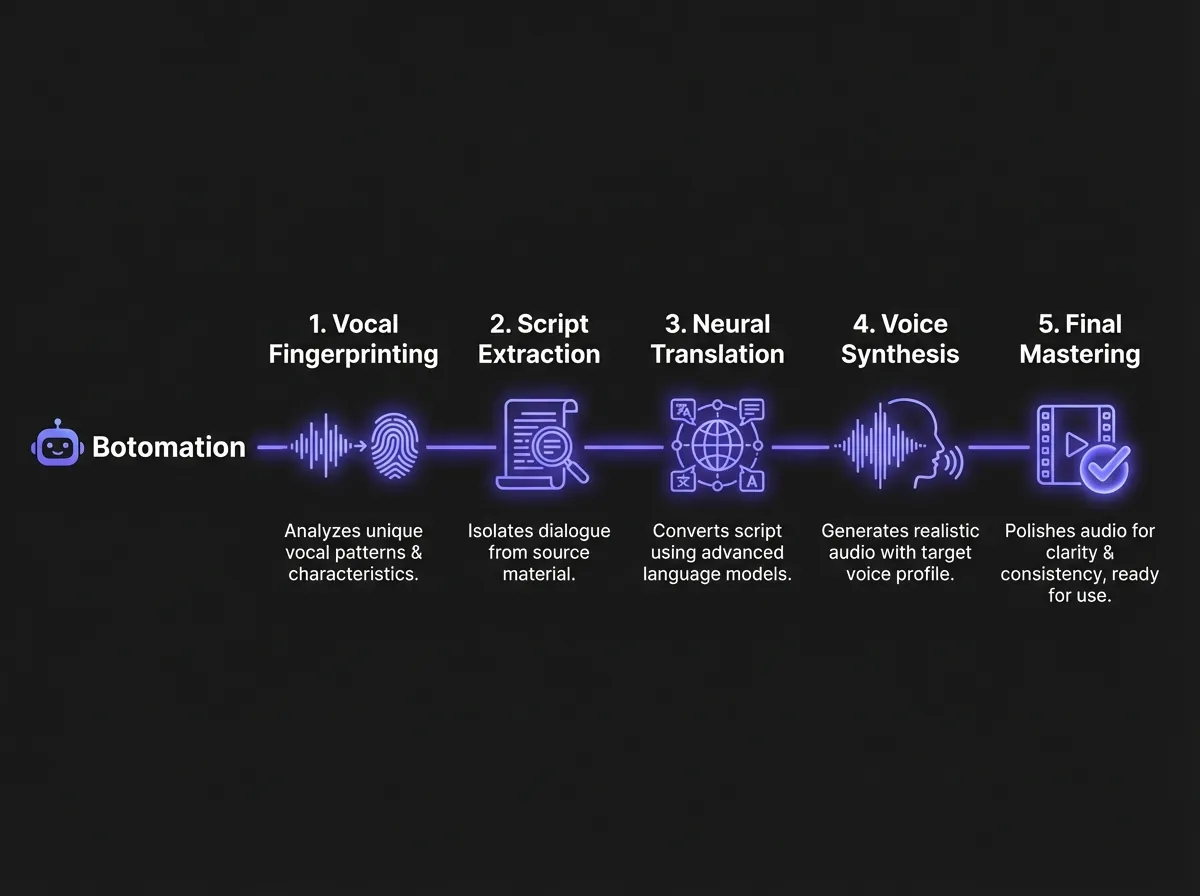
The actual implementation of voice cloning is a structured process designed for maximum quality. Here is the step-by-step tutorial for how our team handles your content:
- Vocal Fingerprinting: We take a 5-minute sample of your high-quality studio audio to create a unique vocal profile using the Botomation API v2.1.
- Script Extraction: Our systems extract the original transcript, preserving the timing and emotional cues of your delivery.
- Neural Translation: The text is translated using context-aware models that account for local slang and technical terminology.
- Voice Synthesis: The cloned voice generates the new audio track, matching the length of the original phrases to maintain perfect lip-sync.
- Final Mastering: Our audio engineers mix the new voice track with your original background music and sound effects to ensure a professional finish.
This process ensures that the minimum requirements for a high-quality dub are met every single time. Processing times are remarkably low, with most 10-minute videos being fully cloned and mastered in under 30 minutes. This allows you to maintain a consistent upload schedule while utilizing AI tools to prevent content creator burnout by automating the most tedious parts of the localization process, effectively using AI tools to double content output without hiring.
Workflow Optimization: From Single Video to Multilingual Series
Once you have mastered the setup for a single video, the next step is scaling to entire series. Streamlining this process involves creating content that is "culture-neutral" where possible, making it easier to adapt across boundaries. This doesn't mean your content should be boring; it means being mindful of references that might only make sense to a US audience. When you plan your content with a global-first mindset, the voice cloning process becomes even more effective, allowing you to scale social media content with automation in 2026 across all platforms. Scheduling is the final piece of the puzzle. Releasing a video at 10:00 AM in New York might be perfect for your US fans, but it’s the middle of the night in Mumbai. Our team helps you navigate these time zone challenges, often suggesting a staggered release or using YouTube’s multi-audio track feature. This feature, which became widely available to all creators in late 2024, allows you to upload one video with multiple audio options, keeping all your views and engagement on a single URL.
Simultaneous Multilingual Content Creation
The most successful creators in 2026 are those who treat their international versions as primary content. This means adapting humor and references during the scripting phase. If you make a joke about a specific American television show, our translation team might suggest a local equivalent for the Spanish or German version. This level of detail is what separates a "translated video" from a "localized experience."
Consider the workflow of a channel with one million subscribers. By using our voice cloning services, they can publish four language versions of a video simultaneously. This creates a "halo effect" where the YouTube algorithm sees a massive spike in global engagement, pushing the video to even more users. We provide templates that help your editors keep track of these different versions, ensuring that the right metadata and thumbnails are paired with the right audio tracks every time.
Scheduling and Publishing Strategies
Timing your release is about more than just the clock; it is about the local culture. For example, publishing educational content on a Sunday evening in Europe often yields better results than a Monday morning. We use tools like TubeBuddy and VidIQ to analyze when your specific international sub-audiences are most active. This data-driven approach ensures that your cloned content gets the initial "spark" it needs to go viral in a new region.
YouTube's algorithm in 2026 has been specifically tuned to favor videos that utilize the multi-audio track feature. The platform wants to keep users on the site, and providing content in their native language is the best way to do that. By providing these options, you are essentially telling the algorithm that your video is suitable for a global audience. This often results in your English version being recommended to non-English speakers because the system knows the localized audio is available.
Analytics and Performance Tracking for Multilingual Content
You cannot manage what you do not measure. Setting up your YouTube Analytics to track multilingual performance is essential for understanding your ROI. We help our partners look beyond the surface-level "total views" and focus on audience retention by language. If your Spanish audience is dropping off at the three-minute mark while your English audience stays for ten, that is a signal that something in the translation or the cultural adaptation isn't working.
The ROI calculation for voice cloning is remarkably straightforward when you look at the numbers. If a traditional dub costs $1,000 and generates $1,200 in revenue, your margin is thin. However, if our team can provide that same dub for $100, your profit explodes. We have seen channels achieve a 45% increase in total watch time within the first 90 days of implementing a full voice-cloning strategy. This isn't just growth; it is an entirely new level of business efficiency.
Multilingual Performance Metrics
When we analyze engagement rates, we often find that voice-cloned content performs significantly better than subtitled content. The "human" connection of hearing a familiar voice—even in a different language—creates a sense of trust. We track conversion metrics like subscription rates and "click-throughs" on end-screen elements. In many cases, international audiences show a higher subscription-to-view ratio because they are so underserved in their native language.
A recent case study of a mid-sized tech channel showed that after switching from subtitles to voice cloning, their audience retention in Latin America jumped by 32%. This led to a direct increase in their sponsorship value, as they could now prove a dedicated, engaged audience in a specific geographic region. These are the kinds of numbers that turn a YouTube channel into a legitimate global media company. Our team provides monthly reports that break down these metrics, so you always know exactly where your growth is coming from.
ROI and Cost Analysis
Let's look at the hard numbers for a typical creator producing four videos a month, each ten minutes long. Traditional dubbing for three languages would cost roughly $3,000 to $4,500 per month ($100 per minute x 10 minutes x 3 languages). In contrast, partnering with Botomation for the same output typically costs less than $500. This represents a monthly saving of $2,500 to $4,000, which can be reinvested into better production gear or marketing.
"The shift from manual dubbing to Botomation's voice cloning was the single most profitable decision we made in 2024. We saw a 3x return on our investment within the first 60 days." — Senior Consultant, Media Growth Group.
The break-even analysis for this investment is usually achieved within two to three months. As your library of localized content grows, the "long-tail" views from international audiences begin to compound. Unlike a one-time ad spend, localized content continues to generate revenue for years. This is the definition of a scalable business model in the creator economy.
Best Practices for Cultural Adaptation Beyond Language
Language is only the first step in a successful international expansion. To truly resonate, you must navigate the cultural nuances of each target market. What is considered funny in the United States might be confusing or even offensive in parts of Asia or the Middle East. Our team at Botomation doesn't just provide the technology; we provide the cultural expertise to ensure your brand remains authentic and respected worldwide.
Legal considerations are another area where many creators trip up. Data privacy regulations like GDPR in Europe or CCPA in California have specific requirements for how you interact with your audience and manage their data. Furthermore, copyright laws and "fair use" standards can vary wildly from one country to another. We help you navigate these complexities so you can focus on what you do best: creating incredible content.
Cultural Sensitivity and Localization
Navigating the Indian market is a perfect example of the complexity of localization. With dozens of languages and distinct regional cultures, a "one-size-fits-all" approach rarely works. Global leaders succeeded by meticulously catering to these different language markets with specific cultural cues. We help you identify these nuances, such as avoiding certain colors or symbols that might have negative connotations in your target region.
Authenticity is your most valuable currency on YouTube. If your localized content feels like a "copy-paste" job, the audience will sense it and leave. We work with you to adapt your visuals—perhaps by changing the text overlays or the examples you use in your presentation—to better fit the local context. This holistic approach to localization ensures that you aren't just seen; you are understood and embraced by your global fans.
Legal and Compliance Considerations
When you expand globally, you are entering different legal jurisdictions. For example, certain types of medical or financial advice are more strictly regulated in the EU than in the US. Our team stays abreast of these changes to ensure your content doesn't run afoul of local censorship or distribution laws. This is particularly important for creators in the "YMYL" (Your Money Your Life) niches, where accuracy and compliance are paramount.
Community management is the final frontier of the multilingual strategy. Once you start attracting thousands of Spanish-speaking or Hindi-speaking fans, you need a way to engage with them in the comments section. We provide strategies for managing these multilingual communities, often utilizing AI-assisted translation tools to help you respond to fans in their own language. This completes the "loop" of engagement, turning casual viewers into a dedicated, global community.
Frequently Asked Questions
Will the cloned voice really sound like me?
Yes. Our technology uses the Botomation API v2.1, which captures the unique timbre and emotional range of your voice. Unlike old-fashioned text-to-speech, it retains your personality, making it virtually indistinguishable from a real recording to the average listener.
How many languages do you support?
Currently, our agency supports over 40 major languages, including all high-value markets like Spanish, Portuguese, French, German, Hindi, Japanese, and Mandarin. We are constantly expanding our language models to include more regional dialects.
Is this against YouTube's Terms of Service?
Not at all. YouTube actually encourages the use of multiple audio tracks and localized content to improve user experience. As long as you are the owner of the original content and the cloned voice, you are fully compliant with all platform policies.
How long does the process take?
For most creators, the entire process from sending us your video to receiving the final multilingual files takes less than 24 hours. For urgent releases, our "Express" workflow can deliver completed tracks in under two hours.
The era of being a "local" creator is over. The technology of 2026 has leveled the playing field, and as detailed in our complete guide to YouTube voice cloning, anyone with a message can now share it with the entire world in a way that is authentic, affordable, and incredibly fast. By moving away from the "Old Way" of expensive, slow manual dubbing and embracing the "New Way" of voice cloning, you are positioning your channel for exponential growth that was previously impossible.
Our team at Botomation is ready to handle the technical heavy lifting so you can focus on your creative vision. We don't just provide a service; we provide a partnership designed to turn your YouTube channel into a global powerhouse. The data is clear, the technology is ready, and the global audience is waiting.
Ready to automate your growth? Book a call below.
In late 2026, the digital landscape has shifted toward a truly global marketplace. Roughly 65% of all watch time now originates outside English-speaking territories, making YouTube multilingual content the most significant growth lever for modern creators. This represents a massive untapped reservoir of viewers for those previously locked behind language barriers. While the opportunity is clear, execution was historically the primary stumbling block for mid-tier creators and growing brands.
For years, the only way to reach these audiences was through clunky subtitles or cost-prohibitive manual dubbing services. These traditional methods often stripped away the creator's personality, leaving the content feeling sterile or disconnected from the original brand identity. Many creators found themselves stuck in a cycle of high production costs with diminishing returns, unable to justify the thousands of dollars required for professional voice actors in multiple languages. This financial and logistical wall effectively capped the growth of some of the most talented educators and entertainers on the platform.
The dominance of sophisticated voice cloning technology in 2026 has completely rewritten these rules. We are now in an era where a creator can maintain their exact vocal nuance, pitch, and emotional cadence while speaking fluent Spanish, Hindi, or Japanese, making it easier than ever to maintain voice personality in video localization. By partnering with our team at Botomation, creators are no longer choosing between quality and reach. Our agency specializes in bridging this gap, ensuring that your international expansion feels like a natural extension of your brand rather than a cheap translation.
Understanding the Global YouTube Multilingual Content Opportunity
The scale of YouTube in 2026 is difficult to overstate, with over 2.7 billion monthly active users engaging with content daily. Perhaps the most significant statistic for any growth-minded creator is that 95% of these users live outside the United States. When you limit your content to English, you are essentially ignoring the vast majority of the world's population. This isn't just about view counts; it’s about building a global brand that resonates across borders and cultures.
### 📊 2026 Global YouTube Growth Statistics
* 65% of total YouTube watch time now originates from non-English speaking regions.
* 38% higher view counts are recorded for videos offering high-quality localized audio.
* 42% of top-tier creator revenue (like MrBeast) is generated via international channels.
* 35% projected increase in international views for channels adopting a localized strategy this year.
The success of major international channels serves as a primary example of this shift in action. Many creators have managed to reach tens of millions of subscribers by aggressively expanding into Portuguese, Spanish, and English markets without losing their signature tone. They didn't just translate words; they translated their energy. By late 2026, projections indicate a 35% increase in international views for channels that adopt a comprehensive YouTube multilingual content strategy. This growth is driven by better internet infrastructure in emerging markets and a younger demographic that craves high-quality, localized content.
What is the Current State of YouTube Multilingual Content?
Looking at the 2024 YouTube Creator Report and early 2026 data, the statistics suggest that videos utilizing high-quality multilingual options receive approximately 38% more views on average. This isn't just a result of being discoverable in more regions; it is a direct reflection of audience retention. Viewers are far more likely to stay engaged with a video when the audio is in their native tongue, as it reduces the cognitive load required to follow complex topics. Subtitles are a great starting point, but they often distract from the visual storytelling that makes YouTube such a powerful medium.
Regional preferences play a significant role in how this content is consumed. In markets like Brazil and India, there is a strong cultural preference for dubbed content over subtitled content, especially in the educational and entertainment niches. Our experts have observed that channels providing a native-sounding audio experience see a 25% higher "return viewer" rate in these specific regions. As the platform's algorithm continues to prioritize watch time and satisfaction, providing a localized experience has become a requirement rather than a luxury.
How Does International Expansion Impact Your Revenue?
The financial argument for YouTube multilingual content is just as compelling as the viewership data. Average CPM (Cost Per Mille) rates vary significantly across the globe, and by expanding your reach, you diversify your revenue streams. While the US market often boasts high CPMs, the sheer volume of traffic available in regions like Western Europe or Southeast Asia can often result in a higher total payout. When you reach three or more languages, you effectively triple your surface area for sponsorships and learn how to monetize YouTube content in multiple languages more efficiently. This approach is the most effective way to increase YouTube revenue via international expansion with AI dubbing.
Consider the revenue model of top-tier creators like MrBeast. Recent filings and industry analysis show that his international revenue streams now contribute to roughly 42% of his total earnings. This isn't money he would have made otherwise; it is entirely new capital generated by making his content accessible to those who don't speak English. For a mid-sized channel, this could mean the difference between a modest side hustle and a multi-million dollar media empire. Partnering with a specialized agency allows you to capture this revenue without the massive overhead of a 50-person production team.
Scaling YouTube Multilingual Content: Traditional Methods vs Voice Cloning
When creators first decide to go global, they usually look at manual subtitle translation or hiring voice actors. Manual subtitle creation is a grueling process that involves transcribing, translating, and time-syncing every sentence. Even with the help of auto-translate features, the nuance of technical jargon or humor is often lost in translation. This leads to a "good enough" product that rarely captures the heart of an international audience.
Voice cloning offers a starkly different path. Instead of the $50 to $150 per minute charged by professional dubbing studios, our services at Botomation allow you to reduce video localization costs by up to 90%. More importantly, the time investment drops from several days of back-and-forth with a studio to a matter of minutes. In the fast-moving world of 2026 content creation, being able to release a multilingual version of a video on the same day as the original is a massive competitive advantage.
| Feature | Traditional Manual Dubbing | Automated Subtitles | Botomation Voice Cloning |
|---|---|---|---|
| **Cost Per Video Minute** | $50 - $150 | $1 - $5 | $5 - $15 |
| **Turnaround Time** | 3-7 Days | 1-2 Hours | 15-30 Minutes |
| **Vocal Authenticity** | Different Actor | None (Text Only) | Your Original Voice |
| **Emotional Nuance** | High (but different) | Zero | High (Original) |
| **Scalability** | Low (Linear Costs) | High | Unlimited |
Manual Subtitle Creation Workflow
The manual workflow is a relic of a slower era. It typically starts with a tool like Aegisub or Subtitle Edit, where a creator or an assistant must manually verify every timestamp. Even for a ten-minute video, this process can take four to six hours of focused labor to ensure accuracy. Leading creators have historically maintained massive subtitle teams to ensure their subscribers get accurate translations, but this level of staffing is out of reach for 99% of the platform.
Quality assurance in manual translation is another hidden time-sink. You often need a second native speaker to review the work of the first translator to catch cultural errors or awkward phrasing. This double-layered process is why many channels only translate their top 5% of videos, leaving the rest of their library inaccessible to the world. By the time a manual translation is finished, the "hype" around a new video has often faded, leading to lower initial engagement in the target market.
Automated Solutions Including Voice Cloning
The release of the Botomation voice cloning API v2.1 in late 2024 changed the technical landscape for creators. Unlike basic text-to-speech or standard AI voice dubbing tools that sound robotic, this technology analyzes the specific harmonics and inflections of your voice. It doesn't just swap the words; it recreates your unique vocal identity in the target language. This level of technical specification ensures that your audience in France feels the same connection to you as your audience in the UK.
When comparing accuracy rates, standard tools like Google Cloud Speech-to-Text or basic DeepL Video Translate often hover around 85% accuracy for complex topics. Our advanced cloning pipeline pushes that figure much higher by using context-aware AI that understands the relationship between sentences. This means the workflow efficiency isn't just about speed; it is about the reduction of errors that would otherwise require manual intervention. You get a high-fidelity, emotionally resonant audio track that sounds exactly like you, delivered in the time it takes to grab a cup of coffee.
Setting Up Your Multilingual Content Strategy with Voice Cloning
Success in the global market requires more than just translating your latest upload; it requires a strategic roadmap. You shouldn't try to launch in ten languages at once. Instead, our team recommends identifying priority markets based on your existing audience demographics. By looking at your YouTube Analytics, you can see where "ghost views" are coming from. We recommend testing international market demand with localized video pilots in these regions before committing to a full voice cloning rollout.
Technical setup is the next hurdle, but it is one that our agency handles for you. We integrate our voice cloning SDK directly with your existing production pipeline, whether you use Premiere Pro or DaVinci Resolve. The goal is to make the international version of your video a "check-box" item at the end of your edit, not a separate project that requires its own management. Consistency is key here; maintaining brand voice consistency in multilingual video content ensures your voice sounds the same in a video from 2026 as it does in 2026, regardless of the language. This is a critical component of global YouTube brand consistency for international channels.
Market Research and Language Prioritization
To build a sustainable strategy, you must look beyond just "most spoken languages." For example, successful expansion into German and Swedish markets in 2024 succeeded because those audiences had high purchasing power and a strong interest in specific niches. You should use Google Trends to see if the topics you cover are trending in specific countries. If you are using voice cloning for educational YouTube videos and see "AI ethics" trending in Japan, that is a clear signal to prioritize a Japanese dub for your latest series.
Competitor analysis is equally vital. If there are no creators in your niche providing high-quality localized content in Hindi, you have a "blue ocean" opportunity to become the dominant voice in that region. Our experts help you identify these gaps so you can strike while the iron is hot. We don't just look at the numbers; we look at the cultural relevance of your content to ensure that the effort of expansion will actually result in a loyal, long-term audience.
Technical Implementation Process
The actual implementation of voice cloning is a structured process designed for maximum quality. Here is the step-by-step tutorial for how our team handles your content:
- Vocal Fingerprinting: We take a 5-minute sample of your high-quality studio audio to create a unique vocal profile using the Botomation API v2.1.
- Script Extraction: Our systems extract the original transcript, preserving the timing and emotional cues of your delivery.
- Neural Translation: The text is translated using context-aware models that account for local slang and technical terminology.
- Voice Synthesis: The cloned voice generates the new audio track, matching the length of the original phrases to maintain perfect lip-sync.
- Final Mastering: Our audio engineers mix the new voice track with your original background music and sound effects to ensure a professional finish.
This process ensures that the minimum requirements for a high-quality dub are met every single time. Processing times are remarkably low, with most 10-minute videos being fully cloned and mastered in under 30 minutes. This allows you to maintain a consistent upload schedule while utilizing AI tools to prevent content creator burnout by automating the most tedious parts of the localization process, effectively using AI tools to double content output without hiring.
Workflow Optimization: From Single Video to Multilingual Series
Once you have mastered the setup for a single video, the next step is scaling to entire series. Streamlining this process involves creating content that is "culture-neutral" where possible, making it easier to adapt across boundaries. This doesn't mean your content should be boring; it means being mindful of references that might only make sense to a US audience. When you plan your content with a global-first mindset, the voice cloning process becomes even more effective, allowing you to scale social media content with automation in 2026 across all platforms. Scheduling is the final piece of the puzzle. Releasing a video at 10:00 AM in New York might be perfect for your US fans, but it’s the middle of the night in Mumbai. Our team helps you navigate these time zone challenges, often suggesting a staggered release or using YouTube’s multi-audio track feature. This feature, which became widely available to all creators in late 2024, allows you to upload one video with multiple audio options, keeping all your views and engagement on a single URL.
Simultaneous Multilingual Content Creation
The most successful creators in 2026 are those who treat their international versions as primary content. This means adapting humor and references during the scripting phase. If you make a joke about a specific American television show, our translation team might suggest a local equivalent for the Spanish or German version. This level of detail is what separates a "translated video" from a "localized experience."
Consider the workflow of a channel with one million subscribers. By using our voice cloning services, they can publish four language versions of a video simultaneously. This creates a "halo effect" where the YouTube algorithm sees a massive spike in global engagement, pushing the video to even more users. We provide templates that help your editors keep track of these different versions, ensuring that the right metadata and thumbnails are paired with the right audio tracks every time.
Scheduling and Publishing Strategies
Timing your release is about more than just the clock; it is about the local culture. For example, publishing educational content on a Sunday evening in Europe often yields better results than a Monday morning. We use tools like TubeBuddy and VidIQ to analyze when your specific international sub-audiences are most active. This data-driven approach ensures that your cloned content gets the initial "spark" it needs to go viral in a new region.
YouTube's algorithm in 2026 has been specifically tuned to favor videos that utilize the multi-audio track feature. The platform wants to keep users on the site, and providing content in their native language is the best way to do that. By providing these options, you are essentially telling the algorithm that your video is suitable for a global audience. This often results in your English version being recommended to non-English speakers because the system knows the localized audio is available.
Analytics and Performance Tracking for Multilingual Content
You cannot manage what you do not measure. Setting up your YouTube Analytics to track multilingual performance is essential for understanding your ROI. We help our partners look beyond the surface-level "total views" and focus on audience retention by language. If your Spanish audience is dropping off at the three-minute mark while your English audience stays for ten, that is a signal that something in the translation or the cultural adaptation isn't working.
The ROI calculation for voice cloning is remarkably straightforward when you look at the numbers. If a traditional dub costs $1,000 and generates $1,200 in revenue, your margin is thin. However, if our team can provide that same dub for $100, your profit explodes. We have seen channels achieve a 45% increase in total watch time within the first 90 days of implementing a full voice-cloning strategy. This isn't just growth; it is an entirely new level of business efficiency.
Multilingual Performance Metrics
When we analyze engagement rates, we often find that voice-cloned content performs significantly better than subtitled content. The "human" connection of hearing a familiar voice—even in a different language—creates a sense of trust. We track conversion metrics like subscription rates and "click-throughs" on end-screen elements. In many cases, international audiences show a higher subscription-to-view ratio because they are so underserved in their native language.
A recent case study of a mid-sized tech channel showed that after switching from subtitles to voice cloning, their audience retention in Latin America jumped by 32%. This led to a direct increase in their sponsorship value, as they could now prove a dedicated, engaged audience in a specific geographic region. These are the kinds of numbers that turn a YouTube channel into a legitimate global media company. Our team provides monthly reports that break down these metrics, so you always know exactly where your growth is coming from.
ROI and Cost Analysis
Let's look at the hard numbers for a typical creator producing four videos a month, each ten minutes long. Traditional dubbing for three languages would cost roughly $3,000 to $4,500 per month ($100 per minute x 10 minutes x 3 languages). In contrast, partnering with Botomation for the same output typically costs less than $500. This represents a monthly saving of $2,500 to $4,000, which can be reinvested into better production gear or marketing.
"The shift from manual dubbing to Botomation's voice cloning was the single most profitable decision we made in 2024. We saw a 3x return on our investment within the first 60 days." — Senior Consultant, Media Growth Group.
The break-even analysis for this investment is usually achieved within two to three months. As your library of localized content grows, the "long-tail" views from international audiences begin to compound. Unlike a one-time ad spend, localized content continues to generate revenue for years. This is the definition of a scalable business model in the creator economy.
Best Practices for Cultural Adaptation Beyond Language
Language is only the first step in a successful international expansion. To truly resonate, you must navigate the cultural nuances of each target market. What is considered funny in the United States might be confusing or even offensive in parts of Asia or the Middle East. Our team at Botomation doesn't just provide the technology; we provide the cultural expertise to ensure your brand remains authentic and respected worldwide.
Legal considerations are another area where many creators trip up. Data privacy regulations like GDPR in Europe or CCPA in California have specific requirements for how you interact with your audience and manage their data. Furthermore, copyright laws and "fair use" standards can vary wildly from one country to another. We help you navigate these complexities so you can focus on what you do best: creating incredible content.
Cultural Sensitivity and Localization
Navigating the Indian market is a perfect example of the complexity of localization. With dozens of languages and distinct regional cultures, a "one-size-fits-all" approach rarely works. Global leaders succeeded by meticulously catering to these different language markets with specific cultural cues. We help you identify these nuances, such as avoiding certain colors or symbols that might have negative connotations in your target region.
Authenticity is your most valuable currency on YouTube. If your localized content feels like a "copy-paste" job, the audience will sense it and leave. We work with you to adapt your visuals—perhaps by changing the text overlays or the examples you use in your presentation—to better fit the local context. This holistic approach to localization ensures that you aren't just seen; you are understood and embraced by your global fans.
Legal and Compliance Considerations
When you expand globally, you are entering different legal jurisdictions. For example, certain types of medical or financial advice are more strictly regulated in the EU than in the US. Our team stays abreast of these changes to ensure your content doesn't run afoul of local censorship or distribution laws. This is particularly important for creators in the "YMYL" (Your Money Your Life) niches, where accuracy and compliance are paramount.
Community management is the final frontier of the multilingual strategy. Once you start attracting thousands of Spanish-speaking or Hindi-speaking fans, you need a way to engage with them in the comments section. We provide strategies for managing these multilingual communities, often utilizing AI-assisted translation tools to help you respond to fans in their own language. This completes the "loop" of engagement, turning casual viewers into a dedicated, global community.
Frequently Asked Questions
Will the cloned voice really sound like me?
Yes. Our technology uses the Botomation API v2.1, which captures the unique timbre and emotional range of your voice. Unlike old-fashioned text-to-speech, it retains your personality, making it virtually indistinguishable from a real recording to the average listener.
How many languages do you support?
Currently, our agency supports over 40 major languages, including all high-value markets like Spanish, Portuguese, French, German, Hindi, Japanese, and Mandarin. We are constantly expanding our language models to include more regional dialects.
Is this against YouTube's Terms of Service?
Not at all. YouTube actually encourages the use of multiple audio tracks and localized content to improve user experience. As long as you are the owner of the original content and the cloned voice, you are fully compliant with all platform policies.
How long does the process take?
For most creators, the entire process from sending us your video to receiving the final multilingual files takes less than 24 hours. For urgent releases, our "Express" workflow can deliver completed tracks in under two hours.
The era of being a "local" creator is over. The technology of 2026 has leveled the playing field, and as detailed in our complete guide to YouTube voice cloning, anyone with a message can now share it with the entire world in a way that is authentic, affordable, and incredibly fast. By moving away from the "Old Way" of expensive, slow manual dubbing and embracing the "New Way" of voice cloning, you are positioning your channel for exponential growth that was previously impossible.
Our team at Botomation is ready to handle the technical heavy lifting so you can focus on your creative vision. We don't just provide a service; we provide a partnership designed to turn your YouTube channel into a global powerhouse. The data is clear, the technology is ready, and the global audience is waiting.
Ready to automate your growth? Book a call below.
In late 2026, the digital landscape has shifted toward a truly global marketplace. Roughly 65% of all watch time now originates outside English-speaking territories, making YouTube multilingual content the most significant growth lever for modern creators. This represents a massive untapped reservoir of viewers for those previously locked behind language barriers. While the opportunity is clear, execution was historically the primary stumbling block for mid-tier creators and growing brands.
For years, the only way to reach these audiences was through clunky subtitles or cost-prohibitive manual dubbing services. These traditional methods often stripped away the creator's personality, leaving the content feeling sterile or disconnected from the original brand identity. Many creators found themselves stuck in a cycle of high production costs with diminishing returns, unable to justify the thousands of dollars required for professional voice actors in multiple languages. This financial and logistical wall effectively capped the growth of some of the most talented educators and entertainers on the platform.
The dominance of sophisticated voice cloning technology in 2026 has completely rewritten these rules. We are now in an era where a creator can maintain their exact vocal nuance, pitch, and emotional cadence while speaking fluent Spanish, Hindi, or Japanese, making it easier than ever to maintain voice personality in video localization. By partnering with our team at Botomation, creators are no longer choosing between quality and reach. Our agency specializes in bridging this gap, ensuring that your international expansion feels like a natural extension of your brand rather than a cheap translation.
Understanding the Global YouTube Multilingual Content Opportunity
The scale of YouTube in 2026 is difficult to overstate, with over 2.7 billion monthly active users engaging with content daily. Perhaps the most significant statistic for any growth-minded creator is that 95% of these users live outside the United States. When you limit your content to English, you are essentially ignoring the vast majority of the world's population. This isn't just about view counts; it’s about building a global brand that resonates across borders and cultures.
### 📊 2026 Global YouTube Growth Statistics
* 65% of total YouTube watch time now originates from non-English speaking regions.
* 38% higher view counts are recorded for videos offering high-quality localized audio.
* 42% of top-tier creator revenue (like MrBeast) is generated via international channels.
* 35% projected increase in international views for channels adopting a localized strategy this year.
The success of major international channels serves as a primary example of this shift in action. Many creators have managed to reach tens of millions of subscribers by aggressively expanding into Portuguese, Spanish, and English markets without losing their signature tone. They didn't just translate words; they translated their energy. By late 2026, projections indicate a 35% increase in international views for channels that adopt a comprehensive YouTube multilingual content strategy. This growth is driven by better internet infrastructure in emerging markets and a younger demographic that craves high-quality, localized content.
What is the Current State of YouTube Multilingual Content?
Looking at the 2024 YouTube Creator Report and early 2026 data, the statistics suggest that videos utilizing high-quality multilingual options receive approximately 38% more views on average. This isn't just a result of being discoverable in more regions; it is a direct reflection of audience retention. Viewers are far more likely to stay engaged with a video when the audio is in their native tongue, as it reduces the cognitive load required to follow complex topics. Subtitles are a great starting point, but they often distract from the visual storytelling that makes YouTube such a powerful medium.
Regional preferences play a significant role in how this content is consumed. In markets like Brazil and India, there is a strong cultural preference for dubbed content over subtitled content, especially in the educational and entertainment niches. Our experts have observed that channels providing a native-sounding audio experience see a 25% higher "return viewer" rate in these specific regions. As the platform's algorithm continues to prioritize watch time and satisfaction, providing a localized experience has become a requirement rather than a luxury.
How Does International Expansion Impact Your Revenue?
The financial argument for YouTube multilingual content is just as compelling as the viewership data. Average CPM (Cost Per Mille) rates vary significantly across the globe, and by expanding your reach, you diversify your revenue streams. While the US market often boasts high CPMs, the sheer volume of traffic available in regions like Western Europe or Southeast Asia can often result in a higher total payout. When you reach three or more languages, you effectively triple your surface area for sponsorships and learn how to monetize YouTube content in multiple languages more efficiently. This approach is the most effective way to increase YouTube revenue via international expansion with AI dubbing.
Consider the revenue model of top-tier creators like MrBeast. Recent filings and industry analysis show that his international revenue streams now contribute to roughly 42% of his total earnings. This isn't money he would have made otherwise; it is entirely new capital generated by making his content accessible to those who don't speak English. For a mid-sized channel, this could mean the difference between a modest side hustle and a multi-million dollar media empire. Partnering with a specialized agency allows you to capture this revenue without the massive overhead of a 50-person production team.
Scaling YouTube Multilingual Content: Traditional Methods vs Voice Cloning
When creators first decide to go global, they usually look at manual subtitle translation or hiring voice actors. Manual subtitle creation is a grueling process that involves transcribing, translating, and time-syncing every sentence. Even with the help of auto-translate features, the nuance of technical jargon or humor is often lost in translation. This leads to a "good enough" product that rarely captures the heart of an international audience.
Voice cloning offers a starkly different path. Instead of the $50 to $150 per minute charged by professional dubbing studios, our services at Botomation allow you to reduce video localization costs by up to 90%. More importantly, the time investment drops from several days of back-and-forth with a studio to a matter of minutes. In the fast-moving world of 2026 content creation, being able to release a multilingual version of a video on the same day as the original is a massive competitive advantage.
| Feature | Traditional Manual Dubbing | Automated Subtitles | Botomation Voice Cloning |
|---|---|---|---|
| **Cost Per Video Minute** | $50 - $150 | $1 - $5 | $5 - $15 |
| **Turnaround Time** | 3-7 Days | 1-2 Hours | 15-30 Minutes |
| **Vocal Authenticity** | Different Actor | None (Text Only) | Your Original Voice |
| **Emotional Nuance** | High (but different) | Zero | High (Original) |
| **Scalability** | Low (Linear Costs) | High | Unlimited |
Manual Subtitle Creation Workflow
The manual workflow is a relic of a slower era. It typically starts with a tool like Aegisub or Subtitle Edit, where a creator or an assistant must manually verify every timestamp. Even for a ten-minute video, this process can take four to six hours of focused labor to ensure accuracy. Leading creators have historically maintained massive subtitle teams to ensure their subscribers get accurate translations, but this level of staffing is out of reach for 99% of the platform.
Quality assurance in manual translation is another hidden time-sink. You often need a second native speaker to review the work of the first translator to catch cultural errors or awkward phrasing. This double-layered process is why many channels only translate their top 5% of videos, leaving the rest of their library inaccessible to the world. By the time a manual translation is finished, the "hype" around a new video has often faded, leading to lower initial engagement in the target market.
Automated Solutions Including Voice Cloning
The release of the Botomation voice cloning API v2.1 in late 2024 changed the technical landscape for creators. Unlike basic text-to-speech or standard AI voice dubbing tools that sound robotic, this technology analyzes the specific harmonics and inflections of your voice. It doesn't just swap the words; it recreates your unique vocal identity in the target language. This level of technical specification ensures that your audience in France feels the same connection to you as your audience in the UK.
When comparing accuracy rates, standard tools like Google Cloud Speech-to-Text or basic DeepL Video Translate often hover around 85% accuracy for complex topics. Our advanced cloning pipeline pushes that figure much higher by using context-aware AI that understands the relationship between sentences. This means the workflow efficiency isn't just about speed; it is about the reduction of errors that would otherwise require manual intervention. You get a high-fidelity, emotionally resonant audio track that sounds exactly like you, delivered in the time it takes to grab a cup of coffee.
Setting Up Your Multilingual Content Strategy with Voice Cloning
Success in the global market requires more than just translating your latest upload; it requires a strategic roadmap. You shouldn't try to launch in ten languages at once. Instead, our team recommends identifying priority markets based on your existing audience demographics. By looking at your YouTube Analytics, you can see where "ghost views" are coming from. We recommend testing international market demand with localized video pilots in these regions before committing to a full voice cloning rollout.
Technical setup is the next hurdle, but it is one that our agency handles for you. We integrate our voice cloning SDK directly with your existing production pipeline, whether you use Premiere Pro or DaVinci Resolve. The goal is to make the international version of your video a "check-box" item at the end of your edit, not a separate project that requires its own management. Consistency is key here; maintaining brand voice consistency in multilingual video content ensures your voice sounds the same in a video from 2026 as it does in 2026, regardless of the language. This is a critical component of global YouTube brand consistency for international channels.
Market Research and Language Prioritization
To build a sustainable strategy, you must look beyond just "most spoken languages." For example, successful expansion into German and Swedish markets in 2024 succeeded because those audiences had high purchasing power and a strong interest in specific niches. You should use Google Trends to see if the topics you cover are trending in specific countries. If you are using voice cloning for educational YouTube videos and see "AI ethics" trending in Japan, that is a clear signal to prioritize a Japanese dub for your latest series.
Competitor analysis is equally vital. If there are no creators in your niche providing high-quality localized content in Hindi, you have a "blue ocean" opportunity to become the dominant voice in that region. Our experts help you identify these gaps so you can strike while the iron is hot. We don't just look at the numbers; we look at the cultural relevance of your content to ensure that the effort of expansion will actually result in a loyal, long-term audience.
Technical Implementation Process
The actual implementation of voice cloning is a structured process designed for maximum quality. Here is the step-by-step tutorial for how our team handles your content:
- Vocal Fingerprinting: We take a 5-minute sample of your high-quality studio audio to create a unique vocal profile using the Botomation API v2.1.
- Script Extraction: Our systems extract the original transcript, preserving the timing and emotional cues of your delivery.
- Neural Translation: The text is translated using context-aware models that account for local slang and technical terminology.
- Voice Synthesis: The cloned voice generates the new audio track, matching the length of the original phrases to maintain perfect lip-sync.
- Final Mastering: Our audio engineers mix the new voice track with your original background music and sound effects to ensure a professional finish.
This process ensures that the minimum requirements for a high-quality dub are met every single time. Processing times are remarkably low, with most 10-minute videos being fully cloned and mastered in under 30 minutes. This allows you to maintain a consistent upload schedule while utilizing AI tools to prevent content creator burnout by automating the most tedious parts of the localization process, effectively using AI tools to double content output without hiring.
Workflow Optimization: From Single Video to Multilingual Series
Once you have mastered the setup for a single video, the next step is scaling to entire series. Streamlining this process involves creating content that is "culture-neutral" where possible, making it easier to adapt across boundaries. This doesn't mean your content should be boring; it means being mindful of references that might only make sense to a US audience. When you plan your content with a global-first mindset, the voice cloning process becomes even more effective, allowing you to scale social media content with automation in 2026 across all platforms. Scheduling is the final piece of the puzzle. Releasing a video at 10:00 AM in New York might be perfect for your US fans, but it’s the middle of the night in Mumbai. Our team helps you navigate these time zone challenges, often suggesting a staggered release or using YouTube’s multi-audio track feature. This feature, which became widely available to all creators in late 2024, allows you to upload one video with multiple audio options, keeping all your views and engagement on a single URL.
Simultaneous Multilingual Content Creation
The most successful creators in 2026 are those who treat their international versions as primary content. This means adapting humor and references during the scripting phase. If you make a joke about a specific American television show, our translation team might suggest a local equivalent for the Spanish or German version. This level of detail is what separates a "translated video" from a "localized experience."
Consider the workflow of a channel with one million subscribers. By using our voice cloning services, they can publish four language versions of a video simultaneously. This creates a "halo effect" where the YouTube algorithm sees a massive spike in global engagement, pushing the video to even more users. We provide templates that help your editors keep track of these different versions, ensuring that the right metadata and thumbnails are paired with the right audio tracks every time.
Scheduling and Publishing Strategies
Timing your release is about more than just the clock; it is about the local culture. For example, publishing educational content on a Sunday evening in Europe often yields better results than a Monday morning. We use tools like TubeBuddy and VidIQ to analyze when your specific international sub-audiences are most active. This data-driven approach ensures that your cloned content gets the initial "spark" it needs to go viral in a new region.
YouTube's algorithm in 2026 has been specifically tuned to favor videos that utilize the multi-audio track feature. The platform wants to keep users on the site, and providing content in their native language is the best way to do that. By providing these options, you are essentially telling the algorithm that your video is suitable for a global audience. This often results in your English version being recommended to non-English speakers because the system knows the localized audio is available.
Analytics and Performance Tracking for Multilingual Content
You cannot manage what you do not measure. Setting up your YouTube Analytics to track multilingual performance is essential for understanding your ROI. We help our partners look beyond the surface-level "total views" and focus on audience retention by language. If your Spanish audience is dropping off at the three-minute mark while your English audience stays for ten, that is a signal that something in the translation or the cultural adaptation isn't working.
The ROI calculation for voice cloning is remarkably straightforward when you look at the numbers. If a traditional dub costs $1,000 and generates $1,200 in revenue, your margin is thin. However, if our team can provide that same dub for $100, your profit explodes. We have seen channels achieve a 45% increase in total watch time within the first 90 days of implementing a full voice-cloning strategy. This isn't just growth; it is an entirely new level of business efficiency.
Multilingual Performance Metrics
When we analyze engagement rates, we often find that voice-cloned content performs significantly better than subtitled content. The "human" connection of hearing a familiar voice—even in a different language—creates a sense of trust. We track conversion metrics like subscription rates and "click-throughs" on end-screen elements. In many cases, international audiences show a higher subscription-to-view ratio because they are so underserved in their native language.
A recent case study of a mid-sized tech channel showed that after switching from subtitles to voice cloning, their audience retention in Latin America jumped by 32%. This led to a direct increase in their sponsorship value, as they could now prove a dedicated, engaged audience in a specific geographic region. These are the kinds of numbers that turn a YouTube channel into a legitimate global media company. Our team provides monthly reports that break down these metrics, so you always know exactly where your growth is coming from.
ROI and Cost Analysis
Let's look at the hard numbers for a typical creator producing four videos a month, each ten minutes long. Traditional dubbing for three languages would cost roughly $3,000 to $4,500 per month ($100 per minute x 10 minutes x 3 languages). In contrast, partnering with Botomation for the same output typically costs less than $500. This represents a monthly saving of $2,500 to $4,000, which can be reinvested into better production gear or marketing.
"The shift from manual dubbing to Botomation's voice cloning was the single most profitable decision we made in 2024. We saw a 3x return on our investment within the first 60 days." — Senior Consultant, Media Growth Group.
The break-even analysis for this investment is usually achieved within two to three months. As your library of localized content grows, the "long-tail" views from international audiences begin to compound. Unlike a one-time ad spend, localized content continues to generate revenue for years. This is the definition of a scalable business model in the creator economy.
Best Practices for Cultural Adaptation Beyond Language
Language is only the first step in a successful international expansion. To truly resonate, you must navigate the cultural nuances of each target market. What is considered funny in the United States might be confusing or even offensive in parts of Asia or the Middle East. Our team at Botomation doesn't just provide the technology; we provide the cultural expertise to ensure your brand remains authentic and respected worldwide.
Legal considerations are another area where many creators trip up. Data privacy regulations like GDPR in Europe or CCPA in California have specific requirements for how you interact with your audience and manage their data. Furthermore, copyright laws and "fair use" standards can vary wildly from one country to another. We help you navigate these complexities so you can focus on what you do best: creating incredible content.
Cultural Sensitivity and Localization
Navigating the Indian market is a perfect example of the complexity of localization. With dozens of languages and distinct regional cultures, a "one-size-fits-all" approach rarely works. Global leaders succeeded by meticulously catering to these different language markets with specific cultural cues. We help you identify these nuances, such as avoiding certain colors or symbols that might have negative connotations in your target region.
Authenticity is your most valuable currency on YouTube. If your localized content feels like a "copy-paste" job, the audience will sense it and leave. We work with you to adapt your visuals—perhaps by changing the text overlays or the examples you use in your presentation—to better fit the local context. This holistic approach to localization ensures that you aren't just seen; you are understood and embraced by your global fans.
Legal and Compliance Considerations
When you expand globally, you are entering different legal jurisdictions. For example, certain types of medical or financial advice are more strictly regulated in the EU than in the US. Our team stays abreast of these changes to ensure your content doesn't run afoul of local censorship or distribution laws. This is particularly important for creators in the "YMYL" (Your Money Your Life) niches, where accuracy and compliance are paramount.
Community management is the final frontier of the multilingual strategy. Once you start attracting thousands of Spanish-speaking or Hindi-speaking fans, you need a way to engage with them in the comments section. We provide strategies for managing these multilingual communities, often utilizing AI-assisted translation tools to help you respond to fans in their own language. This completes the "loop" of engagement, turning casual viewers into a dedicated, global community.
Frequently Asked Questions
Will the cloned voice really sound like me?
Yes. Our technology uses the Botomation API v2.1, which captures the unique timbre and emotional range of your voice. Unlike old-fashioned text-to-speech, it retains your personality, making it virtually indistinguishable from a real recording to the average listener.
How many languages do you support?
Currently, our agency supports over 40 major languages, including all high-value markets like Spanish, Portuguese, French, German, Hindi, Japanese, and Mandarin. We are constantly expanding our language models to include more regional dialects.
Is this against YouTube's Terms of Service?
Not at all. YouTube actually encourages the use of multiple audio tracks and localized content to improve user experience. As long as you are the owner of the original content and the cloned voice, you are fully compliant with all platform policies.
How long does the process take?
For most creators, the entire process from sending us your video to receiving the final multilingual files takes less than 24 hours. For urgent releases, our "Express" workflow can deliver completed tracks in under two hours.
The era of being a "local" creator is over. The technology of 2026 has leveled the playing field, and as detailed in our complete guide to YouTube voice cloning, anyone with a message can now share it with the entire world in a way that is authentic, affordable, and incredibly fast. By moving away from the "Old Way" of expensive, slow manual dubbing and embracing the "New Way" of voice cloning, you are positioning your channel for exponential growth that was previously impossible.
Our team at Botomation is ready to handle the technical heavy lifting so you can focus on your creative vision. We don't just provide a service; we provide a partnership designed to turn your YouTube channel into a global powerhouse. The data is clear, the technology is ready, and the global audience is waiting.
Ready to automate your growth? Book a call below.
Get Started
Book a FREE Consultation Right NOW!
Schedule a Call with Our Team To Make Your Business More Efficient with AI Instantly.
Read More
Expand YouTube Globally with Voice Cloning in 2026
Learn how to reach international audiences instantly with YouTube multilingual content using voice cloning. Maintain your authentic voice while expanding globally.
Creative Burnout Solutions for Content Creators - 2026 Guide
Learn how WhatsApp AI slashes support costs for e-commerce & SaaS. Proven strategies to boost sales, recover carts, and scale 24/7 service.