AI Automation for Small Businesses Cuts Costs by 40 Percent
Feb 17, 2026
AI Automation
Small Business
Cost Reduction
AI Automation
Small Business
Cost Reduction
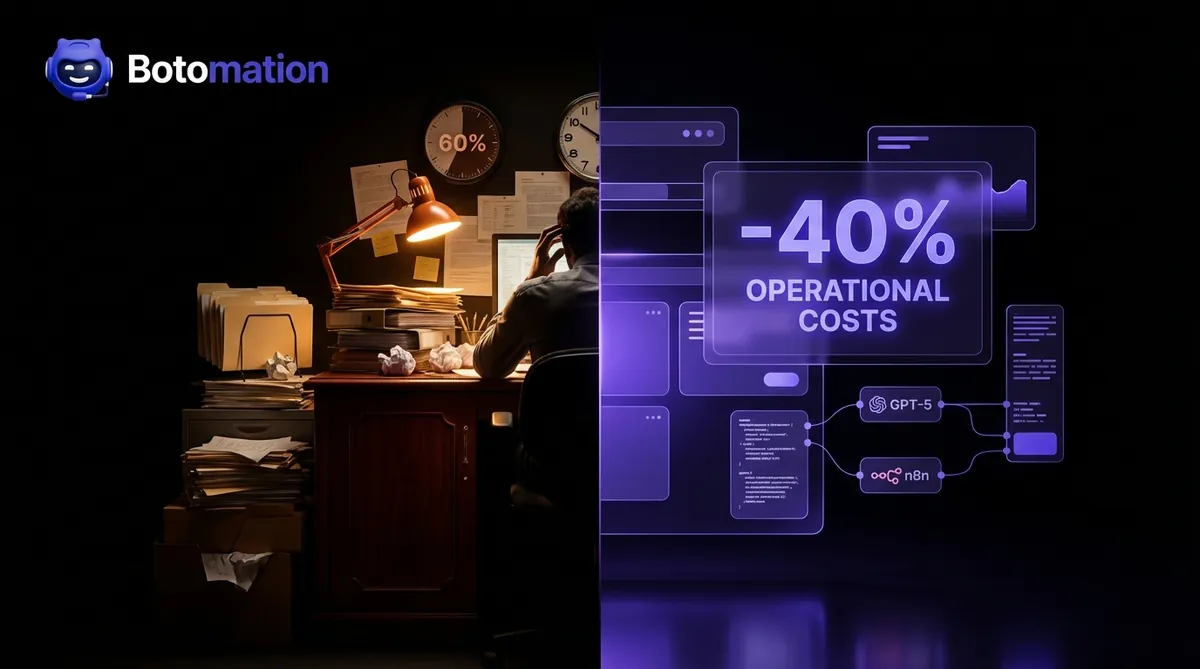
Small business owners in January 2026 are facing a unique paradox. While technology has never been more advanced, the sheer volume of administrative "noise" has reached a breaking point. Most founders find themselves trapped in a cycle of managing spreadsheets, chasing invoices, and manually updating CRMs instead of focusing on high-level strategy or product innovation. This administrative burden isn't just a nuisance; it acts as a direct tax on your profitability and growth, making AI automation of mundane tasks for small businesses a critical priority for sustainable scaling.
Recent data from late 2026 indicates that small businesses implementing AI agents for SMBs are seeing operational cost reductions ranging from 40% to 50%. These aren't just minor tweaks to existing workflows. We are seeing a fundamental shift where the ability to automate routine business tasks is replacing manual data entry and repetitive scheduling with autonomous agents. At Botomation, we have observed that the gap between "the way we've always done it" and the "automated way" is no longer a matter of convenience; it is now a matter of survival in an economy where speed is the primary currency.
The landscape of tools has also matured significantly. We are no longer limited to simple "if this, then that" triggers. Platforms like n8n, Bardeen AI, and MAKE.COM have evolved to support complex, multi-step reasoning. By integrating these with the latest models like GPT-5 and Claude 3.5, small businesses can now deploy enterprise-grade intelligence without the enterprise-grade price tag. However, the tool itself is only half the battle. The real value lies in the architectural design of these workflows.
At Botomation, we approach this not as a software subscription, but as a strategic partnership. We recognize that a generic tool won't solve a specific business bottleneck. Our experts focus on building custom revenue engines that replace slow, manual processes with 24/7 AI agents. We don't just give you a platform; we build the infrastructure that allows your business to scale without a proportional increase in headcount. This article explores how you can reclaim your time and slash your overhead by embracing the new standard of operational efficiency.
The Hidden Costs of Manual Operations and the Need for AI Automation of Mundane Tasks for Small Businesses
Many business owners believe that "doing it themselves" is the most cost-effective way to run a lean operation. This perspective often ignores the staggering hidden costs associated with manual labor. When you calculate the hourly rate of a founder or a senior manager, spending three hours a day on email sorting or invoice matching becomes an incredibly expensive endeavor. Time tracking studies conducted throughout 2024 and 2026 show that the average small business owner spends nearly 60% of their day on low-value manual tasks. This is time that could be spent on sales, networking, or improving the customer experience.
The financial drain doesn't stop at the clock. Human error remains one of the most significant, yet overlooked, expenses in small business operations. Whether it is a typo in a shipping address, a missed follow-up with a warm lead, or an error in a financial spreadsheet, the cost of correction is often triple the cost of the original task. In a manual environment, you aren't just paying for the time to do the work; you are paying for the inevitable time required to fix the mistakes. These errors erode profit margins and, perhaps more importantly, damage the trust you have built with your clients.
Expert Insight: "The most dangerous cost in a business is the one you can't see on a P&L statement. Opportunity cost—the revenue you didn't generate because you were busy with admin—is what keeps small businesses small." — Senior Consultant, Botomation.
Consider the impact on growth potential. If your current processes require a human to touch every order or every lead, your growth is capped by your hiring capacity. In the 2026 market, hiring remains expensive and slow. If you need to double your staff just to double your output, your business model is fundamentally inefficient. AI automation breaks this linear relationship between labor and revenue. It allows a small team to punch far above its weight class, handling a volume of work that would typically require a department of twenty people.
Quantifying Manual Task Impact on Small Business Profitability
When we sit down with clients, we often start by auditing their "invisible" labor. The numbers are usually shocking. A typical administrative assistant or office manager might spend 2 to 4 hours every single day just on manual data entry. This includes moving information from emails to CRMs, updating inventory logs, or syncing tools to replace manual data entry. Over a year, that equates to roughly 500 to 1,000 hours of labor dedicated to tasks that require zero creative thought.
| Task Category | Manual Hours/Week | Annual Cost (at $30/hr) | Automated Cost (Est.) |
|---|---|---|---|
| Data Entry & CRM Updates | 15 | $23,400 | $1,200 |
| Invoicing & Collections | 8 | $12,480 | $800 |
| Customer Support Sorting | 10 | $15,600 | $1,500 |
| [Social Media Scheduling](/blog/automate-social-media-posting-schedule-across-platforms-2026) | 5 | $7,800 | $400 |
| **Total** | **38** | **$59,280** | **$3,900** |
The cost of error correction adds another layer of financial strain. Industry benchmarks suggest that fixing a manual data entry error takes 2.5 times longer than the initial entry. If your team makes just five significant errors a week, you are losing an additional 10 to 12 hours of productivity. When you aggregate these numbers, the "savings" of not automating actually look like a massive annual deficit. Small businesses often find that they are paying a "manual tax" that exceeds their total annual marketing budget.
Comparison: Manual vs. Automated Process Costs
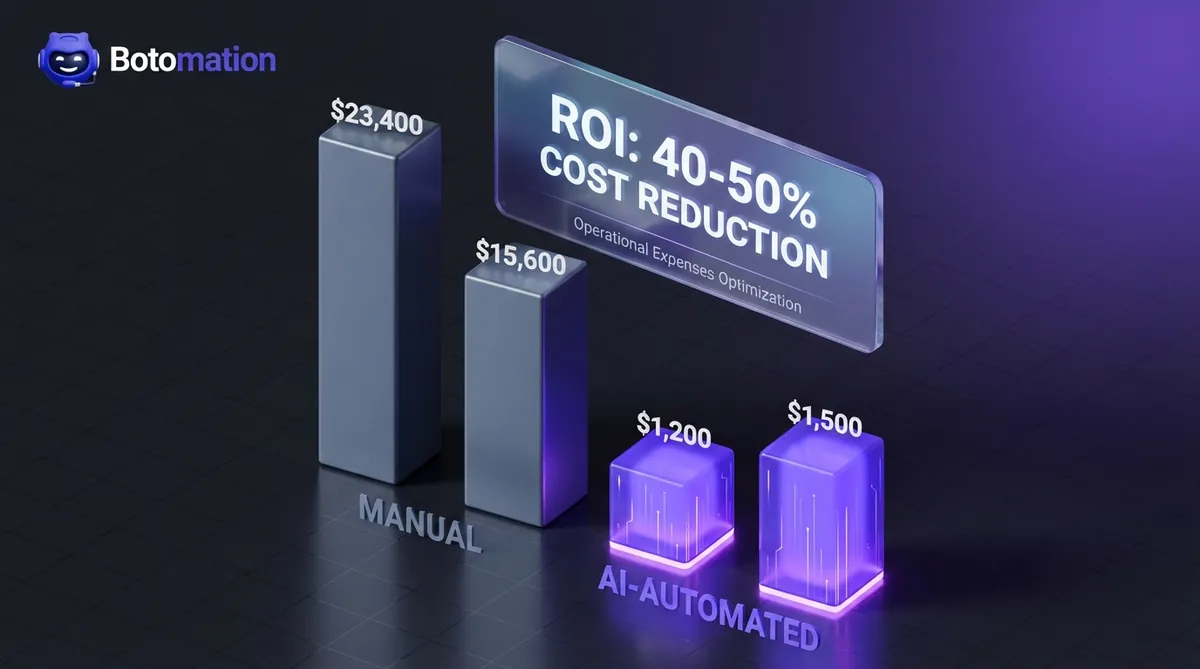
The scalability challenge is perhaps the most painful aspect of manual operations. In a manual setup, your costs scale vertically with your success. If you land a major contract, you suddenly need to hire more people to handle the paperwork, which eats into the profit of the new contract. This creates a "growth trap" where the more you succeed, the more stressed and less profitable your operations become. It is a cycle that leads to burnout and stagnation.
Automated processes offer a flat cost structure. Once an AI agent is built and deployed by our team, the cost to process 1,000 invoices is virtually the same as the cost to process 10. This shift from variable costs to fixed costs is what allows small businesses to compete with much larger organizations. Furthermore, customer satisfaction sees a natural lift when processes are automated. Customers in 2026 expect instant confirmations, immediate support, and flawless execution. Manual processes simply cannot keep up with the "instant gratification" standard of the modern economy.
Best AI Tools for AI Automation of Mundane Tasks for Small Businesses in 2026
The barrier to entry for high-level automation has vanished. In previous years, you needed a team of developers and a six-figure budget to build custom integrations. Today, the "No-Code" and "Low-Code" revolution has democratized access to these capabilities. Tools like n8n and MAKE.COM allow for the creation of sophisticated logic flows that can connect hundreds of different applications. These platforms serve as the "nervous system" of a modern business, ensuring that data flows where it needs to go without human intervention.
One of the most impressive developments we've seen this year is the rise of specialized AI agents like BlinqIO for QA and testing. While originally designed for software, the logic applies to business processes: having an AI "Test Engineer" review your workflows can reduce quality assurance costs by 60%. Similarly, Bardeen AI has made it possible to automate "browser-based" tasks—like lead scraping or competitor monitoring—with a single click. These tools are no longer experimental; they are reliable, robust, and ready for production environments.
- n8n: A powerful workflow automation tool that allows for self-hosted or cloud-based deployments. It is particularly effective for businesses that handle sensitive data and need more control than Zapier offers.
- MAKE.COM: Known for its visual interface, it allows you to see your data moving through different stages. It is excellent for complex multi-branching logic.
- Bardeen AI: A browser-based automation tool that excels at extracting data from websites and moving it into your local apps.
No-Code AI Automation Platforms
Zapier remains a household name, but in 2026, its capabilities have expanded far beyond simple triggers. With the introduction of Zapier Central, business owners can now teach AI agents how to behave across thousands of apps using natural language. This means you don't necessarily need to be a "coder" to build a logic-heavy workflow. However, for more advanced needs, we often steer our clients toward Activepieces. It is an open-source alternative that provides incredible flexibility for those who want to build custom, private automation hubs.
The user interfaces of these platforms have been redesigned to be more intuitive for non-technical users. You can now describe a process in plain English—"Every time a new lead comes in from LinkedIn, check their website for their latest blog post, summarize it, and add it to our CRM notes"—and the AI will help construct the workflow for you. This "conversational automation" is a massive leap forward, though it still requires a strategic hand to ensure the logic doesn't break when faced with edge cases.
Specialized Small Business AI Tools
Beyond general automation, specialized tools like Gumloop and Stack AI are changing how we process unstructured data. Small businesses often struggle with "messy" information—PDFs, handwritten notes, or long email threads. In the past, this required a human to read and interpret. Now, Stack AI can be trained to extract specific data points from diverse sources with 99% accuracy. This is particularly useful for industries like real estate, law, or construction, where document processing is a major bottleneck.
Pricing models have also become more small-business friendly. Most of these tools offer a "pay-as-you-go" or tiered model that starts at a very low entry point. This allows you to start small, automating one specific headache, and then scale as you see the ROI. The implementation costs are no longer about buying the software; they are about investing in the expertise to set them up correctly the first time. This is where partnering with an agency like Botomation becomes a force multiplier for your budget.
Real Examples of Small Businesses Successfully Implementing AI Automation
To understand the impact of these systems, we should look at how they are performing in the real world. A local restaurant group we consulted with was struggling to manage inventory across three locations. They were relying on managers to manually count stock and email orders to suppliers every Tuesday night. By implementing a custom AI agent that integrated their Point of Sale (POS) data with their supplier's ordering portal, they reduced waste by 22% and saved each manager five hours of work per week. The system now predicts demand based on historical trends and upcoming local events, ensuring they never over-order perishable goods.
In the retail sector, a boutique e-commerce brand used AI to solve their "customer service mountain." They were receiving hundreds of emails daily, mostly asking for shipping updates or basic product questions. We helped them deploy an AI agent that doesn't just give canned responses but actually checks the shipping carrier's API and provides real-time updates. If a customer asks a complex question, the AI summarizes the history and hands it off to a human. This didn't just save time; it improved their response time from 12 hours to 12 seconds, leading to a significant boost in customer retention.
Stat Box: The Impact of Automation
* Average Cost Reduction: 40% within the first 6 months.
* Time Reclaimed: 15-20 hours per week for business owners.
* Error Rate: Reduced from 5% (human average) to less than 0.1%.
* Scalability: 3x increase in volume capacity without new hires.
Professional services firms are perhaps the biggest beneficiaries of this shift. We recently worked with a small accounting firm that was drowning in tax season prep. Their onboarding process involved a 20-step checklist and multiple manual document requests. By choosing to automate project management and billing including document collection and initial data categorization using Stack AI, they reduced the time spent on "prep work" by 70%. This allowed the senior accountants to focus on high-value advisory services rather than chasing clients for missing PDF files.
Retail and E-commerce Automation Success Stories
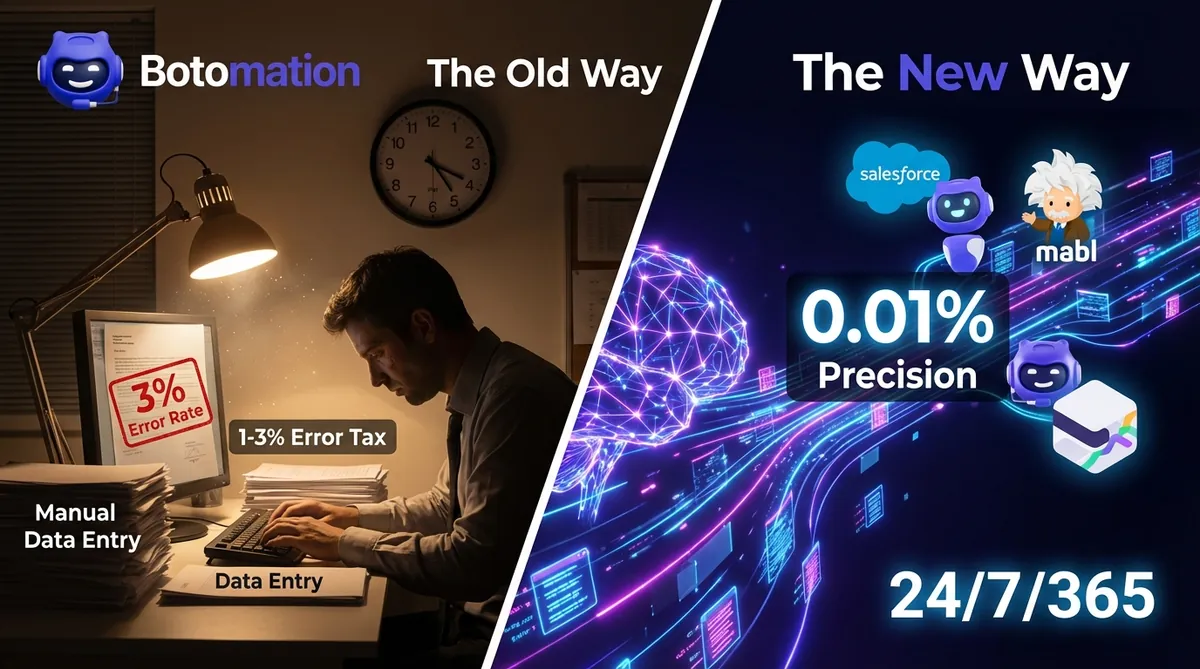
For retail businesses, the "Old Way" of managing inventory was a constant headache of spreadsheets and manual audits. The "New Way" involves AI agents that monitor sales velocity in real-time. When a specific SKU hits a threshold, the agent automatically generates a purchase order and sends it to the vendor. This prevents the "out of stock" scenarios that kill conversions. Furthermore, these agents can now handle "dynamic pricing," adjusting prices by small increments based on competitor pricing data and current demand, ensuring the business always maximizes its margins.
Sales process automation has also seen a massive upgrade. Instead of a salesperson manually following up with leads, an AI agent can nurture those leads through personalized email sequences that feel genuinely human. These agents can analyze a lead's social media profile or company news to include relevant "icebreakers" in the email. This level of personalization at scale was previously impossible for a small business. The result is a higher conversion rate and a sales team that only spends time talking to "ready-to-buy" prospects.
Professional Services AI Implementation Examples
In the world of professional services, client onboarding is often the most friction-filled part of the relationship. An automated onboarding flow ensures that every new client receives a consistent, high-touch experience. From the moment a contract is signed, the AI can create a project in the management tool, set up a shared Slack channel, send a "Welcome" gift via a fulfillment service, and schedule the kickoff call. This happens instantly, day or night, making the firm look incredibly professional and organized.
Lead qualification is another area where AI agents shine. Instead of a human spending 15 minutes researching a new inquiry, an AI agent can instantly pull the prospect's LinkedIn data, company revenue, and recent news. It then "scores" the lead based on the firm's ideal client profile and alerts the team only if the lead is a high-value match. This ensures that the most valuable opportunities are never buried in a crowded inbox.
Step-by-Step Implementation Guide for Small Business AI Automation
Starting your automation journey can feel overwhelming, but the key is to avoid trying to "boil the ocean." You don't need to automate your entire business in a single weekend. The most successful strategies for implementing AI in small businesses start with a single, high-friction task. This allows you to prove the concept, see the immediate ROI, and build the internal momentum needed for larger projects. We recommend a "crawl, walk, run" approach that focuses on stability and immediate value.
The first step is always a thorough assessment of your current workflows. Look for tasks that are "high frequency" and "low complexity." If a task happens ten times a day and follows a predictable set of rules, it is a prime candidate for an AI agent. Avoid trying to automate tasks that require deep emotional intelligence or complex ethical decision-making. Focus on the "busy work" that drains your energy and clutters your mind.
Task Assessment and Prioritization for Small Businesses
To identify the best candidates for automation, we suggest keeping a "friction log" for one week. Every time you or an employee performs a task that feels repetitive or boring, write it down and note how long it took. At the end of the week, you will likely have a list of 5 to 10 tasks that are eating up a significant portion of your team's time. Rank these tasks based on two factors: how much time they take and how easy they are to define as a set of rules.
A cost-benefit analysis doesn't have to be complicated. If a task takes 5 hours a week and you value your time at $100/hour, that task is costing you $26,000 a year. If an AI agent can handle 90% of that task for a $50/month software fee and a one-time setup cost, the decision becomes a "no-brainer." Always start with the project that has the highest ROI and the lowest technical risk. This "pilot project" will serve as the blueprint for your future automation efforts.
Tool Selection and Setup Process
Choosing the right tool is about more than just features; it is about integration. Your automation hub needs to "talk" to the tools you already use—your CRM, your email provider, and your accounting software. If you are heavily invested in the Google ecosystem, tools with native Google Workspace integrations should be at the top of your list. If you require high-level security or custom code execution, n8n is often the superior choice.
Tutorial: Setting Up Your First AI Lead Responder
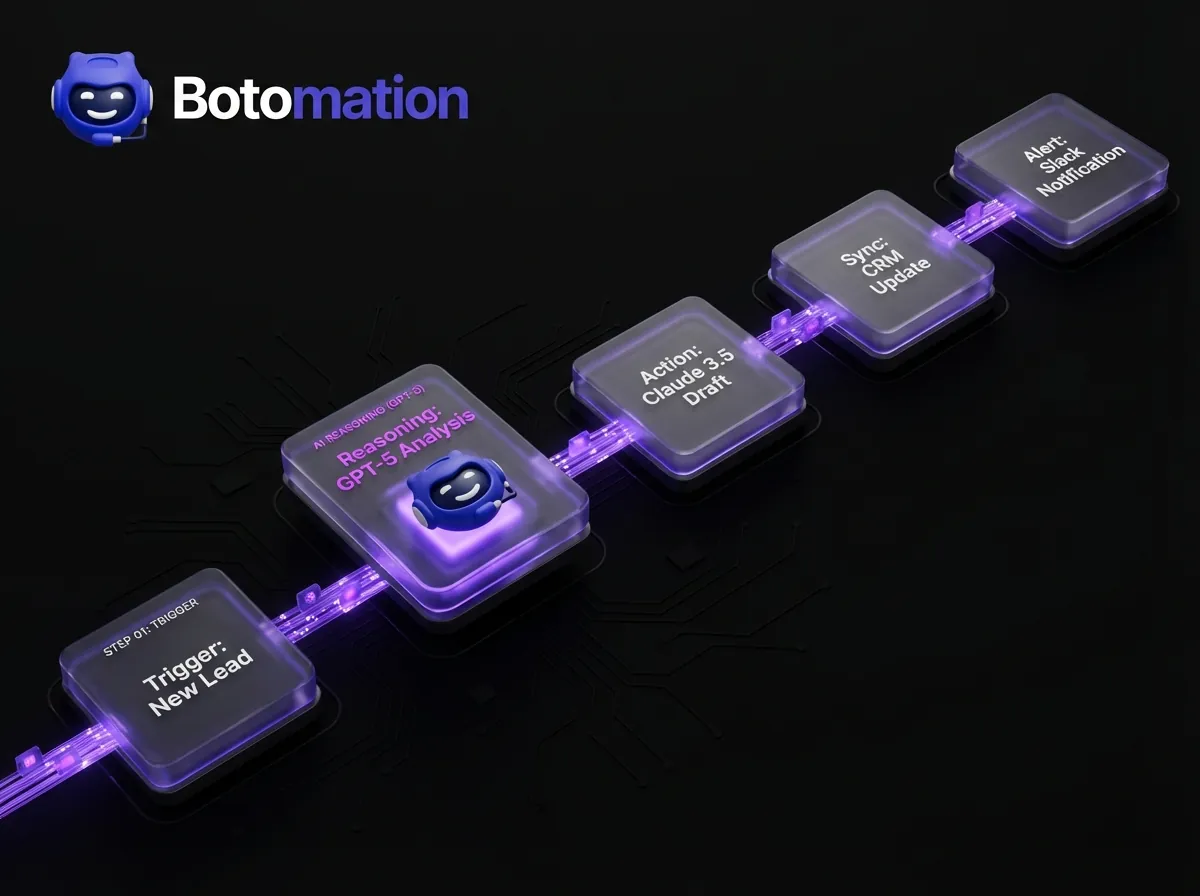
- Define the Trigger: Use a tool like MAKE.COM to watch for new entries in your website's contact form (e.g., Elementor, Typeform).
- Add a Reasoning Step: Connect the form data to an OpenAI or Claude module. Give it a prompt like: "Analyze this lead's message. If they are asking for pricing, summarize our standard packages. If they are asking for a meeting, provide our booking link."
- Perform the Action: Send a personalized email via Gmail or Outlook.
- Update the CRM: Automatically create a new "Deal" in Pipedrive or HubSpot with the AI's summary included in the notes.
- Notify the Team: Send a quick alert to a Slack channel so the team knows a response has already been sent.
Once the tool is selected, the setup process should include a "testing phase" where the AI agent runs in parallel with a human. This allows you to catch any logic errors before the system goes fully autonomous. Training your team is also crucial. They need to understand that the AI isn't there to replace them, but to act as their "digital assistant," taking over the tasks they likely hate doing anyway. This shift in mindset is what transforms a "tool" into a true operational advantage.
Monitoring and Optimization After Implementation
Deployment is not the end of the journey; it is the beginning of a new phase of optimization. You should track key metrics like "Time Saved" and "Error Rate" to ensure the system is performing as expected. AI models can sometimes "drift" or produce unexpected results if the input data changes significantly. Regular check-ins—perhaps once a month—allow you to tweak the prompts and logic to keep the system running at peak efficiency.
As your business grows, your automation needs will evolve. A system that works for 100 customers might need adjustments to handle 10,000. This is the beauty of the Botomation approach. We build systems that are designed to scale. By using modular architecture, we can add new capabilities—like voice-to-text processing or advanced sentiment analysis—without having to rebuild your entire infrastructure from scratch.
Calculating ROI and Measuring Success in Small Business AI Implementation
The ultimate measure of any business investment is the Return on Investment (ROI). In the world of AI automation, ROI is often much higher and much faster than traditional software investments. However, you must look beyond just the "hours saved." You need to consider the total impact on your business's health. This includes both quantitative data (the numbers) and qualitative benefits (the "feel" of the business).
When calculating the financial impact, start with the base salary of the employees involved, but don't forget to include benefits, taxes, and overhead. A $45,000/year employee actually costs a business closer to $56,250 when you factor in these extras. If an AI agent can reclaim 40% of that person's time, you have effectively "gained" $22,500 in productive capacity. This isn't just a cost saving; it's a revenue-generating opportunity, as that employee can now focus on tasks that actually move the needle.
Financial Impact Measurement for Small Businesses
To get a true picture of the ROI, we look at the "Cost Per Task." For example, if it manually costs $15 in labor to process a single purchase order, and the automated system brings that cost down to $0.50, the math is undeniable. Over 1,000 orders, you've saved $14,500. These savings go directly to your bottom line. Furthermore, the reduction in errors can save thousands more in "re-work" costs and customer churn.
- Manual Cost: $45,000 base + $11,250 benefits = $56,250 total.
- Time Reclaimed: 40% of 2,000 annual hours = 800 hours.
- Value of Reclaimed Time: $22,500 in labor value redirected to growth.
- Automation Cost: $3,000 (setup) + $1,200 (annual software) = $4,200.
- First Year Net Gain: $18,300 + 800 hours of founder/staff focus.
The "Break-Even" point for most of our automation projects is typically between 3 and 5 months. After that point, the system is essentially printing money for the business by operating at a fraction of the cost of manual labor. This financial freedom allows small businesses to reinvest in marketing, product development, or further automation, creating a virtuous cycle of efficiency and growth.
Growth and Scalability Benefits
While the financial numbers are compelling, the qualitative benefits are often what founders appreciate most. There is a profound psychological relief that comes from knowing your "boring but critical" tasks are being handled perfectly by a system that never sleeps, never gets sick, and never has a "bad day." This reduces the mental load on the leadership team, allowing for clearer thinking and better decision-making.
Automation also provides a massive competitive advantage. In an industry where everyone else is slow and prone to errors, being the firm that responds instantly and executes flawlessly is a powerful differentiator. You can handle more volume, offer better prices, and provide a superior customer experience. This is how small businesses in 2026 are disrupting established players. They aren't out-spending them; they are out-automating them.
Frequently Asked Questions
Will AI automation replace my current employees?
No. The goal of automation is to augment your team, not replace them. By removing the mundane, repetitive tasks that cause burnout, your employees can focus on high-value work that requires human creativity, empathy, and strategy. Most businesses find that automation allows them to grow their revenue significantly without needing to add new headcount.
Is AI automation too expensive for a very small business?
Not at all. With the rise of no-code tools and tiered pricing models, automation is more accessible than ever. The cost of not automating—in terms of lost time and errors—is usually much higher than the investment in the technology. We specialize in building cost-effective solutions that provide a clear, rapid ROI for small to mid-sized operations.
How long does it take to see results from AI agents?
Most businesses see an immediate reduction in their "to-do" list within the first week of a pilot project. Full operational cost reductions typically manifest within 3 to 6 months as the systems are refined and expanded across different departments.
Is my data safe when using these AI tools?
Security is a top priority. When we build systems for our clients, we use enterprise-grade encryption and can even set up self-hosted environments (using tools like n8n) where your data never leaves your own servers. We ensure that all automations comply with relevant data protection regulations.
The shift toward AI-driven operations is the defining business trend of 2026. The data is clear: small businesses that embrace AI agents can reduce their operational costs by 40% or more, while simultaneously increasing their capacity for growth. This isn't about chasing a "shiny new toy"; it is about building a modern, resilient business infrastructure that can thrive in an increasingly competitive landscape.
The "Old Way" of manual, slow, and expensive operations is a recipe for stagnation. The "New Way"—partnering with experts to build intelligent, custom-coded automation engines—is the path to true scalability. At Botomation, we don't just sell software; we provide the premium agency expertise needed to transform your business into a high-speed revenue engine. We bridge the gap between complex AI technology and practical, bottom-line results.
Ready to automate your growth? Stop losing money on manual tasks and start building your revenue engine today. Book a free consultation call below.
Small business owners in January 2026 are facing a unique paradox. While technology has never been more advanced, the sheer volume of administrative "noise" has reached a breaking point. Most founders find themselves trapped in a cycle of managing spreadsheets, chasing invoices, and manually updating CRMs instead of focusing on high-level strategy or product innovation. This administrative burden isn't just a nuisance; it acts as a direct tax on your profitability and growth, making AI automation of mundane tasks for small businesses a critical priority for sustainable scaling.
Recent data from late 2026 indicates that small businesses implementing AI agents for SMBs are seeing operational cost reductions ranging from 40% to 50%. These aren't just minor tweaks to existing workflows. We are seeing a fundamental shift where the ability to automate routine business tasks is replacing manual data entry and repetitive scheduling with autonomous agents. At Botomation, we have observed that the gap between "the way we've always done it" and the "automated way" is no longer a matter of convenience; it is now a matter of survival in an economy where speed is the primary currency.
The landscape of tools has also matured significantly. We are no longer limited to simple "if this, then that" triggers. Platforms like n8n, Bardeen AI, and MAKE.COM have evolved to support complex, multi-step reasoning. By integrating these with the latest models like GPT-5 and Claude 3.5, small businesses can now deploy enterprise-grade intelligence without the enterprise-grade price tag. However, the tool itself is only half the battle. The real value lies in the architectural design of these workflows.
At Botomation, we approach this not as a software subscription, but as a strategic partnership. We recognize that a generic tool won't solve a specific business bottleneck. Our experts focus on building custom revenue engines that replace slow, manual processes with 24/7 AI agents. We don't just give you a platform; we build the infrastructure that allows your business to scale without a proportional increase in headcount. This article explores how you can reclaim your time and slash your overhead by embracing the new standard of operational efficiency.
The Hidden Costs of Manual Operations and the Need for AI Automation of Mundane Tasks for Small Businesses
Many business owners believe that "doing it themselves" is the most cost-effective way to run a lean operation. This perspective often ignores the staggering hidden costs associated with manual labor. When you calculate the hourly rate of a founder or a senior manager, spending three hours a day on email sorting or invoice matching becomes an incredibly expensive endeavor. Time tracking studies conducted throughout 2024 and 2026 show that the average small business owner spends nearly 60% of their day on low-value manual tasks. This is time that could be spent on sales, networking, or improving the customer experience.
The financial drain doesn't stop at the clock. Human error remains one of the most significant, yet overlooked, expenses in small business operations. Whether it is a typo in a shipping address, a missed follow-up with a warm lead, or an error in a financial spreadsheet, the cost of correction is often triple the cost of the original task. In a manual environment, you aren't just paying for the time to do the work; you are paying for the inevitable time required to fix the mistakes. These errors erode profit margins and, perhaps more importantly, damage the trust you have built with your clients.
Expert Insight: "The most dangerous cost in a business is the one you can't see on a P&L statement. Opportunity cost—the revenue you didn't generate because you were busy with admin—is what keeps small businesses small." — Senior Consultant, Botomation.
Consider the impact on growth potential. If your current processes require a human to touch every order or every lead, your growth is capped by your hiring capacity. In the 2026 market, hiring remains expensive and slow. If you need to double your staff just to double your output, your business model is fundamentally inefficient. AI automation breaks this linear relationship between labor and revenue. It allows a small team to punch far above its weight class, handling a volume of work that would typically require a department of twenty people.
Quantifying Manual Task Impact on Small Business Profitability
When we sit down with clients, we often start by auditing their "invisible" labor. The numbers are usually shocking. A typical administrative assistant or office manager might spend 2 to 4 hours every single day just on manual data entry. This includes moving information from emails to CRMs, updating inventory logs, or syncing tools to replace manual data entry. Over a year, that equates to roughly 500 to 1,000 hours of labor dedicated to tasks that require zero creative thought.
| Task Category | Manual Hours/Week | Annual Cost (at $30/hr) | Automated Cost (Est.) |
|---|---|---|---|
| Data Entry & CRM Updates | 15 | $23,400 | $1,200 |
| Invoicing & Collections | 8 | $12,480 | $800 |
| Customer Support Sorting | 10 | $15,600 | $1,500 |
| [Social Media Scheduling](/blog/automate-social-media-posting-schedule-across-platforms-2026) | 5 | $7,800 | $400 |
| **Total** | **38** | **$59,280** | **$3,900** |
The cost of error correction adds another layer of financial strain. Industry benchmarks suggest that fixing a manual data entry error takes 2.5 times longer than the initial entry. If your team makes just five significant errors a week, you are losing an additional 10 to 12 hours of productivity. When you aggregate these numbers, the "savings" of not automating actually look like a massive annual deficit. Small businesses often find that they are paying a "manual tax" that exceeds their total annual marketing budget.
Comparison: Manual vs. Automated Process Costs
The scalability challenge is perhaps the most painful aspect of manual operations. In a manual setup, your costs scale vertically with your success. If you land a major contract, you suddenly need to hire more people to handle the paperwork, which eats into the profit of the new contract. This creates a "growth trap" where the more you succeed, the more stressed and less profitable your operations become. It is a cycle that leads to burnout and stagnation.
Automated processes offer a flat cost structure. Once an AI agent is built and deployed by our team, the cost to process 1,000 invoices is virtually the same as the cost to process 10. This shift from variable costs to fixed costs is what allows small businesses to compete with much larger organizations. Furthermore, customer satisfaction sees a natural lift when processes are automated. Customers in 2026 expect instant confirmations, immediate support, and flawless execution. Manual processes simply cannot keep up with the "instant gratification" standard of the modern economy.
Best AI Tools for AI Automation of Mundane Tasks for Small Businesses in 2026
The barrier to entry for high-level automation has vanished. In previous years, you needed a team of developers and a six-figure budget to build custom integrations. Today, the "No-Code" and "Low-Code" revolution has democratized access to these capabilities. Tools like n8n and MAKE.COM allow for the creation of sophisticated logic flows that can connect hundreds of different applications. These platforms serve as the "nervous system" of a modern business, ensuring that data flows where it needs to go without human intervention.
One of the most impressive developments we've seen this year is the rise of specialized AI agents like BlinqIO for QA and testing. While originally designed for software, the logic applies to business processes: having an AI "Test Engineer" review your workflows can reduce quality assurance costs by 60%. Similarly, Bardeen AI has made it possible to automate "browser-based" tasks—like lead scraping or competitor monitoring—with a single click. These tools are no longer experimental; they are reliable, robust, and ready for production environments.
- n8n: A powerful workflow automation tool that allows for self-hosted or cloud-based deployments. It is particularly effective for businesses that handle sensitive data and need more control than Zapier offers.
- MAKE.COM: Known for its visual interface, it allows you to see your data moving through different stages. It is excellent for complex multi-branching logic.
- Bardeen AI: A browser-based automation tool that excels at extracting data from websites and moving it into your local apps.
No-Code AI Automation Platforms
Zapier remains a household name, but in 2026, its capabilities have expanded far beyond simple triggers. With the introduction of Zapier Central, business owners can now teach AI agents how to behave across thousands of apps using natural language. This means you don't necessarily need to be a "coder" to build a logic-heavy workflow. However, for more advanced needs, we often steer our clients toward Activepieces. It is an open-source alternative that provides incredible flexibility for those who want to build custom, private automation hubs.
The user interfaces of these platforms have been redesigned to be more intuitive for non-technical users. You can now describe a process in plain English—"Every time a new lead comes in from LinkedIn, check their website for their latest blog post, summarize it, and add it to our CRM notes"—and the AI will help construct the workflow for you. This "conversational automation" is a massive leap forward, though it still requires a strategic hand to ensure the logic doesn't break when faced with edge cases.
Specialized Small Business AI Tools
Beyond general automation, specialized tools like Gumloop and Stack AI are changing how we process unstructured data. Small businesses often struggle with "messy" information—PDFs, handwritten notes, or long email threads. In the past, this required a human to read and interpret. Now, Stack AI can be trained to extract specific data points from diverse sources with 99% accuracy. This is particularly useful for industries like real estate, law, or construction, where document processing is a major bottleneck.
Pricing models have also become more small-business friendly. Most of these tools offer a "pay-as-you-go" or tiered model that starts at a very low entry point. This allows you to start small, automating one specific headache, and then scale as you see the ROI. The implementation costs are no longer about buying the software; they are about investing in the expertise to set them up correctly the first time. This is where partnering with an agency like Botomation becomes a force multiplier for your budget.
Real Examples of Small Businesses Successfully Implementing AI Automation
To understand the impact of these systems, we should look at how they are performing in the real world. A local restaurant group we consulted with was struggling to manage inventory across three locations. They were relying on managers to manually count stock and email orders to suppliers every Tuesday night. By implementing a custom AI agent that integrated their Point of Sale (POS) data with their supplier's ordering portal, they reduced waste by 22% and saved each manager five hours of work per week. The system now predicts demand based on historical trends and upcoming local events, ensuring they never over-order perishable goods.
In the retail sector, a boutique e-commerce brand used AI to solve their "customer service mountain." They were receiving hundreds of emails daily, mostly asking for shipping updates or basic product questions. We helped them deploy an AI agent that doesn't just give canned responses but actually checks the shipping carrier's API and provides real-time updates. If a customer asks a complex question, the AI summarizes the history and hands it off to a human. This didn't just save time; it improved their response time from 12 hours to 12 seconds, leading to a significant boost in customer retention.
Stat Box: The Impact of Automation
* Average Cost Reduction: 40% within the first 6 months.
* Time Reclaimed: 15-20 hours per week for business owners.
* Error Rate: Reduced from 5% (human average) to less than 0.1%.
* Scalability: 3x increase in volume capacity without new hires.
Professional services firms are perhaps the biggest beneficiaries of this shift. We recently worked with a small accounting firm that was drowning in tax season prep. Their onboarding process involved a 20-step checklist and multiple manual document requests. By choosing to automate project management and billing including document collection and initial data categorization using Stack AI, they reduced the time spent on "prep work" by 70%. This allowed the senior accountants to focus on high-value advisory services rather than chasing clients for missing PDF files.
Retail and E-commerce Automation Success Stories
For retail businesses, the "Old Way" of managing inventory was a constant headache of spreadsheets and manual audits. The "New Way" involves AI agents that monitor sales velocity in real-time. When a specific SKU hits a threshold, the agent automatically generates a purchase order and sends it to the vendor. This prevents the "out of stock" scenarios that kill conversions. Furthermore, these agents can now handle "dynamic pricing," adjusting prices by small increments based on competitor pricing data and current demand, ensuring the business always maximizes its margins.
Sales process automation has also seen a massive upgrade. Instead of a salesperson manually following up with leads, an AI agent can nurture those leads through personalized email sequences that feel genuinely human. These agents can analyze a lead's social media profile or company news to include relevant "icebreakers" in the email. This level of personalization at scale was previously impossible for a small business. The result is a higher conversion rate and a sales team that only spends time talking to "ready-to-buy" prospects.
Professional Services AI Implementation Examples
In the world of professional services, client onboarding is often the most friction-filled part of the relationship. An automated onboarding flow ensures that every new client receives a consistent, high-touch experience. From the moment a contract is signed, the AI can create a project in the management tool, set up a shared Slack channel, send a "Welcome" gift via a fulfillment service, and schedule the kickoff call. This happens instantly, day or night, making the firm look incredibly professional and organized.
Lead qualification is another area where AI agents shine. Instead of a human spending 15 minutes researching a new inquiry, an AI agent can instantly pull the prospect's LinkedIn data, company revenue, and recent news. It then "scores" the lead based on the firm's ideal client profile and alerts the team only if the lead is a high-value match. This ensures that the most valuable opportunities are never buried in a crowded inbox.
Step-by-Step Implementation Guide for Small Business AI Automation
Starting your automation journey can feel overwhelming, but the key is to avoid trying to "boil the ocean." You don't need to automate your entire business in a single weekend. The most successful strategies for implementing AI in small businesses start with a single, high-friction task. This allows you to prove the concept, see the immediate ROI, and build the internal momentum needed for larger projects. We recommend a "crawl, walk, run" approach that focuses on stability and immediate value.
The first step is always a thorough assessment of your current workflows. Look for tasks that are "high frequency" and "low complexity." If a task happens ten times a day and follows a predictable set of rules, it is a prime candidate for an AI agent. Avoid trying to automate tasks that require deep emotional intelligence or complex ethical decision-making. Focus on the "busy work" that drains your energy and clutters your mind.
Task Assessment and Prioritization for Small Businesses
To identify the best candidates for automation, we suggest keeping a "friction log" for one week. Every time you or an employee performs a task that feels repetitive or boring, write it down and note how long it took. At the end of the week, you will likely have a list of 5 to 10 tasks that are eating up a significant portion of your team's time. Rank these tasks based on two factors: how much time they take and how easy they are to define as a set of rules.
A cost-benefit analysis doesn't have to be complicated. If a task takes 5 hours a week and you value your time at $100/hour, that task is costing you $26,000 a year. If an AI agent can handle 90% of that task for a $50/month software fee and a one-time setup cost, the decision becomes a "no-brainer." Always start with the project that has the highest ROI and the lowest technical risk. This "pilot project" will serve as the blueprint for your future automation efforts.
Tool Selection and Setup Process
Choosing the right tool is about more than just features; it is about integration. Your automation hub needs to "talk" to the tools you already use—your CRM, your email provider, and your accounting software. If you are heavily invested in the Google ecosystem, tools with native Google Workspace integrations should be at the top of your list. If you require high-level security or custom code execution, n8n is often the superior choice.
Tutorial: Setting Up Your First AI Lead Responder
- Define the Trigger: Use a tool like MAKE.COM to watch for new entries in your website's contact form (e.g., Elementor, Typeform).
- Add a Reasoning Step: Connect the form data to an OpenAI or Claude module. Give it a prompt like: "Analyze this lead's message. If they are asking for pricing, summarize our standard packages. If they are asking for a meeting, provide our booking link."
- Perform the Action: Send a personalized email via Gmail or Outlook.
- Update the CRM: Automatically create a new "Deal" in Pipedrive or HubSpot with the AI's summary included in the notes.
- Notify the Team: Send a quick alert to a Slack channel so the team knows a response has already been sent.
Once the tool is selected, the setup process should include a "testing phase" where the AI agent runs in parallel with a human. This allows you to catch any logic errors before the system goes fully autonomous. Training your team is also crucial. They need to understand that the AI isn't there to replace them, but to act as their "digital assistant," taking over the tasks they likely hate doing anyway. This shift in mindset is what transforms a "tool" into a true operational advantage.
Monitoring and Optimization After Implementation
Deployment is not the end of the journey; it is the beginning of a new phase of optimization. You should track key metrics like "Time Saved" and "Error Rate" to ensure the system is performing as expected. AI models can sometimes "drift" or produce unexpected results if the input data changes significantly. Regular check-ins—perhaps once a month—allow you to tweak the prompts and logic to keep the system running at peak efficiency.
As your business grows, your automation needs will evolve. A system that works for 100 customers might need adjustments to handle 10,000. This is the beauty of the Botomation approach. We build systems that are designed to scale. By using modular architecture, we can add new capabilities—like voice-to-text processing or advanced sentiment analysis—without having to rebuild your entire infrastructure from scratch.
Calculating ROI and Measuring Success in Small Business AI Implementation
The ultimate measure of any business investment is the Return on Investment (ROI). In the world of AI automation, ROI is often much higher and much faster than traditional software investments. However, you must look beyond just the "hours saved." You need to consider the total impact on your business's health. This includes both quantitative data (the numbers) and qualitative benefits (the "feel" of the business).
When calculating the financial impact, start with the base salary of the employees involved, but don't forget to include benefits, taxes, and overhead. A $45,000/year employee actually costs a business closer to $56,250 when you factor in these extras. If an AI agent can reclaim 40% of that person's time, you have effectively "gained" $22,500 in productive capacity. This isn't just a cost saving; it's a revenue-generating opportunity, as that employee can now focus on tasks that actually move the needle.
Financial Impact Measurement for Small Businesses
To get a true picture of the ROI, we look at the "Cost Per Task." For example, if it manually costs $15 in labor to process a single purchase order, and the automated system brings that cost down to $0.50, the math is undeniable. Over 1,000 orders, you've saved $14,500. These savings go directly to your bottom line. Furthermore, the reduction in errors can save thousands more in "re-work" costs and customer churn.
- Manual Cost: $45,000 base + $11,250 benefits = $56,250 total.
- Time Reclaimed: 40% of 2,000 annual hours = 800 hours.
- Value of Reclaimed Time: $22,500 in labor value redirected to growth.
- Automation Cost: $3,000 (setup) + $1,200 (annual software) = $4,200.
- First Year Net Gain: $18,300 + 800 hours of founder/staff focus.
The "Break-Even" point for most of our automation projects is typically between 3 and 5 months. After that point, the system is essentially printing money for the business by operating at a fraction of the cost of manual labor. This financial freedom allows small businesses to reinvest in marketing, product development, or further automation, creating a virtuous cycle of efficiency and growth.
Growth and Scalability Benefits
While the financial numbers are compelling, the qualitative benefits are often what founders appreciate most. There is a profound psychological relief that comes from knowing your "boring but critical" tasks are being handled perfectly by a system that never sleeps, never gets sick, and never has a "bad day." This reduces the mental load on the leadership team, allowing for clearer thinking and better decision-making.
Automation also provides a massive competitive advantage. In an industry where everyone else is slow and prone to errors, being the firm that responds instantly and executes flawlessly is a powerful differentiator. You can handle more volume, offer better prices, and provide a superior customer experience. This is how small businesses in 2026 are disrupting established players. They aren't out-spending them; they are out-automating them.
Frequently Asked Questions
Will AI automation replace my current employees?
No. The goal of automation is to augment your team, not replace them. By removing the mundane, repetitive tasks that cause burnout, your employees can focus on high-value work that requires human creativity, empathy, and strategy. Most businesses find that automation allows them to grow their revenue significantly without needing to add new headcount.
Is AI automation too expensive for a very small business?
Not at all. With the rise of no-code tools and tiered pricing models, automation is more accessible than ever. The cost of not automating—in terms of lost time and errors—is usually much higher than the investment in the technology. We specialize in building cost-effective solutions that provide a clear, rapid ROI for small to mid-sized operations.
How long does it take to see results from AI agents?
Most businesses see an immediate reduction in their "to-do" list within the first week of a pilot project. Full operational cost reductions typically manifest within 3 to 6 months as the systems are refined and expanded across different departments.
Is my data safe when using these AI tools?
Security is a top priority. When we build systems for our clients, we use enterprise-grade encryption and can even set up self-hosted environments (using tools like n8n) where your data never leaves your own servers. We ensure that all automations comply with relevant data protection regulations.
The shift toward AI-driven operations is the defining business trend of 2026. The data is clear: small businesses that embrace AI agents can reduce their operational costs by 40% or more, while simultaneously increasing their capacity for growth. This isn't about chasing a "shiny new toy"; it is about building a modern, resilient business infrastructure that can thrive in an increasingly competitive landscape.
The "Old Way" of manual, slow, and expensive operations is a recipe for stagnation. The "New Way"—partnering with experts to build intelligent, custom-coded automation engines—is the path to true scalability. At Botomation, we don't just sell software; we provide the premium agency expertise needed to transform your business into a high-speed revenue engine. We bridge the gap between complex AI technology and practical, bottom-line results.
Ready to automate your growth? Stop losing money on manual tasks and start building your revenue engine today. Book a free consultation call below.
Get Started
Book a FREE Consultation Right NOW!
Schedule a Call with Our Team To Make Your Business More Efficient with AI Instantly.
Read More
AI Automation for Small Businesses Cuts Costs by 40 Percent
Scale with AI automation of mundane tasks for small businesses. Deploy AI agents via n8n and Make to cut costs 40% and boost operational efficiency.
Automate Repetitive Business Tasks with AI - 2026 Guide
Learn how WhatsApp AI slashes support costs for e-commerce & SaaS. Proven strategies to boost sales, recover carts, and scale 24/7 service.