How AI Agents Can Replace Manual Data Entry Work in 2026
Feb 17, 2026
AI Automation
Data Management
Business Efficiency
AI Automation
Data Management
Business Efficiency
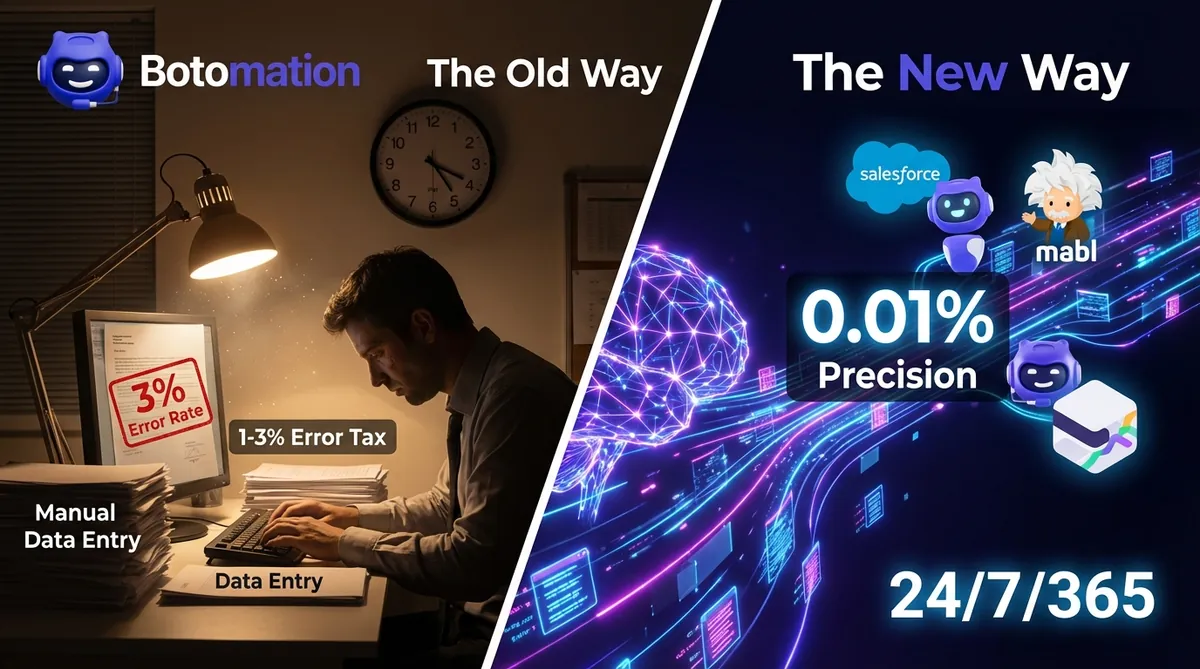
In late 2026, business leaders are increasingly asking how to automate repetitive business tasks with AI agents to overcome the limitations of traditional human-led processes. The landscape of modern business operations has reached a critical tipping point where traditional reliance on manual data entry is no longer just a slow process, but a significant competitive liability. As we navigate through this digital era, the sheer volume of data generated by digital interactions has vastly outpaced the human capacity to process it accurately or cost-effectively. Organizations that continue to tether their growth to manual keyboard-and-mouse labor find themselves trapped in a cycle of escalating overhead and diminishing returns. At Botomation, we have seen firsthand how these legacy workflows create invisible ceilings on organizational potential.
Recent industry benchmarks reveal a staggering reality that forward-thinking executives are now prioritizing. Current estimates suggest that approximately 70% of all data entry tasks currently performed by human staff can be fully automated using the sophisticated AI agents available today. We are no longer discussing simple macros or rigid scripts that break at the slightest change in a website’s user interface. With the maturation of Salesforce Einstein’s autonomous capabilities and the evolution of mabl for intelligent data creation, the "New Way" of doing business has arrived. These agents possess the cognitive flexibility to interpret unstructured data, navigate complex software interfaces, and execute tasks with a level of precision that humans simply cannot maintain over an eight-hour shift.
Transitioning from manual labor to AI-powered data processing is a strategic necessity for any founder or CEO looking to scale business operations with AI automation without a linear increase in headcount. Botomation serves as the bridge for businesses caught in this transition, moving them away from the "Old Way" of slow, error-prone manual entry toward a future of instant, 24/7 autonomous operations. By replacing manual tasks with intelligent agents, we help our partners turn data processing from a cost center into a high-speed revenue engine. This article explores how AI agents can replace manual data entry work to fundamentally reshape the workplace and why partnering with an expert agency is the most effective way to stay ahead of the curve.
Why is the Scale and Cost of Manual Data Entry a Problem for Modern Businesses?
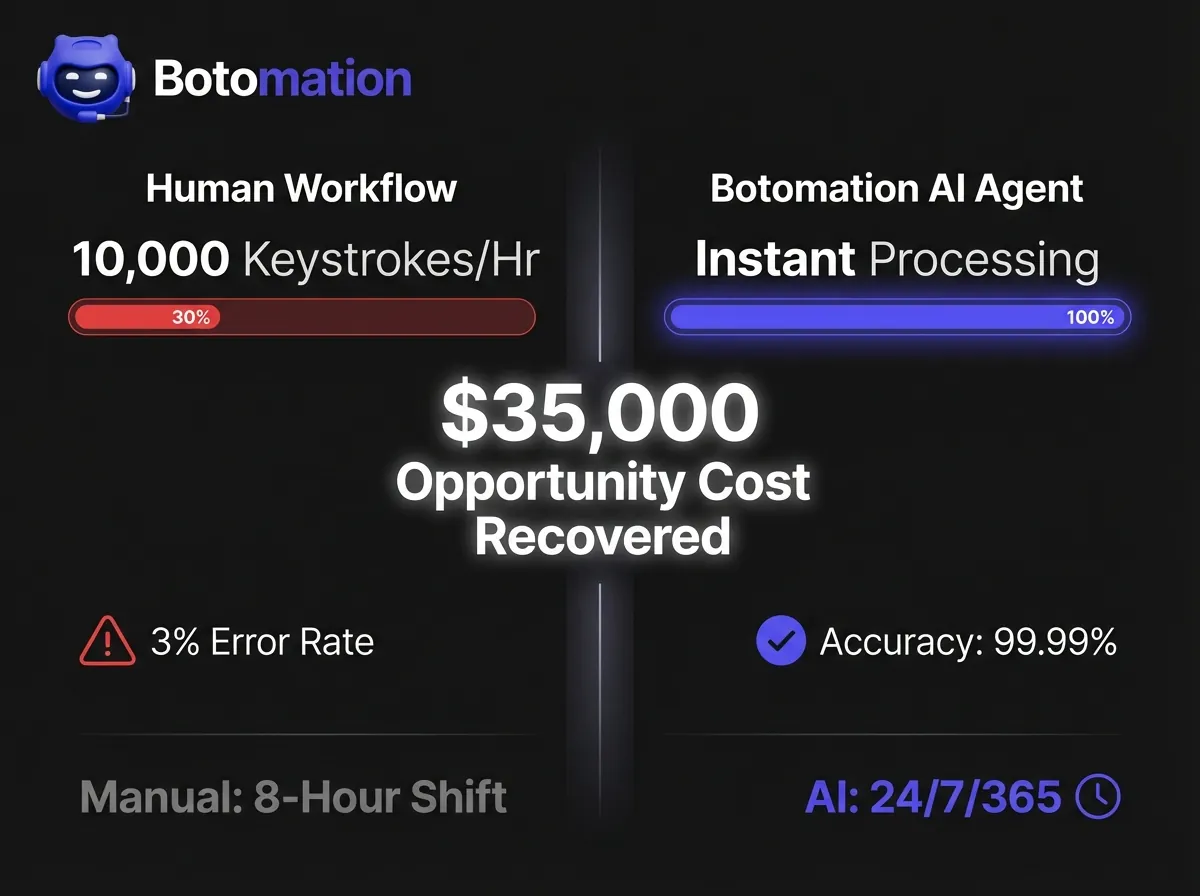
The financial drain of manual data entry is often obscured because it is spread across dozens of different roles and departments. When conducting operational audits for our clients, we frequently find that skilled employees—from accountants to marketing managers—lose 30% to 60% of their workday to basic data manipulation. This is not merely a waste of specialized talent; it is a direct hit to the company’s bottom line. While a human worker might process a few hundred records in a day, they remain subject to fatigue, distraction, and the physical limits of human speed. In a 2026 business environment that moves at the speed of fiber optics, relying on manual typing is equivalent to using a horse-drawn carriage on a Formula 1 track.
Beyond direct labor costs, the hidden "error tax" of manual entry is perhaps the most dangerous threat to business integrity. Human error rates in data processing typically hover between 1% and 3%, which may seem negligible until you consider the cumulative effect. One mistyped digit in a financial record or a single transposed letter in a patient’s medical history can trigger a cascade of operational failures costing thousands of dollars to rectify. AI systems, by contrast, have pushed error rates down to 0.01% or lower by utilizing real-time data entry validation, providing a level of data integrity that human teams cannot match. These digital workers for data management ensure that the manual oversight model is rapidly becoming obsolete for efficiency-focused leaders.
How Can You Quantify the Data Entry Problem?
To truly understand this burden, one must examine the opportunity cost of manual workflows. When a $70,000-a-year employee spends half their time on data entry, the business is not just paying $35,000 for clerical work; it is losing $35,000 worth of strategic output that could have driven growth. Across high-volume industries like logistics, healthcare, and finance, the aggregate loss is staggering. Our experts at Botomation have calculated that for a mid-sized enterprise, the transition to AI agents often recovers thousands of hours of productive time in the first year alone. This recovered time allows teams to focus on customer relationships and innovation by following a complete guide to automated data sync for CRM rather than manual spreadsheet management.
What Does Current Industry Data Say About Data Entry Workloads?
The volume of data requiring processing has grown exponentially, yet the methods for handling it have largely remained stagnant in many organizations. Employees are now expected to connect disparate software tools to manage data across a dozen different platforms, from Slack and email to specialized ERP systems. During seasonal peaks, such as the end of the fiscal year or holiday shopping periods, the workload often becomes unmanageable, leading to burnout and even higher error rates. We are seeing a trend where data volume growth is outstripping the ability of companies to hire their way out of the problem. This is where the scalability of AI agents becomes a decisive advantage.
How AI Agents Can Replace Manual Data Entry Work More Effectively Than Humans?
The performance gap between human workers and AI agents has widened significantly with the release of GPT-5 and specialized tools like LambdaTest KaneAI. While a fast human might enter 10,000 keystrokes per hour, an AI agent can process that same volume of information in seconds. However, speed is only one part of the equation. The real advantage of the "New Way" lies in the agent's ability to work 24 hours a day, 365 days a year, without a single break. This constant availability means that data received at 2:00 AM is processed by 2:01 AM, providing real-time insights that were previously impossible to achieve with a standard 9-to-5 workforce.
| Feature | Manual Data Entry (The Old Way) | Botomation AI Agents (The New Way) |
|---|---|---|
| **Processing Speed** | Limited by human typing/reading | Near-instantaneous across thousands of records |
| **Availability** | 8 hours/day, 5 days/week | 24/7/365 (no breaks or downtime) |
| **Error Rate** | 1% - 3% (increases with fatigue) | < 0.01% (consistent precision) |
| **Scalability** | Requires hiring and training | Instant scaling to handle any volume spike |
| **Cost Trend** | Increasing (wages and benefits) | Decreasing as technology improves |
What are the Speed and Efficiency Advantages of AI Data Processing?
The throughput of an AI-driven system is difficult to visualize. Imagine a scenario where a logistics company receives 5,000 bills of lading every night. A human team would take days to categorize and enter that data, leading to a massive backlog. An AI agent, integrated by our team, can ingest all 5,000 documents simultaneously, verify the information against existing databases, and update the ERP system before the next business day begins. This is not just a minor improvement; it is a total transformation of operational velocity.
How Does AI Automation Improve Accuracy and Quality?
Quality assurance is often an afterthought in manual data entry workflows, usually consisting of a manager "spot-checking" a small percentage of the work. AI agents change this dynamic by building quality assurance directly into the processing flow. Every piece of data handled by an agent can be cross-referenced against multiple sources in real-time. If data does not align with historical patterns or predefined logic, the agent flags it immediately for review, ensuring only clean data touches your core systems.
What are the Real-World Results of AI Agents Replacing Manual Data Entry?
To see the true power of this transition, we look at the results achieved by companies that have abandoned the "Old Way" in favor of Botomation’s expert-led AI integration. In the financial services sector, we help firms automate administrative tasks using RPA, which recently allowed one of our partners to reduce processing time from 45 minutes to under three minutes per file. The company reduced its dedicated data entry staff by 60%, reallocating those individuals to customer-facing roles that actively grew the business. In the healthcare industry, we deployed a suite of agents to handle insurance claim forms 5x faster than the human team, significantly improving cash flow.
How Do Financial Services Benefit from Data Entry Automation?
Financial data requires a level of security and auditability that manual processes struggle to provide. Our AI agents are built with a "security-first" architecture, ensuring every action is logged in an immutable audit trail. In the case of a mid-sized investment firm we partnered with, agents categorized and reconciled thousands of transactions autonomously before the markets opened. This result was more than just a reduction in labor costs; the firm achieved a level of compliance that was previously unattainable.
How Does Healthcare Use AI for Patient Record Management?
The complexity of healthcare data—often a mix of handwritten notes and digital scans—has long been a barrier to automation. However, the latest generation of AI agents can now synthesize these disparate sources with ease. We worked with a regional hospital system to automate their patient intake and billing cycle. Previously, a patient’s journey involved multiple manual hand-offs. By implementing a unified AI agent layer, the hospital ensured patient data flowed seamlessly through the system with 99.9% accuracy.
How AI Agents Can Replace Manual Data Entry Work Using a Strategic Roadmap?
Moving from a manual workflow to an autonomous one is a process our team has refined into a science. The first step is always a deep assessment of current operations, often following our 7 steps to automate data entry and admin tasks. We identify the "low-hanging fruit" where automation will provide immediate ROI. This assessment phase ensures we build a solution tailored to your specific business needs rather than a generic software fix.
How Do You Automate Your First Data Entry Workflow?
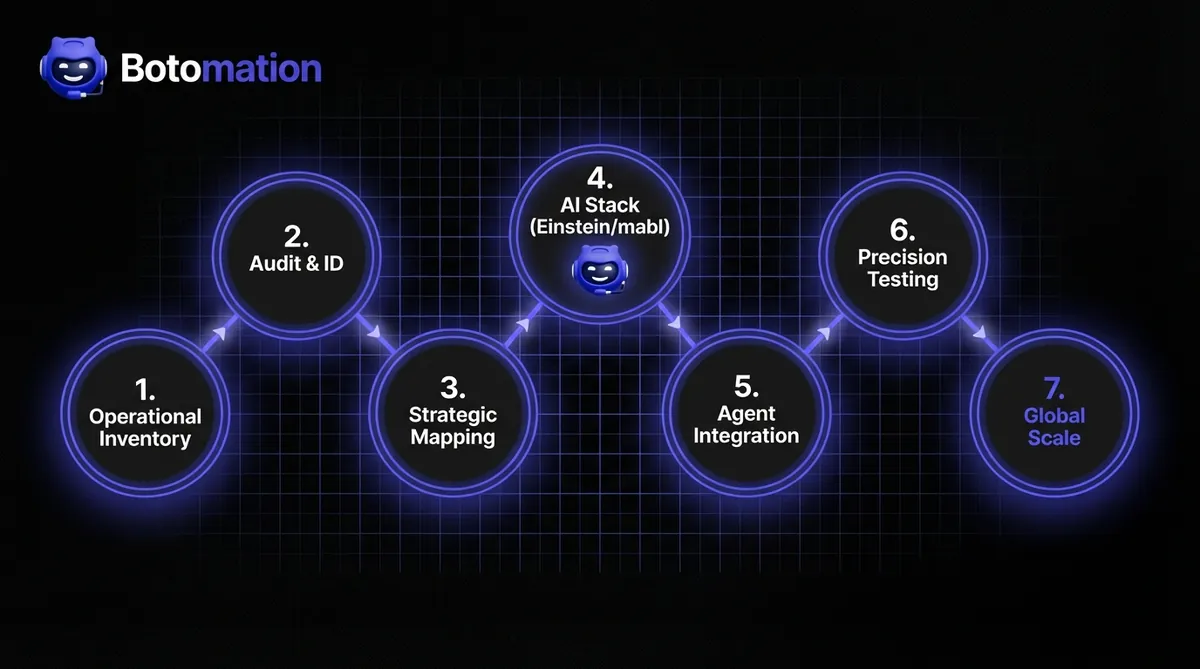
Transitioning to AI agents requires a methodical approach to ensure data integrity and team buy-in. Follow these steps to begin your journey:
- Inventory Your Manual Tasks: List every repetitive data entry task performed by your team.
- Identify High-Impact Opportunities: Prioritize tasks with high volume or high error rates.
- Define the Data Logic: Document the rules a human currently uses to process this data.
- Select Your AI Stack: Partner with experts to choose the right combination of LLMs.
- Build a Prototype Agent: Create a pilot agent to handle a small subset of data.
- Execute a Phased Rollout: Gradually increase the agent's workload, monitoring performance.
- Scale and Optimize: Use insights gained to automate the next task on your list.
How Should You Handle AI Tool Selection and Integration?
The market is currently flooded with AI tools, but most are superficial wrappers. At Botomation, we select tools based on their ability to handle real-world complexity. For example, we might use TestResults.io for its superior ability to navigate legacy software interfaces. We also prioritize API-first integrations to eliminate manual data copying, allowing our agents to move data directly between systems at the server level and bypassing the slow methods used by older RPA software.
How Do You Manage Change and Staff Transitions During Automation?
One of the biggest hurdles to automation is not the technology, but the people. We address this through proactive change management. We frame the transition as an upgrade for the staff, moving them from "data entry clerks" to "AI supervisors." By involving your team in the process and showing them how agents take away the most tedious parts of their jobs, we turn skeptics into advocates.
How Do You Measure the Success and ROI of AI-Powered Data Entry Operations?
To justify the investment in AI agents, you must be able to point to clear, quantifiable results, such as the ability to reduce operational costs by 40%. We focus on Key Performance Indicators (KPIs) beyond just "time saved." Most of our clients see a full return on investment within the first six to nine months. The qualitative improvements are just as significant; employee satisfaction typically skyrockets when drudge work is eliminated.
Which Performance Metrics and KPIs Should You Track for AI Data Processing?
When we track the success of an automation project, we look for a "velocity shift." This is the point where the business can handle a 2x or 3x increase in volume without any increase in operational cost. We measure this by tracking the throughput per hour of our agents versus previous human benchmarks. We also monitor the "Exception Rate"—the percentage of tasks the AI cannot handle. Our goal is to keep this rate below 2%, ensuring your team only spends time on the most complex issues.
What is the Financial Impact and Cost Analysis of AI Agents?
The financial argument for AI agents is overwhelming. Over a three-year period, the total cost of ownership (TCO) for an AI-powered system is often 75% lower than maintaining a manual team. Furthermore, the "scalability tax" is eliminated. In the "New Way," doubling your business volume might only require a negligible increase in server capacity. This decoupling of growth from headcount is the holy grail of modern business operations.
Frequently Asked Questions
How can AI agents replace manual data entry work in my specific industry?
AI agents are versatile and can be trained on industry-specific rules. Whether it's healthcare, finance, or logistics, these agents use natural language processing to understand your unique data types and workflows, automating up to 98% of repetitive tasks.
Will AI agents make my current staff obsolete?
No. The goal of partnering with Botomation is to elevate your staff. By removing repetitive, manual tasks that lead to burnout, we allow your team to focus on high-value work that requires human intuition, empathy, and strategic thinking.
Is my data secure when using AI agents for entry?
Absolutely. We prioritize enterprise-grade security. Our agents operate within your existing security framework, using encrypted connections and following all relevant compliance standards like HIPAA, GDPR, and SOC2.
How long does it take to see a return on investment?
While every business is different, most of our partners see a break-even point within 6 to 9 months. The immediate reduction in error rates and the recovery of staff time provide ROI from day one.
Can AI agents handle messy or handwritten data?
Yes. Thanks to the latest advancements in GPT-5 and specialized OCR technologies, our agents can interpret handwritten notes and low-quality scans with a level of accuracy that matches or exceeds human capability.
The era of manual data entry is coming to an end. Businesses that cling to the "Old Way" of slow, expensive, and error-prone human labor are setting themselves up for failure in an increasingly automated world. The "New Way" offers a path to 24/7 operations, near-perfect accuracy, and a level of scalability that was previously unimaginable. At Botomation, we specialize in making this transition seamless, turning your operational bottlenecks into competitive advantages.
Ready to automate your growth? Stop losing money to manual errors and high overhead today. Book a call below to explore how our team can implement 24/7 AI data processing for your business.
In late 2026, business leaders are increasingly asking how to automate repetitive business tasks with AI agents to overcome the limitations of traditional human-led processes. The landscape of modern business operations has reached a critical tipping point where traditional reliance on manual data entry is no longer just a slow process, but a significant competitive liability. As we navigate through this digital era, the sheer volume of data generated by digital interactions has vastly outpaced the human capacity to process it accurately or cost-effectively. Organizations that continue to tether their growth to manual keyboard-and-mouse labor find themselves trapped in a cycle of escalating overhead and diminishing returns. At Botomation, we have seen firsthand how these legacy workflows create invisible ceilings on organizational potential.
Recent industry benchmarks reveal a staggering reality that forward-thinking executives are now prioritizing. Current estimates suggest that approximately 70% of all data entry tasks currently performed by human staff can be fully automated using the sophisticated AI agents available today. We are no longer discussing simple macros or rigid scripts that break at the slightest change in a website’s user interface. With the maturation of Salesforce Einstein’s autonomous capabilities and the evolution of mabl for intelligent data creation, the "New Way" of doing business has arrived. These agents possess the cognitive flexibility to interpret unstructured data, navigate complex software interfaces, and execute tasks with a level of precision that humans simply cannot maintain over an eight-hour shift.
Transitioning from manual labor to AI-powered data processing is a strategic necessity for any founder or CEO looking to scale business operations with AI automation without a linear increase in headcount. Botomation serves as the bridge for businesses caught in this transition, moving them away from the "Old Way" of slow, error-prone manual entry toward a future of instant, 24/7 autonomous operations. By replacing manual tasks with intelligent agents, we help our partners turn data processing from a cost center into a high-speed revenue engine. This article explores how AI agents can replace manual data entry work to fundamentally reshape the workplace and why partnering with an expert agency is the most effective way to stay ahead of the curve.
Why is the Scale and Cost of Manual Data Entry a Problem for Modern Businesses?
The financial drain of manual data entry is often obscured because it is spread across dozens of different roles and departments. When conducting operational audits for our clients, we frequently find that skilled employees—from accountants to marketing managers—lose 30% to 60% of their workday to basic data manipulation. This is not merely a waste of specialized talent; it is a direct hit to the company’s bottom line. While a human worker might process a few hundred records in a day, they remain subject to fatigue, distraction, and the physical limits of human speed. In a 2026 business environment that moves at the speed of fiber optics, relying on manual typing is equivalent to using a horse-drawn carriage on a Formula 1 track.
Beyond direct labor costs, the hidden "error tax" of manual entry is perhaps the most dangerous threat to business integrity. Human error rates in data processing typically hover between 1% and 3%, which may seem negligible until you consider the cumulative effect. One mistyped digit in a financial record or a single transposed letter in a patient’s medical history can trigger a cascade of operational failures costing thousands of dollars to rectify. AI systems, by contrast, have pushed error rates down to 0.01% or lower by utilizing real-time data entry validation, providing a level of data integrity that human teams cannot match. These digital workers for data management ensure that the manual oversight model is rapidly becoming obsolete for efficiency-focused leaders.
How Can You Quantify the Data Entry Problem?
To truly understand this burden, one must examine the opportunity cost of manual workflows. When a $70,000-a-year employee spends half their time on data entry, the business is not just paying $35,000 for clerical work; it is losing $35,000 worth of strategic output that could have driven growth. Across high-volume industries like logistics, healthcare, and finance, the aggregate loss is staggering. Our experts at Botomation have calculated that for a mid-sized enterprise, the transition to AI agents often recovers thousands of hours of productive time in the first year alone. This recovered time allows teams to focus on customer relationships and innovation by following a complete guide to automated data sync for CRM rather than manual spreadsheet management.
What Does Current Industry Data Say About Data Entry Workloads?
The volume of data requiring processing has grown exponentially, yet the methods for handling it have largely remained stagnant in many organizations. Employees are now expected to connect disparate software tools to manage data across a dozen different platforms, from Slack and email to specialized ERP systems. During seasonal peaks, such as the end of the fiscal year or holiday shopping periods, the workload often becomes unmanageable, leading to burnout and even higher error rates. We are seeing a trend where data volume growth is outstripping the ability of companies to hire their way out of the problem. This is where the scalability of AI agents becomes a decisive advantage.
How AI Agents Can Replace Manual Data Entry Work More Effectively Than Humans?
The performance gap between human workers and AI agents has widened significantly with the release of GPT-5 and specialized tools like LambdaTest KaneAI. While a fast human might enter 10,000 keystrokes per hour, an AI agent can process that same volume of information in seconds. However, speed is only one part of the equation. The real advantage of the "New Way" lies in the agent's ability to work 24 hours a day, 365 days a year, without a single break. This constant availability means that data received at 2:00 AM is processed by 2:01 AM, providing real-time insights that were previously impossible to achieve with a standard 9-to-5 workforce.
| Feature | Manual Data Entry (The Old Way) | Botomation AI Agents (The New Way) |
|---|---|---|
| **Processing Speed** | Limited by human typing/reading | Near-instantaneous across thousands of records |
| **Availability** | 8 hours/day, 5 days/week | 24/7/365 (no breaks or downtime) |
| **Error Rate** | 1% - 3% (increases with fatigue) | < 0.01% (consistent precision) |
| **Scalability** | Requires hiring and training | Instant scaling to handle any volume spike |
| **Cost Trend** | Increasing (wages and benefits) | Decreasing as technology improves |
What are the Speed and Efficiency Advantages of AI Data Processing?
The throughput of an AI-driven system is difficult to visualize. Imagine a scenario where a logistics company receives 5,000 bills of lading every night. A human team would take days to categorize and enter that data, leading to a massive backlog. An AI agent, integrated by our team, can ingest all 5,000 documents simultaneously, verify the information against existing databases, and update the ERP system before the next business day begins. This is not just a minor improvement; it is a total transformation of operational velocity.
How Does AI Automation Improve Accuracy and Quality?
Quality assurance is often an afterthought in manual data entry workflows, usually consisting of a manager "spot-checking" a small percentage of the work. AI agents change this dynamic by building quality assurance directly into the processing flow. Every piece of data handled by an agent can be cross-referenced against multiple sources in real-time. If data does not align with historical patterns or predefined logic, the agent flags it immediately for review, ensuring only clean data touches your core systems.
What are the Real-World Results of AI Agents Replacing Manual Data Entry?
To see the true power of this transition, we look at the results achieved by companies that have abandoned the "Old Way" in favor of Botomation’s expert-led AI integration. In the financial services sector, we help firms automate administrative tasks using RPA, which recently allowed one of our partners to reduce processing time from 45 minutes to under three minutes per file. The company reduced its dedicated data entry staff by 60%, reallocating those individuals to customer-facing roles that actively grew the business. In the healthcare industry, we deployed a suite of agents to handle insurance claim forms 5x faster than the human team, significantly improving cash flow.
How Do Financial Services Benefit from Data Entry Automation?
Financial data requires a level of security and auditability that manual processes struggle to provide. Our AI agents are built with a "security-first" architecture, ensuring every action is logged in an immutable audit trail. In the case of a mid-sized investment firm we partnered with, agents categorized and reconciled thousands of transactions autonomously before the markets opened. This result was more than just a reduction in labor costs; the firm achieved a level of compliance that was previously unattainable.
How Does Healthcare Use AI for Patient Record Management?
The complexity of healthcare data—often a mix of handwritten notes and digital scans—has long been a barrier to automation. However, the latest generation of AI agents can now synthesize these disparate sources with ease. We worked with a regional hospital system to automate their patient intake and billing cycle. Previously, a patient’s journey involved multiple manual hand-offs. By implementing a unified AI agent layer, the hospital ensured patient data flowed seamlessly through the system with 99.9% accuracy.
How AI Agents Can Replace Manual Data Entry Work Using a Strategic Roadmap?
Moving from a manual workflow to an autonomous one is a process our team has refined into a science. The first step is always a deep assessment of current operations, often following our 7 steps to automate data entry and admin tasks. We identify the "low-hanging fruit" where automation will provide immediate ROI. This assessment phase ensures we build a solution tailored to your specific business needs rather than a generic software fix.
How Do You Automate Your First Data Entry Workflow?
Transitioning to AI agents requires a methodical approach to ensure data integrity and team buy-in. Follow these steps to begin your journey:
- Inventory Your Manual Tasks: List every repetitive data entry task performed by your team.
- Identify High-Impact Opportunities: Prioritize tasks with high volume or high error rates.
- Define the Data Logic: Document the rules a human currently uses to process this data.
- Select Your AI Stack: Partner with experts to choose the right combination of LLMs.
- Build a Prototype Agent: Create a pilot agent to handle a small subset of data.
- Execute a Phased Rollout: Gradually increase the agent's workload, monitoring performance.
- Scale and Optimize: Use insights gained to automate the next task on your list.
How Should You Handle AI Tool Selection and Integration?
The market is currently flooded with AI tools, but most are superficial wrappers. At Botomation, we select tools based on their ability to handle real-world complexity. For example, we might use TestResults.io for its superior ability to navigate legacy software interfaces. We also prioritize API-first integrations to eliminate manual data copying, allowing our agents to move data directly between systems at the server level and bypassing the slow methods used by older RPA software.
How Do You Manage Change and Staff Transitions During Automation?
One of the biggest hurdles to automation is not the technology, but the people. We address this through proactive change management. We frame the transition as an upgrade for the staff, moving them from "data entry clerks" to "AI supervisors." By involving your team in the process and showing them how agents take away the most tedious parts of their jobs, we turn skeptics into advocates.
How Do You Measure the Success and ROI of AI-Powered Data Entry Operations?
To justify the investment in AI agents, you must be able to point to clear, quantifiable results, such as the ability to reduce operational costs by 40%. We focus on Key Performance Indicators (KPIs) beyond just "time saved." Most of our clients see a full return on investment within the first six to nine months. The qualitative improvements are just as significant; employee satisfaction typically skyrockets when drudge work is eliminated.
Which Performance Metrics and KPIs Should You Track for AI Data Processing?
When we track the success of an automation project, we look for a "velocity shift." This is the point where the business can handle a 2x or 3x increase in volume without any increase in operational cost. We measure this by tracking the throughput per hour of our agents versus previous human benchmarks. We also monitor the "Exception Rate"—the percentage of tasks the AI cannot handle. Our goal is to keep this rate below 2%, ensuring your team only spends time on the most complex issues.
What is the Financial Impact and Cost Analysis of AI Agents?
The financial argument for AI agents is overwhelming. Over a three-year period, the total cost of ownership (TCO) for an AI-powered system is often 75% lower than maintaining a manual team. Furthermore, the "scalability tax" is eliminated. In the "New Way," doubling your business volume might only require a negligible increase in server capacity. This decoupling of growth from headcount is the holy grail of modern business operations.
Frequently Asked Questions
How can AI agents replace manual data entry work in my specific industry?
AI agents are versatile and can be trained on industry-specific rules. Whether it's healthcare, finance, or logistics, these agents use natural language processing to understand your unique data types and workflows, automating up to 98% of repetitive tasks.
Will AI agents make my current staff obsolete?
No. The goal of partnering with Botomation is to elevate your staff. By removing repetitive, manual tasks that lead to burnout, we allow your team to focus on high-value work that requires human intuition, empathy, and strategic thinking.
Is my data secure when using AI agents for entry?
Absolutely. We prioritize enterprise-grade security. Our agents operate within your existing security framework, using encrypted connections and following all relevant compliance standards like HIPAA, GDPR, and SOC2.
How long does it take to see a return on investment?
While every business is different, most of our partners see a break-even point within 6 to 9 months. The immediate reduction in error rates and the recovery of staff time provide ROI from day one.
Can AI agents handle messy or handwritten data?
Yes. Thanks to the latest advancements in GPT-5 and specialized OCR technologies, our agents can interpret handwritten notes and low-quality scans with a level of accuracy that matches or exceeds human capability.
The era of manual data entry is coming to an end. Businesses that cling to the "Old Way" of slow, expensive, and error-prone human labor are setting themselves up for failure in an increasingly automated world. The "New Way" offers a path to 24/7 operations, near-perfect accuracy, and a level of scalability that was previously unimaginable. At Botomation, we specialize in making this transition seamless, turning your operational bottlenecks into competitive advantages.
Ready to automate your growth? Stop losing money to manual errors and high overhead today. Book a call below to explore how our team can implement 24/7 AI data processing for your business.
Get Started
Book a FREE Consultation Right NOW!
Schedule a Call with Our Team To Make Your Business More Efficient with AI Instantly.
Read More
How AI Agents Can Replace Manual Data Entry Work in 2026
Discover how AI agents can replace manual data entry work. Botomation provides 24/7 automation to reduce costs, eliminate errors, and scale ROI fast.

AI Automation for Small Businesses Cuts Costs by 40 Percent
Learn how WhatsApp AI slashes support costs for e-commerce & SaaS. Proven strategies to boost sales, recover carts, and scale 24/7 service.