Automate Repetitive Business Tasks with AI - 2026 Guide
Feb 17, 2026
AI Automation
Business Efficiency
Enterprise AI
AI Automation
Business Efficiency
Enterprise AI
The struggle to scale a business often hits a predictable brick wall where hiring more staff no longer solves the underlying problem. By late 2026, the distinction between high-growth companies and those stagnating has become unmistakable: success is no longer about the size of the team, but the efficiency of the digital workforce. Most founders and COOs find themselves trapped in a cycle of "managing the mess," where manual data entry, repetitive customer inquiries, and legacy software bottlenecks consume up to 40% of their team's productive hours. This is where the transition to AI agents becomes a strategic necessity rather than a luxury. When companies decide to automate manual tasks with artificial intelligence, they aren't just saving time; they are reclaiming their competitive edge.
An AI agent differs fundamentally from the basic automation tools of the past decade. While traditional software follows a rigid "if-this-then-that" logic, an AI agent is designed to understand goals, reason through complex steps, and adapt to changing environments without constant human intervention. In the current landscape of January 2026, tools like Salesforce Einstein and Applitools’ fourth-wave AI have moved beyond simple scripts. They now function as autonomous entities capable of self-healing and sophisticated decision-making, allowing businesses to operate with unprecedented agility.
The business case for choosing to automate repetitive business tasks with AI is no longer just about saving time; it is about structural cost reduction and the ability to operate at a speed that manual processes simply cannot match. When you replace a slow, human-dependent workflow with a 24/7 AI agent, you aren't just making a task faster—you are building a revenue engine that works while your leadership team focuses on high-level strategy. At Botomation, we see this gap every day between complex, inaccessible AI research and the practical, bottom-line results that businesses actually need. Our agency specializes in bridging that gap by deploying custom-coded AI solutions that replace legacy friction with enterprise-grade speed.
How Can You Automate Repetitive Business Tasks with AI to Transform Your Operations?
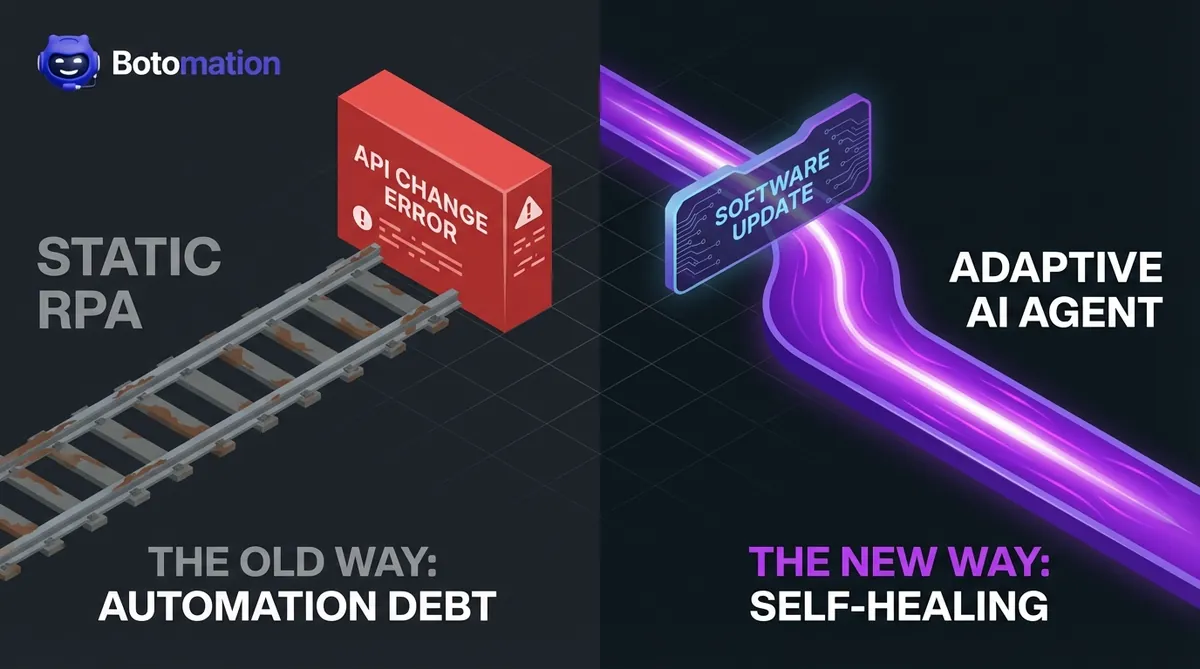
To truly understand how to automate repetitive business tasks with AI, one must first recognize that we have moved past the era of Robotic Process Automation (RPA). Traditional RPA was like a train on a track; if a single pebble was placed on the rail—such as a website changing its layout or a form adding a new field—the entire process crashed. Modern AI agents are more like autonomous vehicles. They perceive their digital environment, identify obstacles, and navigate around them to reach the desired destination.
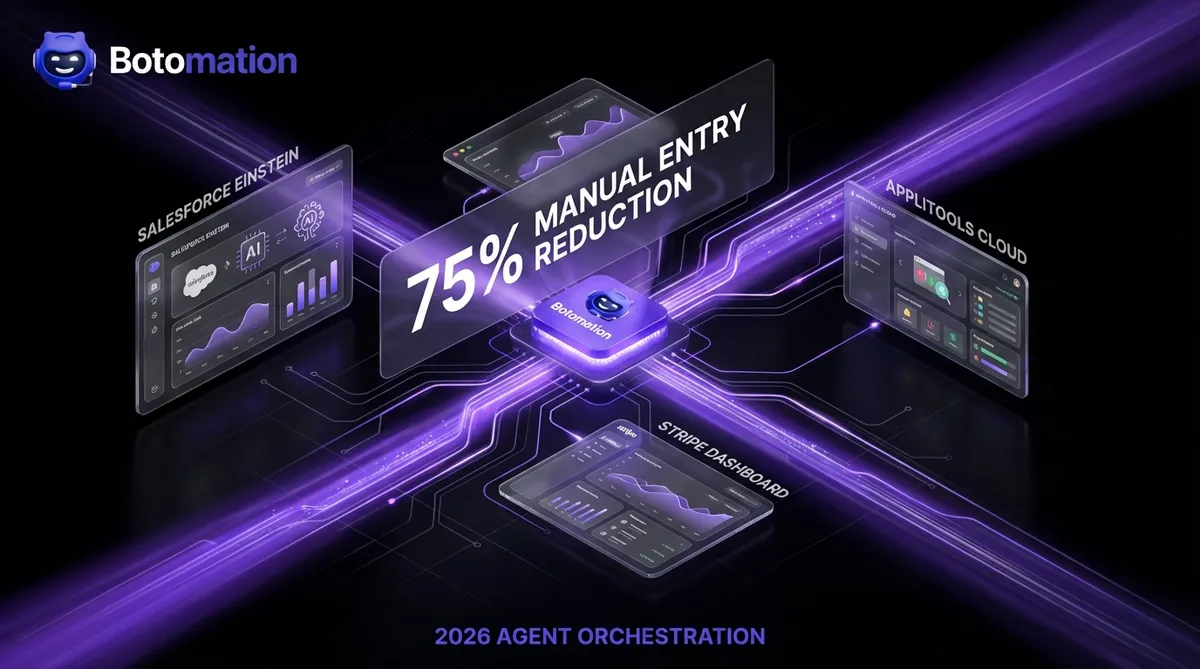
In 2026, the technical capabilities of these agents have reached a critical tipping point. We are seeing Salesforce Einstein 1.0 evolved into a system that doesn't just suggest CRM updates but actively manages the entire data lifecycle through advanced CRM email integration, reducing manual entry time by a staggering 75% for enterprise sales teams. This transformation is powered by "self-healing" execution clouds, a technology popularized by Applitools. If an underlying software interface changes, the AI agent recognizes the change, updates its own internal logic, and continues the task without triggering an error report.
How Have AI Agents Evolved from Traditional Automation?
The "Old Way" of automation relied on static rules that required constant maintenance and developer oversight. Every time a third-party API updated or a vendor changed their dashboard, your automation would break, leading to "automation debt" that often cost more to fix than the manual labor it replaced. AI agents represent the "New Way," utilizing adaptive learning to handle the unpredictability of modern business software.
Take HubSpot’s evolution in lead scoring as a primary example. Previously, a marketer had to manually assign point values to actions like "opened email" or "visited pricing page." Today’s AI agents analyze millions of data points across your entire tech stack to identify hidden patterns in buyer behavior that a human would never notice. They don't just follow your rules; they discover better ones. This shift from reactive scripts to proactive intelligence is what allows companies to scale their operations without a linear increase in headcount.
What Are the Key Capabilities of Modern AI Agents in 2026?
The most significant advancement in 2026 is the integration of Natural Language Processing (NLP) directly into the execution layer of business tools. You no longer need to write code to "teach" an agent a new task. Instead, you can describe the business requirement in plain English, and the agent translates that into a sequence of actions across multiple platforms. This is particularly evident in the mabl MCP Server IDE integration, which allows teams to bridge the gap between development environments and live business processes. These AI agents for enterprise environments are designed to handle complex, multi-step workflows that previously required a human touch.
These agents also possess cross-platform functionality that was previously impossible. An agent can now pull data from a legacy ERP system, cross-reference it with a modern Stripe dashboard, and then generate a personalized report in a custom-built React interface. This level of interoperability is a core pillar of what we do at Botomation. We don't just give you a tool; we build the custom infrastructure that allows these agents to navigate your entire digital ecosystem with zero friction.
Expert Insight: "The goal of AI automation in 2026 isn't to replace humans, but to scale business operations with AI automation by removing the 'robotic' parts of human jobs. When an agent handles the 1,000th data entry task or uses AI tools to double content output without extra hiring, your team is free to handle the creative problem-solving that actually moves the needle." — Senior Consultant, Botomation.
Which Industries Are Successfully Choosing to Automate Repetitive Business Tasks with AI?
While every sector can find value in automation, certain industries are seeing a total structural overhaul. Healthcare, finance, and e-commerce are leading the charge because they deal with the highest volumes of structured and semi-structured data. In these environments, the cost of human error isn't just a minor annoyance; it’s a significant financial and legal liability. Implementing AI business process automation in these sectors has moved from a pilot phase to a core operational standard.
Amazon’s warehouse operations provide the most visible case study for this transition. By late 2026, their fleet of autonomous agents and robots handles approximately 75% of all internal logistics, from inventory sorting to last-mile coordination. This hasn't just reduced costs; it has enabled a level of precision and speed that manual labor could never achieve. For smaller businesses, the same logic applies to their digital warehouses—their data, customer records, and financial transactions.
How Is AI Transforming Healthcare and Medical Services?
In the healthcare sector, AI agents are solving the chronic problem of administrative burnout. By automating administrative tasks like processing patient data, insurance claims, and appointment scheduling, clinics can significantly reduce the burden on back-office teams. By implementing agents powered by IBM Watson Health, clinics are now automating the intake process with 99% accuracy. These agents can read handwritten notes via advanced OCR, verify insurance coverage in real-time, and flag potential drug interactions before a doctor even sees the patient.
Compliance remains the biggest hurdle in healthcare, but 2026-era AI agents are built with HIPAA and GDPR "by design." They operate within encrypted environments where data is processed locally or via secure "Clean Rooms," ensuring that sensitive patient information never leaves the protected perimeter. This allows medical providers to automate repetitive business tasks with AI while actually increasing their security posture compared to manual paper-based or legacy digital systems.
What Does AI Automation Look Like in Financial Services?
The financial sector has moved beyond simple chatbots to sophisticated agents that handle fraud detection and transaction categorization. Cleobank and Revolut have pioneered the use of AI assistants that don't just answer "What is my balance?" but actually manage complex financial workflows. For instance, Cleobank’s AI implementation has reduced the time required for business loan processing by integrating automated pipeline building for SaaS sales techniques and autonomously gathering a thousand different data points.
Regulatory compliance is another area where agents excel, enabling firms to automate administrative tasks using RPA for financial services. Instead of a human compliance officer manually checking every transaction against a checklist, an AI agent monitors the entire network in real-time. It can identify "smurfing" patterns or suspicious movements across international borders that would be invisible to the naked eye. This proactive stance on security is why many financial institutions are pivoting away from legacy software toward AI-powered legacy system migration and the custom, high-speed code and AI integration that Botomation provides.
What Are the Most Profitable Tasks to Automate with AI Agents?
Identifying which tasks to hand over to an AI agent is the first step toward operational excellence. The most successful implementations focus on "high-frequency, high-logic" tasks. These are processes that happen hundreds of times a week and require a specific set of rules or patterns to complete. If a task involves moving data from Point A to Point B, or summarizing information for a decision-maker, it is a prime candidate for automation.
Data entry remains the most common "silent killer" of productivity. Whether it is updating CRM records or syncing inventory across multiple storefronts, these tasks are exhausting for humans and prone to error. By implementing automated data entry validation via Salesforce Einstein or custom-built agents, businesses are seeing these manual burdens evaporate. This allows the "Old Way" of manual spreadsheets to be replaced by the "New Way" of real-time, AI-synchronized data.
How Can You Automate Document Processing and Data Entry?
The combination of Optical Character Recognition (OCR) and Natural Language Processing (NLP) has turned document processing into a solved problem. In 2026, an AI agent can receive an invoice in any format—PDF, JPG, or even a mobile photo—and instantly extract the vendor name, line items, tax ID, and payment terms. It doesn't just "read" the text; it understands the context.
Salesforce Einstein has demonstrated that by automating these workflows, companies can reduce manual data entry by up to 60%. This isn't just about speed; it's about data integrity. When an AI agent handles the entry, you eliminate the typos and missing fields that plague manual systems. At Botomation, we ensure these agents are integrated directly into your custom web architecture, so the data flows directly into your revenue-generating systems without any middleman.
How Do AI Agents Handle Customer Communication and Support?
Customer support is no longer about "deflecting" tickets with unhelpful bots. The AI agents of 2026, integrated with platforms like Zendesk and Intercom, are capable of resolving 80% of routine inquiries without human intervention. They can process refunds, update shipping addresses, and troubleshoot technical issues by accessing the company’s internal knowledge base and customer history. This 24/7 business automation, often utilizing a WhatsApp bot for 24/7 Shopify support, ensures that no customer is left waiting, regardless of the time zone.
The key to this success is personalization. An AI agent knows exactly who the customer is, what they bought, and their previous interaction history. Instead of a generic "How can I help you?", the agent can say, "I see your order from Tuesday is delayed; would you like me to issue a partial refund or expedite the shipping?" This level of service was previously only possible with expensive, high-touch support teams. By choosing to automate repetitive business tasks with AI in your support department, you turn a cost center into a customer loyalty engine.
| Metric | Traditional Manual Process | AI Agent Automation (2026) |
|---|---|---|
| **Response Time** | 2 - 24 Hours | < 3 Seconds |
| **Accuracy Rate** | 85% - 92% (Human Error) | 99.2% |
| **Operational Hours** | 40 Hours / Week | 168 Hours / Week (24/7) |
| **Cost Per Transaction** | $15.00 - $45.00 | $0.50 - $2.00 |
| **Scalability** | Requires New Hires | Instant / Infinite |
How Do You Implement AI Workflow Automation in Your Business Step-by-Step?
Implementing AI is not a "flip the switch" event; it is a strategic deployment. Many companies fail because they try to automate everything at once, leading to a "Frankenstein" system of disconnected tools. To succeed, you must follow a structured framework that prioritizes the highest ROI tasks while ensuring your technical foundation is strong enough to support autonomous agents. Effective AI workflow automation, particularly when you automate client onboarding processes, requires a balance between off-the-shelf tools and custom integration.
The first step is always an audit of your current "legacy friction." Where are your highly-paid employees spending time on low-value tasks? If your lead developer is manually syncing databases or your head of sales is cleaning up CRM lead lists, you have a massive opportunity for automation. At Botomation, we help CEOs identify these leaks and build the custom code necessary to plug them permanently.
Which Framework Should You Use for Task Identification?
Not every task should be automated. To find the "sweet spot," look for tasks that meet three criteria: high volume, low complexity, and high cost of error. A task that happens once a month for ten minutes isn't worth the engineering effort. However, a task that happens 50 times a day and takes five minutes each time is costing you over 40 hours of labor per month.
Conduct a cost-benefit analysis by looking at the "Fully Burdened Labor Cost." If an employee makes $60,000 a year, their actual cost to the business—including benefits, office space, and taxes—is closer to $85,000. If an AI agent can take over 30% of their workload, you are essentially "buying back" $25,500 of high-value time for a fraction of that cost. This financial clarity is essential for getting buy-in from stakeholders.
How Do You Select the Right Technical Tools for Implementation?
Choosing the right stack is critical. In 2026, the market is split between general-purpose LLMs and specialized automation tools. For testing and quality assurance, tools like Katalon, BlinqIO, and ACCELQ have become industry standards. However, for core business operations, we often look toward the "Fourth Wave" AI implementations like those released by Perfecto in January 2026. These tools offer the self-healing capabilities and API-first architecture required for a stable environment.
When selecting a tool, prioritize API integration and data security. An AI agent is only as good as the data it can access. If your current systems are "closed" or use outdated legacy code, you will need a partner like Botomation to eliminate data silos between business applications by building the "bridge" APIs that allow modern AI to communicate with your old data. We specialize in replacing these slow legacy systems with lightning-fast custom code that serves as the perfect playground for AI agents.
What Are the Best Practices for Testing and Deployment?
Once an agent is built, it must undergo a rigorous QA process. You cannot simply turn an autonomous agent loose on your live customer database without "guardrails." We recommend a "Human-in-the-Loop" (HITL) phase, where the AI agent performs the task but a human supervisor approves the final action. As the agent proves its accuracy over several hundred transactions, the guardrails can be gradually removed.
Monitoring is the final, ongoing step. You need a dashboard that tracks time savings, error reduction, and cost impact in real-time. If an agent starts to deviate from its expected performance—perhaps due to a change in an external website it interacts with—your system should alert your team immediately. This continuous optimization ensures that your automation doesn't just work on day one, but continues to improve as your business grows.
How Do You Measure the ROI of AI-Powered Business Efficiency?
To justify the investment in AI, you must move beyond "vibe-based" reporting and into hard data. The most successful AI implementations we see at Botomation are those where the CEO can point to a specific line item on the P&L and show how it has decreased. Measuring ROI involves both quantitative metrics (the numbers) and qualitative improvements (the "feel" of the business). Achieving true AI-powered business efficiency means your team is doing more with less, consistently.
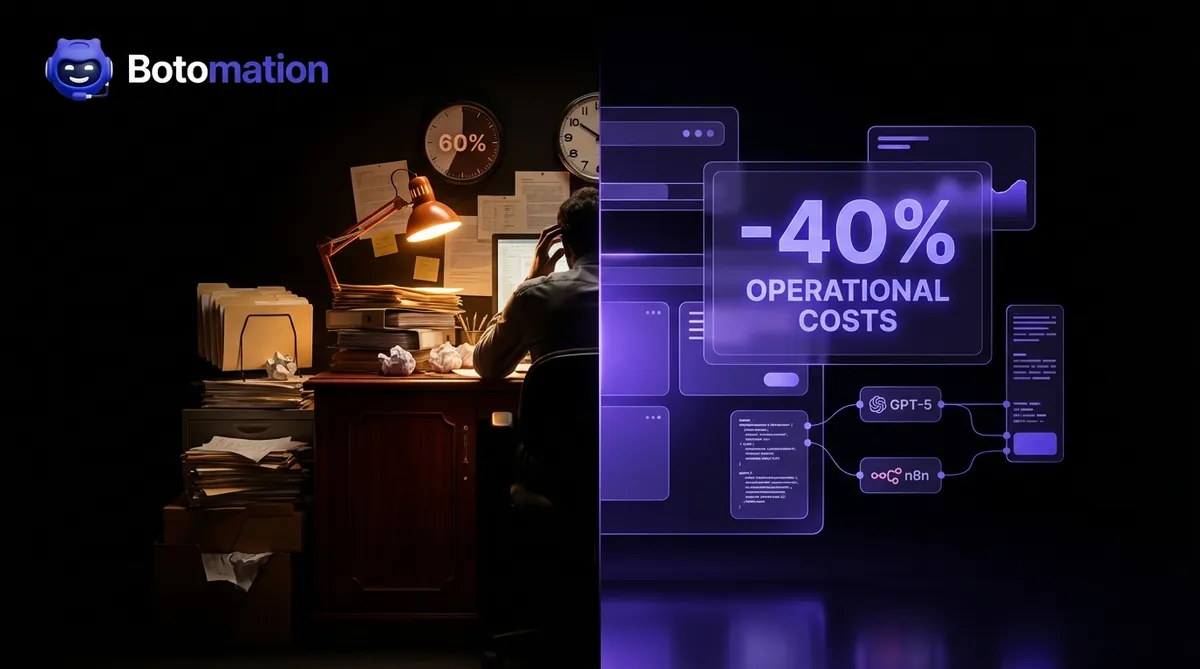
Industry benchmarks in late 2026 suggest that companies successfully implementing AI agents are reducing operational costs by 40% or more within the first 12 months. This isn't magic; it's the result of removing the "human tax" from repetitive digital labor. When you no longer have to pay a human to perform a task that a machine can do for pennies, your margins expand almost instantly.
Which KPIs Define Automation Success?
The first KPI to track is "Cycle Time Reduction." How long did it take to process an invoice or respond to a lead before the AI agent, and how long does it take now? In most cases, we see this drop from hours to seconds. This speed doesn't just save money; it wins business. In a world where the first company to respond to a lead usually gets the sale, speed is a competitive MOAT.
The second KPI is the "Error Rate." Human data entry typically has an error rate of 3-5%. While that sounds small, at scale, it's a disaster. An AI agent operating on a well-defined logic path has an error rate of less than 0.5%. By tracking the "Cost of Correction"—the time spent by senior staff fixing junior staff's mistakes—you can see the true value of AI precision.
How Do You Calculate the Financial Returns of AI?
Let's break down a real-world calculation for a mid-sized e-commerce business. Suppose they have three customer support reps, each costing the business $55,000 annually (total $165,000). These reps spend 70% of their time answering "Where is my order?" (WISMO) tickets.
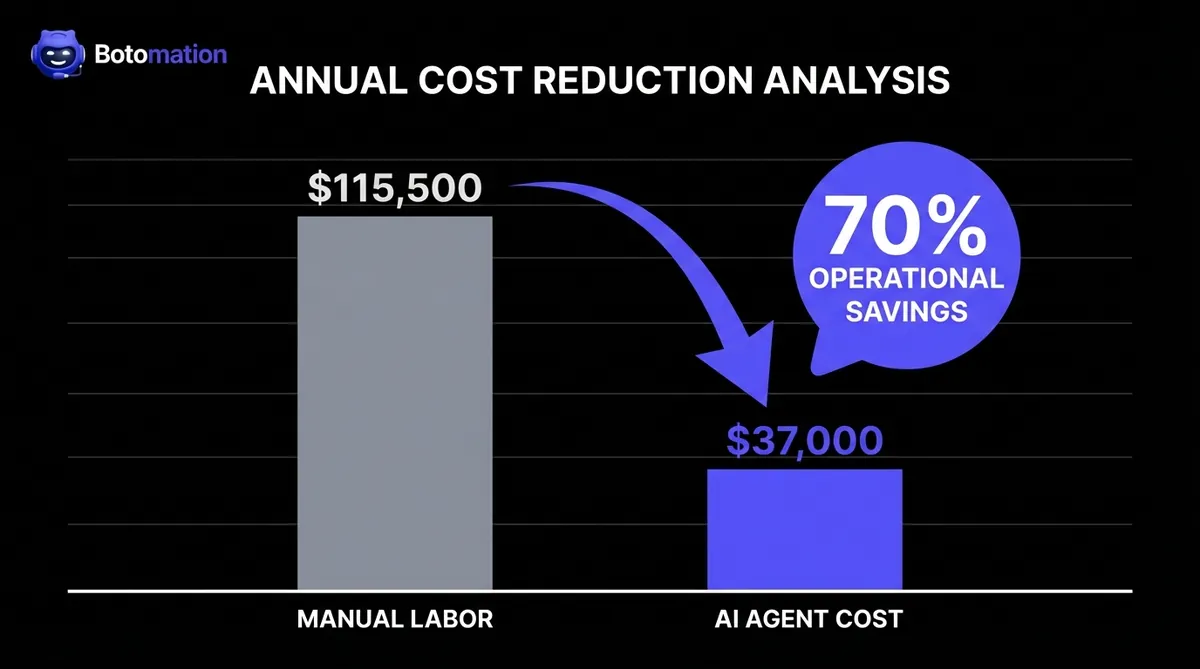
- Manual Cost of WISMO: $165,000 x 0.70 = $115,500 per year.
- AI Implementation Cost: $25,000 (one-time setup with Botomation) + $1,000/month for AI tokens and maintenance.
- Year 1 Total AI Cost: $37,000.
- Year 1 Savings: $115,500 - $37,000 = $78,500.
In this scenario, the business sees a full return on investment in less than four months. More importantly, those three support reps are now free to focus on proactive customer success and upselling, which can drive additional revenue that isn't even captured in the "savings" calculation. This is the "New Way" of doing business: using AI to handle the floor, so your humans can reach for the ceiling.
Frequently Asked Questions
Will AI agents replace my existing employees?
The goal of AI agents is to automate tasks, not necessarily roles. By removing the repetitive, "robotic" portions of a job, your employees can shift their focus to higher-value activities that require human empathy, creativity, and strategic thinking. Most of our clients find that they don't fire people; they simply stop needing to hire more people as they scale.
How secure is my data when using AI agents?
Security is a top priority in 2026. Modern AI agents can be deployed within your own private cloud or "Clean Room" environments, ensuring that sensitive data never leaves your control. At Botomation, we build custom, enterprise-grade security layers into every automation we deploy, often making the automated system more secure than the manual processes it replaces.
How long does it take to see a return on investment?
Most businesses see a positive ROI within 3 to 6 months. The initial setup cost is quickly offset by the immediate reduction in manual labor hours and the elimination of costly human errors. Because AI agents work 24/7 without breaks or benefits, the "break-even" point happens much faster than traditional software implementations.
Can AI agents work with my old, legacy software?
Yes, but it often requires a custom "bridge." This is one of the primary reasons businesses partner with an agency like Botomation. We specialize in helping businesses replace legacy systems with custom web development, writing the custom code and APIs necessary to connect modern AI agents to older systems that weren't originally designed to communicate with AI.
What is the first step to start automating repetitive tasks?
The first step is a thorough process audit. You must identify which workflows are costing you the most in terms of time and human error. Once these are identified, you can prioritize them based on ease of implementation and potential ROI. Partnering with experts can help streamline this discovery phase.
The transition to an AI-driven business model is no longer a "future" trend—it is the current reality of late 2026. Companies that continue to rely on manual, repetitive processes are effectively paying a "legacy tax" that their competitors are not. This tax manifests in slower response times, higher error rates, and an inability to scale without massive hiring sprees. By choosing to automate repetitive business tasks with AI, you are choosing to modernize your operations for a new era of efficiency.
At Botomation, we don't just sell you a tool and walk away. We are a premium agency of experts who partner with you to build custom, high-speed revenue engines. We replace your slow legacy systems with lightning-fast code and deploy 24/7 AI agents that work tirelessly to grow your business. The "Old Way" of doing business is manual, expensive, and slow. The "New Way" is automated, instant, and powered by Botomation.
Ready to automate your growth? Stop losing money on manual tasks and legacy friction today. Book a call below to explore how our experts can implement custom AI solutions for your business.
The struggle to scale a business often hits a predictable brick wall where hiring more staff no longer solves the underlying problem. By late 2026, the distinction between high-growth companies and those stagnating has become unmistakable: success is no longer about the size of the team, but the efficiency of the digital workforce. Most founders and COOs find themselves trapped in a cycle of "managing the mess," where manual data entry, repetitive customer inquiries, and legacy software bottlenecks consume up to 40% of their team's productive hours. This is where the transition to AI agents becomes a strategic necessity rather than a luxury. When companies decide to automate manual tasks with artificial intelligence, they aren't just saving time; they are reclaiming their competitive edge.
An AI agent differs fundamentally from the basic automation tools of the past decade. While traditional software follows a rigid "if-this-then-that" logic, an AI agent is designed to understand goals, reason through complex steps, and adapt to changing environments without constant human intervention. In the current landscape of January 2026, tools like Salesforce Einstein and Applitools’ fourth-wave AI have moved beyond simple scripts. They now function as autonomous entities capable of self-healing and sophisticated decision-making, allowing businesses to operate with unprecedented agility.
The business case for choosing to automate repetitive business tasks with AI is no longer just about saving time; it is about structural cost reduction and the ability to operate at a speed that manual processes simply cannot match. When you replace a slow, human-dependent workflow with a 24/7 AI agent, you aren't just making a task faster—you are building a revenue engine that works while your leadership team focuses on high-level strategy. At Botomation, we see this gap every day between complex, inaccessible AI research and the practical, bottom-line results that businesses actually need. Our agency specializes in bridging that gap by deploying custom-coded AI solutions that replace legacy friction with enterprise-grade speed.
How Can You Automate Repetitive Business Tasks with AI to Transform Your Operations?
To truly understand how to automate repetitive business tasks with AI, one must first recognize that we have moved past the era of Robotic Process Automation (RPA). Traditional RPA was like a train on a track; if a single pebble was placed on the rail—such as a website changing its layout or a form adding a new field—the entire process crashed. Modern AI agents are more like autonomous vehicles. They perceive their digital environment, identify obstacles, and navigate around them to reach the desired destination.
In 2026, the technical capabilities of these agents have reached a critical tipping point. We are seeing Salesforce Einstein 1.0 evolved into a system that doesn't just suggest CRM updates but actively manages the entire data lifecycle through advanced CRM email integration, reducing manual entry time by a staggering 75% for enterprise sales teams. This transformation is powered by "self-healing" execution clouds, a technology popularized by Applitools. If an underlying software interface changes, the AI agent recognizes the change, updates its own internal logic, and continues the task without triggering an error report.
How Have AI Agents Evolved from Traditional Automation?
The "Old Way" of automation relied on static rules that required constant maintenance and developer oversight. Every time a third-party API updated or a vendor changed their dashboard, your automation would break, leading to "automation debt" that often cost more to fix than the manual labor it replaced. AI agents represent the "New Way," utilizing adaptive learning to handle the unpredictability of modern business software.
Take HubSpot’s evolution in lead scoring as a primary example. Previously, a marketer had to manually assign point values to actions like "opened email" or "visited pricing page." Today’s AI agents analyze millions of data points across your entire tech stack to identify hidden patterns in buyer behavior that a human would never notice. They don't just follow your rules; they discover better ones. This shift from reactive scripts to proactive intelligence is what allows companies to scale their operations without a linear increase in headcount.
What Are the Key Capabilities of Modern AI Agents in 2026?
The most significant advancement in 2026 is the integration of Natural Language Processing (NLP) directly into the execution layer of business tools. You no longer need to write code to "teach" an agent a new task. Instead, you can describe the business requirement in plain English, and the agent translates that into a sequence of actions across multiple platforms. This is particularly evident in the mabl MCP Server IDE integration, which allows teams to bridge the gap between development environments and live business processes. These AI agents for enterprise environments are designed to handle complex, multi-step workflows that previously required a human touch.
These agents also possess cross-platform functionality that was previously impossible. An agent can now pull data from a legacy ERP system, cross-reference it with a modern Stripe dashboard, and then generate a personalized report in a custom-built React interface. This level of interoperability is a core pillar of what we do at Botomation. We don't just give you a tool; we build the custom infrastructure that allows these agents to navigate your entire digital ecosystem with zero friction.
Expert Insight: "The goal of AI automation in 2026 isn't to replace humans, but to scale business operations with AI automation by removing the 'robotic' parts of human jobs. When an agent handles the 1,000th data entry task or uses AI tools to double content output without extra hiring, your team is free to handle the creative problem-solving that actually moves the needle." — Senior Consultant, Botomation.
Which Industries Are Successfully Choosing to Automate Repetitive Business Tasks with AI?
While every sector can find value in automation, certain industries are seeing a total structural overhaul. Healthcare, finance, and e-commerce are leading the charge because they deal with the highest volumes of structured and semi-structured data. In these environments, the cost of human error isn't just a minor annoyance; it’s a significant financial and legal liability. Implementing AI business process automation in these sectors has moved from a pilot phase to a core operational standard.
Amazon’s warehouse operations provide the most visible case study for this transition. By late 2026, their fleet of autonomous agents and robots handles approximately 75% of all internal logistics, from inventory sorting to last-mile coordination. This hasn't just reduced costs; it has enabled a level of precision and speed that manual labor could never achieve. For smaller businesses, the same logic applies to their digital warehouses—their data, customer records, and financial transactions.
How Is AI Transforming Healthcare and Medical Services?
In the healthcare sector, AI agents are solving the chronic problem of administrative burnout. By automating administrative tasks like processing patient data, insurance claims, and appointment scheduling, clinics can significantly reduce the burden on back-office teams. By implementing agents powered by IBM Watson Health, clinics are now automating the intake process with 99% accuracy. These agents can read handwritten notes via advanced OCR, verify insurance coverage in real-time, and flag potential drug interactions before a doctor even sees the patient.
Compliance remains the biggest hurdle in healthcare, but 2026-era AI agents are built with HIPAA and GDPR "by design." They operate within encrypted environments where data is processed locally or via secure "Clean Rooms," ensuring that sensitive patient information never leaves the protected perimeter. This allows medical providers to automate repetitive business tasks with AI while actually increasing their security posture compared to manual paper-based or legacy digital systems.
What Does AI Automation Look Like in Financial Services?
The financial sector has moved beyond simple chatbots to sophisticated agents that handle fraud detection and transaction categorization. Cleobank and Revolut have pioneered the use of AI assistants that don't just answer "What is my balance?" but actually manage complex financial workflows. For instance, Cleobank’s AI implementation has reduced the time required for business loan processing by integrating automated pipeline building for SaaS sales techniques and autonomously gathering a thousand different data points.
Regulatory compliance is another area where agents excel, enabling firms to automate administrative tasks using RPA for financial services. Instead of a human compliance officer manually checking every transaction against a checklist, an AI agent monitors the entire network in real-time. It can identify "smurfing" patterns or suspicious movements across international borders that would be invisible to the naked eye. This proactive stance on security is why many financial institutions are pivoting away from legacy software toward AI-powered legacy system migration and the custom, high-speed code and AI integration that Botomation provides.
What Are the Most Profitable Tasks to Automate with AI Agents?
Identifying which tasks to hand over to an AI agent is the first step toward operational excellence. The most successful implementations focus on "high-frequency, high-logic" tasks. These are processes that happen hundreds of times a week and require a specific set of rules or patterns to complete. If a task involves moving data from Point A to Point B, or summarizing information for a decision-maker, it is a prime candidate for automation.
Data entry remains the most common "silent killer" of productivity. Whether it is updating CRM records or syncing inventory across multiple storefronts, these tasks are exhausting for humans and prone to error. By implementing automated data entry validation via Salesforce Einstein or custom-built agents, businesses are seeing these manual burdens evaporate. This allows the "Old Way" of manual spreadsheets to be replaced by the "New Way" of real-time, AI-synchronized data.
How Can You Automate Document Processing and Data Entry?
The combination of Optical Character Recognition (OCR) and Natural Language Processing (NLP) has turned document processing into a solved problem. In 2026, an AI agent can receive an invoice in any format—PDF, JPG, or even a mobile photo—and instantly extract the vendor name, line items, tax ID, and payment terms. It doesn't just "read" the text; it understands the context.
Salesforce Einstein has demonstrated that by automating these workflows, companies can reduce manual data entry by up to 60%. This isn't just about speed; it's about data integrity. When an AI agent handles the entry, you eliminate the typos and missing fields that plague manual systems. At Botomation, we ensure these agents are integrated directly into your custom web architecture, so the data flows directly into your revenue-generating systems without any middleman.
How Do AI Agents Handle Customer Communication and Support?
Customer support is no longer about "deflecting" tickets with unhelpful bots. The AI agents of 2026, integrated with platforms like Zendesk and Intercom, are capable of resolving 80% of routine inquiries without human intervention. They can process refunds, update shipping addresses, and troubleshoot technical issues by accessing the company’s internal knowledge base and customer history. This 24/7 business automation, often utilizing a WhatsApp bot for 24/7 Shopify support, ensures that no customer is left waiting, regardless of the time zone.
The key to this success is personalization. An AI agent knows exactly who the customer is, what they bought, and their previous interaction history. Instead of a generic "How can I help you?", the agent can say, "I see your order from Tuesday is delayed; would you like me to issue a partial refund or expedite the shipping?" This level of service was previously only possible with expensive, high-touch support teams. By choosing to automate repetitive business tasks with AI in your support department, you turn a cost center into a customer loyalty engine.
| Metric | Traditional Manual Process | AI Agent Automation (2026) |
|---|---|---|
| **Response Time** | 2 - 24 Hours | < 3 Seconds |
| **Accuracy Rate** | 85% - 92% (Human Error) | 99.2% |
| **Operational Hours** | 40 Hours / Week | 168 Hours / Week (24/7) |
| **Cost Per Transaction** | $15.00 - $45.00 | $0.50 - $2.00 |
| **Scalability** | Requires New Hires | Instant / Infinite |
How Do You Implement AI Workflow Automation in Your Business Step-by-Step?
Implementing AI is not a "flip the switch" event; it is a strategic deployment. Many companies fail because they try to automate everything at once, leading to a "Frankenstein" system of disconnected tools. To succeed, you must follow a structured framework that prioritizes the highest ROI tasks while ensuring your technical foundation is strong enough to support autonomous agents. Effective AI workflow automation, particularly when you automate client onboarding processes, requires a balance between off-the-shelf tools and custom integration.
The first step is always an audit of your current "legacy friction." Where are your highly-paid employees spending time on low-value tasks? If your lead developer is manually syncing databases or your head of sales is cleaning up CRM lead lists, you have a massive opportunity for automation. At Botomation, we help CEOs identify these leaks and build the custom code necessary to plug them permanently.
Which Framework Should You Use for Task Identification?
Not every task should be automated. To find the "sweet spot," look for tasks that meet three criteria: high volume, low complexity, and high cost of error. A task that happens once a month for ten minutes isn't worth the engineering effort. However, a task that happens 50 times a day and takes five minutes each time is costing you over 40 hours of labor per month.
Conduct a cost-benefit analysis by looking at the "Fully Burdened Labor Cost." If an employee makes $60,000 a year, their actual cost to the business—including benefits, office space, and taxes—is closer to $85,000. If an AI agent can take over 30% of their workload, you are essentially "buying back" $25,500 of high-value time for a fraction of that cost. This financial clarity is essential for getting buy-in from stakeholders.
How Do You Select the Right Technical Tools for Implementation?
Choosing the right stack is critical. In 2026, the market is split between general-purpose LLMs and specialized automation tools. For testing and quality assurance, tools like Katalon, BlinqIO, and ACCELQ have become industry standards. However, for core business operations, we often look toward the "Fourth Wave" AI implementations like those released by Perfecto in January 2026. These tools offer the self-healing capabilities and API-first architecture required for a stable environment.
When selecting a tool, prioritize API integration and data security. An AI agent is only as good as the data it can access. If your current systems are "closed" or use outdated legacy code, you will need a partner like Botomation to eliminate data silos between business applications by building the "bridge" APIs that allow modern AI to communicate with your old data. We specialize in replacing these slow legacy systems with lightning-fast custom code that serves as the perfect playground for AI agents.
What Are the Best Practices for Testing and Deployment?
Once an agent is built, it must undergo a rigorous QA process. You cannot simply turn an autonomous agent loose on your live customer database without "guardrails." We recommend a "Human-in-the-Loop" (HITL) phase, where the AI agent performs the task but a human supervisor approves the final action. As the agent proves its accuracy over several hundred transactions, the guardrails can be gradually removed.
Monitoring is the final, ongoing step. You need a dashboard that tracks time savings, error reduction, and cost impact in real-time. If an agent starts to deviate from its expected performance—perhaps due to a change in an external website it interacts with—your system should alert your team immediately. This continuous optimization ensures that your automation doesn't just work on day one, but continues to improve as your business grows.
How Do You Measure the ROI of AI-Powered Business Efficiency?
To justify the investment in AI, you must move beyond "vibe-based" reporting and into hard data. The most successful AI implementations we see at Botomation are those where the CEO can point to a specific line item on the P&L and show how it has decreased. Measuring ROI involves both quantitative metrics (the numbers) and qualitative improvements (the "feel" of the business). Achieving true AI-powered business efficiency means your team is doing more with less, consistently.
Industry benchmarks in late 2026 suggest that companies successfully implementing AI agents are reducing operational costs by 40% or more within the first 12 months. This isn't magic; it's the result of removing the "human tax" from repetitive digital labor. When you no longer have to pay a human to perform a task that a machine can do for pennies, your margins expand almost instantly.
Which KPIs Define Automation Success?
The first KPI to track is "Cycle Time Reduction." How long did it take to process an invoice or respond to a lead before the AI agent, and how long does it take now? In most cases, we see this drop from hours to seconds. This speed doesn't just save money; it wins business. In a world where the first company to respond to a lead usually gets the sale, speed is a competitive MOAT.
The second KPI is the "Error Rate." Human data entry typically has an error rate of 3-5%. While that sounds small, at scale, it's a disaster. An AI agent operating on a well-defined logic path has an error rate of less than 0.5%. By tracking the "Cost of Correction"—the time spent by senior staff fixing junior staff's mistakes—you can see the true value of AI precision.
How Do You Calculate the Financial Returns of AI?
Let's break down a real-world calculation for a mid-sized e-commerce business. Suppose they have three customer support reps, each costing the business $55,000 annually (total $165,000). These reps spend 70% of their time answering "Where is my order?" (WISMO) tickets.
- Manual Cost of WISMO: $165,000 x 0.70 = $115,500 per year.
- AI Implementation Cost: $25,000 (one-time setup with Botomation) + $1,000/month for AI tokens and maintenance.
- Year 1 Total AI Cost: $37,000.
- Year 1 Savings: $115,500 - $37,000 = $78,500.
In this scenario, the business sees a full return on investment in less than four months. More importantly, those three support reps are now free to focus on proactive customer success and upselling, which can drive additional revenue that isn't even captured in the "savings" calculation. This is the "New Way" of doing business: using AI to handle the floor, so your humans can reach for the ceiling.
Frequently Asked Questions
Will AI agents replace my existing employees?
The goal of AI agents is to automate tasks, not necessarily roles. By removing the repetitive, "robotic" portions of a job, your employees can shift their focus to higher-value activities that require human empathy, creativity, and strategic thinking. Most of our clients find that they don't fire people; they simply stop needing to hire more people as they scale.
How secure is my data when using AI agents?
Security is a top priority in 2026. Modern AI agents can be deployed within your own private cloud or "Clean Room" environments, ensuring that sensitive data never leaves your control. At Botomation, we build custom, enterprise-grade security layers into every automation we deploy, often making the automated system more secure than the manual processes it replaces.
How long does it take to see a return on investment?
Most businesses see a positive ROI within 3 to 6 months. The initial setup cost is quickly offset by the immediate reduction in manual labor hours and the elimination of costly human errors. Because AI agents work 24/7 without breaks or benefits, the "break-even" point happens much faster than traditional software implementations.
Can AI agents work with my old, legacy software?
Yes, but it often requires a custom "bridge." This is one of the primary reasons businesses partner with an agency like Botomation. We specialize in helping businesses replace legacy systems with custom web development, writing the custom code and APIs necessary to connect modern AI agents to older systems that weren't originally designed to communicate with AI.
What is the first step to start automating repetitive tasks?
The first step is a thorough process audit. You must identify which workflows are costing you the most in terms of time and human error. Once these are identified, you can prioritize them based on ease of implementation and potential ROI. Partnering with experts can help streamline this discovery phase.
The transition to an AI-driven business model is no longer a "future" trend—it is the current reality of late 2026. Companies that continue to rely on manual, repetitive processes are effectively paying a "legacy tax" that their competitors are not. This tax manifests in slower response times, higher error rates, and an inability to scale without massive hiring sprees. By choosing to automate repetitive business tasks with AI, you are choosing to modernize your operations for a new era of efficiency.
At Botomation, we don't just sell you a tool and walk away. We are a premium agency of experts who partner with you to build custom, high-speed revenue engines. We replace your slow legacy systems with lightning-fast code and deploy 24/7 AI agents that work tirelessly to grow your business. The "Old Way" of doing business is manual, expensive, and slow. The "New Way" is automated, instant, and powered by Botomation.
Ready to automate your growth? Stop losing money on manual tasks and legacy friction today. Book a call below to explore how our experts can implement custom AI solutions for your business.
Get Started
Book a FREE Consultation Right NOW!
Schedule a Call with Our Team To Make Your Business More Efficient with AI Instantly.
Read More
Automate Repetitive Business Tasks with AI - 2026 Guide
Learn how to automate repetitive business tasks with AI to scale operations and boost ROI. Deploy 24/7 AI agents and modern efficiency with Botomation experts.
AI Modernization of Legacy Systems 2026 Migration Guide
Learn how WhatsApp AI slashes support costs for e-commerce & SaaS. Proven strategies to boost sales, recover carts, and scale 24/7 service.