Replace Legacy Systems with Custom Web Development in 2026
Jan 7, 2026
Web Development
AI Automation
Enterprise Tech
Web Development
AI Automation
Enterprise Tech
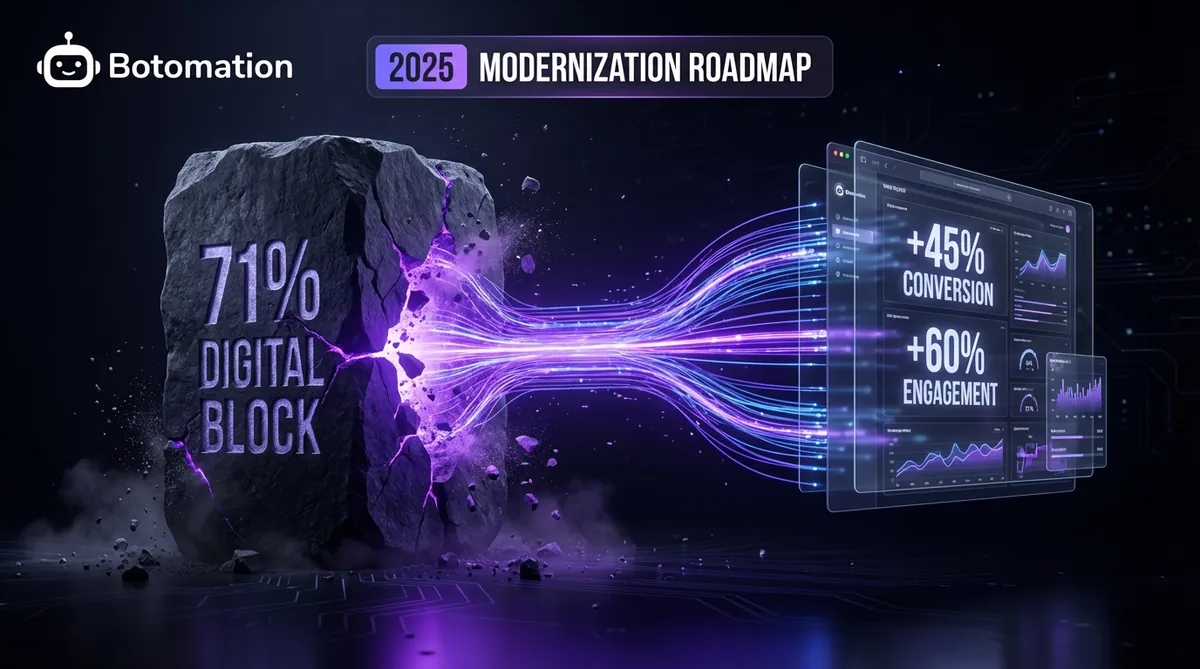
In late 2026, the strategic mandate to replace legacy systems with custom web development has become the primary differentiator between market leaders and those facing obsolescence. Statista reports that 71% of businesses are currently blocked from achieving their primary digital goals because of the gravity exerted by legacy systems. These aging architectures act as anchors, preventing organizations from adopting the very tools that define modern competitiveness. When your core infrastructure relies on frameworks that were outdated by 2022 standards, you aren't just moving slower; you are actively losing market share to leaner, AI-native competitors.
Transitioning to custom web development powered by artificial intelligence is no longer a luxury for the tech-forward few; it is a survival mandate. Our team has observed that companies making this shift experience 45% higher conversion rates and a 60% surge in user engagement compared to those clinging to generic, off-the-shelf solutions. The difference lies in the precision of the build. By moving away from bloated, one-size-fits-all platforms and toward custom code optimized by tools like GPT-5 and Midjourney v7, businesses can finally align their digital presence with their actual operational needs.
Recent case studies from the first half of 2026 highlight a significant shift in development velocity. Organizations utilizing AI-assisted modernization frameworks, such as NestJS migration paths and the Cursor development environment, are shipping code 3x faster than they were just twelve months ago. This guide provides a strategic roadmap for founders and CEOs who are ready to discard the "Old Way" of manual, slow-moving development and follow an AI-powered legacy system migration guide to build high-performance revenue engines.
Understanding the Need to Replace Legacy Systems with Custom Web Development
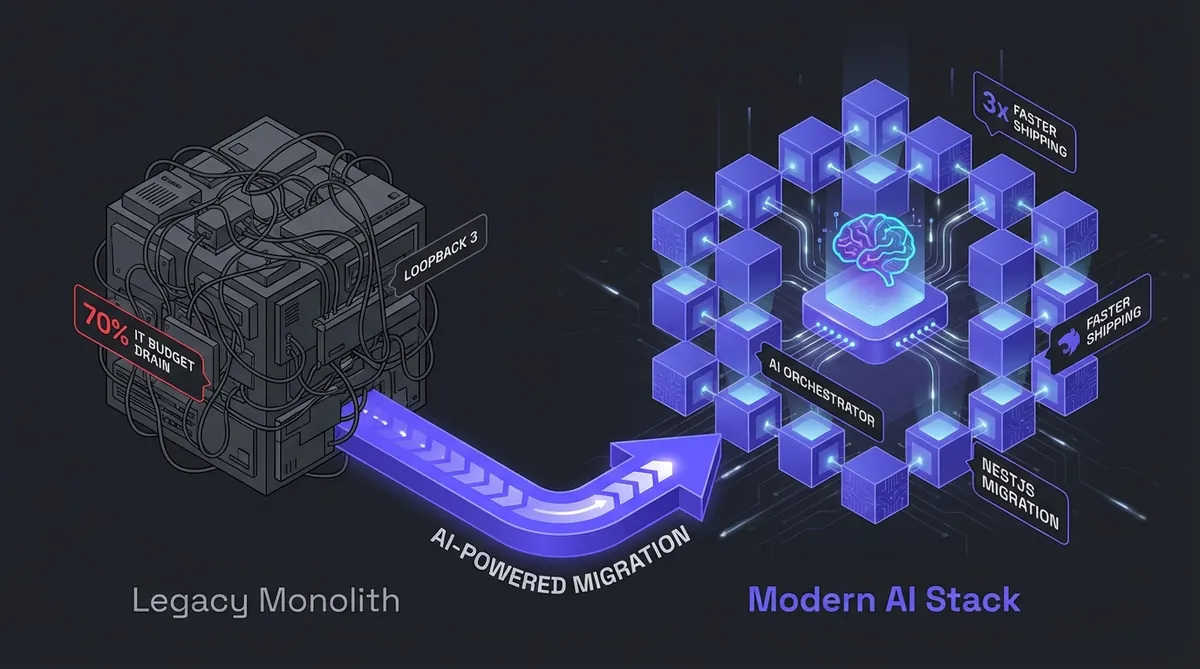
In the current landscape, a legacy system is defined by its inability to communicate with modern AI agents, such as B2B lead qualification bots, and its resistance to rapid scaling. These are typically monolithic architectures—massive, interconnected blocks of code where changing a single button can trigger a cascade of errors across the entire platform. Many B2B firms are still struggling with databases and infrastructure that lack proper documentation, creating a "black box" scenario where only a few senior developers understand how the system functions. This vendor lock-in and dependency on specialized, expensive talent is a primary driver of operational stagnation.
The financial drain of these systems is quantifiable and severe. On average, businesses maintaining legacy infrastructure face a 35% reduction in overall team productivity. When server response times are 65% slower than the industry standard, you aren't just frustrating users; you are signaling to search engines and partners that your business is a relic. We frequently see B2B retail firms experiencing total system failures because they are still running on LoopBack 3—a framework that has been obsolete for years. These failures don't just cost hours of downtime; they cost reputation and customer trust that can take years to rebuild.
Identifying Legacy System Characteristics and Red Flags
Recognizing the need for change starts with identifying specific red flags. Frequent downtime is the most obvious symptom, but subtle indicators are often more damaging. If your development team reports that adding a simple feature, like a new payment gateway or B2B lead generation chatbots, will take months of work, you are dealing with a legacy monolith. This lack of agility is a direct result of "spaghetti code" and a lack of modularity that prevents modern integrations. Furthermore, legacy system replacement with custom portals ensures that your client-facing tools are as advanced as your internal ones.
Security is another critical concern that cannot be ignored in 2026. Many older systems no longer receive security patches from their original vendors, leaving customer data exposed to modern threats. Integration challenges with modern APIs are also a major hurdle. If your website cannot fluidly connect to your CRM, ERP, or AI-driven marketing tools without custom-built middleware that breaks every week, your infrastructure is obsolete. Currently, maintenance costs consume up to 70% of IT budgets in firms with legacy stacks, leaving almost nothing for the development of new value.
Current State of Legacy Systems in 2026
Despite the clear risks, industry statistics show that 83% of enterprise workloads are still running on some form of legacy infrastructure. This creates a massive opportunity for the remaining 17% to dominate their niches. The trend for 2026 is a decisive shift toward cloud-native architectures and containerization. We are seeing the emergence of AI-powered assessment tools that can scan a million lines of legacy code in minutes, identifying every security flaw and performance bottleneck with surgical precision.
Remote work has further exposed the flaws of old systems. Legacy software often lacks the accessibility and performance required for a distributed workforce, leading to laggy interfaces and frustrated employees. In regulated industries, the challenge is even steeper. Compliance standards are evolving faster than legacy systems can be updated, putting companies at risk of massive fines simply because their software cannot support modern data privacy protocols. Partnering with our experts allows you to leapfrog these issues by building on a foundation designed for the requirements of today, not a decade ago.
The Financial Benefits to Replace Legacy Systems with Custom Web Development
The transition to custom, AI-integrated development offers a measurable return on investment that template-based solutions cannot match, as evidenced in our legacy vs custom development cost analysis. Approximately 83% of businesses report significant financial returns within the first year of implementing custom web development for marketing tailored to their specific workflows. Unlike generic platforms that force you to change business processes to fit their software, our custom builds are designed to mirror and accelerate your existing successful strategies, often resulting in SEO-optimized custom websites that outperform the competition. Utilizing custom enterprise applications for legacy modernization allows for a seamless transition that preserves data while upgrading performance.
Performance gains are equally dramatic. Custom solutions built by our team typically see 40% faster load times compared to template websites, which are often weighed down by unnecessary code and plugins. We focus on a 65% reduction in server response times by utilizing modern, lightweight frameworks. Consider a B2B retail platform that recently migrated from a monolithic LoopBack 3 architecture to a NestJS environment with our AI assistance. They didn't just see a slight improvement; their development velocity tripled, allowing them to ship more features in a single quarter than they had in the previous two years.
Financial Benefits and Cost Savings
The long-term financial impact of modernization is often the most compelling argument for CEOs. Maintenance costs typically drop by 40% when moving away from legacy systems because modern code is easier to read, test, and update. When you reduce the complexity of your infrastructure, you reduce the number of hours your team spends on firefighting and bug fixes. These efficiency gains, combined with efforts to automate data entry and admin tasks with AI, often translate to a 30% reduction in overall operational expenses within the first 24 months.
| Metric | Legacy System (Old Way) | Custom AI Solution (Botomation) |
|---|---|---|
| **Maintenance Cost** | 70% of IT Budget | 25% of IT Budget |
| **Development Speed** | 1x (Baseline) | 3x - 4x Faster |
| **Security Risk** | High (Unpatched) | Low (Architecture-level) |
| **User Engagement** | Declining | 60% Increase |
| **Conversion Rate** | Static/Low | 45% Improvement |
The ROI timeline for these projects is surprisingly short. On average, our clients see a full payback on their investment within 18 months. This is achieved by eliminating technical debt—the interest you pay on old, bad code. In 2026, case studies consistently show that the 20-30% cost savings realized from modernization are being reinvested into AI agents and automated growth strategies, creating a compounding effect on business value.
Operational and Performance Improvements
Operational excellence is the byproduct of a system that works with you, not against you. We have seen custom solutions drive 45% higher conversion rates because the user journey is optimized for the specific needs of the customer, often by focusing on how to improve website speed for better conversions without the friction found in generic templates. User engagement metrics often climb by 60% as the interface becomes more intuitive and responsive. For e-commerce systems, this directly results in a 35% reduction in cart abandonment rates, especially when paired with high-converting custom e-commerce designs, as customers no longer deal with slow page loads or broken checkout flows.
System reliability is the foundation of digital trust. Our modernized systems come with 99.9% uptime guarantees, supported by AI-driven observability tools that predict and prevent failures before they impact the user. The "New Way" of development focuses on the user experience (UX) by creating fluid, modern interfaces that respond instantly, far outperforming standard setups as detailed in our custom website vs WordPress performance guide. When your internal team has tools that actually work, their productivity skyrockets, and your business can finally operate at the speed of the 2026 market.
Key Takeaway: Replacing legacy systems isn't just a technical upgrade; it's a financial strategy. By reducing maintenance overhead and increasing conversion rates, custom AI-powered development pays for itself while providing a superior foundation for growth.
AI-Powered Tools and Technologies for Legacy System Modernization in 2026
The tools available for modernization have evolved significantly. We no longer rely on manual code audits that take weeks to complete. Instead, our experts utilize AI for code analysis tools that can ingest an entire legacy codebase and map out every dependency, hidden bug, and architectural flaw in a matter of hours. This allows us to create a migration plan based on data, not guesswork.
Frameworks like NestJS have become the gold standard for API migration. NestJS provides a structured, modular approach that allows us to break down monolithic applications into manageable microservices. For those moving from older Java environments, OpenRewrite has become an essential tool for automated migration to Jakarta namespaces, handling the repetitive refactoring that used to consume hundreds of developer hours. Large Language Models (LLMs) are now used to generate comprehensive documentation for systems that have had none for decades, ensuring that your team is never again held hostage by a black box system.
Code Analysis and Migration Tools
The heart of our modernization process is the use of AI-assisted development environments like Cursor. Cursor allows our developers to interact with the legacy code using natural language, asking the AI to refactor functions for better performance or identify security vulnerabilities in authentication modules, ensuring enterprise-grade solutions for small businesses remain secure. This doesn't replace the developer; it augments them, leading to the 3x velocity increase we discussed earlier.
Version control systems in 2026 now feature integrated AI governance. This ensures that every line of code committed to the new repository meets strict quality and security standards automatically. We also utilize specialized tools for data migration that can transform legacy database schemas into modern, optimized structures without losing a single record. This level of automation ensures that the transition is not only faster but significantly more accurate than manual methods.
Containerization and Cloud Technologies
Modernization is incomplete without a shift to cloud-native architectures. We utilize Docker for containerization, which allows the new application to run consistently across any environment. Kubernetes then acts as the orchestrator, automatically scaling your system up during peak traffic and down during quiet periods to save on hosting costs. This is a far cry from the "Old Way" of maintaining expensive, underutilized on-premises servers.
Serverless computing is another key component of our 2026 strategy. By using serverless functions for specific tasks, we can build highly cost-effective systems where you only pay for the exact computing power you use. All of this is tied together with CI/CD (Continuous Integration/Continuous Delivery) pipelines. These pipelines ensure that new features are tested and deployed automatically, with AI governance checking for performance regressions at every step. This creates a revenue engine that is always up-to-date and optimized for performance.
Step-by-Step Process for Replacing Legacy Systems with Custom AI Solutions
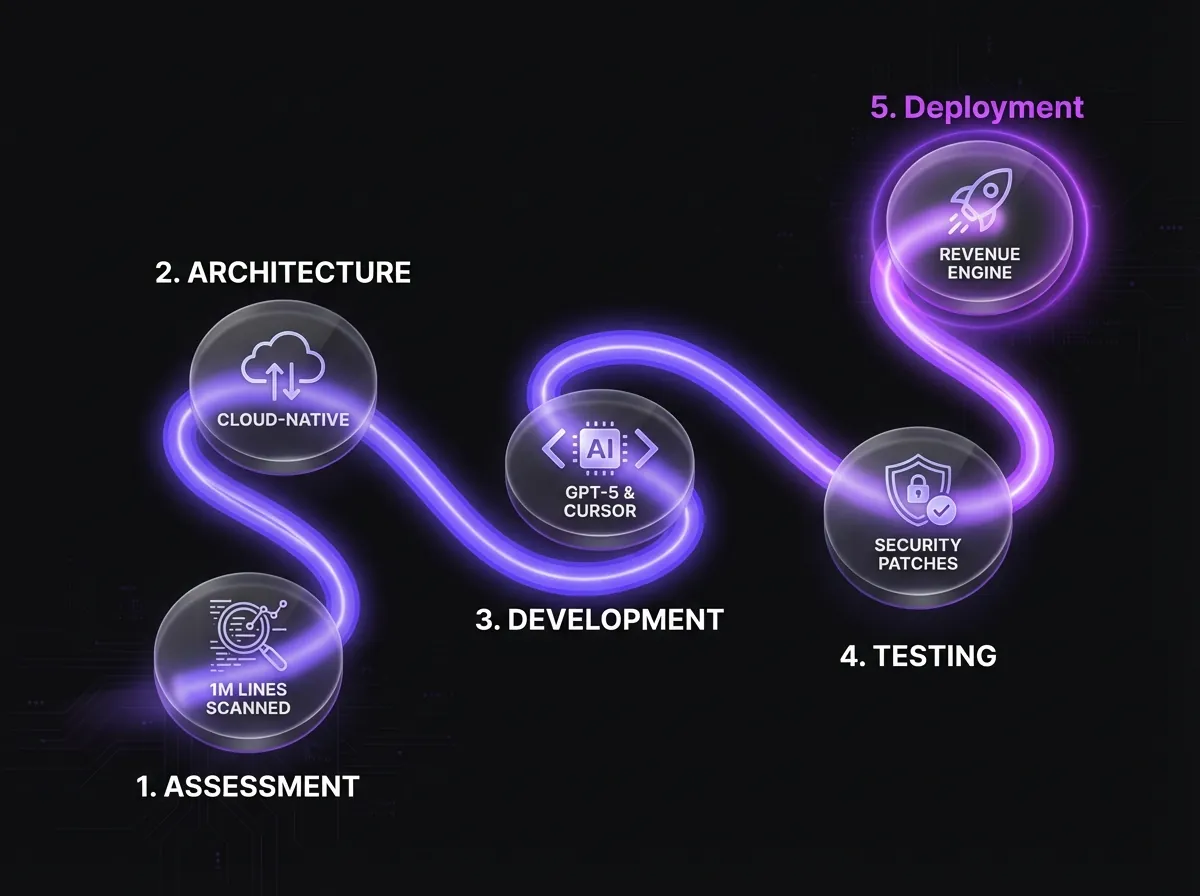
Replacing a legacy system requires a surgical approach to avoid disrupting daily operations. Our team follows a rigorous five-phase process designed to ensure a smooth transition from the "Old Way" to the "New Way."
Phase 1: Assessment and Planning
We begin with a comprehensive audit of your existing infrastructure. Using AI analysis tools, we map out the entire system architecture, identifying the most critical bottlenecks and security risks. This isn't just a technical audit; we also define your business requirements for the new solution. We develop a risk assessment and mitigation strategy to ensure that your data and operations remain protected throughout the process.
Phase 2: Architecture Design
Once the audit is complete, our experts design a modern architecture using 2026 frameworks like NestJS. We focus on a microservices-based approach, which allows different parts of your system to be updated or scaled independently. This design phase is where we plan for future AI integrations, ensuring that your new web application is ready to host the next generation of 24/7 AI agents.
Phase 3: Development and Migration
This is where the 3x velocity becomes apparent. Using AI-assisted environments like Cursor, our developers build your custom solution with unprecedented speed. We don't just write code; we build a system optimized for your specific revenue goals. Data migration happens progressively. We don't believe in "big bang" migrations that risk total system failure. Instead, we migrate data and functionality in stages, ensuring each piece is fully functional before moving to the next.
Phase 4: Testing and Automation
Quality assurance is handled through our AQA (Automated Quality Assurance) frameworks. In 2026, we achieve 80-90% test coverage through automation, ensuring that every possible user path is tested for errors. This phase includes rigorous security testing and performance benchmarking, often utilizing real-time data entry validation to ensure the new system exceeds the metrics of the old one.
Phase 5: Deployment and Optimization
The final phase involves the actual switch to the new system. We use AI-driven observability tools to monitor the deployment in real-time, allowing us to catch and fix any minor issues before they affect users. Once live, we continue to optimize the system based on real-world data, ensuring that your revenue engine is always tuned for maximum performance.
Real-World Case Studies: Successful Legacy Modernization with AI in 2024-2026
The impact of this approach is best seen through the success of companies that have already made the jump. A prominent B2B retail software platform recently faced a crisis: their monolithic LoopBack 3 application was so slow and buggy that they were losing major clients. By partnering with our team and utilizing AI-assisted migration to NestJS, their development velocity nearly tripled. They went from an average of 15 weekly commits to 43. This wasn't just more code; it was better code, with a 35% reduction in critical bugs reported by users.
Another large B2B platform utilized Cursor AI tools to complete a massive modernization project in just two months. Under the "Old Way" of manual development, this project was estimated to take between 6 and 12 months. This 3-6x speed improvement allowed them to launch their new features ahead of competitors, capturing a significant portion of the market during a critical seasonal window. The legacy code on their backend decreased from 100% of the codebase to just 25% in record time.
Enterprise Migration Success Stories
Even the largest players in the industry are following this path. Netflix famously completed a gradual migration to the AWS cloud by using an API-first approach. They didn't try to move everything at once; they built modern services around their old monolith, slowly strangling the legacy code until it was no longer needed. This Strangler Pattern is a core strategy our team uses for complex enterprise projects.
Capital One provides another stellar example. They migrated from eight on-premises data centers to a fully cloud-native environment on AWS. The result? A 50% reduction in transaction errors and the ability to release software updates hundreds of times a day instead of once a quarter. Industry-wide metrics for 2026 show that AI-assisted projects like these finish 40% faster and save 20-30% in total costs. These aren't just technical wins; they are massive competitive advantages.
Modernization Statistics for 2026:
- Development Speed: 3x increase using AI-assisted environments.
- Cost Reduction: 20-30% savings on total project budgets.
- Error Rates: 50% fewer production bugs in modernized systems.
- Time to Market: 40% faster delivery of new features.
Overcoming Common Challenges in AI-Powered Legacy Modernization
Modernization is not without its hurdles, but they are manageable with the right strategy. The most common challenge is data migration complexity. Moving decades of data from a fragmented legacy database to a modern environment is a high-stakes task. We minimize downtime by using phased migration strategies and automated data validation tools that ensure 100% data integrity throughout the process, similar to how AI agents replace manual data entry work to ensure precision.
Team skill gaps are another concern. Your internal team may be experts in your legacy system but unfamiliar with NestJS or AI-assisted development tools. Our agency bridges this gap by providing the expert talent needed for the transition while training your team on the new infrastructure, helping to scale business operations with AI automation effectively. We ensure that when we hand over the keys to your new system, your team is fully equipped to manage it.
Technical Challenges and Solutions
Integrating with existing third-party systems that you aren't ready to replace yet can be difficult. We solve this by building robust API layers that allow your new, modern web application to communicate with older external services. Security is also a major focus; during the migration, we maintain strict access controls to ensure that your data is never exposed. We use AI-driven testing to simulate worst-case scenarios, ensuring the new system is stable under any conditions.
Organizational and Change Management
The human element is often the biggest obstacle. Resistance to change is natural, especially when employees have spent years mastering a specific tool. We address this through clear communication and a phased rollout that allows users to adapt to the new interface gradually. By demonstrating immediate benefits—such as faster load times and more intuitive workflows—we build buy-in from the ground up. Our goal is to make the transition so beneficial to the end-user that they would never want to go back to the "Old Way."
The Future of Your Infrastructure
The decision to replace a legacy system is a defining moment for any business. In 2026, the gap between companies running on modern, AI-powered custom code and those struggling with legacy monoliths is widening into a chasm. The "Old Way" of development—slow, expensive, and reactive—is a path to obsolescence. By partnering with our experts at Botomation, you are choosing the "New Way": high-speed, enterprise-grade development that turns your website into a high-performance revenue engine.
We have seen firsthand how a 3x increase in development velocity and a 40% reduction in maintenance costs can transform a struggling firm into a market leader. The B2B retail case studies prove that with the right AI tools and architectural expertise, migration times can be cut in half while significantly improving the end-user experience. You don't have to be held back by your past. Our team is ready to help you build the infrastructure that will carry your business through 2026 and beyond.
Ready to automate your growth? Book a call below.
Frequently Asked Questions
How long does a typical legacy system replacement take with your agency?
While every project is unique, our AI-assisted approach typically reduces traditional timelines by 40-60%. A project that might have taken 12 months using manual methods can often be completed in 4 to 6 months. We focus on a phased rollout, meaning you start seeing improvements and new features in weeks, not years.
Will there be downtime during the migration process?
Our goal is zero downtime for your critical business operations. We utilize strategies like the Strangler Pattern, where we build the new system alongside the old one and migrate traffic gradually. This ensures that your customers and internal teams can continue working without interruption while the modernization takes place.
Why should we choose a custom solution over a modern SaaS platform?
SaaS platforms offer convenience but often lack the flexibility needed for complex, scaling businesses. A custom solution from Botomation is built specifically for your workflows, giving you total ownership of your code and data. This eliminates monthly per-user fees and allows for deep AI integrations that generic platforms simply cannot support.
Is my data safe during the migration to a new system?
Data integrity is our top priority. We use automated validation tools to ensure that every record is migrated accurately. Furthermore, our modernized architectures include enterprise-grade security features that are significantly more resilient against modern threats than legacy systems.
In late 2026, the strategic mandate to replace legacy systems with custom web development has become the primary differentiator between market leaders and those facing obsolescence. Statista reports that 71% of businesses are currently blocked from achieving their primary digital goals because of the gravity exerted by legacy systems. These aging architectures act as anchors, preventing organizations from adopting the very tools that define modern competitiveness. When your core infrastructure relies on frameworks that were outdated by 2022 standards, you aren't just moving slower; you are actively losing market share to leaner, AI-native competitors.
Transitioning to custom web development powered by artificial intelligence is no longer a luxury for the tech-forward few; it is a survival mandate. Our team has observed that companies making this shift experience 45% higher conversion rates and a 60% surge in user engagement compared to those clinging to generic, off-the-shelf solutions. The difference lies in the precision of the build. By moving away from bloated, one-size-fits-all platforms and toward custom code optimized by tools like GPT-5 and Midjourney v7, businesses can finally align their digital presence with their actual operational needs.
Recent case studies from the first half of 2026 highlight a significant shift in development velocity. Organizations utilizing AI-assisted modernization frameworks, such as NestJS migration paths and the Cursor development environment, are shipping code 3x faster than they were just twelve months ago. This guide provides a strategic roadmap for founders and CEOs who are ready to discard the "Old Way" of manual, slow-moving development and follow an AI-powered legacy system migration guide to build high-performance revenue engines.
Understanding the Need to Replace Legacy Systems with Custom Web Development
In the current landscape, a legacy system is defined by its inability to communicate with modern AI agents, such as B2B lead qualification bots, and its resistance to rapid scaling. These are typically monolithic architectures—massive, interconnected blocks of code where changing a single button can trigger a cascade of errors across the entire platform. Many B2B firms are still struggling with databases and infrastructure that lack proper documentation, creating a "black box" scenario where only a few senior developers understand how the system functions. This vendor lock-in and dependency on specialized, expensive talent is a primary driver of operational stagnation.
The financial drain of these systems is quantifiable and severe. On average, businesses maintaining legacy infrastructure face a 35% reduction in overall team productivity. When server response times are 65% slower than the industry standard, you aren't just frustrating users; you are signaling to search engines and partners that your business is a relic. We frequently see B2B retail firms experiencing total system failures because they are still running on LoopBack 3—a framework that has been obsolete for years. These failures don't just cost hours of downtime; they cost reputation and customer trust that can take years to rebuild.
Identifying Legacy System Characteristics and Red Flags
Recognizing the need for change starts with identifying specific red flags. Frequent downtime is the most obvious symptom, but subtle indicators are often more damaging. If your development team reports that adding a simple feature, like a new payment gateway or B2B lead generation chatbots, will take months of work, you are dealing with a legacy monolith. This lack of agility is a direct result of "spaghetti code" and a lack of modularity that prevents modern integrations. Furthermore, legacy system replacement with custom portals ensures that your client-facing tools are as advanced as your internal ones.
Security is another critical concern that cannot be ignored in 2026. Many older systems no longer receive security patches from their original vendors, leaving customer data exposed to modern threats. Integration challenges with modern APIs are also a major hurdle. If your website cannot fluidly connect to your CRM, ERP, or AI-driven marketing tools without custom-built middleware that breaks every week, your infrastructure is obsolete. Currently, maintenance costs consume up to 70% of IT budgets in firms with legacy stacks, leaving almost nothing for the development of new value.
Current State of Legacy Systems in 2026
Despite the clear risks, industry statistics show that 83% of enterprise workloads are still running on some form of legacy infrastructure. This creates a massive opportunity for the remaining 17% to dominate their niches. The trend for 2026 is a decisive shift toward cloud-native architectures and containerization. We are seeing the emergence of AI-powered assessment tools that can scan a million lines of legacy code in minutes, identifying every security flaw and performance bottleneck with surgical precision.
Remote work has further exposed the flaws of old systems. Legacy software often lacks the accessibility and performance required for a distributed workforce, leading to laggy interfaces and frustrated employees. In regulated industries, the challenge is even steeper. Compliance standards are evolving faster than legacy systems can be updated, putting companies at risk of massive fines simply because their software cannot support modern data privacy protocols. Partnering with our experts allows you to leapfrog these issues by building on a foundation designed for the requirements of today, not a decade ago.
The Financial Benefits to Replace Legacy Systems with Custom Web Development
The transition to custom, AI-integrated development offers a measurable return on investment that template-based solutions cannot match, as evidenced in our legacy vs custom development cost analysis. Approximately 83% of businesses report significant financial returns within the first year of implementing custom web development for marketing tailored to their specific workflows. Unlike generic platforms that force you to change business processes to fit their software, our custom builds are designed to mirror and accelerate your existing successful strategies, often resulting in SEO-optimized custom websites that outperform the competition. Utilizing custom enterprise applications for legacy modernization allows for a seamless transition that preserves data while upgrading performance.
Performance gains are equally dramatic. Custom solutions built by our team typically see 40% faster load times compared to template websites, which are often weighed down by unnecessary code and plugins. We focus on a 65% reduction in server response times by utilizing modern, lightweight frameworks. Consider a B2B retail platform that recently migrated from a monolithic LoopBack 3 architecture to a NestJS environment with our AI assistance. They didn't just see a slight improvement; their development velocity tripled, allowing them to ship more features in a single quarter than they had in the previous two years.
Financial Benefits and Cost Savings
The long-term financial impact of modernization is often the most compelling argument for CEOs. Maintenance costs typically drop by 40% when moving away from legacy systems because modern code is easier to read, test, and update. When you reduce the complexity of your infrastructure, you reduce the number of hours your team spends on firefighting and bug fixes. These efficiency gains, combined with efforts to automate data entry and admin tasks with AI, often translate to a 30% reduction in overall operational expenses within the first 24 months.
| Metric | Legacy System (Old Way) | Custom AI Solution (Botomation) |
|---|---|---|
| **Maintenance Cost** | 70% of IT Budget | 25% of IT Budget |
| **Development Speed** | 1x (Baseline) | 3x - 4x Faster |
| **Security Risk** | High (Unpatched) | Low (Architecture-level) |
| **User Engagement** | Declining | 60% Increase |
| **Conversion Rate** | Static/Low | 45% Improvement |
The ROI timeline for these projects is surprisingly short. On average, our clients see a full payback on their investment within 18 months. This is achieved by eliminating technical debt—the interest you pay on old, bad code. In 2026, case studies consistently show that the 20-30% cost savings realized from modernization are being reinvested into AI agents and automated growth strategies, creating a compounding effect on business value.
Operational and Performance Improvements
Operational excellence is the byproduct of a system that works with you, not against you. We have seen custom solutions drive 45% higher conversion rates because the user journey is optimized for the specific needs of the customer, often by focusing on how to improve website speed for better conversions without the friction found in generic templates. User engagement metrics often climb by 60% as the interface becomes more intuitive and responsive. For e-commerce systems, this directly results in a 35% reduction in cart abandonment rates, especially when paired with high-converting custom e-commerce designs, as customers no longer deal with slow page loads or broken checkout flows.
System reliability is the foundation of digital trust. Our modernized systems come with 99.9% uptime guarantees, supported by AI-driven observability tools that predict and prevent failures before they impact the user. The "New Way" of development focuses on the user experience (UX) by creating fluid, modern interfaces that respond instantly, far outperforming standard setups as detailed in our custom website vs WordPress performance guide. When your internal team has tools that actually work, their productivity skyrockets, and your business can finally operate at the speed of the 2026 market.
Key Takeaway: Replacing legacy systems isn't just a technical upgrade; it's a financial strategy. By reducing maintenance overhead and increasing conversion rates, custom AI-powered development pays for itself while providing a superior foundation for growth.
AI-Powered Tools and Technologies for Legacy System Modernization in 2026
The tools available for modernization have evolved significantly. We no longer rely on manual code audits that take weeks to complete. Instead, our experts utilize AI for code analysis tools that can ingest an entire legacy codebase and map out every dependency, hidden bug, and architectural flaw in a matter of hours. This allows us to create a migration plan based on data, not guesswork.
Frameworks like NestJS have become the gold standard for API migration. NestJS provides a structured, modular approach that allows us to break down monolithic applications into manageable microservices. For those moving from older Java environments, OpenRewrite has become an essential tool for automated migration to Jakarta namespaces, handling the repetitive refactoring that used to consume hundreds of developer hours. Large Language Models (LLMs) are now used to generate comprehensive documentation for systems that have had none for decades, ensuring that your team is never again held hostage by a black box system.
Code Analysis and Migration Tools
The heart of our modernization process is the use of AI-assisted development environments like Cursor. Cursor allows our developers to interact with the legacy code using natural language, asking the AI to refactor functions for better performance or identify security vulnerabilities in authentication modules, ensuring enterprise-grade solutions for small businesses remain secure. This doesn't replace the developer; it augments them, leading to the 3x velocity increase we discussed earlier.
Version control systems in 2026 now feature integrated AI governance. This ensures that every line of code committed to the new repository meets strict quality and security standards automatically. We also utilize specialized tools for data migration that can transform legacy database schemas into modern, optimized structures without losing a single record. This level of automation ensures that the transition is not only faster but significantly more accurate than manual methods.
Containerization and Cloud Technologies
Modernization is incomplete without a shift to cloud-native architectures. We utilize Docker for containerization, which allows the new application to run consistently across any environment. Kubernetes then acts as the orchestrator, automatically scaling your system up during peak traffic and down during quiet periods to save on hosting costs. This is a far cry from the "Old Way" of maintaining expensive, underutilized on-premises servers.
Serverless computing is another key component of our 2026 strategy. By using serverless functions for specific tasks, we can build highly cost-effective systems where you only pay for the exact computing power you use. All of this is tied together with CI/CD (Continuous Integration/Continuous Delivery) pipelines. These pipelines ensure that new features are tested and deployed automatically, with AI governance checking for performance regressions at every step. This creates a revenue engine that is always up-to-date and optimized for performance.
Step-by-Step Process for Replacing Legacy Systems with Custom AI Solutions
Replacing a legacy system requires a surgical approach to avoid disrupting daily operations. Our team follows a rigorous five-phase process designed to ensure a smooth transition from the "Old Way" to the "New Way."
Phase 1: Assessment and Planning
We begin with a comprehensive audit of your existing infrastructure. Using AI analysis tools, we map out the entire system architecture, identifying the most critical bottlenecks and security risks. This isn't just a technical audit; we also define your business requirements for the new solution. We develop a risk assessment and mitigation strategy to ensure that your data and operations remain protected throughout the process.
Phase 2: Architecture Design
Once the audit is complete, our experts design a modern architecture using 2026 frameworks like NestJS. We focus on a microservices-based approach, which allows different parts of your system to be updated or scaled independently. This design phase is where we plan for future AI integrations, ensuring that your new web application is ready to host the next generation of 24/7 AI agents.
Phase 3: Development and Migration
This is where the 3x velocity becomes apparent. Using AI-assisted environments like Cursor, our developers build your custom solution with unprecedented speed. We don't just write code; we build a system optimized for your specific revenue goals. Data migration happens progressively. We don't believe in "big bang" migrations that risk total system failure. Instead, we migrate data and functionality in stages, ensuring each piece is fully functional before moving to the next.
Phase 4: Testing and Automation
Quality assurance is handled through our AQA (Automated Quality Assurance) frameworks. In 2026, we achieve 80-90% test coverage through automation, ensuring that every possible user path is tested for errors. This phase includes rigorous security testing and performance benchmarking, often utilizing real-time data entry validation to ensure the new system exceeds the metrics of the old one.
Phase 5: Deployment and Optimization
The final phase involves the actual switch to the new system. We use AI-driven observability tools to monitor the deployment in real-time, allowing us to catch and fix any minor issues before they affect users. Once live, we continue to optimize the system based on real-world data, ensuring that your revenue engine is always tuned for maximum performance.
Real-World Case Studies: Successful Legacy Modernization with AI in 2024-2026
The impact of this approach is best seen through the success of companies that have already made the jump. A prominent B2B retail software platform recently faced a crisis: their monolithic LoopBack 3 application was so slow and buggy that they were losing major clients. By partnering with our team and utilizing AI-assisted migration to NestJS, their development velocity nearly tripled. They went from an average of 15 weekly commits to 43. This wasn't just more code; it was better code, with a 35% reduction in critical bugs reported by users.
Another large B2B platform utilized Cursor AI tools to complete a massive modernization project in just two months. Under the "Old Way" of manual development, this project was estimated to take between 6 and 12 months. This 3-6x speed improvement allowed them to launch their new features ahead of competitors, capturing a significant portion of the market during a critical seasonal window. The legacy code on their backend decreased from 100% of the codebase to just 25% in record time.
Enterprise Migration Success Stories
Even the largest players in the industry are following this path. Netflix famously completed a gradual migration to the AWS cloud by using an API-first approach. They didn't try to move everything at once; they built modern services around their old monolith, slowly strangling the legacy code until it was no longer needed. This Strangler Pattern is a core strategy our team uses for complex enterprise projects.
Capital One provides another stellar example. They migrated from eight on-premises data centers to a fully cloud-native environment on AWS. The result? A 50% reduction in transaction errors and the ability to release software updates hundreds of times a day instead of once a quarter. Industry-wide metrics for 2026 show that AI-assisted projects like these finish 40% faster and save 20-30% in total costs. These aren't just technical wins; they are massive competitive advantages.
Modernization Statistics for 2026:
- Development Speed: 3x increase using AI-assisted environments.
- Cost Reduction: 20-30% savings on total project budgets.
- Error Rates: 50% fewer production bugs in modernized systems.
- Time to Market: 40% faster delivery of new features.
Overcoming Common Challenges in AI-Powered Legacy Modernization
Modernization is not without its hurdles, but they are manageable with the right strategy. The most common challenge is data migration complexity. Moving decades of data from a fragmented legacy database to a modern environment is a high-stakes task. We minimize downtime by using phased migration strategies and automated data validation tools that ensure 100% data integrity throughout the process, similar to how AI agents replace manual data entry work to ensure precision.
Team skill gaps are another concern. Your internal team may be experts in your legacy system but unfamiliar with NestJS or AI-assisted development tools. Our agency bridges this gap by providing the expert talent needed for the transition while training your team on the new infrastructure, helping to scale business operations with AI automation effectively. We ensure that when we hand over the keys to your new system, your team is fully equipped to manage it.
Technical Challenges and Solutions
Integrating with existing third-party systems that you aren't ready to replace yet can be difficult. We solve this by building robust API layers that allow your new, modern web application to communicate with older external services. Security is also a major focus; during the migration, we maintain strict access controls to ensure that your data is never exposed. We use AI-driven testing to simulate worst-case scenarios, ensuring the new system is stable under any conditions.
Organizational and Change Management
The human element is often the biggest obstacle. Resistance to change is natural, especially when employees have spent years mastering a specific tool. We address this through clear communication and a phased rollout that allows users to adapt to the new interface gradually. By demonstrating immediate benefits—such as faster load times and more intuitive workflows—we build buy-in from the ground up. Our goal is to make the transition so beneficial to the end-user that they would never want to go back to the "Old Way."
The Future of Your Infrastructure
The decision to replace a legacy system is a defining moment for any business. In 2026, the gap between companies running on modern, AI-powered custom code and those struggling with legacy monoliths is widening into a chasm. The "Old Way" of development—slow, expensive, and reactive—is a path to obsolescence. By partnering with our experts at Botomation, you are choosing the "New Way": high-speed, enterprise-grade development that turns your website into a high-performance revenue engine.
We have seen firsthand how a 3x increase in development velocity and a 40% reduction in maintenance costs can transform a struggling firm into a market leader. The B2B retail case studies prove that with the right AI tools and architectural expertise, migration times can be cut in half while significantly improving the end-user experience. You don't have to be held back by your past. Our team is ready to help you build the infrastructure that will carry your business through 2026 and beyond.
Ready to automate your growth? Book a call below.
Frequently Asked Questions
How long does a typical legacy system replacement take with your agency?
While every project is unique, our AI-assisted approach typically reduces traditional timelines by 40-60%. A project that might have taken 12 months using manual methods can often be completed in 4 to 6 months. We focus on a phased rollout, meaning you start seeing improvements and new features in weeks, not years.
Will there be downtime during the migration process?
Our goal is zero downtime for your critical business operations. We utilize strategies like the Strangler Pattern, where we build the new system alongside the old one and migrate traffic gradually. This ensures that your customers and internal teams can continue working without interruption while the modernization takes place.
Why should we choose a custom solution over a modern SaaS platform?
SaaS platforms offer convenience but often lack the flexibility needed for complex, scaling businesses. A custom solution from Botomation is built specifically for your workflows, giving you total ownership of your code and data. This eliminates monthly per-user fees and allows for deep AI integrations that generic platforms simply cannot support.
Is my data safe during the migration to a new system?
Data integrity is our top priority. We use automated validation tools to ensure that every record is migrated accurately. Furthermore, our modernized architectures include enterprise-grade security features that are significantly more resilient against modern threats than legacy systems.
In late 2026, the strategic mandate to replace legacy systems with custom web development has become the primary differentiator between market leaders and those facing obsolescence. Statista reports that 71% of businesses are currently blocked from achieving their primary digital goals because of the gravity exerted by legacy systems. These aging architectures act as anchors, preventing organizations from adopting the very tools that define modern competitiveness. When your core infrastructure relies on frameworks that were outdated by 2022 standards, you aren't just moving slower; you are actively losing market share to leaner, AI-native competitors.
Transitioning to custom web development powered by artificial intelligence is no longer a luxury for the tech-forward few; it is a survival mandate. Our team has observed that companies making this shift experience 45% higher conversion rates and a 60% surge in user engagement compared to those clinging to generic, off-the-shelf solutions. The difference lies in the precision of the build. By moving away from bloated, one-size-fits-all platforms and toward custom code optimized by tools like GPT-5 and Midjourney v7, businesses can finally align their digital presence with their actual operational needs.
Recent case studies from the first half of 2026 highlight a significant shift in development velocity. Organizations utilizing AI-assisted modernization frameworks, such as NestJS migration paths and the Cursor development environment, are shipping code 3x faster than they were just twelve months ago. This guide provides a strategic roadmap for founders and CEOs who are ready to discard the "Old Way" of manual, slow-moving development and follow an AI-powered legacy system migration guide to build high-performance revenue engines.
Understanding the Need to Replace Legacy Systems with Custom Web Development
In the current landscape, a legacy system is defined by its inability to communicate with modern AI agents, such as B2B lead qualification bots, and its resistance to rapid scaling. These are typically monolithic architectures—massive, interconnected blocks of code where changing a single button can trigger a cascade of errors across the entire platform. Many B2B firms are still struggling with databases and infrastructure that lack proper documentation, creating a "black box" scenario where only a few senior developers understand how the system functions. This vendor lock-in and dependency on specialized, expensive talent is a primary driver of operational stagnation.
The financial drain of these systems is quantifiable and severe. On average, businesses maintaining legacy infrastructure face a 35% reduction in overall team productivity. When server response times are 65% slower than the industry standard, you aren't just frustrating users; you are signaling to search engines and partners that your business is a relic. We frequently see B2B retail firms experiencing total system failures because they are still running on LoopBack 3—a framework that has been obsolete for years. These failures don't just cost hours of downtime; they cost reputation and customer trust that can take years to rebuild.
Identifying Legacy System Characteristics and Red Flags
Recognizing the need for change starts with identifying specific red flags. Frequent downtime is the most obvious symptom, but subtle indicators are often more damaging. If your development team reports that adding a simple feature, like a new payment gateway or B2B lead generation chatbots, will take months of work, you are dealing with a legacy monolith. This lack of agility is a direct result of "spaghetti code" and a lack of modularity that prevents modern integrations. Furthermore, legacy system replacement with custom portals ensures that your client-facing tools are as advanced as your internal ones.
Security is another critical concern that cannot be ignored in 2026. Many older systems no longer receive security patches from their original vendors, leaving customer data exposed to modern threats. Integration challenges with modern APIs are also a major hurdle. If your website cannot fluidly connect to your CRM, ERP, or AI-driven marketing tools without custom-built middleware that breaks every week, your infrastructure is obsolete. Currently, maintenance costs consume up to 70% of IT budgets in firms with legacy stacks, leaving almost nothing for the development of new value.
Current State of Legacy Systems in 2026
Despite the clear risks, industry statistics show that 83% of enterprise workloads are still running on some form of legacy infrastructure. This creates a massive opportunity for the remaining 17% to dominate their niches. The trend for 2026 is a decisive shift toward cloud-native architectures and containerization. We are seeing the emergence of AI-powered assessment tools that can scan a million lines of legacy code in minutes, identifying every security flaw and performance bottleneck with surgical precision.
Remote work has further exposed the flaws of old systems. Legacy software often lacks the accessibility and performance required for a distributed workforce, leading to laggy interfaces and frustrated employees. In regulated industries, the challenge is even steeper. Compliance standards are evolving faster than legacy systems can be updated, putting companies at risk of massive fines simply because their software cannot support modern data privacy protocols. Partnering with our experts allows you to leapfrog these issues by building on a foundation designed for the requirements of today, not a decade ago.
The Financial Benefits to Replace Legacy Systems with Custom Web Development
The transition to custom, AI-integrated development offers a measurable return on investment that template-based solutions cannot match, as evidenced in our legacy vs custom development cost analysis. Approximately 83% of businesses report significant financial returns within the first year of implementing custom web development for marketing tailored to their specific workflows. Unlike generic platforms that force you to change business processes to fit their software, our custom builds are designed to mirror and accelerate your existing successful strategies, often resulting in SEO-optimized custom websites that outperform the competition. Utilizing custom enterprise applications for legacy modernization allows for a seamless transition that preserves data while upgrading performance.
Performance gains are equally dramatic. Custom solutions built by our team typically see 40% faster load times compared to template websites, which are often weighed down by unnecessary code and plugins. We focus on a 65% reduction in server response times by utilizing modern, lightweight frameworks. Consider a B2B retail platform that recently migrated from a monolithic LoopBack 3 architecture to a NestJS environment with our AI assistance. They didn't just see a slight improvement; their development velocity tripled, allowing them to ship more features in a single quarter than they had in the previous two years.
Financial Benefits and Cost Savings
The long-term financial impact of modernization is often the most compelling argument for CEOs. Maintenance costs typically drop by 40% when moving away from legacy systems because modern code is easier to read, test, and update. When you reduce the complexity of your infrastructure, you reduce the number of hours your team spends on firefighting and bug fixes. These efficiency gains, combined with efforts to automate data entry and admin tasks with AI, often translate to a 30% reduction in overall operational expenses within the first 24 months.
| Metric | Legacy System (Old Way) | Custom AI Solution (Botomation) |
|---|---|---|
| **Maintenance Cost** | 70% of IT Budget | 25% of IT Budget |
| **Development Speed** | 1x (Baseline) | 3x - 4x Faster |
| **Security Risk** | High (Unpatched) | Low (Architecture-level) |
| **User Engagement** | Declining | 60% Increase |
| **Conversion Rate** | Static/Low | 45% Improvement |
The ROI timeline for these projects is surprisingly short. On average, our clients see a full payback on their investment within 18 months. This is achieved by eliminating technical debt—the interest you pay on old, bad code. In 2026, case studies consistently show that the 20-30% cost savings realized from modernization are being reinvested into AI agents and automated growth strategies, creating a compounding effect on business value.
Operational and Performance Improvements
Operational excellence is the byproduct of a system that works with you, not against you. We have seen custom solutions drive 45% higher conversion rates because the user journey is optimized for the specific needs of the customer, often by focusing on how to improve website speed for better conversions without the friction found in generic templates. User engagement metrics often climb by 60% as the interface becomes more intuitive and responsive. For e-commerce systems, this directly results in a 35% reduction in cart abandonment rates, especially when paired with high-converting custom e-commerce designs, as customers no longer deal with slow page loads or broken checkout flows.
System reliability is the foundation of digital trust. Our modernized systems come with 99.9% uptime guarantees, supported by AI-driven observability tools that predict and prevent failures before they impact the user. The "New Way" of development focuses on the user experience (UX) by creating fluid, modern interfaces that respond instantly, far outperforming standard setups as detailed in our custom website vs WordPress performance guide. When your internal team has tools that actually work, their productivity skyrockets, and your business can finally operate at the speed of the 2026 market.
Key Takeaway: Replacing legacy systems isn't just a technical upgrade; it's a financial strategy. By reducing maintenance overhead and increasing conversion rates, custom AI-powered development pays for itself while providing a superior foundation for growth.
AI-Powered Tools and Technologies for Legacy System Modernization in 2026
The tools available for modernization have evolved significantly. We no longer rely on manual code audits that take weeks to complete. Instead, our experts utilize AI for code analysis tools that can ingest an entire legacy codebase and map out every dependency, hidden bug, and architectural flaw in a matter of hours. This allows us to create a migration plan based on data, not guesswork.
Frameworks like NestJS have become the gold standard for API migration. NestJS provides a structured, modular approach that allows us to break down monolithic applications into manageable microservices. For those moving from older Java environments, OpenRewrite has become an essential tool for automated migration to Jakarta namespaces, handling the repetitive refactoring that used to consume hundreds of developer hours. Large Language Models (LLMs) are now used to generate comprehensive documentation for systems that have had none for decades, ensuring that your team is never again held hostage by a black box system.
Code Analysis and Migration Tools
The heart of our modernization process is the use of AI-assisted development environments like Cursor. Cursor allows our developers to interact with the legacy code using natural language, asking the AI to refactor functions for better performance or identify security vulnerabilities in authentication modules, ensuring enterprise-grade solutions for small businesses remain secure. This doesn't replace the developer; it augments them, leading to the 3x velocity increase we discussed earlier.
Version control systems in 2026 now feature integrated AI governance. This ensures that every line of code committed to the new repository meets strict quality and security standards automatically. We also utilize specialized tools for data migration that can transform legacy database schemas into modern, optimized structures without losing a single record. This level of automation ensures that the transition is not only faster but significantly more accurate than manual methods.
Containerization and Cloud Technologies
Modernization is incomplete without a shift to cloud-native architectures. We utilize Docker for containerization, which allows the new application to run consistently across any environment. Kubernetes then acts as the orchestrator, automatically scaling your system up during peak traffic and down during quiet periods to save on hosting costs. This is a far cry from the "Old Way" of maintaining expensive, underutilized on-premises servers.
Serverless computing is another key component of our 2026 strategy. By using serverless functions for specific tasks, we can build highly cost-effective systems where you only pay for the exact computing power you use. All of this is tied together with CI/CD (Continuous Integration/Continuous Delivery) pipelines. These pipelines ensure that new features are tested and deployed automatically, with AI governance checking for performance regressions at every step. This creates a revenue engine that is always up-to-date and optimized for performance.
Step-by-Step Process for Replacing Legacy Systems with Custom AI Solutions
Replacing a legacy system requires a surgical approach to avoid disrupting daily operations. Our team follows a rigorous five-phase process designed to ensure a smooth transition from the "Old Way" to the "New Way."
Phase 1: Assessment and Planning
We begin with a comprehensive audit of your existing infrastructure. Using AI analysis tools, we map out the entire system architecture, identifying the most critical bottlenecks and security risks. This isn't just a technical audit; we also define your business requirements for the new solution. We develop a risk assessment and mitigation strategy to ensure that your data and operations remain protected throughout the process.
Phase 2: Architecture Design
Once the audit is complete, our experts design a modern architecture using 2026 frameworks like NestJS. We focus on a microservices-based approach, which allows different parts of your system to be updated or scaled independently. This design phase is where we plan for future AI integrations, ensuring that your new web application is ready to host the next generation of 24/7 AI agents.
Phase 3: Development and Migration
This is where the 3x velocity becomes apparent. Using AI-assisted environments like Cursor, our developers build your custom solution with unprecedented speed. We don't just write code; we build a system optimized for your specific revenue goals. Data migration happens progressively. We don't believe in "big bang" migrations that risk total system failure. Instead, we migrate data and functionality in stages, ensuring each piece is fully functional before moving to the next.
Phase 4: Testing and Automation
Quality assurance is handled through our AQA (Automated Quality Assurance) frameworks. In 2026, we achieve 80-90% test coverage through automation, ensuring that every possible user path is tested for errors. This phase includes rigorous security testing and performance benchmarking, often utilizing real-time data entry validation to ensure the new system exceeds the metrics of the old one.
Phase 5: Deployment and Optimization
The final phase involves the actual switch to the new system. We use AI-driven observability tools to monitor the deployment in real-time, allowing us to catch and fix any minor issues before they affect users. Once live, we continue to optimize the system based on real-world data, ensuring that your revenue engine is always tuned for maximum performance.
Real-World Case Studies: Successful Legacy Modernization with AI in 2024-2026
The impact of this approach is best seen through the success of companies that have already made the jump. A prominent B2B retail software platform recently faced a crisis: their monolithic LoopBack 3 application was so slow and buggy that they were losing major clients. By partnering with our team and utilizing AI-assisted migration to NestJS, their development velocity nearly tripled. They went from an average of 15 weekly commits to 43. This wasn't just more code; it was better code, with a 35% reduction in critical bugs reported by users.
Another large B2B platform utilized Cursor AI tools to complete a massive modernization project in just two months. Under the "Old Way" of manual development, this project was estimated to take between 6 and 12 months. This 3-6x speed improvement allowed them to launch their new features ahead of competitors, capturing a significant portion of the market during a critical seasonal window. The legacy code on their backend decreased from 100% of the codebase to just 25% in record time.
Enterprise Migration Success Stories
Even the largest players in the industry are following this path. Netflix famously completed a gradual migration to the AWS cloud by using an API-first approach. They didn't try to move everything at once; they built modern services around their old monolith, slowly strangling the legacy code until it was no longer needed. This Strangler Pattern is a core strategy our team uses for complex enterprise projects.
Capital One provides another stellar example. They migrated from eight on-premises data centers to a fully cloud-native environment on AWS. The result? A 50% reduction in transaction errors and the ability to release software updates hundreds of times a day instead of once a quarter. Industry-wide metrics for 2026 show that AI-assisted projects like these finish 40% faster and save 20-30% in total costs. These aren't just technical wins; they are massive competitive advantages.
Modernization Statistics for 2026:
- Development Speed: 3x increase using AI-assisted environments.
- Cost Reduction: 20-30% savings on total project budgets.
- Error Rates: 50% fewer production bugs in modernized systems.
- Time to Market: 40% faster delivery of new features.
Overcoming Common Challenges in AI-Powered Legacy Modernization
Modernization is not without its hurdles, but they are manageable with the right strategy. The most common challenge is data migration complexity. Moving decades of data from a fragmented legacy database to a modern environment is a high-stakes task. We minimize downtime by using phased migration strategies and automated data validation tools that ensure 100% data integrity throughout the process, similar to how AI agents replace manual data entry work to ensure precision.
Team skill gaps are another concern. Your internal team may be experts in your legacy system but unfamiliar with NestJS or AI-assisted development tools. Our agency bridges this gap by providing the expert talent needed for the transition while training your team on the new infrastructure, helping to scale business operations with AI automation effectively. We ensure that when we hand over the keys to your new system, your team is fully equipped to manage it.
Technical Challenges and Solutions
Integrating with existing third-party systems that you aren't ready to replace yet can be difficult. We solve this by building robust API layers that allow your new, modern web application to communicate with older external services. Security is also a major focus; during the migration, we maintain strict access controls to ensure that your data is never exposed. We use AI-driven testing to simulate worst-case scenarios, ensuring the new system is stable under any conditions.
Organizational and Change Management
The human element is often the biggest obstacle. Resistance to change is natural, especially when employees have spent years mastering a specific tool. We address this through clear communication and a phased rollout that allows users to adapt to the new interface gradually. By demonstrating immediate benefits—such as faster load times and more intuitive workflows—we build buy-in from the ground up. Our goal is to make the transition so beneficial to the end-user that they would never want to go back to the "Old Way."
The Future of Your Infrastructure
The decision to replace a legacy system is a defining moment for any business. In 2026, the gap between companies running on modern, AI-powered custom code and those struggling with legacy monoliths is widening into a chasm. The "Old Way" of development—slow, expensive, and reactive—is a path to obsolescence. By partnering with our experts at Botomation, you are choosing the "New Way": high-speed, enterprise-grade development that turns your website into a high-performance revenue engine.
We have seen firsthand how a 3x increase in development velocity and a 40% reduction in maintenance costs can transform a struggling firm into a market leader. The B2B retail case studies prove that with the right AI tools and architectural expertise, migration times can be cut in half while significantly improving the end-user experience. You don't have to be held back by your past. Our team is ready to help you build the infrastructure that will carry your business through 2026 and beyond.
Ready to automate your growth? Book a call below.
Frequently Asked Questions
How long does a typical legacy system replacement take with your agency?
While every project is unique, our AI-assisted approach typically reduces traditional timelines by 40-60%. A project that might have taken 12 months using manual methods can often be completed in 4 to 6 months. We focus on a phased rollout, meaning you start seeing improvements and new features in weeks, not years.
Will there be downtime during the migration process?
Our goal is zero downtime for your critical business operations. We utilize strategies like the Strangler Pattern, where we build the new system alongside the old one and migrate traffic gradually. This ensures that your customers and internal teams can continue working without interruption while the modernization takes place.
Why should we choose a custom solution over a modern SaaS platform?
SaaS platforms offer convenience but often lack the flexibility needed for complex, scaling businesses. A custom solution from Botomation is built specifically for your workflows, giving you total ownership of your code and data. This eliminates monthly per-user fees and allows for deep AI integrations that generic platforms simply cannot support.
Is my data safe during the migration to a new system?
Data integrity is our top priority. We use automated validation tools to ensure that every record is migrated accurately. Furthermore, our modernized architectures include enterprise-grade security features that are significantly more resilient against modern threats than legacy systems.
Get Started
Book a FREE Consultation Right NOW!
Schedule a Call with Our Team To Make Your Business More Efficient with AI Instantly.
Read More
Replace Legacy Systems with Custom Web Development in 2026
Learn how to replace legacy systems with custom web development and AI automation. Boost efficiency, reduce costs, and accelerate growth in 2026.
Expand YouTube Globally with Voice Cloning in 2026
Learn how WhatsApp AI slashes support costs for e-commerce & SaaS. Proven strategies to boost sales, recover carts, and scale 24/7 service.