Cut Shopify Support Tickets by 78% with WhatsApp Automation
Jan 8, 2026
AI Automation
Shopify
AI Automation
Shopify
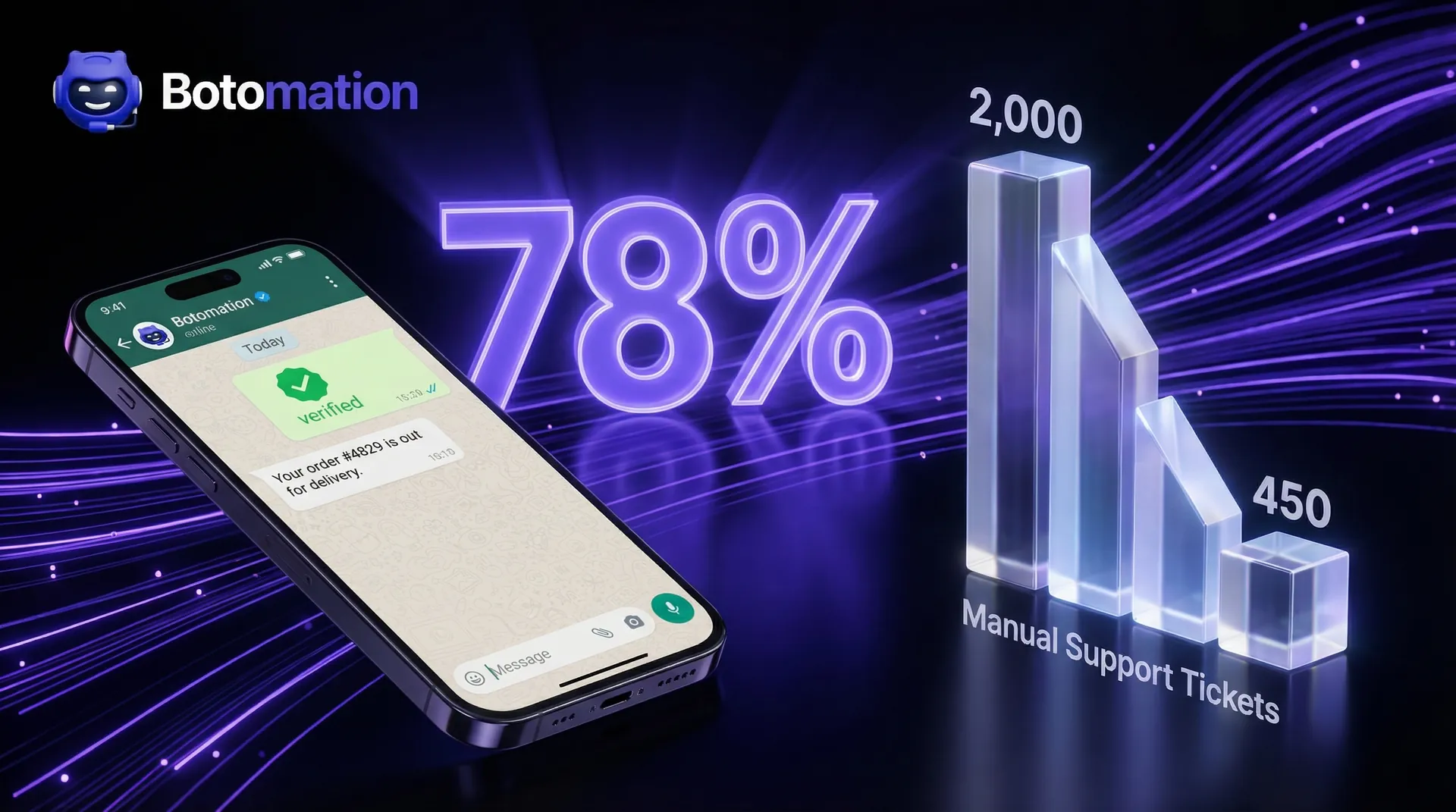
In January 2026, implementing whatsapp automation reduce support tickets shopify owners receive by 78% has become the gold standard for e-commerce efficiency. The landscape has shifted dramatically, and the sheer volume of customer inquiries is reaching a breaking point for many growing brands. Shopify store owners often find themselves buried under a mountain of repetitive questions that drain resources and prevent teams from focusing on high-value growth activities. While email was once the industry standard for support, its declining open rates and sluggish response times have transformed it into a bottleneck.
WhatsApp has emerged as the clear winner in this communication shift, boasting staggering 98% response rates that leave email and even SMS in the dust. By integrating a sophisticated whatsapp ai assistant into this channel, our team at Botomation has seen brands fundamentally transform their operations. The goal is no longer just to answer tickets faster, but to eliminate the need for those tickets to be created in the first place. Recent data suggests that a well-executed strategy can reduce manual ticket volume significantly, allowing lean teams to manage massive order scales effectively.
Implementing this level of efficiency requires more than just a simple chatbot; it demands a strategic, three-phase approach that builds a robust foundation, layers in smart AI capabilities, and continuously optimizes based on real-time data. This guide will walk you through the exact blueprint we use to help Shopify merchants reclaim their time and improve their customer experience. By the end of this article, you will understand how to transition from a reactive support model to a proactive, automated ecosystem.
How Can WhatsApp Automation Reduce Support Tickets for Shopify in 2026?
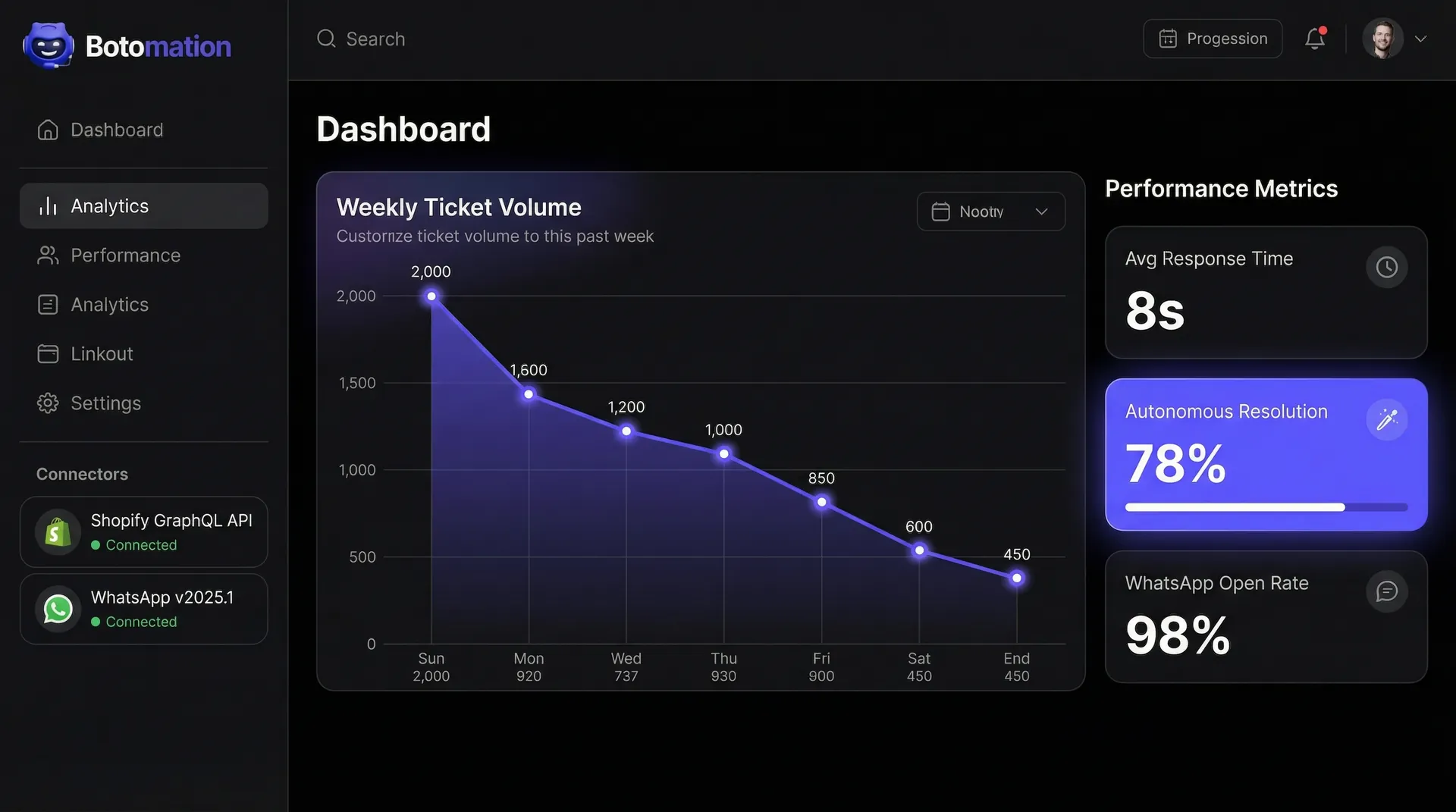
The traditional model of e-commerce support is fundamentally broken because it relies on linear scaling. As your order volume grows, your ticket volume grows alongside it, which usually necessitates hiring more staff just to maintain equilibrium. Industry reports from late 2026 show a 40% increase in total support ticket volumes across the e-commerce sector. This spike isn't necessarily because products are failing, but because customers are more engaged and have lower thresholds for waiting than ever before.
When a support response takes longer than four hours, customer satisfaction (CSAT) scores plummet by an average of 67%. In a world where major retailers provide instant updates, a Shopify store that takes a day to answer a "Where is my order?" (WISMO) query feels like a relic of the past. The financial cost of manual handling is also significant. If an agent spends 78% of their time answering the same five questions, you are essentially wasting thousands on tasks that an AI agent could handle instantly for a fraction of the cost.
Repetitive Queries Clogging Your Support System
The vast majority of support friction follows the 80/20 rule, where a handful of question types account for the bulk of the workload. Our internal audits at Botomation consistently show that queries regarding order tracking, refund status, and return policies make up nearly 80% of the daily queue. These are not complex issues requiring human empathy; they are data-retrieval tasks.
When these repetitive queries clog the system, high-priority issues get buried. This leads to a "death spiral" where the support team is constantly playing catch-up. We recently worked with a fashion retailer struggling with 2,000 monthly tickets. After our team implemented a structured WhatsApp flow, that number dropped to just 450 tickets within the first sixty days. The 1,550 tickets that disappeared were all low-value, repetitive questions that the AI handled autonomously.
What Customers Expect in the AI Era
We have entered an era where "instant" is the only acceptable speed for basic information. Research from late 2026 indicates that 90% of customers now expect a reply to their initial query within ten minutes. Email cannot meet this expectation. WhatsApp provides the perfect middle ground because it lives on the device the customer is already using, and the interface facilitates a conversational, rapid-fire exchange.
The latest trends show that customers actually prefer an automated response if it is accurate and immediate. There is no longer a stigma around interacting with AI, provided the AI actually solves the problem. When you use the best WhatsApp automation tools and provide a WhatsApp button on your Shopify store, you are meeting the customer where they already are. This shift leads to higher loyalty and a much higher likelihood of repeat purchases.
Key Insight: Reducing support tickets isn't about hiding from your customers; it's about providing them with the information they need so efficiently that they never feel the need to "open a ticket."
Why Should You Use WhatsApp Automation to Reduce Support Tickets for Shopify?
To achieve a 78% reduction in tickets, you cannot rely on the basic WhatsApp Business app. You need the WhatsApp Business API, specifically the v2026.1 release, which offers the deep integration capabilities required for true automation. This version allows for sophisticated Shopify WhatsApp integration and webhook configurations that trigger messages based on almost any event within your Shopify backend.
Security and compliance are also paramount in 2026. With stricter global data protection regulations, how you handle customer data within these messaging channels is a critical business risk. Our experts ensure that every integration we build uses end-to-end encryption and follows strict data retention policies. This technical foundation ensures that as you scale, your automation remains a secure asset.
Integrating WhatsApp API with Your Shopify Store
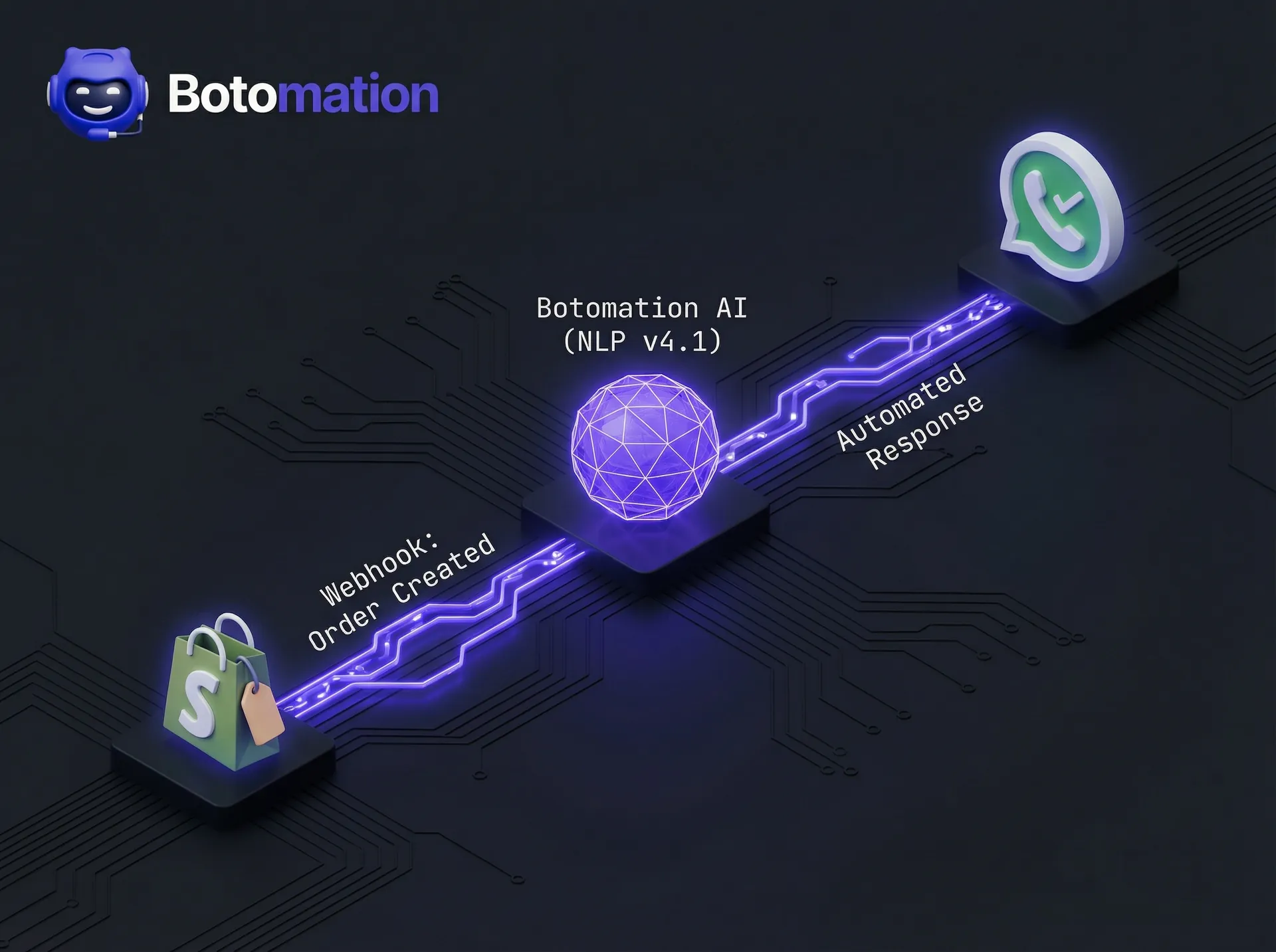
The integration process starts with establishing a solid link between Meta’s infrastructure and your Shopify store’s data. While some merchants attempt to use basic third-party apps, we find that a custom-configured approach using Shopify’s GraphQL API provides the most flexibility and speed. This allows the WhatsApp interface to pull specific line items, tracking numbers, and even warehouse processing statuses directly into the conversation.
Step-by-Step Implementation for WhatsApp Automation
- Secure your WhatsApp Business API credentials through a verified Meta Business Partner to ensure high messaging limits.
- Configure the Shopify Webhook settings to send real-time triggers for events like "Order Created" and "Shipping Updated."
- Map the data fields from Shopify’s GraphQL API to your WhatsApp message templates to ensure dynamic information like names and tracking links are inserted correctly.
- Set up the Natural Language Processing (NLP) engine to recognize the intent behind customer messages.
- Establish a "Human-in-the-Loop" protocol where complex queries are instantly routed to a human agent via a shared team inbox.
Configuring AI Agents for Specific E-commerce Queries
An AI agent is only as good as the data it is trained on. In the context of a Shopify store, this means the AI needs to understand your product catalog and return window. We use advanced context-aware models that don't just look for keywords but understand the nuance of a customer's request. For example, a whatsapp bot for order tracking can check the exact status of a specific item via Shopify's GraphQL API.
If the carrier shows a delay, the AI can explain the situation and perhaps offer a small discount code for the trouble—all without a human ever touching the keyboard. We also implement intent recognition algorithms that distinguish between a customer checking their status and a customer who is genuinely frustrated, ensuring the latter is escalated to a human before the relationship is damaged.
How Do You Build a Winning WhatsApp Automation Strategy for Shopify?
Success in automation isn't about turning everything on at once; it’s about a phased rollout that prioritizes the biggest pain points first. We recommend a three-phase roadmap that ensures the system is stable and effective before adding complexity. This prevents the "hallucination" issues often seen in poorly implemented AI.
The first phase focuses on "low-hanging fruit"—the questions that take up 60% of your time but require 0% of your brainpower. Once those are handled, we move into more predictive and proactive communications. This strategy allows the business to see an immediate ROI while building toward a fully autonomous support ecosystem.
Phase 1: Setting Up the Basic Automation Foundation
The foundation phase focuses on transactional transparency. Most support tickets are born from uncertainty. If a customer doesn't know their order has been shipped, they will ask. By automating these core flows, you proactively resolve the ticket before it is even created. We integrate these flows directly with Shopify's order management system so the data is always 100% accurate.
In this phase, we also implement basic FAQ responses using NLP v3.2. This allows the system to handle questions about shipping times and sizing charts. Even at this early stage, most of our clients see a 30% to 40% reduction in manual workload.
Phase 2: Moving Toward Smart Automation with AI Capabilities
Once the foundation is solid, we layer in "smart" features. This involves using AI model v4.1 to handle context-aware conversations. This means if a customer asks a follow-up question, the AI remembers what was said previously. It can also perform sentiment analysis in real-time. If the AI detects frustration, it can automatically adjust its tone or flag a manager for an override.
This phase also includes integration with your inventory systems. If a customer asks if a specific item will be back in stock, the AI can check warehouse arrival dates. We also set up predictive automation, where the system might message a customer regarding a delivery delay before they even realize there is a problem, offering a proactive apology and solution.
Key Performance Statistics for 2026 Automation
| Metric | Manual Support | Botomation AI Support |
|---|---|---|
| Average Response Time | 4 - 12 Hours | < 10 Seconds |
| Ticket Resolution Rate | 100% (Human) | 78% (Autonomous) |
| Customer Satisfaction (CSAT) | 6.8 / 10 | 8.9 / 10 |
| Cost Per Interaction | $5.00 - $12.00 | $0.15 - $0.50 |
| Open Rate | 20% (Email) | 98% (WhatsApp) |
What Does Success Look Like When You Use WhatsApp Automation to Reduce Support Tickets for Shopify?
To understand the impact of this technology, we must look at the actual results achieved by brands that moved away from manual support. These are transformative shifts in how companies operate. When you remove the burden of 78% of your support volume, the energy of the entire company changes.
The following case studies from the 2024-2026 period demonstrate how various e-commerce businesses benefit from WhatsApp automation. Whether it's a high-volume fashion brand or a technical electronics store, the principles of reducing friction remain the same.
How ModaShop Achieved a 78 Percent Ticket Reduction
ModaShop, a mid-market fashion retailer, was struggling with seasonal spikes. During the Q4 holiday season of 2024, their support team was completely overwhelmed. They partnered with Botomation to implement a comprehensive WhatsApp AI strategy using GPT-4.5 integration. The results were immediate.
By automating their entire return and exchange process through a WhatsApp interface, ModaShop reduced their monthly ticket count from 2,000 to just 450. The AI handled everything from automated returns and exchanges to explaining sizing differences. This saved their team approximately 15 hours of manual labor every single day. Within six months, the brand saw a 240% return on their investment.
Proactive Communication at TechGadgets
TechGadgets faced a different challenge: high technical inquiry volume and WISMO queries. By implementing our proactive notification system, TechGadgets started sending real-time updates via WhatsApp every time a package moved through a new carrier hub, providing more detail than standard Shopify notifications.
The impact was a staggering 87% reduction in WISMO queries. Furthermore, TechGadgets used AI to handle basic troubleshooting. By allowing customers to upload photos of their setup through WhatsApp, the AI could identify common installation errors using image recognition technology. This led to a CSAT increase from 6.2 to 8.7 out of 10.
How Can You Move Beyond Basic Support Queries with WhatsApp?
The true power of partnering with Botomation lies in our ability to take automation beyond just answering questions. In 2026, the most successful Shopify stores use WhatsApp as a full-funnel engagement tool. Once you have solved the support problem, you can use that same infrastructure to drive revenue.
Proactive messaging is the key to this transition. Instead of waiting for a customer to have a problem, you reach out with value. This could be part of a post-purchase follow-up to see how they are enjoying their purchase or a personalized recommendation based on their browsing history. Because these messages happen in WhatsApp, they are actually seen and acted upon.
Preventing Issues Before They Happen
The best support ticket is the one that never exists. Proactive communication allows you to address potential friction points before the customer even notices them. For example, if our system detects a carrier delay, it can automatically trigger a WhatsApp message. This message explains the situation and provides the new ETA.
This turns a potentially negative experience into a loyalty-building moment. We also use this for inventory management. If a customer has a "back-in-stock" request, our AI initiates a conversation on WhatsApp, asks if they are still interested, and provides a direct link to a pre-filled checkout. This proactive approach eliminates disappointment and keeps the customer engaged.
Recovering Lost Sales via WhatsApp
Cart abandonment remains one of the biggest leaks in the e-commerce bucket, but the "Old Way" of sending recovery emails is no longer effective. In late 2026, we use WhatsApp's conversational interface to recover these sales. When a customer leaves a high-value cart, our whatsapp abandoned cart recovery system reaches out to ask if they had questions about the product.
This isn't just a reminder; it's a conversation. The AI can calculate shipping costs, offer a one-time shipping code, and provide a direct "Buy Now" button that opens the Shopify checkout with the code already applied. Our clients typically see a 23% recovery rate with this method, compared to the industry average of 4% for email-based recovery.
How Do You Measure the Impact of WhatsApp Automation on Your Shopify Bottom Line?
To justify the shift to automation, you need hard data. In 2026, we track a specific set of KPIs that demonstrate the true ROI of our services. The most obvious is the reduction in ticket volume, but we also look at the "Cost per Resolution." When a human handles a ticket, it costs between $5 and $12; when our AI handles it, that cost drops to pennies.
We also look at the long-term impact on Customer Lifetime Value (CLV). Customers who receive instant, helpful support on WhatsApp are significantly more likely to return. By analyzing the purchase frequency of customers who interacted with the AI, we can see a clear "loyalty lift" that contributes directly to the store's valuation.
Primary KPIs for WhatsApp Automation
The first metric we always target is the 78% ticket reduction. However, we also look at "First Response Time." In the manual world, this is measured in hours; in the Botomation world, it is measured in seconds. If your AI isn't responding in under 10 seconds, it's not meeting the 2026 standard.
Another critical KPI is the "Resolution Rate." This measures how many conversations were finished without needing to be transferred to a human. A high resolution rate indicates that your AI is well-trained and has access to the right data. We also track CSAT scores specifically for automated interactions. Surprisingly, we often find that customers rate the AI higher than human agents because the AI is always consistent and available 24/7.
Using Analytics to Optimize Performance
The data we collect from these interactions is a goldmine for business intelligence. By analyzing the "Conversation Completion Rate," we can identify exactly where customers are getting confused. This constant feedback loop allows us to refine the AI's persona and technical accuracy every single week.
We also perform A/B testing on different response styles. Does a "professional and brief" tone work better for your brand, or does a "friendly and emoji-heavy" tone drive more sales? Our analytics dashboard provides these answers. This level of optimization is what keeps our partner brands ahead of their competitors.
Expert Tip: Don't just look at how many tickets you closed. Look at how much revenue was generated within the support channel. In 2026, support is a profit center.
Frequently Asked Questions
Does WhatsApp automation feel impersonal to customers?
Actually, the opposite is usually true. Because the AI can access the customer's entire order history and name instantly, the interaction often feels more personal than a human support agent asking for an order number for the third time. When the response is instant and helpful, customers feel valued.
What happens if the AI can't answer a question?
Our "Human-in-the-Loop" system ensures no customer is ever left stranded. If the AI detects a complex query or a high level of frustration, it seamlessly transfers the entire chat history to a human agent. The agent can then step in with full context, so the customer doesn't have to repeat themselves.
Is it difficult to integrate with my existing Shopify setup?
When you partner with our team, we handle the heavy lifting. We use the Shopify GraphQL API and the latest WhatsApp Business API v2026.1 to ensure a smooth connection. Most stores can be up and running with their first level of automation in just a few weeks.
How do you handle different languages for international stores?
Our AI agents are built on multilingual models that support over 50 languages. The system automatically detects the customer's language based on their initial message and responds fluently, ensuring a consistent experience for your global customer base without the need for a multilingual support team.
Can I use WhatsApp to recover abandoned carts?
Yes, and it is highly effective. Our clients typically see a 23% recovery rate using WhatsApp's conversational interface, which is significantly higher than traditional email recovery methods. The AI can answer questions and provide direct checkout links with applied discounts.
The shift toward WhatsApp automation is no longer a luxury for Shopify stores; it is a competitive necessity. As we have seen throughout 2026, brands that continue to rely on manual, email-heavy support are being left behind by those providing instant, proactive, and mobile-first experiences. By reducing your ticket volume by 78%, you aren't just saving money—you are freeing your team to focus on innovation and the high-level strategy that actually grows a brand.
The "Old Way" of managing support is a treadmill that only goes faster as you succeed. The "New Way," powered by Botomation's expert integration of AI and WhatsApp, is an escalator that carries you and your customers toward a more efficient and profitable future.
Ready to automate your growth? Book a call below.
In January 2026, implementing whatsapp automation reduce support tickets shopify owners receive by 78% has become the gold standard for e-commerce efficiency. The landscape has shifted dramatically, and the sheer volume of customer inquiries is reaching a breaking point for many growing brands. Shopify store owners often find themselves buried under a mountain of repetitive questions that drain resources and prevent teams from focusing on high-value growth activities. While email was once the industry standard for support, its declining open rates and sluggish response times have transformed it into a bottleneck.
WhatsApp has emerged as the clear winner in this communication shift, boasting staggering 98% response rates that leave email and even SMS in the dust. By integrating a sophisticated whatsapp ai assistant into this channel, our team at Botomation has seen brands fundamentally transform their operations. The goal is no longer just to answer tickets faster, but to eliminate the need for those tickets to be created in the first place. Recent data suggests that a well-executed strategy can reduce manual ticket volume significantly, allowing lean teams to manage massive order scales effectively.
Implementing this level of efficiency requires more than just a simple chatbot; it demands a strategic, three-phase approach that builds a robust foundation, layers in smart AI capabilities, and continuously optimizes based on real-time data. This guide will walk you through the exact blueprint we use to help Shopify merchants reclaim their time and improve their customer experience. By the end of this article, you will understand how to transition from a reactive support model to a proactive, automated ecosystem.
How Can WhatsApp Automation Reduce Support Tickets for Shopify in 2026?
The traditional model of e-commerce support is fundamentally broken because it relies on linear scaling. As your order volume grows, your ticket volume grows alongside it, which usually necessitates hiring more staff just to maintain equilibrium. Industry reports from late 2026 show a 40% increase in total support ticket volumes across the e-commerce sector. This spike isn't necessarily because products are failing, but because customers are more engaged and have lower thresholds for waiting than ever before.
When a support response takes longer than four hours, customer satisfaction (CSAT) scores plummet by an average of 67%. In a world where major retailers provide instant updates, a Shopify store that takes a day to answer a "Where is my order?" (WISMO) query feels like a relic of the past. The financial cost of manual handling is also significant. If an agent spends 78% of their time answering the same five questions, you are essentially wasting thousands on tasks that an AI agent could handle instantly for a fraction of the cost.
Repetitive Queries Clogging Your Support System
The vast majority of support friction follows the 80/20 rule, where a handful of question types account for the bulk of the workload. Our internal audits at Botomation consistently show that queries regarding order tracking, refund status, and return policies make up nearly 80% of the daily queue. These are not complex issues requiring human empathy; they are data-retrieval tasks.
When these repetitive queries clog the system, high-priority issues get buried. This leads to a "death spiral" where the support team is constantly playing catch-up. We recently worked with a fashion retailer struggling with 2,000 monthly tickets. After our team implemented a structured WhatsApp flow, that number dropped to just 450 tickets within the first sixty days. The 1,550 tickets that disappeared were all low-value, repetitive questions that the AI handled autonomously.
What Customers Expect in the AI Era
We have entered an era where "instant" is the only acceptable speed for basic information. Research from late 2026 indicates that 90% of customers now expect a reply to their initial query within ten minutes. Email cannot meet this expectation. WhatsApp provides the perfect middle ground because it lives on the device the customer is already using, and the interface facilitates a conversational, rapid-fire exchange.
The latest trends show that customers actually prefer an automated response if it is accurate and immediate. There is no longer a stigma around interacting with AI, provided the AI actually solves the problem. When you use the best WhatsApp automation tools and provide a WhatsApp button on your Shopify store, you are meeting the customer where they already are. This shift leads to higher loyalty and a much higher likelihood of repeat purchases.
Key Insight: Reducing support tickets isn't about hiding from your customers; it's about providing them with the information they need so efficiently that they never feel the need to "open a ticket."
Why Should You Use WhatsApp Automation to Reduce Support Tickets for Shopify?
To achieve a 78% reduction in tickets, you cannot rely on the basic WhatsApp Business app. You need the WhatsApp Business API, specifically the v2026.1 release, which offers the deep integration capabilities required for true automation. This version allows for sophisticated Shopify WhatsApp integration and webhook configurations that trigger messages based on almost any event within your Shopify backend.
Security and compliance are also paramount in 2026. With stricter global data protection regulations, how you handle customer data within these messaging channels is a critical business risk. Our experts ensure that every integration we build uses end-to-end encryption and follows strict data retention policies. This technical foundation ensures that as you scale, your automation remains a secure asset.
Integrating WhatsApp API with Your Shopify Store
The integration process starts with establishing a solid link between Meta’s infrastructure and your Shopify store’s data. While some merchants attempt to use basic third-party apps, we find that a custom-configured approach using Shopify’s GraphQL API provides the most flexibility and speed. This allows the WhatsApp interface to pull specific line items, tracking numbers, and even warehouse processing statuses directly into the conversation.
Step-by-Step Implementation for WhatsApp Automation
- Secure your WhatsApp Business API credentials through a verified Meta Business Partner to ensure high messaging limits.
- Configure the Shopify Webhook settings to send real-time triggers for events like "Order Created" and "Shipping Updated."
- Map the data fields from Shopify’s GraphQL API to your WhatsApp message templates to ensure dynamic information like names and tracking links are inserted correctly.
- Set up the Natural Language Processing (NLP) engine to recognize the intent behind customer messages.
- Establish a "Human-in-the-Loop" protocol where complex queries are instantly routed to a human agent via a shared team inbox.
Configuring AI Agents for Specific E-commerce Queries
An AI agent is only as good as the data it is trained on. In the context of a Shopify store, this means the AI needs to understand your product catalog and return window. We use advanced context-aware models that don't just look for keywords but understand the nuance of a customer's request. For example, a whatsapp bot for order tracking can check the exact status of a specific item via Shopify's GraphQL API.
If the carrier shows a delay, the AI can explain the situation and perhaps offer a small discount code for the trouble—all without a human ever touching the keyboard. We also implement intent recognition algorithms that distinguish between a customer checking their status and a customer who is genuinely frustrated, ensuring the latter is escalated to a human before the relationship is damaged.
How Do You Build a Winning WhatsApp Automation Strategy for Shopify?
Success in automation isn't about turning everything on at once; it’s about a phased rollout that prioritizes the biggest pain points first. We recommend a three-phase roadmap that ensures the system is stable and effective before adding complexity. This prevents the "hallucination" issues often seen in poorly implemented AI.
The first phase focuses on "low-hanging fruit"—the questions that take up 60% of your time but require 0% of your brainpower. Once those are handled, we move into more predictive and proactive communications. This strategy allows the business to see an immediate ROI while building toward a fully autonomous support ecosystem.
Phase 1: Setting Up the Basic Automation Foundation
The foundation phase focuses on transactional transparency. Most support tickets are born from uncertainty. If a customer doesn't know their order has been shipped, they will ask. By automating these core flows, you proactively resolve the ticket before it is even created. We integrate these flows directly with Shopify's order management system so the data is always 100% accurate.
In this phase, we also implement basic FAQ responses using NLP v3.2. This allows the system to handle questions about shipping times and sizing charts. Even at this early stage, most of our clients see a 30% to 40% reduction in manual workload.
Phase 2: Moving Toward Smart Automation with AI Capabilities
Once the foundation is solid, we layer in "smart" features. This involves using AI model v4.1 to handle context-aware conversations. This means if a customer asks a follow-up question, the AI remembers what was said previously. It can also perform sentiment analysis in real-time. If the AI detects frustration, it can automatically adjust its tone or flag a manager for an override.
This phase also includes integration with your inventory systems. If a customer asks if a specific item will be back in stock, the AI can check warehouse arrival dates. We also set up predictive automation, where the system might message a customer regarding a delivery delay before they even realize there is a problem, offering a proactive apology and solution.
Key Performance Statistics for 2026 Automation
| Metric | Manual Support | Botomation AI Support |
|---|---|---|
| Average Response Time | 4 - 12 Hours | < 10 Seconds |
| Ticket Resolution Rate | 100% (Human) | 78% (Autonomous) |
| Customer Satisfaction (CSAT) | 6.8 / 10 | 8.9 / 10 |
| Cost Per Interaction | $5.00 - $12.00 | $0.15 - $0.50 |
| Open Rate | 20% (Email) | 98% (WhatsApp) |
What Does Success Look Like When You Use WhatsApp Automation to Reduce Support Tickets for Shopify?
To understand the impact of this technology, we must look at the actual results achieved by brands that moved away from manual support. These are transformative shifts in how companies operate. When you remove the burden of 78% of your support volume, the energy of the entire company changes.
The following case studies from the 2024-2026 period demonstrate how various e-commerce businesses benefit from WhatsApp automation. Whether it's a high-volume fashion brand or a technical electronics store, the principles of reducing friction remain the same.
How ModaShop Achieved a 78 Percent Ticket Reduction
ModaShop, a mid-market fashion retailer, was struggling with seasonal spikes. During the Q4 holiday season of 2024, their support team was completely overwhelmed. They partnered with Botomation to implement a comprehensive WhatsApp AI strategy using GPT-4.5 integration. The results were immediate.
By automating their entire return and exchange process through a WhatsApp interface, ModaShop reduced their monthly ticket count from 2,000 to just 450. The AI handled everything from automated returns and exchanges to explaining sizing differences. This saved their team approximately 15 hours of manual labor every single day. Within six months, the brand saw a 240% return on their investment.
Proactive Communication at TechGadgets
TechGadgets faced a different challenge: high technical inquiry volume and WISMO queries. By implementing our proactive notification system, TechGadgets started sending real-time updates via WhatsApp every time a package moved through a new carrier hub, providing more detail than standard Shopify notifications.
The impact was a staggering 87% reduction in WISMO queries. Furthermore, TechGadgets used AI to handle basic troubleshooting. By allowing customers to upload photos of their setup through WhatsApp, the AI could identify common installation errors using image recognition technology. This led to a CSAT increase from 6.2 to 8.7 out of 10.
How Can You Move Beyond Basic Support Queries with WhatsApp?
The true power of partnering with Botomation lies in our ability to take automation beyond just answering questions. In 2026, the most successful Shopify stores use WhatsApp as a full-funnel engagement tool. Once you have solved the support problem, you can use that same infrastructure to drive revenue.
Proactive messaging is the key to this transition. Instead of waiting for a customer to have a problem, you reach out with value. This could be part of a post-purchase follow-up to see how they are enjoying their purchase or a personalized recommendation based on their browsing history. Because these messages happen in WhatsApp, they are actually seen and acted upon.
Preventing Issues Before They Happen
The best support ticket is the one that never exists. Proactive communication allows you to address potential friction points before the customer even notices them. For example, if our system detects a carrier delay, it can automatically trigger a WhatsApp message. This message explains the situation and provides the new ETA.
This turns a potentially negative experience into a loyalty-building moment. We also use this for inventory management. If a customer has a "back-in-stock" request, our AI initiates a conversation on WhatsApp, asks if they are still interested, and provides a direct link to a pre-filled checkout. This proactive approach eliminates disappointment and keeps the customer engaged.
Recovering Lost Sales via WhatsApp
Cart abandonment remains one of the biggest leaks in the e-commerce bucket, but the "Old Way" of sending recovery emails is no longer effective. In late 2026, we use WhatsApp's conversational interface to recover these sales. When a customer leaves a high-value cart, our whatsapp abandoned cart recovery system reaches out to ask if they had questions about the product.
This isn't just a reminder; it's a conversation. The AI can calculate shipping costs, offer a one-time shipping code, and provide a direct "Buy Now" button that opens the Shopify checkout with the code already applied. Our clients typically see a 23% recovery rate with this method, compared to the industry average of 4% for email-based recovery.
How Do You Measure the Impact of WhatsApp Automation on Your Shopify Bottom Line?
To justify the shift to automation, you need hard data. In 2026, we track a specific set of KPIs that demonstrate the true ROI of our services. The most obvious is the reduction in ticket volume, but we also look at the "Cost per Resolution." When a human handles a ticket, it costs between $5 and $12; when our AI handles it, that cost drops to pennies.
We also look at the long-term impact on Customer Lifetime Value (CLV). Customers who receive instant, helpful support on WhatsApp are significantly more likely to return. By analyzing the purchase frequency of customers who interacted with the AI, we can see a clear "loyalty lift" that contributes directly to the store's valuation.
Primary KPIs for WhatsApp Automation
The first metric we always target is the 78% ticket reduction. However, we also look at "First Response Time." In the manual world, this is measured in hours; in the Botomation world, it is measured in seconds. If your AI isn't responding in under 10 seconds, it's not meeting the 2026 standard.
Another critical KPI is the "Resolution Rate." This measures how many conversations were finished without needing to be transferred to a human. A high resolution rate indicates that your AI is well-trained and has access to the right data. We also track CSAT scores specifically for automated interactions. Surprisingly, we often find that customers rate the AI higher than human agents because the AI is always consistent and available 24/7.
Using Analytics to Optimize Performance
The data we collect from these interactions is a goldmine for business intelligence. By analyzing the "Conversation Completion Rate," we can identify exactly where customers are getting confused. This constant feedback loop allows us to refine the AI's persona and technical accuracy every single week.
We also perform A/B testing on different response styles. Does a "professional and brief" tone work better for your brand, or does a "friendly and emoji-heavy" tone drive more sales? Our analytics dashboard provides these answers. This level of optimization is what keeps our partner brands ahead of their competitors.
Expert Tip: Don't just look at how many tickets you closed. Look at how much revenue was generated within the support channel. In 2026, support is a profit center.
Frequently Asked Questions
Does WhatsApp automation feel impersonal to customers?
Actually, the opposite is usually true. Because the AI can access the customer's entire order history and name instantly, the interaction often feels more personal than a human support agent asking for an order number for the third time. When the response is instant and helpful, customers feel valued.
What happens if the AI can't answer a question?
Our "Human-in-the-Loop" system ensures no customer is ever left stranded. If the AI detects a complex query or a high level of frustration, it seamlessly transfers the entire chat history to a human agent. The agent can then step in with full context, so the customer doesn't have to repeat themselves.
Is it difficult to integrate with my existing Shopify setup?
When you partner with our team, we handle the heavy lifting. We use the Shopify GraphQL API and the latest WhatsApp Business API v2026.1 to ensure a smooth connection. Most stores can be up and running with their first level of automation in just a few weeks.
How do you handle different languages for international stores?
Our AI agents are built on multilingual models that support over 50 languages. The system automatically detects the customer's language based on their initial message and responds fluently, ensuring a consistent experience for your global customer base without the need for a multilingual support team.
Can I use WhatsApp to recover abandoned carts?
Yes, and it is highly effective. Our clients typically see a 23% recovery rate using WhatsApp's conversational interface, which is significantly higher than traditional email recovery methods. The AI can answer questions and provide direct checkout links with applied discounts.
The shift toward WhatsApp automation is no longer a luxury for Shopify stores; it is a competitive necessity. As we have seen throughout 2026, brands that continue to rely on manual, email-heavy support are being left behind by those providing instant, proactive, and mobile-first experiences. By reducing your ticket volume by 78%, you aren't just saving money—you are freeing your team to focus on innovation and the high-level strategy that actually grows a brand.
The "Old Way" of managing support is a treadmill that only goes faster as you succeed. The "New Way," powered by Botomation's expert integration of AI and WhatsApp, is an escalator that carries you and your customers toward a more efficient and profitable future.
Ready to automate your growth? Book a call below.
Get Started
Book a FREE Consultation Right NOW!
Schedule a Call with Our Team To Make Your Business More Efficient with AI Instantly.
Read More
Cut Shopify Support Tickets by 78% with WhatsApp Automation
Use WhatsApp automation to reduce support tickets for Shopify. Our AI agents handle order tracking and returns, cutting manual ticket volume by 78%.
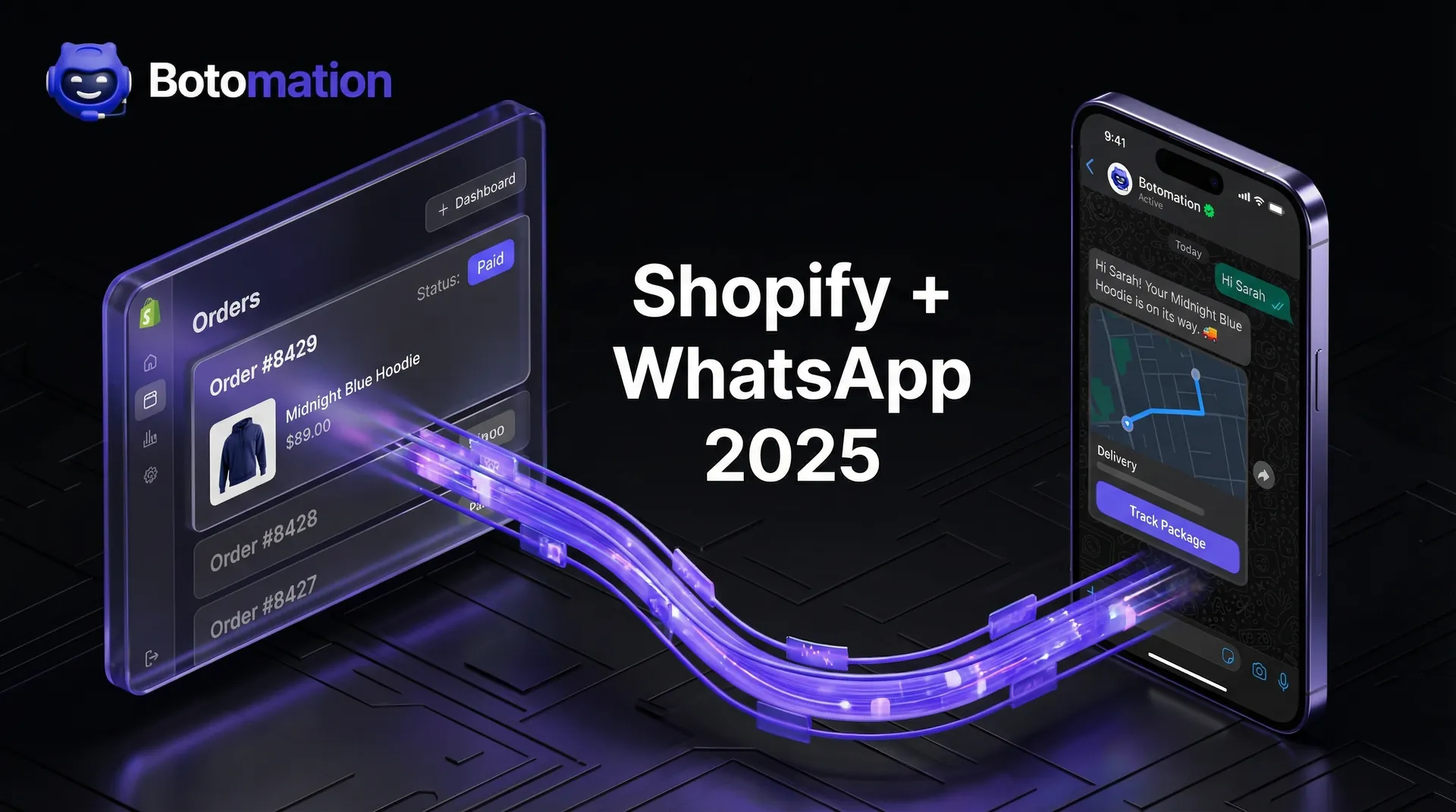
Shopify WhatsApp Integration for Order Status Updates 2026
Learn how WhatsApp AI slashes support costs for e-commerce & SaaS. Proven strategies to boost sales, recover carts, and scale 24/7 service.