AI Chatbot for E-commerce Customer Support - 2026 Guide
Jan 8, 2026
Shopify
AI Automation
E-commerce
Shopify
AI Automation
E-commerce
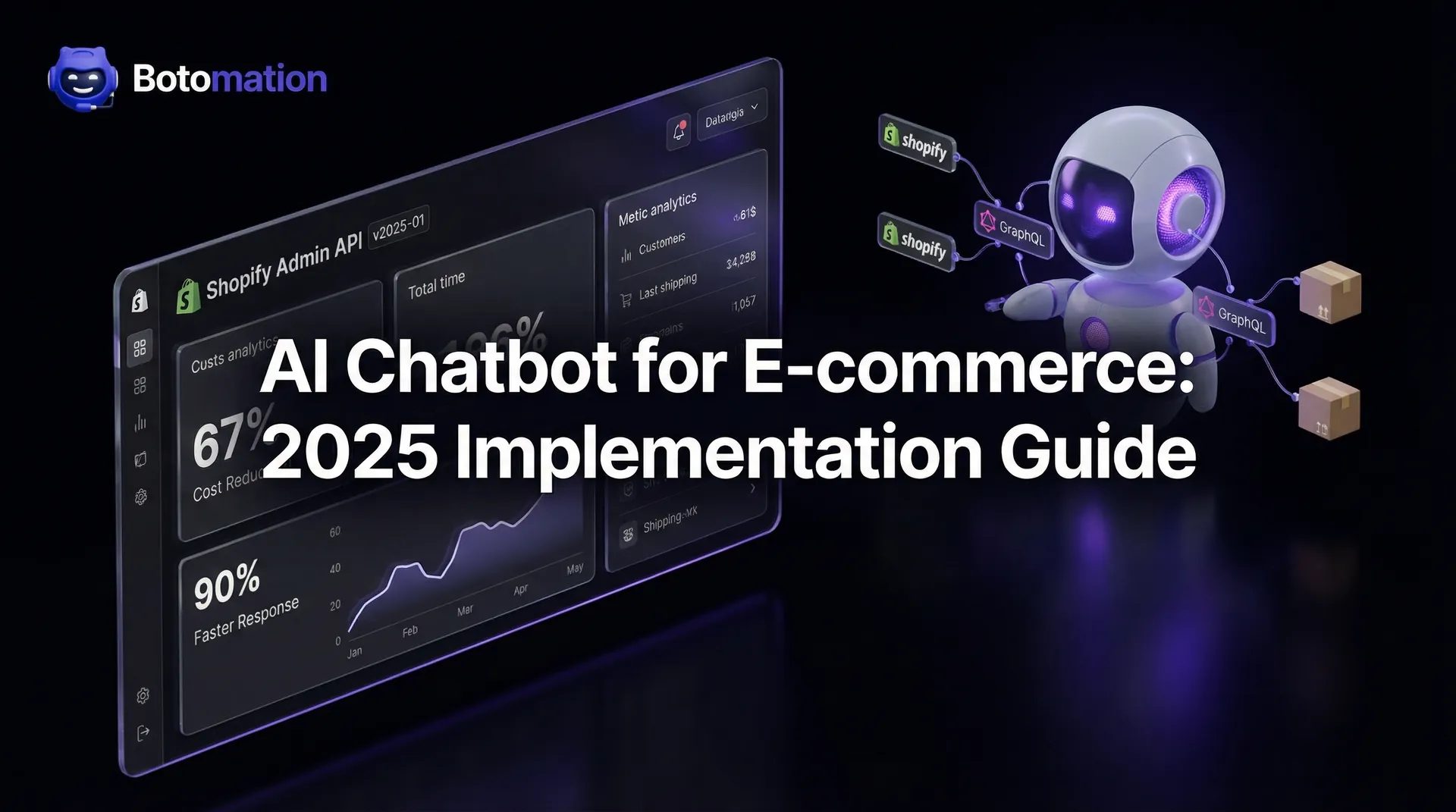
The landscape of online retail has shifted dramatically as we navigate January 2026. Gone are the days when customers were willing to wait six to twelve hours for a response to a simple "where is my order" inquiry. Today, an ai chatbot for e-commerce customer support isn't just a luxury for the biggest players; it's the baseline expectation for any Shopify store that wants to survive the current competitive climate. We have moved past the era of frustrating, circular chat menus and entered an age where AI agents, powered by models like GPT-5, handle complex nuances with the same grace as a seasoned support veteran.
Our team at Botomation has observed a fundamental change in how high-growth brands approach their post-purchase experience. By moving away from bloated, manual support teams and adopting deeply integrated AI systems, brands are seeing an average 67% reduction in support costs while simultaneously achieving 90% faster response times. This isn't just about answering questions; it's about creating a frictionless journey from the moment a customer lands on your site to the moment they receive their package. Shopify store owners face unique challenges, from managing fluctuating inventory to handling complex shipping logistics, and a properly implemented AI agent is the only way to scale those operations without your overhead spiraling out of control.
What is the Role of an ai chatbot for e-commerce customer support in 2026?
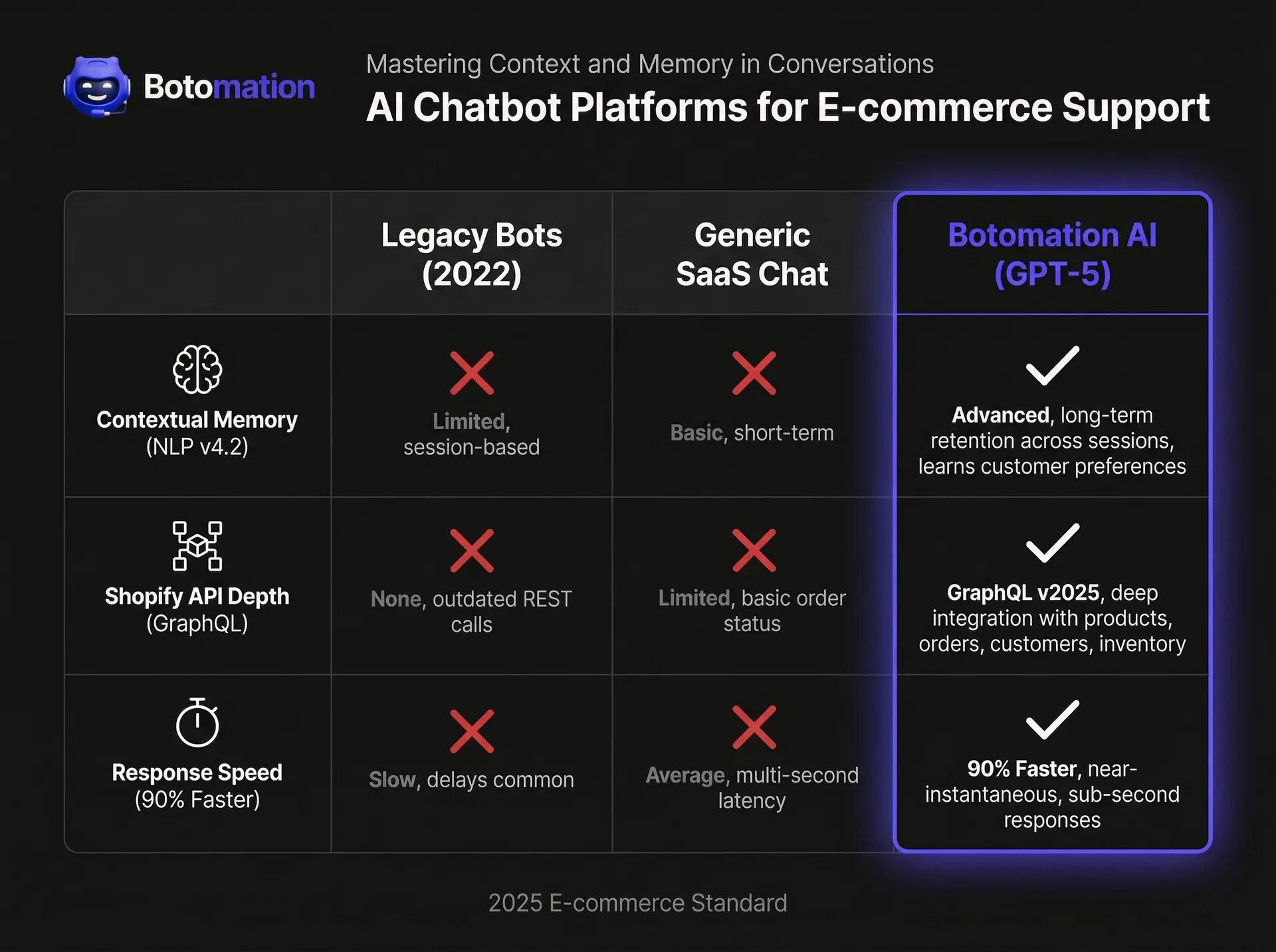
The chatbots of 2022 and 2023 were often more of a hindrance than a help because they relied on rigid decision trees. If a customer didn't use the exact keyword the bot was programmed to recognize, the entire interaction broke down, leading to frustrated shoppers and increased ticket volumes. In 2026, the paradigm has shifted toward generative intelligence using GPT-5 and advanced Natural Language Processing (NLP) v4.2. These modern systems don't just look for keywords; they understand intent, tone, and context, allowing them to provide answers that feel genuinely helpful rather than robotic. Implementing a sophisticated customer service chatbot ensures that your brand voice remains consistent while providing instant utility.
When you partner with our experts to overhaul your support strategy, we move your store away from these "Old Way" FAQ bots and into a system that lives and breathes your brand data. Traditional bots could only point a user to a static link, but an intelligent agent can look at a customer's specific order history, check the real-time status with a carrier, and offer a personalized solution if there’s a delay. This level of sophistication is what separates a world-class Shopify experience from a mediocre one.
How Does Shopify Customer Support Automation Handle Complex Inquiries?
Building a high-performing ai chatbot for e-commerce customer support requires a sophisticated technology stack that goes far beyond a simple API call. Our team utilizes GPT-5 integration to ensure that every response is context-aware and capable of handling multi-layered queries that would usually require a human. We also implement Emotion AI v3.1, which serves as a digital "vibe check" for every interaction. If the system detects that a customer is becoming genuinely frustrated or using aggressive language, it doesn't keep trying to automate the solution; it intelligently escalates the issue to a human specialist with a full summary of the interaction.
Accessing the Shopify GraphQL API is a critical component of this stack, as it allows the AI to pull real-time data with surgical precision. Unlike older REST APIs that were often slow and data-heavy, GraphQL enables our agents to fetch exactly what they need—whether that's a specific line item in a complex order or the current stock level at a specific warehouse. This real-time connectivity ensures that the AI never gives outdated information, which is the quickest way to lose a customer's trust.
Mastering Context and Memory in Conversations
One of the biggest complaints about legacy chatbots was their "amnesia"—the inability to remember what was said just two minutes prior. Modern AI agents developed by our team feature advanced memory retention across sessions, meaning if a customer returns three days later, the bot remembers their previous issue. This continuity builds a sense of relationship and recognition that manual support teams often struggle to maintain at scale.
The integration of your full product catalog allows the AI to act as a digital personal shopper rather than just a support agent. It can recognize that a customer who bought a specific skincare serum might need a particular moisturizer to go with it, based on the ingredients and the customer's stated skin type. By recognizing multiple intents within a single message, such as "I want to return my shoes and also find out when the blue jacket is back in stock," the AI can address every part of the query in a single, coherent response.
Technical Requirements for Professional Shopify Support Automation
Deploying a professional-grade AI agent on high-converting custom e-commerce websites is a significant undertaking that requires more than just installing a basic app. It involves creating a custom middleware environment that can handle secure data processing while maintaining the lightning-fast load times your customers expect. Our team handles the heavy lifting of Shopify Admin API v2026-01 integration, ensuring that the connection between your store’s data and the AI model is both secure and highly performant. This deep-level shopify customer support automation is what allows for true operational scaling.
Data security has become the primary concern for e-commerce brands in 2026, especially with tightening global privacy regulations. We build our systems with a "privacy-first" architecture, ensuring that sensitive customer information is handled according to the latest compliance standards. This includes setting up proper OAuth protocols and ensuring that your custom app has exactly the permissions it needs—no more, no less—to protect your store from potential vulnerabilities.
Strategic API Integration and Data Access
To make an ai chatbot for e-commerce customer support truly effective, it must have deep roots in your Shopify ecosystem. We configure webhooks for real-time order updates, so the moment a shipping label is created or a package is delivered, the AI is aware of it. This proactive data access means the bot can often solve a problem before the customer even realizes there is one.
Performance optimization is another area where our agency excels, particularly for high-traffic stores that see massive spikes during Black Friday or seasonal sales. We implement sophisticated rate-limiting and caching strategies to ensure the AI remains responsive even when thousands of customers are interacting with it simultaneously. This level of stability is something that off-the-shelf "SaaS" tools simply cannot guarantee when the pressure is on.
Training the AI on Your Brand Voice
An AI agent that doesn't sound like your brand is a liability, not an asset. Our process involves a deep dive into your historical chat logs, email correspondence, and brand guidelines to fine-tune the model's personality. We don't just give it a list of FAQs; we train it on the nuances of your industry-specific terminology and your unique company policies.
Continuous learning is baked into our implementation strategy. We don't just set the bot live and walk away; we monitor its performance and use "human-in-the-loop" feedback to refine its responses over time. This ensures that as your product line evolves and your customer base grows, your AI support agent stays perfectly aligned with your business goals and customer expectations.
| Feature | The Old Way (Manual/Basic Bots) | The Botomation Way (AI Agents) |
|---|---|---|
| **Response Time** | 2 - 24 Hours | < 2 Seconds |
| **Availability** | Business Hours Only | 24/7/365 |
| **Personalization** | Generic Templates | Deep Order Integration |
| **Accuracy** | Prone to Human Error | Data-Driven Precision |
| **Scalability** | Hire More People | Instant Unlimited Capacity |
| **Cost** | $12+ Per Ticket | $0.25 Per Ticket |
Essential Features of a 2026 E-commerce AI Agent
The true power of a modern ai chatbot for e-commerce customer support lies in its ability to perform actions, not just speak words. In 2026, customers expect to be able to modify their orders, initiate returns, and track shipments directly within the chat interface without ever being redirected to a separate portal. Our agents are designed to be "action-oriented," meaning they can execute tasks within your Shopify admin based on the permissions we've configured.
Can a Customer Service Chatbot Manage Returns and Refunds?
Automated returns and refunds are perhaps the most significant time-savers we implement for our clients. By integrating your specific return policy directly into the AI's logic, the agent can verify if an item is eligible for a return, generate a shipping label, and update the customer's account in seconds. This turns what is usually a point of friction into a moment of "wow" for the customer, significantly increasing the likelihood of a repeat purchase. The modern customer service chatbot acts as a fully empowered support representative, not just a messenger.
Advanced Order Management and Tracking
The most common question in e-commerce remains "Where is my order?" and our AI agents provide automated order tracking notifications with a level of detail that was previously impossible. By connecting directly with carrier APIs like FedEx, UPS, and DHL, the bot can provide granular updates, such as "Your package is currently at the Chicago sorting facility and is expected to arrive by 4 PM tomorrow." It can even explain why a package might be delayed, such as weather conditions in a specific region, which humanizes the brand and reduces frustration.
For customers with complex purchase histories or multiple active orders, the AI can intelligently distinguish between them. It won't just say "Your order is on the way"; it will ask, "Are you asking about the blue sneakers you ordered yesterday, or the winter coat from last week?" This level of clarity prevents confusion and ensures the customer feels heard and understood.
Proactive Engagement and Revenue Recovery
Beyond support, our AI agents serve as a powerful tool for revenue growth. We implement WhatsApp abandoned cart recovery strategies that go beyond a simple "you forgot something" email. The AI can engage a customer who left a cart, ask if they have any questions about the products, and offer a real-time incentive or answer a specific concern that might be holding up the purchase.
Cross-selling and up-selling become much more effective when they are handled by an AI that understands the context of a conversation. If a customer is asking about the care instructions for a leather bag, the AI can naturally suggest a specific leather conditioner that other customers have paired with that exact item. This isn't a random pop-up; it's a helpful suggestion that adds value to the customer's experience while increasing your average order value through personalized recommendations.
"The shift from reactive support to proactive AI engagement is the single biggest competitive advantage for Shopify brands in 2026. It's no longer about just fixing problems; it's about anticipating needs before the customer even articulates them." — Senior Strategy Consultant at Botomation.
Success Stories of Brands Mastering AI Support
Seeing the theory in practice is essential for understanding the true ROI of this technology. We have partnered with dozens of brands to transition them from the "Old Way" of support to our AI-driven model. The results are consistently transformative, not just for the bottom line, but for the morale of the internal teams who are no longer buried under a mountain of repetitive, mind-numbing tickets.
Beauty Brand Transformation: GlowUp Cosmetics
GlowUp Cosmetics, a rapidly growing DTC beauty brand, approached us in early 2024 when their support team was completely overwhelmed by the volume of skincare routine questions and order status inquiries. We implemented a custom GPT-5 model trained specifically on their product ingredients and dermatological benefits. The results were immediate: we helped reduce support tickets by 80% as support ticket volume dropped by 85% within the first month.
Beyond just handling tickets, the AI became a "Digital Esthetician" for the brand. It could analyze a customer's skin concerns and recommend a full morning and evening routine, leading to a 22% increase in conversion rates for first-time visitors. By the end of Q2 2026, GlowUp reported a 310% ROI on their implementation, with customer satisfaction scores reaching an all-time high of 9.2 out of 10.
Electronics Retailer Impact: TechStore Proactive Support
TechStore, a high-volume electronics retailer, faced a different challenge: high return rates due to customers not understanding how to set up their complex devices. Our team built an AI agent that integrated with their inventory management and shipping carriers to provide proactive support. The moment a package was delivered, the AI would reach out with a "Getting Started" guide and offer to answer any setup questions.
This proactive approach led to a 73% reduction in return-related tickets and a 41% increase in repeat purchases. Customers loved the feeling that the brand was looking out for them even after the sale was finalized. The AI also handled warranty registrations and repair scheduling, turning a traditionally difficult process into a seamless, automated conversation.
Strategic Integration with Your Business Ecosystem
An ai chatbot for e-commerce customer support is only as good as the data it can access. To truly unlock its potential, it must be woven into the fabric of your existing business systems. Our team specializes in creating these deep connections, ensuring that the AI isn't just a "plugin" but a central hub for customer interaction. Furthermore, as mobile-first shopping continues to dominate, many of our clients are now prioritizing whatsapp ai support for shopify to reach customers directly on their most-used apps.
CRM and Customer Data Hubs
Connecting the AI with platforms like Klaviyo, HubSpot, or Salesforce is a top priority for our implementation team. This integration allows the AI to see the customer's full journey—every email they've opened, every ad they've clicked, and every previous purchase they've made. This data allows the AI to tailor its tone and suggestions to the individual, creating a truly bespoke experience.
Payment and Inventory Synchronization
Real-time inventory updates are crucial for preventing the "out of stock" disappointment that plagues many Shopify stores. Our AI agents are directly linked to your warehouse management system, so they can tell a customer exactly how many units of a product are left. On the payment side, our integrations with Stripe, PayPal, and Shop Pay allow the AI to handle transaction confirmations and refund processing with total security.
How to Measure the ROI of an ai chatbot for e-commerce customer support?
To understand the impact of your ai chatbot for e-commerce customer support, you need to look beyond simple vanity metrics. While "number of messages sent" is interesting, it doesn't tell you how much money the system is saving you or how much it's improving the customer experience. Our team provides comprehensive analytics that track the KPIs that actually matter to your bottom line, such as ticket deflection rate, cost per resolution, and the impact on your Net Promoter Score (NPS).
Support Metrics and Financial ROI
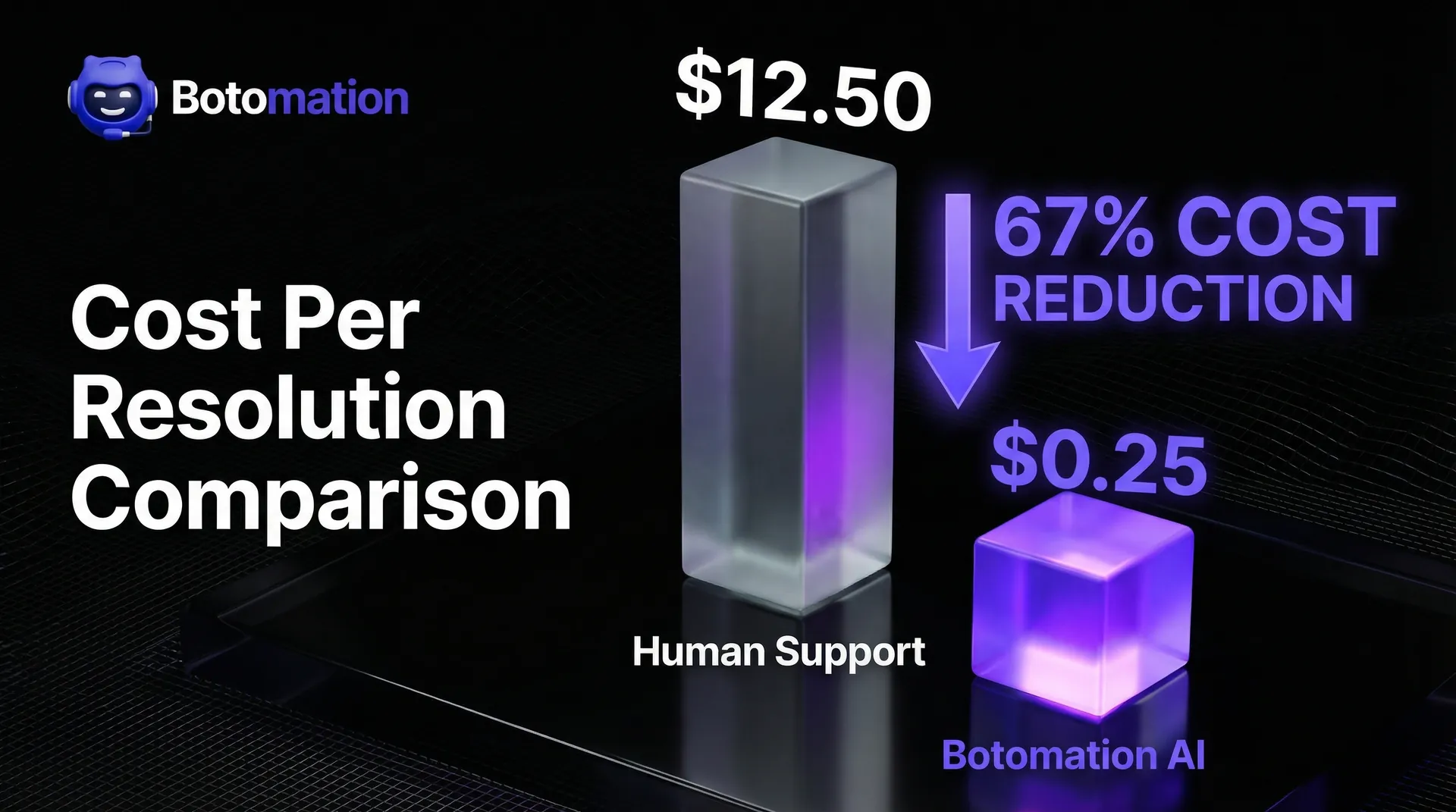
The most immediate impact of a Botomation AI implementation is the dramatic reduction in cost per resolution. When you factor in the base salary of a support agent, their benefits, and overhead, the average cost to resolve a single ticket in 2026 is roughly $12.50. In contrast, our AI agents resolve the same issues for approximately $0.25 per interaction. For a store handling 5,000 tickets a month, that's a monthly saving of over $60,000.
First contact resolution (FCR) is another critical metric. Human agents often need to pass a ticket back and forth, leading to an average FCR of around 60%. Because our AI agents have instant access to all your business data, they can often resolve the issue on the first try, pushing FCR rates to 87% or higher. This doesn't just save money; it significantly improves the customer's perception of your brand's efficiency.
Quantifying the Human Element and Brand Loyalty
While the financial metrics are impressive, the impact on customer sentiment is where the long-term value lies. We've seen an average increase of 2.1 points on a 10-point customer satisfaction scale following the implementation of our AI systems. Our data shows that stores using our AI agents see a 23% increase in repeat purchase rates within the first six months. This is because the post-purchase experience is handled with such precision that customers feel confident buying again.
How to Implement a High-Performance AI Agent
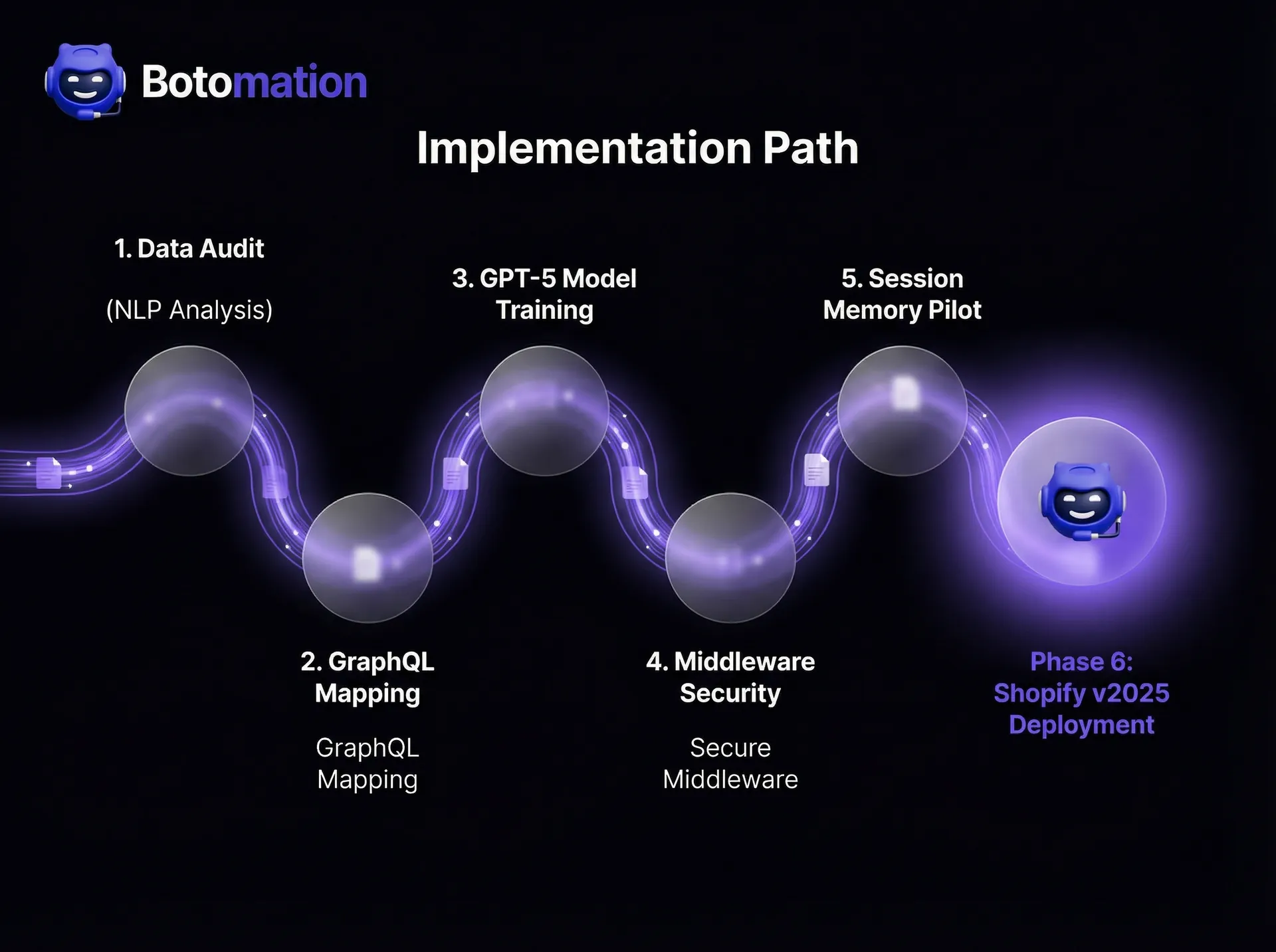
Implementing a robust AI strategy requires a structured approach to ensure accuracy and brand alignment. We follow a rigorous 6-step process that minimizes risk while maximizing the speed of deployment.
- Audit Your Support Data: We begin by analyzing your last 6 months of support history to identify the most common "low-value" tickets that are prime for automation.
- Map Your Ecosystem: Our technical team maps out every integration point, from your Shopify Admin to your 3PL and CRM, ensuring a seamless data flow.
- Train the Personality: We use your brand guidelines to create a custom "persona" for the AI, ensuring it speaks in your voice and adheres to your specific policies.
- Secure the Infrastructure: We build the custom middleware and API connections, implementing high-level encryption and privacy compliance.
- Pilot and Refine: The AI is launched in a controlled "shadow" mode where it drafts responses for human review, allowing us to fine-tune its accuracy before it goes fully autonomous.
- Full Deployment and Optimization: Once the AI hits our accuracy benchmarks, it goes live 24/7, with our team providing ongoing monitoring and updates.
Frequently Asked Questions
How does an ai chatbot for e-commerce customer support handle multi-language stores?
In 2026, our AI agents are natively multilingual. Using GPT-5's advanced translation capabilities, the bot can detect the customer's language automatically and respond with perfect grammar and cultural nuance in over 95 languages. This allows you to scale globally without hiring localized support teams for every region.
Can I integrate the chatbot with my existing helpdesk like Zendesk or Gorgias?
Absolutely. We specialize in "hybrid" setups where the AI acts as the first line of defense within your existing helpdesk. If the AI cannot resolve a query, it creates a ticket in Zendesk or Gorgias with a full transcript and summary, ensuring your human agents have all the context they need to finish the job.
Does the AI understand slang, typos, or regional dialects?
Yes. Modern Natural Language Processing (NLP) v4.2 is designed to understand intent rather than just matching keywords. It can accurately interpret messages with heavy typos, informal slang, and even emojis, ensuring the customer never feels like they have to "speak like a computer" to get help.
How does the system prevent "hallucinations" or incorrect information?
We use a technique called Retrieval-Augmented Generation (RAG). This restricts the AI to only using your specific, verified data sources (like your product pages and policy documents) to answer questions. If the information isn't in your data, the AI is programmed to admit it doesn't know and escalate to a human rather than making up an answer.
What is the setup time for a custom Shopify AI agent?
While basic apps can be installed in minutes, a professional-grade implementation typically takes 4 to 6 weeks. This time is used for deep API integration, custom model training, and the "shadow mode" testing phase to ensure 99%+ accuracy before the system goes live to your customers.
Conclusion: The Future of Shopify Support
The era of manual, slow-moving customer support is over. For Shopify brands in 2026, the choice is clear: continue to struggle with rising support costs and frustrated customers, or embrace the "New Way" of automated, intelligent engagement. Partnering with the experts at Botomation ensures that you aren't just installing another tool, but building a sophisticated, data-driven asset that will grow with your business. Our team handles every technical nuance, from GPT-5 fine-tuning to deep Shopify API integration, so you can focus on what you do best—scaling your brand.
The competitive advantage of 2026 belongs to those who can provide instant, accurate, and personalized support at scale. Don't let your support team be the bottleneck that holds back your growth. By implementing a custom AI agent, you turn your support department from a cost center into a powerful engine for customer retention and revenue. The data is clear, the technology is ready, and your customers are waiting for a better experience.
Ready to automate your growth? Book a call below.
The landscape of online retail has shifted dramatically as we navigate January 2026. Gone are the days when customers were willing to wait six to twelve hours for a response to a simple "where is my order" inquiry. Today, an ai chatbot for e-commerce customer support isn't just a luxury for the biggest players; it's the baseline expectation for any Shopify store that wants to survive the current competitive climate. We have moved past the era of frustrating, circular chat menus and entered an age where AI agents, powered by models like GPT-5, handle complex nuances with the same grace as a seasoned support veteran.
Our team at Botomation has observed a fundamental change in how high-growth brands approach their post-purchase experience. By moving away from bloated, manual support teams and adopting deeply integrated AI systems, brands are seeing an average 67% reduction in support costs while simultaneously achieving 90% faster response times. This isn't just about answering questions; it's about creating a frictionless journey from the moment a customer lands on your site to the moment they receive their package. Shopify store owners face unique challenges, from managing fluctuating inventory to handling complex shipping logistics, and a properly implemented AI agent is the only way to scale those operations without your overhead spiraling out of control.
What is the Role of an ai chatbot for e-commerce customer support in 2026?
The chatbots of 2022 and 2023 were often more of a hindrance than a help because they relied on rigid decision trees. If a customer didn't use the exact keyword the bot was programmed to recognize, the entire interaction broke down, leading to frustrated shoppers and increased ticket volumes. In 2026, the paradigm has shifted toward generative intelligence using GPT-5 and advanced Natural Language Processing (NLP) v4.2. These modern systems don't just look for keywords; they understand intent, tone, and context, allowing them to provide answers that feel genuinely helpful rather than robotic. Implementing a sophisticated customer service chatbot ensures that your brand voice remains consistent while providing instant utility.
When you partner with our experts to overhaul your support strategy, we move your store away from these "Old Way" FAQ bots and into a system that lives and breathes your brand data. Traditional bots could only point a user to a static link, but an intelligent agent can look at a customer's specific order history, check the real-time status with a carrier, and offer a personalized solution if there’s a delay. This level of sophistication is what separates a world-class Shopify experience from a mediocre one.
How Does Shopify Customer Support Automation Handle Complex Inquiries?
Building a high-performing ai chatbot for e-commerce customer support requires a sophisticated technology stack that goes far beyond a simple API call. Our team utilizes GPT-5 integration to ensure that every response is context-aware and capable of handling multi-layered queries that would usually require a human. We also implement Emotion AI v3.1, which serves as a digital "vibe check" for every interaction. If the system detects that a customer is becoming genuinely frustrated or using aggressive language, it doesn't keep trying to automate the solution; it intelligently escalates the issue to a human specialist with a full summary of the interaction.
Accessing the Shopify GraphQL API is a critical component of this stack, as it allows the AI to pull real-time data with surgical precision. Unlike older REST APIs that were often slow and data-heavy, GraphQL enables our agents to fetch exactly what they need—whether that's a specific line item in a complex order or the current stock level at a specific warehouse. This real-time connectivity ensures that the AI never gives outdated information, which is the quickest way to lose a customer's trust.
Mastering Context and Memory in Conversations
One of the biggest complaints about legacy chatbots was their "amnesia"—the inability to remember what was said just two minutes prior. Modern AI agents developed by our team feature advanced memory retention across sessions, meaning if a customer returns three days later, the bot remembers their previous issue. This continuity builds a sense of relationship and recognition that manual support teams often struggle to maintain at scale.
The integration of your full product catalog allows the AI to act as a digital personal shopper rather than just a support agent. It can recognize that a customer who bought a specific skincare serum might need a particular moisturizer to go with it, based on the ingredients and the customer's stated skin type. By recognizing multiple intents within a single message, such as "I want to return my shoes and also find out when the blue jacket is back in stock," the AI can address every part of the query in a single, coherent response.
Technical Requirements for Professional Shopify Support Automation
Deploying a professional-grade AI agent on high-converting custom e-commerce websites is a significant undertaking that requires more than just installing a basic app. It involves creating a custom middleware environment that can handle secure data processing while maintaining the lightning-fast load times your customers expect. Our team handles the heavy lifting of Shopify Admin API v2026-01 integration, ensuring that the connection between your store’s data and the AI model is both secure and highly performant. This deep-level shopify customer support automation is what allows for true operational scaling.
Data security has become the primary concern for e-commerce brands in 2026, especially with tightening global privacy regulations. We build our systems with a "privacy-first" architecture, ensuring that sensitive customer information is handled according to the latest compliance standards. This includes setting up proper OAuth protocols and ensuring that your custom app has exactly the permissions it needs—no more, no less—to protect your store from potential vulnerabilities.
Strategic API Integration and Data Access
To make an ai chatbot for e-commerce customer support truly effective, it must have deep roots in your Shopify ecosystem. We configure webhooks for real-time order updates, so the moment a shipping label is created or a package is delivered, the AI is aware of it. This proactive data access means the bot can often solve a problem before the customer even realizes there is one.
Performance optimization is another area where our agency excels, particularly for high-traffic stores that see massive spikes during Black Friday or seasonal sales. We implement sophisticated rate-limiting and caching strategies to ensure the AI remains responsive even when thousands of customers are interacting with it simultaneously. This level of stability is something that off-the-shelf "SaaS" tools simply cannot guarantee when the pressure is on.
Training the AI on Your Brand Voice
An AI agent that doesn't sound like your brand is a liability, not an asset. Our process involves a deep dive into your historical chat logs, email correspondence, and brand guidelines to fine-tune the model's personality. We don't just give it a list of FAQs; we train it on the nuances of your industry-specific terminology and your unique company policies.
Continuous learning is baked into our implementation strategy. We don't just set the bot live and walk away; we monitor its performance and use "human-in-the-loop" feedback to refine its responses over time. This ensures that as your product line evolves and your customer base grows, your AI support agent stays perfectly aligned with your business goals and customer expectations.
| Feature | The Old Way (Manual/Basic Bots) | The Botomation Way (AI Agents) |
|---|---|---|
| **Response Time** | 2 - 24 Hours | < 2 Seconds |
| **Availability** | Business Hours Only | 24/7/365 |
| **Personalization** | Generic Templates | Deep Order Integration |
| **Accuracy** | Prone to Human Error | Data-Driven Precision |
| **Scalability** | Hire More People | Instant Unlimited Capacity |
| **Cost** | $12+ Per Ticket | $0.25 Per Ticket |
Essential Features of a 2026 E-commerce AI Agent
The true power of a modern ai chatbot for e-commerce customer support lies in its ability to perform actions, not just speak words. In 2026, customers expect to be able to modify their orders, initiate returns, and track shipments directly within the chat interface without ever being redirected to a separate portal. Our agents are designed to be "action-oriented," meaning they can execute tasks within your Shopify admin based on the permissions we've configured.
Can a Customer Service Chatbot Manage Returns and Refunds?
Automated returns and refunds are perhaps the most significant time-savers we implement for our clients. By integrating your specific return policy directly into the AI's logic, the agent can verify if an item is eligible for a return, generate a shipping label, and update the customer's account in seconds. This turns what is usually a point of friction into a moment of "wow" for the customer, significantly increasing the likelihood of a repeat purchase. The modern customer service chatbot acts as a fully empowered support representative, not just a messenger.
Advanced Order Management and Tracking
The most common question in e-commerce remains "Where is my order?" and our AI agents provide automated order tracking notifications with a level of detail that was previously impossible. By connecting directly with carrier APIs like FedEx, UPS, and DHL, the bot can provide granular updates, such as "Your package is currently at the Chicago sorting facility and is expected to arrive by 4 PM tomorrow." It can even explain why a package might be delayed, such as weather conditions in a specific region, which humanizes the brand and reduces frustration.
For customers with complex purchase histories or multiple active orders, the AI can intelligently distinguish between them. It won't just say "Your order is on the way"; it will ask, "Are you asking about the blue sneakers you ordered yesterday, or the winter coat from last week?" This level of clarity prevents confusion and ensures the customer feels heard and understood.
Proactive Engagement and Revenue Recovery
Beyond support, our AI agents serve as a powerful tool for revenue growth. We implement WhatsApp abandoned cart recovery strategies that go beyond a simple "you forgot something" email. The AI can engage a customer who left a cart, ask if they have any questions about the products, and offer a real-time incentive or answer a specific concern that might be holding up the purchase.
Cross-selling and up-selling become much more effective when they are handled by an AI that understands the context of a conversation. If a customer is asking about the care instructions for a leather bag, the AI can naturally suggest a specific leather conditioner that other customers have paired with that exact item. This isn't a random pop-up; it's a helpful suggestion that adds value to the customer's experience while increasing your average order value through personalized recommendations.
"The shift from reactive support to proactive AI engagement is the single biggest competitive advantage for Shopify brands in 2026. It's no longer about just fixing problems; it's about anticipating needs before the customer even articulates them." — Senior Strategy Consultant at Botomation.
Success Stories of Brands Mastering AI Support
Seeing the theory in practice is essential for understanding the true ROI of this technology. We have partnered with dozens of brands to transition them from the "Old Way" of support to our AI-driven model. The results are consistently transformative, not just for the bottom line, but for the morale of the internal teams who are no longer buried under a mountain of repetitive, mind-numbing tickets.
Beauty Brand Transformation: GlowUp Cosmetics
GlowUp Cosmetics, a rapidly growing DTC beauty brand, approached us in early 2024 when their support team was completely overwhelmed by the volume of skincare routine questions and order status inquiries. We implemented a custom GPT-5 model trained specifically on their product ingredients and dermatological benefits. The results were immediate: we helped reduce support tickets by 80% as support ticket volume dropped by 85% within the first month.
Beyond just handling tickets, the AI became a "Digital Esthetician" for the brand. It could analyze a customer's skin concerns and recommend a full morning and evening routine, leading to a 22% increase in conversion rates for first-time visitors. By the end of Q2 2026, GlowUp reported a 310% ROI on their implementation, with customer satisfaction scores reaching an all-time high of 9.2 out of 10.
Electronics Retailer Impact: TechStore Proactive Support
TechStore, a high-volume electronics retailer, faced a different challenge: high return rates due to customers not understanding how to set up their complex devices. Our team built an AI agent that integrated with their inventory management and shipping carriers to provide proactive support. The moment a package was delivered, the AI would reach out with a "Getting Started" guide and offer to answer any setup questions.
This proactive approach led to a 73% reduction in return-related tickets and a 41% increase in repeat purchases. Customers loved the feeling that the brand was looking out for them even after the sale was finalized. The AI also handled warranty registrations and repair scheduling, turning a traditionally difficult process into a seamless, automated conversation.
Strategic Integration with Your Business Ecosystem
An ai chatbot for e-commerce customer support is only as good as the data it can access. To truly unlock its potential, it must be woven into the fabric of your existing business systems. Our team specializes in creating these deep connections, ensuring that the AI isn't just a "plugin" but a central hub for customer interaction. Furthermore, as mobile-first shopping continues to dominate, many of our clients are now prioritizing whatsapp ai support for shopify to reach customers directly on their most-used apps.
CRM and Customer Data Hubs
Connecting the AI with platforms like Klaviyo, HubSpot, or Salesforce is a top priority for our implementation team. This integration allows the AI to see the customer's full journey—every email they've opened, every ad they've clicked, and every previous purchase they've made. This data allows the AI to tailor its tone and suggestions to the individual, creating a truly bespoke experience.
Payment and Inventory Synchronization
Real-time inventory updates are crucial for preventing the "out of stock" disappointment that plagues many Shopify stores. Our AI agents are directly linked to your warehouse management system, so they can tell a customer exactly how many units of a product are left. On the payment side, our integrations with Stripe, PayPal, and Shop Pay allow the AI to handle transaction confirmations and refund processing with total security.
How to Measure the ROI of an ai chatbot for e-commerce customer support?
To understand the impact of your ai chatbot for e-commerce customer support, you need to look beyond simple vanity metrics. While "number of messages sent" is interesting, it doesn't tell you how much money the system is saving you or how much it's improving the customer experience. Our team provides comprehensive analytics that track the KPIs that actually matter to your bottom line, such as ticket deflection rate, cost per resolution, and the impact on your Net Promoter Score (NPS).
Support Metrics and Financial ROI
The most immediate impact of a Botomation AI implementation is the dramatic reduction in cost per resolution. When you factor in the base salary of a support agent, their benefits, and overhead, the average cost to resolve a single ticket in 2026 is roughly $12.50. In contrast, our AI agents resolve the same issues for approximately $0.25 per interaction. For a store handling 5,000 tickets a month, that's a monthly saving of over $60,000.
First contact resolution (FCR) is another critical metric. Human agents often need to pass a ticket back and forth, leading to an average FCR of around 60%. Because our AI agents have instant access to all your business data, they can often resolve the issue on the first try, pushing FCR rates to 87% or higher. This doesn't just save money; it significantly improves the customer's perception of your brand's efficiency.
Quantifying the Human Element and Brand Loyalty
While the financial metrics are impressive, the impact on customer sentiment is where the long-term value lies. We've seen an average increase of 2.1 points on a 10-point customer satisfaction scale following the implementation of our AI systems. Our data shows that stores using our AI agents see a 23% increase in repeat purchase rates within the first six months. This is because the post-purchase experience is handled with such precision that customers feel confident buying again.
How to Implement a High-Performance AI Agent
Implementing a robust AI strategy requires a structured approach to ensure accuracy and brand alignment. We follow a rigorous 6-step process that minimizes risk while maximizing the speed of deployment.
- Audit Your Support Data: We begin by analyzing your last 6 months of support history to identify the most common "low-value" tickets that are prime for automation.
- Map Your Ecosystem: Our technical team maps out every integration point, from your Shopify Admin to your 3PL and CRM, ensuring a seamless data flow.
- Train the Personality: We use your brand guidelines to create a custom "persona" for the AI, ensuring it speaks in your voice and adheres to your specific policies.
- Secure the Infrastructure: We build the custom middleware and API connections, implementing high-level encryption and privacy compliance.
- Pilot and Refine: The AI is launched in a controlled "shadow" mode where it drafts responses for human review, allowing us to fine-tune its accuracy before it goes fully autonomous.
- Full Deployment and Optimization: Once the AI hits our accuracy benchmarks, it goes live 24/7, with our team providing ongoing monitoring and updates.
Frequently Asked Questions
How does an ai chatbot for e-commerce customer support handle multi-language stores?
In 2026, our AI agents are natively multilingual. Using GPT-5's advanced translation capabilities, the bot can detect the customer's language automatically and respond with perfect grammar and cultural nuance in over 95 languages. This allows you to scale globally without hiring localized support teams for every region.
Can I integrate the chatbot with my existing helpdesk like Zendesk or Gorgias?
Absolutely. We specialize in "hybrid" setups where the AI acts as the first line of defense within your existing helpdesk. If the AI cannot resolve a query, it creates a ticket in Zendesk or Gorgias with a full transcript and summary, ensuring your human agents have all the context they need to finish the job.
Does the AI understand slang, typos, or regional dialects?
Yes. Modern Natural Language Processing (NLP) v4.2 is designed to understand intent rather than just matching keywords. It can accurately interpret messages with heavy typos, informal slang, and even emojis, ensuring the customer never feels like they have to "speak like a computer" to get help.
How does the system prevent "hallucinations" or incorrect information?
We use a technique called Retrieval-Augmented Generation (RAG). This restricts the AI to only using your specific, verified data sources (like your product pages and policy documents) to answer questions. If the information isn't in your data, the AI is programmed to admit it doesn't know and escalate to a human rather than making up an answer.
What is the setup time for a custom Shopify AI agent?
While basic apps can be installed in minutes, a professional-grade implementation typically takes 4 to 6 weeks. This time is used for deep API integration, custom model training, and the "shadow mode" testing phase to ensure 99%+ accuracy before the system goes live to your customers.
Conclusion: The Future of Shopify Support
The era of manual, slow-moving customer support is over. For Shopify brands in 2026, the choice is clear: continue to struggle with rising support costs and frustrated customers, or embrace the "New Way" of automated, intelligent engagement. Partnering with the experts at Botomation ensures that you aren't just installing another tool, but building a sophisticated, data-driven asset that will grow with your business. Our team handles every technical nuance, from GPT-5 fine-tuning to deep Shopify API integration, so you can focus on what you do best—scaling your brand.
The competitive advantage of 2026 belongs to those who can provide instant, accurate, and personalized support at scale. Don't let your support team be the bottleneck that holds back your growth. By implementing a custom AI agent, you turn your support department from a cost center into a powerful engine for customer retention and revenue. The data is clear, the technology is ready, and your customers are waiting for a better experience.
Ready to automate your growth? Book a call below.
Get Started
Book a FREE Consultation Right NOW!
Schedule a Call with Our Team To Make Your Business More Efficient with AI Instantly.
Read More
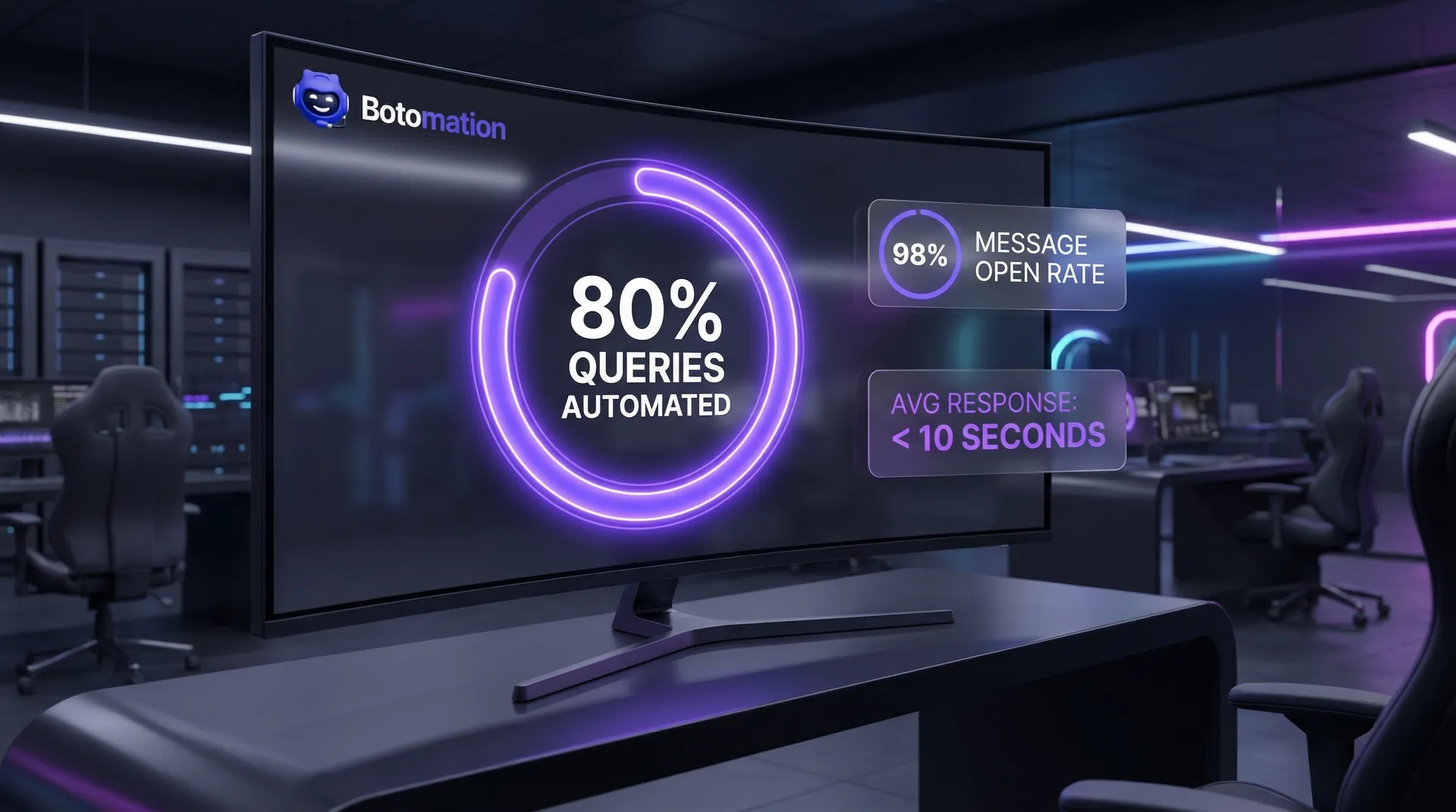
AI Chatbot for E-commerce Customer Support - 2026 Guide
Deploy an AI chatbot for e-commerce customer support on Shopify. Reduce tickets by 80% with GPT-5, automate returns, and drive ROI via automation.
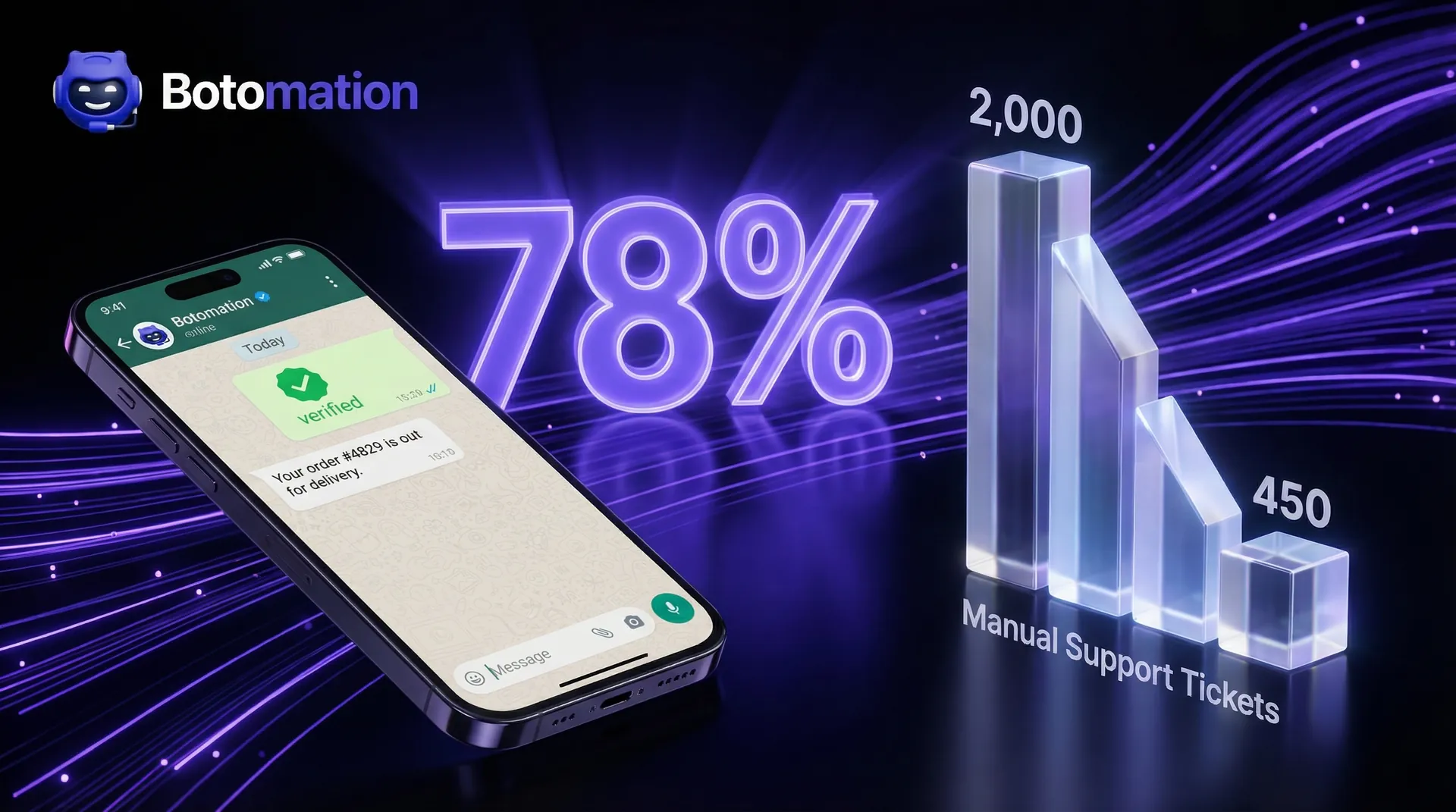
Cut Shopify Support Tickets by 78% with WhatsApp Automation
Learn how WhatsApp AI slashes support costs for e-commerce & SaaS. Proven strategies to boost sales, recover carts, and scale 24/7 service.