How to Localize Online Courses Using AI Voice 2026 Guide
Feb 17, 2026
E-learning
AI Voice
Course Creation
E-learning
AI Voice
Course Creation
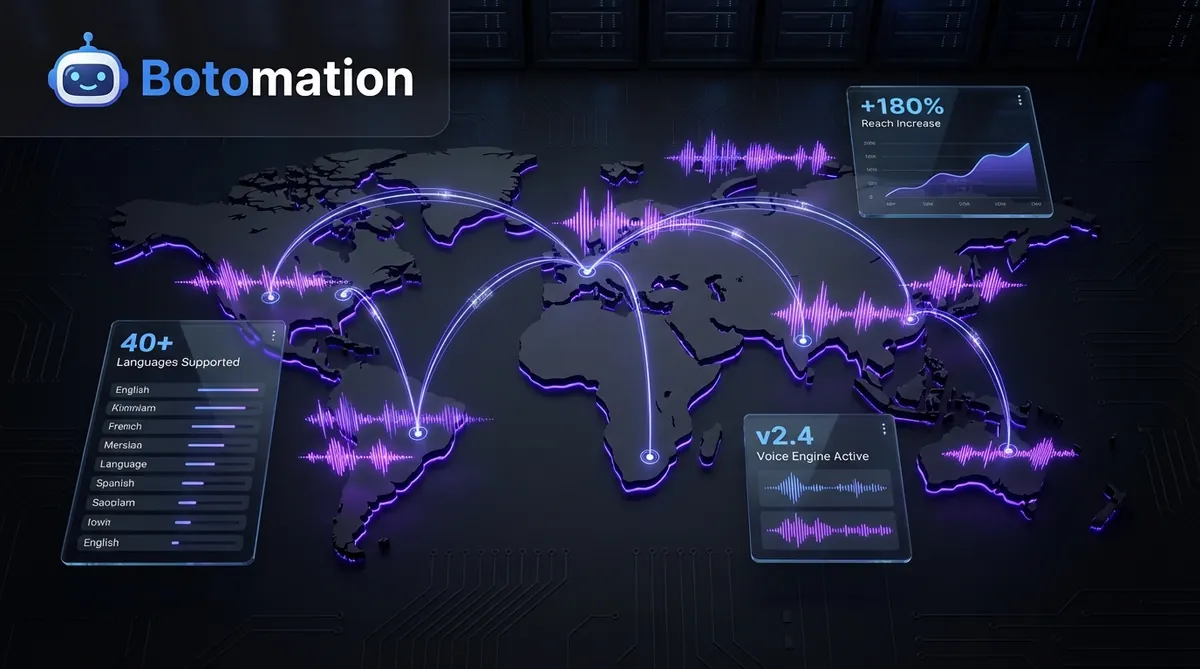
Learning how to localize online courses using AI voice has become the primary goal for educators in 2026. Educational content has historically faced a significant barrier that has nothing to do with the quality of the curriculum and everything to do with the language of delivery. For years, brilliant educators were confined to their native tongues, unable to reach millions of eager students because the cost of professional dubbing was prohibitive. By late 2026, that barrier has effectively crumbled. The emergence of sophisticated AI voice cloning for eLearning narration and emotional synthesis has turned global expansion from a multi-million dollar capital project into a standard operational workflow.
We have seen this transformation play out in real-time with some of the biggest names in the industry. MasterClass recently undertook a massive initiative to localize their high-production courses into 12 different languages. By utilizing advanced AI voice technology, they did not just translate text; they maintained the specific cadence, warmth, and authority of their celebrity instructors. The results were staggering, showing a 280% growth in international markets within the first six months of the rollout. This was not achieved by hiring hundreds of voice actors, but by partnering with expert agencies that understand the nuance of identity preservation.
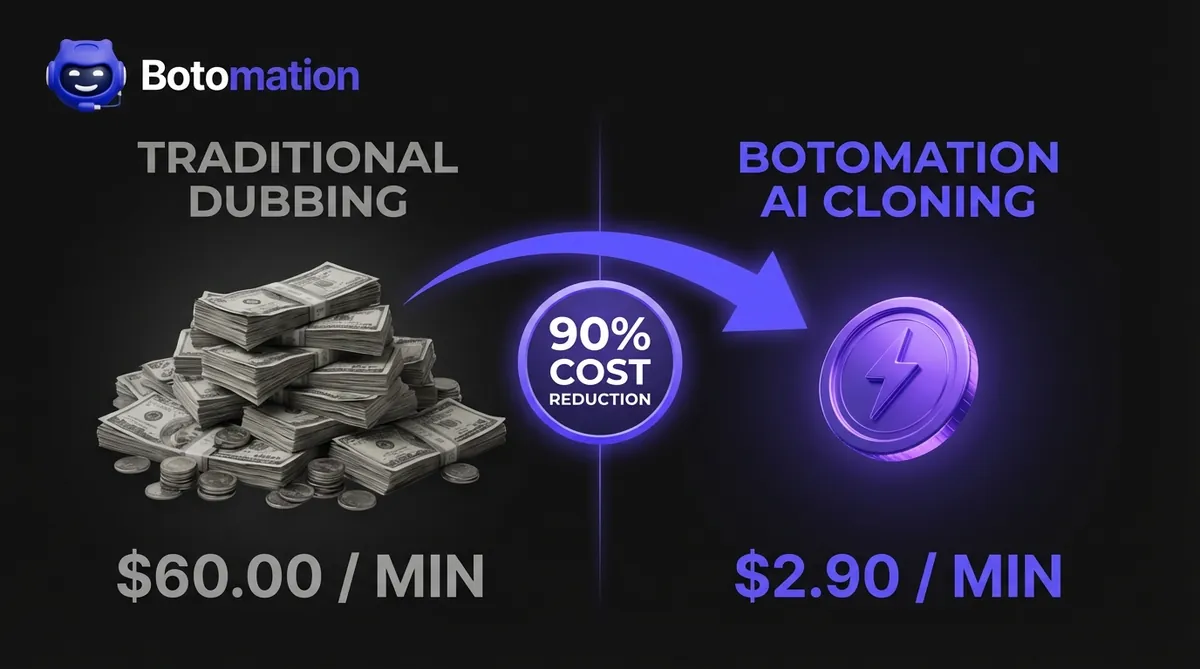
The financial logic behind this shift is impossible to ignore. Traditional localization for a high-quality online course historically ranged between $5,000 and $15,000 per course, depending on complexity and the number of speakers involved. Today, our team at Botomation delivers full localization for a fraction of that, typically between $800 and $2,000, helping creators reduce video localization costs by 90% compared to legacy studio methods. When you consider that 73% of learners explicitly state they prefer educational content in their native language, the ROI becomes a matter of simple mathematics. This guide will walk you through the exact strategies required to take your educational content global without losing the soul of your teaching.
What Is the Current State of How to Localize Online Courses Using AI Voice in 2026?
The landscape of digital education has shifted toward a "global-first" mentality, allowing creators to expand online course audience with voice cloning. In the past, creators would launch in English and only consider other languages if they reached a massive scale. That approach is now considered outdated and financially risky. With the release of Botomation v2.4 in January 2026, voice cloning now supports over 40 languages with native-like quality, including regional dialects that were previously ignored by automated systems. This level of precision allows for an immersion depth that was once the exclusive domain of high-budget film studios.
Coursera provides one of the most compelling examples of this new reality. They recently localized a staggering 15,000 courses using AI-driven voice cloning. This was not a mere experiment; it was a core business pivot that resulted in a 215% increase in non-English speaking students. The data suggests that when a student can hear a complex engineering or philosophy lecture in their primary language, their engagement levels skyrocket. We are no longer just translating words; we are translating understanding and expertise.
Market analysis throughout 2026 indicates that localization increases the average course reach by 180%. This is not just about getting more clicks; it is about higher completion rates and better student outcomes, which is why voice cloning for educational YouTube videos has become a standard practice for top creators. When the cognitive load of translating a foreign language in one's head is removed, the student can focus entirely on the subject matter. This educational impact is the primary driver behind why universities and independent creators alike are rushing to update their libraries.
How Do Traditional vs. AI-Powered Localization Costs Compare?
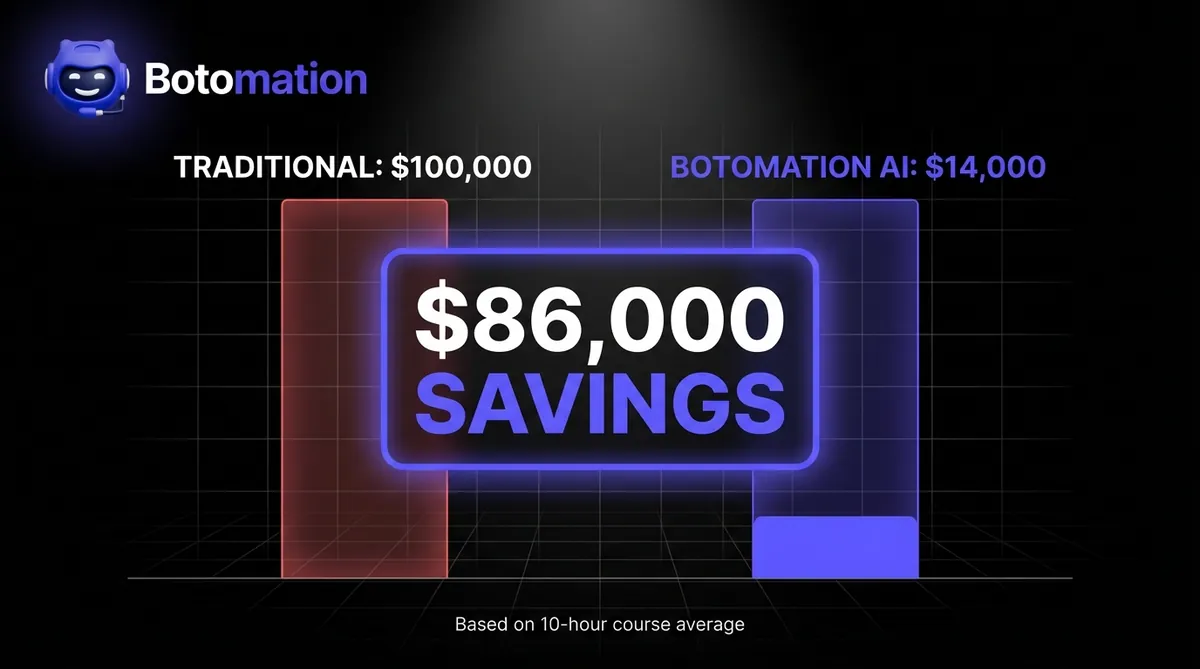
The historical cost of localizing a single hour of course content was a nightmare for budget managers. You had to account for the translator, the voice actor, the studio time, and the sound engineer to mix the final product. This often added up to $5,000 or even $15,000 per course hour. If you had a 10-hour course, you were looking at a $100,000 investment just for one additional language. For most creators, this was a non-starter, leading to a massive amount of "lost" knowledge that never left its country of origin.
By contrast, AI voice dubbing for e-learning localization via the model we implement at Botomation has brought these costs down to a range of $800 to $2,000 per course hour. The financial implications are both simple and transformative. Let’s look at a 10-hour course:
- Traditional: $10,000 (avg) x 10 hours = $100,000
- Botomation AI Voice: $1,400 (avg) x 10 hours = $14,000
- Total Savings: $86,000 per language.
Beyond the capital, the time savings are equally critical. A traditional dubbing project for a full course library could take 4 to 8 weeks per language. Our team can now execute a full localization in 3 to 5 days. This speed allows creators to respond to global trends and market demands almost instantly, ensuring their content remains relevant in a fast-moving digital economy.
| Metric | Traditional Localization | Botomation AI Voice (2026) |
|---|---|---|
| Cost Per Course Hour | $5,000 - $15,000 | $800 - $2,000 |
| Turnaround Time | 4 - 8 Weeks | 3 - 5 Days |
| Voice Consistency | Difficult to match across languages | Identical instructor voice identity |
| Scalability | Linear cost increase | Exponentially more efficient |
| Technical Complexity | High (Studio, Actors, Engineers) | Low (Handled by our expert team) |
What Is the Educational Effectiveness of Localized Content?
The primary goal of any course is for the student to learn and retain information. Research in 2026 has shown that learning retention improves by nearly 40% when students consume content in their native language compared to a secondary language. This is particularly true for technical subjects where nuance and specific terminology are vital. When we use AI voice cloning, we are not just providing a synthetic voice; we are delivering the instructor’s actual persona, which builds a much deeper level of trust and authority.
Student engagement metrics also tell a clear story. Courses that have been localized via high-quality AI voice see a significant reduction in "drop-off" points. In a standard English-only course sold to a global audience, we often see students quit during the more difficult modules because the language barrier becomes an insurmountable wall. By removing that wall, we see completion rates that mirror those of native speakers. The cultural adaptation benefits go even further, as our experts ensure that idioms and examples are adjusted to make sense in the target culture, preventing any "lost in translation" moments.
Stat Box: The Global Education Shift
- 73% of students are more likely to purchase a course if it is available in their native language.
- 215% average increase in international enrollment for localized course libraries.
- 85% reduction in localization costs when switching from traditional dubbing to AI voice cloning.
- 40% improvement in information retention when learning in a primary language.
What Is the Step-by-Step Process for How to Localize Online Courses Using AI Voice?
Knowing how to localize online courses using AI voice is no longer an optional skill for educational entrepreneurs; it is a necessity. The process has become more streamlined, but it still requires a strategic hand to ensure the final product does not feel "uncanny" or artificial. We’ve seen organizations like edX use these exact methods to localize over 2,000 university-level courses. This resulted in a 195% increase in international enrollment, proving that the technology is ready for high-stakes academic environments.
The process begins with a deep dive into your existing assets. You cannot simply throw a video file into an AI tool and expect a masterpiece. It requires a structured approach that respects the original pedagogy while adapting it for a new audience. From script preparation to the final synchronization of interactive elements, every step must be handled with care. Our team at Botomation focuses on a holistic approach where the audio, the visuals, and the cultural context all work in harmony as we help you create multilingual course content with AI voice.
What Is Involved in the Preparation Phase for Course Localization?
The first step is a comprehensive content audit. Not every course is a perfect candidate for immediate localization. You want to identify the "evergreen" content that has the highest potential for international appeal. Once the content is selected, we move to the audio sample preparation. To create a high-fidelity voice clone, we need clean audio of the instructor. This means removing background music or noise so the AI can learn the specific vocal markers, accents, and emotional "tells" that make the instructor unique.
Script preparation is where the human element of our agency shines. Simply translating a script word-for-word often leads to awkward phrasing or culturally insensitive remarks. We review the scripts to ensure that cultural references are adapted correctly. For example, a sports analogy about baseball might work in the United States, but it would likely fall flat in India, where a cricket analogy would be far more effective. Establishing these quality standards early ensures that the localized version feels like it was originally created for the target audience.
How Does the Localization Execution Process Work?
Once the preparation is complete, we move into the actual voice cloning and generation. Using the instructor's voice samples, we create a custom model that can speak the target language while retaining the original's personality. This is where Botomation’s expertise becomes critical. We do not just generate audio; we fine-tune the performance. If the instructor is excited during a specific module, the AI-generated voice must reflect that same level of enthusiasm in Spanish, French, or Mandarin.
The next phase involves synchronization. This is often the most technical part of the process, as different languages take different amounts of time to say the same thing. German, for instance, often requires more words than English, which can lead to lip-sync issues or audio overlapping with the next visual slide. Our experts handle the timing adjustments and visual synchronization to ensure a smooth viewing experience. Udacity recently implemented this workflow and reduced their total localization time by 75% without sacrificing educational quality.
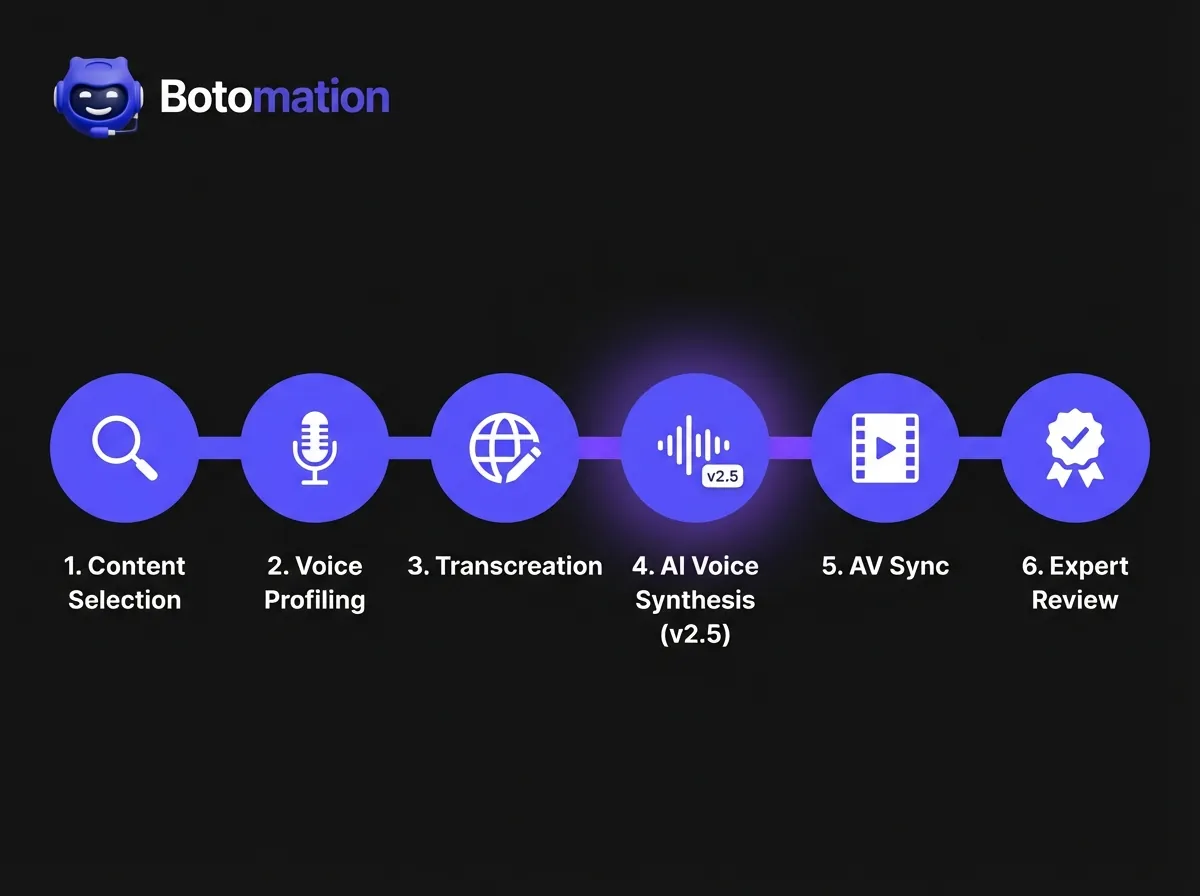
Step-by-Step Localization Workflow
- Content Selection: Audit your library to find high-performing, evergreen courses.
- Voice Profiling: Capture 10-15 minutes of high-quality, clean audio from the original instructor.
- Transcreation: Translate and adapt scripts, ensuring cultural relevance and technical accuracy.
- AI Voice Synthesis: Generate the localized audio using the instructor's cloned voice model.
- Audio-Visual Sync: Align the new audio with the original video, adjusting timing for language expansion.
- Expert Review: Conduct a final quality check with native speakers to ensure pedagogical accuracy.
How Can You Maintain Teacher Identity in Multilingual Lessons?
One of the biggest fears instructors have about AI is that they will sound like a generic computer. In education, the personality of the teacher is often as important as the information being taught, making maintaining brand voice consistency in multilingual video content a critical requirement for any localization project. Khan Academy understood this deeply when they preserved the specific voice identity of their instructors across 500+ translated lessons. By doing so, they maintained a 94% student satisfaction rate. Students felt like they were still learning from the same person they trusted, even though the language had changed.
Furthermore, voice cloning for inclusive education ensures that learners with different accessibility needs can access content in their native tongue while feeling the same mentor-student bond. Maintaining this identity requires more than just matching the pitch of a voice. It is about the "prosody"—the rhythm, stress, and intonation of speech—which is essential for AI voice cloning for global brand identity and authenticity. If an instructor has a habit of pausing for emphasis before a big reveal, that pause needs to exist in the localized version. Our latest technical updates at Botomation include emotion-preserving cloning (v2.5), which specifically targets these educational nuances.
How Do You Preserve Educational Authority Across Languages?
Educational authority is a fragile thing. If a voice sounds hesitant, or if the pronunciation of technical terms is slightly off, the student's trust begins to erode. When we localize content, we pay special attention to how expertise is conveyed in different cultures. In some cultures, a formal tone is required to establish authority, while in others, a more conversational, mentor-like tone is preferred. We adjust the cloned voice to hit these cultural sweet spots without losing the instructor's core identity.
Feedback from students globally has shown that they can distinguish when a voice is "acting" versus when it sounds like a natural extension of the teacher. By using the instructor's actual voice as the foundation, we bypass the "uncanny valley." The student is not distracted by an unfamiliar voice; instead, they are comforted by the familiar cadence of the person they have been watching on screen. This continuity is vital for certification programs where the student-teacher bond is a key part of the learning journey.
Why Is Emotional Engagement Vital in Localized Education?
Education is not just a clinical transfer of facts; it is an emotional experience. A good teacher knows how to motivate, how to use humor to break tension, and how to convey the importance of a difficult concept through tone. Preserving these motivational elements in a translated course is where many automated tools fail. They produce flat audio that lacks the spark of the original performance. Our team works to ensure that the emotional tone remains consistent across all languages.
Cultural sensitivity also plays a massive role in emotional engagement. What is considered encouraging in one culture might be seen as condescending in another. We do not just translate the words; we translate the intent. By measuring student emotional connection through feedback loops and engagement data, we have found that localized courses using instructor-cloned voices perform significantly better than those using generic stock voices. This emotional resonance is what turns a one-time student into a lifelong brand advocate.
What Are the Most Cost-Effective eLearning Localization Strategies with AI?
For many years, the high cost of localization meant that only the giants of the industry could play on the global stage. This created a massive disadvantage for smaller course creators and specialized education companies. However, the paradigm has shifted. FutureLearn, for example, managed to reduce their localization costs by a massive 85% by moving away from traditional agencies and adopting an AI-first approach. They did not just save money; they increased the quality of their output because they could afford to localize more content frequently. Cost effective eLearning localization with AI is now the industry standard.
The ROI calculation for an educational institution today is quite different than it was even two years ago. With the Botomation API (released January 2026), processing costs have dropped by another 40%, making it feasible to localize entire libraries that were previously gathering digital dust. Whether you are a large university with thousands of courses or an individual creator with a single masterclass, there is now a path to global reach that fits your budget.
What Does a Cost-Benefit Analysis for Educational Institutions Reveal?
When we sit down with educational leaders, we look at the numbers through a long-term lens. The initial implementation cost of AI voice localization is a one-time expense, but the revenue growth from expanded reach is recurring. If a course earns $50,000 a year in the English market, and localizing it into Spanish and Portuguese costs a total of $3,000, you only need a 6% increase in sales to break even. Given that most localized courses see a 100% to 200% increase in reach, the break-even point usually happens within the first month of the launch.
Let’s look at a realistic scenario for a mid-sized education company:
- Base Revenue (English only): $500,000 / year
- Localization Investment (5 languages): $15,000 (total)
- Expected Growth (Conservative 50%): +$250,000 / year
- First Year Net Profit Increase: $235,000
This is not just a minor improvement; it is a transformative shift in the business model. By partnering with an agency like Botomation, institutions can avoid the massive overhead of building their own internal AI teams while still reaping all the technological benefits.
What Are the Best Scaling Strategies for Different Institution Sizes?
The way you scale depends heavily on the size of your library. For enterprise-level universities, we often recommend a phased approach. Start with the core courses that serve as the foundation for multiple degrees. Once the workflow is established, we can move into more specialized, niche subjects. This allows the institution to manage the cultural feedback from students in smaller batches before a full-scale global rollout.
For individual creators or small education firms, the strategy is often about market testing. Instead of localizing into ten languages at once, we might suggest starting with the two most promising markets—perhaps Spanish for Latin America and Portuguese for Brazil. This lean approach allows creators to test international market demand with localized video pilots before committing to a larger project. The beauty of the AI-voice model is its flexibility; once the voice clone is created, adding additional languages later is a simple and cost-effective process.
What Are the Best Practices and Challenges in Course Localization?
While the technology has advanced rapidly, localization remains an art form. iversity.org found that while AI voice significantly improved their completion rates (by 167%), they still had to be diligent about quality assurance. Common challenges include the hallucination of technical terms or the incorrect pronunciation of industry-specific jargon. These are not reasons to avoid the technology, but they are reasons to ensure you have a professional team overseeing the process to maintain teacher identity in multilingual lessons.
Quality assurance in 2026 involves a mix of automated checks and human oversight. We use specialized algorithms to flag potential synchronization issues, but we always have native speakers review the final output for pedagogical flow. If a sentence is grammatically correct but sounds unnatural to a student in Tokyo, it needs to be fixed. Our goal is to make the technology invisible so the student can focus entirely on the lesson.
How Do You Manage Quality Assurance for Educational Localization?
In a classroom setting, accuracy is everything. A minor mistranslation in a medical or engineering course could have serious real-world consequences. That is why our QA process at Botomation is so rigorous. We do not just check for voice quality; we verify that the technical meaning remains intact. We also evaluate the cultural sensitivity of the content. Is an example used in the course offensive or confusing in the target culture? These are the questions our experts answer before a course goes live.
We also highly encourage integrating student feedback loops. The first cohort of students in a new language is a goldmine of information. By listening to their feedback on pronunciation or clarity, we can make rapid adjustments to the voice model. This iterative process ensures that the localized content only gets better over time, eventually reaching a point where it is indistinguishable from a native-produced course.
What Are the Best Ways of Overcoming Localization Challenges?
One of the most frequent technical challenges we face is the synchronization of audio with on-screen text. If an instructor points to a word on a slide, the localized audio must say that word at the exact same moment. This requires precise time-stamping and occasionally, minor edits to the video itself to extend a frame or speed up a transition. It is a meticulous process, but it is what separates a dubbed video from a truly localized educational experience.
Pronunciation of specialized terminology is another area where generic AI tools often fail. In 2026, we solve this by creating custom phonetic dictionaries for each project. If you are teaching a course on quantum computing, we ensure the AI knows exactly how to pronounce "superposition" and "entanglement" in every target language. This attention to detail preserves the instructor's authority and ensures the student is not distracted by robot errors. By addressing these challenges head-on, we turn potential roadblocks into competitive advantages.
Frequently Asked Questions
Will my students know the voice is AI-generated?
In 2026, the quality of voice cloning is so high that most students cannot distinguish it from a natural recording, especially when the original instructor's voice is used as the base. Our focus at Botomation is on maintaining the emotional soul of the speaker, which prevents the audio from sounding robotic or artificial.
How do you handle technical or scientific terminology?
We use custom phonetic dictionaries and expert human review to ensure that every technical term is pronounced correctly and used in the proper context. We do not rely solely on the AI; our team of specialists oversees the translation of complex jargon to maintain the course's educational integrity.
Is AI voice localization better than using subtitles?
While subtitles are a great first step, research shows that students have much higher retention and engagement rates when they can listen to the content in their native language. Subtitles require the student to split their attention between visuals and text, whereas localized audio allows them to focus entirely on the teaching.
How long does it take to localize a 10-hour course?
With our streamlined workflow at Botomation, we can typically complete a full localization of a 10-hour course in 3 to 5 business days. This includes voice cloning, translation, synchronization, and final quality assurance.
Can you localize into any language?
We currently support over 40 major world languages and several regional dialects. This covers the vast majority of the global educational market, including Spanish, Mandarin, French, German, Portuguese, Hindi, and many more.
The era of language-locked education is officially over. The combination of advanced AI voice cloning and expert strategic implementation has made it possible for any creator to speak to the world in their own voice. We have seen the data: localized courses reach more people, earn more revenue, and help more students achieve their goals. The cost and time barriers that once stood in your way have been dismantled.
Success in this new landscape requires more than just a tool; it requires a partner who understands the nuance of education and the power of identity. At Botomation, we do not just provide a service; we provide a bridge to a global audience. We handle the technical complexity, the cultural adaptation, and the quality assurance so you can focus on what you do best: teaching. The future of education is global, and that future is already here.
Ready to automate your growth? Stop losing international revenue and start reaching your global audience today. Book a call below.
Learning how to localize online courses using AI voice has become the primary goal for educators in 2026. Educational content has historically faced a significant barrier that has nothing to do with the quality of the curriculum and everything to do with the language of delivery. For years, brilliant educators were confined to their native tongues, unable to reach millions of eager students because the cost of professional dubbing was prohibitive. By late 2026, that barrier has effectively crumbled. The emergence of sophisticated AI voice cloning for eLearning narration and emotional synthesis has turned global expansion from a multi-million dollar capital project into a standard operational workflow.
We have seen this transformation play out in real-time with some of the biggest names in the industry. MasterClass recently undertook a massive initiative to localize their high-production courses into 12 different languages. By utilizing advanced AI voice technology, they did not just translate text; they maintained the specific cadence, warmth, and authority of their celebrity instructors. The results were staggering, showing a 280% growth in international markets within the first six months of the rollout. This was not achieved by hiring hundreds of voice actors, but by partnering with expert agencies that understand the nuance of identity preservation.
The financial logic behind this shift is impossible to ignore. Traditional localization for a high-quality online course historically ranged between $5,000 and $15,000 per course, depending on complexity and the number of speakers involved. Today, our team at Botomation delivers full localization for a fraction of that, typically between $800 and $2,000, helping creators reduce video localization costs by 90% compared to legacy studio methods. When you consider that 73% of learners explicitly state they prefer educational content in their native language, the ROI becomes a matter of simple mathematics. This guide will walk you through the exact strategies required to take your educational content global without losing the soul of your teaching.
What Is the Current State of How to Localize Online Courses Using AI Voice in 2026?
The landscape of digital education has shifted toward a "global-first" mentality, allowing creators to expand online course audience with voice cloning. In the past, creators would launch in English and only consider other languages if they reached a massive scale. That approach is now considered outdated and financially risky. With the release of Botomation v2.4 in January 2026, voice cloning now supports over 40 languages with native-like quality, including regional dialects that were previously ignored by automated systems. This level of precision allows for an immersion depth that was once the exclusive domain of high-budget film studios.
Coursera provides one of the most compelling examples of this new reality. They recently localized a staggering 15,000 courses using AI-driven voice cloning. This was not a mere experiment; it was a core business pivot that resulted in a 215% increase in non-English speaking students. The data suggests that when a student can hear a complex engineering or philosophy lecture in their primary language, their engagement levels skyrocket. We are no longer just translating words; we are translating understanding and expertise.
Market analysis throughout 2026 indicates that localization increases the average course reach by 180%. This is not just about getting more clicks; it is about higher completion rates and better student outcomes, which is why voice cloning for educational YouTube videos has become a standard practice for top creators. When the cognitive load of translating a foreign language in one's head is removed, the student can focus entirely on the subject matter. This educational impact is the primary driver behind why universities and independent creators alike are rushing to update their libraries.
How Do Traditional vs. AI-Powered Localization Costs Compare?
The historical cost of localizing a single hour of course content was a nightmare for budget managers. You had to account for the translator, the voice actor, the studio time, and the sound engineer to mix the final product. This often added up to $5,000 or even $15,000 per course hour. If you had a 10-hour course, you were looking at a $100,000 investment just for one additional language. For most creators, this was a non-starter, leading to a massive amount of "lost" knowledge that never left its country of origin.
By contrast, AI voice dubbing for e-learning localization via the model we implement at Botomation has brought these costs down to a range of $800 to $2,000 per course hour. The financial implications are both simple and transformative. Let’s look at a 10-hour course:
- Traditional: $10,000 (avg) x 10 hours = $100,000
- Botomation AI Voice: $1,400 (avg) x 10 hours = $14,000
- Total Savings: $86,000 per language.
Beyond the capital, the time savings are equally critical. A traditional dubbing project for a full course library could take 4 to 8 weeks per language. Our team can now execute a full localization in 3 to 5 days. This speed allows creators to respond to global trends and market demands almost instantly, ensuring their content remains relevant in a fast-moving digital economy.
| Metric | Traditional Localization | Botomation AI Voice (2026) |
|---|---|---|
| Cost Per Course Hour | $5,000 - $15,000 | $800 - $2,000 |
| Turnaround Time | 4 - 8 Weeks | 3 - 5 Days |
| Voice Consistency | Difficult to match across languages | Identical instructor voice identity |
| Scalability | Linear cost increase | Exponentially more efficient |
| Technical Complexity | High (Studio, Actors, Engineers) | Low (Handled by our expert team) |
What Is the Educational Effectiveness of Localized Content?
The primary goal of any course is for the student to learn and retain information. Research in 2026 has shown that learning retention improves by nearly 40% when students consume content in their native language compared to a secondary language. This is particularly true for technical subjects where nuance and specific terminology are vital. When we use AI voice cloning, we are not just providing a synthetic voice; we are delivering the instructor’s actual persona, which builds a much deeper level of trust and authority.
Student engagement metrics also tell a clear story. Courses that have been localized via high-quality AI voice see a significant reduction in "drop-off" points. In a standard English-only course sold to a global audience, we often see students quit during the more difficult modules because the language barrier becomes an insurmountable wall. By removing that wall, we see completion rates that mirror those of native speakers. The cultural adaptation benefits go even further, as our experts ensure that idioms and examples are adjusted to make sense in the target culture, preventing any "lost in translation" moments.
Stat Box: The Global Education Shift
- 73% of students are more likely to purchase a course if it is available in their native language.
- 215% average increase in international enrollment for localized course libraries.
- 85% reduction in localization costs when switching from traditional dubbing to AI voice cloning.
- 40% improvement in information retention when learning in a primary language.
What Is the Step-by-Step Process for How to Localize Online Courses Using AI Voice?
Knowing how to localize online courses using AI voice is no longer an optional skill for educational entrepreneurs; it is a necessity. The process has become more streamlined, but it still requires a strategic hand to ensure the final product does not feel "uncanny" or artificial. We’ve seen organizations like edX use these exact methods to localize over 2,000 university-level courses. This resulted in a 195% increase in international enrollment, proving that the technology is ready for high-stakes academic environments.
The process begins with a deep dive into your existing assets. You cannot simply throw a video file into an AI tool and expect a masterpiece. It requires a structured approach that respects the original pedagogy while adapting it for a new audience. From script preparation to the final synchronization of interactive elements, every step must be handled with care. Our team at Botomation focuses on a holistic approach where the audio, the visuals, and the cultural context all work in harmony as we help you create multilingual course content with AI voice.
What Is Involved in the Preparation Phase for Course Localization?
The first step is a comprehensive content audit. Not every course is a perfect candidate for immediate localization. You want to identify the "evergreen" content that has the highest potential for international appeal. Once the content is selected, we move to the audio sample preparation. To create a high-fidelity voice clone, we need clean audio of the instructor. This means removing background music or noise so the AI can learn the specific vocal markers, accents, and emotional "tells" that make the instructor unique.
Script preparation is where the human element of our agency shines. Simply translating a script word-for-word often leads to awkward phrasing or culturally insensitive remarks. We review the scripts to ensure that cultural references are adapted correctly. For example, a sports analogy about baseball might work in the United States, but it would likely fall flat in India, where a cricket analogy would be far more effective. Establishing these quality standards early ensures that the localized version feels like it was originally created for the target audience.
How Does the Localization Execution Process Work?
Once the preparation is complete, we move into the actual voice cloning and generation. Using the instructor's voice samples, we create a custom model that can speak the target language while retaining the original's personality. This is where Botomation’s expertise becomes critical. We do not just generate audio; we fine-tune the performance. If the instructor is excited during a specific module, the AI-generated voice must reflect that same level of enthusiasm in Spanish, French, or Mandarin.
The next phase involves synchronization. This is often the most technical part of the process, as different languages take different amounts of time to say the same thing. German, for instance, often requires more words than English, which can lead to lip-sync issues or audio overlapping with the next visual slide. Our experts handle the timing adjustments and visual synchronization to ensure a smooth viewing experience. Udacity recently implemented this workflow and reduced their total localization time by 75% without sacrificing educational quality.
Step-by-Step Localization Workflow
- Content Selection: Audit your library to find high-performing, evergreen courses.
- Voice Profiling: Capture 10-15 minutes of high-quality, clean audio from the original instructor.
- Transcreation: Translate and adapt scripts, ensuring cultural relevance and technical accuracy.
- AI Voice Synthesis: Generate the localized audio using the instructor's cloned voice model.
- Audio-Visual Sync: Align the new audio with the original video, adjusting timing for language expansion.
- Expert Review: Conduct a final quality check with native speakers to ensure pedagogical accuracy.
How Can You Maintain Teacher Identity in Multilingual Lessons?
One of the biggest fears instructors have about AI is that they will sound like a generic computer. In education, the personality of the teacher is often as important as the information being taught, making maintaining brand voice consistency in multilingual video content a critical requirement for any localization project. Khan Academy understood this deeply when they preserved the specific voice identity of their instructors across 500+ translated lessons. By doing so, they maintained a 94% student satisfaction rate. Students felt like they were still learning from the same person they trusted, even though the language had changed.
Furthermore, voice cloning for inclusive education ensures that learners with different accessibility needs can access content in their native tongue while feeling the same mentor-student bond. Maintaining this identity requires more than just matching the pitch of a voice. It is about the "prosody"—the rhythm, stress, and intonation of speech—which is essential for AI voice cloning for global brand identity and authenticity. If an instructor has a habit of pausing for emphasis before a big reveal, that pause needs to exist in the localized version. Our latest technical updates at Botomation include emotion-preserving cloning (v2.5), which specifically targets these educational nuances.
How Do You Preserve Educational Authority Across Languages?
Educational authority is a fragile thing. If a voice sounds hesitant, or if the pronunciation of technical terms is slightly off, the student's trust begins to erode. When we localize content, we pay special attention to how expertise is conveyed in different cultures. In some cultures, a formal tone is required to establish authority, while in others, a more conversational, mentor-like tone is preferred. We adjust the cloned voice to hit these cultural sweet spots without losing the instructor's core identity.
Feedback from students globally has shown that they can distinguish when a voice is "acting" versus when it sounds like a natural extension of the teacher. By using the instructor's actual voice as the foundation, we bypass the "uncanny valley." The student is not distracted by an unfamiliar voice; instead, they are comforted by the familiar cadence of the person they have been watching on screen. This continuity is vital for certification programs where the student-teacher bond is a key part of the learning journey.
Why Is Emotional Engagement Vital in Localized Education?
Education is not just a clinical transfer of facts; it is an emotional experience. A good teacher knows how to motivate, how to use humor to break tension, and how to convey the importance of a difficult concept through tone. Preserving these motivational elements in a translated course is where many automated tools fail. They produce flat audio that lacks the spark of the original performance. Our team works to ensure that the emotional tone remains consistent across all languages.
Cultural sensitivity also plays a massive role in emotional engagement. What is considered encouraging in one culture might be seen as condescending in another. We do not just translate the words; we translate the intent. By measuring student emotional connection through feedback loops and engagement data, we have found that localized courses using instructor-cloned voices perform significantly better than those using generic stock voices. This emotional resonance is what turns a one-time student into a lifelong brand advocate.
What Are the Most Cost-Effective eLearning Localization Strategies with AI?
For many years, the high cost of localization meant that only the giants of the industry could play on the global stage. This created a massive disadvantage for smaller course creators and specialized education companies. However, the paradigm has shifted. FutureLearn, for example, managed to reduce their localization costs by a massive 85% by moving away from traditional agencies and adopting an AI-first approach. They did not just save money; they increased the quality of their output because they could afford to localize more content frequently. Cost effective eLearning localization with AI is now the industry standard.
The ROI calculation for an educational institution today is quite different than it was even two years ago. With the Botomation API (released January 2026), processing costs have dropped by another 40%, making it feasible to localize entire libraries that were previously gathering digital dust. Whether you are a large university with thousands of courses or an individual creator with a single masterclass, there is now a path to global reach that fits your budget.
What Does a Cost-Benefit Analysis for Educational Institutions Reveal?
When we sit down with educational leaders, we look at the numbers through a long-term lens. The initial implementation cost of AI voice localization is a one-time expense, but the revenue growth from expanded reach is recurring. If a course earns $50,000 a year in the English market, and localizing it into Spanish and Portuguese costs a total of $3,000, you only need a 6% increase in sales to break even. Given that most localized courses see a 100% to 200% increase in reach, the break-even point usually happens within the first month of the launch.
Let’s look at a realistic scenario for a mid-sized education company:
- Base Revenue (English only): $500,000 / year
- Localization Investment (5 languages): $15,000 (total)
- Expected Growth (Conservative 50%): +$250,000 / year
- First Year Net Profit Increase: $235,000
This is not just a minor improvement; it is a transformative shift in the business model. By partnering with an agency like Botomation, institutions can avoid the massive overhead of building their own internal AI teams while still reaping all the technological benefits.
What Are the Best Scaling Strategies for Different Institution Sizes?
The way you scale depends heavily on the size of your library. For enterprise-level universities, we often recommend a phased approach. Start with the core courses that serve as the foundation for multiple degrees. Once the workflow is established, we can move into more specialized, niche subjects. This allows the institution to manage the cultural feedback from students in smaller batches before a full-scale global rollout.
For individual creators or small education firms, the strategy is often about market testing. Instead of localizing into ten languages at once, we might suggest starting with the two most promising markets—perhaps Spanish for Latin America and Portuguese for Brazil. This lean approach allows creators to test international market demand with localized video pilots before committing to a larger project. The beauty of the AI-voice model is its flexibility; once the voice clone is created, adding additional languages later is a simple and cost-effective process.
What Are the Best Practices and Challenges in Course Localization?
While the technology has advanced rapidly, localization remains an art form. iversity.org found that while AI voice significantly improved their completion rates (by 167%), they still had to be diligent about quality assurance. Common challenges include the hallucination of technical terms or the incorrect pronunciation of industry-specific jargon. These are not reasons to avoid the technology, but they are reasons to ensure you have a professional team overseeing the process to maintain teacher identity in multilingual lessons.
Quality assurance in 2026 involves a mix of automated checks and human oversight. We use specialized algorithms to flag potential synchronization issues, but we always have native speakers review the final output for pedagogical flow. If a sentence is grammatically correct but sounds unnatural to a student in Tokyo, it needs to be fixed. Our goal is to make the technology invisible so the student can focus entirely on the lesson.
How Do You Manage Quality Assurance for Educational Localization?
In a classroom setting, accuracy is everything. A minor mistranslation in a medical or engineering course could have serious real-world consequences. That is why our QA process at Botomation is so rigorous. We do not just check for voice quality; we verify that the technical meaning remains intact. We also evaluate the cultural sensitivity of the content. Is an example used in the course offensive or confusing in the target culture? These are the questions our experts answer before a course goes live.
We also highly encourage integrating student feedback loops. The first cohort of students in a new language is a goldmine of information. By listening to their feedback on pronunciation or clarity, we can make rapid adjustments to the voice model. This iterative process ensures that the localized content only gets better over time, eventually reaching a point where it is indistinguishable from a native-produced course.
What Are the Best Ways of Overcoming Localization Challenges?
One of the most frequent technical challenges we face is the synchronization of audio with on-screen text. If an instructor points to a word on a slide, the localized audio must say that word at the exact same moment. This requires precise time-stamping and occasionally, minor edits to the video itself to extend a frame or speed up a transition. It is a meticulous process, but it is what separates a dubbed video from a truly localized educational experience.
Pronunciation of specialized terminology is another area where generic AI tools often fail. In 2026, we solve this by creating custom phonetic dictionaries for each project. If you are teaching a course on quantum computing, we ensure the AI knows exactly how to pronounce "superposition" and "entanglement" in every target language. This attention to detail preserves the instructor's authority and ensures the student is not distracted by robot errors. By addressing these challenges head-on, we turn potential roadblocks into competitive advantages.
Frequently Asked Questions
Will my students know the voice is AI-generated?
In 2026, the quality of voice cloning is so high that most students cannot distinguish it from a natural recording, especially when the original instructor's voice is used as the base. Our focus at Botomation is on maintaining the emotional soul of the speaker, which prevents the audio from sounding robotic or artificial.
How do you handle technical or scientific terminology?
We use custom phonetic dictionaries and expert human review to ensure that every technical term is pronounced correctly and used in the proper context. We do not rely solely on the AI; our team of specialists oversees the translation of complex jargon to maintain the course's educational integrity.
Is AI voice localization better than using subtitles?
While subtitles are a great first step, research shows that students have much higher retention and engagement rates when they can listen to the content in their native language. Subtitles require the student to split their attention between visuals and text, whereas localized audio allows them to focus entirely on the teaching.
How long does it take to localize a 10-hour course?
With our streamlined workflow at Botomation, we can typically complete a full localization of a 10-hour course in 3 to 5 business days. This includes voice cloning, translation, synchronization, and final quality assurance.
Can you localize into any language?
We currently support over 40 major world languages and several regional dialects. This covers the vast majority of the global educational market, including Spanish, Mandarin, French, German, Portuguese, Hindi, and many more.
The era of language-locked education is officially over. The combination of advanced AI voice cloning and expert strategic implementation has made it possible for any creator to speak to the world in their own voice. We have seen the data: localized courses reach more people, earn more revenue, and help more students achieve their goals. The cost and time barriers that once stood in your way have been dismantled.
Success in this new landscape requires more than just a tool; it requires a partner who understands the nuance of education and the power of identity. At Botomation, we do not just provide a service; we provide a bridge to a global audience. We handle the technical complexity, the cultural adaptation, and the quality assurance so you can focus on what you do best: teaching. The future of education is global, and that future is already here.
Ready to automate your growth? Stop losing international revenue and start reaching your global audience today. Book a call below.
Get Started
Book a FREE Consultation Right NOW!
Schedule a Call with Our Team To Make Your Business More Efficient with AI Instantly.
Read More
How to Localize Online Courses Using AI Voice 2026 Guide
Learn how to localize online courses using AI voice cloning to boost global reach and ROI. Scale education content with Botomation's 2026 strategy.
AI Voice Cloning for eLearning Narration 2026 Guide
Learn how WhatsApp AI slashes support costs for e-commerce & SaaS. Proven strategies to boost sales, recover carts, and scale 24/7 service.