Recover 70% of Abandoned Carts on Shopify with WhatsApp Automation
Dec 20, 2025
AI Automation
E-commerce
AI Automation
E-commerce
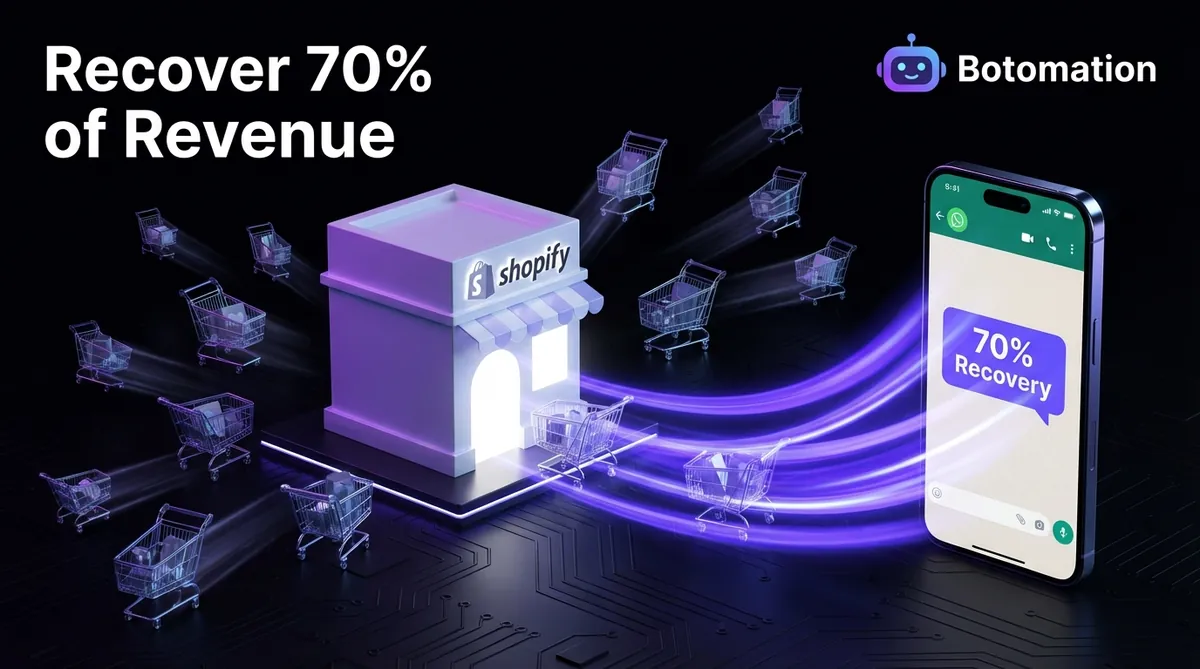
Abandoning a full shopping cart is the digital equivalent of a customer walking out of a physical store just as they reach the checkout counter. In the current e-commerce landscape of January 2026, this phenomenon is not just a minor leak; it is a massive breach in the revenue hull of most online businesses. Statistics consistently show that over 70% of shoppers abandon their carts before completing a purchase, representing trillions of dollars in global lost opportunity. While traditional recovery methods have leaned heavily on email sequences, the reality is that email inboxes have become digital graveyards where promotional messages are frequently ignored.
The shift toward whatsapp automation for cart abandonment shopify has fundamentally changed the economics for high-growth brands. While email recovery sequences typically struggle to exceed a 15% conversion rate, our team at Botomation has seen WhatsApp sequences consistently convert at 20% to 30%. You can see a full breakdown of these metrics in our WhatsApp vs email cart recovery guide. This is not just a marginal improvement; it is a transformative shift in how brands interact with their audience. For instance, brands like GymWear Co. have partnered with our experts to recover upwards of $40,000 per month in previously lost sales by meeting the customer exactly where they are already active.
In 2026, the tools at our disposal have evolved far beyond simple text reminders. With the latest WhatsApp Business API updates and the integration of sophisticated AI agents, we can now provide real-time, interactive experiences that resolve customer concerns the moment they arise. This WhatsApp abandoned cart recovery for Shopify guide provides a comprehensive look at how to implement these high-converting strategies to ensure your Shopify store stops leaving money on the table. By the time you finish reading, you will understand the technical, psychological, and strategic layers—much like those used in WhatsApp AI agents for B2B lead qualification—required to master cart recovery in the modern era.
What is WhatsApp Automation for Cart Abandonment Shopify and Why Does it Work?
The average cart abandonment rate across the e-commerce industry currently sits at a staggering 69.99%. To solve this, we must first understand that abandonment is rarely a sign of a lack of interest. Most shoppers use the cart as a "save for later" list or a way to calculate the final price including taxes and shipping. When the final total does not align with their expectations, or if the checkout process feels cumbersome, they simply close the tab. This is where traditional communication fails because it is too slow to engage the customer while they are still in a buying mindset.
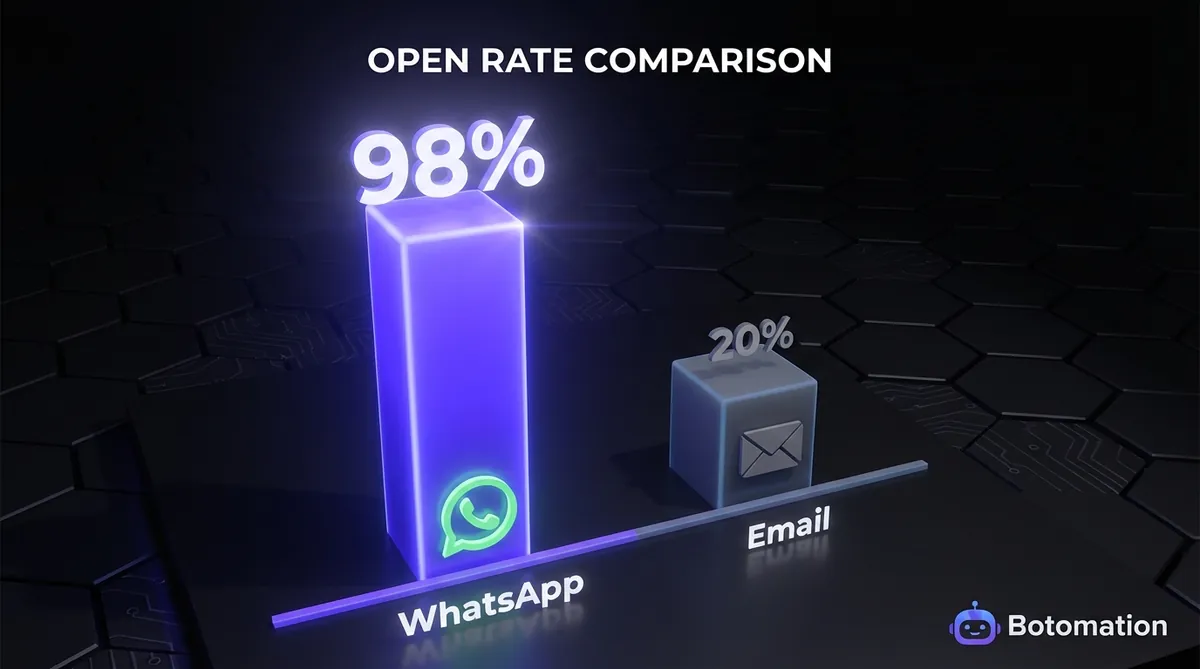
WhatsApp offers a 98% open rate, which stands in stark contrast to the 20% to 30% open rates seen in even the best-performing email campaigns. When a customer receives a WhatsApp message, it arrives in the same space where they communicate with friends and family, creating an immediate sense of urgency and personal connection. This direct channel allows our team to address the specific hesitations that lead to abandonment, whether that is a question about sizing or a concern about delivery times. Our experience shows that the psychology of a WhatsApp message feels less like a marketing blast and more like a helpful nudge from a shop assistant.
| Feature | WhatsApp Recovery (New Way) | Email Recovery (Old Way) |
|---|---|---|
| **Open Rate** | 98% | 20% - 30% |
| **Click-Through Rate** | 45% - 60% | 2% - 5% |
| **Average Recovery Rate** | 25% | 11% |
| **Customer Sentiment** | High Engagement / Personal | Low Engagement / Perceived as Spam |
| **Response Time** | Instant / Real-time | Hours or Days |
Understanding the Cart Abandonment Psychology
Data from 2026 indicates that 48% of users abandon their carts specifically due to unexpected shipping costs or hidden fees that appear only at the final stage. When a shopper sees an extra $15 added to a $50 order, the perceived value of the product drops instantly, leading to a quick exit. Another 24% of users leave because the store requires account creation, which adds unnecessary friction to what should be a seamless transaction. These are not technical errors but psychological barriers that require a human-centric solution to overcome.
WhatsApp's Advantages Over Traditional Recovery Methods
The speed of engagement on WhatsApp is its greatest competitive advantage. While an email might sit in a "Promotions" tab for six hours, most WhatsApp messages are read within three minutes of receipt. This allows us to catch the customer while the product is still fresh in their mind and the desire to purchase is at its peak. When you combine this with the fact that response rates on WhatsApp average between 45% and 60%, you have a tool that is not just a notification system but a conversation starter.
How to Set Up WhatsApp Automation for Cart Abandonment Shopify in 2026?
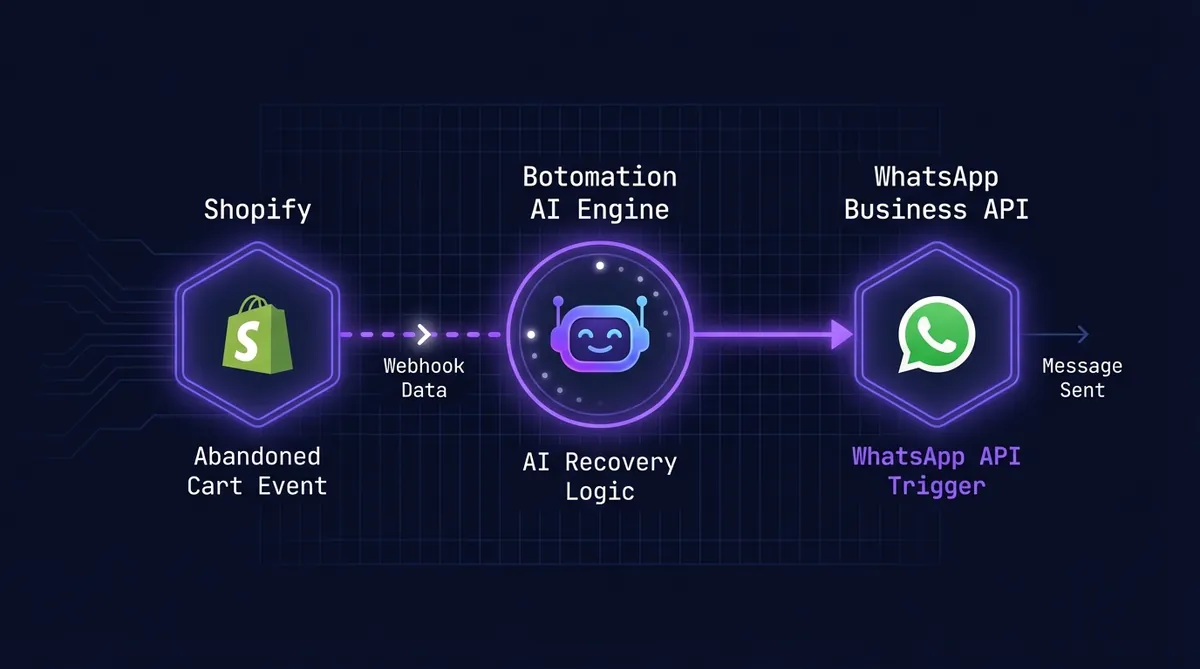
Implementing whatsapp automation for cart abandonment shopify requires moving beyond the standard consumer app and into the professional WhatsApp Business API. In 2026, the API introduced advanced features such as interactive buttons, list messages, and the ability to automate order tracking notifications with WhatsApp for Shopify, which allows for a much richer user experience. Setting up the whatsapp api for ecommerce cart abandonment recovery ensures that this technical foundation is handled correctly from the start. We focus on creating a deep integration that connects your Shopify backend directly to Meta's infrastructure, allowing for real-time data triggers that react the moment a cart is left behind.
The technical requirements for a successful integration involve configuring webhooks that listen for the checkout_started and checkout_completed events within Shopify. When a user enters their phone number but fails to complete the order within a set timeframe, the webhook triggers the recovery sequence. This setup must be compliant with Meta's strict commerce policies to avoid number flagging or shadow-banning.
WhatsApp Business API Configuration Steps
- Register your business number: You must use a clean, dedicated phone number that is not currently associated with a personal WhatsApp account.
- Setup in Facebook Business Manager: Create a developer account and link your WhatsApp Business Account (WABA) to your verified business manager.
- Create Message Templates: All proactive messages must be pre-approved by Meta. Our experts draft these templates to ensure they follow the 2026 guidelines for utility and marketing categories.
- Configure API Credentials: Generate permanent access tokens to allow your Shopify store to communicate securely with the WhatsApp API.
Shopify App Integration Process
Once the API is live, the focus shifts to the Shopify environment where the data resides. While choosing the right shopify app for whatsapp abandoned cart recovery is important, many off-the-shelf apps lack the flexibility needed for high-level personalization. Our approach involves mapping specific customer data fields—such as the cart total, specific product IDs, and the customer's first name—directly into the WhatsApp message payload. By utilizing a shopify whatsapp bot for abandoned cart recovery, store owners can ensure that every message sent is hyper-relevant to what the customer was actually viewing.
Compliance Requirements and Best Practices
Compliance is the foundation of any successful WhatsApp strategy. In 2026, obtaining explicit opt-in consent is not just a best practice; it is a legal requirement under frameworks like GDPR and CCPA. We implement opt-in mechanisms at multiple touchpoints, such as a checkbox on the checkout page or a "Subscribe for updates" button on the product page. This ensures that every message sent is welcomed, which keeps deliverability rates high and spam reports low.
Using Automated WhatsApp Messages for Checkout Recovery
The success of whatsapp automation for cart abandonment shopify hinges on the timing and content of the messages. In 2026, the "golden hour" remains the most critical window for recovery. The core of this strategy is automated whatsapp messages for checkout recovery sent 60 minutes after abandonment, which has a significantly higher chance of converting than one sent five hours later. Our team designs these sequences to feel like a helpful service rather than a sales pitch.
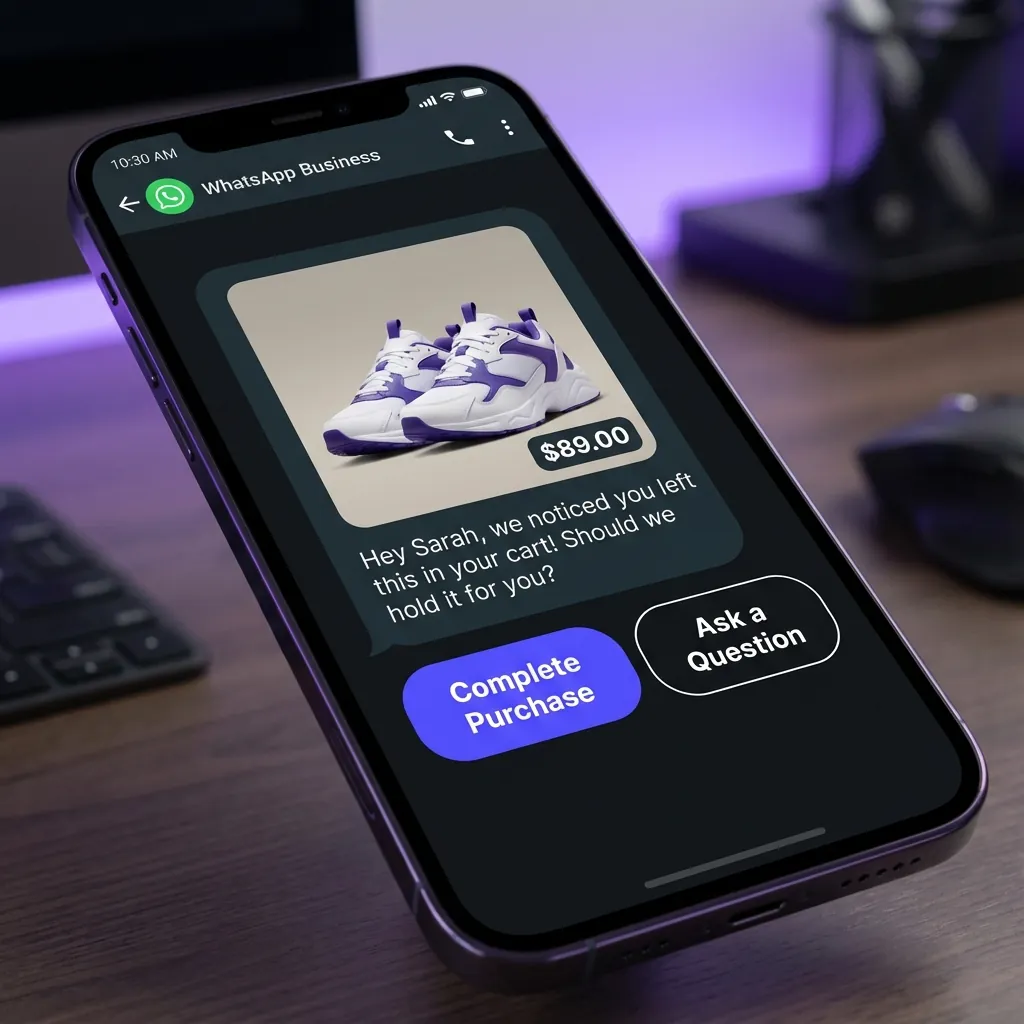
The first message should be a gentle reminder, perhaps framed as a "technical check-in" to see if something went wrong during checkout. If there is no response, a second message can be sent 24 hours later, offering a small incentive or highlighting a specific benefit of the product. The key is to use dynamic content insertion. Instead of saying "You left items in your cart," we send a message that says "Hey Sarah, we noticed you left the [Product Name] in your cart. Would you like us to hold it for you?" This level of specificity makes the message feel personal and hard to ignore.
Timing Strategies for Maximum Engagement
Our research into 2026 consumer behavior shows that mobile shoppers have shorter attention spans than desktop users. For mobile-heavy stores, we often recommend a shorter delay for the first message—sometimes as little as 30 minutes. Desktop users, who might be shopping during work hours, often respond better to a 2-hour delay. We analyze your specific traffic patterns to determine the optimal windows for your unique audience.
Message Templates That Drive Conversions
A high-converting template in 2026 must be visually engaging. You can find inspiration in our collection of 50+ WhatsApp abandoned cart message templates. We leverage the WhatsApp API's ability to send high-resolution product images and short video snippets within the recovery flow. Seeing the actual item they were considering—rendered beautifully—reignites the desire to own it. We also utilize "Quick Reply" buttons, allowing the customer to click "Complete Purchase" or "Ask a Question" without having to type a single word.
Best Practices for AI Chatbot to Recover Abandoned Shopping Carts Shopify
The "one size fits all" approach to marketing is obsolete. In 2026, customers expect personalization that reflects their specific relationship with a brand. Integrating an ai chatbot to recover abandoned shopping carts shopify provides a level of intelligence that standard messaging cannot match. By using customer data stored in Shopify, we can segment abandoned carts into different categories. A first-time visitor who abandons a $50 cart should receive a different message than a VIP customer who just walked away from a $300 order.
GymWear Co. provides a perfect example of this in action. By partnering with our team, they implemented a strategy where high-value carts (over $150) were automatically routed to a priority flow. These customers received a more personalized message that included a direct link to a VIP support agent who could answer questions in real-time. This single change improved their recovery rate by 23% in 2026 because the customers felt valued and prioritized.
Dynamic Content Personalization
Personalization goes far beyond just using the customer's first name. Our experts implement Shopify WhatsApp integration for product suggestions based on the specific items left in the cart. If a customer leaves a pair of running shoes, the WhatsApp message might also suggest matching moisture-wicking socks. This not only helps recover the original cart but often increases the Average Order Value (AOV) by providing relevant additions the customer might have missed.
Customer Segmentation for Targeted Recovery
Segmentation allows us to manage the frequency and tone of messages effectively. For new visitors, the tone is often educational and welcoming, focusing on brand trust and risk-free shopping. For repeat customers, the tone is more familiar and appreciative, acknowledging their loyalty. This prevents the "spammy" feeling that occurs when a long-term fan of a brand receives a generic, robotic message.
How to Measure the ROI of Your WhatsApp Recovery Strategy?
You cannot improve what you do not measure. In 2026, the analytics available through the WhatsApp Business API and Shopify integration provide a granular view of recovery performance. We track everything from delivery and read rates to the final conversion. However, the most important metric we focus on at Botomation is the "Net Revenue Recovered." This is the total value of recovered carts minus the cost of the WhatsApp messages and any discounts offered.
Key Performance Indicators for Cart Recovery
The primary KPI is the Cart Recovery Rate, defined as the percentage of abandoned checkouts that result in a completed order within 72 hours of the first message. In 2026, a healthy benchmark for WhatsApp recovery is between 20% and 35%. If your rate is below this, it usually indicates an issue with message timing or the clarity of your call-to-action.
Another critical metric is the Conversation Rate. Since WhatsApp is a two-way channel, we track how many customers reply to the automated messages. A high reply rate is a goldmine for customer insights. If 10% of your customers reply saying "shipping is too expensive," you have direct evidence that you need to adjust your shipping strategy. This two-way communication is why brands can reduce Shopify support tickets by 78% while providing direct insights and saving time.
Analytics Tools and Reporting Dashboards
Our team provides custom reporting dashboards that pull data from both the WhatsApp API and Shopify. This allows store owners to see the customer journey in its entirety. You can see exactly which message in a sequence triggered the purchase and which product categories have the highest recovery potential. This level of transparency ensures that every dollar spent on automation is justified by results.
Compliance and Privacy for WhatsApp Automation for Ecommerce Checkout Recovery
As we move through 2026, Meta has become increasingly strict about how businesses use the WhatsApp API. Mastering whatsapp automation for ecommerce checkout recovery requires a value-first approach to every automation we build. Maintaining a "High" quality rating on your phone number is essential for ensuring your messages actually reach the customer's inbox. If too many users report your messages as spam, Meta will throttle your sending limits or suspend your account entirely.
Privacy Laws and Data Protection
For brands selling in Europe or California, compliance is non-negotiable. We implement robust "Right to be Forgotten" protocols, where a customer can request that their data be deleted from the automation system at any time. We also ensure that no sensitive personal information is sent over the WhatsApp channel itself, keeping the conversation focused on the transaction and the products.
WhatsApp Policy Compliance
Meta's 2026 policy requires that all marketing messages have a clear opt-out option. We go a step further by making the opt-out process as frictionless as possible. If a customer wants to stop receiving messages, they should be able to do so with one click. Ironically, making it easy to leave increases customer trust and reduces the likelihood that they will report your message as spam.
Frequently Asked Questions
Is WhatsApp automation better than email for cart recovery?
Yes, in almost every measurable metric. While email is still useful for long-term nurturing, WhatsApp’s 98% open rate and 45%+ click-through rate make it the superior choice for time-sensitive tasks like cart recovery. Most customers in 2026 prefer the convenience of a quick message over a cluttered email inbox.
How much does it cost to implement WhatsApp automation?
The cost is divided into two parts: the Meta API fees (which are per-conversation) and the expert service fee for our team to build and manage the system. When compared to the revenue recovered—often tens of thousands of dollars per month—the ROI is typically much higher than any other marketing channel.
Will customers find WhatsApp messages intrusive?
Not if they are handled correctly. By obtaining proper opt-in consent and focusing on being helpful rather than sales-driven, most customers appreciate the reminder. Our data shows that when a message includes a helpful link or an answer to a common question, customer sentiment remains very high.
Can I use my existing personal WhatsApp number?
No, the WhatsApp Business API requires a dedicated number that is not linked to a personal account. This ensures your business communications remain professional and allows for the advanced automation features that are not available on the standard consumer app.
How long does it take to see results?
Most of our clients see recovered sales within the first 24 to 48 hours of the system going live. Because the automation reacts to real-time behavior, it begins capturing lost revenue immediately.
Partnering with the experts at Botomation is the most effective way to turn your abandoned carts into a consistent stream of revenue. While the "Old Way" of relying on ignored emails continues to fail, our high-performance WhatsApp integrations are helping Shopify stores dominate their markets. We handle the technical complexity, the compliance, and the strategic optimization—including WhatsApp automation for returns and exchanges—so that you can focus on scaling your brand.
The data is clear: recovering 20% to 30% of your lost carts can fundamentally change the trajectory of your business. In 2026, this is no longer an optional extra but a core requirement for any serious e-commerce operation. Stop letting your hard-earned traffic walk away at the finish line.
Ready to automate your growth? Book a call below.
Abandoning a full shopping cart is the digital equivalent of a customer walking out of a physical store just as they reach the checkout counter. In the current e-commerce landscape of January 2026, this phenomenon is not just a minor leak; it is a massive breach in the revenue hull of most online businesses. Statistics consistently show that over 70% of shoppers abandon their carts before completing a purchase, representing trillions of dollars in global lost opportunity. While traditional recovery methods have leaned heavily on email sequences, the reality is that email inboxes have become digital graveyards where promotional messages are frequently ignored.
The shift toward whatsapp automation for cart abandonment shopify has fundamentally changed the economics for high-growth brands. While email recovery sequences typically struggle to exceed a 15% conversion rate, our team at Botomation has seen WhatsApp sequences consistently convert at 20% to 30%. You can see a full breakdown of these metrics in our WhatsApp vs email cart recovery guide. This is not just a marginal improvement; it is a transformative shift in how brands interact with their audience. For instance, brands like GymWear Co. have partnered with our experts to recover upwards of $40,000 per month in previously lost sales by meeting the customer exactly where they are already active.
In 2026, the tools at our disposal have evolved far beyond simple text reminders. With the latest WhatsApp Business API updates and the integration of sophisticated AI agents, we can now provide real-time, interactive experiences that resolve customer concerns the moment they arise. This WhatsApp abandoned cart recovery for Shopify guide provides a comprehensive look at how to implement these high-converting strategies to ensure your Shopify store stops leaving money on the table. By the time you finish reading, you will understand the technical, psychological, and strategic layers—much like those used in WhatsApp AI agents for B2B lead qualification—required to master cart recovery in the modern era.
What is WhatsApp Automation for Cart Abandonment Shopify and Why Does it Work?
The average cart abandonment rate across the e-commerce industry currently sits at a staggering 69.99%. To solve this, we must first understand that abandonment is rarely a sign of a lack of interest. Most shoppers use the cart as a "save for later" list or a way to calculate the final price including taxes and shipping. When the final total does not align with their expectations, or if the checkout process feels cumbersome, they simply close the tab. This is where traditional communication fails because it is too slow to engage the customer while they are still in a buying mindset.
WhatsApp offers a 98% open rate, which stands in stark contrast to the 20% to 30% open rates seen in even the best-performing email campaigns. When a customer receives a WhatsApp message, it arrives in the same space where they communicate with friends and family, creating an immediate sense of urgency and personal connection. This direct channel allows our team to address the specific hesitations that lead to abandonment, whether that is a question about sizing or a concern about delivery times. Our experience shows that the psychology of a WhatsApp message feels less like a marketing blast and more like a helpful nudge from a shop assistant.
| Feature | WhatsApp Recovery (New Way) | Email Recovery (Old Way) |
|---|---|---|
| **Open Rate** | 98% | 20% - 30% |
| **Click-Through Rate** | 45% - 60% | 2% - 5% |
| **Average Recovery Rate** | 25% | 11% |
| **Customer Sentiment** | High Engagement / Personal | Low Engagement / Perceived as Spam |
| **Response Time** | Instant / Real-time | Hours or Days |
Understanding the Cart Abandonment Psychology
Data from 2026 indicates that 48% of users abandon their carts specifically due to unexpected shipping costs or hidden fees that appear only at the final stage. When a shopper sees an extra $15 added to a $50 order, the perceived value of the product drops instantly, leading to a quick exit. Another 24% of users leave because the store requires account creation, which adds unnecessary friction to what should be a seamless transaction. These are not technical errors but psychological barriers that require a human-centric solution to overcome.
WhatsApp's Advantages Over Traditional Recovery Methods
The speed of engagement on WhatsApp is its greatest competitive advantage. While an email might sit in a "Promotions" tab for six hours, most WhatsApp messages are read within three minutes of receipt. This allows us to catch the customer while the product is still fresh in their mind and the desire to purchase is at its peak. When you combine this with the fact that response rates on WhatsApp average between 45% and 60%, you have a tool that is not just a notification system but a conversation starter.
How to Set Up WhatsApp Automation for Cart Abandonment Shopify in 2026?
Implementing whatsapp automation for cart abandonment shopify requires moving beyond the standard consumer app and into the professional WhatsApp Business API. In 2026, the API introduced advanced features such as interactive buttons, list messages, and the ability to automate order tracking notifications with WhatsApp for Shopify, which allows for a much richer user experience. Setting up the whatsapp api for ecommerce cart abandonment recovery ensures that this technical foundation is handled correctly from the start. We focus on creating a deep integration that connects your Shopify backend directly to Meta's infrastructure, allowing for real-time data triggers that react the moment a cart is left behind.
The technical requirements for a successful integration involve configuring webhooks that listen for the checkout_started and checkout_completed events within Shopify. When a user enters their phone number but fails to complete the order within a set timeframe, the webhook triggers the recovery sequence. This setup must be compliant with Meta's strict commerce policies to avoid number flagging or shadow-banning.
WhatsApp Business API Configuration Steps
- Register your business number: You must use a clean, dedicated phone number that is not currently associated with a personal WhatsApp account.
- Setup in Facebook Business Manager: Create a developer account and link your WhatsApp Business Account (WABA) to your verified business manager.
- Create Message Templates: All proactive messages must be pre-approved by Meta. Our experts draft these templates to ensure they follow the 2026 guidelines for utility and marketing categories.
- Configure API Credentials: Generate permanent access tokens to allow your Shopify store to communicate securely with the WhatsApp API.
Shopify App Integration Process
Once the API is live, the focus shifts to the Shopify environment where the data resides. While choosing the right shopify app for whatsapp abandoned cart recovery is important, many off-the-shelf apps lack the flexibility needed for high-level personalization. Our approach involves mapping specific customer data fields—such as the cart total, specific product IDs, and the customer's first name—directly into the WhatsApp message payload. By utilizing a shopify whatsapp bot for abandoned cart recovery, store owners can ensure that every message sent is hyper-relevant to what the customer was actually viewing.
Compliance Requirements and Best Practices
Compliance is the foundation of any successful WhatsApp strategy. In 2026, obtaining explicit opt-in consent is not just a best practice; it is a legal requirement under frameworks like GDPR and CCPA. We implement opt-in mechanisms at multiple touchpoints, such as a checkbox on the checkout page or a "Subscribe for updates" button on the product page. This ensures that every message sent is welcomed, which keeps deliverability rates high and spam reports low.
Using Automated WhatsApp Messages for Checkout Recovery
The success of whatsapp automation for cart abandonment shopify hinges on the timing and content of the messages. In 2026, the "golden hour" remains the most critical window for recovery. The core of this strategy is automated whatsapp messages for checkout recovery sent 60 minutes after abandonment, which has a significantly higher chance of converting than one sent five hours later. Our team designs these sequences to feel like a helpful service rather than a sales pitch.
The first message should be a gentle reminder, perhaps framed as a "technical check-in" to see if something went wrong during checkout. If there is no response, a second message can be sent 24 hours later, offering a small incentive or highlighting a specific benefit of the product. The key is to use dynamic content insertion. Instead of saying "You left items in your cart," we send a message that says "Hey Sarah, we noticed you left the [Product Name] in your cart. Would you like us to hold it for you?" This level of specificity makes the message feel personal and hard to ignore.
Timing Strategies for Maximum Engagement
Our research into 2026 consumer behavior shows that mobile shoppers have shorter attention spans than desktop users. For mobile-heavy stores, we often recommend a shorter delay for the first message—sometimes as little as 30 minutes. Desktop users, who might be shopping during work hours, often respond better to a 2-hour delay. We analyze your specific traffic patterns to determine the optimal windows for your unique audience.
Message Templates That Drive Conversions
A high-converting template in 2026 must be visually engaging. You can find inspiration in our collection of 50+ WhatsApp abandoned cart message templates. We leverage the WhatsApp API's ability to send high-resolution product images and short video snippets within the recovery flow. Seeing the actual item they were considering—rendered beautifully—reignites the desire to own it. We also utilize "Quick Reply" buttons, allowing the customer to click "Complete Purchase" or "Ask a Question" without having to type a single word.
Best Practices for AI Chatbot to Recover Abandoned Shopping Carts Shopify
The "one size fits all" approach to marketing is obsolete. In 2026, customers expect personalization that reflects their specific relationship with a brand. Integrating an ai chatbot to recover abandoned shopping carts shopify provides a level of intelligence that standard messaging cannot match. By using customer data stored in Shopify, we can segment abandoned carts into different categories. A first-time visitor who abandons a $50 cart should receive a different message than a VIP customer who just walked away from a $300 order.
GymWear Co. provides a perfect example of this in action. By partnering with our team, they implemented a strategy where high-value carts (over $150) were automatically routed to a priority flow. These customers received a more personalized message that included a direct link to a VIP support agent who could answer questions in real-time. This single change improved their recovery rate by 23% in 2026 because the customers felt valued and prioritized.
Dynamic Content Personalization
Personalization goes far beyond just using the customer's first name. Our experts implement Shopify WhatsApp integration for product suggestions based on the specific items left in the cart. If a customer leaves a pair of running shoes, the WhatsApp message might also suggest matching moisture-wicking socks. This not only helps recover the original cart but often increases the Average Order Value (AOV) by providing relevant additions the customer might have missed.
Customer Segmentation for Targeted Recovery
Segmentation allows us to manage the frequency and tone of messages effectively. For new visitors, the tone is often educational and welcoming, focusing on brand trust and risk-free shopping. For repeat customers, the tone is more familiar and appreciative, acknowledging their loyalty. This prevents the "spammy" feeling that occurs when a long-term fan of a brand receives a generic, robotic message.
How to Measure the ROI of Your WhatsApp Recovery Strategy?
You cannot improve what you do not measure. In 2026, the analytics available through the WhatsApp Business API and Shopify integration provide a granular view of recovery performance. We track everything from delivery and read rates to the final conversion. However, the most important metric we focus on at Botomation is the "Net Revenue Recovered." This is the total value of recovered carts minus the cost of the WhatsApp messages and any discounts offered.
Key Performance Indicators for Cart Recovery
The primary KPI is the Cart Recovery Rate, defined as the percentage of abandoned checkouts that result in a completed order within 72 hours of the first message. In 2026, a healthy benchmark for WhatsApp recovery is between 20% and 35%. If your rate is below this, it usually indicates an issue with message timing or the clarity of your call-to-action.
Another critical metric is the Conversation Rate. Since WhatsApp is a two-way channel, we track how many customers reply to the automated messages. A high reply rate is a goldmine for customer insights. If 10% of your customers reply saying "shipping is too expensive," you have direct evidence that you need to adjust your shipping strategy. This two-way communication is why brands can reduce Shopify support tickets by 78% while providing direct insights and saving time.
Analytics Tools and Reporting Dashboards
Our team provides custom reporting dashboards that pull data from both the WhatsApp API and Shopify. This allows store owners to see the customer journey in its entirety. You can see exactly which message in a sequence triggered the purchase and which product categories have the highest recovery potential. This level of transparency ensures that every dollar spent on automation is justified by results.
Compliance and Privacy for WhatsApp Automation for Ecommerce Checkout Recovery
As we move through 2026, Meta has become increasingly strict about how businesses use the WhatsApp API. Mastering whatsapp automation for ecommerce checkout recovery requires a value-first approach to every automation we build. Maintaining a "High" quality rating on your phone number is essential for ensuring your messages actually reach the customer's inbox. If too many users report your messages as spam, Meta will throttle your sending limits or suspend your account entirely.
Privacy Laws and Data Protection
For brands selling in Europe or California, compliance is non-negotiable. We implement robust "Right to be Forgotten" protocols, where a customer can request that their data be deleted from the automation system at any time. We also ensure that no sensitive personal information is sent over the WhatsApp channel itself, keeping the conversation focused on the transaction and the products.
WhatsApp Policy Compliance
Meta's 2026 policy requires that all marketing messages have a clear opt-out option. We go a step further by making the opt-out process as frictionless as possible. If a customer wants to stop receiving messages, they should be able to do so with one click. Ironically, making it easy to leave increases customer trust and reduces the likelihood that they will report your message as spam.
Frequently Asked Questions
Is WhatsApp automation better than email for cart recovery?
Yes, in almost every measurable metric. While email is still useful for long-term nurturing, WhatsApp’s 98% open rate and 45%+ click-through rate make it the superior choice for time-sensitive tasks like cart recovery. Most customers in 2026 prefer the convenience of a quick message over a cluttered email inbox.
How much does it cost to implement WhatsApp automation?
The cost is divided into two parts: the Meta API fees (which are per-conversation) and the expert service fee for our team to build and manage the system. When compared to the revenue recovered—often tens of thousands of dollars per month—the ROI is typically much higher than any other marketing channel.
Will customers find WhatsApp messages intrusive?
Not if they are handled correctly. By obtaining proper opt-in consent and focusing on being helpful rather than sales-driven, most customers appreciate the reminder. Our data shows that when a message includes a helpful link or an answer to a common question, customer sentiment remains very high.
Can I use my existing personal WhatsApp number?
No, the WhatsApp Business API requires a dedicated number that is not linked to a personal account. This ensures your business communications remain professional and allows for the advanced automation features that are not available on the standard consumer app.
How long does it take to see results?
Most of our clients see recovered sales within the first 24 to 48 hours of the system going live. Because the automation reacts to real-time behavior, it begins capturing lost revenue immediately.
Partnering with the experts at Botomation is the most effective way to turn your abandoned carts into a consistent stream of revenue. While the "Old Way" of relying on ignored emails continues to fail, our high-performance WhatsApp integrations are helping Shopify stores dominate their markets. We handle the technical complexity, the compliance, and the strategic optimization—including WhatsApp automation for returns and exchanges—so that you can focus on scaling your brand.
The data is clear: recovering 20% to 30% of your lost carts can fundamentally change the trajectory of your business. In 2026, this is no longer an optional extra but a core requirement for any serious e-commerce operation. Stop letting your hard-earned traffic walk away at the finish line.
Ready to automate your growth? Book a call below.
Abandoning a full shopping cart is the digital equivalent of a customer walking out of a physical store just as they reach the checkout counter. In the current e-commerce landscape of January 2026, this phenomenon is not just a minor leak; it is a massive breach in the revenue hull of most online businesses. Statistics consistently show that over 70% of shoppers abandon their carts before completing a purchase, representing trillions of dollars in global lost opportunity. While traditional recovery methods have leaned heavily on email sequences, the reality is that email inboxes have become digital graveyards where promotional messages are frequently ignored.
The shift toward whatsapp automation for cart abandonment shopify has fundamentally changed the economics for high-growth brands. While email recovery sequences typically struggle to exceed a 15% conversion rate, our team at Botomation has seen WhatsApp sequences consistently convert at 20% to 30%. You can see a full breakdown of these metrics in our WhatsApp vs email cart recovery guide. This is not just a marginal improvement; it is a transformative shift in how brands interact with their audience. For instance, brands like GymWear Co. have partnered with our experts to recover upwards of $40,000 per month in previously lost sales by meeting the customer exactly where they are already active.
In 2026, the tools at our disposal have evolved far beyond simple text reminders. With the latest WhatsApp Business API updates and the integration of sophisticated AI agents, we can now provide real-time, interactive experiences that resolve customer concerns the moment they arise. This WhatsApp abandoned cart recovery for Shopify guide provides a comprehensive look at how to implement these high-converting strategies to ensure your Shopify store stops leaving money on the table. By the time you finish reading, you will understand the technical, psychological, and strategic layers—much like those used in WhatsApp AI agents for B2B lead qualification—required to master cart recovery in the modern era.
What is WhatsApp Automation for Cart Abandonment Shopify and Why Does it Work?
The average cart abandonment rate across the e-commerce industry currently sits at a staggering 69.99%. To solve this, we must first understand that abandonment is rarely a sign of a lack of interest. Most shoppers use the cart as a "save for later" list or a way to calculate the final price including taxes and shipping. When the final total does not align with their expectations, or if the checkout process feels cumbersome, they simply close the tab. This is where traditional communication fails because it is too slow to engage the customer while they are still in a buying mindset.
WhatsApp offers a 98% open rate, which stands in stark contrast to the 20% to 30% open rates seen in even the best-performing email campaigns. When a customer receives a WhatsApp message, it arrives in the same space where they communicate with friends and family, creating an immediate sense of urgency and personal connection. This direct channel allows our team to address the specific hesitations that lead to abandonment, whether that is a question about sizing or a concern about delivery times. Our experience shows that the psychology of a WhatsApp message feels less like a marketing blast and more like a helpful nudge from a shop assistant.
| Feature | WhatsApp Recovery (New Way) | Email Recovery (Old Way) |
|---|---|---|
| **Open Rate** | 98% | 20% - 30% |
| **Click-Through Rate** | 45% - 60% | 2% - 5% |
| **Average Recovery Rate** | 25% | 11% |
| **Customer Sentiment** | High Engagement / Personal | Low Engagement / Perceived as Spam |
| **Response Time** | Instant / Real-time | Hours or Days |
Understanding the Cart Abandonment Psychology
Data from 2026 indicates that 48% of users abandon their carts specifically due to unexpected shipping costs or hidden fees that appear only at the final stage. When a shopper sees an extra $15 added to a $50 order, the perceived value of the product drops instantly, leading to a quick exit. Another 24% of users leave because the store requires account creation, which adds unnecessary friction to what should be a seamless transaction. These are not technical errors but psychological barriers that require a human-centric solution to overcome.
WhatsApp's Advantages Over Traditional Recovery Methods
The speed of engagement on WhatsApp is its greatest competitive advantage. While an email might sit in a "Promotions" tab for six hours, most WhatsApp messages are read within three minutes of receipt. This allows us to catch the customer while the product is still fresh in their mind and the desire to purchase is at its peak. When you combine this with the fact that response rates on WhatsApp average between 45% and 60%, you have a tool that is not just a notification system but a conversation starter.
How to Set Up WhatsApp Automation for Cart Abandonment Shopify in 2026?
Implementing whatsapp automation for cart abandonment shopify requires moving beyond the standard consumer app and into the professional WhatsApp Business API. In 2026, the API introduced advanced features such as interactive buttons, list messages, and the ability to automate order tracking notifications with WhatsApp for Shopify, which allows for a much richer user experience. Setting up the whatsapp api for ecommerce cart abandonment recovery ensures that this technical foundation is handled correctly from the start. We focus on creating a deep integration that connects your Shopify backend directly to Meta's infrastructure, allowing for real-time data triggers that react the moment a cart is left behind.
The technical requirements for a successful integration involve configuring webhooks that listen for the checkout_started and checkout_completed events within Shopify. When a user enters their phone number but fails to complete the order within a set timeframe, the webhook triggers the recovery sequence. This setup must be compliant with Meta's strict commerce policies to avoid number flagging or shadow-banning.
WhatsApp Business API Configuration Steps
- Register your business number: You must use a clean, dedicated phone number that is not currently associated with a personal WhatsApp account.
- Setup in Facebook Business Manager: Create a developer account and link your WhatsApp Business Account (WABA) to your verified business manager.
- Create Message Templates: All proactive messages must be pre-approved by Meta. Our experts draft these templates to ensure they follow the 2026 guidelines for utility and marketing categories.
- Configure API Credentials: Generate permanent access tokens to allow your Shopify store to communicate securely with the WhatsApp API.
Shopify App Integration Process
Once the API is live, the focus shifts to the Shopify environment where the data resides. While choosing the right shopify app for whatsapp abandoned cart recovery is important, many off-the-shelf apps lack the flexibility needed for high-level personalization. Our approach involves mapping specific customer data fields—such as the cart total, specific product IDs, and the customer's first name—directly into the WhatsApp message payload. By utilizing a shopify whatsapp bot for abandoned cart recovery, store owners can ensure that every message sent is hyper-relevant to what the customer was actually viewing.
Compliance Requirements and Best Practices
Compliance is the foundation of any successful WhatsApp strategy. In 2026, obtaining explicit opt-in consent is not just a best practice; it is a legal requirement under frameworks like GDPR and CCPA. We implement opt-in mechanisms at multiple touchpoints, such as a checkbox on the checkout page or a "Subscribe for updates" button on the product page. This ensures that every message sent is welcomed, which keeps deliverability rates high and spam reports low.
Using Automated WhatsApp Messages for Checkout Recovery
The success of whatsapp automation for cart abandonment shopify hinges on the timing and content of the messages. In 2026, the "golden hour" remains the most critical window for recovery. The core of this strategy is automated whatsapp messages for checkout recovery sent 60 minutes after abandonment, which has a significantly higher chance of converting than one sent five hours later. Our team designs these sequences to feel like a helpful service rather than a sales pitch.
The first message should be a gentle reminder, perhaps framed as a "technical check-in" to see if something went wrong during checkout. If there is no response, a second message can be sent 24 hours later, offering a small incentive or highlighting a specific benefit of the product. The key is to use dynamic content insertion. Instead of saying "You left items in your cart," we send a message that says "Hey Sarah, we noticed you left the [Product Name] in your cart. Would you like us to hold it for you?" This level of specificity makes the message feel personal and hard to ignore.
Timing Strategies for Maximum Engagement
Our research into 2026 consumer behavior shows that mobile shoppers have shorter attention spans than desktop users. For mobile-heavy stores, we often recommend a shorter delay for the first message—sometimes as little as 30 minutes. Desktop users, who might be shopping during work hours, often respond better to a 2-hour delay. We analyze your specific traffic patterns to determine the optimal windows for your unique audience.
Message Templates That Drive Conversions
A high-converting template in 2026 must be visually engaging. You can find inspiration in our collection of 50+ WhatsApp abandoned cart message templates. We leverage the WhatsApp API's ability to send high-resolution product images and short video snippets within the recovery flow. Seeing the actual item they were considering—rendered beautifully—reignites the desire to own it. We also utilize "Quick Reply" buttons, allowing the customer to click "Complete Purchase" or "Ask a Question" without having to type a single word.
Best Practices for AI Chatbot to Recover Abandoned Shopping Carts Shopify
The "one size fits all" approach to marketing is obsolete. In 2026, customers expect personalization that reflects their specific relationship with a brand. Integrating an ai chatbot to recover abandoned shopping carts shopify provides a level of intelligence that standard messaging cannot match. By using customer data stored in Shopify, we can segment abandoned carts into different categories. A first-time visitor who abandons a $50 cart should receive a different message than a VIP customer who just walked away from a $300 order.
GymWear Co. provides a perfect example of this in action. By partnering with our team, they implemented a strategy where high-value carts (over $150) were automatically routed to a priority flow. These customers received a more personalized message that included a direct link to a VIP support agent who could answer questions in real-time. This single change improved their recovery rate by 23% in 2026 because the customers felt valued and prioritized.
Dynamic Content Personalization
Personalization goes far beyond just using the customer's first name. Our experts implement Shopify WhatsApp integration for product suggestions based on the specific items left in the cart. If a customer leaves a pair of running shoes, the WhatsApp message might also suggest matching moisture-wicking socks. This not only helps recover the original cart but often increases the Average Order Value (AOV) by providing relevant additions the customer might have missed.
Customer Segmentation for Targeted Recovery
Segmentation allows us to manage the frequency and tone of messages effectively. For new visitors, the tone is often educational and welcoming, focusing on brand trust and risk-free shopping. For repeat customers, the tone is more familiar and appreciative, acknowledging their loyalty. This prevents the "spammy" feeling that occurs when a long-term fan of a brand receives a generic, robotic message.
How to Measure the ROI of Your WhatsApp Recovery Strategy?
You cannot improve what you do not measure. In 2026, the analytics available through the WhatsApp Business API and Shopify integration provide a granular view of recovery performance. We track everything from delivery and read rates to the final conversion. However, the most important metric we focus on at Botomation is the "Net Revenue Recovered." This is the total value of recovered carts minus the cost of the WhatsApp messages and any discounts offered.
Key Performance Indicators for Cart Recovery
The primary KPI is the Cart Recovery Rate, defined as the percentage of abandoned checkouts that result in a completed order within 72 hours of the first message. In 2026, a healthy benchmark for WhatsApp recovery is between 20% and 35%. If your rate is below this, it usually indicates an issue with message timing or the clarity of your call-to-action.
Another critical metric is the Conversation Rate. Since WhatsApp is a two-way channel, we track how many customers reply to the automated messages. A high reply rate is a goldmine for customer insights. If 10% of your customers reply saying "shipping is too expensive," you have direct evidence that you need to adjust your shipping strategy. This two-way communication is why brands can reduce Shopify support tickets by 78% while providing direct insights and saving time.
Analytics Tools and Reporting Dashboards
Our team provides custom reporting dashboards that pull data from both the WhatsApp API and Shopify. This allows store owners to see the customer journey in its entirety. You can see exactly which message in a sequence triggered the purchase and which product categories have the highest recovery potential. This level of transparency ensures that every dollar spent on automation is justified by results.
Compliance and Privacy for WhatsApp Automation for Ecommerce Checkout Recovery
As we move through 2026, Meta has become increasingly strict about how businesses use the WhatsApp API. Mastering whatsapp automation for ecommerce checkout recovery requires a value-first approach to every automation we build. Maintaining a "High" quality rating on your phone number is essential for ensuring your messages actually reach the customer's inbox. If too many users report your messages as spam, Meta will throttle your sending limits or suspend your account entirely.
Privacy Laws and Data Protection
For brands selling in Europe or California, compliance is non-negotiable. We implement robust "Right to be Forgotten" protocols, where a customer can request that their data be deleted from the automation system at any time. We also ensure that no sensitive personal information is sent over the WhatsApp channel itself, keeping the conversation focused on the transaction and the products.
WhatsApp Policy Compliance
Meta's 2026 policy requires that all marketing messages have a clear opt-out option. We go a step further by making the opt-out process as frictionless as possible. If a customer wants to stop receiving messages, they should be able to do so with one click. Ironically, making it easy to leave increases customer trust and reduces the likelihood that they will report your message as spam.
Frequently Asked Questions
Is WhatsApp automation better than email for cart recovery?
Yes, in almost every measurable metric. While email is still useful for long-term nurturing, WhatsApp’s 98% open rate and 45%+ click-through rate make it the superior choice for time-sensitive tasks like cart recovery. Most customers in 2026 prefer the convenience of a quick message over a cluttered email inbox.
How much does it cost to implement WhatsApp automation?
The cost is divided into two parts: the Meta API fees (which are per-conversation) and the expert service fee for our team to build and manage the system. When compared to the revenue recovered—often tens of thousands of dollars per month—the ROI is typically much higher than any other marketing channel.
Will customers find WhatsApp messages intrusive?
Not if they are handled correctly. By obtaining proper opt-in consent and focusing on being helpful rather than sales-driven, most customers appreciate the reminder. Our data shows that when a message includes a helpful link or an answer to a common question, customer sentiment remains very high.
Can I use my existing personal WhatsApp number?
No, the WhatsApp Business API requires a dedicated number that is not linked to a personal account. This ensures your business communications remain professional and allows for the advanced automation features that are not available on the standard consumer app.
How long does it take to see results?
Most of our clients see recovered sales within the first 24 to 48 hours of the system going live. Because the automation reacts to real-time behavior, it begins capturing lost revenue immediately.
Partnering with the experts at Botomation is the most effective way to turn your abandoned carts into a consistent stream of revenue. While the "Old Way" of relying on ignored emails continues to fail, our high-performance WhatsApp integrations are helping Shopify stores dominate their markets. We handle the technical complexity, the compliance, and the strategic optimization—including WhatsApp automation for returns and exchanges—so that you can focus on scaling your brand.
The data is clear: recovering 20% to 30% of your lost carts can fundamentally change the trajectory of your business. In 2026, this is no longer an optional extra but a core requirement for any serious e-commerce operation. Stop letting your hard-earned traffic walk away at the finish line.
Ready to automate your growth? Book a call below.
Get Started
Book a FREE Consultation Right NOW!
Schedule a Call with Our Team To Make Your Business More Efficient with AI Instantly.
Read More
Recover 70% of Abandoned Carts on Shopify with WhatsApp Automation
Learn how to use WhatsApp automation for cart abandonment on Shopify to recover 70% of lost sales. Step-by-step guide with templates and best practices.
Replace Legacy Systems with Custom Web Development in 2026
Learn how WhatsApp AI slashes support costs for e-commerce & SaaS. Proven strategies to boost sales, recover carts, and scale 24/7 service.