High-Converting Custom E-Commerce Websites for Marketing Teams 2026
Jan 7, 2026
E-commerce
AI Automation
Marketing ROI
E-commerce
AI Automation
Marketing ROI

By January 2026, marketing teams face a landscape where the cost of customer acquisition has reached an all-time high, making destination efficiency more critical than traffic volume. A custom e-commerce website is no longer a luxury for brands aiming to scale; it is a foundational requirement for maintaining a healthy marketing ROI. When every millisecond of latency or friction point in a checkout flow results in a measurable drop in revenue, the "good enough" approach of using bloated templates and generic plugins becomes a significant liability. Our team at Botomation has observed that marketing directors who shift away from off-the-shelf solutions toward precision-engineered custom builds see a transformative impact on their bottom line.
The relationship between a high-converting site and marketing ROI is direct and unforgiving. If your marketing team spends $50,000 on a Meta or Google Ads campaign, a conversion rate increase from 2% to 3% represents a 50% increase in revenue for the exact same ad spend. In late 2026, achieving these gains requires more than just an attractive layout; it demands deep integration of performance, psychology, and technical SEO. This article explores how a custom e-commerce website, built specifically for the needs of modern marketing teams, serves as the ultimate engine for growth and customer retention.
Why a Custom E-Commerce Website is Essential for ROI?
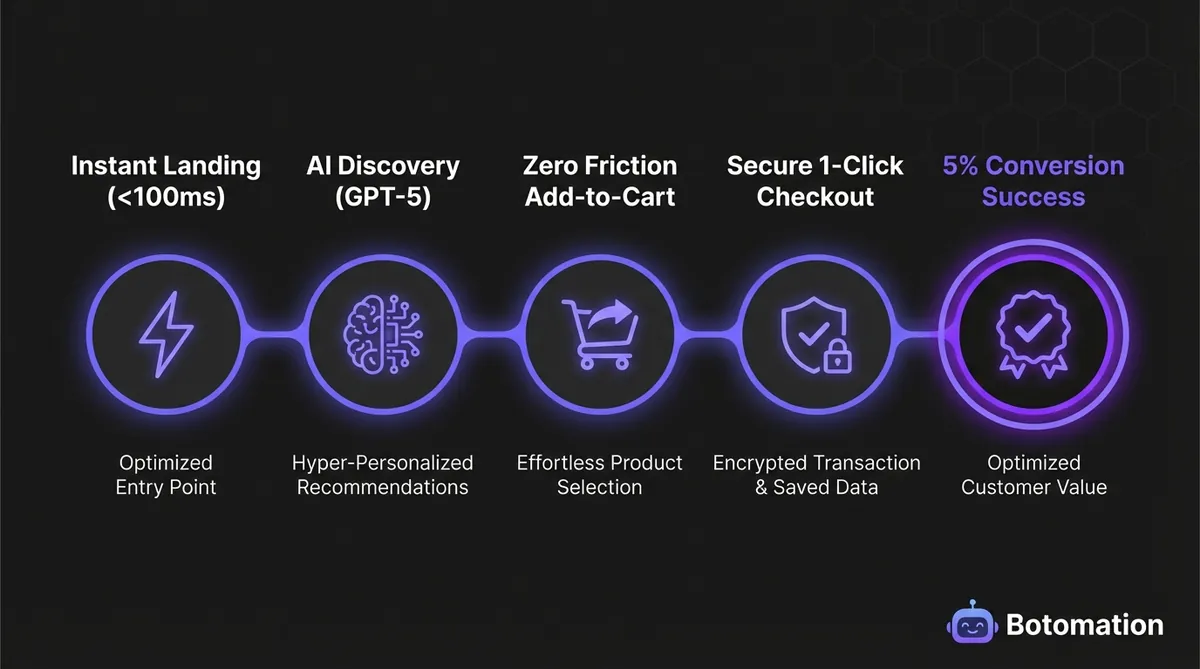
A high-converting e-commerce website is characterized by its ability to guide a visitor from discovery to purchase with zero cognitive friction. In the current market, "high-converting" refers to a site architecture that anticipates user needs and responds instantly. We define these sites by their lean code, intuitive navigation, and the psychological cues that build immediate trust. For marketing teams, the ability to control every pixel and data point is the difference between a campaign that barely breaks even and one that scales profitably.
Custom e-commerce development plays a pivotal role in this success by removing the limitations imposed by "all-in-one" platforms. While those platforms offer convenience, they often include thousands of lines of unused code that degrade the user experience, highlighting the stark performance gap between custom sites and WordPress. By choosing a custom e-commerce website, you ensure that every feature on the page serves a specific business goal. Recent 2026 industry data indicates that B2B e-commerce sites utilizing custom, headless architectures are seeing conversion rates climb toward 5%, while competitors on standard templates struggle to remain above 2%.
Characteristics of High Converters
The most successful e-commerce sites share non-negotiable traits that prioritize the user's time and attention. First is the concept of "perceived performance," where the site feels instantaneous even during complex background data processing. This involves optimizing the critical rendering path so that essential elements—like product images and calls to action—appear first. When a user lands on a product page, they should never wait for a spinning loader to see the price or the "Add to Cart" button.
Beyond speed, high-converting sites master micro-interactions. These are the subtle animations or feedback loops that confirm a user's action was successful, such as a subtle glow when a coupon is applied or a smooth slide-in for a mini-cart. These elements reduce the "abandonment anxiety" that often occurs during checkout. We analyze performance metrics like the "Conversion-to-Load-Time Ratio," which shows a sharp decline in sales for every 100ms of delay. A custom build allows our experts to shave off the milliseconds that generic themes simply cannot reach.
Custom Development Benefits
For a marketing team, the primary benefit of custom website development is the total freedom to experiment and integrate. Marketing directors often find themselves hamstrung by platform limitations when launching a new landing page or a complex promotional offer. With a custom e-commerce website, the site architecture is designed as a flexible tool for marketing, not a hurdle for IT. This means you can integrate GPT-5 powered recommendation engines or advanced visual assets without worrying about breaking a fragile third-party theme.
Integration with the modern marketing stack is another area where custom builds excel. Instead of relying on buggy plugins to connect your store to your CRM, a custom build uses clean API connections. This ensures that data flows accurately and in real-time, allowing for hyper-personalized marketing campaigns based on actual user behavior. When your website is hand-coded, you are building a proprietary asset that evolves alongside your marketing strategy.
| Feature | The "Old Way" (Bloated Templates) | The "New Way" (Botomation Custom) |
|---|---|---|
| **Page Speed Score** | 30-60 (Red/Orange) | 100/100 (Perfect Green) |
| **Development Time** | 4-8 Weeks for "Setup" | 5 Days from Concept to Live |
| **SEO Performance** | Limited by Theme Structure | Built-in Technical SEO Excellence |
| **Mobile Experience** | "Responsive" but Clunky | Mobile-First Precision |
| **Security** | Vulnerable to Plugin Exploits | Hand-Coded, Hardened Security |
How Does a Custom E-Commerce Website Improve Conversion Rates?
Design in 2026 is less about decoration and more about directing human behavior. A custom e-commerce website allows for a surgical application of User Experience (UX) principles that guide the eye exactly where the marketing team intends. We focus on mobile-first web development, recognizing that over 75% of e-commerce transactions now occur on handheld devices. A custom design ensures that the mobile interface is a bespoke experience tailored for thumb-driven navigation and quick decision-making.
One of our recent case studies involved a mid-market apparel brand struggling with a 65% mobile bounce rate on their WordPress store. By migrating them to a custom-coded environment with a streamlined UI, we achieved a 40% increase in conversions within the first 30 days. The change was not merely aesthetic; we restructured the entire user flow to remove three unnecessary steps from the checkout process. This level of optimization is only possible when you have full control over the underlying code.
UX Best Practices
Effective navigation is the backbone of any high-performing e-commerce site. We implement conversion-focused web design through "predictive navigation" models where the site learns from common user paths to highlight categories or products most likely to interest the visitor. This reduces search time and increases consideration time. Visual hierarchy also plays a critical role; we use size, color, and placement to ensure the primary call to action (CTA) is always the most prominent element without being intrusive.
User flow optimization involves identifying and removing "dead ends" in the customer journey. For example, if a product is out of stock, the custom e-commerce website should not just show a "Sold Out" badge; it should immediately offer a "Notify Me" option or suggest a related alternative. By anticipating these friction points, we keep the user engaged with the brand. Our experts design these flows to be invisible to the user, creating a sense of ease that leads naturally to a completed transaction.
Conversion-Optimized Elements
Specific page elements can make or break a sale. We prioritize marketing conversion optimization via "high-intent" design components, such as sticky "Add to Cart" bars that remain visible as a user scrolls through long product descriptions. This ensures the button is available the moment a customer decides to buy. We also utilize dynamic social proof elements that show real-time data, such as "14 people bought this in the last hour," creating a subtle but effective sense of urgency.
Testing and optimization are continuous processes in custom development. Unlike static themes, our custom builds allow marketing teams to run granular A/B tests on everything from button colors to font sizes without needing a developer for every minor change. By analyzing heatmaps and session recordings, we can identify where users hesitate and adjust the design in real-time. This iterative approach ensures that the custom e-commerce website consistently improves its performance.
Performance Optimization for E-Commerce Success
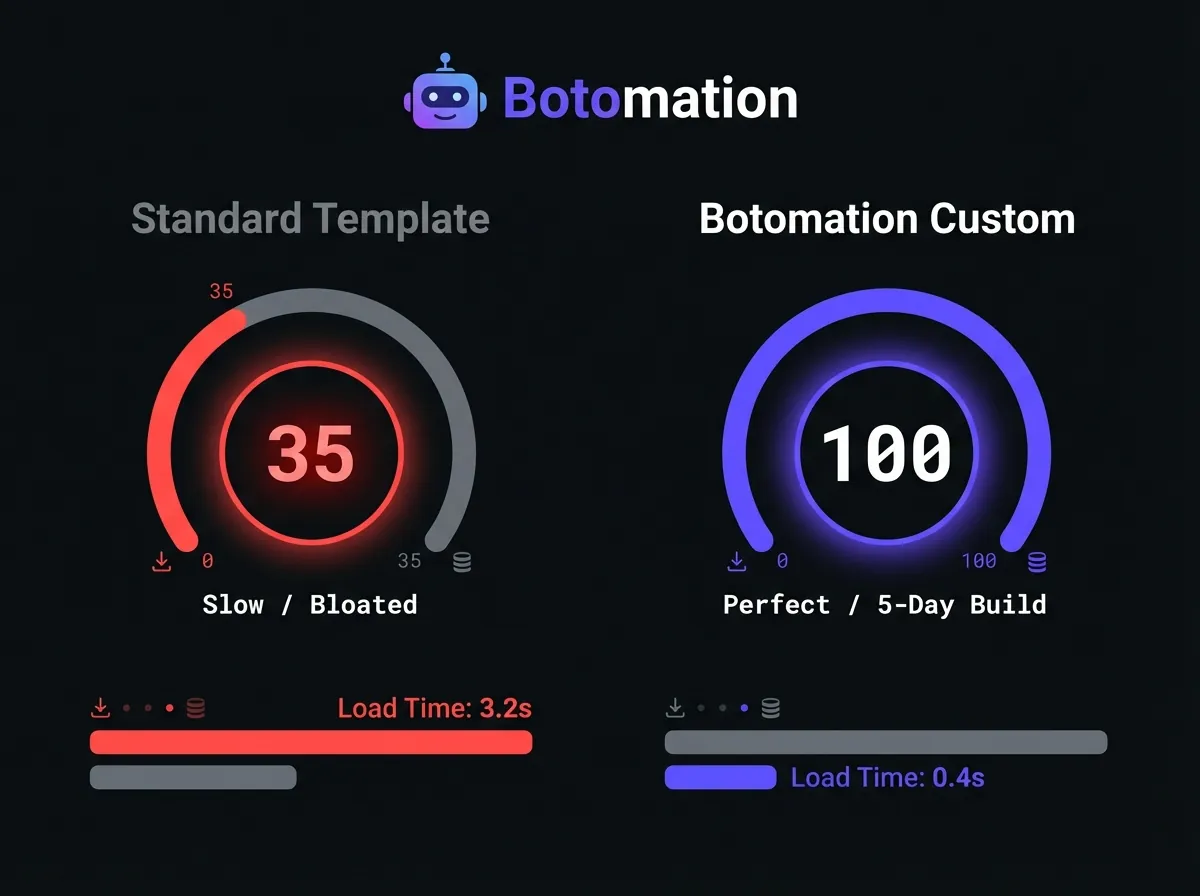
In 2026, speed is a fundamental pillar of customer service. A custom e-commerce website that loads in under a second signals that the brand is professional and respects the customer's time. Google’s Core Web Vitals are the gold standard for measuring this, and failing to meet these benchmarks is essentially a self-imposed penalty on search rankings and conversion rates. Our team at Botomation follows a proven 7-step process for fast loading custom websites and specializes in custom web development for 100 PageSpeed scores by eliminating the "bloat" that plagues modern web development.
Expert Insight: "A one-second delay in page load time can lead to a 7% reduction in conversions. For a site doing $100,000 a month, that’s $84,000 in lost revenue every year just because of a slow server or unoptimized images."
The impact of page speed on customer behavior is psychological. When a page loads instantly, the user enters a "flow state" where they are more likely to browse multiple products. Conversely, even a two-second delay breaks that concentration, giving the user time to reconsider the purchase or get distracted. By partnering with us, marketing teams ensure their site is the fastest in their niche, providing a competitive advantage that cannot be bought through ad spend alone.
What are the Benefits of Website Performance Optimization?
We achieve industry-leading speeds through advanced website performance optimization techniques like Server-Side Rendering (SSR) and Edge Computing. By generating the page on the server and delivering it via a global network of content delivery networks (CDNs), we ensure customers worldwide experience lightning-fast load times. We also implement "lazy loading" for media, meaning the browser only downloads content as the user views it, significantly reducing the initial data transfer.
Tools for tracking speed are integrated directly into our custom builds. We monitor "Real User Metrics" (RUM) to see how the site performs across different devices and network conditions. If a specific region experiences slower load times, our system alerts us to optimize routing or assets for that demographic. This proactive approach to performance is what separates a professional custom e-commerce website from a DIY solution.
Speed and Conversion Relationship
The data is clear: faster sites generate higher revenue. We have seen instances where improving a site's Largest Contentful Paint (LCP) by just 500ms resulted in a 12% increase in average order value (AOV). This occurs because users feel more confident exploring a responsive site. They are more likely to engage with "Frequently Bought Together" sections if those elements appear instantly rather than lagging behind.
Consider a scenario where your marketing team runs a high-traffic flash sale. A standard WordPress or Shopify site might buckle under the sudden influx, leading to slow response times. A hand-coded custom build from Botomation is designed to handle these peaks with ease. By using scalable cloud infrastructure and optimized database queries, we ensure your site remains stable during your most successful promotions. This reliability is essential for maintaining brand reputation during high-stakes marketing events.
Security and Trust Elements in Custom E-Commerce
Security is a silent driver of conversions. If a customer hesitates about the safety of their data, they will abandon their cart instantly. A custom e-commerce website allows for a higher level of security than platforms relying on dozens of third-party plugins. Each plugin in a standard setup is a potential backdoor; by hand-coding the site, we eliminate these vulnerabilities and provide a hardened environment for your business and customer data.
Compliance with standards like PCI-DSS and GDPR is both a legal requirement and a marketing asset. In 2026, consumers are more aware of data privacy than ever. By building a site that exceeds these standards, you can use your security posture as a selling point. Our experts integrate "security by design," ensuring that data encryption and secure payment processing are baked into the core of the site, building a foundation of trust that allows your marketing team to focus on growth.
Security Best Practices
We implement multi-layered security protocols, starting with high-level SSL certificates and extending to advanced fraud detection algorithms. A custom build allows us to integrate directly with payment gateways like Stripe or Adyen using their most secure API methods, ensuring sensitive payment data never touches your server. This "tokenization" of data significantly reduces your compliance burden and protects you from the fallout of a data breach.
Data encryption extends to all user data, including email addresses and browsing history. We also implement strict Content Security Policies (CSP) that prevent unauthorized scripts from running, protecting customers from "skimming" attacks common on less secure platforms. For a marketing director, this peace of mind is invaluable, as a single security incident can destroy years of brand-building effort.
Building Customer Trust
Beyond the technical backend, trust is built through visible cues. We strategically place trust badges at critical decision points like the checkout page. However, in 2026, authentic trust signals—such as verified customer reviews with photos and videos—are more effective than generic badges. A custom e-commerce website allows us to style these reviews as a natural part of the brand experience.
Transparency is another key trust builder. We ensure shipping costs, return policies, and contact information are always easy to find. Nothing kills a conversion faster than a hidden fee at the final checkout step. By designing a clear and honest user interface, we help your brand build long-term relationships. When people trust that their data is safe and the brand is transparent, they become loyal advocates for your business.
SEO and Marketing Integration for E-Commerce
For an SEO specialist, a custom e-commerce website is an ideal asset. Most platforms have rigid URL structures or locked header tags that complicate keyword optimization. With a custom build, every aspect of the site's architecture is search-engine friendly. We create clean, logical URL paths and ensure the site's "crawl budget" is used efficiently by preventing search engines from getting lost in duplicate content.
Technical SEO is the foundation of organic growth, which is why we build SEO-friendly websites from scratch. In 2026, Google’s algorithms prioritize sites providing a superior technical experience, including perfect mobile-friendly scores and properly implemented structured data. Effectively managing SEO for marketing directors means providing a platform that ranks without constant manual fixes. By hand-coding these elements, we give your site a head start in the rankings. We have helped brands move from page five to page one by outperforming WordPress SEO and fixing the technical debt inherent in "off-the-shelf" solutions.
Technical SEO for E-Commerce
Product schema and structured data are essential for appearing in Rich Snippets and Google Shopping results. Our custom builds automatically generate this code for every product, ensuring prices, availability, and review stars show up directly in search results. This increases the click-through rate (CTR) from the search engine results page (SERP). We also optimize internal linking, ensuring your most important "pillar" pages receive the most authority.
Site architecture is another area where custom development excels. We build "flat" architectures where any product is no more than three clicks from the homepage. This makes it easy for both users and search bots to index your content. We also implement advanced image optimization using Next-Gen formats like WebP or AVIF, and ensure all images have descriptive alt-tags. These technical details provide a massive advantage in a competitive search landscape.
Marketing Automation Integration
A custom e-commerce website acts as the central hub for your marketing ecosystem. Instead of using generic connectors, we build direct integrations with your marketing automation tools. This allows for sophisticated triggers; for example, if a high-value customer views a category three times without buying, the site can automatically trigger a personalized email with a targeted discount. This level of behavioral marketing drives high lifetime value (LTV).
Personalization in 2026 involves changing the website experience based on the visitor. A custom build can show different homepage banners, recommendations, and pricing based on past behavior or acquisition source. If a user arrives from a luxury-focused influencer's link, the site can instantly adapt to show premium branding. This seamless integration between the ad and the site experience is the "New Way" of e-commerce that our team delivers.
Analytics and Conversion Tracking
You cannot improve what you cannot measure. For marketing directors, accurate data is the lifeblood of strategy. A custom e-commerce website allows for "clean-room" analytics, where we track interactions without data being skewed by bot traffic. We integrate advanced server-side tracking, which is essential as browser-based cookies are increasingly blocked. This ensures your conversion data is 100% accurate, allowing for confident decisions about ad spend.
Key metrics like Customer Acquisition Cost (CAC), Lifetime Value (LTV), and Return on Ad Spend (ROAS) are displayed in a custom dashboard tailored to your team's needs. Instead of digging through complex generic analytics, we provide a streamlined view of the data that matters. This allows your marketing team to see the immediate impact of campaigns and adjust strategy in real-time. Our experts ensure every dollar spent is accounted for and every conversion is correctly attributed.
Performance Tracking Tools
We go beyond basic pageview tracking. Our custom builds include event-based tracking that monitors specific actions, such as scroll depth, image clicks, and mouse hovers. This granular data provides deep insights into user intent and friction points. We also implement error tracking that alerts us if a user encounters a broken link or payment failure, allowing us to resolve issues before they impact more customers.
Setting up conversion tracking correctly is a common challenge for marketing teams. Many sites double-count conversions or miss them entirely. By using server-side hooks, we ensure a conversion is only recorded when a transaction is successfully processed in the database. This "single source of truth" gives your marketing team the confidence to scale budgets, knowing the ROI they see is accurate.
A/B Testing for E-Commerce
A/B testing is the engine of continuous improvement. In a custom e-commerce website, we can test radical changes to the user flow that would be impossible in a standard template. For example, we might test a single-page checkout versus a multi-step checkout to see which performs better for your specific audience. Because the site is hand-coded, these tests are easy to implement and do not slow down the site.
Analyzing and implementing test results is a collaborative process between our experts and your marketing team. We don't just look at which version "won"; we look at why it won and how that insight applies to other areas. This scientific approach to conversion rate optimization (CRO) ensures your site is always improving. Over a year, small 1% improvements can compound into a massive increase in total revenue.
Summary of Success
Building a high-converting custom e-commerce website in 2026 is about creating a high-performance vehicle for your marketing strategy. By focusing on the "New Way"—hand-coded precision, 100/100 PageSpeed scores, and deep marketing integration—you move away from the slow, bloated, and vulnerable "Old Way" of template-based sites. The result is a site that actively works to increase your ROAS, lower your CAC, and build lasting customer trust.
Partnering with Botomation means you are getting a dedicated team that understands the intersection of technology and marketing. We deliver custom websites in 5 days, ensuring you don't lose momentum in a fast-moving market. If your current site is a bottleneck for growth, it’s time to upgrade to a solution built to win.
Frequently Asked Questions
Why is a custom e-commerce website better than Shopify or WordPress?
While platforms like Shopify or WordPress are easy to start with, they are built to be "everything to everyone." This results in massive amounts of unused code (bloat) that slows down your site and hurts your SEO. A custom e-commerce website from Botomation is hand-coded to include only what you need, resulting in 100/100 PageSpeed scores and a significantly higher conversion rate.
How can you build a custom site in only 5 days?
Our team of senior developers has refined a proprietary workflow that allows us to move from concept to live deployment with extreme efficiency. We don't waste time fighting with buggy plugins or heavy themes; we write clean, purposeful code from the ground up. This rapid turnaround allows marketing teams to launch new brands or pivot strategies without months-long development cycles.
Will a custom site be harder for my marketing team to manage?
Actually, it’s easier. We build custom admin interfaces tailored specifically to your workflow. You won't have to navigate through hundreds of irrelevant settings; you'll have exactly the tools you need to update products, manage content, and view analytics. We build the site to serve your team, not the other way around.
What is the real cost of a slow-loading website?
Beyond user frustration, a slow site directly increases ad costs. Google and Meta penalize slow sites with lower Quality Scores, meaning you pay more for every click. When you combine higher ad costs with a lower conversion rate, a slow site can cost a mid-sized business hundreds of thousands of dollars in lost profit annually.
Ready to automate your growth? Stop losing money on bloated, slow websites and start crushing your competition with a high-performance custom build. Book a free consultation call below.
By January 2026, marketing teams face a landscape where the cost of customer acquisition has reached an all-time high, making destination efficiency more critical than traffic volume. A custom e-commerce website is no longer a luxury for brands aiming to scale; it is a foundational requirement for maintaining a healthy marketing ROI. When every millisecond of latency or friction point in a checkout flow results in a measurable drop in revenue, the "good enough" approach of using bloated templates and generic plugins becomes a significant liability. Our team at Botomation has observed that marketing directors who shift away from off-the-shelf solutions toward precision-engineered custom builds see a transformative impact on their bottom line.
The relationship between a high-converting site and marketing ROI is direct and unforgiving. If your marketing team spends $50,000 on a Meta or Google Ads campaign, a conversion rate increase from 2% to 3% represents a 50% increase in revenue for the exact same ad spend. In late 2026, achieving these gains requires more than just an attractive layout; it demands deep integration of performance, psychology, and technical SEO. This article explores how a custom e-commerce website, built specifically for the needs of modern marketing teams, serves as the ultimate engine for growth and customer retention.
Why a Custom E-Commerce Website is Essential for ROI?
A high-converting e-commerce website is characterized by its ability to guide a visitor from discovery to purchase with zero cognitive friction. In the current market, "high-converting" refers to a site architecture that anticipates user needs and responds instantly. We define these sites by their lean code, intuitive navigation, and the psychological cues that build immediate trust. For marketing teams, the ability to control every pixel and data point is the difference between a campaign that barely breaks even and one that scales profitably.
Custom e-commerce development plays a pivotal role in this success by removing the limitations imposed by "all-in-one" platforms. While those platforms offer convenience, they often include thousands of lines of unused code that degrade the user experience, highlighting the stark performance gap between custom sites and WordPress. By choosing a custom e-commerce website, you ensure that every feature on the page serves a specific business goal. Recent 2026 industry data indicates that B2B e-commerce sites utilizing custom, headless architectures are seeing conversion rates climb toward 5%, while competitors on standard templates struggle to remain above 2%.
Characteristics of High Converters
The most successful e-commerce sites share non-negotiable traits that prioritize the user's time and attention. First is the concept of "perceived performance," where the site feels instantaneous even during complex background data processing. This involves optimizing the critical rendering path so that essential elements—like product images and calls to action—appear first. When a user lands on a product page, they should never wait for a spinning loader to see the price or the "Add to Cart" button.
Beyond speed, high-converting sites master micro-interactions. These are the subtle animations or feedback loops that confirm a user's action was successful, such as a subtle glow when a coupon is applied or a smooth slide-in for a mini-cart. These elements reduce the "abandonment anxiety" that often occurs during checkout. We analyze performance metrics like the "Conversion-to-Load-Time Ratio," which shows a sharp decline in sales for every 100ms of delay. A custom build allows our experts to shave off the milliseconds that generic themes simply cannot reach.
Custom Development Benefits
For a marketing team, the primary benefit of custom website development is the total freedom to experiment and integrate. Marketing directors often find themselves hamstrung by platform limitations when launching a new landing page or a complex promotional offer. With a custom e-commerce website, the site architecture is designed as a flexible tool for marketing, not a hurdle for IT. This means you can integrate GPT-5 powered recommendation engines or advanced visual assets without worrying about breaking a fragile third-party theme.
Integration with the modern marketing stack is another area where custom builds excel. Instead of relying on buggy plugins to connect your store to your CRM, a custom build uses clean API connections. This ensures that data flows accurately and in real-time, allowing for hyper-personalized marketing campaigns based on actual user behavior. When your website is hand-coded, you are building a proprietary asset that evolves alongside your marketing strategy.
| Feature | The "Old Way" (Bloated Templates) | The "New Way" (Botomation Custom) |
|---|---|---|
| **Page Speed Score** | 30-60 (Red/Orange) | 100/100 (Perfect Green) |
| **Development Time** | 4-8 Weeks for "Setup" | 5 Days from Concept to Live |
| **SEO Performance** | Limited by Theme Structure | Built-in Technical SEO Excellence |
| **Mobile Experience** | "Responsive" but Clunky | Mobile-First Precision |
| **Security** | Vulnerable to Plugin Exploits | Hand-Coded, Hardened Security |
How Does a Custom E-Commerce Website Improve Conversion Rates?
Design in 2026 is less about decoration and more about directing human behavior. A custom e-commerce website allows for a surgical application of User Experience (UX) principles that guide the eye exactly where the marketing team intends. We focus on mobile-first web development, recognizing that over 75% of e-commerce transactions now occur on handheld devices. A custom design ensures that the mobile interface is a bespoke experience tailored for thumb-driven navigation and quick decision-making.
One of our recent case studies involved a mid-market apparel brand struggling with a 65% mobile bounce rate on their WordPress store. By migrating them to a custom-coded environment with a streamlined UI, we achieved a 40% increase in conversions within the first 30 days. The change was not merely aesthetic; we restructured the entire user flow to remove three unnecessary steps from the checkout process. This level of optimization is only possible when you have full control over the underlying code.
UX Best Practices
Effective navigation is the backbone of any high-performing e-commerce site. We implement conversion-focused web design through "predictive navigation" models where the site learns from common user paths to highlight categories or products most likely to interest the visitor. This reduces search time and increases consideration time. Visual hierarchy also plays a critical role; we use size, color, and placement to ensure the primary call to action (CTA) is always the most prominent element without being intrusive.
User flow optimization involves identifying and removing "dead ends" in the customer journey. For example, if a product is out of stock, the custom e-commerce website should not just show a "Sold Out" badge; it should immediately offer a "Notify Me" option or suggest a related alternative. By anticipating these friction points, we keep the user engaged with the brand. Our experts design these flows to be invisible to the user, creating a sense of ease that leads naturally to a completed transaction.
Conversion-Optimized Elements
Specific page elements can make or break a sale. We prioritize marketing conversion optimization via "high-intent" design components, such as sticky "Add to Cart" bars that remain visible as a user scrolls through long product descriptions. This ensures the button is available the moment a customer decides to buy. We also utilize dynamic social proof elements that show real-time data, such as "14 people bought this in the last hour," creating a subtle but effective sense of urgency.
Testing and optimization are continuous processes in custom development. Unlike static themes, our custom builds allow marketing teams to run granular A/B tests on everything from button colors to font sizes without needing a developer for every minor change. By analyzing heatmaps and session recordings, we can identify where users hesitate and adjust the design in real-time. This iterative approach ensures that the custom e-commerce website consistently improves its performance.
Performance Optimization for E-Commerce Success
In 2026, speed is a fundamental pillar of customer service. A custom e-commerce website that loads in under a second signals that the brand is professional and respects the customer's time. Google’s Core Web Vitals are the gold standard for measuring this, and failing to meet these benchmarks is essentially a self-imposed penalty on search rankings and conversion rates. Our team at Botomation follows a proven 7-step process for fast loading custom websites and specializes in custom web development for 100 PageSpeed scores by eliminating the "bloat" that plagues modern web development.
Expert Insight: "A one-second delay in page load time can lead to a 7% reduction in conversions. For a site doing $100,000 a month, that’s $84,000 in lost revenue every year just because of a slow server or unoptimized images."
The impact of page speed on customer behavior is psychological. When a page loads instantly, the user enters a "flow state" where they are more likely to browse multiple products. Conversely, even a two-second delay breaks that concentration, giving the user time to reconsider the purchase or get distracted. By partnering with us, marketing teams ensure their site is the fastest in their niche, providing a competitive advantage that cannot be bought through ad spend alone.
What are the Benefits of Website Performance Optimization?
We achieve industry-leading speeds through advanced website performance optimization techniques like Server-Side Rendering (SSR) and Edge Computing. By generating the page on the server and delivering it via a global network of content delivery networks (CDNs), we ensure customers worldwide experience lightning-fast load times. We also implement "lazy loading" for media, meaning the browser only downloads content as the user views it, significantly reducing the initial data transfer.
Tools for tracking speed are integrated directly into our custom builds. We monitor "Real User Metrics" (RUM) to see how the site performs across different devices and network conditions. If a specific region experiences slower load times, our system alerts us to optimize routing or assets for that demographic. This proactive approach to performance is what separates a professional custom e-commerce website from a DIY solution.
Speed and Conversion Relationship
The data is clear: faster sites generate higher revenue. We have seen instances where improving a site's Largest Contentful Paint (LCP) by just 500ms resulted in a 12% increase in average order value (AOV). This occurs because users feel more confident exploring a responsive site. They are more likely to engage with "Frequently Bought Together" sections if those elements appear instantly rather than lagging behind.
Consider a scenario where your marketing team runs a high-traffic flash sale. A standard WordPress or Shopify site might buckle under the sudden influx, leading to slow response times. A hand-coded custom build from Botomation is designed to handle these peaks with ease. By using scalable cloud infrastructure and optimized database queries, we ensure your site remains stable during your most successful promotions. This reliability is essential for maintaining brand reputation during high-stakes marketing events.
Security and Trust Elements in Custom E-Commerce
Security is a silent driver of conversions. If a customer hesitates about the safety of their data, they will abandon their cart instantly. A custom e-commerce website allows for a higher level of security than platforms relying on dozens of third-party plugins. Each plugin in a standard setup is a potential backdoor; by hand-coding the site, we eliminate these vulnerabilities and provide a hardened environment for your business and customer data.
Compliance with standards like PCI-DSS and GDPR is both a legal requirement and a marketing asset. In 2026, consumers are more aware of data privacy than ever. By building a site that exceeds these standards, you can use your security posture as a selling point. Our experts integrate "security by design," ensuring that data encryption and secure payment processing are baked into the core of the site, building a foundation of trust that allows your marketing team to focus on growth.
Security Best Practices
We implement multi-layered security protocols, starting with high-level SSL certificates and extending to advanced fraud detection algorithms. A custom build allows us to integrate directly with payment gateways like Stripe or Adyen using their most secure API methods, ensuring sensitive payment data never touches your server. This "tokenization" of data significantly reduces your compliance burden and protects you from the fallout of a data breach.
Data encryption extends to all user data, including email addresses and browsing history. We also implement strict Content Security Policies (CSP) that prevent unauthorized scripts from running, protecting customers from "skimming" attacks common on less secure platforms. For a marketing director, this peace of mind is invaluable, as a single security incident can destroy years of brand-building effort.
Building Customer Trust
Beyond the technical backend, trust is built through visible cues. We strategically place trust badges at critical decision points like the checkout page. However, in 2026, authentic trust signals—such as verified customer reviews with photos and videos—are more effective than generic badges. A custom e-commerce website allows us to style these reviews as a natural part of the brand experience.
Transparency is another key trust builder. We ensure shipping costs, return policies, and contact information are always easy to find. Nothing kills a conversion faster than a hidden fee at the final checkout step. By designing a clear and honest user interface, we help your brand build long-term relationships. When people trust that their data is safe and the brand is transparent, they become loyal advocates for your business.
SEO and Marketing Integration for E-Commerce
For an SEO specialist, a custom e-commerce website is an ideal asset. Most platforms have rigid URL structures or locked header tags that complicate keyword optimization. With a custom build, every aspect of the site's architecture is search-engine friendly. We create clean, logical URL paths and ensure the site's "crawl budget" is used efficiently by preventing search engines from getting lost in duplicate content.
Technical SEO is the foundation of organic growth, which is why we build SEO-friendly websites from scratch. In 2026, Google’s algorithms prioritize sites providing a superior technical experience, including perfect mobile-friendly scores and properly implemented structured data. Effectively managing SEO for marketing directors means providing a platform that ranks without constant manual fixes. By hand-coding these elements, we give your site a head start in the rankings. We have helped brands move from page five to page one by outperforming WordPress SEO and fixing the technical debt inherent in "off-the-shelf" solutions.
Technical SEO for E-Commerce
Product schema and structured data are essential for appearing in Rich Snippets and Google Shopping results. Our custom builds automatically generate this code for every product, ensuring prices, availability, and review stars show up directly in search results. This increases the click-through rate (CTR) from the search engine results page (SERP). We also optimize internal linking, ensuring your most important "pillar" pages receive the most authority.
Site architecture is another area where custom development excels. We build "flat" architectures where any product is no more than three clicks from the homepage. This makes it easy for both users and search bots to index your content. We also implement advanced image optimization using Next-Gen formats like WebP or AVIF, and ensure all images have descriptive alt-tags. These technical details provide a massive advantage in a competitive search landscape.
Marketing Automation Integration
A custom e-commerce website acts as the central hub for your marketing ecosystem. Instead of using generic connectors, we build direct integrations with your marketing automation tools. This allows for sophisticated triggers; for example, if a high-value customer views a category three times without buying, the site can automatically trigger a personalized email with a targeted discount. This level of behavioral marketing drives high lifetime value (LTV).
Personalization in 2026 involves changing the website experience based on the visitor. A custom build can show different homepage banners, recommendations, and pricing based on past behavior or acquisition source. If a user arrives from a luxury-focused influencer's link, the site can instantly adapt to show premium branding. This seamless integration between the ad and the site experience is the "New Way" of e-commerce that our team delivers.
Analytics and Conversion Tracking
You cannot improve what you cannot measure. For marketing directors, accurate data is the lifeblood of strategy. A custom e-commerce website allows for "clean-room" analytics, where we track interactions without data being skewed by bot traffic. We integrate advanced server-side tracking, which is essential as browser-based cookies are increasingly blocked. This ensures your conversion data is 100% accurate, allowing for confident decisions about ad spend.
Key metrics like Customer Acquisition Cost (CAC), Lifetime Value (LTV), and Return on Ad Spend (ROAS) are displayed in a custom dashboard tailored to your team's needs. Instead of digging through complex generic analytics, we provide a streamlined view of the data that matters. This allows your marketing team to see the immediate impact of campaigns and adjust strategy in real-time. Our experts ensure every dollar spent is accounted for and every conversion is correctly attributed.
Performance Tracking Tools
We go beyond basic pageview tracking. Our custom builds include event-based tracking that monitors specific actions, such as scroll depth, image clicks, and mouse hovers. This granular data provides deep insights into user intent and friction points. We also implement error tracking that alerts us if a user encounters a broken link or payment failure, allowing us to resolve issues before they impact more customers.
Setting up conversion tracking correctly is a common challenge for marketing teams. Many sites double-count conversions or miss them entirely. By using server-side hooks, we ensure a conversion is only recorded when a transaction is successfully processed in the database. This "single source of truth" gives your marketing team the confidence to scale budgets, knowing the ROI they see is accurate.
A/B Testing for E-Commerce
A/B testing is the engine of continuous improvement. In a custom e-commerce website, we can test radical changes to the user flow that would be impossible in a standard template. For example, we might test a single-page checkout versus a multi-step checkout to see which performs better for your specific audience. Because the site is hand-coded, these tests are easy to implement and do not slow down the site.
Analyzing and implementing test results is a collaborative process between our experts and your marketing team. We don't just look at which version "won"; we look at why it won and how that insight applies to other areas. This scientific approach to conversion rate optimization (CRO) ensures your site is always improving. Over a year, small 1% improvements can compound into a massive increase in total revenue.
Summary of Success
Building a high-converting custom e-commerce website in 2026 is about creating a high-performance vehicle for your marketing strategy. By focusing on the "New Way"—hand-coded precision, 100/100 PageSpeed scores, and deep marketing integration—you move away from the slow, bloated, and vulnerable "Old Way" of template-based sites. The result is a site that actively works to increase your ROAS, lower your CAC, and build lasting customer trust.
Partnering with Botomation means you are getting a dedicated team that understands the intersection of technology and marketing. We deliver custom websites in 5 days, ensuring you don't lose momentum in a fast-moving market. If your current site is a bottleneck for growth, it’s time to upgrade to a solution built to win.
Frequently Asked Questions
Why is a custom e-commerce website better than Shopify or WordPress?
While platforms like Shopify or WordPress are easy to start with, they are built to be "everything to everyone." This results in massive amounts of unused code (bloat) that slows down your site and hurts your SEO. A custom e-commerce website from Botomation is hand-coded to include only what you need, resulting in 100/100 PageSpeed scores and a significantly higher conversion rate.
How can you build a custom site in only 5 days?
Our team of senior developers has refined a proprietary workflow that allows us to move from concept to live deployment with extreme efficiency. We don't waste time fighting with buggy plugins or heavy themes; we write clean, purposeful code from the ground up. This rapid turnaround allows marketing teams to launch new brands or pivot strategies without months-long development cycles.
Will a custom site be harder for my marketing team to manage?
Actually, it’s easier. We build custom admin interfaces tailored specifically to your workflow. You won't have to navigate through hundreds of irrelevant settings; you'll have exactly the tools you need to update products, manage content, and view analytics. We build the site to serve your team, not the other way around.
What is the real cost of a slow-loading website?
Beyond user frustration, a slow site directly increases ad costs. Google and Meta penalize slow sites with lower Quality Scores, meaning you pay more for every click. When you combine higher ad costs with a lower conversion rate, a slow site can cost a mid-sized business hundreds of thousands of dollars in lost profit annually.
Ready to automate your growth? Stop losing money on bloated, slow websites and start crushing your competition with a high-performance custom build. Book a free consultation call below.
By January 2026, marketing teams face a landscape where the cost of customer acquisition has reached an all-time high, making destination efficiency more critical than traffic volume. A custom e-commerce website is no longer a luxury for brands aiming to scale; it is a foundational requirement for maintaining a healthy marketing ROI. When every millisecond of latency or friction point in a checkout flow results in a measurable drop in revenue, the "good enough" approach of using bloated templates and generic plugins becomes a significant liability. Our team at Botomation has observed that marketing directors who shift away from off-the-shelf solutions toward precision-engineered custom builds see a transformative impact on their bottom line.
The relationship between a high-converting site and marketing ROI is direct and unforgiving. If your marketing team spends $50,000 on a Meta or Google Ads campaign, a conversion rate increase from 2% to 3% represents a 50% increase in revenue for the exact same ad spend. In late 2026, achieving these gains requires more than just an attractive layout; it demands deep integration of performance, psychology, and technical SEO. This article explores how a custom e-commerce website, built specifically for the needs of modern marketing teams, serves as the ultimate engine for growth and customer retention.
Why a Custom E-Commerce Website is Essential for ROI?
A high-converting e-commerce website is characterized by its ability to guide a visitor from discovery to purchase with zero cognitive friction. In the current market, "high-converting" refers to a site architecture that anticipates user needs and responds instantly. We define these sites by their lean code, intuitive navigation, and the psychological cues that build immediate trust. For marketing teams, the ability to control every pixel and data point is the difference between a campaign that barely breaks even and one that scales profitably.
Custom e-commerce development plays a pivotal role in this success by removing the limitations imposed by "all-in-one" platforms. While those platforms offer convenience, they often include thousands of lines of unused code that degrade the user experience, highlighting the stark performance gap between custom sites and WordPress. By choosing a custom e-commerce website, you ensure that every feature on the page serves a specific business goal. Recent 2026 industry data indicates that B2B e-commerce sites utilizing custom, headless architectures are seeing conversion rates climb toward 5%, while competitors on standard templates struggle to remain above 2%.
Characteristics of High Converters
The most successful e-commerce sites share non-negotiable traits that prioritize the user's time and attention. First is the concept of "perceived performance," where the site feels instantaneous even during complex background data processing. This involves optimizing the critical rendering path so that essential elements—like product images and calls to action—appear first. When a user lands on a product page, they should never wait for a spinning loader to see the price or the "Add to Cart" button.
Beyond speed, high-converting sites master micro-interactions. These are the subtle animations or feedback loops that confirm a user's action was successful, such as a subtle glow when a coupon is applied or a smooth slide-in for a mini-cart. These elements reduce the "abandonment anxiety" that often occurs during checkout. We analyze performance metrics like the "Conversion-to-Load-Time Ratio," which shows a sharp decline in sales for every 100ms of delay. A custom build allows our experts to shave off the milliseconds that generic themes simply cannot reach.
Custom Development Benefits
For a marketing team, the primary benefit of custom website development is the total freedom to experiment and integrate. Marketing directors often find themselves hamstrung by platform limitations when launching a new landing page or a complex promotional offer. With a custom e-commerce website, the site architecture is designed as a flexible tool for marketing, not a hurdle for IT. This means you can integrate GPT-5 powered recommendation engines or advanced visual assets without worrying about breaking a fragile third-party theme.
Integration with the modern marketing stack is another area where custom builds excel. Instead of relying on buggy plugins to connect your store to your CRM, a custom build uses clean API connections. This ensures that data flows accurately and in real-time, allowing for hyper-personalized marketing campaigns based on actual user behavior. When your website is hand-coded, you are building a proprietary asset that evolves alongside your marketing strategy.
| Feature | The "Old Way" (Bloated Templates) | The "New Way" (Botomation Custom) |
|---|---|---|
| **Page Speed Score** | 30-60 (Red/Orange) | 100/100 (Perfect Green) |
| **Development Time** | 4-8 Weeks for "Setup" | 5 Days from Concept to Live |
| **SEO Performance** | Limited by Theme Structure | Built-in Technical SEO Excellence |
| **Mobile Experience** | "Responsive" but Clunky | Mobile-First Precision |
| **Security** | Vulnerable to Plugin Exploits | Hand-Coded, Hardened Security |
How Does a Custom E-Commerce Website Improve Conversion Rates?
Design in 2026 is less about decoration and more about directing human behavior. A custom e-commerce website allows for a surgical application of User Experience (UX) principles that guide the eye exactly where the marketing team intends. We focus on mobile-first web development, recognizing that over 75% of e-commerce transactions now occur on handheld devices. A custom design ensures that the mobile interface is a bespoke experience tailored for thumb-driven navigation and quick decision-making.
One of our recent case studies involved a mid-market apparel brand struggling with a 65% mobile bounce rate on their WordPress store. By migrating them to a custom-coded environment with a streamlined UI, we achieved a 40% increase in conversions within the first 30 days. The change was not merely aesthetic; we restructured the entire user flow to remove three unnecessary steps from the checkout process. This level of optimization is only possible when you have full control over the underlying code.
UX Best Practices
Effective navigation is the backbone of any high-performing e-commerce site. We implement conversion-focused web design through "predictive navigation" models where the site learns from common user paths to highlight categories or products most likely to interest the visitor. This reduces search time and increases consideration time. Visual hierarchy also plays a critical role; we use size, color, and placement to ensure the primary call to action (CTA) is always the most prominent element without being intrusive.
User flow optimization involves identifying and removing "dead ends" in the customer journey. For example, if a product is out of stock, the custom e-commerce website should not just show a "Sold Out" badge; it should immediately offer a "Notify Me" option or suggest a related alternative. By anticipating these friction points, we keep the user engaged with the brand. Our experts design these flows to be invisible to the user, creating a sense of ease that leads naturally to a completed transaction.
Conversion-Optimized Elements
Specific page elements can make or break a sale. We prioritize marketing conversion optimization via "high-intent" design components, such as sticky "Add to Cart" bars that remain visible as a user scrolls through long product descriptions. This ensures the button is available the moment a customer decides to buy. We also utilize dynamic social proof elements that show real-time data, such as "14 people bought this in the last hour," creating a subtle but effective sense of urgency.
Testing and optimization are continuous processes in custom development. Unlike static themes, our custom builds allow marketing teams to run granular A/B tests on everything from button colors to font sizes without needing a developer for every minor change. By analyzing heatmaps and session recordings, we can identify where users hesitate and adjust the design in real-time. This iterative approach ensures that the custom e-commerce website consistently improves its performance.
Performance Optimization for E-Commerce Success
In 2026, speed is a fundamental pillar of customer service. A custom e-commerce website that loads in under a second signals that the brand is professional and respects the customer's time. Google’s Core Web Vitals are the gold standard for measuring this, and failing to meet these benchmarks is essentially a self-imposed penalty on search rankings and conversion rates. Our team at Botomation follows a proven 7-step process for fast loading custom websites and specializes in custom web development for 100 PageSpeed scores by eliminating the "bloat" that plagues modern web development.
Expert Insight: "A one-second delay in page load time can lead to a 7% reduction in conversions. For a site doing $100,000 a month, that’s $84,000 in lost revenue every year just because of a slow server or unoptimized images."
The impact of page speed on customer behavior is psychological. When a page loads instantly, the user enters a "flow state" where they are more likely to browse multiple products. Conversely, even a two-second delay breaks that concentration, giving the user time to reconsider the purchase or get distracted. By partnering with us, marketing teams ensure their site is the fastest in their niche, providing a competitive advantage that cannot be bought through ad spend alone.
What are the Benefits of Website Performance Optimization?
We achieve industry-leading speeds through advanced website performance optimization techniques like Server-Side Rendering (SSR) and Edge Computing. By generating the page on the server and delivering it via a global network of content delivery networks (CDNs), we ensure customers worldwide experience lightning-fast load times. We also implement "lazy loading" for media, meaning the browser only downloads content as the user views it, significantly reducing the initial data transfer.
Tools for tracking speed are integrated directly into our custom builds. We monitor "Real User Metrics" (RUM) to see how the site performs across different devices and network conditions. If a specific region experiences slower load times, our system alerts us to optimize routing or assets for that demographic. This proactive approach to performance is what separates a professional custom e-commerce website from a DIY solution.
Speed and Conversion Relationship
The data is clear: faster sites generate higher revenue. We have seen instances where improving a site's Largest Contentful Paint (LCP) by just 500ms resulted in a 12% increase in average order value (AOV). This occurs because users feel more confident exploring a responsive site. They are more likely to engage with "Frequently Bought Together" sections if those elements appear instantly rather than lagging behind.
Consider a scenario where your marketing team runs a high-traffic flash sale. A standard WordPress or Shopify site might buckle under the sudden influx, leading to slow response times. A hand-coded custom build from Botomation is designed to handle these peaks with ease. By using scalable cloud infrastructure and optimized database queries, we ensure your site remains stable during your most successful promotions. This reliability is essential for maintaining brand reputation during high-stakes marketing events.
Security and Trust Elements in Custom E-Commerce
Security is a silent driver of conversions. If a customer hesitates about the safety of their data, they will abandon their cart instantly. A custom e-commerce website allows for a higher level of security than platforms relying on dozens of third-party plugins. Each plugin in a standard setup is a potential backdoor; by hand-coding the site, we eliminate these vulnerabilities and provide a hardened environment for your business and customer data.
Compliance with standards like PCI-DSS and GDPR is both a legal requirement and a marketing asset. In 2026, consumers are more aware of data privacy than ever. By building a site that exceeds these standards, you can use your security posture as a selling point. Our experts integrate "security by design," ensuring that data encryption and secure payment processing are baked into the core of the site, building a foundation of trust that allows your marketing team to focus on growth.
Security Best Practices
We implement multi-layered security protocols, starting with high-level SSL certificates and extending to advanced fraud detection algorithms. A custom build allows us to integrate directly with payment gateways like Stripe or Adyen using their most secure API methods, ensuring sensitive payment data never touches your server. This "tokenization" of data significantly reduces your compliance burden and protects you from the fallout of a data breach.
Data encryption extends to all user data, including email addresses and browsing history. We also implement strict Content Security Policies (CSP) that prevent unauthorized scripts from running, protecting customers from "skimming" attacks common on less secure platforms. For a marketing director, this peace of mind is invaluable, as a single security incident can destroy years of brand-building effort.
Building Customer Trust
Beyond the technical backend, trust is built through visible cues. We strategically place trust badges at critical decision points like the checkout page. However, in 2026, authentic trust signals—such as verified customer reviews with photos and videos—are more effective than generic badges. A custom e-commerce website allows us to style these reviews as a natural part of the brand experience.
Transparency is another key trust builder. We ensure shipping costs, return policies, and contact information are always easy to find. Nothing kills a conversion faster than a hidden fee at the final checkout step. By designing a clear and honest user interface, we help your brand build long-term relationships. When people trust that their data is safe and the brand is transparent, they become loyal advocates for your business.
SEO and Marketing Integration for E-Commerce
For an SEO specialist, a custom e-commerce website is an ideal asset. Most platforms have rigid URL structures or locked header tags that complicate keyword optimization. With a custom build, every aspect of the site's architecture is search-engine friendly. We create clean, logical URL paths and ensure the site's "crawl budget" is used efficiently by preventing search engines from getting lost in duplicate content.
Technical SEO is the foundation of organic growth, which is why we build SEO-friendly websites from scratch. In 2026, Google’s algorithms prioritize sites providing a superior technical experience, including perfect mobile-friendly scores and properly implemented structured data. Effectively managing SEO for marketing directors means providing a platform that ranks without constant manual fixes. By hand-coding these elements, we give your site a head start in the rankings. We have helped brands move from page five to page one by outperforming WordPress SEO and fixing the technical debt inherent in "off-the-shelf" solutions.
Technical SEO for E-Commerce
Product schema and structured data are essential for appearing in Rich Snippets and Google Shopping results. Our custom builds automatically generate this code for every product, ensuring prices, availability, and review stars show up directly in search results. This increases the click-through rate (CTR) from the search engine results page (SERP). We also optimize internal linking, ensuring your most important "pillar" pages receive the most authority.
Site architecture is another area where custom development excels. We build "flat" architectures where any product is no more than three clicks from the homepage. This makes it easy for both users and search bots to index your content. We also implement advanced image optimization using Next-Gen formats like WebP or AVIF, and ensure all images have descriptive alt-tags. These technical details provide a massive advantage in a competitive search landscape.
Marketing Automation Integration
A custom e-commerce website acts as the central hub for your marketing ecosystem. Instead of using generic connectors, we build direct integrations with your marketing automation tools. This allows for sophisticated triggers; for example, if a high-value customer views a category three times without buying, the site can automatically trigger a personalized email with a targeted discount. This level of behavioral marketing drives high lifetime value (LTV).
Personalization in 2026 involves changing the website experience based on the visitor. A custom build can show different homepage banners, recommendations, and pricing based on past behavior or acquisition source. If a user arrives from a luxury-focused influencer's link, the site can instantly adapt to show premium branding. This seamless integration between the ad and the site experience is the "New Way" of e-commerce that our team delivers.
Analytics and Conversion Tracking
You cannot improve what you cannot measure. For marketing directors, accurate data is the lifeblood of strategy. A custom e-commerce website allows for "clean-room" analytics, where we track interactions without data being skewed by bot traffic. We integrate advanced server-side tracking, which is essential as browser-based cookies are increasingly blocked. This ensures your conversion data is 100% accurate, allowing for confident decisions about ad spend.
Key metrics like Customer Acquisition Cost (CAC), Lifetime Value (LTV), and Return on Ad Spend (ROAS) are displayed in a custom dashboard tailored to your team's needs. Instead of digging through complex generic analytics, we provide a streamlined view of the data that matters. This allows your marketing team to see the immediate impact of campaigns and adjust strategy in real-time. Our experts ensure every dollar spent is accounted for and every conversion is correctly attributed.
Performance Tracking Tools
We go beyond basic pageview tracking. Our custom builds include event-based tracking that monitors specific actions, such as scroll depth, image clicks, and mouse hovers. This granular data provides deep insights into user intent and friction points. We also implement error tracking that alerts us if a user encounters a broken link or payment failure, allowing us to resolve issues before they impact more customers.
Setting up conversion tracking correctly is a common challenge for marketing teams. Many sites double-count conversions or miss them entirely. By using server-side hooks, we ensure a conversion is only recorded when a transaction is successfully processed in the database. This "single source of truth" gives your marketing team the confidence to scale budgets, knowing the ROI they see is accurate.
A/B Testing for E-Commerce
A/B testing is the engine of continuous improvement. In a custom e-commerce website, we can test radical changes to the user flow that would be impossible in a standard template. For example, we might test a single-page checkout versus a multi-step checkout to see which performs better for your specific audience. Because the site is hand-coded, these tests are easy to implement and do not slow down the site.
Analyzing and implementing test results is a collaborative process between our experts and your marketing team. We don't just look at which version "won"; we look at why it won and how that insight applies to other areas. This scientific approach to conversion rate optimization (CRO) ensures your site is always improving. Over a year, small 1% improvements can compound into a massive increase in total revenue.
Summary of Success
Building a high-converting custom e-commerce website in 2026 is about creating a high-performance vehicle for your marketing strategy. By focusing on the "New Way"—hand-coded precision, 100/100 PageSpeed scores, and deep marketing integration—you move away from the slow, bloated, and vulnerable "Old Way" of template-based sites. The result is a site that actively works to increase your ROAS, lower your CAC, and build lasting customer trust.
Partnering with Botomation means you are getting a dedicated team that understands the intersection of technology and marketing. We deliver custom websites in 5 days, ensuring you don't lose momentum in a fast-moving market. If your current site is a bottleneck for growth, it’s time to upgrade to a solution built to win.
Frequently Asked Questions
Why is a custom e-commerce website better than Shopify or WordPress?
While platforms like Shopify or WordPress are easy to start with, they are built to be "everything to everyone." This results in massive amounts of unused code (bloat) that slows down your site and hurts your SEO. A custom e-commerce website from Botomation is hand-coded to include only what you need, resulting in 100/100 PageSpeed scores and a significantly higher conversion rate.
How can you build a custom site in only 5 days?
Our team of senior developers has refined a proprietary workflow that allows us to move from concept to live deployment with extreme efficiency. We don't waste time fighting with buggy plugins or heavy themes; we write clean, purposeful code from the ground up. This rapid turnaround allows marketing teams to launch new brands or pivot strategies without months-long development cycles.
Will a custom site be harder for my marketing team to manage?
Actually, it’s easier. We build custom admin interfaces tailored specifically to your workflow. You won't have to navigate through hundreds of irrelevant settings; you'll have exactly the tools you need to update products, manage content, and view analytics. We build the site to serve your team, not the other way around.
What is the real cost of a slow-loading website?
Beyond user frustration, a slow site directly increases ad costs. Google and Meta penalize slow sites with lower Quality Scores, meaning you pay more for every click. When you combine higher ad costs with a lower conversion rate, a slow site can cost a mid-sized business hundreds of thousands of dollars in lost profit annually.
Ready to automate your growth? Stop losing money on bloated, slow websites and start crushing your competition with a high-performance custom build. Book a free consultation call below.
Get Started
Book a FREE Consultation Right NOW!
Schedule a Call with Our Team To Make Your Business More Efficient with AI Instantly.
Read More
High-Converting Custom E-Commerce Websites for Marketing Teams 2026
Discover how custom e-commerce websites boost conversions by 30-50% through superior speed, SEO, and user experience. Learn design elements, performance optimization, and security features that drive results.
Legacy vs Custom Dev - 2026 Cost-Benefit Analysis
Learn how WhatsApp AI slashes support costs for e-commerce & SaaS. Proven strategies to boost sales, recover carts, and scale 24/7 service.