WhatsApp Bot Handle 80 Percent of Support Queries Shopify 2026
Jan 8, 2026
AI Automation
Shopify
AI Automation
Shopify
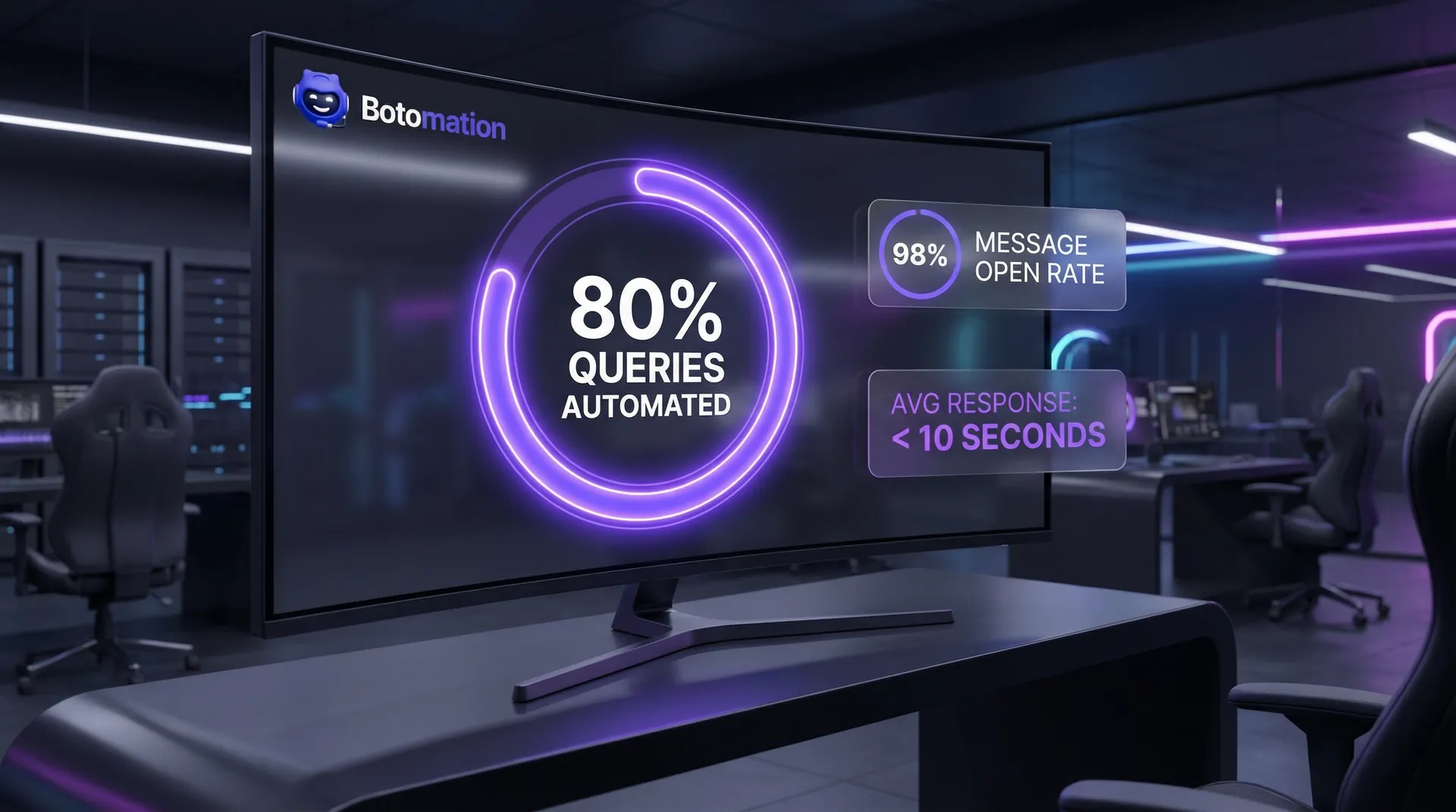
In the competitive landscape of January 2026, having a whatsapp bot handle 80% of support queries is no longer a luxury but a necessity for Shopify merchants. The economics of modern e-commerce support are reaching a breaking point for many growing brands. The traditional model of hiring more seasonal staff to manage ticket spikes is no longer sustainable or effective. Most merchants find themselves trapped in a cycle where 80% of their support volume consists of the same five or six questions repeated thousands of times. This is where the 80% rule transforms the trajectory of a business, moving from reactive firefighting to a streamlined, automated operation.
WhatsApp has solidified its position as the ultimate support channel, boasting over 2.4 billion active users and a staggering 98% message open rate. Unlike email, which often feels like shouting into a void, or live chat that requires a customer to stay glued to a browser tab, WhatsApp offers an asynchronous yet instant connection. This medium allows for a level of 24/7 support automation that was previously impossible. When a whatsapp bot handle 80% of support queries, it isn't just answering questions; it is reclaiming hundreds of hours for your core team to focus on high-value growth activities.
The success stories emerging from the 2024-2026 period show a clear divide between brands that treat automation as a simple "plugin" and those that treat it as a strategic asset. Modern AI technology, specifically the advanced reasoning capabilities of GPT-5, allows these bots to understand nuance, sentiment, and complex intent. We are no longer looking at rigid "press 1 for tracking" menus. Instead, we are deploying sophisticated AI agents that automate repetitive business tasks like cross-referencing inventory, verifying shipping zones, and even processing returns without a single human click.
How a WhatsApp Bot Handle 80% of Support Queries for Shopify Stores
The concept of the 80% rule stems from the Pareto Principle, suggesting that the vast majority of support friction comes from a tiny minority of issue types. In the context of a Shopify store, these are typically low-complexity, high-frequency inquiries that drain the energy of human agents. When our experts analyze a brand's support history, we consistently find that the bulk of the workload is tied to simple data retrieval tasks. By offloading these to a WhatsApp bot, a brand can maintain a lean team even during massive scaling phases.
WhatsApp provides a unique environment for this level of automation because it matches the natural communication habits of the modern consumer. People do not want to fill out contact forms or wait for an email that might land in their spam folder. They want to send a quick text while they are on their lunch break and receive an answer before they finish their coffee. This immediacy is why WhatsApp bots outperform every other channel in terms of resolution speed and user satisfaction.
What Are the Most Common Automatable Shopify Queries?
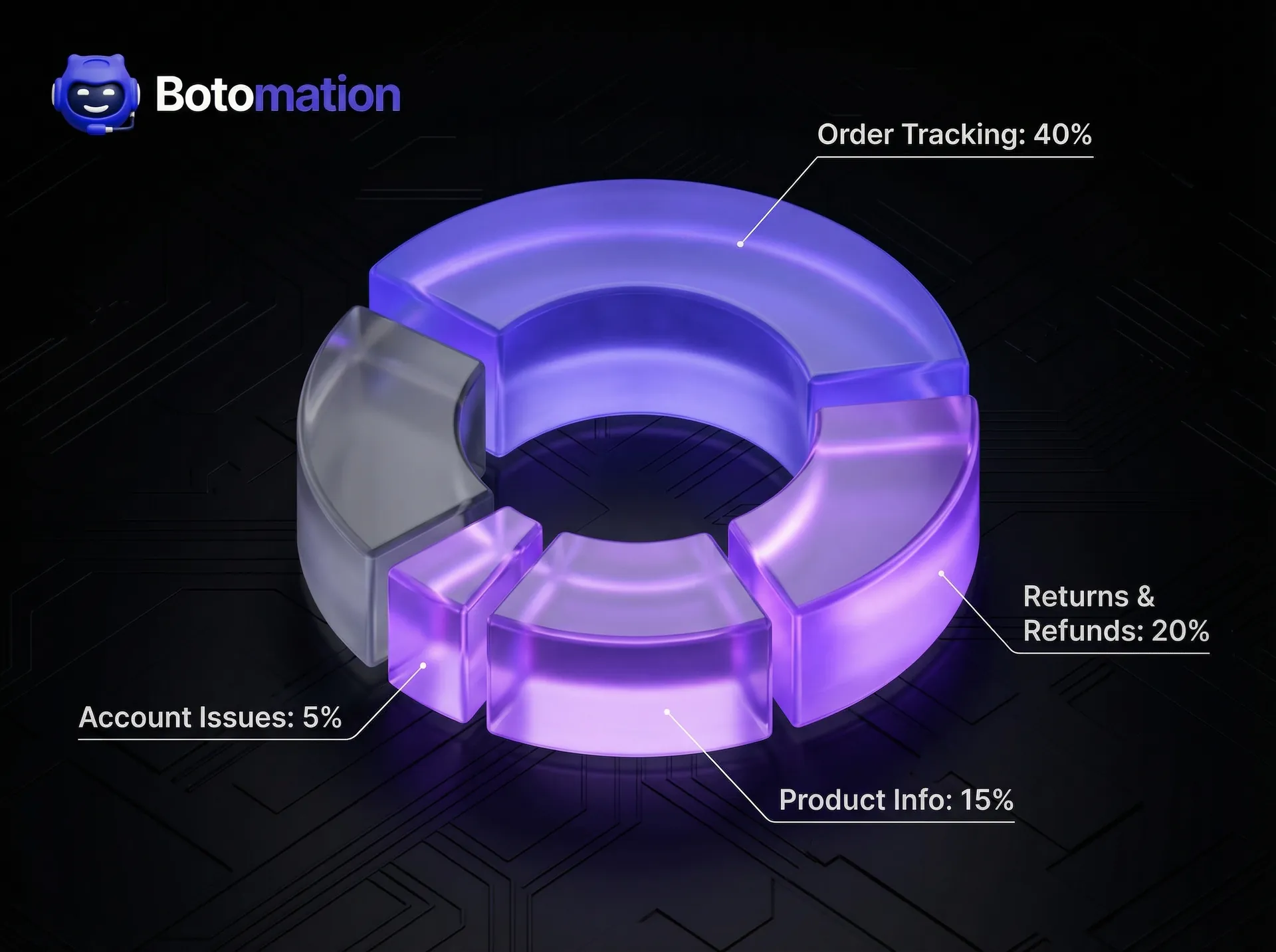
To understand how a whatsapp bot handle 80% of support queries, we must look at the data behind the tickets. Typically, automated order tracking and status inquiries account for roughly 40% of the total volume. These are purely informational requests that require the bot to pull data from the Shopify backend and present it clearly. Another 20% of queries revolve around return and refund policies, which are often just customers looking for a link or a quick confirmation of eligibility.
Product information and specifications take up another 15% of the support pie, often involving AI-driven product recommendations for brands with technical or high-SKU catalogs. Customers often ask about sizing, compatibility, or material details that are already on the site but hard to find on a mobile device. Finally, about 5% of queries relate to account management and payment issues, such as updating an address or checking a gift card balance. When you add these up, you reach that 80% threshold where human intervention adds no real value to the transaction.
Why Is WhatsApp the Best Channel for Support Automation?
The technical architecture of WhatsApp allows for a much more integrated experience than older platforms. In 2026, 73% of consumers report a preference for WhatsApp when communicating with businesses because it keeps their entire purchase history and conversation in one thread. This continuity is a massive advantage for the bot, as it can reference previous interactions to provide more personalized support. It eliminates the "please provide your order number" friction that kills customer satisfaction.
Furthermore, the integration capabilities with Shopify's latest API versions mean that the bot isn't just guessing. It has real-time access to the same data a human agent would see, but it can process and deliver that data in under ten seconds. While an email support agent might take hours to get through a queue, a Botomation-designed WhatsApp agent handles a thousand queries simultaneously without breaking a sweat.
Technical Breakdown: Can a WhatsApp Bot Handle 80% of Support Queries?
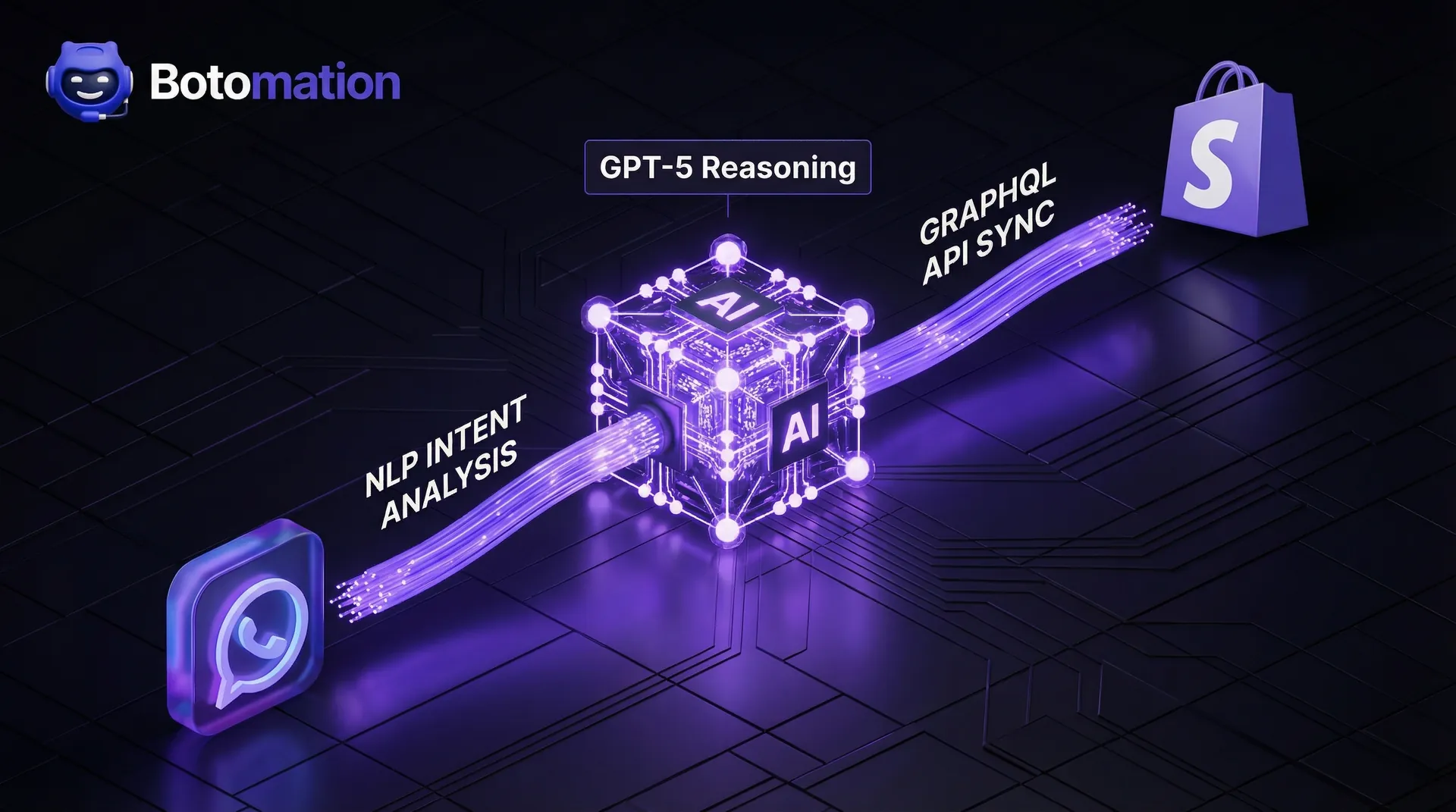
The jump from a basic chatbot to an AI agent capable of handling 80% of queries lies in the underlying technology stack. We utilize advanced Natural Language Processing (NLP) and the latest reasoning models, like GPT-5, to ensure the bot understands the "why" behind a customer's message. It isn't just looking for keywords; it is analyzing the context of the entire conversation. This allows the bot to handle complex, multi-turn interactions where a customer might ask three different questions in a single paragraph.
Integration with Shopify’s GraphQL API is the heartbeat of this system. This connection allows the bot to perform actions, not just recite text. If a customer wants to change their shipping address, the bot can check if the order has been fulfilled, update the record in Shopify, and send a confirmation—all within the WhatsApp interface. This level of autonomy is what separates the "Old Way" of simple FAQ bots from the "New Way" of Botomation's intelligent agents.
AI-Powered Intent Recognition and NLP
The implementation of GPT-5 has been a total shift in how we handle customer frustration and nuance. These models are trained on millions of e-commerce interactions, allowing them to recognize when a customer is asking for a return because of a "sizing issue" versus a "defective product." This distinction is vital for routing the conversation correctly or offering the right solution automatically. The bot can even detect sentiment, identifying if a customer is becoming agitated and proactively offering to escalate the chat to a human specialist.
Multi-language support is another area where modern NLP shines for international Shopify stores. Our bots can detect the language of the incoming message and respond fluently in over 50 languages, maintaining the brand's tone and voice throughout. This eliminates the need for expensive multilingual support teams and ensures that global customers receive the same high-quality service as domestic ones.
Real-Time Data Integration with Shopify
A bot is only as good as the data it can access. By connecting directly to Shopify's core systems, our agents can provide real-time updates on inventory, shipping carrier data, and payment status. When a customer asks, "Is the blue hoodie back in stock?", the bot doesn't just say "I don't know." It checks the live inventory levels, looks at the next expected restock date in the ERP system, and can even offer to notify the customer the moment it arrives.
This data-driven approach extends to payment processors and shipping aggregators. If a package is delayed by a carrier like FedEx or DHL, the bot can see that status change before the customer even asks. It can then proactively message the customer to explain the delay and offer a small discount code as a gesture of goodwill. This level of proactive service is what builds long-term brand loyalty and prevents the support ticket from being created in the first place.
Implementation Strategy: Building Your 80% Automation System
Achieving an 80% automation rate doesn't happen by accident or by simply toggling a switch. It requires a methodical, three-phase implementation strategy that prioritizes the highest impact areas first. At Botomation, our experts work closely with merchants to map out their existing support workflows and identify the low-hanging fruit that will provide the fastest ROI. We focus on building a foundation that is scalable, ensuring that as your order volume grows, your support costs remain flat.
Phase One: Foundation and Basic Automation
The first step is establishing the core automation flows that handle the most frequent "Where Is My Order" (WISMO) requests. We integrate the bot with your Shopify store and shipping providers to ensure it can pull tracking numbers and delivery dates instantly. This phase also includes the ingestion of your entire knowledge base and FAQ section into the AI's memory. Instead of a customer searching your site for a "Return Policy" page, they can simply ask the bot, "How do I send this back?" and get an instant, accurate answer.
Phase Two: Advanced Automation and Proactive Features
Once the foundation is solid, we move into more complex scenarios like WhatsApp cart recovery and proactive notifications. Instead of waiting for a customer to abandon their cart and then sending an email that gets ignored, the bot can reach out via WhatsApp with a helpful reminder or a personalized offer. This is a massive revenue driver for our clients, often seeing recovery rates 3x higher than traditional email methods. We also implement automated shipping updates that keep the customer informed at every stage of the journey.
How to Implement Your WhatsApp Support Bot
- Audit Your Data: Analyze the last 3,000 support tickets to categorize the most frequent questions.
- Map the Flows: Design the logic for how the bot should handle tracking, returns, and general FAQs.
- Connect the APIs: Link the WhatsApp Business API with Shopify, your shipping software, and your CRM.
- Train the AI: Feed your brand guidelines and product documentation into the model for accurate responses.
- Test and Refine: Run a pilot program with 10% of your traffic to identify any gaps in the bot's knowledge.
- Scale and Monitor: Roll out to 100% of your users and monitor the automation rate daily.
Real Success Stories: Shopify Merchants Achieving 80% Automation
The theory of automation is one thing, but the real-world results are where the value becomes undeniable. In 2024 and 2026, we have seen a surge in Shopify merchants who reduce support tickets by 78% by effectively replacing their first-tier support with Botomation's AI agents. These aren't just small "mom and pop" shops; these are high-volume DTC brands doing tens of millions in annual revenue. The common thread among them is a commitment to providing an instant, frictionless experience for their customers.
Home Decor Store Case Study: 83% Query Automation
HomeBliss, a rapidly growing home decor brand, was struggling with a massive influx of support tickets during their Q3 2024 sale event. They were receiving over 5,000 inquiries a week, and their small team of three support agents was buried. By partnering with Botomation, they implemented a custom WhatsApp agent trained on 15,000 of their historical tickets. The results were immediate and dramatic.
Within the first month, the bot was successfully handling 83% of all incoming queries without any human intervention. This led to a reduction in average response time from 14 hours down to just 8 seconds. HomeBliss reported that they saved approximately 12 hours of manual labor every single day, which they redirected into their influencer marketing program.
Fitness Equipment Brand Case Study: Proactive Automation Impact
FitLife, a premium fitness equipment brand, took a different approach by focusing on proactive communication. They realized that most of their support tickets were generated by anxiety during the shipping process for heavy items. We built a WhatsApp system for them that proactively updated customers the moment their order hit a new milestone in the delivery process. This "pre-emptive strike" on support queries was incredibly effective.
FitLife achieved a 79% automation rate, but the real win was the 34% reduction in total ticket volume. By answering the customer's questions before they even thought to ask them, FitLife eliminated the need for support entirely in many cases. They also utilized the bot to provide troubleshooting guides for their equipment.
Advanced Features: Beyond Basic Query Handling
As we look toward 2026, the capabilities of WhatsApp bots are expanding far beyond simple text replies. We are now integrating voice message processing, allowing customers to explain their issues in their own words. The AI transcribes the audio, understands the intent, and responds appropriately. This is particularly useful for older demographics or for customers who are on the go and can't type out a long message.
Image recognition is another "New Way" feature that Botomation is pioneering. When a customer receives a damaged item, they can simply snap a photo and send it to the WhatsApp bot. Our AI agents can analyze the image to confirm the damage, cross-reference it with the order history, and automatically trigger a replacement shipment or a refund based on the brand's logic.
Proactive Communication and Prevention
Prevention is always better than a cure in the world of customer support. By utilizing the WhatsApp Business API, our bots can send outbound messages that keep customers in the loop. This includes everything from "Your order is out for delivery today" to "We noticed your package has been at the local sorting facility for 2 days; we are looking into it." This level of transparency makes the customer feel valued and reduces the impulse to send a "Where is my order?" email.
Advanced Support Features
The integration of appointment scheduling and service booking is becoming a standard for brands that offer more than just physical products. If you run a Shopify store that also offers consultations or installations, the WhatsApp bot can handle the entire booking process through integrated calendar scheduling. It checks the team's availability, offers time slots, and sends calendar invites—all without the customer leaving the chat app.
Measuring Success: Tracking Your 80% Automation Goal
You cannot manage what you do not measure. To reach and maintain an 80% automation rate, you need a robust set of KPIs that go beyond simple ticket counts. We focus on the "Deflection Rate"—the number of customers who started a conversation with the bot and did not end up needing a human agent. This is the ultimate metric for support efficiency. However, we also look closely at the "Resolution Rate," which measures whether the customer's problem was actually solved, not just deflected.
Automation Metrics and KPIs
The most important metric we track is the CSAT (Customer Satisfaction) score specifically for automated interactions. There is a common fear that customers will hate talking to a bot, but the data proves otherwise—as long as the bot is fast and accurate. In 2026, customers value their time more than anything else. An instant, correct answer from a bot is consistently rated higher than a "human" answer that takes 6 hours to arrive.
Optimization and Continuous Improvement
The work doesn't stop once the bot is live. Our team at Botomation performs weekly audits of the "unresolved" queries—the 20% that the bot couldn't handle. We look for patterns. Is there a new product that the bot doesn't know about yet? Is there a specific way customers are phrasing a question that is confusing the AI? We use these insights to update the bot's training data, slowly pushing that 80% automation rate even higher over time.
Frequently Asked Questions
Can a WhatsApp bot really handle complex return requests?
Yes. By integrating with your Shopify backend and shipping providers, the bot can verify the return window, generate a shipping label, and explain the refund process. It can even handle logic like "if the item is under $20, just refund it without a return."
Will my customers get frustrated talking to an AI?
The data shows that 82% of customers prefer an instant AI response over waiting for a human. Frustration only occurs when a bot is poorly designed or can't hand off to a human. Our Botomation agents are designed to be helpful, concise, and to know exactly when to bring in a person.
How long does it take to get a bot to an 80% automation rate?
While basic flows can be live in days, reaching the 80% threshold typically takes 4 to 6 weeks of data gathering and refinement. Our team handles the heavy lifting, ensuring the AI is properly trained on your specific brand data before it goes full-scale.
Does this replace my entire support team?
No, and it shouldn't. The goal is to automate the repetitive tasks so your human team can focus on the 20% of queries that require empathy, complex problem-solving, and high-level decision-making. It makes your team more effective, not obsolete.
Is it expensive to maintain a WhatsApp bot in 2026?
When compared to the cost of hiring, training, and managing a support team, a WhatsApp bot is significantly more cost-effective. The ROI is usually realized within the first 60 days through reduced labor costs and increased sales from cart recovery.
The landscape of e-commerce support has shifted permanently. The "Old Way" of throwing more people at a growing pile of tickets is a recipe for high overhead and inconsistent service. The "New Way" is a strategic partnership with an agency that understands how to build intelligent, autonomous agents that live where your customers already are. By ensuring a whatsapp bot handle 80% of support queries, you aren't just cutting costs; you are building a scalable foundation for a multi-million dollar brand.
Botomation is the premier agency for Shopify merchants who are ready to stop being reactive and start being strategic. Our experts don't just give you a tool; we build a custom-engineered support ecosystem that reflects your brand's voice and solves your customers' problems instantly. The data is clear: the brands that win in 2026 and beyond are those that embrace conversational AI to drive efficiency and growth.
Ready to automate your growth? Stop losing money on manual support and start scaling your Shopify store today. Book a free consultation call below.
In the competitive landscape of January 2026, having a whatsapp bot handle 80% of support queries is no longer a luxury but a necessity for Shopify merchants. The economics of modern e-commerce support are reaching a breaking point for many growing brands. The traditional model of hiring more seasonal staff to manage ticket spikes is no longer sustainable or effective. Most merchants find themselves trapped in a cycle where 80% of their support volume consists of the same five or six questions repeated thousands of times. This is where the 80% rule transforms the trajectory of a business, moving from reactive firefighting to a streamlined, automated operation.
WhatsApp has solidified its position as the ultimate support channel, boasting over 2.4 billion active users and a staggering 98% message open rate. Unlike email, which often feels like shouting into a void, or live chat that requires a customer to stay glued to a browser tab, WhatsApp offers an asynchronous yet instant connection. This medium allows for a level of 24/7 support automation that was previously impossible. When a whatsapp bot handle 80% of support queries, it isn't just answering questions; it is reclaiming hundreds of hours for your core team to focus on high-value growth activities.
The success stories emerging from the 2024-2026 period show a clear divide between brands that treat automation as a simple "plugin" and those that treat it as a strategic asset. Modern AI technology, specifically the advanced reasoning capabilities of GPT-5, allows these bots to understand nuance, sentiment, and complex intent. We are no longer looking at rigid "press 1 for tracking" menus. Instead, we are deploying sophisticated AI agents that automate repetitive business tasks like cross-referencing inventory, verifying shipping zones, and even processing returns without a single human click.
How a WhatsApp Bot Handle 80% of Support Queries for Shopify Stores
The concept of the 80% rule stems from the Pareto Principle, suggesting that the vast majority of support friction comes from a tiny minority of issue types. In the context of a Shopify store, these are typically low-complexity, high-frequency inquiries that drain the energy of human agents. When our experts analyze a brand's support history, we consistently find that the bulk of the workload is tied to simple data retrieval tasks. By offloading these to a WhatsApp bot, a brand can maintain a lean team even during massive scaling phases.
WhatsApp provides a unique environment for this level of automation because it matches the natural communication habits of the modern consumer. People do not want to fill out contact forms or wait for an email that might land in their spam folder. They want to send a quick text while they are on their lunch break and receive an answer before they finish their coffee. This immediacy is why WhatsApp bots outperform every other channel in terms of resolution speed and user satisfaction.
What Are the Most Common Automatable Shopify Queries?
To understand how a whatsapp bot handle 80% of support queries, we must look at the data behind the tickets. Typically, automated order tracking and status inquiries account for roughly 40% of the total volume. These are purely informational requests that require the bot to pull data from the Shopify backend and present it clearly. Another 20% of queries revolve around return and refund policies, which are often just customers looking for a link or a quick confirmation of eligibility.
Product information and specifications take up another 15% of the support pie, often involving AI-driven product recommendations for brands with technical or high-SKU catalogs. Customers often ask about sizing, compatibility, or material details that are already on the site but hard to find on a mobile device. Finally, about 5% of queries relate to account management and payment issues, such as updating an address or checking a gift card balance. When you add these up, you reach that 80% threshold where human intervention adds no real value to the transaction.
Why Is WhatsApp the Best Channel for Support Automation?
The technical architecture of WhatsApp allows for a much more integrated experience than older platforms. In 2026, 73% of consumers report a preference for WhatsApp when communicating with businesses because it keeps their entire purchase history and conversation in one thread. This continuity is a massive advantage for the bot, as it can reference previous interactions to provide more personalized support. It eliminates the "please provide your order number" friction that kills customer satisfaction.
Furthermore, the integration capabilities with Shopify's latest API versions mean that the bot isn't just guessing. It has real-time access to the same data a human agent would see, but it can process and deliver that data in under ten seconds. While an email support agent might take hours to get through a queue, a Botomation-designed WhatsApp agent handles a thousand queries simultaneously without breaking a sweat.
Technical Breakdown: Can a WhatsApp Bot Handle 80% of Support Queries?
The jump from a basic chatbot to an AI agent capable of handling 80% of queries lies in the underlying technology stack. We utilize advanced Natural Language Processing (NLP) and the latest reasoning models, like GPT-5, to ensure the bot understands the "why" behind a customer's message. It isn't just looking for keywords; it is analyzing the context of the entire conversation. This allows the bot to handle complex, multi-turn interactions where a customer might ask three different questions in a single paragraph.
Integration with Shopify’s GraphQL API is the heartbeat of this system. This connection allows the bot to perform actions, not just recite text. If a customer wants to change their shipping address, the bot can check if the order has been fulfilled, update the record in Shopify, and send a confirmation—all within the WhatsApp interface. This level of autonomy is what separates the "Old Way" of simple FAQ bots from the "New Way" of Botomation's intelligent agents.
AI-Powered Intent Recognition and NLP
The implementation of GPT-5 has been a total shift in how we handle customer frustration and nuance. These models are trained on millions of e-commerce interactions, allowing them to recognize when a customer is asking for a return because of a "sizing issue" versus a "defective product." This distinction is vital for routing the conversation correctly or offering the right solution automatically. The bot can even detect sentiment, identifying if a customer is becoming agitated and proactively offering to escalate the chat to a human specialist.
Multi-language support is another area where modern NLP shines for international Shopify stores. Our bots can detect the language of the incoming message and respond fluently in over 50 languages, maintaining the brand's tone and voice throughout. This eliminates the need for expensive multilingual support teams and ensures that global customers receive the same high-quality service as domestic ones.
Real-Time Data Integration with Shopify
A bot is only as good as the data it can access. By connecting directly to Shopify's core systems, our agents can provide real-time updates on inventory, shipping carrier data, and payment status. When a customer asks, "Is the blue hoodie back in stock?", the bot doesn't just say "I don't know." It checks the live inventory levels, looks at the next expected restock date in the ERP system, and can even offer to notify the customer the moment it arrives.
This data-driven approach extends to payment processors and shipping aggregators. If a package is delayed by a carrier like FedEx or DHL, the bot can see that status change before the customer even asks. It can then proactively message the customer to explain the delay and offer a small discount code as a gesture of goodwill. This level of proactive service is what builds long-term brand loyalty and prevents the support ticket from being created in the first place.
Implementation Strategy: Building Your 80% Automation System
Achieving an 80% automation rate doesn't happen by accident or by simply toggling a switch. It requires a methodical, three-phase implementation strategy that prioritizes the highest impact areas first. At Botomation, our experts work closely with merchants to map out their existing support workflows and identify the low-hanging fruit that will provide the fastest ROI. We focus on building a foundation that is scalable, ensuring that as your order volume grows, your support costs remain flat.
Phase One: Foundation and Basic Automation
The first step is establishing the core automation flows that handle the most frequent "Where Is My Order" (WISMO) requests. We integrate the bot with your Shopify store and shipping providers to ensure it can pull tracking numbers and delivery dates instantly. This phase also includes the ingestion of your entire knowledge base and FAQ section into the AI's memory. Instead of a customer searching your site for a "Return Policy" page, they can simply ask the bot, "How do I send this back?" and get an instant, accurate answer.
Phase Two: Advanced Automation and Proactive Features
Once the foundation is solid, we move into more complex scenarios like WhatsApp cart recovery and proactive notifications. Instead of waiting for a customer to abandon their cart and then sending an email that gets ignored, the bot can reach out via WhatsApp with a helpful reminder or a personalized offer. This is a massive revenue driver for our clients, often seeing recovery rates 3x higher than traditional email methods. We also implement automated shipping updates that keep the customer informed at every stage of the journey.
How to Implement Your WhatsApp Support Bot
- Audit Your Data: Analyze the last 3,000 support tickets to categorize the most frequent questions.
- Map the Flows: Design the logic for how the bot should handle tracking, returns, and general FAQs.
- Connect the APIs: Link the WhatsApp Business API with Shopify, your shipping software, and your CRM.
- Train the AI: Feed your brand guidelines and product documentation into the model for accurate responses.
- Test and Refine: Run a pilot program with 10% of your traffic to identify any gaps in the bot's knowledge.
- Scale and Monitor: Roll out to 100% of your users and monitor the automation rate daily.
Real Success Stories: Shopify Merchants Achieving 80% Automation
The theory of automation is one thing, but the real-world results are where the value becomes undeniable. In 2024 and 2026, we have seen a surge in Shopify merchants who reduce support tickets by 78% by effectively replacing their first-tier support with Botomation's AI agents. These aren't just small "mom and pop" shops; these are high-volume DTC brands doing tens of millions in annual revenue. The common thread among them is a commitment to providing an instant, frictionless experience for their customers.
Home Decor Store Case Study: 83% Query Automation
HomeBliss, a rapidly growing home decor brand, was struggling with a massive influx of support tickets during their Q3 2024 sale event. They were receiving over 5,000 inquiries a week, and their small team of three support agents was buried. By partnering with Botomation, they implemented a custom WhatsApp agent trained on 15,000 of their historical tickets. The results were immediate and dramatic.
Within the first month, the bot was successfully handling 83% of all incoming queries without any human intervention. This led to a reduction in average response time from 14 hours down to just 8 seconds. HomeBliss reported that they saved approximately 12 hours of manual labor every single day, which they redirected into their influencer marketing program.
Fitness Equipment Brand Case Study: Proactive Automation Impact
FitLife, a premium fitness equipment brand, took a different approach by focusing on proactive communication. They realized that most of their support tickets were generated by anxiety during the shipping process for heavy items. We built a WhatsApp system for them that proactively updated customers the moment their order hit a new milestone in the delivery process. This "pre-emptive strike" on support queries was incredibly effective.
FitLife achieved a 79% automation rate, but the real win was the 34% reduction in total ticket volume. By answering the customer's questions before they even thought to ask them, FitLife eliminated the need for support entirely in many cases. They also utilized the bot to provide troubleshooting guides for their equipment.
Advanced Features: Beyond Basic Query Handling
As we look toward 2026, the capabilities of WhatsApp bots are expanding far beyond simple text replies. We are now integrating voice message processing, allowing customers to explain their issues in their own words. The AI transcribes the audio, understands the intent, and responds appropriately. This is particularly useful for older demographics or for customers who are on the go and can't type out a long message.
Image recognition is another "New Way" feature that Botomation is pioneering. When a customer receives a damaged item, they can simply snap a photo and send it to the WhatsApp bot. Our AI agents can analyze the image to confirm the damage, cross-reference it with the order history, and automatically trigger a replacement shipment or a refund based on the brand's logic.
Proactive Communication and Prevention
Prevention is always better than a cure in the world of customer support. By utilizing the WhatsApp Business API, our bots can send outbound messages that keep customers in the loop. This includes everything from "Your order is out for delivery today" to "We noticed your package has been at the local sorting facility for 2 days; we are looking into it." This level of transparency makes the customer feel valued and reduces the impulse to send a "Where is my order?" email.
Advanced Support Features
The integration of appointment scheduling and service booking is becoming a standard for brands that offer more than just physical products. If you run a Shopify store that also offers consultations or installations, the WhatsApp bot can handle the entire booking process through integrated calendar scheduling. It checks the team's availability, offers time slots, and sends calendar invites—all without the customer leaving the chat app.
Measuring Success: Tracking Your 80% Automation Goal
You cannot manage what you do not measure. To reach and maintain an 80% automation rate, you need a robust set of KPIs that go beyond simple ticket counts. We focus on the "Deflection Rate"—the number of customers who started a conversation with the bot and did not end up needing a human agent. This is the ultimate metric for support efficiency. However, we also look closely at the "Resolution Rate," which measures whether the customer's problem was actually solved, not just deflected.
Automation Metrics and KPIs
The most important metric we track is the CSAT (Customer Satisfaction) score specifically for automated interactions. There is a common fear that customers will hate talking to a bot, but the data proves otherwise—as long as the bot is fast and accurate. In 2026, customers value their time more than anything else. An instant, correct answer from a bot is consistently rated higher than a "human" answer that takes 6 hours to arrive.
Optimization and Continuous Improvement
The work doesn't stop once the bot is live. Our team at Botomation performs weekly audits of the "unresolved" queries—the 20% that the bot couldn't handle. We look for patterns. Is there a new product that the bot doesn't know about yet? Is there a specific way customers are phrasing a question that is confusing the AI? We use these insights to update the bot's training data, slowly pushing that 80% automation rate even higher over time.
Frequently Asked Questions
Can a WhatsApp bot really handle complex return requests?
Yes. By integrating with your Shopify backend and shipping providers, the bot can verify the return window, generate a shipping label, and explain the refund process. It can even handle logic like "if the item is under $20, just refund it without a return."
Will my customers get frustrated talking to an AI?
The data shows that 82% of customers prefer an instant AI response over waiting for a human. Frustration only occurs when a bot is poorly designed or can't hand off to a human. Our Botomation agents are designed to be helpful, concise, and to know exactly when to bring in a person.
How long does it take to get a bot to an 80% automation rate?
While basic flows can be live in days, reaching the 80% threshold typically takes 4 to 6 weeks of data gathering and refinement. Our team handles the heavy lifting, ensuring the AI is properly trained on your specific brand data before it goes full-scale.
Does this replace my entire support team?
No, and it shouldn't. The goal is to automate the repetitive tasks so your human team can focus on the 20% of queries that require empathy, complex problem-solving, and high-level decision-making. It makes your team more effective, not obsolete.
Is it expensive to maintain a WhatsApp bot in 2026?
When compared to the cost of hiring, training, and managing a support team, a WhatsApp bot is significantly more cost-effective. The ROI is usually realized within the first 60 days through reduced labor costs and increased sales from cart recovery.
The landscape of e-commerce support has shifted permanently. The "Old Way" of throwing more people at a growing pile of tickets is a recipe for high overhead and inconsistent service. The "New Way" is a strategic partnership with an agency that understands how to build intelligent, autonomous agents that live where your customers already are. By ensuring a whatsapp bot handle 80% of support queries, you aren't just cutting costs; you are building a scalable foundation for a multi-million dollar brand.
Botomation is the premier agency for Shopify merchants who are ready to stop being reactive and start being strategic. Our experts don't just give you a tool; we build a custom-engineered support ecosystem that reflects your brand's voice and solves your customers' problems instantly. The data is clear: the brands that win in 2026 and beyond are those that embrace conversational AI to drive efficiency and growth.
Ready to automate your growth? Stop losing money on manual support and start scaling your Shopify store today. Book a free consultation call below.
Get Started
Book a FREE Consultation Right NOW!
Schedule a Call with Our Team To Make Your Business More Efficient with AI Instantly.
Read More
WhatsApp Bot Handle 80 Percent of Support Queries Shopify 2026
See how a whatsapp bot handle 80% of support queries for Shopify stores. Boost ROI with AI automation, cart recovery, and real-time order tracking.
AI Chatbot for E-commerce Customer Support - 2026 Guide
Learn how WhatsApp AI slashes support costs for e-commerce & SaaS. Proven strategies to boost sales, recover carts, and scale 24/7 service.