WhatsApp Automation for Shopify Retention in 2026
Jan 8, 2026
AI Automation
E-commerce
Shopify
AI Automation
E-commerce
Shopify
Running a successful Shopify store in 2026 requires more than just a high-quality product and a polished storefront. Implementing whatsapp automation to increase customer retention has become the definitive strategy for brands looking to scale while maintaining high satisfaction. The modern e-commerce landscape is defined by the post-purchase experience, yet many brands still struggle with the communication "black hole" that occurs after a customer clicks the buy button. Industry data indicates that approximately 30% of all customer support requests for online retailers are "where is my order" (WISMO) queries. Brands that automate Shopify order tracking via WhatsApp can eliminate these repetitive, low-value interactions that drain resources and frustrate customers who expect instant transparency.
WhatsApp has emerged as the definitive solution to this friction, connecting over 2 billion active users globally on a platform they check dozens of times daily. Unlike email, which often gets buried in promotion tabs or spam filters, WhatsApp offers an intimate, direct line of communication that feels personal rather than transactional. Our team at Botomation has observed that companies implementing sophisticated WhatsApp automation strategies see repeat purchase rates climb by 25% to 35% while simultaneously slashing support ticket volumes by half. Some advanced setups can even reduce Shopify support tickets by 78% by addressing common queries instantly. This isn't just about sending a text message; it is about building a proactive ecosystem that anticipates customer needs before they become complaints.
The shift toward mobile-first communication is no longer a trend but a fundamental requirement for DTC brands looking to scale. When a customer receives a shipping update via WhatsApp, the engagement rate is significantly higher than any other medium. By implementing a Shopify WhatsApp integration for order status updates, store owners can transform a standard delivery process into a loyalty-building engine. This article explores how our experts at Botomation help brands master this technology to secure long-term growth and operational efficiency.
Understanding WhatsApp Automation to Increase Customer Retention
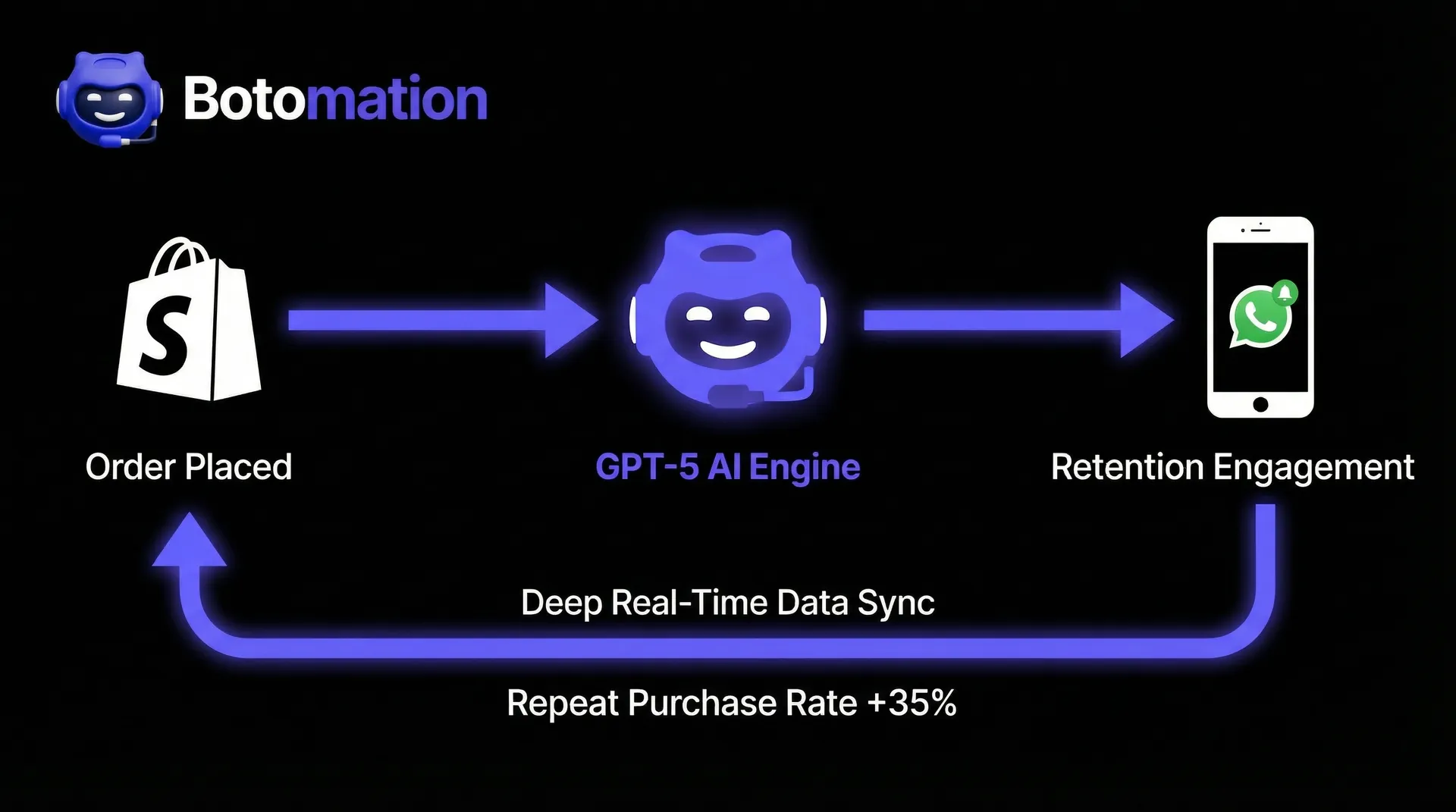
WhatsApp automation in the e-commerce sector refers to the use of the WhatsApp Business API to trigger messages based on specific actions taken within a Shopify store. This goes far beyond the basic "away messages" found in the standard Business App. For a growing brand, the distinction between the regular Business App and the Business API is critical. The API allows for multi-agent support, advanced AI integration, and the ability to send thousands of personalized messages simultaneously without the risk of being flagged as spam.
The impact on customer retention is measurable and profound. When you automate the post-purchase journey, you are essentially providing a 24/7 concierge service that never sleeps. Data suggests that customers who receive proactive updates are 40% more likely to trust the brand for a subsequent purchase. At Botomation, we focus on creating these "moments of delight" where the customer feels seen and valued without your human staff having to lift a finger for every routine update.
| Feature | WhatsApp Business App | WhatsApp Business API (The Botomation Way) |
|---|---|---|
| **Automation Level** | Basic greeting/away messages | Complex AI-driven workflows and Shopify triggers |
| **Scalability** | Limited to one or few devices | Unlimited agents and high-volume messaging |
| **Shopify Integration** | Manual entry required | Deep, real-time data synchronization |
| **AI Capabilities** | None | Advanced GPT-5 powered intent recognition |
| **Broadcast Limits** | 256 contacts (non-personalized) | Unlimited (personalized and segmented) |
The Role of WhatsApp in Modern E-commerce Customer Experience
With over 2 billion users, WhatsApp is the primary communication tool for a global audience. For Shopify store owners, this represents an opportunity to meet customers exactly where they are already comfortable. The preference for mobile-first communication has reached a tipping point where traditional email-only strategies are starting to see diminishing returns. Customers in 2026 value speed and convenience above almost all else, and WhatsApp provides both in a single interface.
Direct integration with Shopify allows our team to pull specific customer data, such as order history and browsing behavior, to make every interaction relevant. Instead of a generic "Thanks for your order," the automation can reference specific items, offer care instructions, or suggest a complementary product. This level of personalization is what separates a world-class brand from a generic dropshipping site. By treating the WhatsApp thread as a living history of the customer's relationship with the brand, you foster a sense of community and reliability.
How Automation Reduces Customer Support Burden
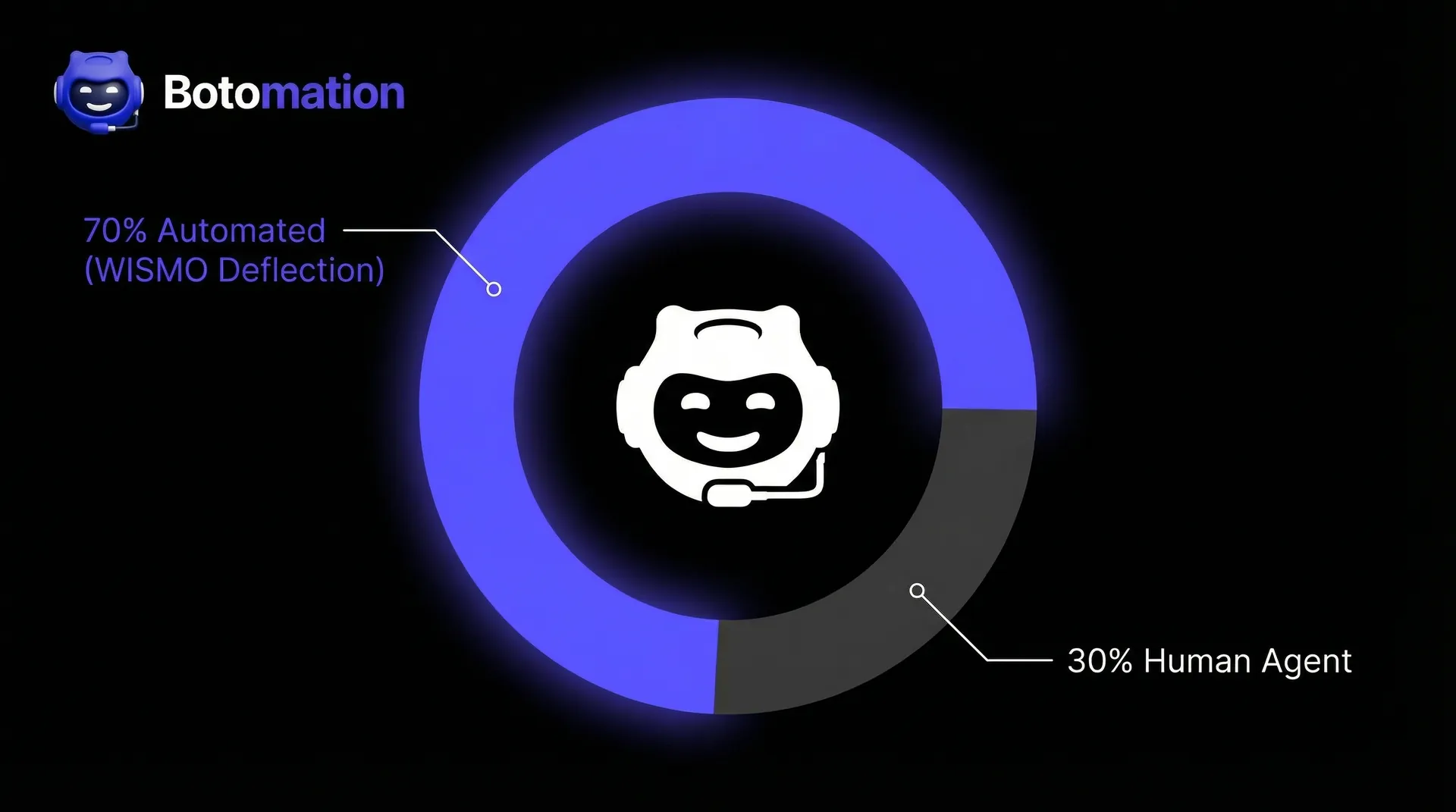
The financial argument for automation is just as compelling as the brand-building one. Our internal data shows that approximately 70% of standard customer support interactions can be handled entirely by an AI chatbot for e-commerce customer support. This includes tasks like tracking a package, checking a refund status, or answering basic product questions. When these tasks are automated, your human agents are freed up to handle complex issues that require empathy and creative problem-solving.
The speed of resolution is another area where automation shines. A well-configured WhatsApp agent can resolve a query in seconds, whereas the average email response time for many Shopify stores still lingers around 12 to 24 hours. In a recent project, our team helped an e-commerce SaaS platform reduce their total ticket volume by 50% within the first 90 days of implementation. This led to a 35% improvement in their Customer Satisfaction (CSAT) scores because customers no longer had to wait for basic information.
Expert Insight: "The goal of automation isn't to replace the human touch, but to ensure that the human touch is reserved for the moments that actually matter. By automating the mundane, you empower your team to be truly exceptional when a customer has a unique problem." — Senior Strategy Consultant at Botomation.
How to Use WhatsApp Automation to Increase Customer Retention: Setting Up the Business API
Getting started with the WhatsApp Business API is a more technical endeavor than simply downloading an app from the store. It requires a verified Meta Business Manager account and a clean phone number that hasn't been used for a personal WhatsApp account recently. Our team at Botomation handles this entire onboarding process, ensuring that your brand meets Meta’s strict "Commerce Policy" requirements to avoid any interruptions in service. Once the API is active, the real magic happens through the connection with your Shopify backend.
The integration relies on webhooks, which are digital signals sent from Shopify to the WhatsApp API whenever an event occurs—like a new order being placed or a fulfillment status changing. Setting these up correctly is vital for real-time accuracy. If a customer asks "Where is my stuff?" the system needs to pull the latest tracking number from Shopify and the current status from the shipping carrier (like UPS or DHL) instantly. We ensure these connections are "low-latency," meaning the response is delivered before the customer even has a chance to put their phone back in their pocket.
Technical Requirements and Prerequisites
To successfully bridge Shopify and WhatsApp, you need a robust middle-layer architecture. This involves configuring Shopify app permissions to allow the reading of orders, customers, and fulfillment data. We also set up secure server environments to handle message processing, ensuring that customer data is encrypted and handled according to modern privacy standards. This technical foundation is what allows for the complex branching logic used in advanced retention flows.
Many store owners attempt to do this using basic third-party apps, but they often run into limitations when they want to customize the logic. For example, you might want to send a different follow-up message to a first-time buyer compared to a VIP customer who has spent over $1,000. Our bespoke integration services allow for this level of granularity. We map out every possible customer touchpoint to ensure the automation feels like a natural extension of your brand voice.
2026 Technical Updates: New Features and Capabilities
As we move through 2026, the capabilities of the WhatsApp Business API have expanded significantly. We are now integrating advanced AI models, such as GPT-5, directly into the chat interface. This allows the bot to understand nuanced questions like "Will this shirt fit me if I'm 6 feet tall?" rather than just responding to keywords. The AI can analyze your product descriptions and size charts in real-time to provide accurate, helpful answers that drive conversions.
Another major shift this year is the widespread adoption of integrated payment solutions within WhatsApp. Customers can now complete a purchase or pay for a recurring subscription without ever leaving the chat window. This reduces friction in the "re-order" process, which is a massive win for retention. Our experts also leverage enhanced analytics dashboards that track not just "messages sent," but the actual revenue generated from each WhatsApp conversation, giving you a clear picture of your Return on Ad Spend (ROAS) and how to increase customer lifetime value with a WhatsApp bot.
Step-by-Step Tutorial: Implementing Your First Automation Flow
- Verify Your Meta Business Manager: Ensure your business is verified by Meta. This involves submitting official documents like tax IDs or utility bills to prove your business is a legal entity.
- Connect to Shopify via API: Generate a "Private App" or "Custom App" within your Shopify admin settings. You will need to grant "Read" and "Write" access for Orders, Customers, and Products.
- Configure the Webhook: Set the webhook URL to point to your automation server. For a "New Order" trigger, Shopify will send a JSON payload containing the customer's phone number and order details.
- Create Your Message Template: WhatsApp requires pre-approval for "Business-Initiated" messages. Draft a clear, helpful template like: "Hi {{1}}, thanks for your order #{{2}}! We are getting it ready for you now."
- Test the Logic: Place a test order on your Shopify store. Verify that the message triggers within 60 seconds and that all variables (like name and order number) are correctly populated.
Implementing Post-Purchase Follow-up Sequences
The period immediately following a purchase is often referred to as the "Golden Hour" of customer experience. We recommend following 7 steps to automate Shopify post-purchase follow-up to ensure this window is used to reinforce the customer's decision and build anticipation. A well-timed WhatsApp message can reinforce their decision and build anticipation. At Botomation, we design sequences that go beyond simple notifications; we create a narrative that keeps the customer engaged throughout the entire shipping process.
Timing and frequency are the two most important variables here. You want to be helpful, not annoying. Sending a message for every single movement of a package might be overkill, but a message when the order is confirmed, when it's out for delivery, and when it has been delivered is usually the "sweet spot." We use data from thousands of interactions to optimize these timings, ensuring your brand stays top-of-mind without becoming a nuisance in the customer's inbox.
Thank You and Order Confirmation Messages
The first message in the sequence should be the order confirmation. While Shopify sends an automated email, the WhatsApp confirmation feels more immediate and personal. This is also an excellent opportunity for low-friction upselling; similarly, brands can recover 70% of abandoned carts on Shopify by using the same direct communication style earlier in the funnel. For example, if a customer buys a pair of leather boots, the confirmation message could include a small button: "Want to add leather protector for 20% off? Just reply YES." Since the payment info is already on file, this can be a one-click experience.
We also use this initial touchpoint to set expectations. If your shipping takes 3-5 days, tell them that immediately. Transparency is the greatest enemy of support tickets. By providing a direct link to a live tracking page within the WhatsApp chat, you significantly reduce the likelihood of that customer emailing your support team two days later asking for an update.
Delivery Confirmation and Feedback Requests
The sequence doesn't end when the package arrives. In fact, the most important message for retention happens about 24 to 48 hours after delivery. This is when we trigger a feedback request. Instead of a long, boring survey, we use interactive buttons: "How do you like your new gear? [Love it! 😍] [It's okay 😐] [Need help 🆘]". This high-engagement format allows you to identify unhappy customers instantly.
If a customer clicks "Need help," the automation can immediately escalate the chat to a human agent or provide a link to the return portal. If they click "Love it!", the bot can then ask for a review or offer a discount code for their next purchase. This proactive approach turns a standard transaction into an ongoing conversation. It also provides your team with invaluable qualitative data about your products that you might not get through traditional channels.
Key Statistics on WhatsApp Engagement:
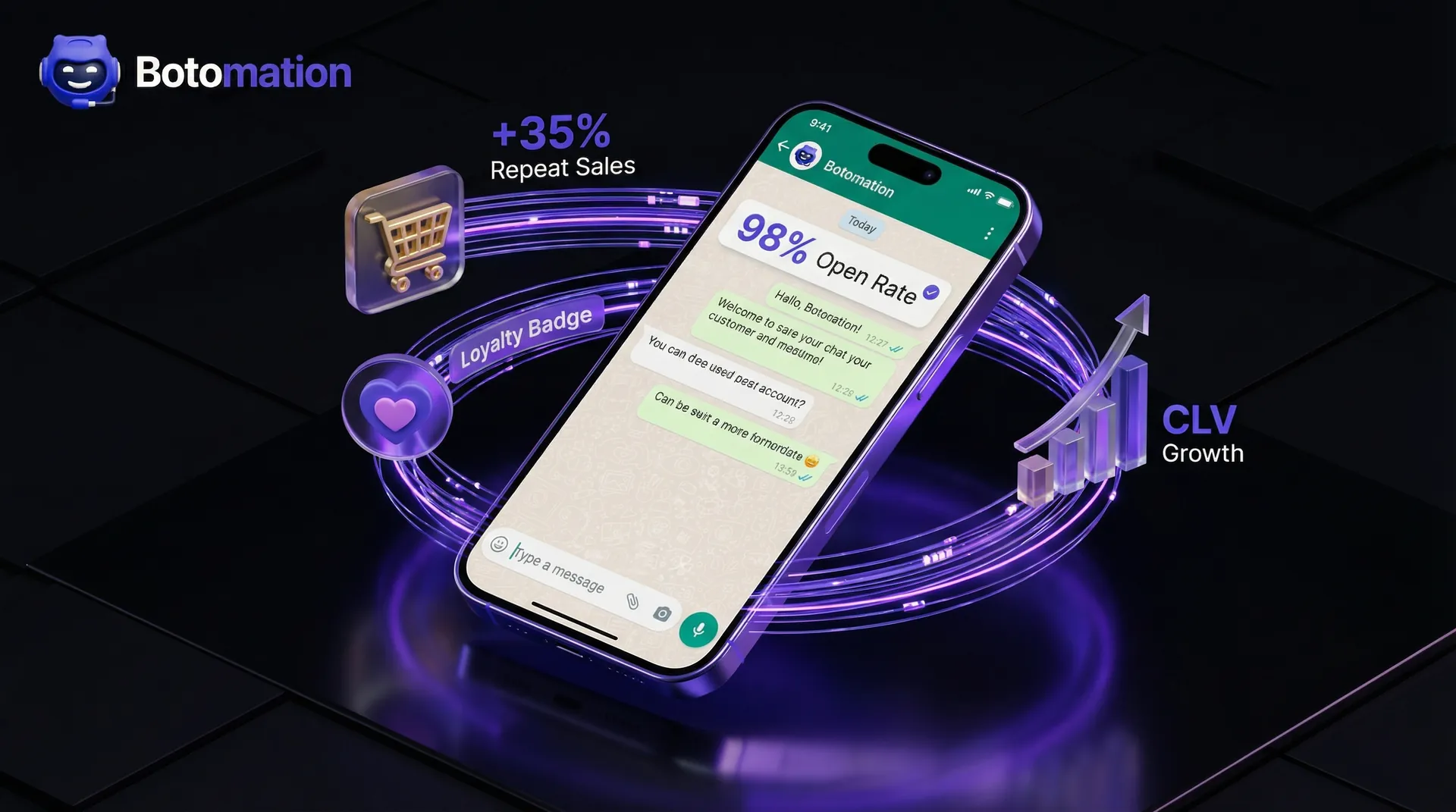
* Open Rates: WhatsApp messages boast a 98% open rate compared to 20% for email.
* Response Times: The average user responds to a WhatsApp message within 90 seconds.
* Conversion: Post-purchase upsells on WhatsApp have a 15% higher conversion rate than email-based upsells.
* Retention: Brands using WhatsApp for feedback collection see a 22% increase in repeat purchases.
AI-Powered Chatbots for Customer Support and Engagement
The "Old Way" of handling support involved a team of people manually typing out the same answers to the same questions hundreds of times a day. It was slow, expensive, and prone to human error. The "New Way"—the Botomation way—uses AI-powered agents that understand the context and intent of a customer's query. These aren't the frustrating "I don't understand" bots of five years ago. These are sophisticated systems capable of handling complex dialogue and providing genuine value.
Integrating these bots with your existing systems, like Gorgias or Zendesk, ensures that your support ecosystem remains unified. If the AI reaches its limit, it can seamlessly hand off the conversation to a human agent, along with a full transcript of what has already been discussed. This prevents the customer from having to repeat themselves, which is one of the biggest pain points in modern customer service.
Common Use Cases for AI Chatbots
One of the most powerful use cases we implement is WhatsApp automation for returns and exchanges. Instead of a customer having to find your policy page, they can simply type "I want to return this" into WhatsApp to start a frictionless process. The bot can check the order date, verify if it's within the return window, and even generate a return shipping label right there in the chat. This transforms a typically negative experience into a frictionless one, which is a major driver of long-term loyalty.
Product recommendations are another area where AI excels. By analyzing a customer's purchase history and the current inventory on Shopify, the bot can act as a personal shopper. If a customer asks, "What goes well with the blue dress I bought last week?", the AI can suggest specific accessories or shoes, complete with images and "Buy Now" buttons. This moves the chatbot from a cost-saving tool to a revenue-generating asset.
Building Effective AI Chatbot Workflows
Creating a successful workflow requires a deep understanding of Natural Language Processing (NLP). We don't just program the bot to look for keywords; we train it to understand the sentiment behind the words. If a customer is clearly angry, the bot should skip the pleasantries and immediately offer a human escalation. This emotional intelligence is what makes an automated system feel human and helpful.
We also build in "fall-back" protocols. If the AI is 80% sure of an answer but not 100%, it can ask for clarification: "It sounds like you're asking about our international shipping rates, is that correct?" This prevents the bot from giving incorrect information and maintains the trust of the user. Our experts at Botomation constantly monitor these interactions, "tuning" the AI to become more accurate and helpful with every conversation it has.
Measuring Retention and Engagement Metrics
You cannot improve what you do not measure. In the world of WhatsApp automation, there are specific KPIs (Key Performance Indicators) that tell the true story of your success. Many brands make the mistake of only looking at "open rates," but that is a vanity metric. What matters is how these interactions move the needle on your bottom line. At Botomation, we provide our clients with detailed reporting that connects WhatsApp activity directly to Shopify sales data.
Setting up this tracking requires a bit of technical finesse. We use UTM parameters on all links sent through WhatsApp so that your Google Analytics can see exactly which sessions and sales originated from the chat. We also track "Return on Conversation," a metric we developed to measure the average revenue generated for every automated chat session. This allows you to see the tangible ROI of your automation strategy.
Essential Metrics for WhatsApp Campaigns
The most important metric for this strategy is the Customer Retention Rate (CRR). We look at the percentage of customers who make a second purchase within a specific timeframe after engaging with the WhatsApp automation compared to those who didn't. Usually, we see a significant delta here. Another critical metric is the Support Deflection Rate. If you used to get 1,000 tickets a month and now you get 500, the automation has "deflected" 50% of your workload.
Let's look at a quick calculation. If your average cost per support ticket is $5.00 (considering agent salary, software, and overhead) and you deflect 600 tickets a month:
- 600 tickets * $5.00 = $3,000 saved per month.
- $3,000 * 12 months = $36,000 saved annually.
This doesn't even account for the extra revenue from upsells and increased LTV. When you see the numbers broken down like this, the decision to automate becomes an easy one.
A/B Testing and Optimization Strategies
The first version of your automation is rarely the best version. We use A/B testing to refine every aspect of the communication. This might involve testing two different subject lines for a shipping update or two different timings for a feedback request. Does a 24-hour delay work better than a 48-hour delay for asking for a review? The data will tell us.
We also analyze customer behavior patterns to identify where people "drop off" in a conversation. If 40% of people stop responding when the bot asks for their email address, we might change the flow to ask for that information later or pull it automatically from Shopify. This iterative process is how we take a good automation strategy and make it world-class. It is about constant refinement based on real-world human behavior.
Best Practices for Compliance and User Experience
As powerful as WhatsApp automation is, it must be handled with care. Meta has very strict rules regarding how businesses can contact users. Violating these rules can lead to your phone number being banned, which can be devastating for your operations. Our team at Botomation ensures that your strategy is 100% compliant with WhatsApp's Terms of Service and local data protection laws like GDPR and CCPA.
The foundation of compliance is "Opt-in." You should never message a customer on WhatsApp unless they have explicitly given you permission to do so. We implement clear opt-in checkboxes on the Shopify checkout page and "Thank You" page. We also make it incredibly easy for customers to "Opt-out" at any time. A simple "Reply STOP to unsubscribe" is not just a legal requirement; it's a best practice for maintaining a positive brand image.
Ensuring Privacy and Compliance
Data protection is a top priority in 2026. When we integrate WhatsApp with Shopify, we ensure that sensitive customer information is never stored unnecessarily and is always encrypted. We also help you draft a clear privacy policy that explains how you use WhatsApp data. Transparency builds trust, and trust is the bedrock of customer retention.
Permission-based messaging also means being respectful of the "Business-Initiated" window. WhatsApp allows you to send a template message to a customer, but once they reply, you have a 24-hour window to chat freely. We design our flows to encourage that first reply, which opens up the conversation and allows for a much richer, more interactive experience without incurring additional template costs from Meta.
Maintaining High-Quality User Experience
User experience (UX) in a chat interface is different from UX on a website. It needs to be concise, helpful, and timely. We avoid sending "walls of text." Instead, we use short, punchy sentences and break up information with emojis and buttons. Every message should have a clear purpose and provide immediate value to the customer. If a message doesn't help them track an order, solve a problem, or get a better deal, it probably shouldn't be sent.
Managing frequency is also key. If a customer is already chatting with a human agent, the automated sequences should be paused to avoid confusion. We implement "silence periods" and priority logic to ensure the customer always gets the most relevant interaction. By focusing on the quality of the interaction rather than the quantity of messages, you ensure that your brand remains a welcome guest in the customer's WhatsApp inbox.
Frequently Asked Questions
Does WhatsApp automation work for international Shopify stores?
Absolutely. One of the biggest advantages of WhatsApp is its global reach. Whether your customers are in Europe, Latin America, or Asia, WhatsApp is often their preferred way to communicate. Our team can set up multi-language bots that automatically detect the customer's language and respond accordingly, providing a localized experience for every shopper.
Is the WhatsApp Business API expensive for a growing brand?
The cost is tiered based on the volume of conversations, making it accessible for both mid-sized brands and large enterprises. While there is an initial setup investment, the "Support Deflection" and "Increased LTV" usually result in the system paying for itself within the first few months. Partnering with an agency like Botomation ensures you don't waste money on inefficient flows or redundant software.
How does this differ from SMS marketing?
SMS has lower open rates, higher costs per message in many regions, and very limited interactive capabilities. WhatsApp allows for rich media (images, videos, PDFs), interactive buttons, and long-form AI conversations that SMS simply cannot match. In 2026, WhatsApp is seen as a premium, branded experience, while SMS is increasingly viewed as a channel for spam.
Can I still talk to my customers manually?
Yes. The automation is designed to handle the 80% of routine queries, but you and your team always have the ability to jump into any conversation. We use a "Shared Inbox" system where all your agents can see the chat history and take over when a personal touch is needed. The transition from bot to human is designed to be seamless and invisible to the customer.
WhatsApp automation is no longer a luxury for e-commerce brands; it is a competitive necessity. By closing the communication gap between the "Buy" button and the delivery truck, you create a customer experience that drives loyalty and significantly reduces operational headaches. The technical hurdles of setting up the Business API and integrating it deeply with Shopify are real, but the rewards are undeniable.
When you move away from the "Old Way" of reactive, email-heavy support and embrace the "New Way" of proactive, AI-driven WhatsApp engagement, you aren't just saving time—you are building a more resilient and profitable business. Our team at Botomation specializes in this exact transition, taking the complexity out of the technology so you can focus on scaling your brand. The data is clear, the technology is ready, and your customers are already waiting for you on WhatsApp.
Ready to automate your growth? Stop losing money on missed opportunities and overwhelmed support teams today. Book a free consultation call below to see how our experts can transform your Shopify store's retention strategy.
Running a successful Shopify store in 2026 requires more than just a high-quality product and a polished storefront. Implementing whatsapp automation to increase customer retention has become the definitive strategy for brands looking to scale while maintaining high satisfaction. The modern e-commerce landscape is defined by the post-purchase experience, yet many brands still struggle with the communication "black hole" that occurs after a customer clicks the buy button. Industry data indicates that approximately 30% of all customer support requests for online retailers are "where is my order" (WISMO) queries. Brands that automate Shopify order tracking via WhatsApp can eliminate these repetitive, low-value interactions that drain resources and frustrate customers who expect instant transparency.
WhatsApp has emerged as the definitive solution to this friction, connecting over 2 billion active users globally on a platform they check dozens of times daily. Unlike email, which often gets buried in promotion tabs or spam filters, WhatsApp offers an intimate, direct line of communication that feels personal rather than transactional. Our team at Botomation has observed that companies implementing sophisticated WhatsApp automation strategies see repeat purchase rates climb by 25% to 35% while simultaneously slashing support ticket volumes by half. Some advanced setups can even reduce Shopify support tickets by 78% by addressing common queries instantly. This isn't just about sending a text message; it is about building a proactive ecosystem that anticipates customer needs before they become complaints.
The shift toward mobile-first communication is no longer a trend but a fundamental requirement for DTC brands looking to scale. When a customer receives a shipping update via WhatsApp, the engagement rate is significantly higher than any other medium. By implementing a Shopify WhatsApp integration for order status updates, store owners can transform a standard delivery process into a loyalty-building engine. This article explores how our experts at Botomation help brands master this technology to secure long-term growth and operational efficiency.
Understanding WhatsApp Automation to Increase Customer Retention
WhatsApp automation in the e-commerce sector refers to the use of the WhatsApp Business API to trigger messages based on specific actions taken within a Shopify store. This goes far beyond the basic "away messages" found in the standard Business App. For a growing brand, the distinction between the regular Business App and the Business API is critical. The API allows for multi-agent support, advanced AI integration, and the ability to send thousands of personalized messages simultaneously without the risk of being flagged as spam.
The impact on customer retention is measurable and profound. When you automate the post-purchase journey, you are essentially providing a 24/7 concierge service that never sleeps. Data suggests that customers who receive proactive updates are 40% more likely to trust the brand for a subsequent purchase. At Botomation, we focus on creating these "moments of delight" where the customer feels seen and valued without your human staff having to lift a finger for every routine update.
| Feature | WhatsApp Business App | WhatsApp Business API (The Botomation Way) |
|---|---|---|
| **Automation Level** | Basic greeting/away messages | Complex AI-driven workflows and Shopify triggers |
| **Scalability** | Limited to one or few devices | Unlimited agents and high-volume messaging |
| **Shopify Integration** | Manual entry required | Deep, real-time data synchronization |
| **AI Capabilities** | None | Advanced GPT-5 powered intent recognition |
| **Broadcast Limits** | 256 contacts (non-personalized) | Unlimited (personalized and segmented) |
The Role of WhatsApp in Modern E-commerce Customer Experience
With over 2 billion users, WhatsApp is the primary communication tool for a global audience. For Shopify store owners, this represents an opportunity to meet customers exactly where they are already comfortable. The preference for mobile-first communication has reached a tipping point where traditional email-only strategies are starting to see diminishing returns. Customers in 2026 value speed and convenience above almost all else, and WhatsApp provides both in a single interface.
Direct integration with Shopify allows our team to pull specific customer data, such as order history and browsing behavior, to make every interaction relevant. Instead of a generic "Thanks for your order," the automation can reference specific items, offer care instructions, or suggest a complementary product. This level of personalization is what separates a world-class brand from a generic dropshipping site. By treating the WhatsApp thread as a living history of the customer's relationship with the brand, you foster a sense of community and reliability.
How Automation Reduces Customer Support Burden
The financial argument for automation is just as compelling as the brand-building one. Our internal data shows that approximately 70% of standard customer support interactions can be handled entirely by an AI chatbot for e-commerce customer support. This includes tasks like tracking a package, checking a refund status, or answering basic product questions. When these tasks are automated, your human agents are freed up to handle complex issues that require empathy and creative problem-solving.
The speed of resolution is another area where automation shines. A well-configured WhatsApp agent can resolve a query in seconds, whereas the average email response time for many Shopify stores still lingers around 12 to 24 hours. In a recent project, our team helped an e-commerce SaaS platform reduce their total ticket volume by 50% within the first 90 days of implementation. This led to a 35% improvement in their Customer Satisfaction (CSAT) scores because customers no longer had to wait for basic information.
Expert Insight: "The goal of automation isn't to replace the human touch, but to ensure that the human touch is reserved for the moments that actually matter. By automating the mundane, you empower your team to be truly exceptional when a customer has a unique problem." — Senior Strategy Consultant at Botomation.
How to Use WhatsApp Automation to Increase Customer Retention: Setting Up the Business API
Getting started with the WhatsApp Business API is a more technical endeavor than simply downloading an app from the store. It requires a verified Meta Business Manager account and a clean phone number that hasn't been used for a personal WhatsApp account recently. Our team at Botomation handles this entire onboarding process, ensuring that your brand meets Meta’s strict "Commerce Policy" requirements to avoid any interruptions in service. Once the API is active, the real magic happens through the connection with your Shopify backend.
The integration relies on webhooks, which are digital signals sent from Shopify to the WhatsApp API whenever an event occurs—like a new order being placed or a fulfillment status changing. Setting these up correctly is vital for real-time accuracy. If a customer asks "Where is my stuff?" the system needs to pull the latest tracking number from Shopify and the current status from the shipping carrier (like UPS or DHL) instantly. We ensure these connections are "low-latency," meaning the response is delivered before the customer even has a chance to put their phone back in their pocket.
Technical Requirements and Prerequisites
To successfully bridge Shopify and WhatsApp, you need a robust middle-layer architecture. This involves configuring Shopify app permissions to allow the reading of orders, customers, and fulfillment data. We also set up secure server environments to handle message processing, ensuring that customer data is encrypted and handled according to modern privacy standards. This technical foundation is what allows for the complex branching logic used in advanced retention flows.
Many store owners attempt to do this using basic third-party apps, but they often run into limitations when they want to customize the logic. For example, you might want to send a different follow-up message to a first-time buyer compared to a VIP customer who has spent over $1,000. Our bespoke integration services allow for this level of granularity. We map out every possible customer touchpoint to ensure the automation feels like a natural extension of your brand voice.
2026 Technical Updates: New Features and Capabilities
As we move through 2026, the capabilities of the WhatsApp Business API have expanded significantly. We are now integrating advanced AI models, such as GPT-5, directly into the chat interface. This allows the bot to understand nuanced questions like "Will this shirt fit me if I'm 6 feet tall?" rather than just responding to keywords. The AI can analyze your product descriptions and size charts in real-time to provide accurate, helpful answers that drive conversions.
Another major shift this year is the widespread adoption of integrated payment solutions within WhatsApp. Customers can now complete a purchase or pay for a recurring subscription without ever leaving the chat window. This reduces friction in the "re-order" process, which is a massive win for retention. Our experts also leverage enhanced analytics dashboards that track not just "messages sent," but the actual revenue generated from each WhatsApp conversation, giving you a clear picture of your Return on Ad Spend (ROAS) and how to increase customer lifetime value with a WhatsApp bot.
Step-by-Step Tutorial: Implementing Your First Automation Flow
- Verify Your Meta Business Manager: Ensure your business is verified by Meta. This involves submitting official documents like tax IDs or utility bills to prove your business is a legal entity.
- Connect to Shopify via API: Generate a "Private App" or "Custom App" within your Shopify admin settings. You will need to grant "Read" and "Write" access for Orders, Customers, and Products.
- Configure the Webhook: Set the webhook URL to point to your automation server. For a "New Order" trigger, Shopify will send a JSON payload containing the customer's phone number and order details.
- Create Your Message Template: WhatsApp requires pre-approval for "Business-Initiated" messages. Draft a clear, helpful template like: "Hi {{1}}, thanks for your order #{{2}}! We are getting it ready for you now."
- Test the Logic: Place a test order on your Shopify store. Verify that the message triggers within 60 seconds and that all variables (like name and order number) are correctly populated.
Implementing Post-Purchase Follow-up Sequences
The period immediately following a purchase is often referred to as the "Golden Hour" of customer experience. We recommend following 7 steps to automate Shopify post-purchase follow-up to ensure this window is used to reinforce the customer's decision and build anticipation. A well-timed WhatsApp message can reinforce their decision and build anticipation. At Botomation, we design sequences that go beyond simple notifications; we create a narrative that keeps the customer engaged throughout the entire shipping process.
Timing and frequency are the two most important variables here. You want to be helpful, not annoying. Sending a message for every single movement of a package might be overkill, but a message when the order is confirmed, when it's out for delivery, and when it has been delivered is usually the "sweet spot." We use data from thousands of interactions to optimize these timings, ensuring your brand stays top-of-mind without becoming a nuisance in the customer's inbox.
Thank You and Order Confirmation Messages
The first message in the sequence should be the order confirmation. While Shopify sends an automated email, the WhatsApp confirmation feels more immediate and personal. This is also an excellent opportunity for low-friction upselling; similarly, brands can recover 70% of abandoned carts on Shopify by using the same direct communication style earlier in the funnel. For example, if a customer buys a pair of leather boots, the confirmation message could include a small button: "Want to add leather protector for 20% off? Just reply YES." Since the payment info is already on file, this can be a one-click experience.
We also use this initial touchpoint to set expectations. If your shipping takes 3-5 days, tell them that immediately. Transparency is the greatest enemy of support tickets. By providing a direct link to a live tracking page within the WhatsApp chat, you significantly reduce the likelihood of that customer emailing your support team two days later asking for an update.
Delivery Confirmation and Feedback Requests
The sequence doesn't end when the package arrives. In fact, the most important message for retention happens about 24 to 48 hours after delivery. This is when we trigger a feedback request. Instead of a long, boring survey, we use interactive buttons: "How do you like your new gear? [Love it! 😍] [It's okay 😐] [Need help 🆘]". This high-engagement format allows you to identify unhappy customers instantly.
If a customer clicks "Need help," the automation can immediately escalate the chat to a human agent or provide a link to the return portal. If they click "Love it!", the bot can then ask for a review or offer a discount code for their next purchase. This proactive approach turns a standard transaction into an ongoing conversation. It also provides your team with invaluable qualitative data about your products that you might not get through traditional channels.
Key Statistics on WhatsApp Engagement:
* Open Rates: WhatsApp messages boast a 98% open rate compared to 20% for email.
* Response Times: The average user responds to a WhatsApp message within 90 seconds.
* Conversion: Post-purchase upsells on WhatsApp have a 15% higher conversion rate than email-based upsells.
* Retention: Brands using WhatsApp for feedback collection see a 22% increase in repeat purchases.
AI-Powered Chatbots for Customer Support and Engagement
The "Old Way" of handling support involved a team of people manually typing out the same answers to the same questions hundreds of times a day. It was slow, expensive, and prone to human error. The "New Way"—the Botomation way—uses AI-powered agents that understand the context and intent of a customer's query. These aren't the frustrating "I don't understand" bots of five years ago. These are sophisticated systems capable of handling complex dialogue and providing genuine value.
Integrating these bots with your existing systems, like Gorgias or Zendesk, ensures that your support ecosystem remains unified. If the AI reaches its limit, it can seamlessly hand off the conversation to a human agent, along with a full transcript of what has already been discussed. This prevents the customer from having to repeat themselves, which is one of the biggest pain points in modern customer service.
Common Use Cases for AI Chatbots
One of the most powerful use cases we implement is WhatsApp automation for returns and exchanges. Instead of a customer having to find your policy page, they can simply type "I want to return this" into WhatsApp to start a frictionless process. The bot can check the order date, verify if it's within the return window, and even generate a return shipping label right there in the chat. This transforms a typically negative experience into a frictionless one, which is a major driver of long-term loyalty.
Product recommendations are another area where AI excels. By analyzing a customer's purchase history and the current inventory on Shopify, the bot can act as a personal shopper. If a customer asks, "What goes well with the blue dress I bought last week?", the AI can suggest specific accessories or shoes, complete with images and "Buy Now" buttons. This moves the chatbot from a cost-saving tool to a revenue-generating asset.
Building Effective AI Chatbot Workflows
Creating a successful workflow requires a deep understanding of Natural Language Processing (NLP). We don't just program the bot to look for keywords; we train it to understand the sentiment behind the words. If a customer is clearly angry, the bot should skip the pleasantries and immediately offer a human escalation. This emotional intelligence is what makes an automated system feel human and helpful.
We also build in "fall-back" protocols. If the AI is 80% sure of an answer but not 100%, it can ask for clarification: "It sounds like you're asking about our international shipping rates, is that correct?" This prevents the bot from giving incorrect information and maintains the trust of the user. Our experts at Botomation constantly monitor these interactions, "tuning" the AI to become more accurate and helpful with every conversation it has.
Measuring Retention and Engagement Metrics
You cannot improve what you do not measure. In the world of WhatsApp automation, there are specific KPIs (Key Performance Indicators) that tell the true story of your success. Many brands make the mistake of only looking at "open rates," but that is a vanity metric. What matters is how these interactions move the needle on your bottom line. At Botomation, we provide our clients with detailed reporting that connects WhatsApp activity directly to Shopify sales data.
Setting up this tracking requires a bit of technical finesse. We use UTM parameters on all links sent through WhatsApp so that your Google Analytics can see exactly which sessions and sales originated from the chat. We also track "Return on Conversation," a metric we developed to measure the average revenue generated for every automated chat session. This allows you to see the tangible ROI of your automation strategy.
Essential Metrics for WhatsApp Campaigns
The most important metric for this strategy is the Customer Retention Rate (CRR). We look at the percentage of customers who make a second purchase within a specific timeframe after engaging with the WhatsApp automation compared to those who didn't. Usually, we see a significant delta here. Another critical metric is the Support Deflection Rate. If you used to get 1,000 tickets a month and now you get 500, the automation has "deflected" 50% of your workload.
Let's look at a quick calculation. If your average cost per support ticket is $5.00 (considering agent salary, software, and overhead) and you deflect 600 tickets a month:
- 600 tickets * $5.00 = $3,000 saved per month.
- $3,000 * 12 months = $36,000 saved annually.
This doesn't even account for the extra revenue from upsells and increased LTV. When you see the numbers broken down like this, the decision to automate becomes an easy one.
A/B Testing and Optimization Strategies
The first version of your automation is rarely the best version. We use A/B testing to refine every aspect of the communication. This might involve testing two different subject lines for a shipping update or two different timings for a feedback request. Does a 24-hour delay work better than a 48-hour delay for asking for a review? The data will tell us.
We also analyze customer behavior patterns to identify where people "drop off" in a conversation. If 40% of people stop responding when the bot asks for their email address, we might change the flow to ask for that information later or pull it automatically from Shopify. This iterative process is how we take a good automation strategy and make it world-class. It is about constant refinement based on real-world human behavior.
Best Practices for Compliance and User Experience
As powerful as WhatsApp automation is, it must be handled with care. Meta has very strict rules regarding how businesses can contact users. Violating these rules can lead to your phone number being banned, which can be devastating for your operations. Our team at Botomation ensures that your strategy is 100% compliant with WhatsApp's Terms of Service and local data protection laws like GDPR and CCPA.
The foundation of compliance is "Opt-in." You should never message a customer on WhatsApp unless they have explicitly given you permission to do so. We implement clear opt-in checkboxes on the Shopify checkout page and "Thank You" page. We also make it incredibly easy for customers to "Opt-out" at any time. A simple "Reply STOP to unsubscribe" is not just a legal requirement; it's a best practice for maintaining a positive brand image.
Ensuring Privacy and Compliance
Data protection is a top priority in 2026. When we integrate WhatsApp with Shopify, we ensure that sensitive customer information is never stored unnecessarily and is always encrypted. We also help you draft a clear privacy policy that explains how you use WhatsApp data. Transparency builds trust, and trust is the bedrock of customer retention.
Permission-based messaging also means being respectful of the "Business-Initiated" window. WhatsApp allows you to send a template message to a customer, but once they reply, you have a 24-hour window to chat freely. We design our flows to encourage that first reply, which opens up the conversation and allows for a much richer, more interactive experience without incurring additional template costs from Meta.
Maintaining High-Quality User Experience
User experience (UX) in a chat interface is different from UX on a website. It needs to be concise, helpful, and timely. We avoid sending "walls of text." Instead, we use short, punchy sentences and break up information with emojis and buttons. Every message should have a clear purpose and provide immediate value to the customer. If a message doesn't help them track an order, solve a problem, or get a better deal, it probably shouldn't be sent.
Managing frequency is also key. If a customer is already chatting with a human agent, the automated sequences should be paused to avoid confusion. We implement "silence periods" and priority logic to ensure the customer always gets the most relevant interaction. By focusing on the quality of the interaction rather than the quantity of messages, you ensure that your brand remains a welcome guest in the customer's WhatsApp inbox.
Frequently Asked Questions
Does WhatsApp automation work for international Shopify stores?
Absolutely. One of the biggest advantages of WhatsApp is its global reach. Whether your customers are in Europe, Latin America, or Asia, WhatsApp is often their preferred way to communicate. Our team can set up multi-language bots that automatically detect the customer's language and respond accordingly, providing a localized experience for every shopper.
Is the WhatsApp Business API expensive for a growing brand?
The cost is tiered based on the volume of conversations, making it accessible for both mid-sized brands and large enterprises. While there is an initial setup investment, the "Support Deflection" and "Increased LTV" usually result in the system paying for itself within the first few months. Partnering with an agency like Botomation ensures you don't waste money on inefficient flows or redundant software.
How does this differ from SMS marketing?
SMS has lower open rates, higher costs per message in many regions, and very limited interactive capabilities. WhatsApp allows for rich media (images, videos, PDFs), interactive buttons, and long-form AI conversations that SMS simply cannot match. In 2026, WhatsApp is seen as a premium, branded experience, while SMS is increasingly viewed as a channel for spam.
Can I still talk to my customers manually?
Yes. The automation is designed to handle the 80% of routine queries, but you and your team always have the ability to jump into any conversation. We use a "Shared Inbox" system where all your agents can see the chat history and take over when a personal touch is needed. The transition from bot to human is designed to be seamless and invisible to the customer.
WhatsApp automation is no longer a luxury for e-commerce brands; it is a competitive necessity. By closing the communication gap between the "Buy" button and the delivery truck, you create a customer experience that drives loyalty and significantly reduces operational headaches. The technical hurdles of setting up the Business API and integrating it deeply with Shopify are real, but the rewards are undeniable.
When you move away from the "Old Way" of reactive, email-heavy support and embrace the "New Way" of proactive, AI-driven WhatsApp engagement, you aren't just saving time—you are building a more resilient and profitable business. Our team at Botomation specializes in this exact transition, taking the complexity out of the technology so you can focus on scaling your brand. The data is clear, the technology is ready, and your customers are already waiting for you on WhatsApp.
Ready to automate your growth? Stop losing money on missed opportunities and overwhelmed support teams today. Book a free consultation call below to see how our experts can transform your Shopify store's retention strategy.
Get Started
Book a FREE Consultation Right NOW!
Schedule a Call with Our Team To Make Your Business More Efficient with AI Instantly.
Read More
WhatsApp Automation for Shopify Retention in 2026
Boost Shopify retention with WhatsApp automation. Use AI support to reduce tickets by 80% and optimize the post-purchase experience for 2026.
Shopify Post-Purchase Follow-Up with AI Chatbot - 7 Steps
Learn how WhatsApp AI slashes support costs for e-commerce & SaaS. Proven strategies to boost sales, recover carts, and scale 24/7 service.