2026 Automated Competitor Analysis for Sales Team Advantage
Feb 17, 2026
AI Automation
B2B Sales
Competitor Intelligence
AI Automation
B2B Sales
Competitor Intelligence
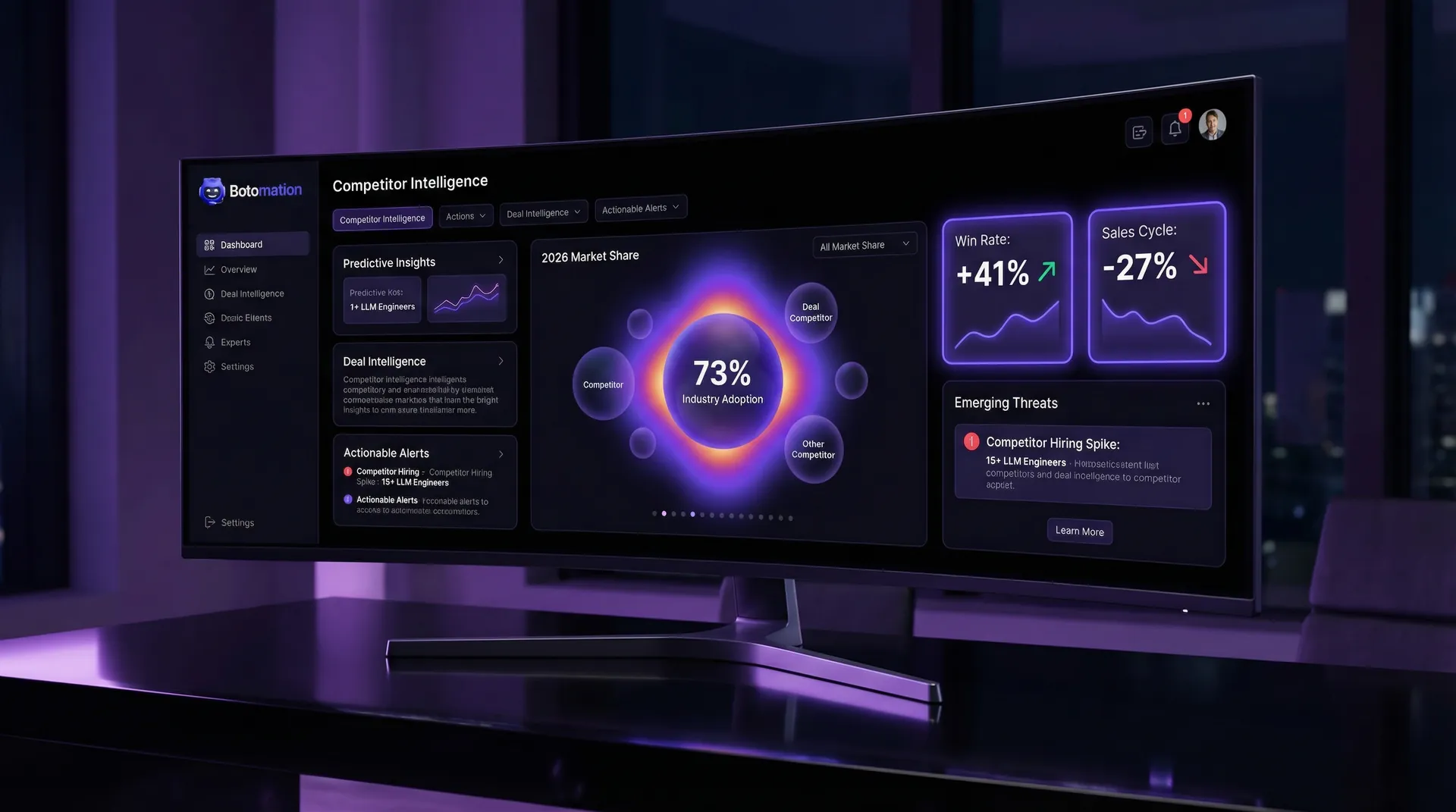
The B2B sales landscape in late 2026 has transitioned beyond the era of simple CRM tracking and manual outreach. Today, the margin between a closed-won deal and a missed opportunity frequently depends on who possesses the most current and accurate market data. Recent industry reports indicate that 73% of high-growth companies have now fully integrated sales intelligence into their daily workflows—a significant leap from the 34% observed just three years ago. This shift reflects a fundamental change in how enterprise organizations approach the market, moving away from reactive strategies toward proactive, data-driven execution to gain a sales team competitive advantage.
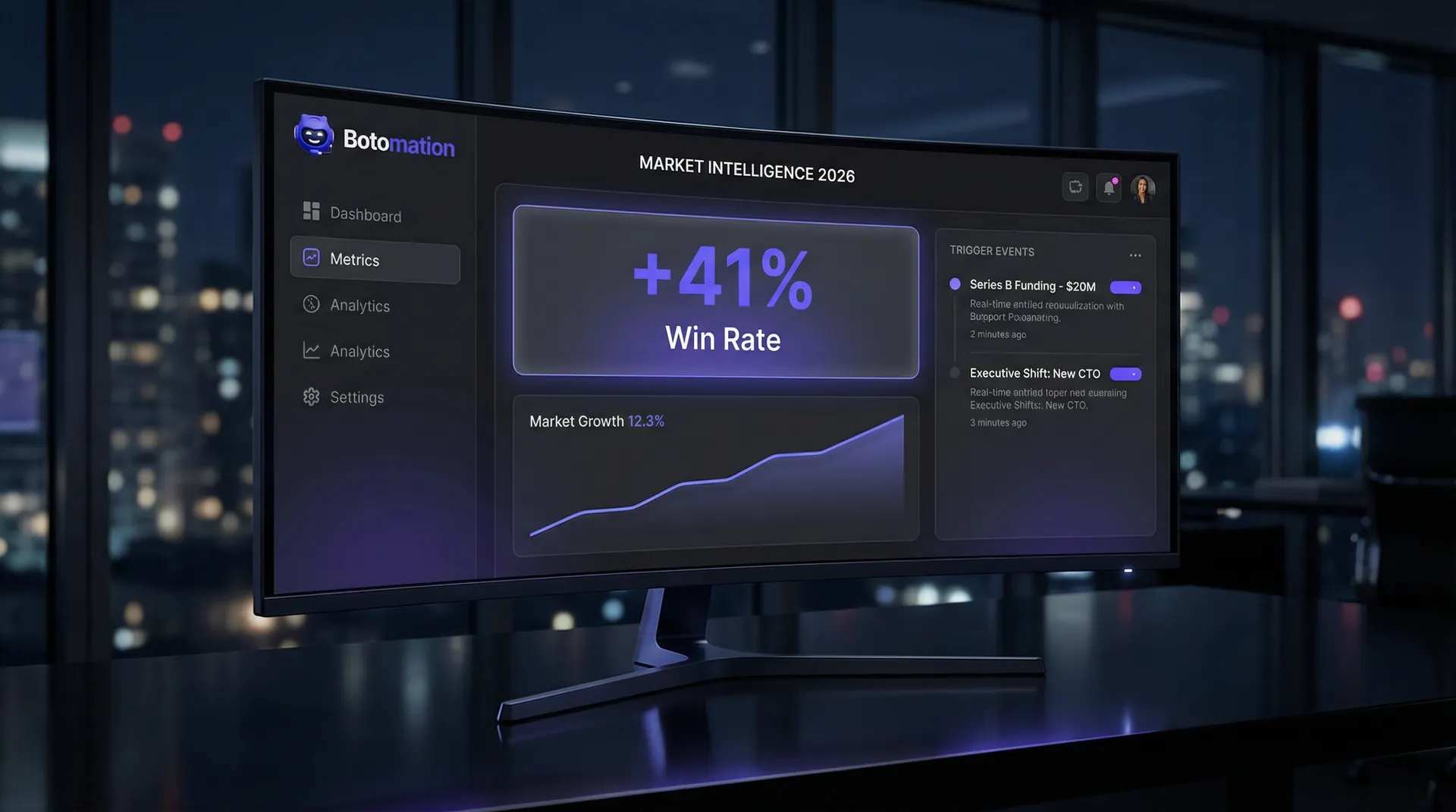
Implementing automated competitor analysis for sales team advantage using the best competitor analysis tools for 2026 is no longer a luxury reserved for the innovative few; it is a baseline requirement for survival. Organizations that fail to automate their intelligence gathering operate at a substantial disadvantage, often discovering competitor moves only after a prospect mentions them during a late-stage meeting. By the time a salesperson hears about a rival’s new feature or a recent price drop from a client, the tactical advantage has already vanished. Conversely, teams utilizing sophisticated automation can see win rates climb by as much as 41% while simultaneously reducing deal cycles by 27%.
The cost of manual competitor tracking is hidden but devastating. It consumes hours of valuable sales time that should be dedicated to relationship building and high-level strategy. When your team is preoccupied with manually browsing LinkedIn or scouring press releases, they aren't selling. At Botomation, we have observed that the "Old Way" of manual research consistently leads to stale data and missed signals. In contrast, the "New Way" involves custom-built pipelines that scan the digital horizon 24/7, delivering fresh, qualified insights directly to your reps before they even begin their day.
Step 1: Setting Up Automated Competitor Analysis for Sales Team Advantage
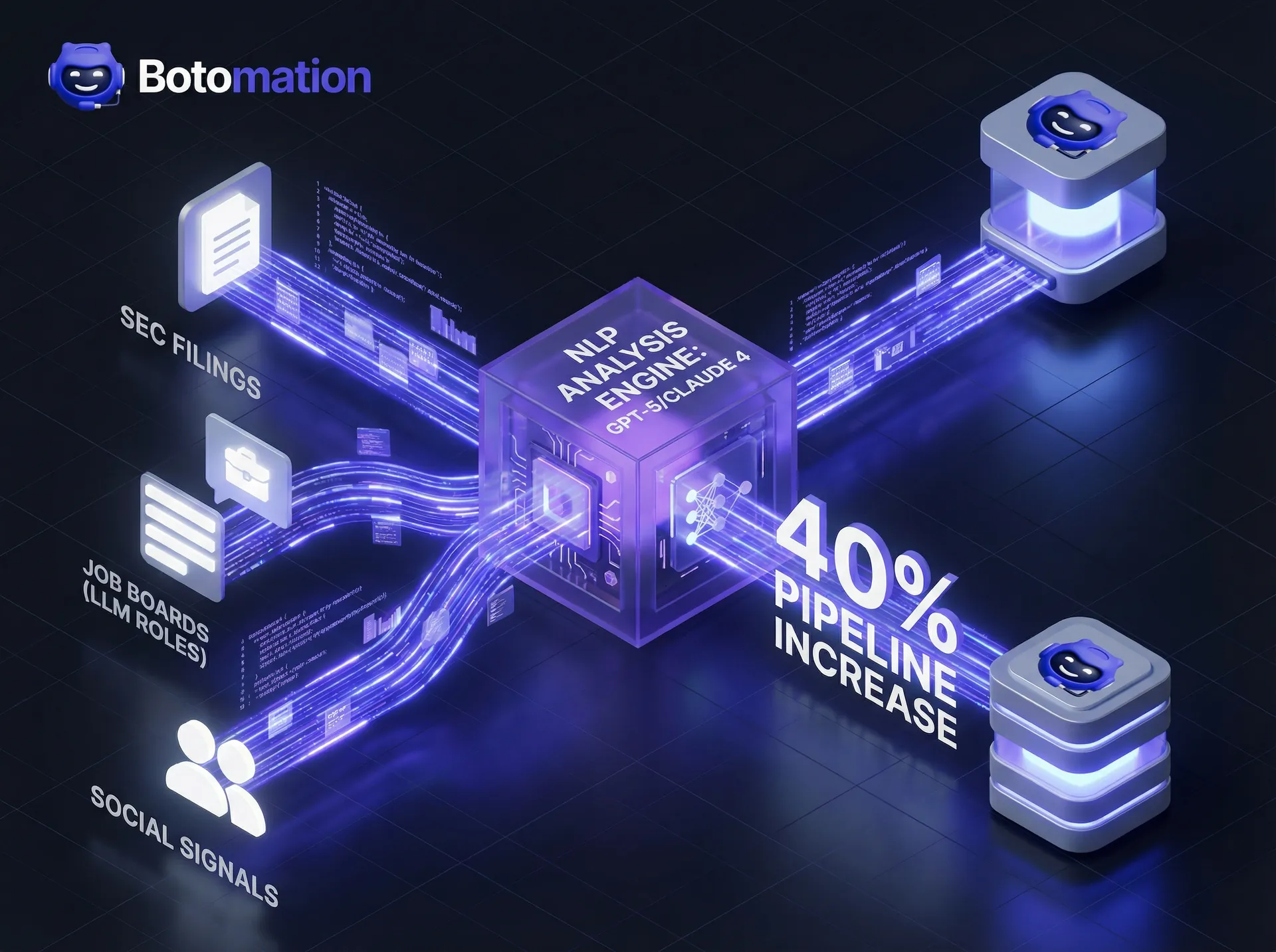
Establishing a reliable infrastructure for B2B competitor tracking automation is the foundation of any successful intelligence strategy. In 2026, this involves more than just setting up basic Google Alerts. It requires a sophisticated web of API integrations and web scraping for competitor intelligence to monitor a variety of public and semi-public data sources. To gain a true automated competitor analysis for sales team advantage, you must look where others aren't: public financial filings, localized hiring patterns, and specific product documentation updates.
When we partner with clients, we focus on building bespoke systems for prospect research automation that handle the heavy lifting of data ingestion. For instance, monitoring SEC filings or international equivalents can reveal shifts in a competitor's R&D spending months before a product launch. Similarly, tracking a rival's job boards for specific technical roles—such as an influx of Python developers specializing in specialized LLM training—can signal a pivot in their technology stack. This level of granularity allows your sales team to anticipate objections and position your solution more effectively.
Industry Insight: A leading B2B SaaS company recently partnered with our experts to overhaul their tracking systems. By automating the monitoring of three primary rivals, they achieved a 40% increase in their sales pipeline within six months. They weren't just finding more leads; they were utilizing AI B2B prospecting tools to identify the right leads at the moment their competitors were most vulnerable.
1.1: Data Sources and Collection Methods
The effectiveness of your intelligence depends entirely on the quality of your inputs. We prioritize monitoring public financial reports and earnings call transcripts using natural language processing (NLP) to identify mentions of market shifts or new strategic priorities. These documents are gold mines for understanding a competitor's long-term roadmap and potential weaknesses.
Beyond financials, your system should track social media activity and press releases in real-time. We also recommend building feature comparison databases that automatically update when a competitor modifies their documentation or pricing pages. This ensures that your sales collateral is never outdated, providing a reliable foundation for every pitch your team delivers.
1.2: Technical Infrastructure Requirements
Building this infrastructure requires a blend of API connectivity and advanced data processing. We utilize custom-built connectors to pull data from diverse sources into a centralized repository, ensuring that information is never siloed across departments. This process includes automated data cleaning and normalization, which is vital for comparing disparate data sets accurately.
Natural language processing (NLP) models, such as those available in GPT-5 or specialized Claude 4 iterations, are employed to analyze competitive documents for sentiment and intent. This technology can distinguish between a routine product update and a major strategic shift. By automating this analysis, your team receives summarized, actionable insights rather than a mountain of raw text that no one has time to digest.
Step 2: Market Intelligence Automation and Identifying Key Competitors
Not all competitors deserve the same level of scrutiny. A common mistake we see is companies trying to track every single player in their space with equal intensity. This leads to information overload and dilutes the impact of the most critical insights. To achieve a real market intelligence automation strategy, you must implement a rigorous prioritization framework that categorizes rivals based on their actual threat level to your specific deals.
We categorize competitors into three distinct buckets: direct, indirect, and potential entrants. Direct competitors offer a similar value proposition to the same target audience. Indirect competitors might solve the same problem with a different technology or business model. Potential entrants are the "stealth" players—startups or established firms from adjacent markets showing signs of moving into your territory. By using AI-driven sentiment analysis and a refined competitive intelligence workflow, our team can identify these emerging threats long before they appear on a standard Gartner Magic Quadrant.
2.1: Competitor Classification Framework
Direct competitors require deep, daily monitoring of their pricing, feature sets, and sales tactics. These are the organizations you meet most often in the final stages of a deal. Your intelligence on them must be surgical, focusing on the specific "why we win" and "why we lose" factors that your sales reps encounter on the ground.
Indirect and potential competitors require a broader, more strategic lens. You aren't necessarily looking for their daily price changes, but rather their shifts in positioning or new partnerships. Understanding these players helps your team frame your solution as a unique category, effectively neutralizing the "substitute" threat before it gains traction in the prospect's mind.
2.2: Priority Scoring System
To keep your team focused, we implement a priority scoring system based on objective metrics like market share, revenue growth, and recent investment rounds. A competitor who just raised $50 million in Series C funding is a much higher priority than a legacy player with stagnant growth. We also factor in "innovation velocity"—how quickly a competitor moves from a feature announcement to a full release.
This scoring is dynamic; it evolves as the market changes. Our automated systems adjust these scores in real-time based on the signals we collect. If a competitor's hiring for sales roles suddenly spikes in your key territory, their priority score increases, and your local reps are notified immediately to shore up their existing accounts and prospects.
Step 3: Monitoring Competitor Pricing, Features, and Positioning
In the fast-moving B2B world of 2026, pricing is rarely static. Competitors often use dynamic pricing or unlisted discounts to capture market share. Our experts at Botomation build custom tools to track competitor pricing automatically by monitoring pricing pages and public-facing quote builders. This allows you to spot trends, such as a rival offering "end-of-quarter" discounts or bundling services that were previously sold separately.
Feature tracking is equally critical. We use automated tools to monitor product changelogs, help documentation, and developer forums. When a competitor launches a new integration or improves their API, your team needs to know that day, not next month. We pair this with positioning analysis, using NLP to scan their latest marketing campaigns and website copy. This helps you understand the "narrative" they are constructing, allowing your sales team to craft a counter-narrative that highlights your unique strengths.
3.1: Pricing Intelligence Automation
Automated pricing intelligence goes beyond just knowing the number on a website. It involves historical trend analysis to recognize patterns in how a competitor discounts their products. For example, if data shows a rival consistently drops prices by 15% in the final two weeks of December, your sales team can proactively address this with prospects who are currently evaluating both solutions.
We also perform competitive pricing gap analysis. By mapping your pricing against the market average and your top three rivals, we can identify "sweet spots" where you can increase margins or areas where your pricing might be a barrier to entry. This data-driven approach removes the guesswork from your pricing strategy and gives your sales team the confidence to hold firm on value.
3.2: Feature and Positioning Analysis
Understanding a competitor's feature set is only half the battle; you also need to understand how they communicate those features. Our team uses advanced scraping and text analysis to monitor changes in competitor messaging. If a rival shifts their focus from "efficiency" to "security," it's a clear indicator of where they believe the market is heading or where they are experiencing the most success.
We generate automated product comparison matrices that are updated in real-time. These aren't static PDFs; they are dynamic tools that your sales team can use during live demos. By highlighting the positioning gaps—the things you do that the competitor doesn't even address—you can steer the conversation toward your strengths and away from a simple feature-by-feature comparison.
| Feature | Manual Research (The Old Way) | Botomation Intelligence (The New Way) |
|---|---|---|
| **Data Freshness** | Weekly or Monthly updates | Real-time, continuous scanning |
| **Accuracy** | Prone to human error and bias | Verified, multi-source data points |
| **Sales Integration** | Reps must search for info | Insights pushed directly to CRM |
| **Scalability** | Limited by headcount | Unlimited; scales with your market |
| **Strategic Value** | Reactive and defensive | Proactive and offensive |
Step 4: Creating Dashboards for Automated Competitor Analysis for Sales Team Advantage
Information is only useful if it is accessible. A common failure point in many organizations is having high-quality data buried in spreadsheets that are rarely opened. To provide a true automated competitor analysis for sales team advantage, we build custom dashboards using competitor intelligence tools for sales like Power BI or Tableau, designed specifically for the needs of a high-velocity sales team. These dashboards provide a "single source of truth" for the competitive landscape.
These interfaces are not one-size-fits-all. A Sales Director needs a high-level view of market share and win/loss trends across the entire organization. A territory rep, however, needs to see which competitors are most active in their specific region and which accounts are currently being targeted by rivals. Our experts design these views to be intuitive, ensuring that even the least tech-savvy rep can find the information they need in seconds.
4.1: Dashboard Design and Functionality
A well-designed dashboard should act as an early warning system. We include competitive heat maps that show where your rivals are gaining ground and where they are retreating. Visual indicators, like red or green arrows, highlight significant changes in competitor pricing or sentiment. This allows leadership to make informed decisions about resource allocation and strategy shifts without digging through raw data.
Alert systems are integrated directly into the dashboard. If a major competitor releases a "killer feature" that directly competes with your core offering, a high-priority alert is triggered. This alert doesn't just announce the update; it includes a brief analysis of the impact and a link to the updated sales battle card, giving your team an immediate response plan.
4.2: CRM Integration and Sales Enablement
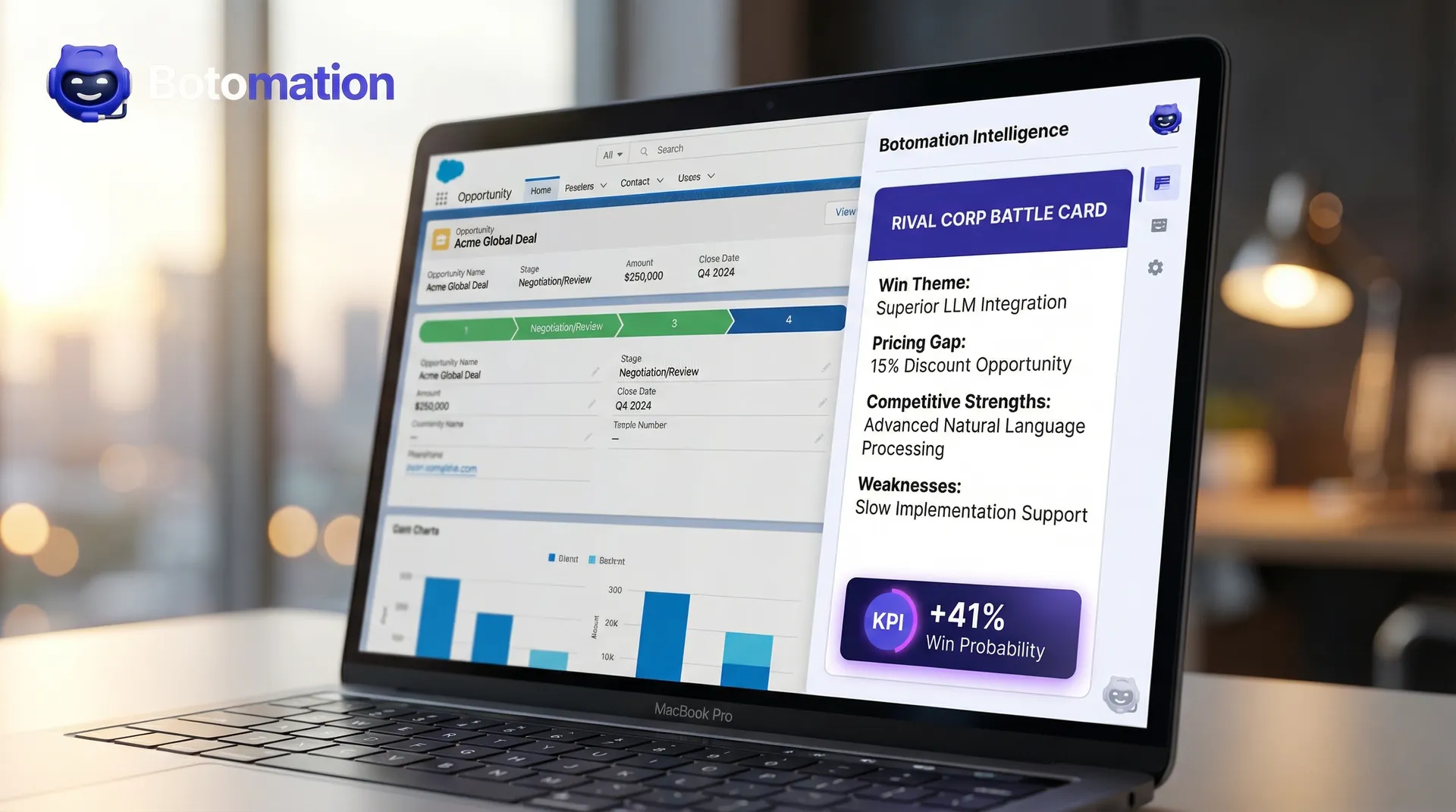
The most effective place for competitive intelligence is inside the tools your team already uses. We specialize in CRM email integration and injecting competitive insights directly into platforms like Salesforce or HubSpot. When a rep opens a specific opportunity and lists a competitor, the system can automatically surface relevant "battle cards" and talking points tailored to that specific rival.
This level of sales enablement ensures that your team is always prepared, even when caught off guard by a prospect's question. By automating the delivery of this information, you remove the friction that often prevents reps from using competitive data. Instead of searching a wiki, the answer is right there on the screen, exactly when they need it.
The Math of Efficiency: Consider a sales team of 20 reps. If each rep spends just 3 hours a week on manual competitor research, that’s 60 hours a week across the team. Over a year (50 weeks), that is 3,000 hours of lost selling time. At an average loaded cost of $100/hour, your "Old Way" of research is costing you $300,000 annually in lost productivity alone, not counting the missed deals.
Step 5: Distributing Competitor Intelligence to Sales Teams Daily
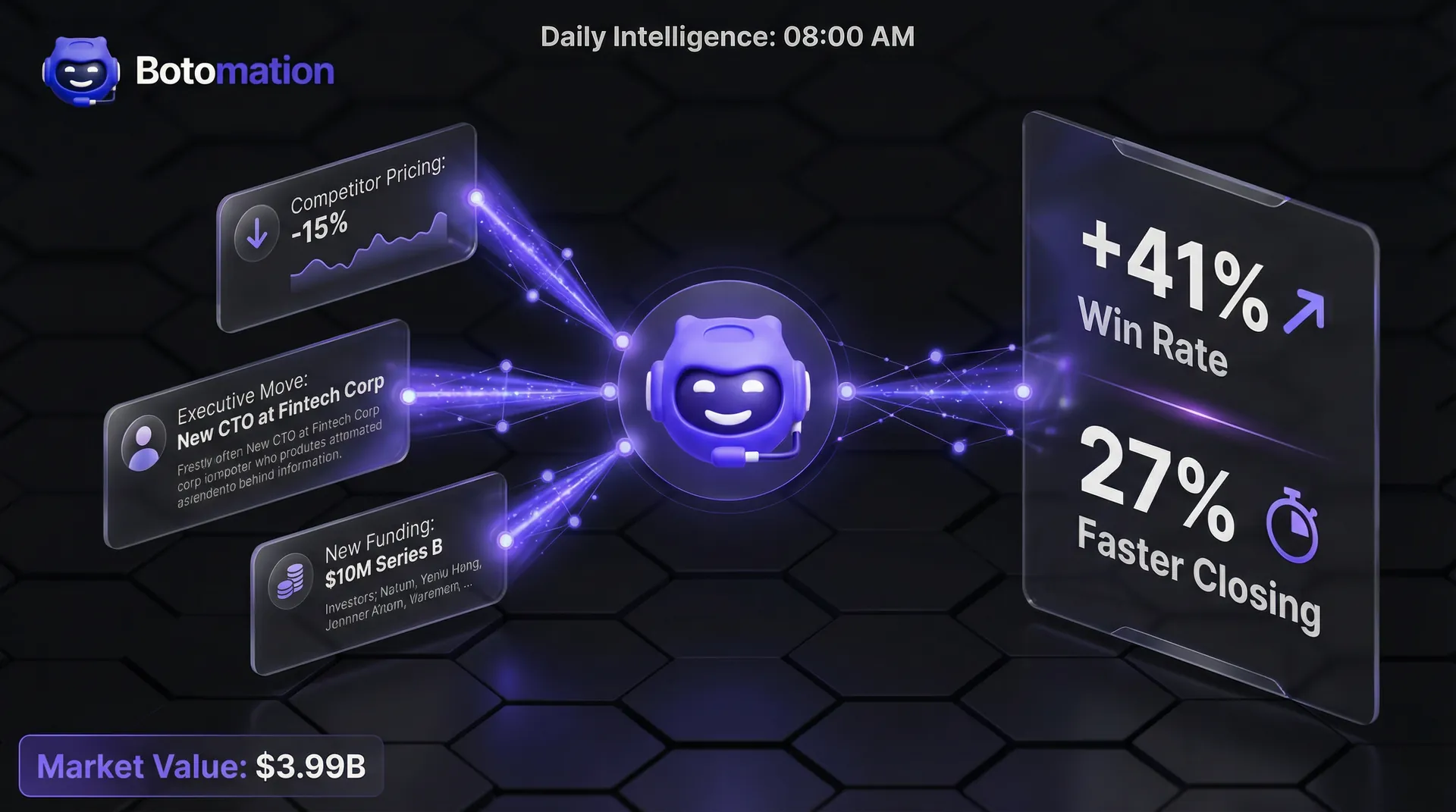
Consistency is the secret to successful intelligence. A massive quarterly report is often ignored, but automated daily market intelligence provides a routine of actionable information that is easily digested and applied. We set up automated distribution channels that deliver intelligence in the flow of work. This might be a daily morning email digest, a dedicated Slack channel with real-time alerts, or mobile app notifications for reps in the field.
The goal is to provide a "morning briefing" that prepares the team for the day's challenges. When a rep sees that a competitor’s site went down for four hours yesterday or that they just lost a major executive, they can use that information to build rapport or subtly cast doubt during their calls. Organizations that implement these daily distribution systems see 27% faster deal velocity because their reps spend less time guessing and more time executing.
5.1: Delivery Mechanisms and Channels
We integrate with the communication tools your team already utilizes. For many of our clients, a "Competitive Intelligence" Slack channel is the most effective method. We set up bots that post real-time updates—such as a competitor being mentioned in a new industry news article or a change in their LinkedIn hiring patterns.
For more detailed updates, we design automated email digests. These are not long-winded newsletters; they are bulleted, high-impact summaries of the last 24 hours. Each update includes a "So What?" section that explains why the information matters and what action the rep should take. This ensures that the data leads directly to a change in sales behavior.
5.2: Personalization and Relevance
Generic intelligence is often ignored. We use automation to ensure that the information delivered is relevant to the recipient. A rep focusing on the healthcare vertical doesn't need to know about a competitor's new fintech partnership. Our systems filter the data based on territory, industry, and even specific account lists.
We also use intelligence to influence lead scoring. If a prospect is searching for terms related to a competitor's specific weakness—a weakness we've identified through our automated tracking—that lead's score is automatically increased. This allows your team to prioritize the prospects where they have the highest mathematical probability of winning based on the current competitive landscape.
Step 6: Measuring and Optimizing Competitor Intelligence Impact
You cannot manage what you do not measure. A critical step in our process is setting up KPIs to track the ROI of your intelligence efforts. We look beyond just "win rates" and examine the specific impact of intelligence on your sales cycle. Are you winning more deals when a specific competitor is involved? Is your "time-to-close" shrinking for accounts where competitive battle cards were utilized?
By analyzing win/loss data alongside our intelligence logs, we can identify which data points are most predictive of success. This allows us to continuously refine your collection and distribution systems. If we find that tracking competitor hiring patterns doesn't correlate with win rates, but tracking their API documentation changes does, we shift our focus accordingly. This optimization ensures that your investment in automated competitor analysis for sales team advantage continues to deliver maximum value over time.
6.1: Performance Metrics and Measurement
We track "Competitive Win Rate" as a primary KPI. This is calculated by taking the number of deals won against a specific rival and dividing it by the total number of deals where that rival was present. By comparing this metric before and after implementing Botomation’s systems, we can provide a clear picture of the impact.
Other key metrics include:
- Competitive Messaging Effectiveness: Tracking which talk tracks lead to the highest progression rates in the sales funnel.
- Intelligence Adoption Rate: Monitoring how often reps are actually accessing the battle cards and dashboards we provide.
- Time-to-Insight: Measuring the gap between a competitor's move and your team's awareness of it.
6.2: Optimization and Continuous Improvement
The market is a living organism, and your intelligence system must be too. We conduct regular "Intelligence Audits" to evaluate the effectiveness of our data sources. If a particular news feed provides too much noise and not enough signal, we remove it. If a new, niche blog becomes a leading indicator for industry trends, we add it to the scraper list.
This continuous improvement cycle also involves gathering feedback from the sales team. We ask: "What information did you wish you had in your last meeting?" or "Which part of the daily digest was most helpful this week?" This human feedback, combined with our technical data, allows us to fine-tune the system so it becomes an indispensable part of the sales process. One of our manufacturing clients saw their customer satisfaction ratings improve by 48% simply because their sales and support teams were better prepared to handle competitive comparisons.
How to Implement Automated Tracking: A Quick Tutorial
- Audit Your Rivals: List your top 5 direct competitors and 3 "ones to watch."
- Define Your Signals: Decide what matters most: pricing, hiring, product updates, or customer reviews.
- Select Your Sources: Identify the websites, job boards, and social channels where these signals appear.
- Build the Pipeline: This is where Botomation excels—creating the custom scrapers and API connectors to pull this data automatically.
- Centralize the Data: Feed everything into a single database (the "Intelligence Hub").
- Create the Views: Build custom dashboards for leadership and "battle cards" for the sales reps.
- Automate Distribution: Set up the daily Slack or email alerts to keep the team informed without them having to search.
Frequently Asked Questions
How do you create a market intelligence dashboard for sales?
We begin by identifying the specific metrics that drive your sales process, such as competitor pricing, feature releases, and market sentiment. We then build a custom data pipeline that feeds this information into a visualization tool like Power BI or Tableau. The key is to create different "views" for different roles—high-level for executives and granular for account executives—ensuring the data is always relevant and actionable.
What are the best tools for sales team market intelligence?
While there are many off-the-shelf products, they often provide generic data that lacks the specific context your team needs. We believe the best "tool" is a custom-built ecosystem that combines specialized scrapers, NLP-driven analysis, and direct integration with your CRM. This approach ensures you own the data and the logic behind the insights, rather than being limited by a third-party platform's features.
How do you integrate competitive intelligence with CRM systems?
Integration is achieved through custom API connectors that link your intelligence database with platforms like Salesforce or HubSpot. We set up triggers so that when a competitor is named in an opportunity, the relevant battle cards, pricing comparisons, and "win themes" are automatically surfaced on the rep's screen. This places the intelligence exactly where the work is happening, maximizing its impact on the deal.
What data sources should be used for competitor tracking?
A comprehensive strategy uses a mix of sources. We monitor public financials (SEC filings), job boards (to track hiring pivots), social media sentiment, developer forums (for technical shifts), and direct website changes (pricing and feature updates). By triangulating data from these different areas, we can provide a much more accurate and predictive picture of a competitor's next move.
What are the best practices for market intelligence in B2B sales?
The best practices include automating the data collection to ensure real-time accuracy, integrating insights directly into the CRM to minimize friction for reps, and prioritizing competitors based on their actual threat level to current deals. Consistency is key; daily summaries are far more effective for sales teams than large quarterly reports.
The landscape of 2026 demands a level of precision that manual processes simply cannot provide. Relying on "gut feeling" or sporadic research is a recipe for stagnation. The data is clear: companies that embrace automation win more often, close deals faster, and maintain higher margins. By the end of this year, an estimated 80% of top-performing B2B organizations will be using some form of AI-powered competitive analysis to drive their sales strategy.
The "Old Way" of manual tracking is slow, expensive, and error-prone. It leaves your sales team reactive and vulnerable. The "New Way"—partnering with the experts at Botomation—gives you a permanent, automated advantage. We don't just provide a tool; we build a custom intelligence engine that works specifically for your business, delivering the leads and insights you need to dominate your market.
Ready to automate your growth? Stop losing deals to competitors you didn't see coming. Book a call below and let our experts build your competitive advantage today.
The B2B sales landscape in late 2026 has transitioned beyond the era of simple CRM tracking and manual outreach. Today, the margin between a closed-won deal and a missed opportunity frequently depends on who possesses the most current and accurate market data. Recent industry reports indicate that 73% of high-growth companies have now fully integrated sales intelligence into their daily workflows—a significant leap from the 34% observed just three years ago. This shift reflects a fundamental change in how enterprise organizations approach the market, moving away from reactive strategies toward proactive, data-driven execution to gain a sales team competitive advantage.
Implementing automated competitor analysis for sales team advantage using the best competitor analysis tools for 2026 is no longer a luxury reserved for the innovative few; it is a baseline requirement for survival. Organizations that fail to automate their intelligence gathering operate at a substantial disadvantage, often discovering competitor moves only after a prospect mentions them during a late-stage meeting. By the time a salesperson hears about a rival’s new feature or a recent price drop from a client, the tactical advantage has already vanished. Conversely, teams utilizing sophisticated automation can see win rates climb by as much as 41% while simultaneously reducing deal cycles by 27%.
The cost of manual competitor tracking is hidden but devastating. It consumes hours of valuable sales time that should be dedicated to relationship building and high-level strategy. When your team is preoccupied with manually browsing LinkedIn or scouring press releases, they aren't selling. At Botomation, we have observed that the "Old Way" of manual research consistently leads to stale data and missed signals. In contrast, the "New Way" involves custom-built pipelines that scan the digital horizon 24/7, delivering fresh, qualified insights directly to your reps before they even begin their day.
Step 1: Setting Up Automated Competitor Analysis for Sales Team Advantage
Establishing a reliable infrastructure for B2B competitor tracking automation is the foundation of any successful intelligence strategy. In 2026, this involves more than just setting up basic Google Alerts. It requires a sophisticated web of API integrations and web scraping for competitor intelligence to monitor a variety of public and semi-public data sources. To gain a true automated competitor analysis for sales team advantage, you must look where others aren't: public financial filings, localized hiring patterns, and specific product documentation updates.
When we partner with clients, we focus on building bespoke systems for prospect research automation that handle the heavy lifting of data ingestion. For instance, monitoring SEC filings or international equivalents can reveal shifts in a competitor's R&D spending months before a product launch. Similarly, tracking a rival's job boards for specific technical roles—such as an influx of Python developers specializing in specialized LLM training—can signal a pivot in their technology stack. This level of granularity allows your sales team to anticipate objections and position your solution more effectively.
Industry Insight: A leading B2B SaaS company recently partnered with our experts to overhaul their tracking systems. By automating the monitoring of three primary rivals, they achieved a 40% increase in their sales pipeline within six months. They weren't just finding more leads; they were utilizing AI B2B prospecting tools to identify the right leads at the moment their competitors were most vulnerable.
1.1: Data Sources and Collection Methods
The effectiveness of your intelligence depends entirely on the quality of your inputs. We prioritize monitoring public financial reports and earnings call transcripts using natural language processing (NLP) to identify mentions of market shifts or new strategic priorities. These documents are gold mines for understanding a competitor's long-term roadmap and potential weaknesses.
Beyond financials, your system should track social media activity and press releases in real-time. We also recommend building feature comparison databases that automatically update when a competitor modifies their documentation or pricing pages. This ensures that your sales collateral is never outdated, providing a reliable foundation for every pitch your team delivers.
1.2: Technical Infrastructure Requirements
Building this infrastructure requires a blend of API connectivity and advanced data processing. We utilize custom-built connectors to pull data from diverse sources into a centralized repository, ensuring that information is never siloed across departments. This process includes automated data cleaning and normalization, which is vital for comparing disparate data sets accurately.
Natural language processing (NLP) models, such as those available in GPT-5 or specialized Claude 4 iterations, are employed to analyze competitive documents for sentiment and intent. This technology can distinguish between a routine product update and a major strategic shift. By automating this analysis, your team receives summarized, actionable insights rather than a mountain of raw text that no one has time to digest.
Step 2: Market Intelligence Automation and Identifying Key Competitors
Not all competitors deserve the same level of scrutiny. A common mistake we see is companies trying to track every single player in their space with equal intensity. This leads to information overload and dilutes the impact of the most critical insights. To achieve a real market intelligence automation strategy, you must implement a rigorous prioritization framework that categorizes rivals based on their actual threat level to your specific deals.
We categorize competitors into three distinct buckets: direct, indirect, and potential entrants. Direct competitors offer a similar value proposition to the same target audience. Indirect competitors might solve the same problem with a different technology or business model. Potential entrants are the "stealth" players—startups or established firms from adjacent markets showing signs of moving into your territory. By using AI-driven sentiment analysis and a refined competitive intelligence workflow, our team can identify these emerging threats long before they appear on a standard Gartner Magic Quadrant.
2.1: Competitor Classification Framework
Direct competitors require deep, daily monitoring of their pricing, feature sets, and sales tactics. These are the organizations you meet most often in the final stages of a deal. Your intelligence on them must be surgical, focusing on the specific "why we win" and "why we lose" factors that your sales reps encounter on the ground.
Indirect and potential competitors require a broader, more strategic lens. You aren't necessarily looking for their daily price changes, but rather their shifts in positioning or new partnerships. Understanding these players helps your team frame your solution as a unique category, effectively neutralizing the "substitute" threat before it gains traction in the prospect's mind.
2.2: Priority Scoring System
To keep your team focused, we implement a priority scoring system based on objective metrics like market share, revenue growth, and recent investment rounds. A competitor who just raised $50 million in Series C funding is a much higher priority than a legacy player with stagnant growth. We also factor in "innovation velocity"—how quickly a competitor moves from a feature announcement to a full release.
This scoring is dynamic; it evolves as the market changes. Our automated systems adjust these scores in real-time based on the signals we collect. If a competitor's hiring for sales roles suddenly spikes in your key territory, their priority score increases, and your local reps are notified immediately to shore up their existing accounts and prospects.
Step 3: Monitoring Competitor Pricing, Features, and Positioning
In the fast-moving B2B world of 2026, pricing is rarely static. Competitors often use dynamic pricing or unlisted discounts to capture market share. Our experts at Botomation build custom tools to track competitor pricing automatically by monitoring pricing pages and public-facing quote builders. This allows you to spot trends, such as a rival offering "end-of-quarter" discounts or bundling services that were previously sold separately.
Feature tracking is equally critical. We use automated tools to monitor product changelogs, help documentation, and developer forums. When a competitor launches a new integration or improves their API, your team needs to know that day, not next month. We pair this with positioning analysis, using NLP to scan their latest marketing campaigns and website copy. This helps you understand the "narrative" they are constructing, allowing your sales team to craft a counter-narrative that highlights your unique strengths.
3.1: Pricing Intelligence Automation
Automated pricing intelligence goes beyond just knowing the number on a website. It involves historical trend analysis to recognize patterns in how a competitor discounts their products. For example, if data shows a rival consistently drops prices by 15% in the final two weeks of December, your sales team can proactively address this with prospects who are currently evaluating both solutions.
We also perform competitive pricing gap analysis. By mapping your pricing against the market average and your top three rivals, we can identify "sweet spots" where you can increase margins or areas where your pricing might be a barrier to entry. This data-driven approach removes the guesswork from your pricing strategy and gives your sales team the confidence to hold firm on value.
3.2: Feature and Positioning Analysis
Understanding a competitor's feature set is only half the battle; you also need to understand how they communicate those features. Our team uses advanced scraping and text analysis to monitor changes in competitor messaging. If a rival shifts their focus from "efficiency" to "security," it's a clear indicator of where they believe the market is heading or where they are experiencing the most success.
We generate automated product comparison matrices that are updated in real-time. These aren't static PDFs; they are dynamic tools that your sales team can use during live demos. By highlighting the positioning gaps—the things you do that the competitor doesn't even address—you can steer the conversation toward your strengths and away from a simple feature-by-feature comparison.
| Feature | Manual Research (The Old Way) | Botomation Intelligence (The New Way) |
|---|---|---|
| **Data Freshness** | Weekly or Monthly updates | Real-time, continuous scanning |
| **Accuracy** | Prone to human error and bias | Verified, multi-source data points |
| **Sales Integration** | Reps must search for info | Insights pushed directly to CRM |
| **Scalability** | Limited by headcount | Unlimited; scales with your market |
| **Strategic Value** | Reactive and defensive | Proactive and offensive |
Step 4: Creating Dashboards for Automated Competitor Analysis for Sales Team Advantage
Information is only useful if it is accessible. A common failure point in many organizations is having high-quality data buried in spreadsheets that are rarely opened. To provide a true automated competitor analysis for sales team advantage, we build custom dashboards using competitor intelligence tools for sales like Power BI or Tableau, designed specifically for the needs of a high-velocity sales team. These dashboards provide a "single source of truth" for the competitive landscape.
These interfaces are not one-size-fits-all. A Sales Director needs a high-level view of market share and win/loss trends across the entire organization. A territory rep, however, needs to see which competitors are most active in their specific region and which accounts are currently being targeted by rivals. Our experts design these views to be intuitive, ensuring that even the least tech-savvy rep can find the information they need in seconds.
4.1: Dashboard Design and Functionality
A well-designed dashboard should act as an early warning system. We include competitive heat maps that show where your rivals are gaining ground and where they are retreating. Visual indicators, like red or green arrows, highlight significant changes in competitor pricing or sentiment. This allows leadership to make informed decisions about resource allocation and strategy shifts without digging through raw data.
Alert systems are integrated directly into the dashboard. If a major competitor releases a "killer feature" that directly competes with your core offering, a high-priority alert is triggered. This alert doesn't just announce the update; it includes a brief analysis of the impact and a link to the updated sales battle card, giving your team an immediate response plan.
4.2: CRM Integration and Sales Enablement
The most effective place for competitive intelligence is inside the tools your team already uses. We specialize in CRM email integration and injecting competitive insights directly into platforms like Salesforce or HubSpot. When a rep opens a specific opportunity and lists a competitor, the system can automatically surface relevant "battle cards" and talking points tailored to that specific rival.
This level of sales enablement ensures that your team is always prepared, even when caught off guard by a prospect's question. By automating the delivery of this information, you remove the friction that often prevents reps from using competitive data. Instead of searching a wiki, the answer is right there on the screen, exactly when they need it.
The Math of Efficiency: Consider a sales team of 20 reps. If each rep spends just 3 hours a week on manual competitor research, that’s 60 hours a week across the team. Over a year (50 weeks), that is 3,000 hours of lost selling time. At an average loaded cost of $100/hour, your "Old Way" of research is costing you $300,000 annually in lost productivity alone, not counting the missed deals.
Step 5: Distributing Competitor Intelligence to Sales Teams Daily
Consistency is the secret to successful intelligence. A massive quarterly report is often ignored, but automated daily market intelligence provides a routine of actionable information that is easily digested and applied. We set up automated distribution channels that deliver intelligence in the flow of work. This might be a daily morning email digest, a dedicated Slack channel with real-time alerts, or mobile app notifications for reps in the field.
The goal is to provide a "morning briefing" that prepares the team for the day's challenges. When a rep sees that a competitor’s site went down for four hours yesterday or that they just lost a major executive, they can use that information to build rapport or subtly cast doubt during their calls. Organizations that implement these daily distribution systems see 27% faster deal velocity because their reps spend less time guessing and more time executing.
5.1: Delivery Mechanisms and Channels
We integrate with the communication tools your team already utilizes. For many of our clients, a "Competitive Intelligence" Slack channel is the most effective method. We set up bots that post real-time updates—such as a competitor being mentioned in a new industry news article or a change in their LinkedIn hiring patterns.
For more detailed updates, we design automated email digests. These are not long-winded newsletters; they are bulleted, high-impact summaries of the last 24 hours. Each update includes a "So What?" section that explains why the information matters and what action the rep should take. This ensures that the data leads directly to a change in sales behavior.
5.2: Personalization and Relevance
Generic intelligence is often ignored. We use automation to ensure that the information delivered is relevant to the recipient. A rep focusing on the healthcare vertical doesn't need to know about a competitor's new fintech partnership. Our systems filter the data based on territory, industry, and even specific account lists.
We also use intelligence to influence lead scoring. If a prospect is searching for terms related to a competitor's specific weakness—a weakness we've identified through our automated tracking—that lead's score is automatically increased. This allows your team to prioritize the prospects where they have the highest mathematical probability of winning based on the current competitive landscape.
Step 6: Measuring and Optimizing Competitor Intelligence Impact
You cannot manage what you do not measure. A critical step in our process is setting up KPIs to track the ROI of your intelligence efforts. We look beyond just "win rates" and examine the specific impact of intelligence on your sales cycle. Are you winning more deals when a specific competitor is involved? Is your "time-to-close" shrinking for accounts where competitive battle cards were utilized?
By analyzing win/loss data alongside our intelligence logs, we can identify which data points are most predictive of success. This allows us to continuously refine your collection and distribution systems. If we find that tracking competitor hiring patterns doesn't correlate with win rates, but tracking their API documentation changes does, we shift our focus accordingly. This optimization ensures that your investment in automated competitor analysis for sales team advantage continues to deliver maximum value over time.
6.1: Performance Metrics and Measurement
We track "Competitive Win Rate" as a primary KPI. This is calculated by taking the number of deals won against a specific rival and dividing it by the total number of deals where that rival was present. By comparing this metric before and after implementing Botomation’s systems, we can provide a clear picture of the impact.
Other key metrics include:
- Competitive Messaging Effectiveness: Tracking which talk tracks lead to the highest progression rates in the sales funnel.
- Intelligence Adoption Rate: Monitoring how often reps are actually accessing the battle cards and dashboards we provide.
- Time-to-Insight: Measuring the gap between a competitor's move and your team's awareness of it.
6.2: Optimization and Continuous Improvement
The market is a living organism, and your intelligence system must be too. We conduct regular "Intelligence Audits" to evaluate the effectiveness of our data sources. If a particular news feed provides too much noise and not enough signal, we remove it. If a new, niche blog becomes a leading indicator for industry trends, we add it to the scraper list.
This continuous improvement cycle also involves gathering feedback from the sales team. We ask: "What information did you wish you had in your last meeting?" or "Which part of the daily digest was most helpful this week?" This human feedback, combined with our technical data, allows us to fine-tune the system so it becomes an indispensable part of the sales process. One of our manufacturing clients saw their customer satisfaction ratings improve by 48% simply because their sales and support teams were better prepared to handle competitive comparisons.
How to Implement Automated Tracking: A Quick Tutorial
- Audit Your Rivals: List your top 5 direct competitors and 3 "ones to watch."
- Define Your Signals: Decide what matters most: pricing, hiring, product updates, or customer reviews.
- Select Your Sources: Identify the websites, job boards, and social channels where these signals appear.
- Build the Pipeline: This is where Botomation excels—creating the custom scrapers and API connectors to pull this data automatically.
- Centralize the Data: Feed everything into a single database (the "Intelligence Hub").
- Create the Views: Build custom dashboards for leadership and "battle cards" for the sales reps.
- Automate Distribution: Set up the daily Slack or email alerts to keep the team informed without them having to search.
Frequently Asked Questions
How do you create a market intelligence dashboard for sales?
We begin by identifying the specific metrics that drive your sales process, such as competitor pricing, feature releases, and market sentiment. We then build a custom data pipeline that feeds this information into a visualization tool like Power BI or Tableau. The key is to create different "views" for different roles—high-level for executives and granular for account executives—ensuring the data is always relevant and actionable.
What are the best tools for sales team market intelligence?
While there are many off-the-shelf products, they often provide generic data that lacks the specific context your team needs. We believe the best "tool" is a custom-built ecosystem that combines specialized scrapers, NLP-driven analysis, and direct integration with your CRM. This approach ensures you own the data and the logic behind the insights, rather than being limited by a third-party platform's features.
How do you integrate competitive intelligence with CRM systems?
Integration is achieved through custom API connectors that link your intelligence database with platforms like Salesforce or HubSpot. We set up triggers so that when a competitor is named in an opportunity, the relevant battle cards, pricing comparisons, and "win themes" are automatically surfaced on the rep's screen. This places the intelligence exactly where the work is happening, maximizing its impact on the deal.
What data sources should be used for competitor tracking?
A comprehensive strategy uses a mix of sources. We monitor public financials (SEC filings), job boards (to track hiring pivots), social media sentiment, developer forums (for technical shifts), and direct website changes (pricing and feature updates). By triangulating data from these different areas, we can provide a much more accurate and predictive picture of a competitor's next move.
What are the best practices for market intelligence in B2B sales?
The best practices include automating the data collection to ensure real-time accuracy, integrating insights directly into the CRM to minimize friction for reps, and prioritizing competitors based on their actual threat level to current deals. Consistency is key; daily summaries are far more effective for sales teams than large quarterly reports.
The landscape of 2026 demands a level of precision that manual processes simply cannot provide. Relying on "gut feeling" or sporadic research is a recipe for stagnation. The data is clear: companies that embrace automation win more often, close deals faster, and maintain higher margins. By the end of this year, an estimated 80% of top-performing B2B organizations will be using some form of AI-powered competitive analysis to drive their sales strategy.
The "Old Way" of manual tracking is slow, expensive, and error-prone. It leaves your sales team reactive and vulnerable. The "New Way"—partnering with the experts at Botomation—gives you a permanent, automated advantage. We don't just provide a tool; we build a custom intelligence engine that works specifically for your business, delivering the leads and insights you need to dominate your market.
Ready to automate your growth? Stop losing deals to competitors you didn't see coming. Book a call below and let our experts build your competitive advantage today.
Get Started
Book a FREE Consultation Right NOW!
Schedule a Call with Our Team To Make Your Business More Efficient with AI Instantly.
Read More
2026 Automated Competitor Analysis for Sales Team Advantage
Optimize automated competitor analysis for sales team advantage. Get B2B market intelligence and automated prospecting for 2026 growth.
Automated Daily Market Intelligence Reports for Sales Teams
Learn how WhatsApp AI slashes support costs for e-commerce & SaaS. Proven strategies to boost sales, recover carts, and scale 24/7 service.