AI B2B Prospecting Tools for SaaS Growth in 2026
Jan 7, 2026
SaaS
AI Automation
B2B Sales
SaaS
AI Automation
B2B Sales
The landscape of B2B sales has shifted fundamentally over the last twelve months. If you are still relying on manual list building and generic email templates in late 2026, you are essentially trying to win a Formula 1 race on a bicycle. We have moved past the era of simple automation into the age of autonomous agentic workflows. Leading SaaS organizations are no longer asking their sales development representatives to spend hours scouring LinkedIn or verifying email addresses. Instead, they are deploying AI SaaS lead qualification tools that handle the heavy lifting of identification, qualification, and initial engagement.
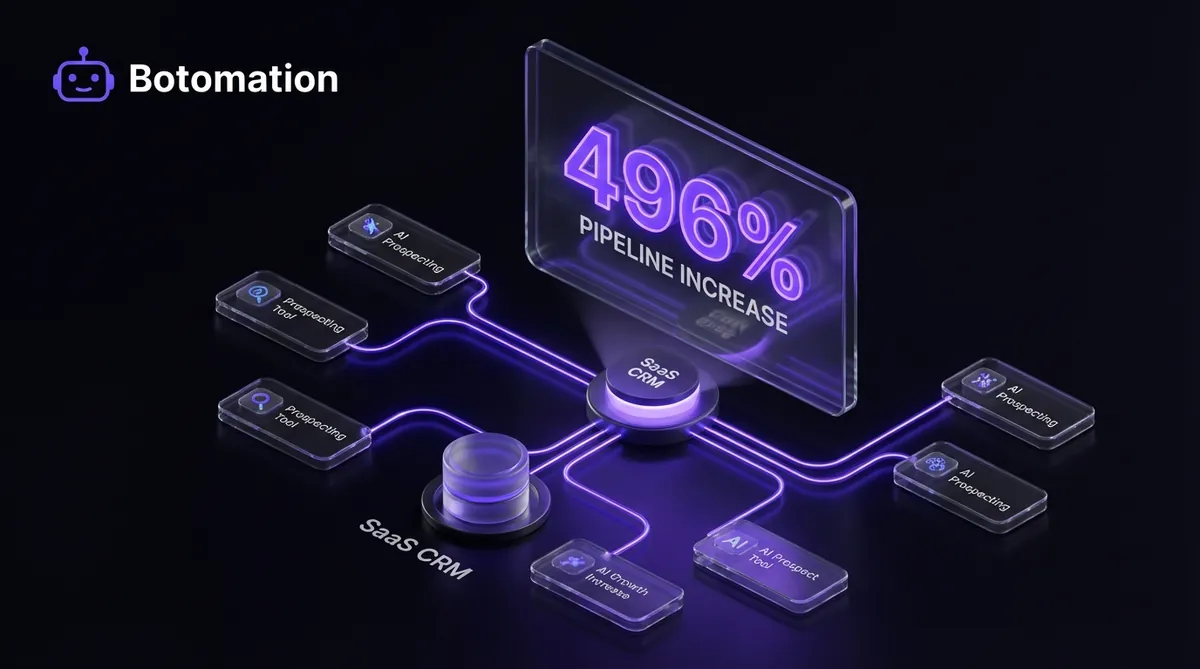
One enterprise software provider recently demonstrated the power of this shift by achieving a staggering 496% increase in their sales pipeline within a single quarter through automated pipeline building for SaaS sales. They didn't hire a massive new team or triple their ad spend; they simply replaced their manual prospecting workflows with a stack of automated B2B prospecting tools for SaaS growth that operate 24/7. This transition is particularly vital for SaaS companies because our industry faces unique hurdles: extended sales cycles, complex buying committees involving five to ten stakeholders, and the constant pressure of high customer acquisition costs (CAC).
These challenges require a level of precision that human researchers struggle to maintain at scale. Automated prospecting solves this by providing a consistent stream of high-intent leads while allowing your human experts to focus on what they do best: closing deals and building strategic relationships. In this guide, we will explore the specific strategies and tools—including daily market intelligence automation for B2B sales and automated competitor intelligence—that are defining sales excellence in 2026, moving from the foundational "why" to the technical "how" of modern pipeline generation.
Why SaaS Companies Need Automated B2B Prospecting in 2026
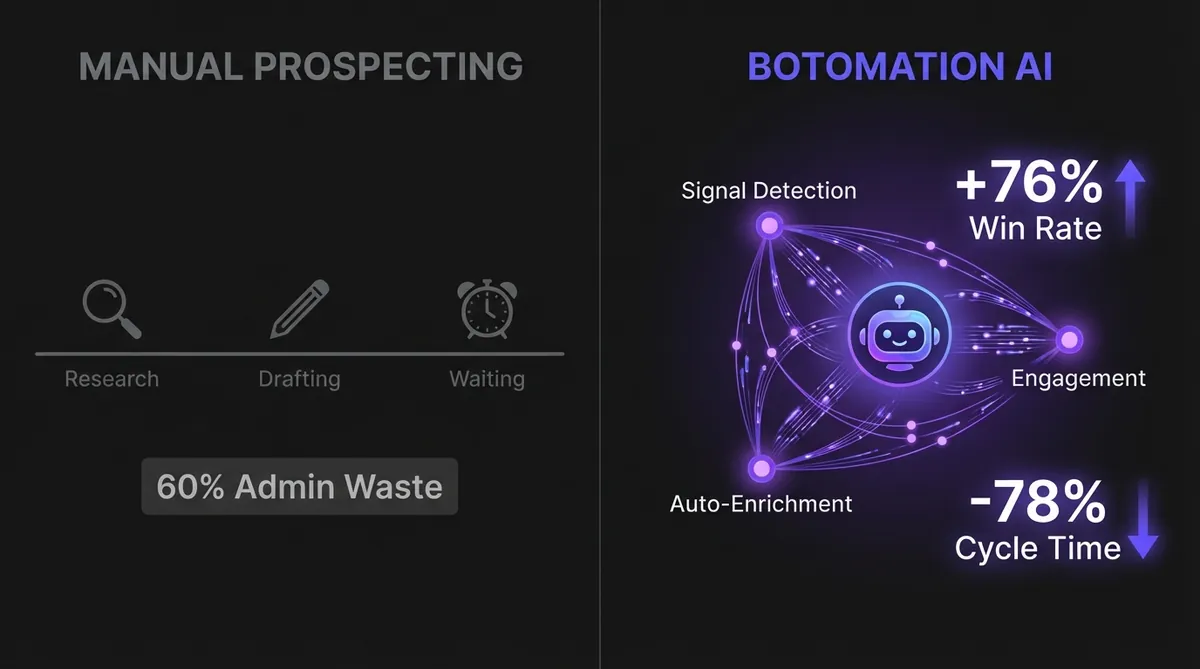
The math behind traditional sales prospecting simply does not add up anymore. When we look at the data from the past year, organizations that have integrated AI into their prospecting workflows are seeing a 76% increase in win rates. Even more impressive is the 78% reduction in deal cycle length. This happens because the AI isn't just finding more people; it is finding the right people at the exact moment they are experiencing the pain point your software solves.
Traditional prospecting is a linear process where a human rep finds a lead, researches them, and sends an email. AI-powered strategies are multi-dimensional. They analyze technographic data, recent funding rounds, hiring patterns, and even social media sentiment simultaneously. For example, a mid-sized insurance technology company recently leveraged automated lead scoring for B2B prospecting to identify which prospects were most likely to churn from their current legacy providers. By focusing their energy only on those "high-probability" targets, they achieved 3.5x higher conversion rates compared to their previous "spray and pray" method.
SaaS Specific Prospecting Challenges
The SaaS model is built on recurring revenue, which means the initial sale is just the beginning. However, getting to that initial sale is harder than ever. SaaS products often require buy-in from IT, Finance, and end-users, creating a complex web of stakeholders. Each of these individuals has different concerns and needs a different narrative. Manual prospecting fails here because a human rep rarely has the time to craft five different, highly-personalized messages for one account.
Furthermore, high customer acquisition costs mean that every hour a sales rep spends on a lead that doesn't fit the Ideal Customer Profile (ICP) is a direct hit to the company's bottom line. You need a system that filters out the noise before it ever reaches a human inbox. Continuous pipeline generation is the only way to offset churn and scale SaaS operations without adding headcount, maintaining the aggressive growth trajectories expected in the SaaS world. Without automation, your pipeline becomes a series of peaks and valleys rather than a steady, predictable flow.
The Cost of Manual Prospecting
To understand the true value of automation, we must look at the hidden costs of the "old way." A study involving the VTT Technical Research Center revealed that their team was losing over 1,000 hours annually just on basic lead qualification tasks, which can be mitigated by using automated lead verification tools. That is time that could have been spent on strategic account planning or high-level negotiations. When you break it down, the average sales representative spends nearly 60% of their day on administrative tasks and prospecting research rather than actually selling—a burden that can be solved by automating administrative tasks with AI.
Consider the financial implications of this inefficiency. If a junior SDR has a base salary of $45,000 and you add $11,250 in benefits and overhead, your total cost is $56,250. If that individual is spending 60% of their time on manual research, you are effectively paying $33,750 per year for data entry. Modern AI agents can replace manual data entry work, performing that same research with 99% accuracy for a fraction of the cost. The opportunity cost is even more damaging: every hour spent on a stale lead list is an hour not spent with a high-value prospect who is ready to buy.
"The goal of AI in prospecting isn't to replace the salesperson, but to remove the 'robotic' parts of their job so they can be more human." — Senior Growth Consultant at Botomation.
8 Best AI-Powered B2B Prospecting Tools for SaaS Companies in 2026
Choosing the right stack is the difference between a system that creates work and a system that creates revenue. In 2026, the best tools are those that offer deep integration, predictive capabilities, and the ability to handle multi-channel outreach without losing the human touch. Our team at Botomation has vetted dozens of platforms, and these eight stand out as the most effective for driving SaaS growth.
| Tool Name | Primary Strength | Best For | Typical Result |
|---|---|---|---|
| Smartlead | Multi-mailbox scaling | High-volume cold email | 30% higher deliverability |
| ZoomInfo | Database depth | Enterprise market intelligence | 95% data accuracy |
| Persana AI | AI SDR agents | End-to-end autonomous prospecting | 496% pipeline increase |
| Clay | Data enrichment | Hyper-personalized outreach | 10x faster lead research |
| 6sense | Intent signaling | Identifying "in-market" buyers | 2x increase in deal size |
| Apollo.io | All-in-one execution | Early-stage SaaS startups | 50% reduction in tool spend |
| Lavender | Email coaching | Improving reply rates | 20% higher response metrics |
| Lusha | Contact accuracy | Direct-dial procurement | 40% more successful connections |
Smartlead - AI-Powered Outreach Platform
Smartlead has become the gold standard for SaaS companies that need to scale their email outreach without landing in the spam folder. Its primary innovation is the multi-mailbox infrastructure, which allows you to distribute your sending volume across dozens of accounts while managing them from a single master inbox. In 2026, their AI-powered email warm-up features have evolved to simulate realistic human conversation patterns, making it nearly impossible for modern spam filters to flag the activity.
The platform also offers behavioral trigger sequences. If a prospect clicks a link but doesn't reply, the AI can automatically pivot the next message to address the specific content they viewed. For a SaaS company, this means you can offer a specific case study or a demo video based on real-time engagement. With pricing starting at $39/month for basic needs and scaling to $94/month for 30,000 leads, it provides a highly cost-effective way to maintain a massive outreach footprint.
ZoomInfo - Comprehensive B2B Database and Prospecting
While many new players have entered the market, ZoomInfo remains the heavyweight champion of B2B data. For SaaS companies targeting enterprise clients, the depth of their technographic data is unmatched. You can filter prospects not just by their job title, but by the specific software they currently use, their department budget, and even their "intent" signals—indicators that they are actively researching a solution like yours.
Their predictive lead scoring uses machine learning to analyze your existing customer base and find "lookalike" prospects who share the same characteristics as your highest-value clients. This moves prospecting from a guessing game to a data science exercise. Establishing a CRM email integration with platforms like Salesforce or HubSpot ensures that this intelligence flows directly into your existing workflows, allowing your sales team to see a prospect's entire history and tech stack before they even pick up the phone.
Persana AI - Advanced Lead Generation Platform
Persana AI represents the "New Way" of prospecting that we champion here at Botomation. It isn't just a database; it is an ecosystem of AI SDRs. These agents are capable of achieving results that were previously thought impossible, such as the 496% increase in pipeline and 454% growth in bookings mentioned earlier. The platform uses conversational AI to handle real-time qualification, often through WhatsApp AI agents for B2B lead qualification that can chat with a lead, answer technical questions, and book a meeting on a calendar without a human ever intervening.
The hyper-personalization engine in Persana AI can save a sales team up to 25 hours every week. Instead of a rep spending ten minutes researching a prospect's recent LinkedIn post to write a clever intro, the AI does it in seconds across thousands of leads. The performance metrics speak for themselves: users often see connection acceptance rates climb to 55% and reply rates hitting 19%, which is nearly four times the industry average for SaaS cold outreach.
Setting Up AI Prospecting Workflows for SaaS Lead Generation
Implementing these tools is not a "set it and forget it" process. To get the results we are talking about, you need a structured workflow that aligns with your specific SaaS business model. Whether you are selling a $50/month seat-based tool or a $100,000 enterprise platform, the underlying logic of automated prospecting remains the same: data integrity, smart scoring, and multi-channel persistence.
The first step is always identifying your "Source of Truth." For most SaaS companies, this is the CRM. However, a CRM is only as good as the data flowing into it. To prevent lead list decay, our experts at Botomation often start by building custom scrapers that scan the web for triggers—using AI-driven competitor analysis tools to detect a company hiring for a specific role or a competitor's service going down—to feed the AI prospecting engine with fresh, relevant leads every morning.
Data Integration and Lead Scoring Setup
Connecting your CRM data to your AI prospecting platform is where the magic happens. You want to move away from static lists and toward dynamic segments. By configuring predictive lead scoring models based on your SaaS Ideal Customer Profile (ICP) and utilizing automated lead filtering based on company size, the system can automatically prioritize leads that "look" like your best customers. This involves setting up behavioral triggers; for instance, if a prospect visits your pricing page three times in 24 hours, the AI should automatically move them to a "High Intent" sequence.
Establishing these qualification criteria is essential. In the SaaS world, a lead isn't just someone with a budget; it's someone with the right technical environment to support your software. Your automated system should be checking for these technographic requirements during the enrichment phase. This ensures that your sales team is only talking to prospects who can actually use your product, drastically reducing the time wasted in the discovery phase.
Multi-Channel Prospecting Sequence Design
A single email is no longer enough to break through the noise. A modern prospecting sequence must be multi-channel and multi-touch. This involves a coordinated dance between LinkedIn, email, and sometimes even automated voice drops. For tech decision-makers, LinkedIn is often the best place for initial engagement. Your AI can be programmed to view a profile, like a recent post, and then send a personalized connection request two days later.
The follow-up cadence should be optimized using behavioral data. If the AI detects that a prospect typically opens emails on Tuesday mornings, it will schedule the next touchpoint for that exact window. This level of granular optimization is what led one of our B2B services partners to achieve a 40% increase in lead generation. They stopped guessing when to reach out and started letting the data dictate the schedule, significantly helping to reduce lead response time with automation.
Advanced AI Features Transforming SaaS Prospecting in 2026
We are currently seeing the rise of "Agentic AI" systems. Unlike traditional automation, which follows a strict "if-this-then-that" logic, agentic systems are given a goal—such as "book 5 meetings with CTOs in the fintech space"—and they determine the best path to achieve it. These systems use neural networks to understand the context of a conversation and can adjust their tone and strategy in real-time.
These advanced features are particularly useful for SaaS companies because they can handle the "Dark Funnel"—the research prospects do before they ever fill out a form on your website. By using NLP (Natural Language Processing) to monitor industry forums, social media, and news cycles, AI can identify a company in crisis or a company entering a growth phase, allowing you to reach out with a solution before they even realize they need one.
Predictive Analytics and Machine Learning
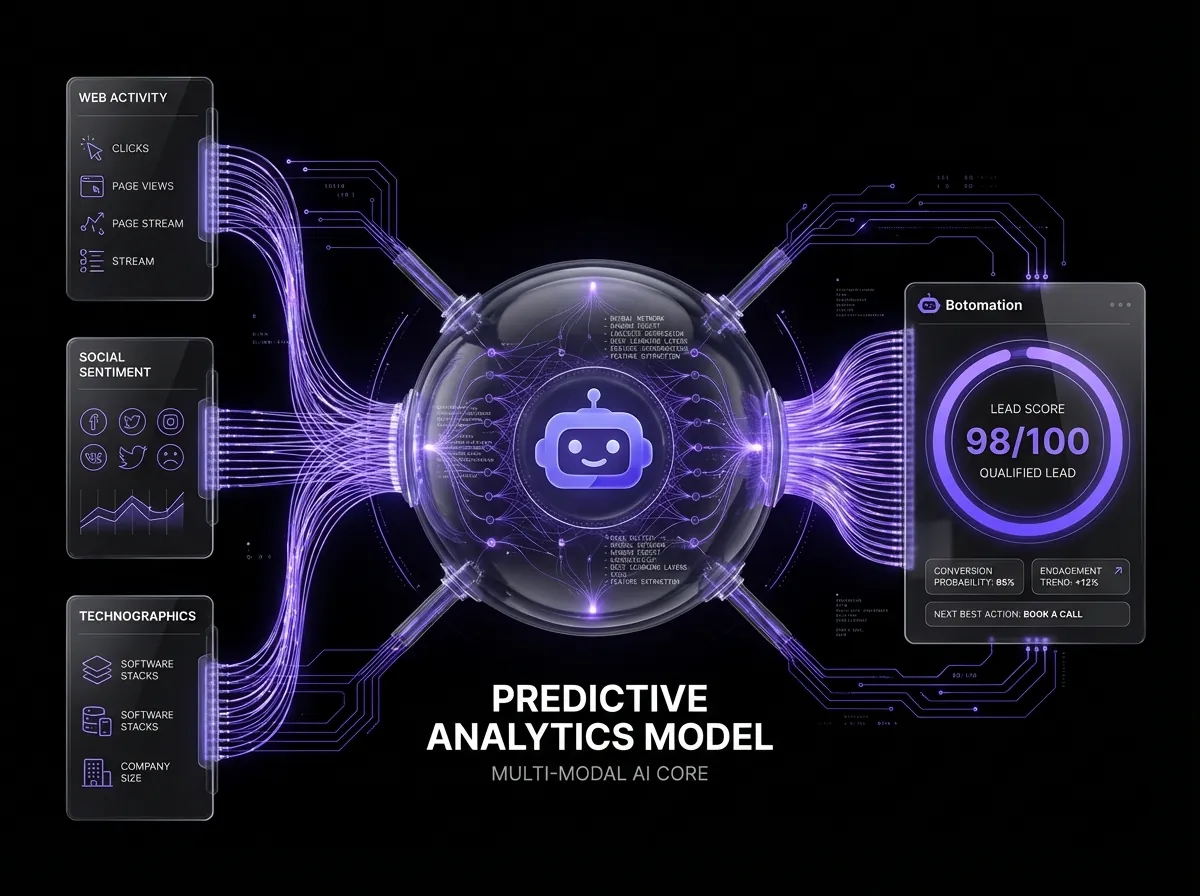
The "brain" behind these tools often relies on Random Forest and Logistic Regression algorithms. While that sounds highly technical, the practical application is simple: the system looks at thousands of data points to predict an outcome. For lead scoring, a Random Forest model might look at 50 different variables—company size, recent news, the job title of the person who opened the email—and assign a probability score to that lead.
Neural networks take this a step further by analyzing multi-modal data. This means the AI isn't just looking at text; it can "understand" the sentiment in a voice message or the intent behind a specific pattern of website navigation. These models are continuously learning. Every time a lead is marked as "unqualified" in your CRM, the AI updates its internal logic to ensure it doesn't bring you a similar lead in the future. This creates a virtuous cycle of increasing lead quality over time.
Behavioral Trigger Systems
The most effective prospecting in 2026 is reactive. Behavioral trigger systems allow your sales engine to respond to real-world events in seconds. If a target company announces a new round of funding, your AI can automatically trigger a "congratulations" email that subtly highlights how your SaaS can help them scale their new capital. This isn't just about speed; it's about relevance.
These systems can also correlate activity across different platforms. If a prospect follows your company on LinkedIn and then downloads a whitepaper, the AI sees this as a unified journey. It can then adjust the outreach sequence to be more aggressive or more educational based on that specific path. This temporal pattern analysis ensures that you are engaging at the "Optimal Moment of Receptivity," which is the brief window where a prospect is most likely to say "yes" to a demo.
Measuring Success: Key Metrics and ROI of Automated Prospecting
You cannot manage what you do not measure. In the world of automated prospecting, the metrics we track have shifted from "volume" to "velocity" and "value." It is no longer impressive to say you sent 10,000 emails. What matters is how many of those emails turned into qualified opportunities and how much it cost to get them there.
SaaS companies must look at the entire funnel to calculate true ROI. A mid-sized software firm recently found that by using AI lead scoring, they increased their conversion rate from demo to close by 25%. This wasn't because their sales reps got better at closing; it was because the AI was sending them better, more qualified prospects who were a perfect fit for the product.
Essential KPIs to Track
When you partner with an agency like Botomation, we focus on several critical KPIs to ensure your automated system is performing. The first is pipeline velocity—how fast a lead moves from the initial touchpoint to a signed contract. AI prospecting should significantly shorten this duration by removing the friction of manual research and slow follow-ups.
- Lead-to-Opportunity Ratio: The percentage of automated leads that turn into real sales opportunities.
- Cost Per Qualified Lead (CPQL): The total spend on AI tools and management divided by the number of high-fit leads.
- Meeting Booking Rate: How effectively your AI agents are converting conversations into calendar events.
- Email Sentiment Score: Using AI to track whether replies are positive, neutral, or negative to refine messaging.
ROI Calculation Framework
To see the real impact, let's look at the math. In our earlier example, we noted that a manual prospecting process can cost a company over $33,000 in wasted salary time per rep. If you implement an AI stack that costs $10,000 per year and it generates the same number of leads as three manual reps, your savings are immediate and massive.
However, the real ROI comes from the increase in pipeline. If your average deal size is $20,000 and your AI system generates an additional 50 qualified opportunities per year (a conservative estimate for a 496% increase), that is an additional $1,000,000 in the top of your funnel. Even with a modest 20% close rate, you are looking at $200,000 in new revenue from a $10,000 investment. This is why automated prospecting isn't just a "nice to have"—it is a fundamental requirement for SaaS survival in 2026.
Frequently Asked Questions
Will automated prospecting make my brand look like a "spammer"?
Not if it is done correctly. The "Old Way" of automation involved sending the same message to everyone. The "New Way" uses AI to ensure every message is hyper-personalized based on real-time data. When a prospect receives an email that mentions a specific challenge their company is facing and offers a relevant solution, they don't see it as spam; they see it as a valuable outreach.
Do I still need SDRs if I use these AI tools?
Yes, but their role changes. Instead of being "researchers," your SDRs become "account strategists." They spend their time handling high-level objections and building deeper relationships with the leads that the AI has already qualified. This shift usually leads to higher job satisfaction and lower turnover for your sales team.
How long does it take to see results from AI prospecting?
While the AI starts working immediately, it typically takes 30 to 60 days to see a significant impact on your pipeline. This period allows the machine learning models to gather enough data to optimize your sequences and for the "warm-up" processes to ensure high deliverability.
Is my data safe when using these AI platforms?
Security is a top priority in 2026. Most leading tools like ZoomInfo and Smartlead are SOC2 Type II compliant and adhere to strict GDPR and CCPA regulations. When you partner with an agency like Botomation, we ensure that all integrations are handled with enterprise-grade security protocols to protect your proprietary lead data.
The transition from manual to automated B2B prospecting is the single most significant lever available to SaaS companies today. By deploying the right combination of tools—like Smartlead for outreach, ZoomInfo for data, and Persana AI for autonomous agents—you can build a growth engine that never sleeps. This isn't just about efficiency; it's about creating a competitive advantage that your manual competitors simply cannot match.
The data is clear: companies that embrace AI-powered prospecting see more pipeline, shorter sales cycles, and higher win rates. But building these systems in-house is complex and time-consuming. It requires deep technical knowledge of API integrations, prompt engineering, and deliverability logistics. This is where the "Old Way" of doing it yourself meets the "New Way" of partnering with experts.
At Botomation, we specialize in building these custom, automated market research and lead generation systems for SaaS companies. We don't just give you a tool; we provide a complete, managed service that delivers fresh, qualified leads to your sales team every single morning. Our experts scan the web, monitor your competitors, and track industry trends automatically so you don't have to. If you are ready to stop searching for customers and start closing them, partnering with us is the most logical step for your business.
Ready to automate your growth? Book a call below.
The landscape of B2B sales has shifted fundamentally over the last twelve months. If you are still relying on manual list building and generic email templates in late 2026, you are essentially trying to win a Formula 1 race on a bicycle. We have moved past the era of simple automation into the age of autonomous agentic workflows. Leading SaaS organizations are no longer asking their sales development representatives to spend hours scouring LinkedIn or verifying email addresses. Instead, they are deploying AI SaaS lead qualification tools that handle the heavy lifting of identification, qualification, and initial engagement.
One enterprise software provider recently demonstrated the power of this shift by achieving a staggering 496% increase in their sales pipeline within a single quarter through automated pipeline building for SaaS sales. They didn't hire a massive new team or triple their ad spend; they simply replaced their manual prospecting workflows with a stack of automated B2B prospecting tools for SaaS growth that operate 24/7. This transition is particularly vital for SaaS companies because our industry faces unique hurdles: extended sales cycles, complex buying committees involving five to ten stakeholders, and the constant pressure of high customer acquisition costs (CAC).
These challenges require a level of precision that human researchers struggle to maintain at scale. Automated prospecting solves this by providing a consistent stream of high-intent leads while allowing your human experts to focus on what they do best: closing deals and building strategic relationships. In this guide, we will explore the specific strategies and tools—including daily market intelligence automation for B2B sales and automated competitor intelligence—that are defining sales excellence in 2026, moving from the foundational "why" to the technical "how" of modern pipeline generation.
Why SaaS Companies Need Automated B2B Prospecting in 2026
The math behind traditional sales prospecting simply does not add up anymore. When we look at the data from the past year, organizations that have integrated AI into their prospecting workflows are seeing a 76% increase in win rates. Even more impressive is the 78% reduction in deal cycle length. This happens because the AI isn't just finding more people; it is finding the right people at the exact moment they are experiencing the pain point your software solves.
Traditional prospecting is a linear process where a human rep finds a lead, researches them, and sends an email. AI-powered strategies are multi-dimensional. They analyze technographic data, recent funding rounds, hiring patterns, and even social media sentiment simultaneously. For example, a mid-sized insurance technology company recently leveraged automated lead scoring for B2B prospecting to identify which prospects were most likely to churn from their current legacy providers. By focusing their energy only on those "high-probability" targets, they achieved 3.5x higher conversion rates compared to their previous "spray and pray" method.
SaaS Specific Prospecting Challenges
The SaaS model is built on recurring revenue, which means the initial sale is just the beginning. However, getting to that initial sale is harder than ever. SaaS products often require buy-in from IT, Finance, and end-users, creating a complex web of stakeholders. Each of these individuals has different concerns and needs a different narrative. Manual prospecting fails here because a human rep rarely has the time to craft five different, highly-personalized messages for one account.
Furthermore, high customer acquisition costs mean that every hour a sales rep spends on a lead that doesn't fit the Ideal Customer Profile (ICP) is a direct hit to the company's bottom line. You need a system that filters out the noise before it ever reaches a human inbox. Continuous pipeline generation is the only way to offset churn and scale SaaS operations without adding headcount, maintaining the aggressive growth trajectories expected in the SaaS world. Without automation, your pipeline becomes a series of peaks and valleys rather than a steady, predictable flow.
The Cost of Manual Prospecting
To understand the true value of automation, we must look at the hidden costs of the "old way." A study involving the VTT Technical Research Center revealed that their team was losing over 1,000 hours annually just on basic lead qualification tasks, which can be mitigated by using automated lead verification tools. That is time that could have been spent on strategic account planning or high-level negotiations. When you break it down, the average sales representative spends nearly 60% of their day on administrative tasks and prospecting research rather than actually selling—a burden that can be solved by automating administrative tasks with AI.
Consider the financial implications of this inefficiency. If a junior SDR has a base salary of $45,000 and you add $11,250 in benefits and overhead, your total cost is $56,250. If that individual is spending 60% of their time on manual research, you are effectively paying $33,750 per year for data entry. Modern AI agents can replace manual data entry work, performing that same research with 99% accuracy for a fraction of the cost. The opportunity cost is even more damaging: every hour spent on a stale lead list is an hour not spent with a high-value prospect who is ready to buy.
"The goal of AI in prospecting isn't to replace the salesperson, but to remove the 'robotic' parts of their job so they can be more human." — Senior Growth Consultant at Botomation.
8 Best AI-Powered B2B Prospecting Tools for SaaS Companies in 2026
Choosing the right stack is the difference between a system that creates work and a system that creates revenue. In 2026, the best tools are those that offer deep integration, predictive capabilities, and the ability to handle multi-channel outreach without losing the human touch. Our team at Botomation has vetted dozens of platforms, and these eight stand out as the most effective for driving SaaS growth.
| Tool Name | Primary Strength | Best For | Typical Result |
|---|---|---|---|
| Smartlead | Multi-mailbox scaling | High-volume cold email | 30% higher deliverability |
| ZoomInfo | Database depth | Enterprise market intelligence | 95% data accuracy |
| Persana AI | AI SDR agents | End-to-end autonomous prospecting | 496% pipeline increase |
| Clay | Data enrichment | Hyper-personalized outreach | 10x faster lead research |
| 6sense | Intent signaling | Identifying "in-market" buyers | 2x increase in deal size |
| Apollo.io | All-in-one execution | Early-stage SaaS startups | 50% reduction in tool spend |
| Lavender | Email coaching | Improving reply rates | 20% higher response metrics |
| Lusha | Contact accuracy | Direct-dial procurement | 40% more successful connections |
Smartlead - AI-Powered Outreach Platform
Smartlead has become the gold standard for SaaS companies that need to scale their email outreach without landing in the spam folder. Its primary innovation is the multi-mailbox infrastructure, which allows you to distribute your sending volume across dozens of accounts while managing them from a single master inbox. In 2026, their AI-powered email warm-up features have evolved to simulate realistic human conversation patterns, making it nearly impossible for modern spam filters to flag the activity.
The platform also offers behavioral trigger sequences. If a prospect clicks a link but doesn't reply, the AI can automatically pivot the next message to address the specific content they viewed. For a SaaS company, this means you can offer a specific case study or a demo video based on real-time engagement. With pricing starting at $39/month for basic needs and scaling to $94/month for 30,000 leads, it provides a highly cost-effective way to maintain a massive outreach footprint.
ZoomInfo - Comprehensive B2B Database and Prospecting
While many new players have entered the market, ZoomInfo remains the heavyweight champion of B2B data. For SaaS companies targeting enterprise clients, the depth of their technographic data is unmatched. You can filter prospects not just by their job title, but by the specific software they currently use, their department budget, and even their "intent" signals—indicators that they are actively researching a solution like yours.
Their predictive lead scoring uses machine learning to analyze your existing customer base and find "lookalike" prospects who share the same characteristics as your highest-value clients. This moves prospecting from a guessing game to a data science exercise. Establishing a CRM email integration with platforms like Salesforce or HubSpot ensures that this intelligence flows directly into your existing workflows, allowing your sales team to see a prospect's entire history and tech stack before they even pick up the phone.
Persana AI - Advanced Lead Generation Platform
Persana AI represents the "New Way" of prospecting that we champion here at Botomation. It isn't just a database; it is an ecosystem of AI SDRs. These agents are capable of achieving results that were previously thought impossible, such as the 496% increase in pipeline and 454% growth in bookings mentioned earlier. The platform uses conversational AI to handle real-time qualification, often through WhatsApp AI agents for B2B lead qualification that can chat with a lead, answer technical questions, and book a meeting on a calendar without a human ever intervening.
The hyper-personalization engine in Persana AI can save a sales team up to 25 hours every week. Instead of a rep spending ten minutes researching a prospect's recent LinkedIn post to write a clever intro, the AI does it in seconds across thousands of leads. The performance metrics speak for themselves: users often see connection acceptance rates climb to 55% and reply rates hitting 19%, which is nearly four times the industry average for SaaS cold outreach.
Setting Up AI Prospecting Workflows for SaaS Lead Generation
Implementing these tools is not a "set it and forget it" process. To get the results we are talking about, you need a structured workflow that aligns with your specific SaaS business model. Whether you are selling a $50/month seat-based tool or a $100,000 enterprise platform, the underlying logic of automated prospecting remains the same: data integrity, smart scoring, and multi-channel persistence.
The first step is always identifying your "Source of Truth." For most SaaS companies, this is the CRM. However, a CRM is only as good as the data flowing into it. To prevent lead list decay, our experts at Botomation often start by building custom scrapers that scan the web for triggers—using AI-driven competitor analysis tools to detect a company hiring for a specific role or a competitor's service going down—to feed the AI prospecting engine with fresh, relevant leads every morning.
Data Integration and Lead Scoring Setup
Connecting your CRM data to your AI prospecting platform is where the magic happens. You want to move away from static lists and toward dynamic segments. By configuring predictive lead scoring models based on your SaaS Ideal Customer Profile (ICP) and utilizing automated lead filtering based on company size, the system can automatically prioritize leads that "look" like your best customers. This involves setting up behavioral triggers; for instance, if a prospect visits your pricing page three times in 24 hours, the AI should automatically move them to a "High Intent" sequence.
Establishing these qualification criteria is essential. In the SaaS world, a lead isn't just someone with a budget; it's someone with the right technical environment to support your software. Your automated system should be checking for these technographic requirements during the enrichment phase. This ensures that your sales team is only talking to prospects who can actually use your product, drastically reducing the time wasted in the discovery phase.
Multi-Channel Prospecting Sequence Design
A single email is no longer enough to break through the noise. A modern prospecting sequence must be multi-channel and multi-touch. This involves a coordinated dance between LinkedIn, email, and sometimes even automated voice drops. For tech decision-makers, LinkedIn is often the best place for initial engagement. Your AI can be programmed to view a profile, like a recent post, and then send a personalized connection request two days later.
The follow-up cadence should be optimized using behavioral data. If the AI detects that a prospect typically opens emails on Tuesday mornings, it will schedule the next touchpoint for that exact window. This level of granular optimization is what led one of our B2B services partners to achieve a 40% increase in lead generation. They stopped guessing when to reach out and started letting the data dictate the schedule, significantly helping to reduce lead response time with automation.
Advanced AI Features Transforming SaaS Prospecting in 2026
We are currently seeing the rise of "Agentic AI" systems. Unlike traditional automation, which follows a strict "if-this-then-that" logic, agentic systems are given a goal—such as "book 5 meetings with CTOs in the fintech space"—and they determine the best path to achieve it. These systems use neural networks to understand the context of a conversation and can adjust their tone and strategy in real-time.
These advanced features are particularly useful for SaaS companies because they can handle the "Dark Funnel"—the research prospects do before they ever fill out a form on your website. By using NLP (Natural Language Processing) to monitor industry forums, social media, and news cycles, AI can identify a company in crisis or a company entering a growth phase, allowing you to reach out with a solution before they even realize they need one.
Predictive Analytics and Machine Learning
The "brain" behind these tools often relies on Random Forest and Logistic Regression algorithms. While that sounds highly technical, the practical application is simple: the system looks at thousands of data points to predict an outcome. For lead scoring, a Random Forest model might look at 50 different variables—company size, recent news, the job title of the person who opened the email—and assign a probability score to that lead.
Neural networks take this a step further by analyzing multi-modal data. This means the AI isn't just looking at text; it can "understand" the sentiment in a voice message or the intent behind a specific pattern of website navigation. These models are continuously learning. Every time a lead is marked as "unqualified" in your CRM, the AI updates its internal logic to ensure it doesn't bring you a similar lead in the future. This creates a virtuous cycle of increasing lead quality over time.
Behavioral Trigger Systems
The most effective prospecting in 2026 is reactive. Behavioral trigger systems allow your sales engine to respond to real-world events in seconds. If a target company announces a new round of funding, your AI can automatically trigger a "congratulations" email that subtly highlights how your SaaS can help them scale their new capital. This isn't just about speed; it's about relevance.
These systems can also correlate activity across different platforms. If a prospect follows your company on LinkedIn and then downloads a whitepaper, the AI sees this as a unified journey. It can then adjust the outreach sequence to be more aggressive or more educational based on that specific path. This temporal pattern analysis ensures that you are engaging at the "Optimal Moment of Receptivity," which is the brief window where a prospect is most likely to say "yes" to a demo.
Measuring Success: Key Metrics and ROI of Automated Prospecting
You cannot manage what you do not measure. In the world of automated prospecting, the metrics we track have shifted from "volume" to "velocity" and "value." It is no longer impressive to say you sent 10,000 emails. What matters is how many of those emails turned into qualified opportunities and how much it cost to get them there.
SaaS companies must look at the entire funnel to calculate true ROI. A mid-sized software firm recently found that by using AI lead scoring, they increased their conversion rate from demo to close by 25%. This wasn't because their sales reps got better at closing; it was because the AI was sending them better, more qualified prospects who were a perfect fit for the product.
Essential KPIs to Track
When you partner with an agency like Botomation, we focus on several critical KPIs to ensure your automated system is performing. The first is pipeline velocity—how fast a lead moves from the initial touchpoint to a signed contract. AI prospecting should significantly shorten this duration by removing the friction of manual research and slow follow-ups.
- Lead-to-Opportunity Ratio: The percentage of automated leads that turn into real sales opportunities.
- Cost Per Qualified Lead (CPQL): The total spend on AI tools and management divided by the number of high-fit leads.
- Meeting Booking Rate: How effectively your AI agents are converting conversations into calendar events.
- Email Sentiment Score: Using AI to track whether replies are positive, neutral, or negative to refine messaging.
ROI Calculation Framework
To see the real impact, let's look at the math. In our earlier example, we noted that a manual prospecting process can cost a company over $33,000 in wasted salary time per rep. If you implement an AI stack that costs $10,000 per year and it generates the same number of leads as three manual reps, your savings are immediate and massive.
However, the real ROI comes from the increase in pipeline. If your average deal size is $20,000 and your AI system generates an additional 50 qualified opportunities per year (a conservative estimate for a 496% increase), that is an additional $1,000,000 in the top of your funnel. Even with a modest 20% close rate, you are looking at $200,000 in new revenue from a $10,000 investment. This is why automated prospecting isn't just a "nice to have"—it is a fundamental requirement for SaaS survival in 2026.
Frequently Asked Questions
Will automated prospecting make my brand look like a "spammer"?
Not if it is done correctly. The "Old Way" of automation involved sending the same message to everyone. The "New Way" uses AI to ensure every message is hyper-personalized based on real-time data. When a prospect receives an email that mentions a specific challenge their company is facing and offers a relevant solution, they don't see it as spam; they see it as a valuable outreach.
Do I still need SDRs if I use these AI tools?
Yes, but their role changes. Instead of being "researchers," your SDRs become "account strategists." They spend their time handling high-level objections and building deeper relationships with the leads that the AI has already qualified. This shift usually leads to higher job satisfaction and lower turnover for your sales team.
How long does it take to see results from AI prospecting?
While the AI starts working immediately, it typically takes 30 to 60 days to see a significant impact on your pipeline. This period allows the machine learning models to gather enough data to optimize your sequences and for the "warm-up" processes to ensure high deliverability.
Is my data safe when using these AI platforms?
Security is a top priority in 2026. Most leading tools like ZoomInfo and Smartlead are SOC2 Type II compliant and adhere to strict GDPR and CCPA regulations. When you partner with an agency like Botomation, we ensure that all integrations are handled with enterprise-grade security protocols to protect your proprietary lead data.
The transition from manual to automated B2B prospecting is the single most significant lever available to SaaS companies today. By deploying the right combination of tools—like Smartlead for outreach, ZoomInfo for data, and Persana AI for autonomous agents—you can build a growth engine that never sleeps. This isn't just about efficiency; it's about creating a competitive advantage that your manual competitors simply cannot match.
The data is clear: companies that embrace AI-powered prospecting see more pipeline, shorter sales cycles, and higher win rates. But building these systems in-house is complex and time-consuming. It requires deep technical knowledge of API integrations, prompt engineering, and deliverability logistics. This is where the "Old Way" of doing it yourself meets the "New Way" of partnering with experts.
At Botomation, we specialize in building these custom, automated market research and lead generation systems for SaaS companies. We don't just give you a tool; we provide a complete, managed service that delivers fresh, qualified leads to your sales team every single morning. Our experts scan the web, monitor your competitors, and track industry trends automatically so you don't have to. If you are ready to stop searching for customers and start closing them, partnering with us is the most logical step for your business.
Ready to automate your growth? Book a call below.
The landscape of B2B sales has shifted fundamentally over the last twelve months. If you are still relying on manual list building and generic email templates in late 2026, you are essentially trying to win a Formula 1 race on a bicycle. We have moved past the era of simple automation into the age of autonomous agentic workflows. Leading SaaS organizations are no longer asking their sales development representatives to spend hours scouring LinkedIn or verifying email addresses. Instead, they are deploying AI SaaS lead qualification tools that handle the heavy lifting of identification, qualification, and initial engagement.
One enterprise software provider recently demonstrated the power of this shift by achieving a staggering 496% increase in their sales pipeline within a single quarter through automated pipeline building for SaaS sales. They didn't hire a massive new team or triple their ad spend; they simply replaced their manual prospecting workflows with a stack of automated B2B prospecting tools for SaaS growth that operate 24/7. This transition is particularly vital for SaaS companies because our industry faces unique hurdles: extended sales cycles, complex buying committees involving five to ten stakeholders, and the constant pressure of high customer acquisition costs (CAC).
These challenges require a level of precision that human researchers struggle to maintain at scale. Automated prospecting solves this by providing a consistent stream of high-intent leads while allowing your human experts to focus on what they do best: closing deals and building strategic relationships. In this guide, we will explore the specific strategies and tools—including daily market intelligence automation for B2B sales and automated competitor intelligence—that are defining sales excellence in 2026, moving from the foundational "why" to the technical "how" of modern pipeline generation.
Why SaaS Companies Need Automated B2B Prospecting in 2026
The math behind traditional sales prospecting simply does not add up anymore. When we look at the data from the past year, organizations that have integrated AI into their prospecting workflows are seeing a 76% increase in win rates. Even more impressive is the 78% reduction in deal cycle length. This happens because the AI isn't just finding more people; it is finding the right people at the exact moment they are experiencing the pain point your software solves.
Traditional prospecting is a linear process where a human rep finds a lead, researches them, and sends an email. AI-powered strategies are multi-dimensional. They analyze technographic data, recent funding rounds, hiring patterns, and even social media sentiment simultaneously. For example, a mid-sized insurance technology company recently leveraged automated lead scoring for B2B prospecting to identify which prospects were most likely to churn from their current legacy providers. By focusing their energy only on those "high-probability" targets, they achieved 3.5x higher conversion rates compared to their previous "spray and pray" method.
SaaS Specific Prospecting Challenges
The SaaS model is built on recurring revenue, which means the initial sale is just the beginning. However, getting to that initial sale is harder than ever. SaaS products often require buy-in from IT, Finance, and end-users, creating a complex web of stakeholders. Each of these individuals has different concerns and needs a different narrative. Manual prospecting fails here because a human rep rarely has the time to craft five different, highly-personalized messages for one account.
Furthermore, high customer acquisition costs mean that every hour a sales rep spends on a lead that doesn't fit the Ideal Customer Profile (ICP) is a direct hit to the company's bottom line. You need a system that filters out the noise before it ever reaches a human inbox. Continuous pipeline generation is the only way to offset churn and scale SaaS operations without adding headcount, maintaining the aggressive growth trajectories expected in the SaaS world. Without automation, your pipeline becomes a series of peaks and valleys rather than a steady, predictable flow.
The Cost of Manual Prospecting
To understand the true value of automation, we must look at the hidden costs of the "old way." A study involving the VTT Technical Research Center revealed that their team was losing over 1,000 hours annually just on basic lead qualification tasks, which can be mitigated by using automated lead verification tools. That is time that could have been spent on strategic account planning or high-level negotiations. When you break it down, the average sales representative spends nearly 60% of their day on administrative tasks and prospecting research rather than actually selling—a burden that can be solved by automating administrative tasks with AI.
Consider the financial implications of this inefficiency. If a junior SDR has a base salary of $45,000 and you add $11,250 in benefits and overhead, your total cost is $56,250. If that individual is spending 60% of their time on manual research, you are effectively paying $33,750 per year for data entry. Modern AI agents can replace manual data entry work, performing that same research with 99% accuracy for a fraction of the cost. The opportunity cost is even more damaging: every hour spent on a stale lead list is an hour not spent with a high-value prospect who is ready to buy.
"The goal of AI in prospecting isn't to replace the salesperson, but to remove the 'robotic' parts of their job so they can be more human." — Senior Growth Consultant at Botomation.
8 Best AI-Powered B2B Prospecting Tools for SaaS Companies in 2026
Choosing the right stack is the difference between a system that creates work and a system that creates revenue. In 2026, the best tools are those that offer deep integration, predictive capabilities, and the ability to handle multi-channel outreach without losing the human touch. Our team at Botomation has vetted dozens of platforms, and these eight stand out as the most effective for driving SaaS growth.
| Tool Name | Primary Strength | Best For | Typical Result |
|---|---|---|---|
| Smartlead | Multi-mailbox scaling | High-volume cold email | 30% higher deliverability |
| ZoomInfo | Database depth | Enterprise market intelligence | 95% data accuracy |
| Persana AI | AI SDR agents | End-to-end autonomous prospecting | 496% pipeline increase |
| Clay | Data enrichment | Hyper-personalized outreach | 10x faster lead research |
| 6sense | Intent signaling | Identifying "in-market" buyers | 2x increase in deal size |
| Apollo.io | All-in-one execution | Early-stage SaaS startups | 50% reduction in tool spend |
| Lavender | Email coaching | Improving reply rates | 20% higher response metrics |
| Lusha | Contact accuracy | Direct-dial procurement | 40% more successful connections |
Smartlead - AI-Powered Outreach Platform
Smartlead has become the gold standard for SaaS companies that need to scale their email outreach without landing in the spam folder. Its primary innovation is the multi-mailbox infrastructure, which allows you to distribute your sending volume across dozens of accounts while managing them from a single master inbox. In 2026, their AI-powered email warm-up features have evolved to simulate realistic human conversation patterns, making it nearly impossible for modern spam filters to flag the activity.
The platform also offers behavioral trigger sequences. If a prospect clicks a link but doesn't reply, the AI can automatically pivot the next message to address the specific content they viewed. For a SaaS company, this means you can offer a specific case study or a demo video based on real-time engagement. With pricing starting at $39/month for basic needs and scaling to $94/month for 30,000 leads, it provides a highly cost-effective way to maintain a massive outreach footprint.
ZoomInfo - Comprehensive B2B Database and Prospecting
While many new players have entered the market, ZoomInfo remains the heavyweight champion of B2B data. For SaaS companies targeting enterprise clients, the depth of their technographic data is unmatched. You can filter prospects not just by their job title, but by the specific software they currently use, their department budget, and even their "intent" signals—indicators that they are actively researching a solution like yours.
Their predictive lead scoring uses machine learning to analyze your existing customer base and find "lookalike" prospects who share the same characteristics as your highest-value clients. This moves prospecting from a guessing game to a data science exercise. Establishing a CRM email integration with platforms like Salesforce or HubSpot ensures that this intelligence flows directly into your existing workflows, allowing your sales team to see a prospect's entire history and tech stack before they even pick up the phone.
Persana AI - Advanced Lead Generation Platform
Persana AI represents the "New Way" of prospecting that we champion here at Botomation. It isn't just a database; it is an ecosystem of AI SDRs. These agents are capable of achieving results that were previously thought impossible, such as the 496% increase in pipeline and 454% growth in bookings mentioned earlier. The platform uses conversational AI to handle real-time qualification, often through WhatsApp AI agents for B2B lead qualification that can chat with a lead, answer technical questions, and book a meeting on a calendar without a human ever intervening.
The hyper-personalization engine in Persana AI can save a sales team up to 25 hours every week. Instead of a rep spending ten minutes researching a prospect's recent LinkedIn post to write a clever intro, the AI does it in seconds across thousands of leads. The performance metrics speak for themselves: users often see connection acceptance rates climb to 55% and reply rates hitting 19%, which is nearly four times the industry average for SaaS cold outreach.
Setting Up AI Prospecting Workflows for SaaS Lead Generation
Implementing these tools is not a "set it and forget it" process. To get the results we are talking about, you need a structured workflow that aligns with your specific SaaS business model. Whether you are selling a $50/month seat-based tool or a $100,000 enterprise platform, the underlying logic of automated prospecting remains the same: data integrity, smart scoring, and multi-channel persistence.
The first step is always identifying your "Source of Truth." For most SaaS companies, this is the CRM. However, a CRM is only as good as the data flowing into it. To prevent lead list decay, our experts at Botomation often start by building custom scrapers that scan the web for triggers—using AI-driven competitor analysis tools to detect a company hiring for a specific role or a competitor's service going down—to feed the AI prospecting engine with fresh, relevant leads every morning.
Data Integration and Lead Scoring Setup
Connecting your CRM data to your AI prospecting platform is where the magic happens. You want to move away from static lists and toward dynamic segments. By configuring predictive lead scoring models based on your SaaS Ideal Customer Profile (ICP) and utilizing automated lead filtering based on company size, the system can automatically prioritize leads that "look" like your best customers. This involves setting up behavioral triggers; for instance, if a prospect visits your pricing page three times in 24 hours, the AI should automatically move them to a "High Intent" sequence.
Establishing these qualification criteria is essential. In the SaaS world, a lead isn't just someone with a budget; it's someone with the right technical environment to support your software. Your automated system should be checking for these technographic requirements during the enrichment phase. This ensures that your sales team is only talking to prospects who can actually use your product, drastically reducing the time wasted in the discovery phase.
Multi-Channel Prospecting Sequence Design
A single email is no longer enough to break through the noise. A modern prospecting sequence must be multi-channel and multi-touch. This involves a coordinated dance between LinkedIn, email, and sometimes even automated voice drops. For tech decision-makers, LinkedIn is often the best place for initial engagement. Your AI can be programmed to view a profile, like a recent post, and then send a personalized connection request two days later.
The follow-up cadence should be optimized using behavioral data. If the AI detects that a prospect typically opens emails on Tuesday mornings, it will schedule the next touchpoint for that exact window. This level of granular optimization is what led one of our B2B services partners to achieve a 40% increase in lead generation. They stopped guessing when to reach out and started letting the data dictate the schedule, significantly helping to reduce lead response time with automation.
Advanced AI Features Transforming SaaS Prospecting in 2026
We are currently seeing the rise of "Agentic AI" systems. Unlike traditional automation, which follows a strict "if-this-then-that" logic, agentic systems are given a goal—such as "book 5 meetings with CTOs in the fintech space"—and they determine the best path to achieve it. These systems use neural networks to understand the context of a conversation and can adjust their tone and strategy in real-time.
These advanced features are particularly useful for SaaS companies because they can handle the "Dark Funnel"—the research prospects do before they ever fill out a form on your website. By using NLP (Natural Language Processing) to monitor industry forums, social media, and news cycles, AI can identify a company in crisis or a company entering a growth phase, allowing you to reach out with a solution before they even realize they need one.
Predictive Analytics and Machine Learning
The "brain" behind these tools often relies on Random Forest and Logistic Regression algorithms. While that sounds highly technical, the practical application is simple: the system looks at thousands of data points to predict an outcome. For lead scoring, a Random Forest model might look at 50 different variables—company size, recent news, the job title of the person who opened the email—and assign a probability score to that lead.
Neural networks take this a step further by analyzing multi-modal data. This means the AI isn't just looking at text; it can "understand" the sentiment in a voice message or the intent behind a specific pattern of website navigation. These models are continuously learning. Every time a lead is marked as "unqualified" in your CRM, the AI updates its internal logic to ensure it doesn't bring you a similar lead in the future. This creates a virtuous cycle of increasing lead quality over time.
Behavioral Trigger Systems
The most effective prospecting in 2026 is reactive. Behavioral trigger systems allow your sales engine to respond to real-world events in seconds. If a target company announces a new round of funding, your AI can automatically trigger a "congratulations" email that subtly highlights how your SaaS can help them scale their new capital. This isn't just about speed; it's about relevance.
These systems can also correlate activity across different platforms. If a prospect follows your company on LinkedIn and then downloads a whitepaper, the AI sees this as a unified journey. It can then adjust the outreach sequence to be more aggressive or more educational based on that specific path. This temporal pattern analysis ensures that you are engaging at the "Optimal Moment of Receptivity," which is the brief window where a prospect is most likely to say "yes" to a demo.
Measuring Success: Key Metrics and ROI of Automated Prospecting
You cannot manage what you do not measure. In the world of automated prospecting, the metrics we track have shifted from "volume" to "velocity" and "value." It is no longer impressive to say you sent 10,000 emails. What matters is how many of those emails turned into qualified opportunities and how much it cost to get them there.
SaaS companies must look at the entire funnel to calculate true ROI. A mid-sized software firm recently found that by using AI lead scoring, they increased their conversion rate from demo to close by 25%. This wasn't because their sales reps got better at closing; it was because the AI was sending them better, more qualified prospects who were a perfect fit for the product.
Essential KPIs to Track
When you partner with an agency like Botomation, we focus on several critical KPIs to ensure your automated system is performing. The first is pipeline velocity—how fast a lead moves from the initial touchpoint to a signed contract. AI prospecting should significantly shorten this duration by removing the friction of manual research and slow follow-ups.
- Lead-to-Opportunity Ratio: The percentage of automated leads that turn into real sales opportunities.
- Cost Per Qualified Lead (CPQL): The total spend on AI tools and management divided by the number of high-fit leads.
- Meeting Booking Rate: How effectively your AI agents are converting conversations into calendar events.
- Email Sentiment Score: Using AI to track whether replies are positive, neutral, or negative to refine messaging.
ROI Calculation Framework
To see the real impact, let's look at the math. In our earlier example, we noted that a manual prospecting process can cost a company over $33,000 in wasted salary time per rep. If you implement an AI stack that costs $10,000 per year and it generates the same number of leads as three manual reps, your savings are immediate and massive.
However, the real ROI comes from the increase in pipeline. If your average deal size is $20,000 and your AI system generates an additional 50 qualified opportunities per year (a conservative estimate for a 496% increase), that is an additional $1,000,000 in the top of your funnel. Even with a modest 20% close rate, you are looking at $200,000 in new revenue from a $10,000 investment. This is why automated prospecting isn't just a "nice to have"—it is a fundamental requirement for SaaS survival in 2026.
Frequently Asked Questions
Will automated prospecting make my brand look like a "spammer"?
Not if it is done correctly. The "Old Way" of automation involved sending the same message to everyone. The "New Way" uses AI to ensure every message is hyper-personalized based on real-time data. When a prospect receives an email that mentions a specific challenge their company is facing and offers a relevant solution, they don't see it as spam; they see it as a valuable outreach.
Do I still need SDRs if I use these AI tools?
Yes, but their role changes. Instead of being "researchers," your SDRs become "account strategists." They spend their time handling high-level objections and building deeper relationships with the leads that the AI has already qualified. This shift usually leads to higher job satisfaction and lower turnover for your sales team.
How long does it take to see results from AI prospecting?
While the AI starts working immediately, it typically takes 30 to 60 days to see a significant impact on your pipeline. This period allows the machine learning models to gather enough data to optimize your sequences and for the "warm-up" processes to ensure high deliverability.
Is my data safe when using these AI platforms?
Security is a top priority in 2026. Most leading tools like ZoomInfo and Smartlead are SOC2 Type II compliant and adhere to strict GDPR and CCPA regulations. When you partner with an agency like Botomation, we ensure that all integrations are handled with enterprise-grade security protocols to protect your proprietary lead data.
The transition from manual to automated B2B prospecting is the single most significant lever available to SaaS companies today. By deploying the right combination of tools—like Smartlead for outreach, ZoomInfo for data, and Persana AI for autonomous agents—you can build a growth engine that never sleeps. This isn't just about efficiency; it's about creating a competitive advantage that your manual competitors simply cannot match.
The data is clear: companies that embrace AI-powered prospecting see more pipeline, shorter sales cycles, and higher win rates. But building these systems in-house is complex and time-consuming. It requires deep technical knowledge of API integrations, prompt engineering, and deliverability logistics. This is where the "Old Way" of doing it yourself meets the "New Way" of partnering with experts.
At Botomation, we specialize in building these custom, automated market research and lead generation systems for SaaS companies. We don't just give you a tool; we provide a complete, managed service that delivers fresh, qualified leads to your sales team every single morning. Our experts scan the web, monitor your competitors, and track industry trends automatically so you don't have to. If you are ready to stop searching for customers and start closing them, partnering with us is the most logical step for your business.
Ready to automate your growth? Book a call below.
Get Started
Book a FREE Consultation Right NOW!
Schedule a Call with Our Team To Make Your Business More Efficient with AI Instantly.
Read More
AI B2B Prospecting Tools for SaaS Growth in 2026
Discover 8 AI-powered B2B prospecting tools that can increase your SaaS pipeline by 496%. Learn how to automate lead generation and boost sales efficiency.
AI Modernization of Legacy Systems - 2026 Migration Guide
Learn how WhatsApp AI slashes support costs for e-commerce & SaaS. Proven strategies to boost sales, recover carts, and scale 24/7 service.