Daily Market Intelligence Automation for B2B Sales 2026
Feb 17, 2026
B2B Sales
AI Automation
Market Intelligence
B2B Sales
AI Automation
Market Intelligence
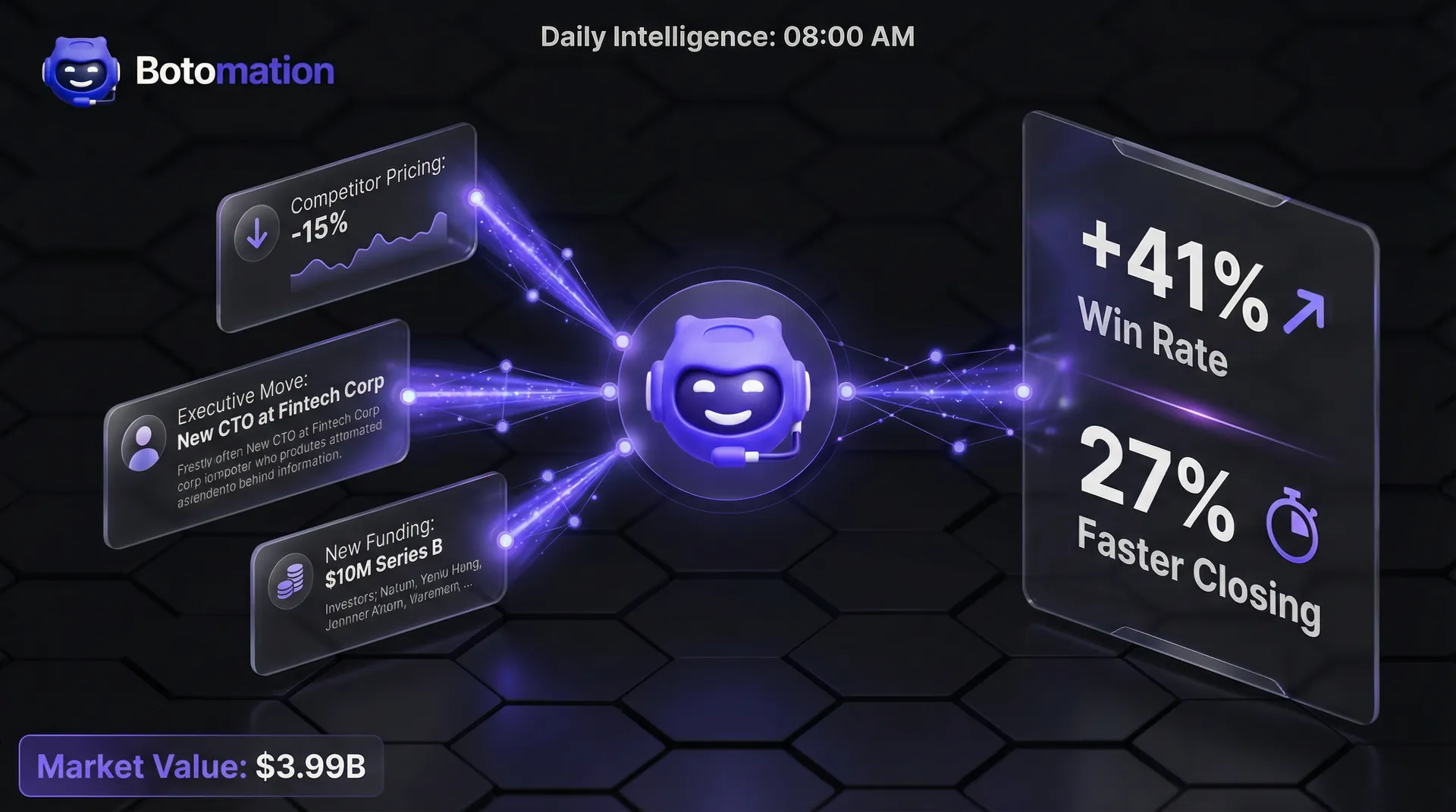
The landscape of B2B sales has shifted from a battle of persistence to a contest of real-time intelligence. By late 2026, the ability to react to market shifts instantly is no longer a luxury for the enterprise but a baseline requirement for any growing agency or sales team. The global market intelligence industry is currently on track to reach a projected $3.99 billion this year, driven by an annual growth rate that hovers between 10% and 12%. This surge represents a fundamental transition toward daily market intelligence automation for B2B sales as a core operational pillar.
Recent research from MarketsandMarkets highlights a stark divide between industry leaders and laggards. Organizations that have successfully automated their intelligence workflows using the best competitor analysis tools for 2026 report 41% higher win rates and close deals 27% faster than those relying on manual research. In an environment where 80% of competitors are already leveraging AI-powered tools, a "wait and see" approach has become a strategy for obsolescence. Our team at Botomation has observed that the most successful B2B players have moved beyond static lead lists to automated pipeline building, opting instead for dynamic systems that scan the web and deliver fresh insights every morning.
The challenge most companies face is the sheer volume of digital noise. While data is abundant, actionable intelligence is rare. Without a structured automation strategy, sales reps spend hours digging through LinkedIn, news releases, and financial reports instead of engaging with qualified prospects. This guide provides a comprehensive roadmap, building on our proven 7 steps to automate competitor intelligence, for implementing a daily system that transforms market noise into a predictable pipeline of high-value opportunities.
Understanding Daily Market Intelligence Automation for B2B Sales
Comprehensive market intelligence automation is the practice of utilizing custom-built agents and scrapers to monitor the digital footprint of an entire industry. It involves the systematic collection of competitor pricing, executive movements, technographic changes, and intent signals without human intervention. Unlike traditional research, which is often a static exercise performed once a quarter, automated intelligence operates on a continuous 24-hour cycle. This ensures that your sales team never works with data more than a few hours old.
The shift toward this model is supported by compelling data from high-growth sectors. Currently, 73% of high-growth companies have fully integrated sales intelligence into their daily workflows, compared to only 34% just three years ago. This doubling of adoption reflects a realization that manual research is a massive drain on resources. When a highly-paid account executive spends their morning searching for "trigger events" like new funding rounds or job changes, they are acting as a high-cost data entry resource.
Components of Market Intelligence Automation
A modern intelligence system consists of three primary layers that work in tandem to support the sales cycle. First, competitor monitoring systems track competitor pricing automatically and monitor every move rivals make, from website copy changes to new product documentation. Second, the system must include AI B2B prospecting tools that utilize research agents to qualify leads based on specific, real-time criteria rather than generic industry codes. Finally, an industry trend detection engine scans news outlets, social media, and regulatory filings to identify macro shifts before they become common knowledge.
By combining these three elements, Botomation creates a "surround sound" view of the market. This allows a sales team to know not just who to call, but exactly why today is the perfect day to engage. Instead of a generic pitch, the representative enters the conversation armed with the knowledge that the prospect recently lost a key vendor or expanded their engineering team in a specific region.
Benefits of Daily Automation vs Manual Processes
The most immediate impact of moving to an automated model is the reclamation of time. We typically see the elimination of 80% of manual research work, which correlates to a 3x gain in overall team productivity. When AI agents replace manual data entry work—handling the labor of finding contact info and verifying company size—the team can focus entirely on high-level strategy and relationship building.
Accuracy is another critical factor where automation outperforms manual effort. A tired sales rep might miss a subtle signal in a 10-K filing or ignore a small update on a competitor’s pricing page. An automated system, however, remains consistent and unbiased, scanning thousands of data points with the same precision every time. This consistency builds a foundation of trust in the data, which is often the biggest hurdle in getting sales teams to adopt new tools.
Expert Insight: "In 2026, the fastest-growing B2B companies are not those with the largest sales teams, but those with the most sophisticated data pipelines. Automation has turned information from a static asset into a kinetic force." — Senior Consultant at Botomation
Market Intelligence Automation Architecture and Technology Stack
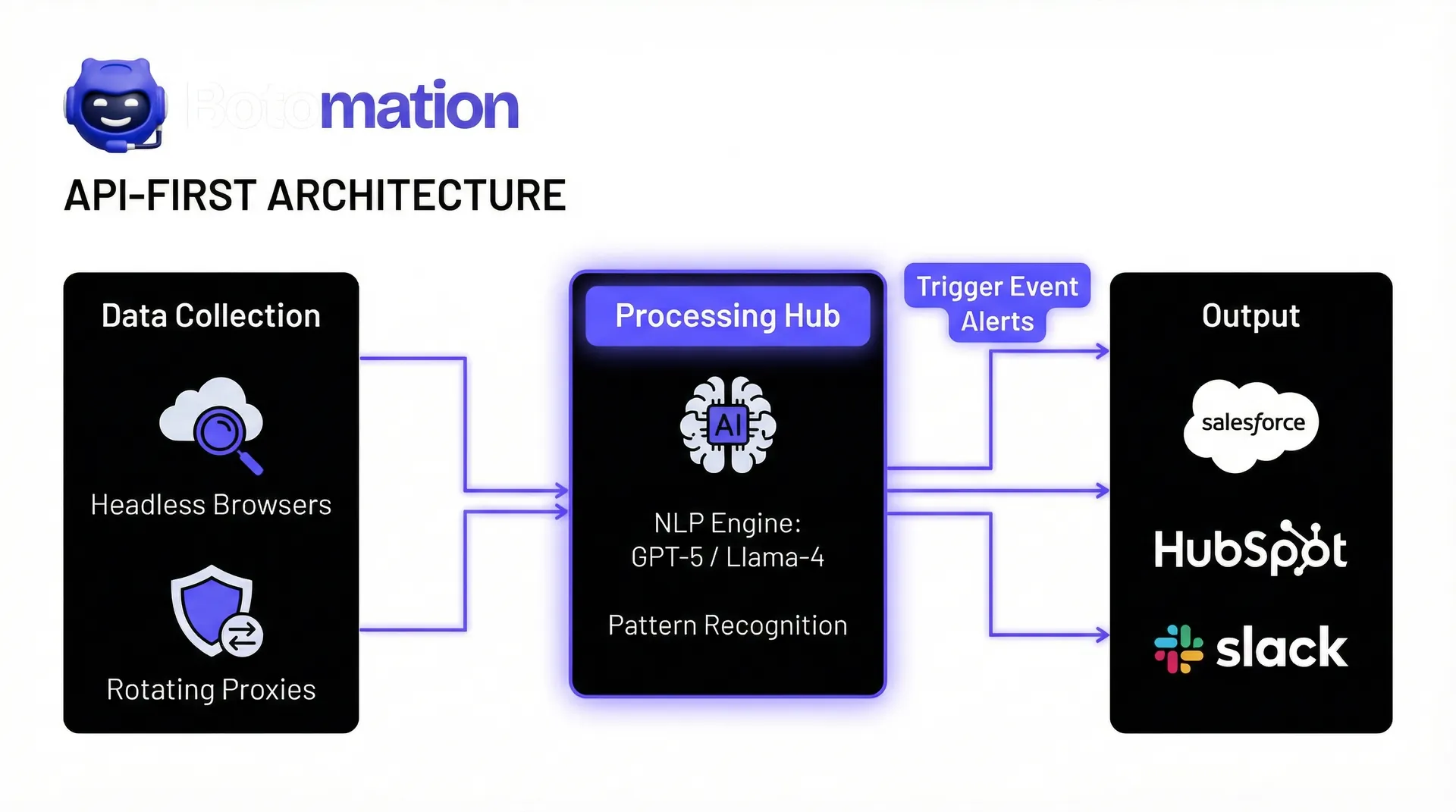
Building a system capable of handling the demands of 2026 requires an API-first architecture. You cannot rely on a single "all-in-one" software package because the market moves too fast for any one vendor to capture every nuance. Instead, our team designs modular infrastructures that connect specialized data sources through a central processing hub. This allows for scalable processing, where you can add or remove data sources as business needs evolve without breaking the workflow.
The core of this architecture usually resides in cloud environments like AWS or Google Cloud, utilizing serverless functions to keep costs low while maintaining the ability to burst during heavy scraping tasks. By using cloud service connectors, we ensure that the intelligence gathered from the web flows directly into existing CRM or Slack channels. This integration transforms raw data into actionable alerts that teams can use immediately.
Core Technology Components
The technical foundation begins with advanced data collection systems that utilize headless browsers and rotating proxy networks to gather information from complex websites. Once the data is harvested, it passes through Natural Language Processing (NLP) models, such as GPT-5 or specialized Llama-4 variants, which are trained to extract specific business meanings from raw text. These models categorize information based on your specific sales playbooks rather than just providing summaries.
Beyond simple extraction, machine learning models are used for pattern recognition and trend prediction. If the system notices that three different competitors have updated their security documentation in the last 48 hours, it can flag this as a potential industry-wide shift in buyer concerns. This predictive layer is what separates a basic scraper from a true market intelligence system.
Integration and Workflow Management
For intelligence to be valuable, it must exist where the sales team already works. Deep CRM integration is non-negotiable, often requiring a robust CRM email integration strategy. Our experts ensure that when a "trigger event" is detected, the relevant lead record in Salesforce or HubSpot is automatically updated. This removes the friction of the representative having to check a separate dashboard.
Workflow automation engines then take this further by generating daily intelligence reports. Every morning at 8:00 AM, representatives receive a personalized briefing that lists their top five "hot" prospects based on the last 24 hours of market activity. Real-time alert systems are also configured for "red alert" events, such as a major prospect mentioning a competitor on social media, allowing for an immediate, strategic response.
Implementing Daily Market Intelligence Automation for B2B Sales
Implementing a robust intelligence system is a journey that typically spans six weeks from initial audit to full deployment. It is a process that requires a balance between technical configuration and strategic alignment. We have found that the most successful implementations follow a rigid three-phase approach that prioritizes data utility over sheer data volume.
One of our recent clients, a mid-market fintech provider, followed this exact roadmap. Before partnering with Botomation, their sales team struggled with a 12% lead-to-opportunity conversion rate because their data was often weeks out of date. After implementing our automated intelligence system, they saw a 215% increase in qualified leads within the first 90 days. This success was not the result of harder work, but of working with the right information at the right time.
Assessment and Planning Phase
The first two weeks are dedicated to a deep-dive audit of current manual processes. We examine how top-performing representatives find information and what specific signals lead to their most successful deals. This requirements-gathering phase is crucial because it defines the logic the automation will eventually follow. We do not just automate existing processes; we optimize them.
During this phase, we also evaluate the existing technology stack. We look for gaps where the CRM might be lacking data or where current marketing tools fail to provide necessary insights. The goal is to select a suite of vendors and custom scripts that work harmoniously without creating data silos that hide important information from stakeholders.
Setup and Configuration Phase
Once the roadmap is clear, the next four weeks focus on the technical setup. This involves configuring APIs, setting up custom scrapers, and tuning AI models to recognize the nuances of your specific industry. It is during this time that we build the automated workflows that handle the daily collection and processing of market data.
Testing is a significant part of this phase. We run the system in "shadow mode" alongside manual processes, utilizing automated lead verification tools to ensure data accuracy and alert relevance. We fine-tune the delivery system—whether via Slack, email, or CRM notifications—to ensure it fits naturally into the sales team’s daily routine. The result is a system that acts as an invisible assistant, providing the right nudge at the perfect moment.
The 6-Week Implementation Roadmap
| Week | Focus Area | Key Deliverables |
|---|---|---|
| Week 1 | Process Audit | Mapping current manual research steps and identifying bottlenecks. |
| Week 2 | Signal Definition | Finalizing the list of "trigger events" and data sources to be monitored. |
| Week 3 | Infrastructure Setup | Building the cloud environment and configuring data scrapers. |
| Week 4 | Logic & AI Tuning | Programming the NLP models to categorize and score the gathered data. |
| Week 5 | System Integration | Connecting the intelligence engine to CRM and communication tools. |
| Week 6 | Team Training | Onboarding the sales team and launching the first live reports. |
Best Practices for Market Intelligence Automation Success
The biggest mistake companies make is assuming that more data equals better results. In reality, excessive data leads to analysis paralysis, where sales representatives become overwhelmed by notifications and stop checking the system entirely. Success in 2026 is defined by the quality and relevance of data, not the quantity. Gartner research suggests that 60% of AI-driven projects fail specifically due to poor data quality, emphasizing the need for rigorous governance.
Another critical factor is transparency and trust. According to PwC, 77% of B2B buyers trust companies more when they are transparent about how they use data. While your intelligence system is an internal tool, the way representatives use that information in conversations matters. The goal is to be informed, not intrusive. Using intelligence to provide value is a win; using it to show off internal knowledge of a prospect's movements can often backfire.
Data Quality and Governance
Maintaining a high-quality data feed requires constant monitoring. Our team implements automated validation checks that flag inconsistent or suspicious data before it reaches a sales representative. For example, if a scraper returns a company size that is 500% different from the previous day, the system holds that record for manual review. This layer of sanity checking is vital for maintaining the credibility of the automation.
Compliance is also a major consideration in the 2026 landscape. With evolving privacy laws, automated systems must be designed with data protection at their core. This means ensuring that all web scraping activities adhere to robots.txt files and that any personal data collected is handled in accordance with GDPR, CCPA, and other regional regulations. Regular audits of your data sources ensure that you are not pulling information from non-compliant providers.
User Adoption and Training
Even the most sophisticated system will fail if the sales team does not utilize it. Change management is often the most difficult part of the implementation process. We recommend a "champion" model, where high-performing representatives are trained first and their successes are shared with the broader team. When the department sees a colleague closing a massive deal because of a real-time intelligence alert, buy-in happens naturally.
Performance tracking should be built into the system from day one. You need to know which alerts are leading to meetings and which are being ignored. This feedback loop allows our experts to continuously refine the system, filtering out noise and doubling down on the signals that move the needle. A monthly review and tune session ensures the automation evolves as quickly as the market.
Measuring Success: KPIs and ROI of Market Intelligence Automation
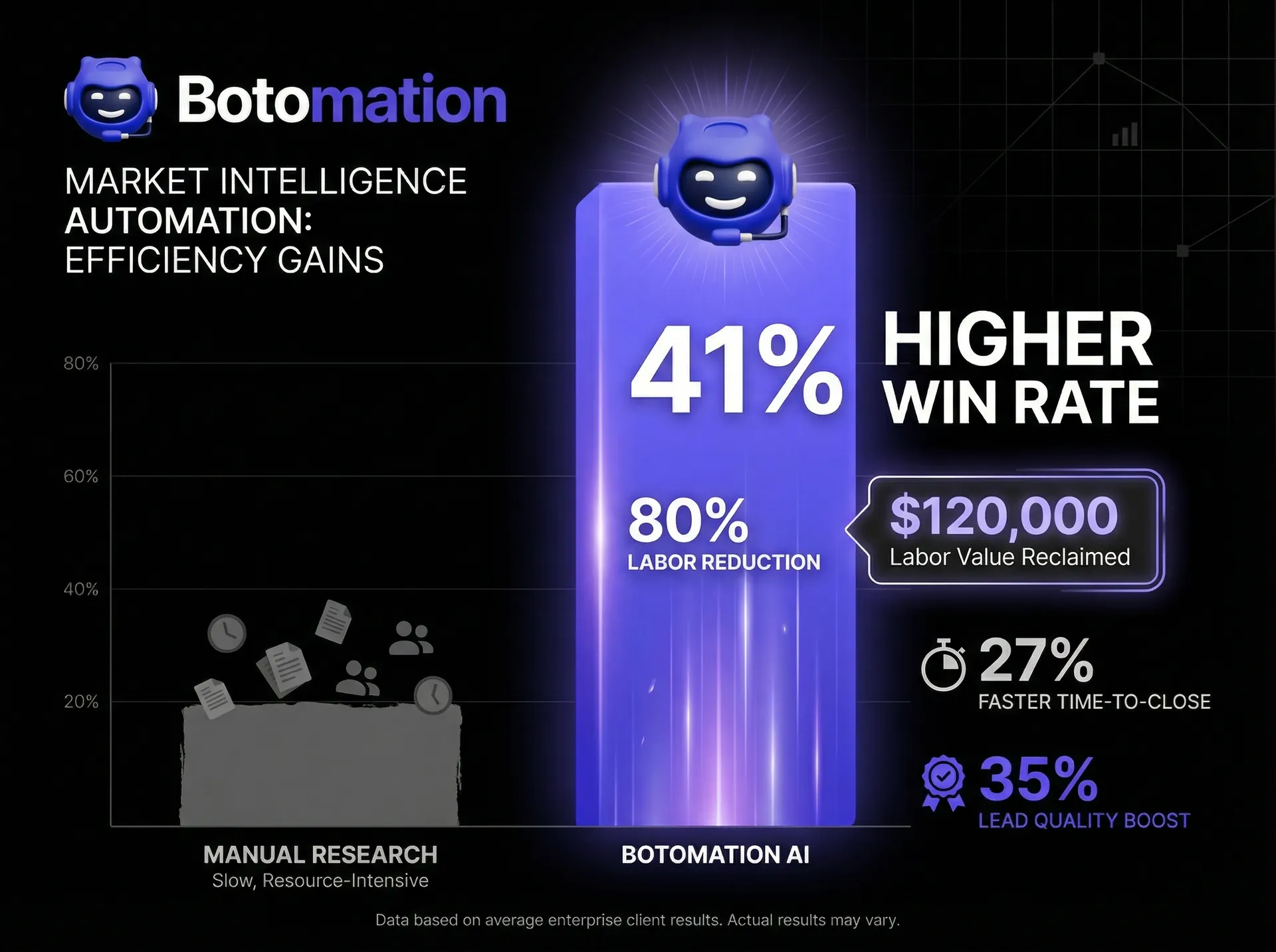
To justify the investment in a premium agency like Botomation, you must look beyond vanity metrics and focus on the bottom line. The most telling statistic remains the 41% higher win rate observed in companies with advanced intelligence capabilities. This is not just a marginal improvement; it is a fundamental shift in the efficiency of the sales engine. When your team stops guessing and starts knowing, every part of the funnel improves.
Lead quality is another area where the impact is immediate. Case studies consistently show a 35% increase in lead qualification rates when automated intelligence is applied. This happens because the system filters out unqualified leads and identifies prospects who are in an active buying window based on their recent market behavior. The result is a cleaner pipeline and a more focused sales force.
Performance Metrics and Tracking
When we look at deal velocity, the data is equally compelling. Companies using daily automation see a 27% faster time-to-close. This is because intelligence allows representatives to skip the discovery phase where they ask basic questions that the system has already answered. They can move straight to solutioning and negotiation, significantly shortening the sales cycle.
Tracking win rates against competitors is also essential. By monitoring your win/loss ratio in deals where you had automated intelligence versus those where you did not, you can see the clear competitive advantage. Often, intelligence provides the specific insight—like a competitor's recent service outage or a change in a prospect's budget authority—that tips the scales in your favor.
Financial ROI Calculation
Let's break down the math of a typical implementation. Consider a sales team of 10 people where each representative spends 5 hours a week on manual research.
- Manual Cost: 10 reps x 5 hours/week = 50 hours/week.
- Annual Hours: 50 hours x 50 weeks = 2,500 hours/year.
- Labor Value: At a conservative $60/hour (salary + benefits), that is $150,000 per year spent just on research.
When Botomation automates 80% of that work, you effectively buy back $120,000 worth of time that can now be spent on revenue-generating activities. If that reclaimed time leads to just two additional $60,000 deals closed per year, the system has already paid for itself multiple times over. This does not even account for the 40% increase in ROI often seen from the higher quality of the opportunities themselves.
Market Impact Summary:
* Win Rate Increase: 41%
* Deal Velocity Improvement: 27%
* Lead Qualification Boost: 35%
* Manual Labor Reduction: 80%
Future Trends in Market Intelligence Automation for B2B Sales
As we look toward the end of 2026 and into 2026, the complexity of these systems will only increase. McKinsey has noted that while the potential is high, 70% of companies still struggle with full AI integration. This gap creates a massive opportunity for those who partner with experts to stay ahead of the curve. One of the most significant emerging trends is the move toward hyper-personalization, where intelligence is tailored not just to a company, but to the specific territory and selling style of an individual representative.
Natural language interfaces are also becoming the primary way sales teams interact with their data. Instead of looking at a dashboard, a representative can simply ask their system, "Which of my accounts in the Northeast are currently hiring for Cybersecurity roles?" and get an instant, accurate answer. This conversational intelligence lowers the barrier to entry and ensures that even the least tech-savvy representatives can benefit from automation.
Emerging Technologies and Capabilities
We are seeing a shift from reactive intelligence to predictive intelligence. Using advanced machine learning, our systems can now analyze years of historical market data to predict when a specific company is likely to enter a buying cycle. This is not just about reacting to a news story; it is about identifying the subtle pre-signals that occur months before a formal RFP is issued.
Real-time scenario analysis is another area of growth. If a major regulatory change is announced, the system can instantly model how that change will impact your entire prospect list, re-priorizing accounts based on who is most affected. This level of agility allows your sales team to be the first to reach out with a relevant solution to a brand-new problem.
Ethical and Governance Considerations
As these tools become more powerful, the focus on ethical AI becomes paramount. We are building bias detection tools directly into our intelligence systems to ensure that the AI is not inadvertently ignoring certain market segments or favoring others based on flawed historical data. Fairness in AI-powered analysis is a business requirement, as biased data leads to missed opportunities.
Explainable AI is also a major focus. Sales representatives need to know why the system is telling them to call a certain prospect. By providing a clear reasoning path alongside every alert, we help the representative understand the context and build a more convincing pitch. This transparency ensures that the human remains the final decision-maker, supported by the best possible data.
Frequently Asked Questions
How do you deliver market intelligence to sales teams?
We deliver insights where the team already works. Our experts configure the system to provide intelligence directly through CRM updates, dedicated Slack or Microsoft Teams channels, and a daily morning email digest. This ensures that intelligence is integrated into the existing workflow rather than requiring a separate platform login.
What are the best tools for sales team market intelligence?
In 2026, the best tool is rarely a single piece of software. It is a customized stack that typically includes headless scraping engines, LLMs like GPT-5 for data synthesis, and integration layers like Zapier or custom API connectors. Botomation builds these custom stacks to fit your specific industry and sales process, avoiding the limitations of off-the-shelf SaaS products.
How do you create a market intelligence dashboard for sales?
A successful dashboard focuses on action. We design interfaces that highlight "Top Opportunities Today" and "Competitor Alerts" in a way that is visually intuitive. Using modern visualization libraries, we ensure the data is easy to digest at a glance, allowing representatives to spend more time selling and less time interpreting charts.
What are the requirements for daily market intelligence automation?
The primary requirement is a clear understanding of your ideal customer profile (ICP) and the trigger events that signify a high-intent prospect. Technically, you need a CRM with an open API and a commitment to data hygiene. Beyond that, the most important requirement is a partnership with a team that understands how to translate raw web data into strategic sales advantages.
How does automation improve win rates?
Automation improves win rates by identifying "trigger events" (like funding rounds or leadership changes) immediately. This allows sales reps to reach out with highly relevant, timely messaging, which research shows can increase win rates by up to 41%.
Is automated market intelligence compliant with privacy laws?
Yes, when designed correctly. Professional systems are built to respect robots.txt files and adhere to global regulations such as GDPR and CCPA. Data governance layers ensure that only publicly available or compliant data is processed.
The competitive landscape of 2026 does not forgive those who rely on outdated information. With the global sales intelligence market reaching new heights and 80% of companies adopting AI tools, the gap between the leaders and the followers is widening every day. Implementing a daily market intelligence automation system is a fundamental shift in how your business interacts with the world.
By moving away from manual, slow, and expensive research, you empower your sales team to act with a level of precision that was impossible just a few years ago. Our team at Botomation is dedicated to building these premium, custom-fit systems that turn the vast expanse of the internet into your most valuable sales asset. We provide a strategic partnership that ensures your growth is fueled by the most accurate, real-time data available.
The choice is clear: you can continue to let your most valuable employees waste their potential on data entry, or you can automate your intelligence and focus on closing deals. Partnering with Botomation is the most logical step toward securing your place at the top of your industry.
Ready to automate your growth? Book a call below.
The landscape of B2B sales has shifted from a battle of persistence to a contest of real-time intelligence. By late 2026, the ability to react to market shifts instantly is no longer a luxury for the enterprise but a baseline requirement for any growing agency or sales team. The global market intelligence industry is currently on track to reach a projected $3.99 billion this year, driven by an annual growth rate that hovers between 10% and 12%. This surge represents a fundamental transition toward daily market intelligence automation for B2B sales as a core operational pillar.
Recent research from MarketsandMarkets highlights a stark divide between industry leaders and laggards. Organizations that have successfully automated their intelligence workflows using the best competitor analysis tools for 2026 report 41% higher win rates and close deals 27% faster than those relying on manual research. In an environment where 80% of competitors are already leveraging AI-powered tools, a "wait and see" approach has become a strategy for obsolescence. Our team at Botomation has observed that the most successful B2B players have moved beyond static lead lists to automated pipeline building, opting instead for dynamic systems that scan the web and deliver fresh insights every morning.
The challenge most companies face is the sheer volume of digital noise. While data is abundant, actionable intelligence is rare. Without a structured automation strategy, sales reps spend hours digging through LinkedIn, news releases, and financial reports instead of engaging with qualified prospects. This guide provides a comprehensive roadmap, building on our proven 7 steps to automate competitor intelligence, for implementing a daily system that transforms market noise into a predictable pipeline of high-value opportunities.
Understanding Daily Market Intelligence Automation for B2B Sales
Comprehensive market intelligence automation is the practice of utilizing custom-built agents and scrapers to monitor the digital footprint of an entire industry. It involves the systematic collection of competitor pricing, executive movements, technographic changes, and intent signals without human intervention. Unlike traditional research, which is often a static exercise performed once a quarter, automated intelligence operates on a continuous 24-hour cycle. This ensures that your sales team never works with data more than a few hours old.
The shift toward this model is supported by compelling data from high-growth sectors. Currently, 73% of high-growth companies have fully integrated sales intelligence into their daily workflows, compared to only 34% just three years ago. This doubling of adoption reflects a realization that manual research is a massive drain on resources. When a highly-paid account executive spends their morning searching for "trigger events" like new funding rounds or job changes, they are acting as a high-cost data entry resource.
Components of Market Intelligence Automation
A modern intelligence system consists of three primary layers that work in tandem to support the sales cycle. First, competitor monitoring systems track competitor pricing automatically and monitor every move rivals make, from website copy changes to new product documentation. Second, the system must include AI B2B prospecting tools that utilize research agents to qualify leads based on specific, real-time criteria rather than generic industry codes. Finally, an industry trend detection engine scans news outlets, social media, and regulatory filings to identify macro shifts before they become common knowledge.
By combining these three elements, Botomation creates a "surround sound" view of the market. This allows a sales team to know not just who to call, but exactly why today is the perfect day to engage. Instead of a generic pitch, the representative enters the conversation armed with the knowledge that the prospect recently lost a key vendor or expanded their engineering team in a specific region.
Benefits of Daily Automation vs Manual Processes
The most immediate impact of moving to an automated model is the reclamation of time. We typically see the elimination of 80% of manual research work, which correlates to a 3x gain in overall team productivity. When AI agents replace manual data entry work—handling the labor of finding contact info and verifying company size—the team can focus entirely on high-level strategy and relationship building.
Accuracy is another critical factor where automation outperforms manual effort. A tired sales rep might miss a subtle signal in a 10-K filing or ignore a small update on a competitor’s pricing page. An automated system, however, remains consistent and unbiased, scanning thousands of data points with the same precision every time. This consistency builds a foundation of trust in the data, which is often the biggest hurdle in getting sales teams to adopt new tools.
Expert Insight: "In 2026, the fastest-growing B2B companies are not those with the largest sales teams, but those with the most sophisticated data pipelines. Automation has turned information from a static asset into a kinetic force." — Senior Consultant at Botomation
Market Intelligence Automation Architecture and Technology Stack
Building a system capable of handling the demands of 2026 requires an API-first architecture. You cannot rely on a single "all-in-one" software package because the market moves too fast for any one vendor to capture every nuance. Instead, our team designs modular infrastructures that connect specialized data sources through a central processing hub. This allows for scalable processing, where you can add or remove data sources as business needs evolve without breaking the workflow.
The core of this architecture usually resides in cloud environments like AWS or Google Cloud, utilizing serverless functions to keep costs low while maintaining the ability to burst during heavy scraping tasks. By using cloud service connectors, we ensure that the intelligence gathered from the web flows directly into existing CRM or Slack channels. This integration transforms raw data into actionable alerts that teams can use immediately.
Core Technology Components
The technical foundation begins with advanced data collection systems that utilize headless browsers and rotating proxy networks to gather information from complex websites. Once the data is harvested, it passes through Natural Language Processing (NLP) models, such as GPT-5 or specialized Llama-4 variants, which are trained to extract specific business meanings from raw text. These models categorize information based on your specific sales playbooks rather than just providing summaries.
Beyond simple extraction, machine learning models are used for pattern recognition and trend prediction. If the system notices that three different competitors have updated their security documentation in the last 48 hours, it can flag this as a potential industry-wide shift in buyer concerns. This predictive layer is what separates a basic scraper from a true market intelligence system.
Integration and Workflow Management
For intelligence to be valuable, it must exist where the sales team already works. Deep CRM integration is non-negotiable, often requiring a robust CRM email integration strategy. Our experts ensure that when a "trigger event" is detected, the relevant lead record in Salesforce or HubSpot is automatically updated. This removes the friction of the representative having to check a separate dashboard.
Workflow automation engines then take this further by generating daily intelligence reports. Every morning at 8:00 AM, representatives receive a personalized briefing that lists their top five "hot" prospects based on the last 24 hours of market activity. Real-time alert systems are also configured for "red alert" events, such as a major prospect mentioning a competitor on social media, allowing for an immediate, strategic response.
Implementing Daily Market Intelligence Automation for B2B Sales
Implementing a robust intelligence system is a journey that typically spans six weeks from initial audit to full deployment. It is a process that requires a balance between technical configuration and strategic alignment. We have found that the most successful implementations follow a rigid three-phase approach that prioritizes data utility over sheer data volume.
One of our recent clients, a mid-market fintech provider, followed this exact roadmap. Before partnering with Botomation, their sales team struggled with a 12% lead-to-opportunity conversion rate because their data was often weeks out of date. After implementing our automated intelligence system, they saw a 215% increase in qualified leads within the first 90 days. This success was not the result of harder work, but of working with the right information at the right time.
Assessment and Planning Phase
The first two weeks are dedicated to a deep-dive audit of current manual processes. We examine how top-performing representatives find information and what specific signals lead to their most successful deals. This requirements-gathering phase is crucial because it defines the logic the automation will eventually follow. We do not just automate existing processes; we optimize them.
During this phase, we also evaluate the existing technology stack. We look for gaps where the CRM might be lacking data or where current marketing tools fail to provide necessary insights. The goal is to select a suite of vendors and custom scripts that work harmoniously without creating data silos that hide important information from stakeholders.
Setup and Configuration Phase
Once the roadmap is clear, the next four weeks focus on the technical setup. This involves configuring APIs, setting up custom scrapers, and tuning AI models to recognize the nuances of your specific industry. It is during this time that we build the automated workflows that handle the daily collection and processing of market data.
Testing is a significant part of this phase. We run the system in "shadow mode" alongside manual processes, utilizing automated lead verification tools to ensure data accuracy and alert relevance. We fine-tune the delivery system—whether via Slack, email, or CRM notifications—to ensure it fits naturally into the sales team’s daily routine. The result is a system that acts as an invisible assistant, providing the right nudge at the perfect moment.
The 6-Week Implementation Roadmap
| Week | Focus Area | Key Deliverables |
|---|---|---|
| Week 1 | Process Audit | Mapping current manual research steps and identifying bottlenecks. |
| Week 2 | Signal Definition | Finalizing the list of "trigger events" and data sources to be monitored. |
| Week 3 | Infrastructure Setup | Building the cloud environment and configuring data scrapers. |
| Week 4 | Logic & AI Tuning | Programming the NLP models to categorize and score the gathered data. |
| Week 5 | System Integration | Connecting the intelligence engine to CRM and communication tools. |
| Week 6 | Team Training | Onboarding the sales team and launching the first live reports. |
Best Practices for Market Intelligence Automation Success
The biggest mistake companies make is assuming that more data equals better results. In reality, excessive data leads to analysis paralysis, where sales representatives become overwhelmed by notifications and stop checking the system entirely. Success in 2026 is defined by the quality and relevance of data, not the quantity. Gartner research suggests that 60% of AI-driven projects fail specifically due to poor data quality, emphasizing the need for rigorous governance.
Another critical factor is transparency and trust. According to PwC, 77% of B2B buyers trust companies more when they are transparent about how they use data. While your intelligence system is an internal tool, the way representatives use that information in conversations matters. The goal is to be informed, not intrusive. Using intelligence to provide value is a win; using it to show off internal knowledge of a prospect's movements can often backfire.
Data Quality and Governance
Maintaining a high-quality data feed requires constant monitoring. Our team implements automated validation checks that flag inconsistent or suspicious data before it reaches a sales representative. For example, if a scraper returns a company size that is 500% different from the previous day, the system holds that record for manual review. This layer of sanity checking is vital for maintaining the credibility of the automation.
Compliance is also a major consideration in the 2026 landscape. With evolving privacy laws, automated systems must be designed with data protection at their core. This means ensuring that all web scraping activities adhere to robots.txt files and that any personal data collected is handled in accordance with GDPR, CCPA, and other regional regulations. Regular audits of your data sources ensure that you are not pulling information from non-compliant providers.
User Adoption and Training
Even the most sophisticated system will fail if the sales team does not utilize it. Change management is often the most difficult part of the implementation process. We recommend a "champion" model, where high-performing representatives are trained first and their successes are shared with the broader team. When the department sees a colleague closing a massive deal because of a real-time intelligence alert, buy-in happens naturally.
Performance tracking should be built into the system from day one. You need to know which alerts are leading to meetings and which are being ignored. This feedback loop allows our experts to continuously refine the system, filtering out noise and doubling down on the signals that move the needle. A monthly review and tune session ensures the automation evolves as quickly as the market.
Measuring Success: KPIs and ROI of Market Intelligence Automation
To justify the investment in a premium agency like Botomation, you must look beyond vanity metrics and focus on the bottom line. The most telling statistic remains the 41% higher win rate observed in companies with advanced intelligence capabilities. This is not just a marginal improvement; it is a fundamental shift in the efficiency of the sales engine. When your team stops guessing and starts knowing, every part of the funnel improves.
Lead quality is another area where the impact is immediate. Case studies consistently show a 35% increase in lead qualification rates when automated intelligence is applied. This happens because the system filters out unqualified leads and identifies prospects who are in an active buying window based on their recent market behavior. The result is a cleaner pipeline and a more focused sales force.
Performance Metrics and Tracking
When we look at deal velocity, the data is equally compelling. Companies using daily automation see a 27% faster time-to-close. This is because intelligence allows representatives to skip the discovery phase where they ask basic questions that the system has already answered. They can move straight to solutioning and negotiation, significantly shortening the sales cycle.
Tracking win rates against competitors is also essential. By monitoring your win/loss ratio in deals where you had automated intelligence versus those where you did not, you can see the clear competitive advantage. Often, intelligence provides the specific insight—like a competitor's recent service outage or a change in a prospect's budget authority—that tips the scales in your favor.
Financial ROI Calculation
Let's break down the math of a typical implementation. Consider a sales team of 10 people where each representative spends 5 hours a week on manual research.
- Manual Cost: 10 reps x 5 hours/week = 50 hours/week.
- Annual Hours: 50 hours x 50 weeks = 2,500 hours/year.
- Labor Value: At a conservative $60/hour (salary + benefits), that is $150,000 per year spent just on research.
When Botomation automates 80% of that work, you effectively buy back $120,000 worth of time that can now be spent on revenue-generating activities. If that reclaimed time leads to just two additional $60,000 deals closed per year, the system has already paid for itself multiple times over. This does not even account for the 40% increase in ROI often seen from the higher quality of the opportunities themselves.
Market Impact Summary:
* Win Rate Increase: 41%
* Deal Velocity Improvement: 27%
* Lead Qualification Boost: 35%
* Manual Labor Reduction: 80%
Future Trends in Market Intelligence Automation for B2B Sales
As we look toward the end of 2026 and into 2026, the complexity of these systems will only increase. McKinsey has noted that while the potential is high, 70% of companies still struggle with full AI integration. This gap creates a massive opportunity for those who partner with experts to stay ahead of the curve. One of the most significant emerging trends is the move toward hyper-personalization, where intelligence is tailored not just to a company, but to the specific territory and selling style of an individual representative.
Natural language interfaces are also becoming the primary way sales teams interact with their data. Instead of looking at a dashboard, a representative can simply ask their system, "Which of my accounts in the Northeast are currently hiring for Cybersecurity roles?" and get an instant, accurate answer. This conversational intelligence lowers the barrier to entry and ensures that even the least tech-savvy representatives can benefit from automation.
Emerging Technologies and Capabilities
We are seeing a shift from reactive intelligence to predictive intelligence. Using advanced machine learning, our systems can now analyze years of historical market data to predict when a specific company is likely to enter a buying cycle. This is not just about reacting to a news story; it is about identifying the subtle pre-signals that occur months before a formal RFP is issued.
Real-time scenario analysis is another area of growth. If a major regulatory change is announced, the system can instantly model how that change will impact your entire prospect list, re-priorizing accounts based on who is most affected. This level of agility allows your sales team to be the first to reach out with a relevant solution to a brand-new problem.
Ethical and Governance Considerations
As these tools become more powerful, the focus on ethical AI becomes paramount. We are building bias detection tools directly into our intelligence systems to ensure that the AI is not inadvertently ignoring certain market segments or favoring others based on flawed historical data. Fairness in AI-powered analysis is a business requirement, as biased data leads to missed opportunities.
Explainable AI is also a major focus. Sales representatives need to know why the system is telling them to call a certain prospect. By providing a clear reasoning path alongside every alert, we help the representative understand the context and build a more convincing pitch. This transparency ensures that the human remains the final decision-maker, supported by the best possible data.
Frequently Asked Questions
How do you deliver market intelligence to sales teams?
We deliver insights where the team already works. Our experts configure the system to provide intelligence directly through CRM updates, dedicated Slack or Microsoft Teams channels, and a daily morning email digest. This ensures that intelligence is integrated into the existing workflow rather than requiring a separate platform login.
What are the best tools for sales team market intelligence?
In 2026, the best tool is rarely a single piece of software. It is a customized stack that typically includes headless scraping engines, LLMs like GPT-5 for data synthesis, and integration layers like Zapier or custom API connectors. Botomation builds these custom stacks to fit your specific industry and sales process, avoiding the limitations of off-the-shelf SaaS products.
How do you create a market intelligence dashboard for sales?
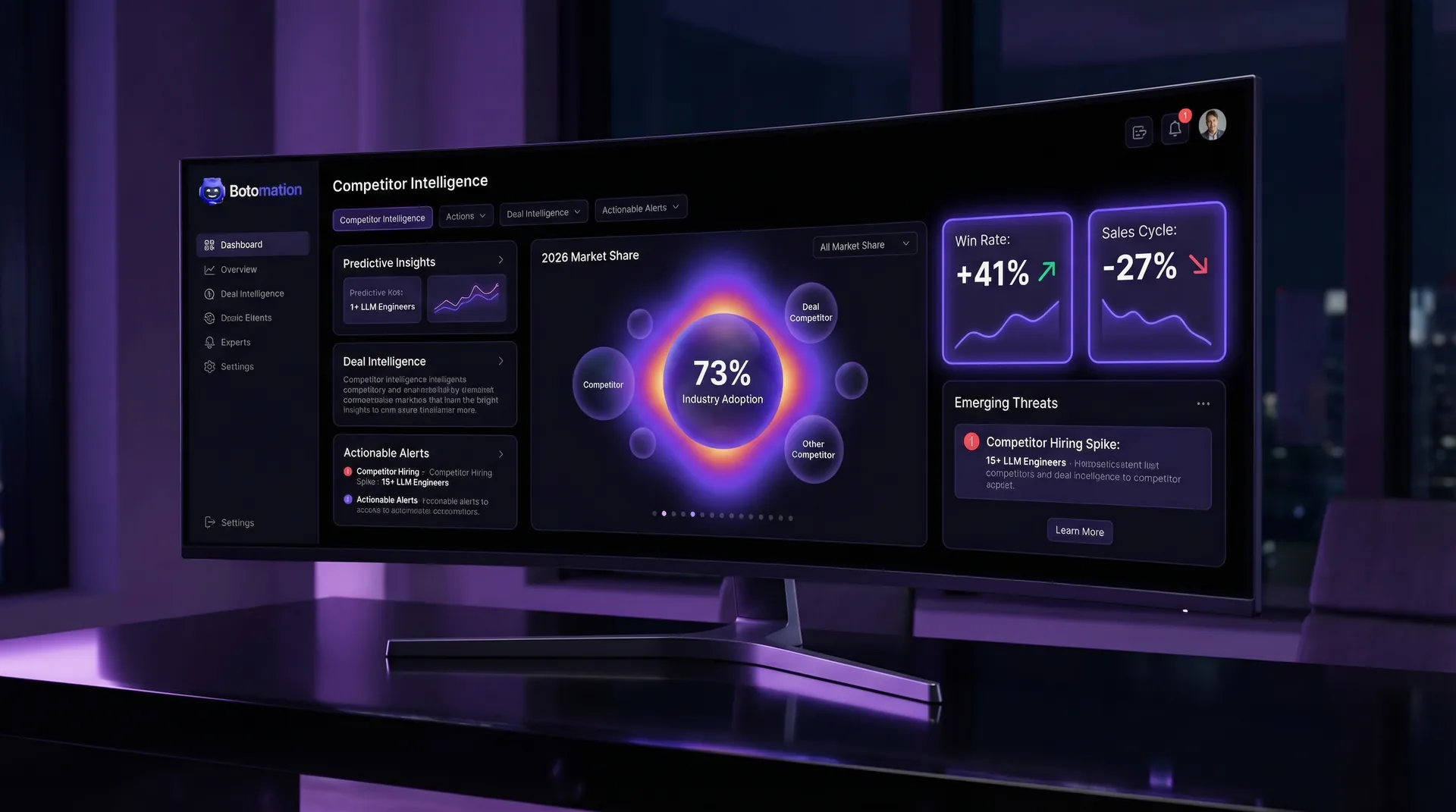
A successful dashboard focuses on action. We design interfaces that highlight "Top Opportunities Today" and "Competitor Alerts" in a way that is visually intuitive. Using modern visualization libraries, we ensure the data is easy to digest at a glance, allowing representatives to spend more time selling and less time interpreting charts.
What are the requirements for daily market intelligence automation?
The primary requirement is a clear understanding of your ideal customer profile (ICP) and the trigger events that signify a high-intent prospect. Technically, you need a CRM with an open API and a commitment to data hygiene. Beyond that, the most important requirement is a partnership with a team that understands how to translate raw web data into strategic sales advantages.
How does automation improve win rates?
Automation improves win rates by identifying "trigger events" (like funding rounds or leadership changes) immediately. This allows sales reps to reach out with highly relevant, timely messaging, which research shows can increase win rates by up to 41%.
Is automated market intelligence compliant with privacy laws?
Yes, when designed correctly. Professional systems are built to respect robots.txt files and adhere to global regulations such as GDPR and CCPA. Data governance layers ensure that only publicly available or compliant data is processed.
The competitive landscape of 2026 does not forgive those who rely on outdated information. With the global sales intelligence market reaching new heights and 80% of companies adopting AI tools, the gap between the leaders and the followers is widening every day. Implementing a daily market intelligence automation system is a fundamental shift in how your business interacts with the world.
By moving away from manual, slow, and expensive research, you empower your sales team to act with a level of precision that was impossible just a few years ago. Our team at Botomation is dedicated to building these premium, custom-fit systems that turn the vast expanse of the internet into your most valuable sales asset. We provide a strategic partnership that ensures your growth is fueled by the most accurate, real-time data available.
The choice is clear: you can continue to let your most valuable employees waste their potential on data entry, or you can automate your intelligence and focus on closing deals. Partnering with Botomation is the most logical step toward securing your place at the top of your industry.
Ready to automate your growth? Book a call below.
Get Started
Book a FREE Consultation Right NOW!
Schedule a Call with Our Team To Make Your Business More Efficient with AI Instantly.
Read More

Daily Market Intelligence Automation for B2B Sales 2026
Master daily market intelligence automation for B2B sales. Automate prospecting, track competitors, and boost win rates with Botomation in late 2026.
2026 Automated Competitor Analysis for Sales Team Advantage
Learn how WhatsApp AI slashes support costs for e-commerce & SaaS. Proven strategies to boost sales, recover carts, and scale 24/7 service.