7 Steps to Automate Lead Scoring Tools for B2B Prospecting
Feb 17, 2026
B2B Prospecting
AI Automation
Sales Strategy
B2B Prospecting
AI Automation
Sales Strategy
Sales teams in 2026 face a paradox of plenty. While there has never been more data available about potential clients, the sheer volume of information often acts as a barrier rather than a bridge to closing deals. Implementing advanced lead scoring tools for B2B prospecting provides the necessary filter to separate high-intent buyers from casual window shoppers, ensuring that your sales representatives focus their energy where it matters most. At Botomation, we have pioneered lead scoring automation for B2B agencies looking to scale their outreach without increasing headcount.
Lead Scoring Performance Metrics 2026
* ROI Increase: Companies implementing automated lead scoring see an average 77% increase in lead generation ROI.
* Response Time: Automation reduces the gap between lead capture and first contact by up to 90%.
* Sales Productivity: Reps spend 35% more time on actual selling activities rather than administrative research.
* Accuracy: Real-time company data integration improves lead qualification accuracy by 68%.
The integration of real-time company data has fundamentally changed the landscape of B2B prospecting. It is no longer enough to know a prospect's job title or their company name. Modern systems now analyze technographic shifts, recent funding rounds, and even intent signals derived from web-wide behavior. By the time a lead enters your CRM, a sophisticated scoring model should have already calculated their value based on hundreds of variables. This proactive approach allows growth-oriented firms to move at a pace that manual research simply cannot match.
What are Lead Scoring Tools for B2B Prospecting?
At its core, lead scoring is a methodology used to rank prospects against a scale that represents the perceived value each lead represents to the organization. The resulting score determines which leads a sales team will engage with and in what order of priority. In the B2B sector, this process is significantly more complex than in B2C, as it involves navigating multiple stakeholders, long sales cycles, and high contract values.
There is a vital distinction between lead scoring and simple lead qualification. Qualification is often a binary "yes or no" based on basic criteria, whereas scoring is a nuanced, continuous assessment. A lead might be qualified because they work in the right industry, but they receive a high score because they recently implemented a competitor's software and are now searching for alternative integrations. This depth of insight is what allows our team at Botomation to build systems that don't just find leads, but identify the exact moment a prospect is ready to buy.
The evolution of these systems has been dramatic. We have moved past the era of "gut feeling" sales where a rep decided who to call based on a familiar company name. We are now firmly in the age of AI-powered systems that utilize GPT-5 and advanced machine learning to parse unstructured data from across the web. These modern systems can identify subtle patterns that a human would miss, such as a sudden spike in hiring for a specific department which often signals an upcoming technology investment.
Consider the case of TechProspecting Inc., a mid-market firm that struggled with a bloated pipeline of low-quality leads. Before partnering with an expert agency to overhaul their process, their sales team spent nearly 40% of their week qualifying leads manually. After implementing an automated scoring system that integrated real-time technographic data, they saw a 140% improvement in lead quality. Their reps stopped chasing "dead-end" contacts and focused exclusively on the top 10% of the pipeline, leading to a record-breaking fiscal year.
Traditional vs. Modern Approaches
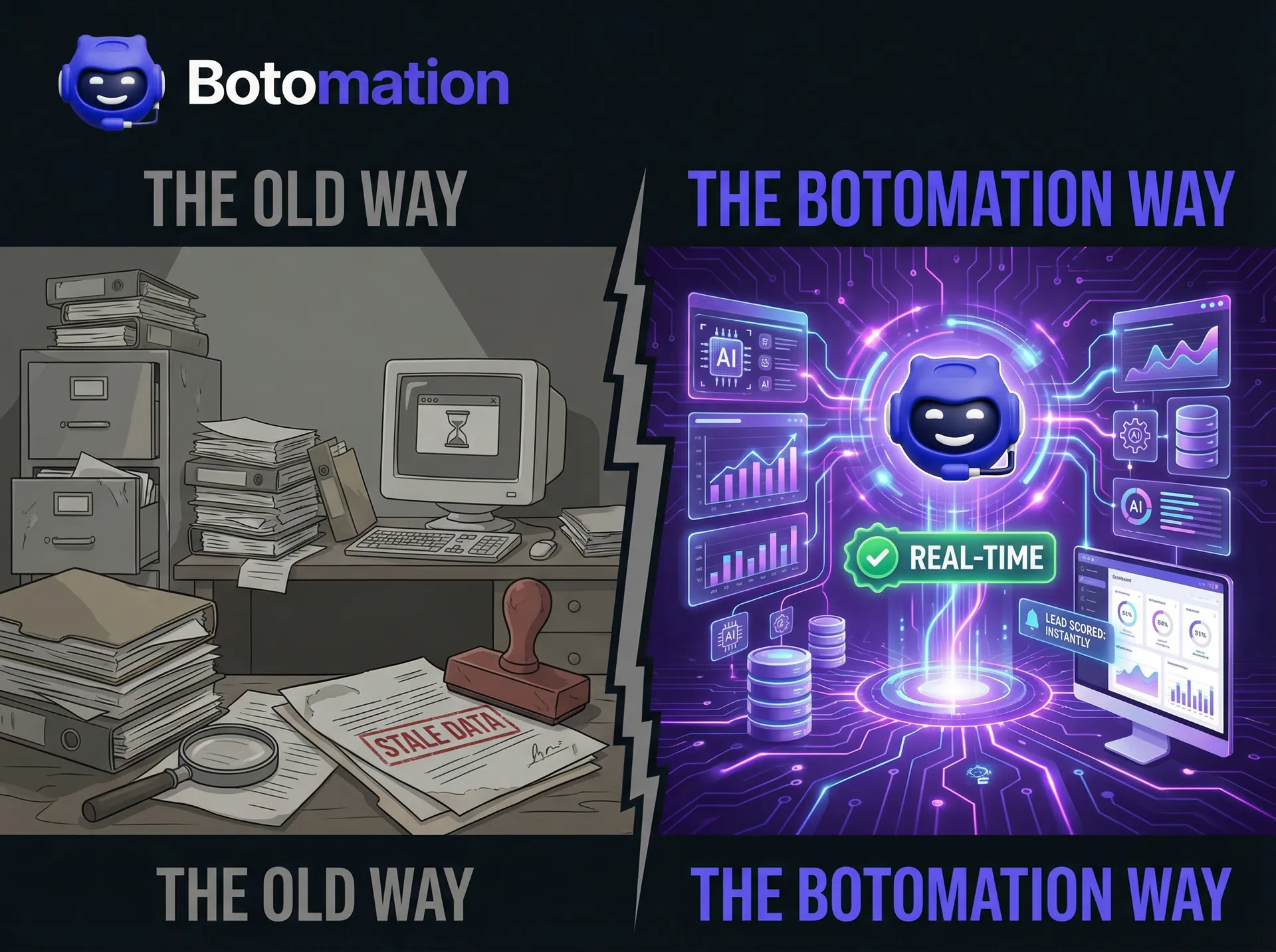
The traditional approach to scoring was largely static and demographic-heavy. You might assign ten points if a lead was a Director and five points if they were a Manager. While this provided some structure, it failed to account for the dynamic nature of business. A Director at a shrinking company is often a worse prospect than a Manager at a Series C startup that just raised $50 million. Traditional models were also plagued by stale data, as CRM records were rarely updated more than once a year.
Modern AI-powered scoring, the kind we implement for our clients at Botomation, uses multiple live data sources to create a 360-degree view of the prospect. These systems leverage predictive models that compare incoming leads against the behavioral patterns of your most successful historical closed-won deals. If your best customers typically use a specific cloud infrastructure or have a certain ratio of engineers to sales staff, the system identifies those traits in new prospects instantly. This real-time integration ensures that the score reflects the company's status today, not six months ago.
Benefits of Lead Scoring Automation
The primary advantage of automation is the drastic increase in conversion rates from marketing qualified leads (MQLs) to sales qualified leads (SQLs). When the scoring criteria are objective and data-driven, the friction between marketing and sales disappears. Sales teams no longer complain about "bad leads" because the system has already verified the prospect's budget, authority, and need through external data validation.
Efficiency is the second major pillar. By automating the research phase, you effectively give your sales team hours of their life back every single day. Instead of hunting for a prospect's current tech stack or trying to find their annual revenue on a 10-K filing, the data is delivered directly to their dashboard. This better resource allocation means your highest-paid talent is spent on closing deals, not data entry. Furthermore, the ability to reduce lead response time ensures the gap between a lead's initial action and a sales follow-up is minimized, which is critical in a market where the first responder wins the deal 50% of the time.
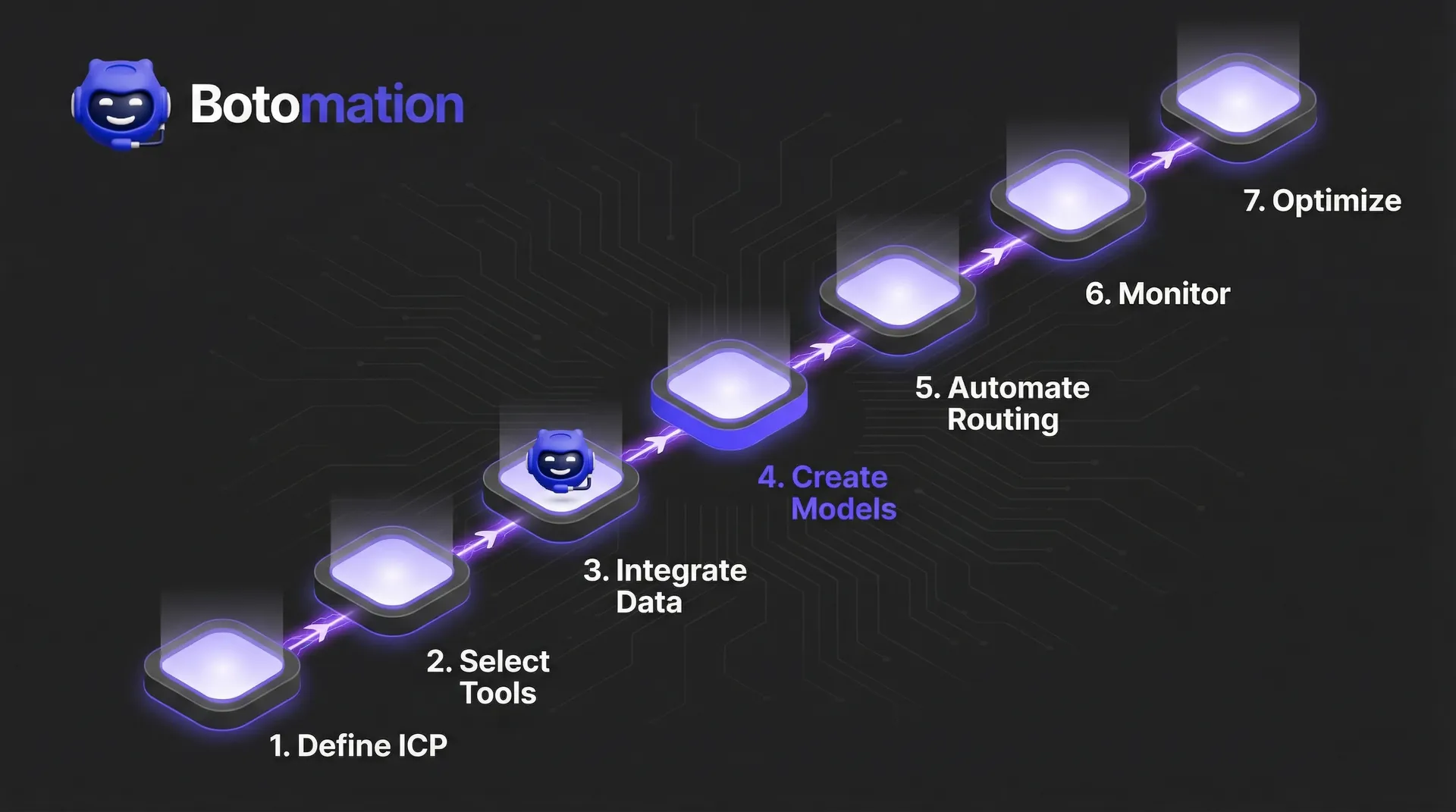
Step 1: Define Your Ideal Customer Profile and Scoring Criteria
Before you can build an automated system, you must have a crystal-clear understanding of who you are trying to reach. An Ideal Customer Profile (ICP) is not a vague description; it is a rigorous set of firmographic, technographic, and behavioral parameters. You need to identify the "signals" that indicate a high probability of conversion. This involves looking beyond the surface level to find the underlying drivers of a purchase decision.
We often see companies making the mistake of being too broad. They want to sell to "any tech company with over 100 employees." A more effective ICP would be "B2B SaaS companies in the FinTech space, using AWS, with a headcount growth of at least 20% year-over-year, and currently utilizing HubSpot for their CRM." This level of specificity enables automated lead qualification based on industry criteria, allowing lead scoring tools for B2B prospecting to function with surgical precision.
Firmographic Scoring Factors
Firmographics are the "demographics" of the business world. To automate this, you must define thresholds for company size, industry, and revenue. For example, if your service is priced for enterprises, a company with 50 employees should receive a negative score or be disqualified entirely. We use NAICS and SIC codes to categorize industries accurately, ensuring that your sales team isn't calling a manufacturing plant when you specialize in professional services.
Geographic location also remains a vital factor, especially for companies with territory-based sales models. If your team only operates in North America and EMEA, a high-intent lead from APAC should be routed differently or scored lower. By setting these hard boundaries in your automation logic, you prevent the "noise" of irrelevant leads from distracting your primary sales force.
Technographic Qualification Criteria
Technographics are perhaps the most undervalued component of modern lead scoring. Knowing what software a company uses can tell you more about their needs than their revenue ever could. If you sell a security plugin for Shopify, every company using Magento is a "negative" lead, while every Shopify Plus user is a "gold" lead. Our experts at Botomation utilize advanced web-scraping and data partnerships to identify these tech stacks in real-time.
We also look for technology upgrade cycles. If a company has been using the same legacy ERP system for seven years, they may be reaching a breaking point where they are ready to switch. Conversely, if they just signed a three-year contract with a direct competitor last month, they are likely not a viable prospect right now regardless of their size. Identifying these vendor relationship indicators allows for much more sophisticated timing in your outreach.
Step 2: Select the Right Lead Scoring Tools for B2B Prospecting
The market for tools for automated prospect evaluation has exploded in complexity as we move through 2026. Choosing the right stack is no longer just about picking a CRM; it is about building an ecosystem where data flows freely between your research tools and your sales platform. While many platforms offer "out-of-the-box" scoring, these often lack the customization required for high-stakes B2B sales.
| Feature | HubSpot SmartLead (v2026.7) | Salesforce Einstein AI | Botomation Custom Build |
|---|---|---|---|
| **Scoring Logic** | Rules-based + Basic AI | Predictive Machine Learning | Custom Multi-Source AI |
| **Data Refresh** | Daily | Near Real-Time | Instant (Web-Scraped) |
| **Integration** | High (Internal Ecosystem) | High (AppExchange) | Unlimited (Custom APIs) |
| **Setup Time** | 2-4 Weeks | 2-3 Months | 4-6 Weeks |
| **Ideal For** | Mid-Market Growth | Large Enterprise | High-Velocity B2B Agencies |
HubSpot’s latest update (v2026.7) introduced SmartLead scoring, which uses basic behavioral triggers to adjust scores. Salesforce Einstein remains a powerhouse for large enterprises that have massive amounts of historical data to train their predictive models. However, for many of our clients, these platforms are too rigid. They want to include data from niche industry databases or automated competitor intelligence that these "big box" solutions can't easily ingest. This is where partnering with a specialized agency like Botomation becomes the "New Way" of prospecting.
Platform Selection Criteria
When evaluating tools, your first priority should be integration. If a tool doesn't play nicely with your existing CRM or your email sequencing software, it will create a data silo that slows you down. You also need to look at data source flexibility. Can the tool pull in intent data from third-party providers? Can it scrape a prospect's "Careers" page to see what roles they are hiring for?
Scalability is equally important. A scoring model that works for 100 leads a month might break when you scale to 10,000. You need a system that can process massive amounts of data without latency. Finally, consider the pricing model. Some tools charge per lead scored, which can become prohibitively expensive as your top-of-funnel activity grows. We prefer models that focus on the value delivered rather than taxing your growth.
Technical Requirements
From a technical standpoint, API availability is non-negotiable. Your scoring engine needs to be able to "talk" to your data providers in real-time. If there is a delay in the data sync, your sales team might be calling a lead based on information that is already 24 hours old. In the fast-paced world of B2B, 24 hours is an eternity.
You also need custom scoring model capabilities. Avoid tools that force you into a "one size fits all" algorithm. Your business is unique, and your scoring should reflect that. Whether you need to weight a specific technographic trigger more heavily or create different scoring tiers for different product lines, the technology should adapt to your strategy, not the other way around.
Step 3: Integrate Real-Time Company Data Sources
The "secret sauce" of high-performing lead scoring is the quality of the data feeding the engine. Static lists are the "Old Way"—they are outdated the moment they are exported. The "New Way" involves direct API integrations with providers like ZoomInfo, Apollo, and Clearbit. With the release of the ZoomInfo API version 2026-01, we now have access to real-time "scoops"—verified business events like leadership changes, budget approvals, or new project launches. This automated lead qualification with company insights ensures that the score reflects the company's status today.
Imagine a scenario where a target company suddenly hires a new VP of Marketing. In the past, it might take months for that information to trickle down to a sales rep. Today, our automated systems detect that change within minutes. The lead's score is immediately boosted because a new executive often means a new budget and a willingness to change existing processes. This is the power of real-time data integration.
Data Integration Process
The technical setup begins with API authentication. This is the "handshake" between your scoring system and the data provider. Once the connection is established, we perform data mapping to ensure that the fields in ZoomInfo or Apollo align perfectly with your CRM fields. For instance, "Total Revenue" in one system must match "Annual Revenue" in yours to avoid calculation errors.
We also set synchronization frequency. For high-priority accounts, we might set this to "near-instant," while for general market research, a daily sync might suffice. It is also vital to build in error handling protocols. If an API call fails or returns a null value, the system needs to know how to handle that lead without crashing the entire workflow or assigning an arbitrary score of zero.
Data Quality Assurance
Automation is only as good as the data it processes. "Garbage in, garbage out" is a cliché for a reason. We implement rigorous validation steps to ensure company data accuracy. This includes cross-referencing multiple sources. If ZoomInfo says a company has 500 employees but Apollo says 5,000, our system flags that lead for manual review or uses a third source like LinkedIn to break the tie.
Regular update schedules are essential to prevent lead list decay. Companies grow, shrink, and get acquired. A lead that was a "perfect fit" last year might be part of a competitor's conglomerate this year. We also use data enrichment strategies to fill in the blanks. If a lead enters your system with only an email address, our automation instantly finds their LinkedIn profile, their company's tech stack, and their recent social media activity to build a complete profile.
Step 4: Create Scoring Models and Weighted Criteria
Building the actual scoring model is where the strategy meets the math. You aren't just adding up points; you are creating a mathematical representation of your sales intuition. Every criterion must be weighted based on its correlation with conversion. If your data shows that companies using "Segment" as their data platform are five times more likely to buy your product, that technographic signal should carry five times the weight of a standard industry match.
We use a combination of positive and negative scoring. Positive points are awarded for "fit" and "interest" signals. Negative points are used to "demote" leads that are clearly not a match—such as students, competitors, or job seekers. This ensures that your sales team's dashboard isn't cluttered with high-scoring leads that are actually just people looking for work at your target companies.
Scoring Model Design
A robust model typically uses a 0-100 scale. We might break it down like this:
- Firmographic Fit (Max 40 points): 10 points for the right industry, 10 for revenue bracket, 10 for headcount, and 10 for HQ location.
- Technographic Fit (Max 30 points): 15 points for using a complementary tool, 15 points for not using a locked-in competitor.
- Behavioral Intent (Max 30 points): 10 points for visiting the pricing page, 10 for downloading a whitepaper, 10 for attending a webinar.
Let's look at the calculation for a "Hot Lead":
Base Score: 40 (Perfect Firmographic Match)
Tech Multiplier: +25 (Uses GPT-5 API)
Intent Bonus: +20 (Visited 'Compare us' page 3 times)
Total Score: 85/100 -> Route to Senior Account Executive immediately.
Model Testing and Validation
You should never "set and forget" a scoring model. We use A/B testing to compare different weighting strategies. For example, does weighting "Job Title" more heavily than "Company Size" lead to more closed deals? By analyzing the conversion rate of different score ranges, we can fine-tune the engine. If leads with a score of 70 are converting better than those with a score of 90, something is wrong with the model logic.
The new machine learning algorithms in Sales Cloud Einstein 2026 have made this process even more efficient. These systems can automatically suggest adjustments to your weights based on real-time performance data. If the market shifts—say, a new regulation makes your product more valuable to the healthcare industry—the AI identifies the trend and suggests increasing the score for healthcare prospects before you even realize there's a trend.
Step 5: Automate Lead Qualification and Routing
Once a lead is scored, the system must act on that information without human intervention. This is where many companies fail; they have great data but slow execution. Automated routing ensures that a high-value lead is handed to a sales representative while they are still thinking about your solution. If a prospect hits a score of 85, they shouldn't wait for a weekly "lead dump"—they should be in a rep's queue in seconds.
Our team at Botomation specializes in building lead qualification automation for agency workflows. We connect your scoring engine to your CRM (like Salesforce or HubSpot) and your communication tools (like Slack or Microsoft Teams). When a "Tier 1" lead is identified, the assigned rep gets a Slack notification with a summary of why the lead scored so high, including their recent website activity and tech stack details.
Workflow Configuration
The configuration process involves setting clear triggers.
- The Trigger: A lead's score crosses a specific threshold (e.g., 80+).
- The Action: The CRM field "Lead Status" is updated to "Sales Ready."
- The Assignment: A task is created for the Account Executive with a 2-hour completion deadline.
- The Notification: An automated "Intro" email is sent from the rep's account to the prospect.
This level of automation ensures that nothing falls through the cracks. It also allows for "lead nurturing" automation. If a lead has a moderate score (40-60), they aren't ignored; they are automatically enrolled in a specific email sequence designed to educate them and push their score higher through engagement. This keeps your pipeline moving at all levels.
Lead Routing Rules
Effective routing is about more than just speed; it's about matching the lead to the right person. You can set rules based on territory, industry expertise, or even "round-robin" assignment to keep things fair. For example, a high-scoring lead from a Fortune 500 company should likely go to an Enterprise Account Executive, while a high-scoring lead from a startup might go to a Mid-Market rep.
We also implement escalation procedures. If a high-value lead isn't contacted within a certain timeframe (e.g., 4 hours), the system automatically reassigns it or notifies a Sales Manager. This accountability is what separates world-class sales organizations from the rest. GrowthPros Agency, one of our partners, reduced their lead response time from 24 hours to just 3 minutes by implementing these automated routing rules.
Steps 6 & 7: Monitor Performance and Optimize
The final steps are about continuous improvement. The B2B market is not static; your competitors change, your product evolves, and buyer behavior shifts. Your lead scoring model must be a living organism. It is vital to automate lead screening process for B2B sales to remain competitive. We recommend a formal review of your scoring performance every 30 days. This isn't just a "check-in"—it's a deep dive into the data to see if your "High Score" leads are actually turning into "High Value" customers.
As Sarah Williams, VP of Sales at LeadOptimize Solutions, notes: "The most successful B2B prospectors review and adjust their scoring models monthly based on conversion data. If you aren't tweaking your weights based on what's actually closing, you're essentially flying blind with a fancy dashboard." This philosophy of constant optimization is what keeps our clients at the top of their industries.
Performance Metrics Tracking
To know if your scoring is working, you must track the right KPIs.
- Lead-to-Customer Conversion Rate: Are high-scoring leads converting at a significantly higher rate than low-scoring ones?
- Sales Feedback: This is qualitative but vital. Do the reps feel the leads they are getting are actually "hot"?
- Cost per Qualified Lead (CPQL): Is automation reducing the amount of money you spend to find a viable prospect?
- Time to Close: Are high-scoring leads moving through the funnel faster?
By calculating the ROI of your automation, you can justify further investment in data sources or more advanced tools. For example, if you spend $2,000 a month on a premium data API but it helps you close one extra $20,000 deal, the ROI is clear. We help our clients build these reporting dashboards so they can see the direct link between automated research and revenue.
Optimization Techniques
Optimization often involves "negative feedback loops." If your sales team consistently rejects leads from a certain industry despite them having high scores, you need to adjust your negative scoring for that industry. You might also find that a new behavioral signal—like a prospect following your CEO on LinkedIn—is a high-value indicator that you haven't been tracking.
We also look at expanding or refining your ICP based on "surprise" wins. Sometimes, a company that doesn't fit your traditional profile becomes a great customer. We analyze those outliers to see if there's a new market segment you should be targeting. This proactive market research, powered by the custom tools we build at Botomation, ensures you are always one step ahead of the competition.
Frequently Asked Questions
What is the biggest mistake companies make with lead scoring?
The most common error is making the model too complex too quickly. Start with 5-10 core criteria that you know correlate with sales success. Once you have a baseline of data, you can begin adding more nuanced layers like intent signals or technographic shifts. Complexity without a foundation leads to "analysis paralysis" where the scores become meaningless.
Do I need a dedicated data scientist to manage this?
While having a data expert helps, modern tools and partnering with an agency like Botomation make this accessible to any growth-focused team. Our experts handle the technical heavy lifting—API integrations, model weighting, and workflow automation—so your sales team can focus on what they do best: building relationships and closing deals.
How often should we update our lead scoring criteria?
At a minimum, you should perform a light review monthly and a deep-dive audit quarterly. However, if you launch a new product or enter a new market, you should update your scoring criteria immediately to reflect the new target profile.
Can lead scoring work for small B2B companies?
Absolutely. In fact, it is often more critical for smaller teams because their resources are limited. Automation acts as a force multiplier, allowing a team of two reps to be as effective as a team of ten by ensuring they only talk to the best prospects.
How does AI integration improve lead scoring accuracy in 2026?
AI systems like GPT-5 can analyze unstructured data—such as the sentiment of a CEO's interview or the specific language in a job posting—to identify intent that traditional firmographic data misses. This leads to a more nuanced score that reflects real-world buying readiness rather than just static company size.
Partner with the Experts at Botomation
The "Old Way" of B2B prospecting—manual research, stale lead lists, and "gut feeling" qualification—is a recipe for stagnation in 2026. Your competitors are already using AI-driven systems to identify and engage your best prospects before you even know they exist. To win in this environment, you need more than just a tool; you need a custom-built engine designed by experts who understand the intersection of data and sales strategy.
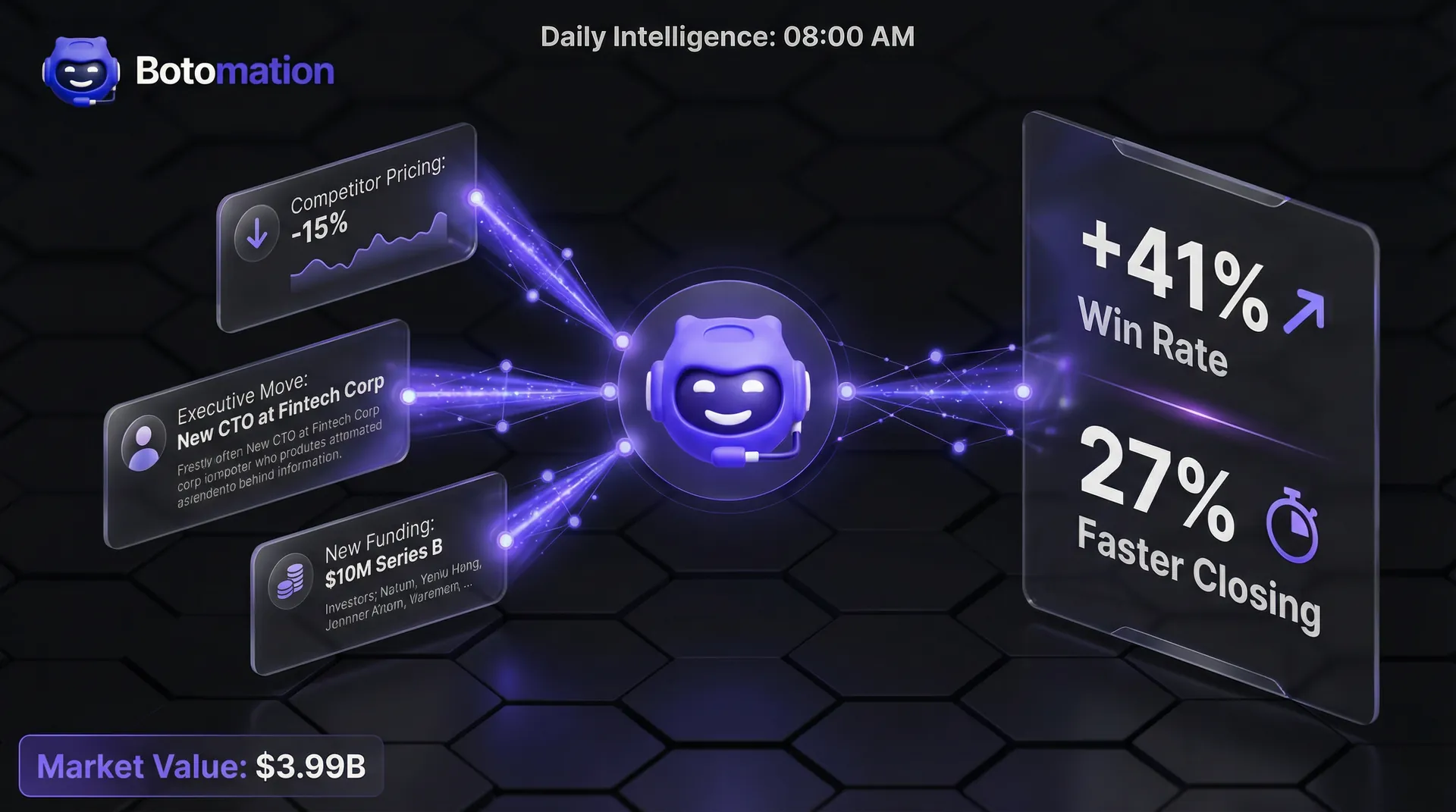
At Botomation, we don't just sell you a platform; we are a premium agency that builds bespoke automation solutions for your specific needs. Our team of experts will scan the web to find your potential clients, monitor your competitors, and deliver fresh, qualified leads to your sales team every single morning. Stop losing money on manual processes and start scaling with precision.
Ready to automate your growth? Book a call below.
Sales teams in 2026 face a paradox of plenty. While there has never been more data available about potential clients, the sheer volume of information often acts as a barrier rather than a bridge to closing deals. Implementing advanced lead scoring tools for B2B prospecting provides the necessary filter to separate high-intent buyers from casual window shoppers, ensuring that your sales representatives focus their energy where it matters most. At Botomation, we have pioneered lead scoring automation for B2B agencies looking to scale their outreach without increasing headcount.
Lead Scoring Performance Metrics 2026
* ROI Increase: Companies implementing automated lead scoring see an average 77% increase in lead generation ROI.
* Response Time: Automation reduces the gap between lead capture and first contact by up to 90%.
* Sales Productivity: Reps spend 35% more time on actual selling activities rather than administrative research.
* Accuracy: Real-time company data integration improves lead qualification accuracy by 68%.
The integration of real-time company data has fundamentally changed the landscape of B2B prospecting. It is no longer enough to know a prospect's job title or their company name. Modern systems now analyze technographic shifts, recent funding rounds, and even intent signals derived from web-wide behavior. By the time a lead enters your CRM, a sophisticated scoring model should have already calculated their value based on hundreds of variables. This proactive approach allows growth-oriented firms to move at a pace that manual research simply cannot match.
What are Lead Scoring Tools for B2B Prospecting?
At its core, lead scoring is a methodology used to rank prospects against a scale that represents the perceived value each lead represents to the organization. The resulting score determines which leads a sales team will engage with and in what order of priority. In the B2B sector, this process is significantly more complex than in B2C, as it involves navigating multiple stakeholders, long sales cycles, and high contract values.
There is a vital distinction between lead scoring and simple lead qualification. Qualification is often a binary "yes or no" based on basic criteria, whereas scoring is a nuanced, continuous assessment. A lead might be qualified because they work in the right industry, but they receive a high score because they recently implemented a competitor's software and are now searching for alternative integrations. This depth of insight is what allows our team at Botomation to build systems that don't just find leads, but identify the exact moment a prospect is ready to buy.
The evolution of these systems has been dramatic. We have moved past the era of "gut feeling" sales where a rep decided who to call based on a familiar company name. We are now firmly in the age of AI-powered systems that utilize GPT-5 and advanced machine learning to parse unstructured data from across the web. These modern systems can identify subtle patterns that a human would miss, such as a sudden spike in hiring for a specific department which often signals an upcoming technology investment.
Consider the case of TechProspecting Inc., a mid-market firm that struggled with a bloated pipeline of low-quality leads. Before partnering with an expert agency to overhaul their process, their sales team spent nearly 40% of their week qualifying leads manually. After implementing an automated scoring system that integrated real-time technographic data, they saw a 140% improvement in lead quality. Their reps stopped chasing "dead-end" contacts and focused exclusively on the top 10% of the pipeline, leading to a record-breaking fiscal year.
Traditional vs. Modern Approaches
The traditional approach to scoring was largely static and demographic-heavy. You might assign ten points if a lead was a Director and five points if they were a Manager. While this provided some structure, it failed to account for the dynamic nature of business. A Director at a shrinking company is often a worse prospect than a Manager at a Series C startup that just raised $50 million. Traditional models were also plagued by stale data, as CRM records were rarely updated more than once a year.
Modern AI-powered scoring, the kind we implement for our clients at Botomation, uses multiple live data sources to create a 360-degree view of the prospect. These systems leverage predictive models that compare incoming leads against the behavioral patterns of your most successful historical closed-won deals. If your best customers typically use a specific cloud infrastructure or have a certain ratio of engineers to sales staff, the system identifies those traits in new prospects instantly. This real-time integration ensures that the score reflects the company's status today, not six months ago.
Benefits of Lead Scoring Automation
The primary advantage of automation is the drastic increase in conversion rates from marketing qualified leads (MQLs) to sales qualified leads (SQLs). When the scoring criteria are objective and data-driven, the friction between marketing and sales disappears. Sales teams no longer complain about "bad leads" because the system has already verified the prospect's budget, authority, and need through external data validation.
Efficiency is the second major pillar. By automating the research phase, you effectively give your sales team hours of their life back every single day. Instead of hunting for a prospect's current tech stack or trying to find their annual revenue on a 10-K filing, the data is delivered directly to their dashboard. This better resource allocation means your highest-paid talent is spent on closing deals, not data entry. Furthermore, the ability to reduce lead response time ensures the gap between a lead's initial action and a sales follow-up is minimized, which is critical in a market where the first responder wins the deal 50% of the time.
Step 1: Define Your Ideal Customer Profile and Scoring Criteria
Before you can build an automated system, you must have a crystal-clear understanding of who you are trying to reach. An Ideal Customer Profile (ICP) is not a vague description; it is a rigorous set of firmographic, technographic, and behavioral parameters. You need to identify the "signals" that indicate a high probability of conversion. This involves looking beyond the surface level to find the underlying drivers of a purchase decision.
We often see companies making the mistake of being too broad. They want to sell to "any tech company with over 100 employees." A more effective ICP would be "B2B SaaS companies in the FinTech space, using AWS, with a headcount growth of at least 20% year-over-year, and currently utilizing HubSpot for their CRM." This level of specificity enables automated lead qualification based on industry criteria, allowing lead scoring tools for B2B prospecting to function with surgical precision.
Firmographic Scoring Factors
Firmographics are the "demographics" of the business world. To automate this, you must define thresholds for company size, industry, and revenue. For example, if your service is priced for enterprises, a company with 50 employees should receive a negative score or be disqualified entirely. We use NAICS and SIC codes to categorize industries accurately, ensuring that your sales team isn't calling a manufacturing plant when you specialize in professional services.
Geographic location also remains a vital factor, especially for companies with territory-based sales models. If your team only operates in North America and EMEA, a high-intent lead from APAC should be routed differently or scored lower. By setting these hard boundaries in your automation logic, you prevent the "noise" of irrelevant leads from distracting your primary sales force.
Technographic Qualification Criteria
Technographics are perhaps the most undervalued component of modern lead scoring. Knowing what software a company uses can tell you more about their needs than their revenue ever could. If you sell a security plugin for Shopify, every company using Magento is a "negative" lead, while every Shopify Plus user is a "gold" lead. Our experts at Botomation utilize advanced web-scraping and data partnerships to identify these tech stacks in real-time.
We also look for technology upgrade cycles. If a company has been using the same legacy ERP system for seven years, they may be reaching a breaking point where they are ready to switch. Conversely, if they just signed a three-year contract with a direct competitor last month, they are likely not a viable prospect right now regardless of their size. Identifying these vendor relationship indicators allows for much more sophisticated timing in your outreach.
Step 2: Select the Right Lead Scoring Tools for B2B Prospecting
The market for tools for automated prospect evaluation has exploded in complexity as we move through 2026. Choosing the right stack is no longer just about picking a CRM; it is about building an ecosystem where data flows freely between your research tools and your sales platform. While many platforms offer "out-of-the-box" scoring, these often lack the customization required for high-stakes B2B sales.
| Feature | HubSpot SmartLead (v2026.7) | Salesforce Einstein AI | Botomation Custom Build |
|---|---|---|---|
| **Scoring Logic** | Rules-based + Basic AI | Predictive Machine Learning | Custom Multi-Source AI |
| **Data Refresh** | Daily | Near Real-Time | Instant (Web-Scraped) |
| **Integration** | High (Internal Ecosystem) | High (AppExchange) | Unlimited (Custom APIs) |
| **Setup Time** | 2-4 Weeks | 2-3 Months | 4-6 Weeks |
| **Ideal For** | Mid-Market Growth | Large Enterprise | High-Velocity B2B Agencies |
HubSpot’s latest update (v2026.7) introduced SmartLead scoring, which uses basic behavioral triggers to adjust scores. Salesforce Einstein remains a powerhouse for large enterprises that have massive amounts of historical data to train their predictive models. However, for many of our clients, these platforms are too rigid. They want to include data from niche industry databases or automated competitor intelligence that these "big box" solutions can't easily ingest. This is where partnering with a specialized agency like Botomation becomes the "New Way" of prospecting.
Platform Selection Criteria
When evaluating tools, your first priority should be integration. If a tool doesn't play nicely with your existing CRM or your email sequencing software, it will create a data silo that slows you down. You also need to look at data source flexibility. Can the tool pull in intent data from third-party providers? Can it scrape a prospect's "Careers" page to see what roles they are hiring for?
Scalability is equally important. A scoring model that works for 100 leads a month might break when you scale to 10,000. You need a system that can process massive amounts of data without latency. Finally, consider the pricing model. Some tools charge per lead scored, which can become prohibitively expensive as your top-of-funnel activity grows. We prefer models that focus on the value delivered rather than taxing your growth.
Technical Requirements
From a technical standpoint, API availability is non-negotiable. Your scoring engine needs to be able to "talk" to your data providers in real-time. If there is a delay in the data sync, your sales team might be calling a lead based on information that is already 24 hours old. In the fast-paced world of B2B, 24 hours is an eternity.
You also need custom scoring model capabilities. Avoid tools that force you into a "one size fits all" algorithm. Your business is unique, and your scoring should reflect that. Whether you need to weight a specific technographic trigger more heavily or create different scoring tiers for different product lines, the technology should adapt to your strategy, not the other way around.
Step 3: Integrate Real-Time Company Data Sources
The "secret sauce" of high-performing lead scoring is the quality of the data feeding the engine. Static lists are the "Old Way"—they are outdated the moment they are exported. The "New Way" involves direct API integrations with providers like ZoomInfo, Apollo, and Clearbit. With the release of the ZoomInfo API version 2026-01, we now have access to real-time "scoops"—verified business events like leadership changes, budget approvals, or new project launches. This automated lead qualification with company insights ensures that the score reflects the company's status today.
Imagine a scenario where a target company suddenly hires a new VP of Marketing. In the past, it might take months for that information to trickle down to a sales rep. Today, our automated systems detect that change within minutes. The lead's score is immediately boosted because a new executive often means a new budget and a willingness to change existing processes. This is the power of real-time data integration.
Data Integration Process
The technical setup begins with API authentication. This is the "handshake" between your scoring system and the data provider. Once the connection is established, we perform data mapping to ensure that the fields in ZoomInfo or Apollo align perfectly with your CRM fields. For instance, "Total Revenue" in one system must match "Annual Revenue" in yours to avoid calculation errors.
We also set synchronization frequency. For high-priority accounts, we might set this to "near-instant," while for general market research, a daily sync might suffice. It is also vital to build in error handling protocols. If an API call fails or returns a null value, the system needs to know how to handle that lead without crashing the entire workflow or assigning an arbitrary score of zero.
Data Quality Assurance
Automation is only as good as the data it processes. "Garbage in, garbage out" is a cliché for a reason. We implement rigorous validation steps to ensure company data accuracy. This includes cross-referencing multiple sources. If ZoomInfo says a company has 500 employees but Apollo says 5,000, our system flags that lead for manual review or uses a third source like LinkedIn to break the tie.
Regular update schedules are essential to prevent lead list decay. Companies grow, shrink, and get acquired. A lead that was a "perfect fit" last year might be part of a competitor's conglomerate this year. We also use data enrichment strategies to fill in the blanks. If a lead enters your system with only an email address, our automation instantly finds their LinkedIn profile, their company's tech stack, and their recent social media activity to build a complete profile.
Step 4: Create Scoring Models and Weighted Criteria
Building the actual scoring model is where the strategy meets the math. You aren't just adding up points; you are creating a mathematical representation of your sales intuition. Every criterion must be weighted based on its correlation with conversion. If your data shows that companies using "Segment" as their data platform are five times more likely to buy your product, that technographic signal should carry five times the weight of a standard industry match.
We use a combination of positive and negative scoring. Positive points are awarded for "fit" and "interest" signals. Negative points are used to "demote" leads that are clearly not a match—such as students, competitors, or job seekers. This ensures that your sales team's dashboard isn't cluttered with high-scoring leads that are actually just people looking for work at your target companies.
Scoring Model Design
A robust model typically uses a 0-100 scale. We might break it down like this:
- Firmographic Fit (Max 40 points): 10 points for the right industry, 10 for revenue bracket, 10 for headcount, and 10 for HQ location.
- Technographic Fit (Max 30 points): 15 points for using a complementary tool, 15 points for not using a locked-in competitor.
- Behavioral Intent (Max 30 points): 10 points for visiting the pricing page, 10 for downloading a whitepaper, 10 for attending a webinar.
Let's look at the calculation for a "Hot Lead":
Base Score: 40 (Perfect Firmographic Match)
Tech Multiplier: +25 (Uses GPT-5 API)
Intent Bonus: +20 (Visited 'Compare us' page 3 times)
Total Score: 85/100 -> Route to Senior Account Executive immediately.
Model Testing and Validation
You should never "set and forget" a scoring model. We use A/B testing to compare different weighting strategies. For example, does weighting "Job Title" more heavily than "Company Size" lead to more closed deals? By analyzing the conversion rate of different score ranges, we can fine-tune the engine. If leads with a score of 70 are converting better than those with a score of 90, something is wrong with the model logic.
The new machine learning algorithms in Sales Cloud Einstein 2026 have made this process even more efficient. These systems can automatically suggest adjustments to your weights based on real-time performance data. If the market shifts—say, a new regulation makes your product more valuable to the healthcare industry—the AI identifies the trend and suggests increasing the score for healthcare prospects before you even realize there's a trend.
Step 5: Automate Lead Qualification and Routing
Once a lead is scored, the system must act on that information without human intervention. This is where many companies fail; they have great data but slow execution. Automated routing ensures that a high-value lead is handed to a sales representative while they are still thinking about your solution. If a prospect hits a score of 85, they shouldn't wait for a weekly "lead dump"—they should be in a rep's queue in seconds.
Our team at Botomation specializes in building lead qualification automation for agency workflows. We connect your scoring engine to your CRM (like Salesforce or HubSpot) and your communication tools (like Slack or Microsoft Teams). When a "Tier 1" lead is identified, the assigned rep gets a Slack notification with a summary of why the lead scored so high, including their recent website activity and tech stack details.
Workflow Configuration
The configuration process involves setting clear triggers.
- The Trigger: A lead's score crosses a specific threshold (e.g., 80+).
- The Action: The CRM field "Lead Status" is updated to "Sales Ready."
- The Assignment: A task is created for the Account Executive with a 2-hour completion deadline.
- The Notification: An automated "Intro" email is sent from the rep's account to the prospect.
This level of automation ensures that nothing falls through the cracks. It also allows for "lead nurturing" automation. If a lead has a moderate score (40-60), they aren't ignored; they are automatically enrolled in a specific email sequence designed to educate them and push their score higher through engagement. This keeps your pipeline moving at all levels.
Lead Routing Rules
Effective routing is about more than just speed; it's about matching the lead to the right person. You can set rules based on territory, industry expertise, or even "round-robin" assignment to keep things fair. For example, a high-scoring lead from a Fortune 500 company should likely go to an Enterprise Account Executive, while a high-scoring lead from a startup might go to a Mid-Market rep.
We also implement escalation procedures. If a high-value lead isn't contacted within a certain timeframe (e.g., 4 hours), the system automatically reassigns it or notifies a Sales Manager. This accountability is what separates world-class sales organizations from the rest. GrowthPros Agency, one of our partners, reduced their lead response time from 24 hours to just 3 minutes by implementing these automated routing rules.
Steps 6 & 7: Monitor Performance and Optimize
The final steps are about continuous improvement. The B2B market is not static; your competitors change, your product evolves, and buyer behavior shifts. Your lead scoring model must be a living organism. It is vital to automate lead screening process for B2B sales to remain competitive. We recommend a formal review of your scoring performance every 30 days. This isn't just a "check-in"—it's a deep dive into the data to see if your "High Score" leads are actually turning into "High Value" customers.
As Sarah Williams, VP of Sales at LeadOptimize Solutions, notes: "The most successful B2B prospectors review and adjust their scoring models monthly based on conversion data. If you aren't tweaking your weights based on what's actually closing, you're essentially flying blind with a fancy dashboard." This philosophy of constant optimization is what keeps our clients at the top of their industries.
Performance Metrics Tracking
To know if your scoring is working, you must track the right KPIs.
- Lead-to-Customer Conversion Rate: Are high-scoring leads converting at a significantly higher rate than low-scoring ones?
- Sales Feedback: This is qualitative but vital. Do the reps feel the leads they are getting are actually "hot"?
- Cost per Qualified Lead (CPQL): Is automation reducing the amount of money you spend to find a viable prospect?
- Time to Close: Are high-scoring leads moving through the funnel faster?
By calculating the ROI of your automation, you can justify further investment in data sources or more advanced tools. For example, if you spend $2,000 a month on a premium data API but it helps you close one extra $20,000 deal, the ROI is clear. We help our clients build these reporting dashboards so they can see the direct link between automated research and revenue.
Optimization Techniques
Optimization often involves "negative feedback loops." If your sales team consistently rejects leads from a certain industry despite them having high scores, you need to adjust your negative scoring for that industry. You might also find that a new behavioral signal—like a prospect following your CEO on LinkedIn—is a high-value indicator that you haven't been tracking.
We also look at expanding or refining your ICP based on "surprise" wins. Sometimes, a company that doesn't fit your traditional profile becomes a great customer. We analyze those outliers to see if there's a new market segment you should be targeting. This proactive market research, powered by the custom tools we build at Botomation, ensures you are always one step ahead of the competition.
Frequently Asked Questions
What is the biggest mistake companies make with lead scoring?
The most common error is making the model too complex too quickly. Start with 5-10 core criteria that you know correlate with sales success. Once you have a baseline of data, you can begin adding more nuanced layers like intent signals or technographic shifts. Complexity without a foundation leads to "analysis paralysis" where the scores become meaningless.
Do I need a dedicated data scientist to manage this?
While having a data expert helps, modern tools and partnering with an agency like Botomation make this accessible to any growth-focused team. Our experts handle the technical heavy lifting—API integrations, model weighting, and workflow automation—so your sales team can focus on what they do best: building relationships and closing deals.
How often should we update our lead scoring criteria?
At a minimum, you should perform a light review monthly and a deep-dive audit quarterly. However, if you launch a new product or enter a new market, you should update your scoring criteria immediately to reflect the new target profile.
Can lead scoring work for small B2B companies?
Absolutely. In fact, it is often more critical for smaller teams because their resources are limited. Automation acts as a force multiplier, allowing a team of two reps to be as effective as a team of ten by ensuring they only talk to the best prospects.
How does AI integration improve lead scoring accuracy in 2026?
AI systems like GPT-5 can analyze unstructured data—such as the sentiment of a CEO's interview or the specific language in a job posting—to identify intent that traditional firmographic data misses. This leads to a more nuanced score that reflects real-world buying readiness rather than just static company size.
Partner with the Experts at Botomation
The "Old Way" of B2B prospecting—manual research, stale lead lists, and "gut feeling" qualification—is a recipe for stagnation in 2026. Your competitors are already using AI-driven systems to identify and engage your best prospects before you even know they exist. To win in this environment, you need more than just a tool; you need a custom-built engine designed by experts who understand the intersection of data and sales strategy.
At Botomation, we don't just sell you a platform; we are a premium agency that builds bespoke automation solutions for your specific needs. Our team of experts will scan the web to find your potential clients, monitor your competitors, and deliver fresh, qualified leads to your sales team every single morning. Stop losing money on manual processes and start scaling with precision.
Ready to automate your growth? Book a call below.
Get Started
Book a FREE Consultation Right NOW!
Schedule a Call with Our Team To Make Your Business More Efficient with AI Instantly.
Read More
7 Steps to Automate Lead Scoring Tools for B2B Prospecting
Optimize lead scoring tools for B2B prospecting. Use real-time company data and AI automation to refine lead qualification and scale sales revenue.
Daily Market Intelligence Automation for B2B Sales 2026
Learn how WhatsApp AI slashes support costs for e-commerce & SaaS. Proven strategies to boost sales, recover carts, and scale 24/7 service.