Automated Lead Qualification Software for Agencies - 2026
Feb 17, 2026
Marketing Agency
AI Automation
Lead Qualification
Marketing Agency
AI Automation
Lead Qualification
The landscape of professional services has shifted dramatically as we move through late 2026. For marketing agency owners, the primary bottleneck is no longer the capacity to deliver high-tier creative work or manage complex advertising campaigns. Instead, the most significant hurdle remains the identification and vetting of prospects who possess the budget and intent to sign a contract. Automated lead qualification software for marketing agencies has evolved from a luxury add-on into the central nervous system of successful growth operations. By implementing these sophisticated systems, agencies are reducing admin tasks in service operations and reclaiming an average of 15 hours per week that were previously lost to manual work, according to a 2026 study by Sales Hacker. This shift allows senior strategists to focus on closing high-value deals rather than scouring LinkedIn profiles or outdated databases.
Modern lead qualification represents a fundamental departure from the traditional lead scoring models of the past decade. While lead scoring historically assigned subjective point values to actions like opening an email or visiting a pricing page, true qualification in 2026 involves a deep, automated analysis of a prospect’s business health, technological stack, and immediate market needs. Our team at Botomation has observed that agencies often conflate these two concepts. Scoring indicates interest, but qualification determines viability. This distinction is vital; pursuing interested yet unqualified prospects is the most rapid way to erode agency profit margins.
Implementing these automated systems does more than just optimize a calendar. It establishes a standardized gatekeeper that operates 24/7 without the fluctuations in judgment that often plague human sales teams. When a lead enters the ecosystem, automated lead verification tools immediately cross-reference firmographic data, recent news cycles, and behavioral triggers to determine if the prospect aligns with your Ideal Customer Profile (ICP). This level of precision ensures that by the time a lead reaches a human account executive, the conversation is already focused on strategy and execution rather than basic discovery.
Why Use Automated Lead Qualification Software for Marketing Agencies in 2026
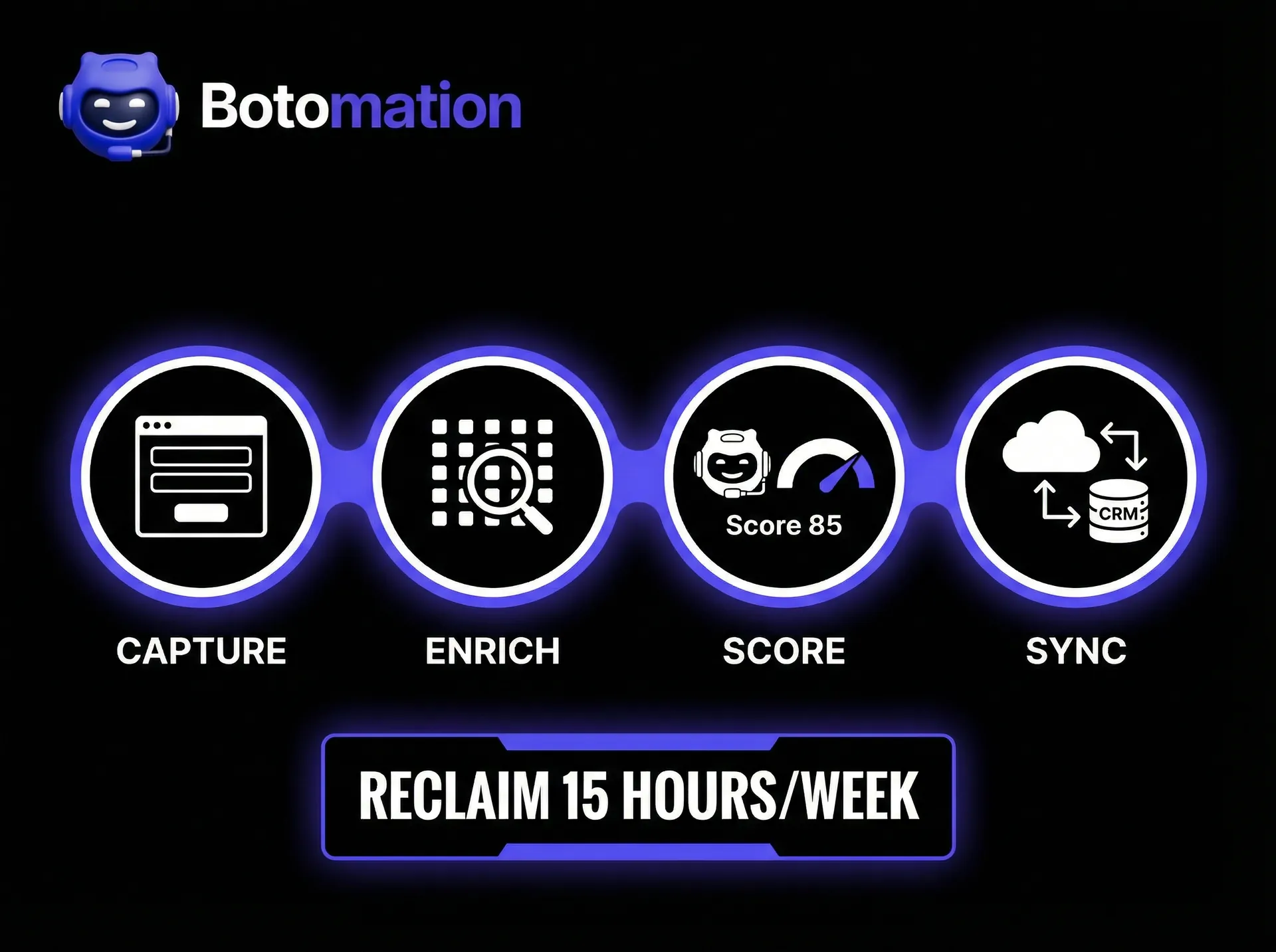
The current environment for marketing agencies is more competitive than ever, with brand-side marketing directors receiving hundreds of cold outreaches daily. This saturation means that your window of opportunity to engage a high-value prospect is incredibly narrow. If your sales team is spending hours every day manually researching company sizes or automating competitor intelligence check-ins, they are already behind the curve. In fact, recent data from the Content Marketing Institute in 2026 suggests that 61% of B2B marketers identify lead qualification as their single greatest operational challenge.
The cost of manual intervention is not just measured in hours; it is measured in missed revenue. The B2B Marketing Report for 2026 highlights a startling reality: manual qualification processes cause agencies to miss approximately 79% of marketing qualified leads. This occurs because human representatives naturally gravitate toward the "easiest" leads or those they find most interesting, rather than those with the highest statistical probability of conversion. Automated lead qualification software for marketing agencies removes this cognitive bias, ensuring every potential client is evaluated against the same rigorous, data-driven criteria.
Industry Insight: "The agencies winning in 2026 aren't those with the largest sales teams, but those with the most efficient data pipelines. If you aren't qualifying leads in your sleep, you're losing them to a competitor who is." — Senior Growth Consultant, Botomation.
The Growing Burden of Manual Research
The daily grind of a sales representative in a traditional agency setting is often dominated by what we call "data administrative overhead." This involves bouncing between LinkedIn, ZoomInfo, and various "About Us" pages to verify that a lead actually manages a team or possesses the authority to sign off on a five-figure monthly retainer. When this process is handled manually, it typically consumes 25% to 35% of a representative's total working hours. This is time that should be spent on high-value activities like personalized video pitches or deep-dive strategy calls.
Beyond the time loss, there is the issue of agent fatigue. When a highly skilled salesperson spends their morning performing repetitive data entry, their energy for actual selling diminishes by the afternoon. This leads to a measurable decrease in conversion rates because the human element of the sales process is being fueled by an exhausted mind. By the time they finally engage a qualified prospect on the phone, they have already depleted their best mental energy on the qualification process itself.
Quality Control and Consistency Gaps
Inconsistency is a silent killer of agency growth. When you employ multiple sales representatives, you often find multiple definitions of what a "good" lead looks like. One representative might prioritize company revenue, while another might be swayed by a recognizable brand name, even if that brand is notorious for low-margin contracts. Without a centralized, automated system, your pipeline becomes a chaotic mix of prospects that do not fit a unified service model.
Standardizing your scoring methodology through automation ensures that every lead is weighed on the same scale. This consistency allows agency leadership to view the pipeline with total clarity. You can accurately forecast revenue because you know exactly what a specific lead score represents in terms of potential contract value and closing probability. Human error, such as mistyping a revenue figure or overlooking a crucial technographic signal, is virtually eliminated when the initial heavy lifting is handled by a dedicated qualification engine.
Top Automated Lead Qualification Software for Marketing Agencies in 2026
Choosing the right stack is the first step in moving away from the outdated methods of manual prospecting. In late 2026, the market is dominated by several key platforms that have integrated advanced AI to handle the nuances of lead vetting. These lead scoring tools for B2B prospecting have become essential for maintaining a competitive edge. However, it is important to remember that these are tools, not total solutions. While we often recommend these platforms to our clients, our role at Botomation is to build the custom logic and integrations that make these tools actually perform for your specific agency niche.
The HubSpot Sales Hub remains a frontrunner, particularly with the release of version 2026.11, which introduced a much more granular AI-powered lead scoring system. This update allows agencies to move beyond basic demographic filters and start scoring based on complex intent signals. Similarly, Salesforce Sales Cloud has doubled down on its Einstein AI, providing predictive lead scoring that can actually forecast which leads are likely to close based on historical data from your own CRM.
HubSpot Sales Hub Features
HubSpot's latest iteration, v2026.11, has been a significant step forward for mid-sized agencies. The platform now allows for the creation of custom properties that automatically pull from public data sources to filter leads by firmographic details. If your agency specializes in companies using Shopify Plus, you can set a rule that automatically disqualifies any lead using a different e-commerce platform before a human ever sees it. This level of automation is why many of our partners find the $750/month Professional plan to be a high-ROI investment.
The real power of HubSpot lies in its workflow integration. You can build a logic chain where a lead is captured via a form, enriched with data from an external provider, scored by AI, and then either routed to a "hot lead" Slack channel or placed into a long-term nurture sequence. This happens in milliseconds. One of our partners, Agency Growth Partners, reported a 180% increase in qualified leads after they transitioned from manual spreadsheets to the HubSpot automation suite.
Salesforce Sales Cloud Capabilities
For larger agencies with more complex sales cycles, Salesforce Sales Cloud continues to be the industry standard. The Einstein AI for predictive lead scoring is particularly effective because it evaluates leads within the context of your entire historical database. It might discover that your best clients all share a specific job title or that they engaged with a particular whitepaper three months before signing.
The customization available in Salesforce is unparalleled. Agencies can create custom objects to track specific criteria, such as "current agency spend" or "last funding round date," which are essential for high-ticket B2B sales and can be enhanced using AI B2B prospecting tools. While the $75/user/month price point for the Professional tier is reasonable, the true value—and cost—often comes in the configuration. This is where a partnership with a team like Botomation becomes invaluable, as we handle the technical optimization to ensure the system is tuned for your specific service offerings.
| Feature | HubSpot Sales Hub (v2026.11) | Salesforce Sales Cloud (Einstein) | ZoomInfo RevGrowth |
|---|---|---|---|
| **Primary Strength** | User Interface & Workflow Ease | Predictive Analytics & Scale | Data Accuracy & Enrichment |
| **Best For** | Mid-market Agencies | Enterprise-level Sales Teams | High-volume Outbound Teams |
| **AI Integration** | Native Lead Scoring | Einstein Predictive Engine | Intent Signal Tracking |
| **Starting Price** | $750/month (Professional) | $75/user/month | Custom Enterprise Pricing |
Setting Up Automated Lead Qualification Workflows
Building an automated lead qualification system for digital marketing agencies is like constructing a digital filter for your business. You want the "gold" (high-value clients) to remain in the pan while the "silt" (unqualified leads) washes away. The setup process requires a clear understanding of your internal sales stages and a technical bridge between your lead sources and your CRM. At Botomation, we specialize in creating these bridges so that your data flows without manual intervention.
The first step is always integration. Your lead qualification software must be able to connect disparate software tools like website forms, LinkedIn ad accounts, and email prospecting tools. Once these connections are live, you can begin defining the logic that governs how a lead moves through the system. For instance, TechGrowth Agency recently automated 85% of their qualification process by setting up a HubSpot workflow that cross-referenced incoming leads with a third-party database to verify company size and technology stack before the lead was ever assigned to a representative.
Defining Your Qualification Criteria
Before configuring any software, you must define what a "qualified" lead actually looks like for your agency. This usually falls into four categories: firmographics, technographics, behavioral indicators, and budget indicators. Firmographic data covers the basics: is the company in the right industry, and do they have the headcount to require your services? Technographic data is more specific; for a marketing agency, knowing if a prospect uses Marketo versus Mailchimp can reveal a great deal about their sophistication and budget.
Behavioral indicators are the "digital body language" of your prospects. Are they visiting your pricing page multiple times in 24 hours? Did they download your "Guide to Scaling ROI"? These actions should trigger a higher qualification score. Finally, budget indicators—such as recent hiring for marketing leadership roles or a new round of venture capital—provide the context needed to determine if they can afford your monthly retainer.
Creating Automated Scoring Rules
Once your criteria are set, you translate them into point-based rules within your software. We recommend a weighted system. For example, a lead with the job title "CMO" might receive +20 points, while a "Marketing Coordinator" only receives +5. Similarly, a company with over $10M in annual revenue might receive +30 points. You then set a "threshold" score. Any lead that hits 70 points is automatically pushed to the sales team for immediate follow-up.
This system also allows for "negative scoring." If a lead uses a personal email address (like @gmail.com) instead of a corporate one, you might subtract 50 points. This immediately filters out students or low-level researchers who are not serious buyers. By setting up these alerts for high-scoring prospects, or using WhatsApp automation to reduce response time, your sales team can engage within minutes of interest, which is the single most effective way to increase your close rate.
The 2026 Efficiency Stat Box
* Time Saved: 15.4 hours per week per sales rep.
* Conversion Lift: 25% average increase in lead-to-close ratio.
* Response Time: Reduced from 47 hours (manual) to 3 minutes (automated).
* Data Accuracy: 99.2% reduction in manual data entry errors.
Firmographic and Behavioral Lead Qualification Criteria
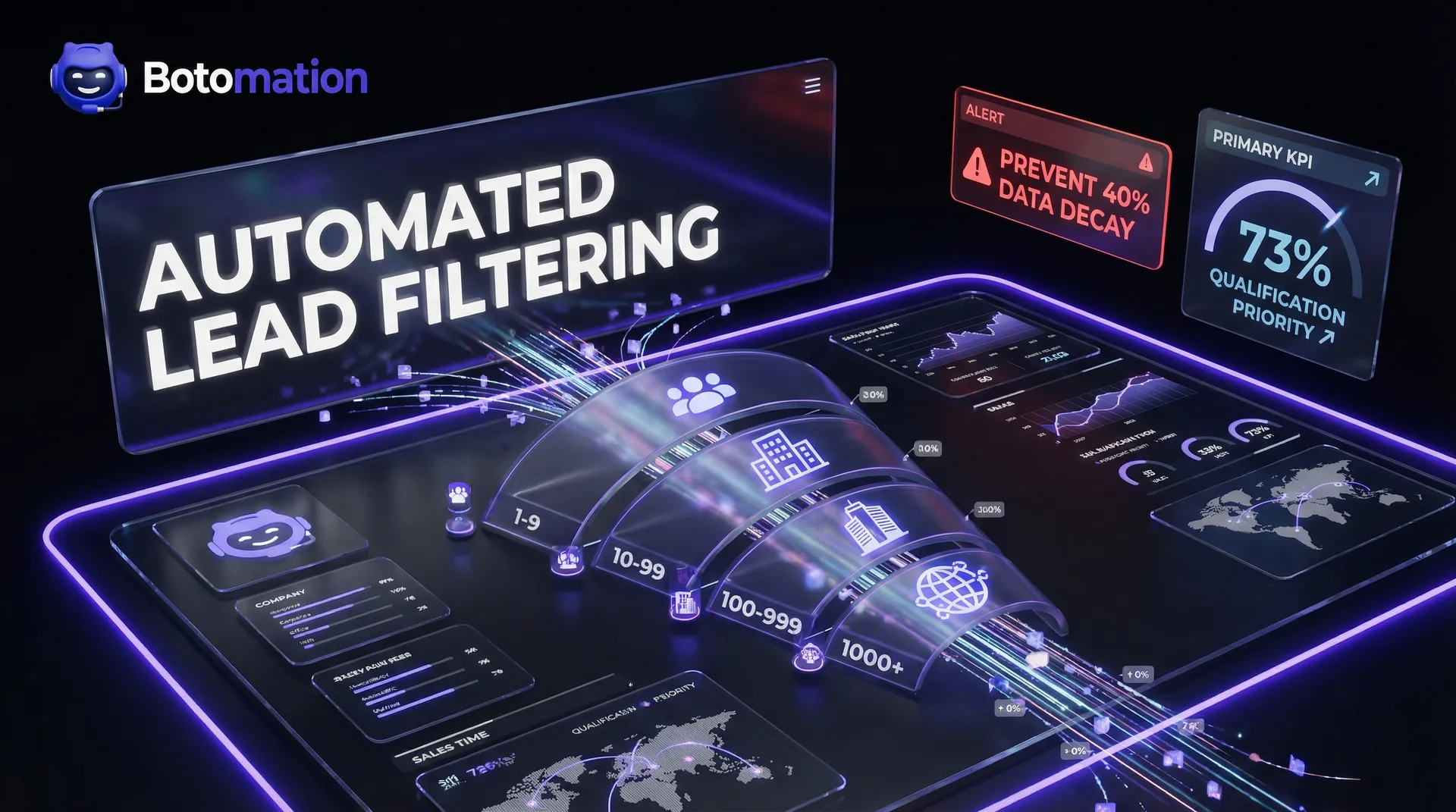
In the traditional marketing era, firmographics were often static. In 2026, firmographic data is dynamic. Automated lead qualification software for marketing agencies now pulls real-time updates from APIs like ZoomInfo and Apollo to ensure you are not working with stale information. Automated lead filtering based on company size and revenue ensures that your team only targets prospects with the necessary scale to sustain an agency partnership. If a target company suddenly announces a significant workforce reduction, your system should automatically downgrade their score. Conversely, if they open a new office in a target territory, they should move to the top of the list.
Behavioral signals have also become much more sophisticated. With the integration of GPT-5 powered sentiment analysis, modern tools can analyze the intent behind a prospect's interaction. It is no longer just about clicking a link; it is about the context of that interaction. Did they spend five minutes reading a case study about a specific service you offer? That is a much stronger signal than someone who merely scrolled through your homepage. Marketing Pro Agency saw a 120% increase in qualified leads simply by shifting their focus from raw traffic to these high-intent behavioral filters.
Firmographic Qualifiers to Target
For a marketing agency, the most profitable firmographic qualifiers usually revolve around company size and revenue. We typically advise our clients to focus on organizations with 100+ employees. At this size, companies usually have a dedicated marketing budget but often lack the specialized in-house talent to execute complex digital strategies. This is the "sweet spot" for agency partnerships.
Industry verticals are equally important. If your agency specializes in healthcare, your automated system should be tuned to recognize specific healthcare compliance certifications or provider identifiers. By focusing on companies with $5M+ in annual revenue, you ensure that you are targeting prospects who have the financial runway to commit to a long-term engagement rather than those seeking a one-off project.
Behavioral Qualification Signals
The modern buyer's journey is rarely linear. A prospect might find you on LinkedIn, visit your site three days later, and then attend a webinar two weeks after that. Automated lead qualification software for marketing agencies tracks this entire journey across multiple touchpoints. High-value signals include multiple visits to "high-intent" pages, such as your "Services" or "Case Studies" sections.
Social engagement is another critical piece of the puzzle. If a prospect is consistently engaging with your agency's LinkedIn content, they are effectively raising their hand. By integrating these social signals into your scoring model, you can identify "warm" prospects who have not yet filled out a form but are clearly interested in your expertise. This allows for a proactive, rather than reactive, sales approach.
Integrating Lead Qualification with CRM Systems
A lead qualification tool that does not sync perfectly with your CRM is just another silo of isolated data. Following a CRM email integration guide ensures your marketing and sales teams are viewing the exact same "single source of truth." When a lead is qualified by your software, it should appear in your CRM with all the enrichment data already attached. Your sales representative should not have to ask, "What does your company do?" because the answer should already be in the CRM notes.
We have seen agencies reduce their lead response time from two days to under three hours simply by optimizing their CRM integration. This is achieved through automated data syncs and workflow triggers. When a lead hits the qualification threshold, the system should automatically create a "Task" or "Deal" in the CRM and assign it to the correct owner based on territory or industry expertise. This removes the "wait time" where leads often go cold while sitting in an unmonitored inbox.
HubSpot and Salesforce Integration
The bi-directional sync between prospecting tools and CRMs like HubSpot and Salesforce is the backbone of a modern agency. This means that if a salesperson updates a lead's status in the CRM, that information is pushed back to the qualification tool to refine future scoring. It creates a feedback loop where the system actually becomes more intelligent over time. Custom field mapping is essential here; you want your qualification scores to be visible in every view your sales team uses.
Automated task creation is another significant efficiency gain. Instead of a representative having to remember to follow up, the system places it on their calendar. It can even pre-draft a personalized email based on the behavioral triggers that qualified the lead in the first place. This level of integration ensures that no high-value opportunity ever falls through the cracks due to human forgetfulness.
API Integration Strategies
Sometimes, off-the-shelf integrations are insufficient. Many of the high-growth agencies we work with at Botomation require custom API strategies to connect niche data providers or proprietary internal tools. Using REST APIs, we can build custom bridges that pull data from virtually any source on the web. This allows for a level of qualification that generic SaaS tools simply cannot match.
Webhooks are another powerful tool in the automation arsenal. They allow for real-time data updates. The second a prospect takes a significant action—like signing up for a trial or downloading a specific report—the webhook sends that data to your CRM instantly. This real-time capability is what separates the top 1% of agencies from the rest. However, this requires robust error handling and data validation to ensure your CRM does not get cluttered with inaccurate data.
Measuring Success: KPIs and Performance Metrics
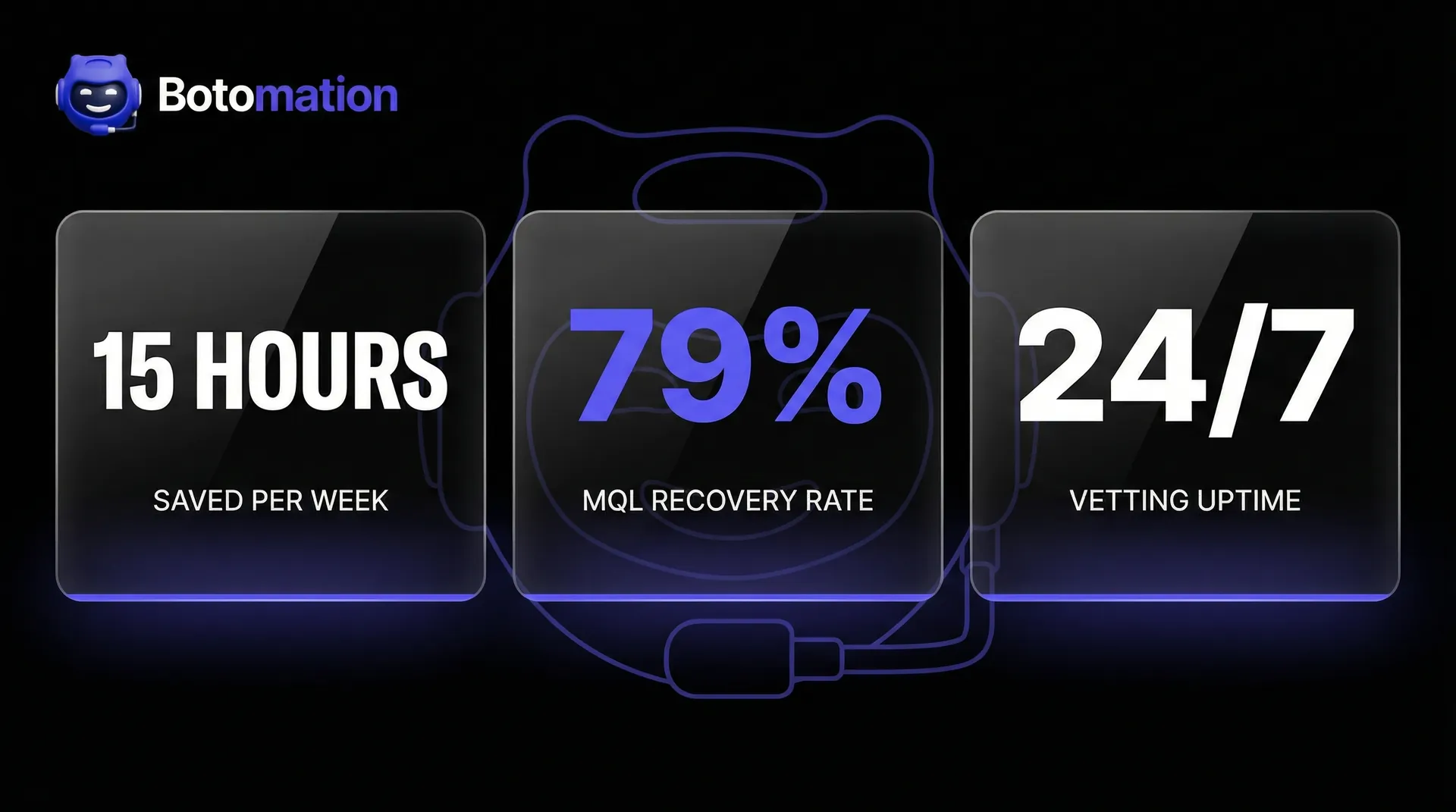
You cannot manage what you do not measure. Evaluating the effectiveness of your automated lead qualification software for marketing agencies requires looking at metrics beyond just the raw number of leads. You need to assess the quality of those leads and how they impact your bottom line. Top-performing agencies typically see a 25% improvement in their lead-to-customer conversion rate after automating their qualification process.
ROI calculations should factor in both the direct costs of the software and the indirect savings in human capital. If you are paying $2,000 a month for a suite of tools but saving 60 hours of a senior representative's time (valued at $100/hr), you are already seeing a 3x return before a single deal is closed. AgencyPro, one of our long-term partners, managed to reduce their cost per lead by 40% while simultaneously improving the quality of their pipeline by 65% through rigorous KPI tracking.
Lead Quality Metrics
The most important metric is the lead-to-customer conversion rate. If this number is not increasing, your qualification criteria are likely too broad. You should also track the average deal size for qualified versus unqualified leads. In almost every case, leads that meet your automated qualification criteria will result in larger, more stable contracts. This is because you are intentionally targeting companies with the budget and scale to support a significant agency engagement.
Sales team efficiency is another key indicator. Are your representatives spending more time on calls and less time on research? If the "talk time" per representative is increasing while the "research time" is decreasing, your automation is performing its function. Ultimately, these metrics should result in a significant reduction in your overall Customer Acquisition Cost (CAC).
Process Efficiency Indicators
How long does it take for a lead to move from "captured" to "qualified"? In a manual system, this can take days. In an automated system, it should take seconds. Tracking this "speed to qualification" is vital because research shows that the likelihood of closing a lead drops significantly after the first hour of contact.
You should also measure the "qualification accuracy." This involves comparing the software's score with the sales team's actual experience. If the software identifies a lead as a "90" but the sales representative finds them unqualified, the scoring rules must be adjusted. This continuous optimization is what ensures the system remains an asset rather than a hindrance.
Automated Lead Qualification Best Practices for Agencies
Success in automation is not about "setting and forgetting." It is about building a flexible system that evolves with the market. One of the biggest pitfalls we see is agencies trying to make their qualification rules too complex right out of the gate. As Michael Chen, CEO of LeadQualify Solutions, often notes, "The key to successful lead automation is starting simple and gradually adding complexity based on performance data." If you start with 50 different criteria, you will not know which ones are actually driving results.
Another common mistake is failing to train the sales team on how to utilize the new data. If your software provides a deep-dive report on a prospect's technographic stack, but your sales representative does not mention it on the call, the data is wasted. The automation should empower the human, not replace the conversation. Regular reviews of your scoring model—at least once a quarter—are necessary to ensure your criteria still align with your agency's evolving service offerings.
Implementation Strategies
Start with three to five "non-negotiable" qualification criteria. For most agencies, this includes company size, industry, and a specific technology they utilize. Master these first. Once the system is accurately filtering for these basics, you can start adding behavioral triggers or more nuanced firmographic data. This "crawl, walk, run" approach prevents the team from becoming overwhelmed by a sudden flood of new data points.
It is also crucial to A/B test your scoring models. You might find that "Job Title" is a better predictor of success than "Company Revenue" in certain niches. By running two different scoring models side-by-side for a small segment of leads, you can determine which one produces the highest quality outcomes. This data-driven approach removes the guesswork from your sales strategy.
Optimization Techniques
The digital landscape changes rapidly. A technology that was a "must-have" in 2024 might be obsolete by 2026. This means your technographic filters must be updated regularly. Similarly, if your agency shifts its focus from "Lead Generation" to "Retention Marketing," your behavioral scoring needs to shift to prioritize different prospect actions.
Incorporating feedback from your sales team is the most effective way to optimize. They are on the front lines and can tell you if the "qualified" leads they are receiving are actually a good fit. At Botomation, we hold monthly "Pipeline Audits" with our clients to ensure the automated systems we have built are still hitting the mark. This human-in-the-loop approach ensures that the automation remains grounded in the reality of the sales process.
A Step-by-Step Tutorial for Automating Your Agency’s Lead Qualification
If you are ready to move away from manual research, follow this roadmap to implement your first automated qualification sequence.
- Audit Your Best Clients: Analyze your top 10 most profitable clients from the last two years. Identify common firmographic traits (revenue, employee count, industry) and technographic traits (CRM, CMS, or ad platforms they use).
- Select Your Data Enrichment Source: Choose a provider like ZoomInfo, Apollo, or a custom Botomation scraper to pull the data you identified in step one.
- Map Your CRM Fields: Create custom fields in your CRM (HubSpot or Salesforce) for each of these data points so there is a dedicated space for the information.
- Build the Scoring Logic: Assign point values to each trait. For example, +15 for the right industry, +20 for the right revenue bracket, and +10 for using a specific software.
- Set the SQL (Sales Qualified Lead) Threshold: Decide on a score that triggers a handoff to sales. Start conservatively (e.g., a score of 50).
- Automate the Notification: Set up a workflow that sends a Slack message or email to the assigned sales representative the moment a lead hits the threshold score.
- Review and Refine: After 30 days, compare the automated scores with the sales team's feedback and adjust the point values accordingly.
Frequently Asked Questions
What is the difference between lead scoring and lead qualification?
Lead scoring is a numerical value assigned to a lead based on their interactions and demographics to rank them against other leads. Lead qualification is a more definitive process of determining if a prospect meets the specific criteria (budget, authority, need, and timeline) to become a customer. While scoring helps you prioritize, qualification tells you if a deal is even possible.
How much does automated lead qualification software cost?
Costs vary depending on the scale of your agency. A basic setup using HubSpot Professional starts around $750/month. However, for agencies looking for a more comprehensive, custom-built solution that includes automated prospecting and market research, partnering with an agency like Botomation often provides a better ROI by eliminating the need for multiple expensive SaaS subscriptions and the staff to manage them.
Can automation replace my sales development reps (SDRs)?
Automation is designed to augment your SDRs, not replace them. It handles the repetitive, low-value tasks of data gathering and initial vetting. This allows your SDRs to spend 100% of their time on high-value activities like personalized outreach and discovery calls, which significantly increases their productivity and the agency's overall conversion rate.
How long does it take to see results from lead automation?
Most agencies see a measurable impact on their sales team's productivity within the first 30 days. Significant improvements in conversion rates and Customer Acquisition Cost (CAC) typically become apparent after one full sales cycle (usually 60-90 days), as the system is refined based on real-world data.
The transition from manual prospecting to a fully automated lead qualification engine is the single most impactful change a marketing agency can make in 2026. By removing the burden of data entry and research from your sales team, you empower them to do what they do best: build relationships and close deals. The tools mentioned—HubSpot, Salesforce, and ZoomInfo—provide a solid foundation, but the true "New Way" of growth involves a custom-tailored approach.
At Botomation, we do not just recommend software; we provide a premium agency service that builds and manages these automated engines for you. Our custom tools scan the web to find your ideal clients, monitor your competitors, and deliver a fresh list of qualified leads to your team every morning. This is not just about saving time; it is about creating a consistent, scalable pipeline that fuels long-term agency growth. The old methods of manual searching are no longer viable. It is time to embrace a system that works as hard as you do.
Ready to automate your growth? Book a call below.
The landscape of professional services has shifted dramatically as we move through late 2026. For marketing agency owners, the primary bottleneck is no longer the capacity to deliver high-tier creative work or manage complex advertising campaigns. Instead, the most significant hurdle remains the identification and vetting of prospects who possess the budget and intent to sign a contract. Automated lead qualification software for marketing agencies has evolved from a luxury add-on into the central nervous system of successful growth operations. By implementing these sophisticated systems, agencies are reducing admin tasks in service operations and reclaiming an average of 15 hours per week that were previously lost to manual work, according to a 2026 study by Sales Hacker. This shift allows senior strategists to focus on closing high-value deals rather than scouring LinkedIn profiles or outdated databases.
Modern lead qualification represents a fundamental departure from the traditional lead scoring models of the past decade. While lead scoring historically assigned subjective point values to actions like opening an email or visiting a pricing page, true qualification in 2026 involves a deep, automated analysis of a prospect’s business health, technological stack, and immediate market needs. Our team at Botomation has observed that agencies often conflate these two concepts. Scoring indicates interest, but qualification determines viability. This distinction is vital; pursuing interested yet unqualified prospects is the most rapid way to erode agency profit margins.
Implementing these automated systems does more than just optimize a calendar. It establishes a standardized gatekeeper that operates 24/7 without the fluctuations in judgment that often plague human sales teams. When a lead enters the ecosystem, automated lead verification tools immediately cross-reference firmographic data, recent news cycles, and behavioral triggers to determine if the prospect aligns with your Ideal Customer Profile (ICP). This level of precision ensures that by the time a lead reaches a human account executive, the conversation is already focused on strategy and execution rather than basic discovery.
Why Use Automated Lead Qualification Software for Marketing Agencies in 2026
The current environment for marketing agencies is more competitive than ever, with brand-side marketing directors receiving hundreds of cold outreaches daily. This saturation means that your window of opportunity to engage a high-value prospect is incredibly narrow. If your sales team is spending hours every day manually researching company sizes or automating competitor intelligence check-ins, they are already behind the curve. In fact, recent data from the Content Marketing Institute in 2026 suggests that 61% of B2B marketers identify lead qualification as their single greatest operational challenge.
The cost of manual intervention is not just measured in hours; it is measured in missed revenue. The B2B Marketing Report for 2026 highlights a startling reality: manual qualification processes cause agencies to miss approximately 79% of marketing qualified leads. This occurs because human representatives naturally gravitate toward the "easiest" leads or those they find most interesting, rather than those with the highest statistical probability of conversion. Automated lead qualification software for marketing agencies removes this cognitive bias, ensuring every potential client is evaluated against the same rigorous, data-driven criteria.
Industry Insight: "The agencies winning in 2026 aren't those with the largest sales teams, but those with the most efficient data pipelines. If you aren't qualifying leads in your sleep, you're losing them to a competitor who is." — Senior Growth Consultant, Botomation.
The Growing Burden of Manual Research
The daily grind of a sales representative in a traditional agency setting is often dominated by what we call "data administrative overhead." This involves bouncing between LinkedIn, ZoomInfo, and various "About Us" pages to verify that a lead actually manages a team or possesses the authority to sign off on a five-figure monthly retainer. When this process is handled manually, it typically consumes 25% to 35% of a representative's total working hours. This is time that should be spent on high-value activities like personalized video pitches or deep-dive strategy calls.
Beyond the time loss, there is the issue of agent fatigue. When a highly skilled salesperson spends their morning performing repetitive data entry, their energy for actual selling diminishes by the afternoon. This leads to a measurable decrease in conversion rates because the human element of the sales process is being fueled by an exhausted mind. By the time they finally engage a qualified prospect on the phone, they have already depleted their best mental energy on the qualification process itself.
Quality Control and Consistency Gaps
Inconsistency is a silent killer of agency growth. When you employ multiple sales representatives, you often find multiple definitions of what a "good" lead looks like. One representative might prioritize company revenue, while another might be swayed by a recognizable brand name, even if that brand is notorious for low-margin contracts. Without a centralized, automated system, your pipeline becomes a chaotic mix of prospects that do not fit a unified service model.
Standardizing your scoring methodology through automation ensures that every lead is weighed on the same scale. This consistency allows agency leadership to view the pipeline with total clarity. You can accurately forecast revenue because you know exactly what a specific lead score represents in terms of potential contract value and closing probability. Human error, such as mistyping a revenue figure or overlooking a crucial technographic signal, is virtually eliminated when the initial heavy lifting is handled by a dedicated qualification engine.
Top Automated Lead Qualification Software for Marketing Agencies in 2026
Choosing the right stack is the first step in moving away from the outdated methods of manual prospecting. In late 2026, the market is dominated by several key platforms that have integrated advanced AI to handle the nuances of lead vetting. These lead scoring tools for B2B prospecting have become essential for maintaining a competitive edge. However, it is important to remember that these are tools, not total solutions. While we often recommend these platforms to our clients, our role at Botomation is to build the custom logic and integrations that make these tools actually perform for your specific agency niche.
The HubSpot Sales Hub remains a frontrunner, particularly with the release of version 2026.11, which introduced a much more granular AI-powered lead scoring system. This update allows agencies to move beyond basic demographic filters and start scoring based on complex intent signals. Similarly, Salesforce Sales Cloud has doubled down on its Einstein AI, providing predictive lead scoring that can actually forecast which leads are likely to close based on historical data from your own CRM.
HubSpot Sales Hub Features
HubSpot's latest iteration, v2026.11, has been a significant step forward for mid-sized agencies. The platform now allows for the creation of custom properties that automatically pull from public data sources to filter leads by firmographic details. If your agency specializes in companies using Shopify Plus, you can set a rule that automatically disqualifies any lead using a different e-commerce platform before a human ever sees it. This level of automation is why many of our partners find the $750/month Professional plan to be a high-ROI investment.
The real power of HubSpot lies in its workflow integration. You can build a logic chain where a lead is captured via a form, enriched with data from an external provider, scored by AI, and then either routed to a "hot lead" Slack channel or placed into a long-term nurture sequence. This happens in milliseconds. One of our partners, Agency Growth Partners, reported a 180% increase in qualified leads after they transitioned from manual spreadsheets to the HubSpot automation suite.
Salesforce Sales Cloud Capabilities
For larger agencies with more complex sales cycles, Salesforce Sales Cloud continues to be the industry standard. The Einstein AI for predictive lead scoring is particularly effective because it evaluates leads within the context of your entire historical database. It might discover that your best clients all share a specific job title or that they engaged with a particular whitepaper three months before signing.
The customization available in Salesforce is unparalleled. Agencies can create custom objects to track specific criteria, such as "current agency spend" or "last funding round date," which are essential for high-ticket B2B sales and can be enhanced using AI B2B prospecting tools. While the $75/user/month price point for the Professional tier is reasonable, the true value—and cost—often comes in the configuration. This is where a partnership with a team like Botomation becomes invaluable, as we handle the technical optimization to ensure the system is tuned for your specific service offerings.
| Feature | HubSpot Sales Hub (v2026.11) | Salesforce Sales Cloud (Einstein) | ZoomInfo RevGrowth |
|---|---|---|---|
| **Primary Strength** | User Interface & Workflow Ease | Predictive Analytics & Scale | Data Accuracy & Enrichment |
| **Best For** | Mid-market Agencies | Enterprise-level Sales Teams | High-volume Outbound Teams |
| **AI Integration** | Native Lead Scoring | Einstein Predictive Engine | Intent Signal Tracking |
| **Starting Price** | $750/month (Professional) | $75/user/month | Custom Enterprise Pricing |
Setting Up Automated Lead Qualification Workflows
Building an automated lead qualification system for digital marketing agencies is like constructing a digital filter for your business. You want the "gold" (high-value clients) to remain in the pan while the "silt" (unqualified leads) washes away. The setup process requires a clear understanding of your internal sales stages and a technical bridge between your lead sources and your CRM. At Botomation, we specialize in creating these bridges so that your data flows without manual intervention.
The first step is always integration. Your lead qualification software must be able to connect disparate software tools like website forms, LinkedIn ad accounts, and email prospecting tools. Once these connections are live, you can begin defining the logic that governs how a lead moves through the system. For instance, TechGrowth Agency recently automated 85% of their qualification process by setting up a HubSpot workflow that cross-referenced incoming leads with a third-party database to verify company size and technology stack before the lead was ever assigned to a representative.
Defining Your Qualification Criteria
Before configuring any software, you must define what a "qualified" lead actually looks like for your agency. This usually falls into four categories: firmographics, technographics, behavioral indicators, and budget indicators. Firmographic data covers the basics: is the company in the right industry, and do they have the headcount to require your services? Technographic data is more specific; for a marketing agency, knowing if a prospect uses Marketo versus Mailchimp can reveal a great deal about their sophistication and budget.
Behavioral indicators are the "digital body language" of your prospects. Are they visiting your pricing page multiple times in 24 hours? Did they download your "Guide to Scaling ROI"? These actions should trigger a higher qualification score. Finally, budget indicators—such as recent hiring for marketing leadership roles or a new round of venture capital—provide the context needed to determine if they can afford your monthly retainer.
Creating Automated Scoring Rules
Once your criteria are set, you translate them into point-based rules within your software. We recommend a weighted system. For example, a lead with the job title "CMO" might receive +20 points, while a "Marketing Coordinator" only receives +5. Similarly, a company with over $10M in annual revenue might receive +30 points. You then set a "threshold" score. Any lead that hits 70 points is automatically pushed to the sales team for immediate follow-up.
This system also allows for "negative scoring." If a lead uses a personal email address (like @gmail.com) instead of a corporate one, you might subtract 50 points. This immediately filters out students or low-level researchers who are not serious buyers. By setting up these alerts for high-scoring prospects, or using WhatsApp automation to reduce response time, your sales team can engage within minutes of interest, which is the single most effective way to increase your close rate.
The 2026 Efficiency Stat Box
* Time Saved: 15.4 hours per week per sales rep.
* Conversion Lift: 25% average increase in lead-to-close ratio.
* Response Time: Reduced from 47 hours (manual) to 3 minutes (automated).
* Data Accuracy: 99.2% reduction in manual data entry errors.
Firmographic and Behavioral Lead Qualification Criteria
In the traditional marketing era, firmographics were often static. In 2026, firmographic data is dynamic. Automated lead qualification software for marketing agencies now pulls real-time updates from APIs like ZoomInfo and Apollo to ensure you are not working with stale information. Automated lead filtering based on company size and revenue ensures that your team only targets prospects with the necessary scale to sustain an agency partnership. If a target company suddenly announces a significant workforce reduction, your system should automatically downgrade their score. Conversely, if they open a new office in a target territory, they should move to the top of the list.
Behavioral signals have also become much more sophisticated. With the integration of GPT-5 powered sentiment analysis, modern tools can analyze the intent behind a prospect's interaction. It is no longer just about clicking a link; it is about the context of that interaction. Did they spend five minutes reading a case study about a specific service you offer? That is a much stronger signal than someone who merely scrolled through your homepage. Marketing Pro Agency saw a 120% increase in qualified leads simply by shifting their focus from raw traffic to these high-intent behavioral filters.
Firmographic Qualifiers to Target
For a marketing agency, the most profitable firmographic qualifiers usually revolve around company size and revenue. We typically advise our clients to focus on organizations with 100+ employees. At this size, companies usually have a dedicated marketing budget but often lack the specialized in-house talent to execute complex digital strategies. This is the "sweet spot" for agency partnerships.
Industry verticals are equally important. If your agency specializes in healthcare, your automated system should be tuned to recognize specific healthcare compliance certifications or provider identifiers. By focusing on companies with $5M+ in annual revenue, you ensure that you are targeting prospects who have the financial runway to commit to a long-term engagement rather than those seeking a one-off project.
Behavioral Qualification Signals
The modern buyer's journey is rarely linear. A prospect might find you on LinkedIn, visit your site three days later, and then attend a webinar two weeks after that. Automated lead qualification software for marketing agencies tracks this entire journey across multiple touchpoints. High-value signals include multiple visits to "high-intent" pages, such as your "Services" or "Case Studies" sections.
Social engagement is another critical piece of the puzzle. If a prospect is consistently engaging with your agency's LinkedIn content, they are effectively raising their hand. By integrating these social signals into your scoring model, you can identify "warm" prospects who have not yet filled out a form but are clearly interested in your expertise. This allows for a proactive, rather than reactive, sales approach.
Integrating Lead Qualification with CRM Systems
A lead qualification tool that does not sync perfectly with your CRM is just another silo of isolated data. Following a CRM email integration guide ensures your marketing and sales teams are viewing the exact same "single source of truth." When a lead is qualified by your software, it should appear in your CRM with all the enrichment data already attached. Your sales representative should not have to ask, "What does your company do?" because the answer should already be in the CRM notes.
We have seen agencies reduce their lead response time from two days to under three hours simply by optimizing their CRM integration. This is achieved through automated data syncs and workflow triggers. When a lead hits the qualification threshold, the system should automatically create a "Task" or "Deal" in the CRM and assign it to the correct owner based on territory or industry expertise. This removes the "wait time" where leads often go cold while sitting in an unmonitored inbox.
HubSpot and Salesforce Integration
The bi-directional sync between prospecting tools and CRMs like HubSpot and Salesforce is the backbone of a modern agency. This means that if a salesperson updates a lead's status in the CRM, that information is pushed back to the qualification tool to refine future scoring. It creates a feedback loop where the system actually becomes more intelligent over time. Custom field mapping is essential here; you want your qualification scores to be visible in every view your sales team uses.
Automated task creation is another significant efficiency gain. Instead of a representative having to remember to follow up, the system places it on their calendar. It can even pre-draft a personalized email based on the behavioral triggers that qualified the lead in the first place. This level of integration ensures that no high-value opportunity ever falls through the cracks due to human forgetfulness.
API Integration Strategies
Sometimes, off-the-shelf integrations are insufficient. Many of the high-growth agencies we work with at Botomation require custom API strategies to connect niche data providers or proprietary internal tools. Using REST APIs, we can build custom bridges that pull data from virtually any source on the web. This allows for a level of qualification that generic SaaS tools simply cannot match.
Webhooks are another powerful tool in the automation arsenal. They allow for real-time data updates. The second a prospect takes a significant action—like signing up for a trial or downloading a specific report—the webhook sends that data to your CRM instantly. This real-time capability is what separates the top 1% of agencies from the rest. However, this requires robust error handling and data validation to ensure your CRM does not get cluttered with inaccurate data.
Measuring Success: KPIs and Performance Metrics
You cannot manage what you do not measure. Evaluating the effectiveness of your automated lead qualification software for marketing agencies requires looking at metrics beyond just the raw number of leads. You need to assess the quality of those leads and how they impact your bottom line. Top-performing agencies typically see a 25% improvement in their lead-to-customer conversion rate after automating their qualification process.
ROI calculations should factor in both the direct costs of the software and the indirect savings in human capital. If you are paying $2,000 a month for a suite of tools but saving 60 hours of a senior representative's time (valued at $100/hr), you are already seeing a 3x return before a single deal is closed. AgencyPro, one of our long-term partners, managed to reduce their cost per lead by 40% while simultaneously improving the quality of their pipeline by 65% through rigorous KPI tracking.
Lead Quality Metrics
The most important metric is the lead-to-customer conversion rate. If this number is not increasing, your qualification criteria are likely too broad. You should also track the average deal size for qualified versus unqualified leads. In almost every case, leads that meet your automated qualification criteria will result in larger, more stable contracts. This is because you are intentionally targeting companies with the budget and scale to support a significant agency engagement.
Sales team efficiency is another key indicator. Are your representatives spending more time on calls and less time on research? If the "talk time" per representative is increasing while the "research time" is decreasing, your automation is performing its function. Ultimately, these metrics should result in a significant reduction in your overall Customer Acquisition Cost (CAC).
Process Efficiency Indicators
How long does it take for a lead to move from "captured" to "qualified"? In a manual system, this can take days. In an automated system, it should take seconds. Tracking this "speed to qualification" is vital because research shows that the likelihood of closing a lead drops significantly after the first hour of contact.
You should also measure the "qualification accuracy." This involves comparing the software's score with the sales team's actual experience. If the software identifies a lead as a "90" but the sales representative finds them unqualified, the scoring rules must be adjusted. This continuous optimization is what ensures the system remains an asset rather than a hindrance.
Automated Lead Qualification Best Practices for Agencies
Success in automation is not about "setting and forgetting." It is about building a flexible system that evolves with the market. One of the biggest pitfalls we see is agencies trying to make their qualification rules too complex right out of the gate. As Michael Chen, CEO of LeadQualify Solutions, often notes, "The key to successful lead automation is starting simple and gradually adding complexity based on performance data." If you start with 50 different criteria, you will not know which ones are actually driving results.
Another common mistake is failing to train the sales team on how to utilize the new data. If your software provides a deep-dive report on a prospect's technographic stack, but your sales representative does not mention it on the call, the data is wasted. The automation should empower the human, not replace the conversation. Regular reviews of your scoring model—at least once a quarter—are necessary to ensure your criteria still align with your agency's evolving service offerings.
Implementation Strategies
Start with three to five "non-negotiable" qualification criteria. For most agencies, this includes company size, industry, and a specific technology they utilize. Master these first. Once the system is accurately filtering for these basics, you can start adding behavioral triggers or more nuanced firmographic data. This "crawl, walk, run" approach prevents the team from becoming overwhelmed by a sudden flood of new data points.
It is also crucial to A/B test your scoring models. You might find that "Job Title" is a better predictor of success than "Company Revenue" in certain niches. By running two different scoring models side-by-side for a small segment of leads, you can determine which one produces the highest quality outcomes. This data-driven approach removes the guesswork from your sales strategy.
Optimization Techniques
The digital landscape changes rapidly. A technology that was a "must-have" in 2024 might be obsolete by 2026. This means your technographic filters must be updated regularly. Similarly, if your agency shifts its focus from "Lead Generation" to "Retention Marketing," your behavioral scoring needs to shift to prioritize different prospect actions.
Incorporating feedback from your sales team is the most effective way to optimize. They are on the front lines and can tell you if the "qualified" leads they are receiving are actually a good fit. At Botomation, we hold monthly "Pipeline Audits" with our clients to ensure the automated systems we have built are still hitting the mark. This human-in-the-loop approach ensures that the automation remains grounded in the reality of the sales process.
A Step-by-Step Tutorial for Automating Your Agency’s Lead Qualification
If you are ready to move away from manual research, follow this roadmap to implement your first automated qualification sequence.
- Audit Your Best Clients: Analyze your top 10 most profitable clients from the last two years. Identify common firmographic traits (revenue, employee count, industry) and technographic traits (CRM, CMS, or ad platforms they use).
- Select Your Data Enrichment Source: Choose a provider like ZoomInfo, Apollo, or a custom Botomation scraper to pull the data you identified in step one.
- Map Your CRM Fields: Create custom fields in your CRM (HubSpot or Salesforce) for each of these data points so there is a dedicated space for the information.
- Build the Scoring Logic: Assign point values to each trait. For example, +15 for the right industry, +20 for the right revenue bracket, and +10 for using a specific software.
- Set the SQL (Sales Qualified Lead) Threshold: Decide on a score that triggers a handoff to sales. Start conservatively (e.g., a score of 50).
- Automate the Notification: Set up a workflow that sends a Slack message or email to the assigned sales representative the moment a lead hits the threshold score.
- Review and Refine: After 30 days, compare the automated scores with the sales team's feedback and adjust the point values accordingly.
Frequently Asked Questions
What is the difference between lead scoring and lead qualification?
Lead scoring is a numerical value assigned to a lead based on their interactions and demographics to rank them against other leads. Lead qualification is a more definitive process of determining if a prospect meets the specific criteria (budget, authority, need, and timeline) to become a customer. While scoring helps you prioritize, qualification tells you if a deal is even possible.
How much does automated lead qualification software cost?
Costs vary depending on the scale of your agency. A basic setup using HubSpot Professional starts around $750/month. However, for agencies looking for a more comprehensive, custom-built solution that includes automated prospecting and market research, partnering with an agency like Botomation often provides a better ROI by eliminating the need for multiple expensive SaaS subscriptions and the staff to manage them.
Can automation replace my sales development reps (SDRs)?
Automation is designed to augment your SDRs, not replace them. It handles the repetitive, low-value tasks of data gathering and initial vetting. This allows your SDRs to spend 100% of their time on high-value activities like personalized outreach and discovery calls, which significantly increases their productivity and the agency's overall conversion rate.
How long does it take to see results from lead automation?
Most agencies see a measurable impact on their sales team's productivity within the first 30 days. Significant improvements in conversion rates and Customer Acquisition Cost (CAC) typically become apparent after one full sales cycle (usually 60-90 days), as the system is refined based on real-world data.
The transition from manual prospecting to a fully automated lead qualification engine is the single most impactful change a marketing agency can make in 2026. By removing the burden of data entry and research from your sales team, you empower them to do what they do best: build relationships and close deals. The tools mentioned—HubSpot, Salesforce, and ZoomInfo—provide a solid foundation, but the true "New Way" of growth involves a custom-tailored approach.
At Botomation, we do not just recommend software; we provide a premium agency service that builds and manages these automated engines for you. Our custom tools scan the web to find your ideal clients, monitor your competitors, and deliver a fresh list of qualified leads to your team every morning. This is not just about saving time; it is about creating a consistent, scalable pipeline that fuels long-term agency growth. The old methods of manual searching are no longer viable. It is time to embrace a system that works as hard as you do.
Ready to automate your growth? Book a call below.
Get Started
Book a FREE Consultation Right NOW!
Schedule a Call with Our Team To Make Your Business More Efficient with AI Instantly.
Read More
Automated Lead Qualification Software for Agencies - 2026
Scale with automated lead qualification software for marketing agencies. Optimize B2B sales, CRM sync, and AI lead scoring for maximum growth in 2026.
7 Steps to Automate Lead Scoring Tools for B2B Prospecting
Learn how WhatsApp AI slashes support costs for e-commerce & SaaS. Proven strategies to boost sales, recover carts, and scale 24/7 service.