7 Steps to Scale Business Operations with RPA and AI 2026
Feb 17, 2026
RPA
AI Automation
Business Strategy
RPA
AI Automation
Business Strategy
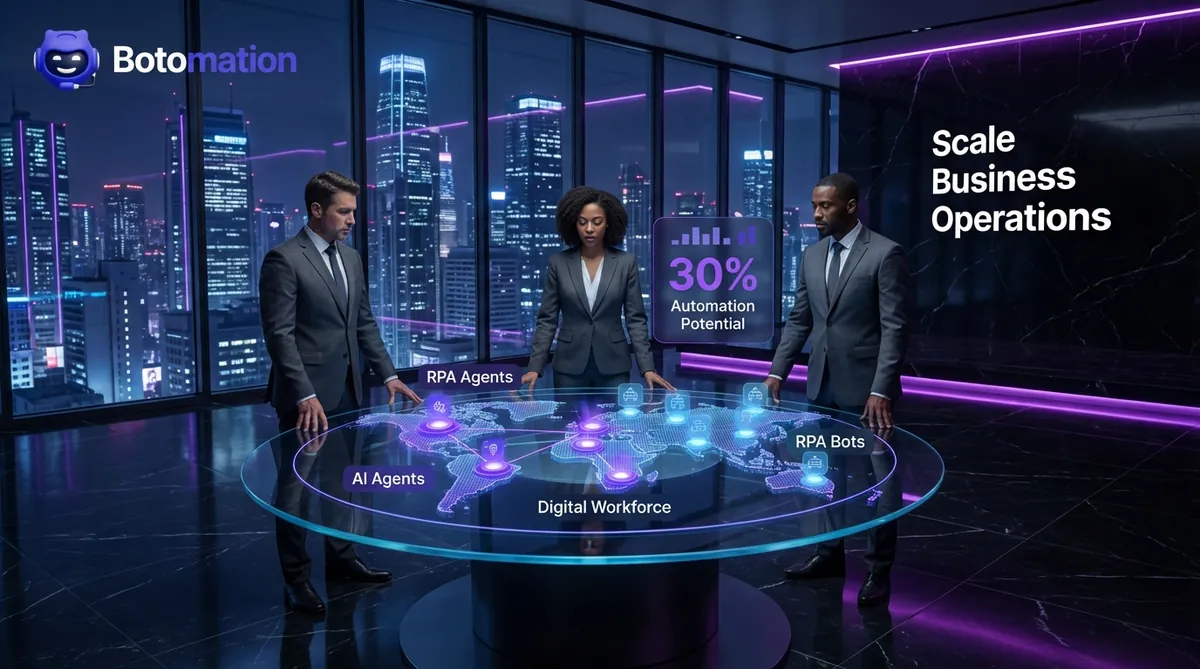
By late 2026, business leaders no longer ask if they should automate, but rather how fast they can deploy autonomous systems to outpace the competition. The industry has moved beyond simple "if-then" logic. Today, the convergence of Robotic Process Automation (RPA) and agentic AI has established a new standard for operational excellence. While traditional RPA handled the "hands" of a business—moving data between spreadsheets—modern AI agents now provide the "brain," making real-time decisions and handling exceptions that previously required human intervention. This shift allows organizations to scale business operations with RPA and AI by learning how to automate repetitive business tasks with AI agents in ways that were technically impossible even two years ago.
The pressure to scale without ballooning headcount is a constant challenge for founders and COOs looking to maintain lean operations. Hiring more personnel to solve volume problems often leads to cultural dilution, management overhead, and increased error rates. Recent data from McKinsey suggests that roughly 60% of all occupations have at least 30% of constituent activities that could be automated. For a growing company, that 30% represents the difference between a profitable year and a stagnant one. By integrating these technologies, our team at Botomation helps businesses reclaim thousands of hours, allowing human talent to focus on high-value strategy rather than the digital equivalent of moving rocks.
We are witnessing a fundamental shift in how work is structured. In late 2026, the distinction between "software" and "worker" is blurring. When you partner with our experts, we don't just hand you a tool; we architect a digital workforce. This article serves as a comprehensive roadmap for navigating this transformation, ensuring your business doesn't just survive the automation wave but rides it to unprecedented levels of efficiency. As we look toward the 2026 fiscal year, the organizations that have successfully integrated AI agents for business scaling are the ones currently dominating their respective markets.
Identifying High-Impact Opportunities to Scale Business Operations with RPA
Before writing code or deploying an agent, you must understand the terrain of your current operations. Most businesses suffer from "invisible friction"—tasks that everyone performs but no one questions. These are the prime candidates for automation. When we assess a client's workflow, we identify processes that are high-volume, repetitive, and prone to human error. If a task requires a human to look at a screen, copy a number, and paste it into another window, it is a liability, not a job.
Evaluating process complexity is the next hurdle. Some tasks are simple but frequent, like processing an invoice. Others are complex but rare, like a specialized legal review. The "sweet spot" for scaling lies in high-frequency, medium-complexity tasks. In late 2026, we are even seeing physical operations join the digital fray. The 1X Neo Humanoid Robot, for instance, is now being integrated into warehouse and office environments to handle physical tasks previously impossible for software-only RPA. This represents the ultimate scaling of operations: a robot that can navigate a physical office to file papers or move inventory, controlled by the same AI agents that manage your digital databases.
How to Spot the Best Spots for RPA and AI in Your Current Setup
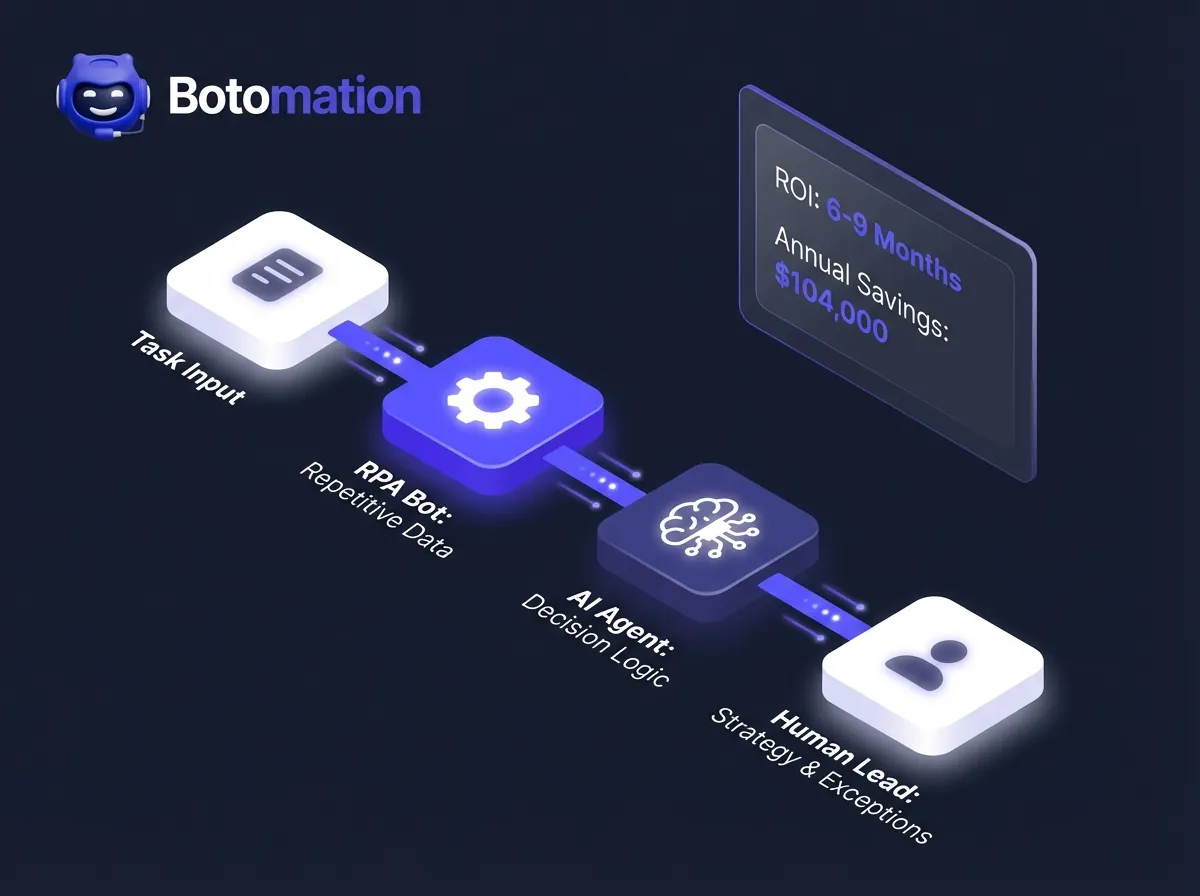
To effectively identify these opportunities, you must conduct a deep-dive audit of your departmental silos. Often, the most significant bottlenecks exist at the intersection of two departments—such as the handoff between Sales and Finance. These manual bridges are where data integrity is most at risk. In 2026, we utilize advanced process discovery tools that sit silently on your network, observing workflows to highlight where time is being leaked. This objective data prevents the "squeaky wheel" from getting the grease, ensuring you automate the processes that actually move the needle on your bottom line.
Techniques for Mapping and Analyzing Your Processes
Mapping a process requires more than a cursory glance at a flowchart; you must identify the exact touchpoints where a human enters data or makes a decision. We recommend starting with a "Value Stream Map" to visualize the flow of information from the initial customer request to final delivery. During this phase, you should measure the "cycle time" for every step. If a procurement officer takes 45 minutes to verify a vendor, that is your baseline.
Standardization is the enemy of chaos and the best friend of automation. If three different employees handle the same task in three different ways, you cannot automate it effectively. Our team focuses on identifying these variances and smoothing them out. We use feasibility scores to rank processes. A process scores high if it has digital inputs, follows clear business rules, and maintains a high volume. If a process relies on "gut feeling" or non-digitized physical mail, it scores low. In late 2026, the ability to ingest unstructured data (like handwritten notes) via LLMs has significantly increased the feasibility scores of many legacy processes.
ROI Calculation for RPA Implementation
Calculating the return on investment for automation is often where COOs hesitate. They focus on the cost of the service rather than the cost of the status quo. Consider a realistic calculation: suppose you have a team of four specialists earning $65,000 each, spending 40% of their time on manual data entry. That represents $104,000 in annual salary spent on tasks a bot could handle.
"Automation is not about replacing people; it is about replacing the parts of their jobs that make them feel like robots." — Botomation Strategy Lead
Beyond salary, you must factor in the "error tax." Humans have an average error rate of 1% to 5% in data entry. A single mistake in a financial report or shipping address can cost thousands in remediation. By implementing automated data entry validation, you can reduce these errors by 60% and eliminate the 'error tax' that drains your margins. Our analysis usually shows that a well-implemented AI agent pays for itself within six to nine months, providing a permanent reduction in operational expenses. Furthermore, the scalability of a bot—its ability to work 24/7 without fatigue—means your ROI actually increases as your business volume grows.
Step 1: Map Critical Processes to Scale Business Operations with RPA
You cannot automate what you do not understand. Many founders attempt to skip straight to advanced AI without realizing their internal processes are a tangled web of legacy habits. Mapping your critical business processes involves creating a "digital twin" of how your company actually functions. This requires documenting every integration point between your CRM, accounting software, and project management tools.
Dependencies are the silent killers of scaling. If your marketing team cannot launch a campaign until the finance team manually approves a budget in a spreadsheet, you have a bottleneck that can be solved if you automate project management and billing to remove manual approvals. By mapping these handoffs, you can identify where an AI agent can step in to provide instant approvals based on pre-set parameters. For example, customer retention rates increase by 27% when CRM systems are used effectively. This is not just because of the software; it is because the data is available to the right person at the right time. Automation ensures that data moves without friction.
How to Actually Calculate the ROI of an RPA Project

To move from a theoretical ROI to a concrete business case, you must track "FTE (Full-Time Equivalent) Reallocation." This isn't just about saving money; it's about what those employees do with their newly freed time. If your top account manager is no longer filing expense reports, they can manage five additional high-value clients. The revenue generated from those five clients should be added to your ROI calculation. Additionally, consider the "compliance benefit." In industries like healthcare or fintech, automated logging of every digital action reduces the cost of audits by up to 60%.
Best Practices for Documenting Your Processes
When our experts document a process, we look for the "exception path." Most organizations document the "happy path"—what happens when everything goes right. However, scaling fails when the system hits an error and lacks instructions. You must define success metrics for every step. What is the acceptable time for an invoice to be processed? What is the maximum allowable error rate?
Every decision point needs a rule. If an AI agent encounters a customer complaint, it needs to know whether to offer a refund, a discount, or escalate to a human. Documenting these business rules is tedious but essential for a reliable automated system. We often use "Process Mining" tools to analyze how data actually moves through a company's network, which frequently reveals that the way employees think they work differs significantly from how they actually work. In the context of 2026, we also document the "data lineage" to ensure that any AI-driven decision can be traced back to its source for regulatory compliance.
Identifying Automation Candidates
Your first automation project should not be your most complex; it should be the one that provides the most visible relief to your team. We look for "low-hanging fruit": tasks with high volume and low variability. Data migration, report generation, and password resets are classic examples.
| Process Type | Volume | Complexity | Automation Potential |
|---|---|---|---|
| Invoice Entry | High | Low | 95% |
| Customer Support (Tier 1) | High | Medium | 80% |
| Strategic Planning | Low | High | 10% |
| Employee Onboarding | Medium | Medium | 70% |
As shown in the table above, tasks like invoice entry are prime candidates. They follow strict rules and occur constantly. By starting here, you build organizational confidence and prove the value of this new operational model. We also look for processes that are "seasonal bottlenecks"—tasks that only become a problem during peak quarters but cause massive stress when they do.
Step 2: Select the Right RPA and AI Tools for Your Business
The landscape of 2026 is crowded with "AI wrappers" that promise much but deliver little. Choosing the right stack is critical. You need tools that integrate seamlessly with your existing legacy systems. This is where most SaaS platforms fail—they require you to move your entire business into their ecosystem. At Botomation, we help you replace legacy systems with custom web development and integrated agentic AI that meets you where you are. We build custom code and integrate agentic AI that meets you where you are.
A standout example in late 2026 is the OpenAI Atlas Browser. Unlike simple chatbots, Atlas acts as an agent that can navigate the web, use internal software, and interact with websites just like a human. It can log into a vendor portal, track competitor pricing automatically, compare it to your internal database, and update your records in real-time. This agentic capability is the bridge between static software and a dynamic digital employee.
Choosing the Right RPA and AI Tools for Your Specific Needs
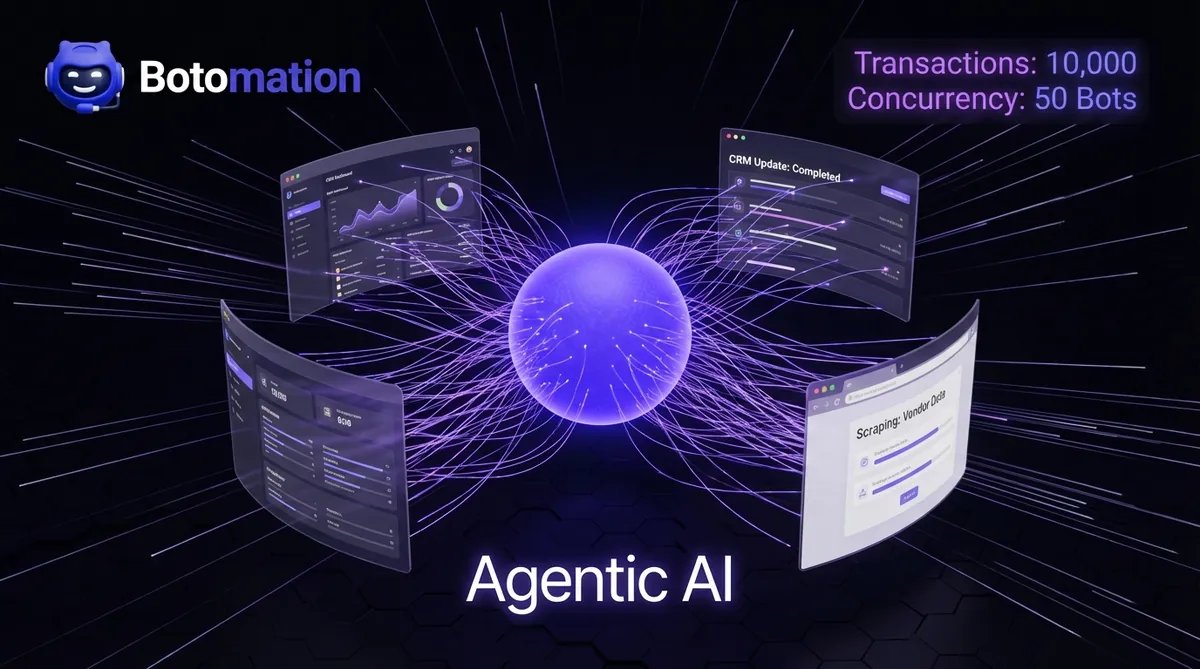
When selecting tools, you must balance "off-the-shelf" ease with "custom-built" power. For standard tasks like document OCR (Optical Character Recognition), modern AI models from Anthropic or Google are excellent. However, for specialized industry workflows, you may need a custom-tuned agent. The key is interoperability. In 2026, the best tools use standardized API protocols that allow an RPA bot to trigger an AI agent, which then passes a result back to your legacy ERP system without manual intervention. This "orchestration" is what allows for true scale.
A Look at Modern RPA Platforms
When evaluating RPA platforms, we look beyond the price tag to "developer experience" and "resilience." Older RPA tools were brittle; a website changing a button color could break the bot. Modern platforms use computer vision and AI to understand the context of a page. If a button moves two pixels to the left, the bot still finds it because it understands what a "Submit" button looks like, rather than relying on fixed coordinates.
Scaling requires a platform that can handle "concurrency." If you need to process 10,000 transactions at 2:00 AM, your infrastructure must spin up 50 bots simultaneously. We prefer solutions with consumption-based pricing models rather than per-bot licenses. This allows our clients to scale their automation based on seasonal demand without paying for idle software. We also prioritize platforms that offer "headless" operation, where bots run in the background without needing a visible desktop environment, significantly reducing server overhead.
AI Tool Selection Criteria
The "brain" of your automation—the AI agent—needs cognitive capabilities. This means it can remember previous interactions, learn from mistakes, and ask for clarification when a task is ambiguous. Security is non-negotiable. In 2026, data privacy is a primary concern for any CEO. Any AI tool you select must have enterprise-grade encryption and the ability to run within your private cloud environment to ensure sensitive data remains under your control.
Adaptive learning is another key feature. You want an agent that improves over time. If a human corrects an agent's output, that correction should be fed back into the model to prevent recurring mistakes. This continuous improvement loop is what separates a basic script from a true revenue engine. We also look for "multimodal" capabilities, where the AI can process images, voice, and text simultaneously, allowing it to handle diverse tasks like verifying a photo of a receipt against a text-based expense claim.
How to Build a Simple AI Data Extraction Agent
To understand how AI agents replace manual data entry work, here is a simplified look at how our experts might configure an agent to handle incoming sales inquiries:
- Define the Trigger: Set the agent to monitor a specific "Sales" inbox or Slack channel.
- Analyze the Intent: Use a model like GPT-5 to determine if the message is a new lead, a support request, or spam.
- Extract Key Entities: The agent identifies the sender's name, company, budget, and specific pain points.
- Check Internal Data: The agent queries your CRM to see if this lead already exists.
- Draft a Response: Based on extracted data, the agent drafts a personalized response for human review.
- Update the Pipeline: The agent automatically creates a new "Deal" in your CRM with all relevant notes attached.
Step 3: Develop a Comprehensive Implementation Strategy for AI Agents for Business Scaling
A strategy is not a static document; it is a living roadmap. The biggest mistake businesses make is attempting to automate everything at once, which leads to "automation anxiety" among staff and technical debt for IT. We advocate for a phased implementation. Start with a pilot, prove the ROI, and then expand. By focusing on AI agents for business scaling, you ensure that your automation isn't just a series of disconnected scripts, but a cohesive digital workforce that grows with your company.
Change management is the most underrated part of scaling. You are changing how people work, which can be daunting. However, the data is clear: 83% of SMEs report significant cost reductions from outsourcing manual processes to automated systems. The goal is to frame this as "augmentation," not "replacement." When your team sees that the AI agent handles the tasks they dislike—like filing expense reports or chasing late payments—they become your biggest advocates.
Phased Implementation Approach
The first 30 days of an automation journey should focus entirely on the pilot. Pick one department, one process, and one goal. This allows you to resolve issues in a controlled environment. Once successful, you move to the "Expansion" phase, rolling out the technology to adjacent departments. This prevents the "big bang" failure where a company tries to flip a switch and automate everything overnight, only to have the entire system crash due to unforeseen edge cases.
Resource allocation is vital. You need a dedicated "Process Owner" for every automation. This person does not need to be a coder but must understand the business logic. They monitor the bot's performance and ensure it continues delivering value. Our team works closely with these internal champions to ensure a smooth transition. We also recommend setting aside a "stabilization period" after each rollout where the focus is on bug fixes and user feedback rather than adding new features.
Change Management Strategy
You must address the "elephant in the room": job security. The most successful companies we work with are transparent about their automation goals. They explain that by automating repetitive tasks, the company can grow faster, creating more opportunities for humans to perform creative, high-level work. We call this the "Upskilling Initiative." Instead of fearing the bot, employees are trained to manage the bot, moving from "doers" to "orchestrators."
Creating a "Center of Excellence" (CoE) is an effective way to build internal momentum. This is a small group of employees trained on the new tools who help other departments identify automation opportunities. This bottom-up approach ensures that those closest to the work drive the change. Continuous feedback loops are essential; if a bot makes someone's job harder, you need to know immediately to refine the process. In late 2026, we even see companies gamifying this process, rewarding employees who identify the most "automatable" tasks.
Step 4: Pilot Testing and AI Workflow Optimization
You wouldn't hire a human and let them work without training; the same applies to a bot. Pilot testing is about more than checking for bugs; it is about validating business logic. Does the bot handle misspelled names correctly? Does it know what to do if a server goes down? This phase is where AI workflow optimization truly begins, as we fine-tune the agent's decision-making parameters based on real-world data.
Measuring performance against baseline metrics is the only way to confirm success. If your manual process took 10 minutes and the bot takes 2 minutes, that is a 5x improvement. However, you must also monitor quality. If the bot is faster but makes more mistakes, you haven't scaled; you've just created a faster way to fail. We use "A/B testing" for our AI agents, running the manual process alongside the automated one to ensure outputs are identical or superior.
Creating a Testing Framework
A testing framework should include "Stress Testing." What happens if the work volume triples overnight? In 2026, we use synthetic data sets to simulate high-load scenarios, ensuring your infrastructure can handle the scale before going live. This is particularly important for customer-facing AI agents, where a sudden surge in traffic (e.g., during a Black Friday sale) could lead to latency or hallucinations if the system isn't properly load-balanced.
Key Stat: Companies that invest in robust testing frameworks for their automation see a 40% higher long-term success rate than those that do not.
Error handling is another critical area. A "graceful failure" occurs when a bot realizes it cannot complete a task and hands it to a human with a clear explanation. A "hard failure" is when the bot stops or continues with incorrect data. We build "human-in-the-loop" checkpoints into every automation to ensure high-stakes decisions receive human oversight. This ensures that AI workflow optimization is a safe, controlled process that builds trust with stakeholders.
Validating Results and ROI
Once the pilot concludes, you must present the results. Compare actual savings against projections. Don't just discuss "time saved"; discuss "opportunity cost." If your sales team saved 100 hours of data entry, how many more calls did they make? How much new revenue did that generate? This is the "multiplier effect" of automation. In 2026, we also track "employee satisfaction scores" as a key metric of success, as reduced drudgery leads to lower turnover rates.
Refining the process based on pilot results is a sign of a healthy project. Perhaps the AI agent excels at extracting data but struggles with a specific PDF type. Instead of forcing it, you adjust the process to include a pre-processing step. This level of detail is what Botomation brings to the table, ensuring the final rollout is bulletproof. We ensure that every lesson learned during the pilot is documented in a "Lessons Learned" repository to inform future automation projects.
Step 5: Full-Scale Deployment and Continuous Optimization
Full-scale deployment is where the real transformation occurs. This is when you stop thinking about "bots" and start thinking about a "digital workforce." At this stage, you are optimizing for peak performance across the entire enterprise. Standardization and governance become the priority. You need a way to monitor all bots from a single dashboard to ensure they perform as expected and comply with security protocols.
Optimization is a continuous process. As your business grows, your processes will change. An automation that worked for 50 customers might struggle with 5,000. MIT research shows that workplace training delivers a 250% return on investment, and this applies to your digital workers too. You need to re-train your AI models regularly with fresh data to ensure they stay sharp and relevant to your evolving business goals.
Strategies for a Smooth Enterprise Rollout
A coordinated rollout requires a clear governance framework. Who is authorized to create a new bot? Who is responsible for maintenance? Without these rules, you end up with "Shadow IT"—disconnected automations that no one knows how to fix. We help you establish an "Automation Lifecycle Management" process that covers everything from the initial idea to the eventual retirement of a bot.
We recommend a "Hub and Spoke" model. The "Hub" (your CoE or Botomation) provides tools, standards, and security, while the "Spokes" (individual departments) implement specific use cases. This balances central control with departmental flexibility. Reporting systems should be transparent, allowing every manager to see the efficiency gains their team is achieving. This transparency fosters a culture of continuous improvement and healthy competition between departments.
How to Keep Optimizing Your Results
Ongoing optimization is about finding the next 1% of efficiency. We use "Process Discovery" AI to constantly scan your operations for new bottlenecks. As models like GPT-5 and Claude 3.5 evolve, we can swap out the "brain" of your agents for newer, faster versions without rebuilding the entire workflow. This modular approach ensures your automation stack remains cutting-edge without requiring massive reinvestment.
Tuning AI models is a specialized task. It involves fine-tuning the model on your specific company data so it understands your brand voice, product jargon, and unique customer needs. This turns a generic AI into a specialized expert. The goal is "Continuous Value Realization"—a state where automation is not just a cost-saver, but a driver of new business value, such as identifying new market trends through automated data analysis.
Frequently Asked Questions
Is RPA only for large enterprises?
Not anymore. In 2026, the cost of entry has dropped significantly. Our team specializes in bringing enterprise-grade automation to growing businesses and SMEs. You don't need a million-dollar budget to scale business operations with RPA and AI agents; you just need a strategic roadmap and the right implementation partner.
Will AI agents replace my existing staff?
The goal of automation is to eliminate "drudge work." Most clients find their staff is much happier once repetitive tasks are gone, allowing them to focus on tasks requiring empathy, creativity, and strategic thinking—things AI still cannot do. We view this as a way to let your humans be more human.
How long does it take to see results?
A typical pilot project can be operational in 4 to 6 weeks. Most businesses see a positive ROI within the first year, often much sooner if the automated process is high-volume. The key is to start small and scale fast once the value is proven.
What happens if the AI makes a mistake?
We build "human-in-the-loop" systems. For high-stakes or ambiguous tasks, the AI agent drafts the work and a human provides final approval. This ensures 100% quality control while gaining 90% of the efficiency. We also implement rigorous error-logging and automated alerts to catch issues in real-time.
Do I need to know how to code to manage these bots?
No. While our experts handle complex custom coding and integration, the management interfaces we provide are designed for business users. You can monitor performance, review AI outputs, and adjust business rules through simple, intuitive dashboards that require no technical background.
What is the difference between an AI Agent and a traditional RPA bot?
Traditional RPA is strictly rule-based; it follows a fixed script (e.g., "copy this cell to that box"). An AI agent uses LLMs to handle ambiguity. If a customer sends an email that isn't in a standard format, an AI agent can read it, understand the intent, and decide which RPA bot to trigger to fulfill the request. Together, they form a complete digital employee.
The "Old Way" of scaling—hiring more people for manual work—is a recipe for burnout and thin margins. The "New Way" is to build a high-speed revenue engine powered by custom code and intelligent AI agents. This isn't just about saving time; it's about building a business that can grow infinitely without the friction of legacy systems.
Scaling your operations with RPA and AI is the most significant competitive advantage available in 2026. By following these seven steps, you move from a reactive state to a proactive, automated powerhouse. But you don't have to do it alone. Our team at Botomation is ready to help you bridge the gap between complex AI technology and practical, bottom-line results. We don't just build websites; we build the digital infrastructure that lets your business run while you sleep.
Ready to automate your growth? Stop losing money on manual tasks and legacy friction today. Book a free consultation call below to start building your digital workforce with our team of experts.
By late 2026, business leaders no longer ask if they should automate, but rather how fast they can deploy autonomous systems to outpace the competition. The industry has moved beyond simple "if-then" logic. Today, the convergence of Robotic Process Automation (RPA) and agentic AI has established a new standard for operational excellence. While traditional RPA handled the "hands" of a business—moving data between spreadsheets—modern AI agents now provide the "brain," making real-time decisions and handling exceptions that previously required human intervention. This shift allows organizations to scale business operations with RPA and AI by learning how to automate repetitive business tasks with AI agents in ways that were technically impossible even two years ago.
The pressure to scale without ballooning headcount is a constant challenge for founders and COOs looking to maintain lean operations. Hiring more personnel to solve volume problems often leads to cultural dilution, management overhead, and increased error rates. Recent data from McKinsey suggests that roughly 60% of all occupations have at least 30% of constituent activities that could be automated. For a growing company, that 30% represents the difference between a profitable year and a stagnant one. By integrating these technologies, our team at Botomation helps businesses reclaim thousands of hours, allowing human talent to focus on high-value strategy rather than the digital equivalent of moving rocks.
We are witnessing a fundamental shift in how work is structured. In late 2026, the distinction between "software" and "worker" is blurring. When you partner with our experts, we don't just hand you a tool; we architect a digital workforce. This article serves as a comprehensive roadmap for navigating this transformation, ensuring your business doesn't just survive the automation wave but rides it to unprecedented levels of efficiency. As we look toward the 2026 fiscal year, the organizations that have successfully integrated AI agents for business scaling are the ones currently dominating their respective markets.
Identifying High-Impact Opportunities to Scale Business Operations with RPA
Before writing code or deploying an agent, you must understand the terrain of your current operations. Most businesses suffer from "invisible friction"—tasks that everyone performs but no one questions. These are the prime candidates for automation. When we assess a client's workflow, we identify processes that are high-volume, repetitive, and prone to human error. If a task requires a human to look at a screen, copy a number, and paste it into another window, it is a liability, not a job.
Evaluating process complexity is the next hurdle. Some tasks are simple but frequent, like processing an invoice. Others are complex but rare, like a specialized legal review. The "sweet spot" for scaling lies in high-frequency, medium-complexity tasks. In late 2026, we are even seeing physical operations join the digital fray. The 1X Neo Humanoid Robot, for instance, is now being integrated into warehouse and office environments to handle physical tasks previously impossible for software-only RPA. This represents the ultimate scaling of operations: a robot that can navigate a physical office to file papers or move inventory, controlled by the same AI agents that manage your digital databases.
How to Spot the Best Spots for RPA and AI in Your Current Setup
To effectively identify these opportunities, you must conduct a deep-dive audit of your departmental silos. Often, the most significant bottlenecks exist at the intersection of two departments—such as the handoff between Sales and Finance. These manual bridges are where data integrity is most at risk. In 2026, we utilize advanced process discovery tools that sit silently on your network, observing workflows to highlight where time is being leaked. This objective data prevents the "squeaky wheel" from getting the grease, ensuring you automate the processes that actually move the needle on your bottom line.
Techniques for Mapping and Analyzing Your Processes
Mapping a process requires more than a cursory glance at a flowchart; you must identify the exact touchpoints where a human enters data or makes a decision. We recommend starting with a "Value Stream Map" to visualize the flow of information from the initial customer request to final delivery. During this phase, you should measure the "cycle time" for every step. If a procurement officer takes 45 minutes to verify a vendor, that is your baseline.
Standardization is the enemy of chaos and the best friend of automation. If three different employees handle the same task in three different ways, you cannot automate it effectively. Our team focuses on identifying these variances and smoothing them out. We use feasibility scores to rank processes. A process scores high if it has digital inputs, follows clear business rules, and maintains a high volume. If a process relies on "gut feeling" or non-digitized physical mail, it scores low. In late 2026, the ability to ingest unstructured data (like handwritten notes) via LLMs has significantly increased the feasibility scores of many legacy processes.
ROI Calculation for RPA Implementation
Calculating the return on investment for automation is often where COOs hesitate. They focus on the cost of the service rather than the cost of the status quo. Consider a realistic calculation: suppose you have a team of four specialists earning $65,000 each, spending 40% of their time on manual data entry. That represents $104,000 in annual salary spent on tasks a bot could handle.
"Automation is not about replacing people; it is about replacing the parts of their jobs that make them feel like robots." — Botomation Strategy Lead
Beyond salary, you must factor in the "error tax." Humans have an average error rate of 1% to 5% in data entry. A single mistake in a financial report or shipping address can cost thousands in remediation. By implementing automated data entry validation, you can reduce these errors by 60% and eliminate the 'error tax' that drains your margins. Our analysis usually shows that a well-implemented AI agent pays for itself within six to nine months, providing a permanent reduction in operational expenses. Furthermore, the scalability of a bot—its ability to work 24/7 without fatigue—means your ROI actually increases as your business volume grows.
Step 1: Map Critical Processes to Scale Business Operations with RPA
You cannot automate what you do not understand. Many founders attempt to skip straight to advanced AI without realizing their internal processes are a tangled web of legacy habits. Mapping your critical business processes involves creating a "digital twin" of how your company actually functions. This requires documenting every integration point between your CRM, accounting software, and project management tools.
Dependencies are the silent killers of scaling. If your marketing team cannot launch a campaign until the finance team manually approves a budget in a spreadsheet, you have a bottleneck that can be solved if you automate project management and billing to remove manual approvals. By mapping these handoffs, you can identify where an AI agent can step in to provide instant approvals based on pre-set parameters. For example, customer retention rates increase by 27% when CRM systems are used effectively. This is not just because of the software; it is because the data is available to the right person at the right time. Automation ensures that data moves without friction.
How to Actually Calculate the ROI of an RPA Project
To move from a theoretical ROI to a concrete business case, you must track "FTE (Full-Time Equivalent) Reallocation." This isn't just about saving money; it's about what those employees do with their newly freed time. If your top account manager is no longer filing expense reports, they can manage five additional high-value clients. The revenue generated from those five clients should be added to your ROI calculation. Additionally, consider the "compliance benefit." In industries like healthcare or fintech, automated logging of every digital action reduces the cost of audits by up to 60%.
Best Practices for Documenting Your Processes
When our experts document a process, we look for the "exception path." Most organizations document the "happy path"—what happens when everything goes right. However, scaling fails when the system hits an error and lacks instructions. You must define success metrics for every step. What is the acceptable time for an invoice to be processed? What is the maximum allowable error rate?
Every decision point needs a rule. If an AI agent encounters a customer complaint, it needs to know whether to offer a refund, a discount, or escalate to a human. Documenting these business rules is tedious but essential for a reliable automated system. We often use "Process Mining" tools to analyze how data actually moves through a company's network, which frequently reveals that the way employees think they work differs significantly from how they actually work. In the context of 2026, we also document the "data lineage" to ensure that any AI-driven decision can be traced back to its source for regulatory compliance.
Identifying Automation Candidates
Your first automation project should not be your most complex; it should be the one that provides the most visible relief to your team. We look for "low-hanging fruit": tasks with high volume and low variability. Data migration, report generation, and password resets are classic examples.
| Process Type | Volume | Complexity | Automation Potential |
|---|---|---|---|
| Invoice Entry | High | Low | 95% |
| Customer Support (Tier 1) | High | Medium | 80% |
| Strategic Planning | Low | High | 10% |
| Employee Onboarding | Medium | Medium | 70% |
As shown in the table above, tasks like invoice entry are prime candidates. They follow strict rules and occur constantly. By starting here, you build organizational confidence and prove the value of this new operational model. We also look for processes that are "seasonal bottlenecks"—tasks that only become a problem during peak quarters but cause massive stress when they do.
Step 2: Select the Right RPA and AI Tools for Your Business
The landscape of 2026 is crowded with "AI wrappers" that promise much but deliver little. Choosing the right stack is critical. You need tools that integrate seamlessly with your existing legacy systems. This is where most SaaS platforms fail—they require you to move your entire business into their ecosystem. At Botomation, we help you replace legacy systems with custom web development and integrated agentic AI that meets you where you are. We build custom code and integrate agentic AI that meets you where you are.
A standout example in late 2026 is the OpenAI Atlas Browser. Unlike simple chatbots, Atlas acts as an agent that can navigate the web, use internal software, and interact with websites just like a human. It can log into a vendor portal, track competitor pricing automatically, compare it to your internal database, and update your records in real-time. This agentic capability is the bridge between static software and a dynamic digital employee.
Choosing the Right RPA and AI Tools for Your Specific Needs
When selecting tools, you must balance "off-the-shelf" ease with "custom-built" power. For standard tasks like document OCR (Optical Character Recognition), modern AI models from Anthropic or Google are excellent. However, for specialized industry workflows, you may need a custom-tuned agent. The key is interoperability. In 2026, the best tools use standardized API protocols that allow an RPA bot to trigger an AI agent, which then passes a result back to your legacy ERP system without manual intervention. This "orchestration" is what allows for true scale.
A Look at Modern RPA Platforms
When evaluating RPA platforms, we look beyond the price tag to "developer experience" and "resilience." Older RPA tools were brittle; a website changing a button color could break the bot. Modern platforms use computer vision and AI to understand the context of a page. If a button moves two pixels to the left, the bot still finds it because it understands what a "Submit" button looks like, rather than relying on fixed coordinates.
Scaling requires a platform that can handle "concurrency." If you need to process 10,000 transactions at 2:00 AM, your infrastructure must spin up 50 bots simultaneously. We prefer solutions with consumption-based pricing models rather than per-bot licenses. This allows our clients to scale their automation based on seasonal demand without paying for idle software. We also prioritize platforms that offer "headless" operation, where bots run in the background without needing a visible desktop environment, significantly reducing server overhead.
AI Tool Selection Criteria
The "brain" of your automation—the AI agent—needs cognitive capabilities. This means it can remember previous interactions, learn from mistakes, and ask for clarification when a task is ambiguous. Security is non-negotiable. In 2026, data privacy is a primary concern for any CEO. Any AI tool you select must have enterprise-grade encryption and the ability to run within your private cloud environment to ensure sensitive data remains under your control.
Adaptive learning is another key feature. You want an agent that improves over time. If a human corrects an agent's output, that correction should be fed back into the model to prevent recurring mistakes. This continuous improvement loop is what separates a basic script from a true revenue engine. We also look for "multimodal" capabilities, where the AI can process images, voice, and text simultaneously, allowing it to handle diverse tasks like verifying a photo of a receipt against a text-based expense claim.
How to Build a Simple AI Data Extraction Agent
To understand how AI agents replace manual data entry work, here is a simplified look at how our experts might configure an agent to handle incoming sales inquiries:
- Define the Trigger: Set the agent to monitor a specific "Sales" inbox or Slack channel.
- Analyze the Intent: Use a model like GPT-5 to determine if the message is a new lead, a support request, or spam.
- Extract Key Entities: The agent identifies the sender's name, company, budget, and specific pain points.
- Check Internal Data: The agent queries your CRM to see if this lead already exists.
- Draft a Response: Based on extracted data, the agent drafts a personalized response for human review.
- Update the Pipeline: The agent automatically creates a new "Deal" in your CRM with all relevant notes attached.
Step 3: Develop a Comprehensive Implementation Strategy for AI Agents for Business Scaling
A strategy is not a static document; it is a living roadmap. The biggest mistake businesses make is attempting to automate everything at once, which leads to "automation anxiety" among staff and technical debt for IT. We advocate for a phased implementation. Start with a pilot, prove the ROI, and then expand. By focusing on AI agents for business scaling, you ensure that your automation isn't just a series of disconnected scripts, but a cohesive digital workforce that grows with your company.
Change management is the most underrated part of scaling. You are changing how people work, which can be daunting. However, the data is clear: 83% of SMEs report significant cost reductions from outsourcing manual processes to automated systems. The goal is to frame this as "augmentation," not "replacement." When your team sees that the AI agent handles the tasks they dislike—like filing expense reports or chasing late payments—they become your biggest advocates.
Phased Implementation Approach
The first 30 days of an automation journey should focus entirely on the pilot. Pick one department, one process, and one goal. This allows you to resolve issues in a controlled environment. Once successful, you move to the "Expansion" phase, rolling out the technology to adjacent departments. This prevents the "big bang" failure where a company tries to flip a switch and automate everything overnight, only to have the entire system crash due to unforeseen edge cases.
Resource allocation is vital. You need a dedicated "Process Owner" for every automation. This person does not need to be a coder but must understand the business logic. They monitor the bot's performance and ensure it continues delivering value. Our team works closely with these internal champions to ensure a smooth transition. We also recommend setting aside a "stabilization period" after each rollout where the focus is on bug fixes and user feedback rather than adding new features.
Change Management Strategy
You must address the "elephant in the room": job security. The most successful companies we work with are transparent about their automation goals. They explain that by automating repetitive tasks, the company can grow faster, creating more opportunities for humans to perform creative, high-level work. We call this the "Upskilling Initiative." Instead of fearing the bot, employees are trained to manage the bot, moving from "doers" to "orchestrators."
Creating a "Center of Excellence" (CoE) is an effective way to build internal momentum. This is a small group of employees trained on the new tools who help other departments identify automation opportunities. This bottom-up approach ensures that those closest to the work drive the change. Continuous feedback loops are essential; if a bot makes someone's job harder, you need to know immediately to refine the process. In late 2026, we even see companies gamifying this process, rewarding employees who identify the most "automatable" tasks.
Step 4: Pilot Testing and AI Workflow Optimization
You wouldn't hire a human and let them work without training; the same applies to a bot. Pilot testing is about more than checking for bugs; it is about validating business logic. Does the bot handle misspelled names correctly? Does it know what to do if a server goes down? This phase is where AI workflow optimization truly begins, as we fine-tune the agent's decision-making parameters based on real-world data.
Measuring performance against baseline metrics is the only way to confirm success. If your manual process took 10 minutes and the bot takes 2 minutes, that is a 5x improvement. However, you must also monitor quality. If the bot is faster but makes more mistakes, you haven't scaled; you've just created a faster way to fail. We use "A/B testing" for our AI agents, running the manual process alongside the automated one to ensure outputs are identical or superior.
Creating a Testing Framework
A testing framework should include "Stress Testing." What happens if the work volume triples overnight? In 2026, we use synthetic data sets to simulate high-load scenarios, ensuring your infrastructure can handle the scale before going live. This is particularly important for customer-facing AI agents, where a sudden surge in traffic (e.g., during a Black Friday sale) could lead to latency or hallucinations if the system isn't properly load-balanced.
Key Stat: Companies that invest in robust testing frameworks for their automation see a 40% higher long-term success rate than those that do not.
Error handling is another critical area. A "graceful failure" occurs when a bot realizes it cannot complete a task and hands it to a human with a clear explanation. A "hard failure" is when the bot stops or continues with incorrect data. We build "human-in-the-loop" checkpoints into every automation to ensure high-stakes decisions receive human oversight. This ensures that AI workflow optimization is a safe, controlled process that builds trust with stakeholders.
Validating Results and ROI
Once the pilot concludes, you must present the results. Compare actual savings against projections. Don't just discuss "time saved"; discuss "opportunity cost." If your sales team saved 100 hours of data entry, how many more calls did they make? How much new revenue did that generate? This is the "multiplier effect" of automation. In 2026, we also track "employee satisfaction scores" as a key metric of success, as reduced drudgery leads to lower turnover rates.
Refining the process based on pilot results is a sign of a healthy project. Perhaps the AI agent excels at extracting data but struggles with a specific PDF type. Instead of forcing it, you adjust the process to include a pre-processing step. This level of detail is what Botomation brings to the table, ensuring the final rollout is bulletproof. We ensure that every lesson learned during the pilot is documented in a "Lessons Learned" repository to inform future automation projects.
Step 5: Full-Scale Deployment and Continuous Optimization
Full-scale deployment is where the real transformation occurs. This is when you stop thinking about "bots" and start thinking about a "digital workforce." At this stage, you are optimizing for peak performance across the entire enterprise. Standardization and governance become the priority. You need a way to monitor all bots from a single dashboard to ensure they perform as expected and comply with security protocols.
Optimization is a continuous process. As your business grows, your processes will change. An automation that worked for 50 customers might struggle with 5,000. MIT research shows that workplace training delivers a 250% return on investment, and this applies to your digital workers too. You need to re-train your AI models regularly with fresh data to ensure they stay sharp and relevant to your evolving business goals.
Strategies for a Smooth Enterprise Rollout
A coordinated rollout requires a clear governance framework. Who is authorized to create a new bot? Who is responsible for maintenance? Without these rules, you end up with "Shadow IT"—disconnected automations that no one knows how to fix. We help you establish an "Automation Lifecycle Management" process that covers everything from the initial idea to the eventual retirement of a bot.
We recommend a "Hub and Spoke" model. The "Hub" (your CoE or Botomation) provides tools, standards, and security, while the "Spokes" (individual departments) implement specific use cases. This balances central control with departmental flexibility. Reporting systems should be transparent, allowing every manager to see the efficiency gains their team is achieving. This transparency fosters a culture of continuous improvement and healthy competition between departments.
How to Keep Optimizing Your Results
Ongoing optimization is about finding the next 1% of efficiency. We use "Process Discovery" AI to constantly scan your operations for new bottlenecks. As models like GPT-5 and Claude 3.5 evolve, we can swap out the "brain" of your agents for newer, faster versions without rebuilding the entire workflow. This modular approach ensures your automation stack remains cutting-edge without requiring massive reinvestment.
Tuning AI models is a specialized task. It involves fine-tuning the model on your specific company data so it understands your brand voice, product jargon, and unique customer needs. This turns a generic AI into a specialized expert. The goal is "Continuous Value Realization"—a state where automation is not just a cost-saver, but a driver of new business value, such as identifying new market trends through automated data analysis.
Frequently Asked Questions
Is RPA only for large enterprises?
Not anymore. In 2026, the cost of entry has dropped significantly. Our team specializes in bringing enterprise-grade automation to growing businesses and SMEs. You don't need a million-dollar budget to scale business operations with RPA and AI agents; you just need a strategic roadmap and the right implementation partner.
Will AI agents replace my existing staff?
The goal of automation is to eliminate "drudge work." Most clients find their staff is much happier once repetitive tasks are gone, allowing them to focus on tasks requiring empathy, creativity, and strategic thinking—things AI still cannot do. We view this as a way to let your humans be more human.
How long does it take to see results?
A typical pilot project can be operational in 4 to 6 weeks. Most businesses see a positive ROI within the first year, often much sooner if the automated process is high-volume. The key is to start small and scale fast once the value is proven.
What happens if the AI makes a mistake?
We build "human-in-the-loop" systems. For high-stakes or ambiguous tasks, the AI agent drafts the work and a human provides final approval. This ensures 100% quality control while gaining 90% of the efficiency. We also implement rigorous error-logging and automated alerts to catch issues in real-time.
Do I need to know how to code to manage these bots?
No. While our experts handle complex custom coding and integration, the management interfaces we provide are designed for business users. You can monitor performance, review AI outputs, and adjust business rules through simple, intuitive dashboards that require no technical background.
What is the difference between an AI Agent and a traditional RPA bot?
Traditional RPA is strictly rule-based; it follows a fixed script (e.g., "copy this cell to that box"). An AI agent uses LLMs to handle ambiguity. If a customer sends an email that isn't in a standard format, an AI agent can read it, understand the intent, and decide which RPA bot to trigger to fulfill the request. Together, they form a complete digital employee.
The "Old Way" of scaling—hiring more people for manual work—is a recipe for burnout and thin margins. The "New Way" is to build a high-speed revenue engine powered by custom code and intelligent AI agents. This isn't just about saving time; it's about building a business that can grow infinitely without the friction of legacy systems.
Scaling your operations with RPA and AI is the most significant competitive advantage available in 2026. By following these seven steps, you move from a reactive state to a proactive, automated powerhouse. But you don't have to do it alone. Our team at Botomation is ready to help you bridge the gap between complex AI technology and practical, bottom-line results. We don't just build websites; we build the digital infrastructure that lets your business run while you sleep.
Ready to automate your growth? Stop losing money on manual tasks and legacy friction today. Book a free consultation call below to start building your digital workforce with our team of experts.
Get Started
Book a FREE Consultation Right NOW!
Schedule a Call with Our Team To Make Your Business More Efficient with AI Instantly.
Read More
7 Steps to Scale Business Operations with RPA and AI 2026
Discover how to scale business operations with RPA and AI agents in 2026. Our 7-step guide covers implementation, ROI, and building a digital workforce.
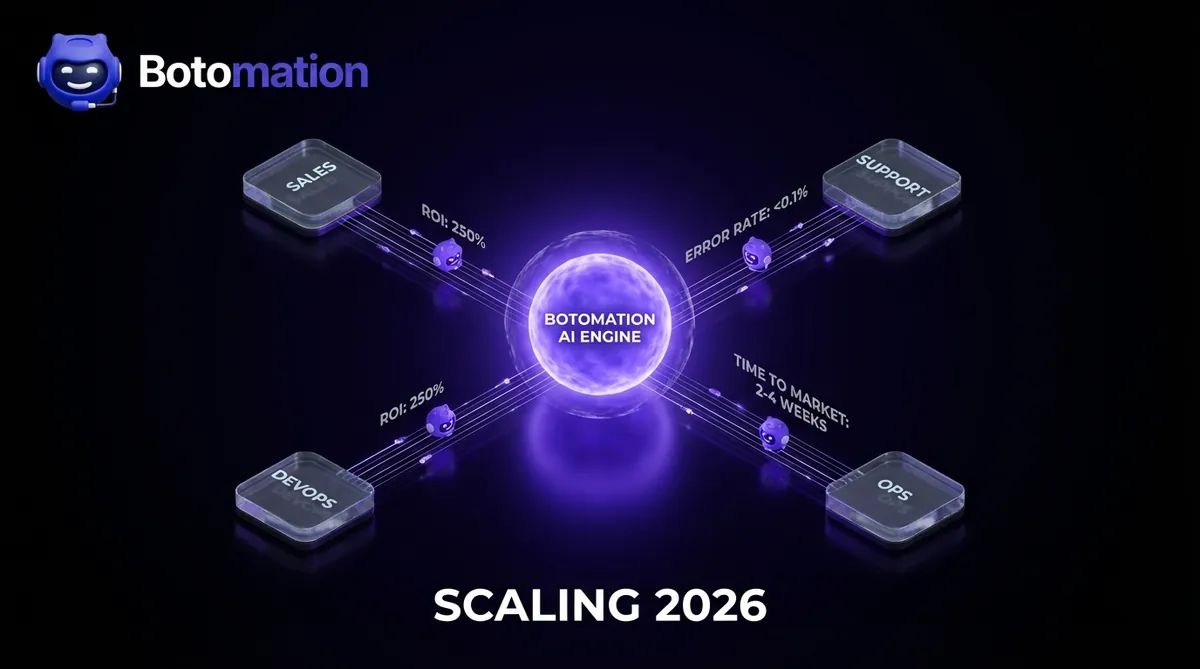
Scale Business Operations with AI Automation - 2026 Guide
Learn how WhatsApp AI slashes support costs for e-commerce & SaaS. Proven strategies to boost sales, recover carts, and scale 24/7 service.