How to Scale Business Operations without Hiring More Staff in 2026
Feb 17, 2026
SaaS
AI Automation
Business Growth
SaaS
AI Automation
Business Growth
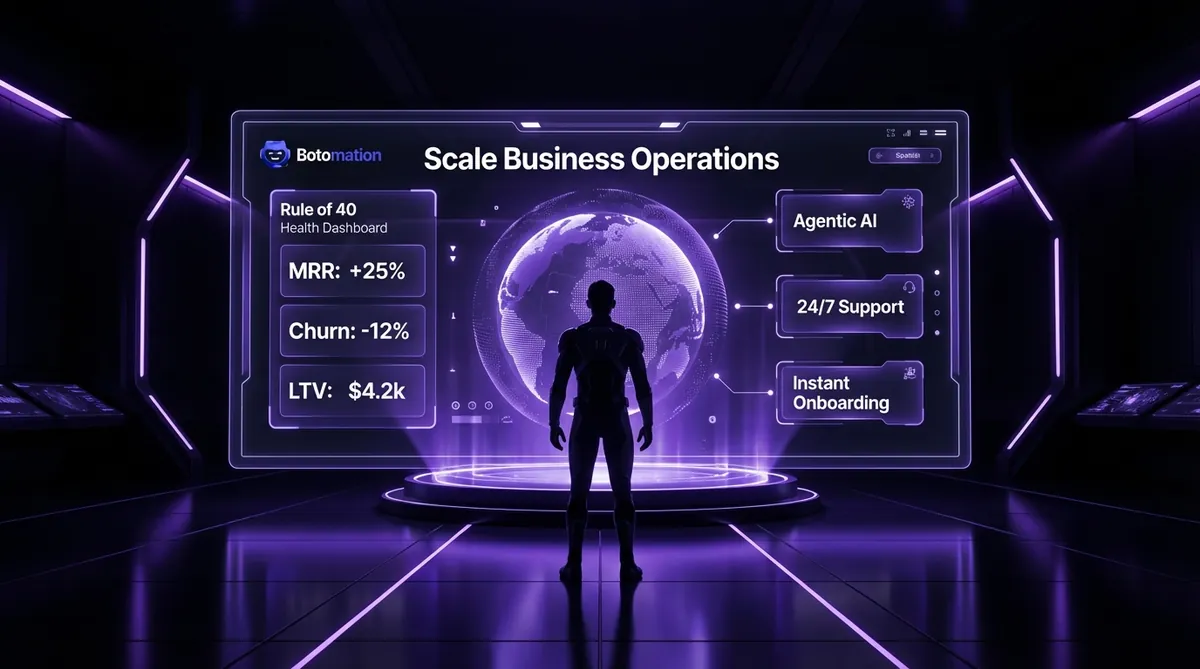
The growth trajectory of a SaaS company in 2026 is no longer measured solely by the velocity of recruitment. In fact, the most successful founders we partner with at Botomation are finding ways to scale business operations without hiring more staff. They are actively seeking strategies to decouple revenue growth from headcount expansion. While the "Rule of 40" remains the gold standard for SaaS health, achieving it has become increasingly difficult as customer acquisition costs rise and the talent market for specialized operations roles remains tight and expensive. When a company hits the scaling phase, the immediate instinct is often to "throw bodies at the problem" to manage the influx of support tickets, onboarding sessions, and billing queries. However, this approach creates a bloated organizational structure that erodes margins and slows down critical decision-making. This guide provides the roadmap to increase operational efficiency without more employees.
Operational efficiency isn't just a buzzword for us; it is the foundation of a sustainable software business. Recent 2026 industry benchmarks suggest that roughly 60% of all employees could save more than 30% of their time by implementing sophisticated workflow automation. For a SaaS company, that 30% represents the difference between a team drowning in manual data entry and a team focused on high-level product strategy and customer delight. By choosing to automate repetitive business tasks with AI agents, you empower your staff to focus on high-impact work. The challenge lies in the transition. Most companies are stuck with legacy processes that were "good enough" at the seed stage but are now breaking under the pressure of scale. This is where the shift toward intelligent, agentic automation becomes a necessity rather than a luxury.
By moving away from manual, repetitive tasks and toward 24/7 AI agents, SaaS companies can maintain a lean, agile core team while their operational capacity expands infinitely. Our team at Botomation specializes in bridging this gap, replacing legacy systems with custom web development and high-speed, custom-coded automation. This article explores how you can navigate this transition, ensuring your infrastructure grows alongside your user base without the traditional overhead—allowing you to scale business operations without hiring more staff.
Understanding How to Scale Business Operations without Hiring More Staff
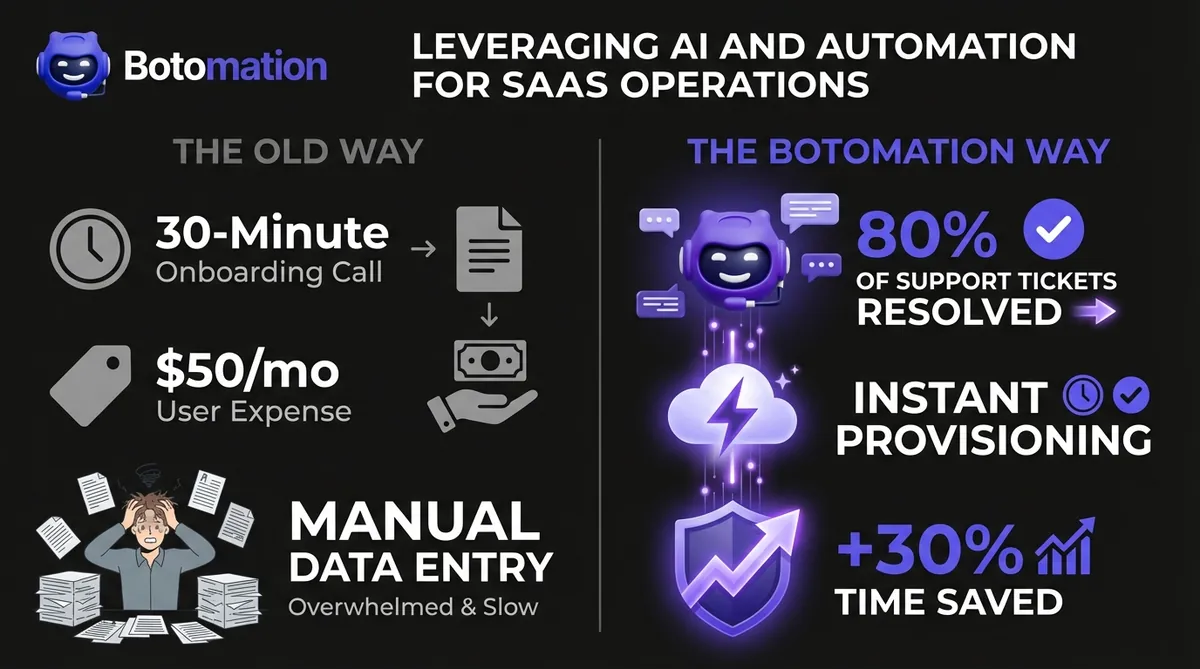
Scaling a SaaS business is fundamentally different from scaling a traditional service or manufacturing company. In a traditional model, costs often scale linearly with output. In SaaS, we strive for exponential growth with sub-linear costs. However, the operational reality often involves hidden complexities that trap founders into hiring more staff than they actually need. The demand for customer retention is just as high as the demand for acquisition, and both require significant operational resources. If your onboarding process is manual, every new customer represents an additional hour of work for a human employee. Over time, this creates a ceiling on your growth.
Customer retention rates can increase by as much as 27% when a CRM system is properly integrated into the operational workflow, yet many companies still treat their CRM as a glorified spreadsheet. The complexity of managing thousands of subscriptions, each with different tiers, renewal dates, and usage limits, creates a massive administrative burden. When you add the need for 24/7 technical support and proactive customer success monitoring, the operational weight becomes immense. Without automation, your "software" company starts looking a lot like a "services" company, which is exactly what investors want to avoid.
Operational Differences in SaaS vs. Traditional Businesses
The recurring revenue model is the heartbeat of SaaS, but it introduces a layer of continuous operational demand that traditional one-time sales models don't face. In a traditional business, once the product is shipped, the transaction is largely complete. In SaaS, the transaction is just the beginning of a long-term relationship that requires constant maintenance. Customer onboarding and setup processes must be frictionless; otherwise, you face high churn rates in the first 90 days. If a human has to manually provision every account or send out every welcome email, the system will eventually fail during a period of rapid growth.
Continuous support and success requirements also set SaaS apart. Customers expect the software to work perfectly every minute of every day. Data management and security considerations add another layer of complexity. As you scale, the volume of data you handle grows exponentially, requiring automated systems for governance, compliance, and protection. Our experts at Botomation often find that companies are still using manual workflows for data auditing, which is not only slow but also prone to human error that could lead to catastrophic security breaches.
Common Scaling Bottlenecks in SaaS Operations
Technical support is usually the first area to break during a growth phase. As your user base doubles, your ticket volume often triples because new users are less familiar with the platform. If you don't have automated routing and AI-driven resolution systems, you'll find yourself hiring support agents every month just to keep your head above water. Similarly, billing and payment processing become a nightmare as you introduce more complex pricing models, such as usage-based billing or multi-currency support.
Customer success and onboarding are the next major bottlenecks. If your "high-touch" onboarding model requires a 30-minute call for every $50/month user, you are losing money on every sale. Data analytics and reporting also become a drag on resources. Founders need real-time insights into MRR, churn, and CAC, but if an analyst has to spend three days a week pulling data from various sources into a master spreadsheet, your leadership team is making decisions based on old information. These bottlenecks are the primary reason companies feel forced to hire more staff, even when the work itself is repetitive and low-value.
| Operational Area | The Manual "Old Way" | The Botomation "New Way" |
|---|---|---|
| **Customer Onboarding** | Human-led calls and manual account setup. | AI-driven interactive guides and instant provisioning. |
| **Support Tickets** | First-come, first-served queue with human triage. | Agentic AI resolves 80% of queries; instant routing for the rest. |
| **Billing & Dunning** | Manual follow-ups on failed credit cards. | Automated, smart-retry sequences and dunning emails. |
| **Data Reporting** | Weekly manual exports and spreadsheet merging. | Real-time dashboards with predictive growth modeling. |
| **Code Maintenance** | Manual bug hunting and legacy debt accumulation. | AI-assisted code reviews and autonomous refactoring. |
Leveraging AI to Scale Business Operations without Hiring More Staff
The landscape of AI in 2026 has moved far beyond simple chatbots. We are now in the era of agentic AI—systems that don't just answer questions but actually perform tasks across different software environments. For SaaS companies, this means you can deploy agents that act as virtual employees. Instead of using generic software, our team implements the best AI marketing tools and specialized solutions like GitHub Copilot for code automation. These aren't just gadgets; they are core components of a modern revenue engine.
Customer support automation has also evolved. With the release of GPT-5 and specialized agentic frameworks, AI can now navigate your product's UI to help a user solve a problem in real-time. Tools like the OpenAI Atlas Browser allow AI agents to perform research and gather information from across the web or your internal documentation without human intervention. This level of autonomy allows your existing staff to focus on strategy while the AI handles the execution of routine workflows.
Development and Code Automation
In 2026, the speed of your development cycle is a competitive advantage. GitHub Copilot's Agent Mode has changed the way our developers work, allowing for autonomous coding of routine features and bug fixes. When we build custom solutions for our clients, we utilize these tools to ensure the code is not only written faster but is also more robust. Code review and quality automation tools can now catch edge cases that human reviewers might miss, significantly reducing the time spent in the QA phase.
Continuous integration and deployment (CI/CD) automation have also become more sophisticated. We can now automate the entire pipeline from code commit to production deployment with minimal human oversight. Furthermore, for marketing and product teams, OpenAI Sora 2 has made it possible to create high-fidelity product demonstration videos from simple text descriptions. This eliminates the need for expensive video production teams and allows you to update your product demos every time you release a new feature, ensuring your marketing always reflects the current state of your software.
Marketing and Customer Engagement Automation
Marketing is often a massive headcount sink for SaaS companies. Between content creation, social media management, and lead nurturing, it’s easy to end up with a team of ten people doing work that could be handled by two people and the right automation stack. Adobe Firefly allows for the automated creation of marketing assets that are on-brand and tailored to specific audience segments. Meanwhile, the Miro AI Innovation Workspace has streamlined the way teams collaborate on product roadmaps and campaign strategies, using AI to cluster ideas and generate actionable tasks.
Automated social media and campaign management systems can now handle the distribution and optimization of content across a dozen platforms simultaneously. Lead scoring and nurturing have also become more intelligent. Instead of basic "if-then" logic, AI-driven lead scoring models analyze thousands of data points to identify which prospects are most likely to convert. This allows your sales team to stop chasing cold leads and focus their energy on high-value opportunities, effectively scaling your sales capacity without adding a single salesperson.
Customer Onboarding and Success Automation
The first experience a customer has with your SaaS product determines whether they will stay for years or churn within days. Most companies struggle here because they rely on human-led onboarding. While "high-touch" sounds premium, it is often slow and creates a bottleneck. If a customer has to wait three days for an onboarding call, they’ve already lost interest. Automation allows you to provide a "high-tech" experience that feels personalized but scales infinitely.
Interestingly, 83% of SMEs report significant cost reductions from outsourcing their operational automation to specialized agencies rather than trying to build everything in-house. By automating the client onboarding process, you ensure every customer receives the same high-quality introduction to your product. We use AI to monitor customer behavior during those first critical days, identifying exactly where a user gets stuck and proactively offering help before they even realize they need it. This proactive approach is the key to maintaining high retention rates during periods of rapid growth.
Automated Customer Onboarding Workflows
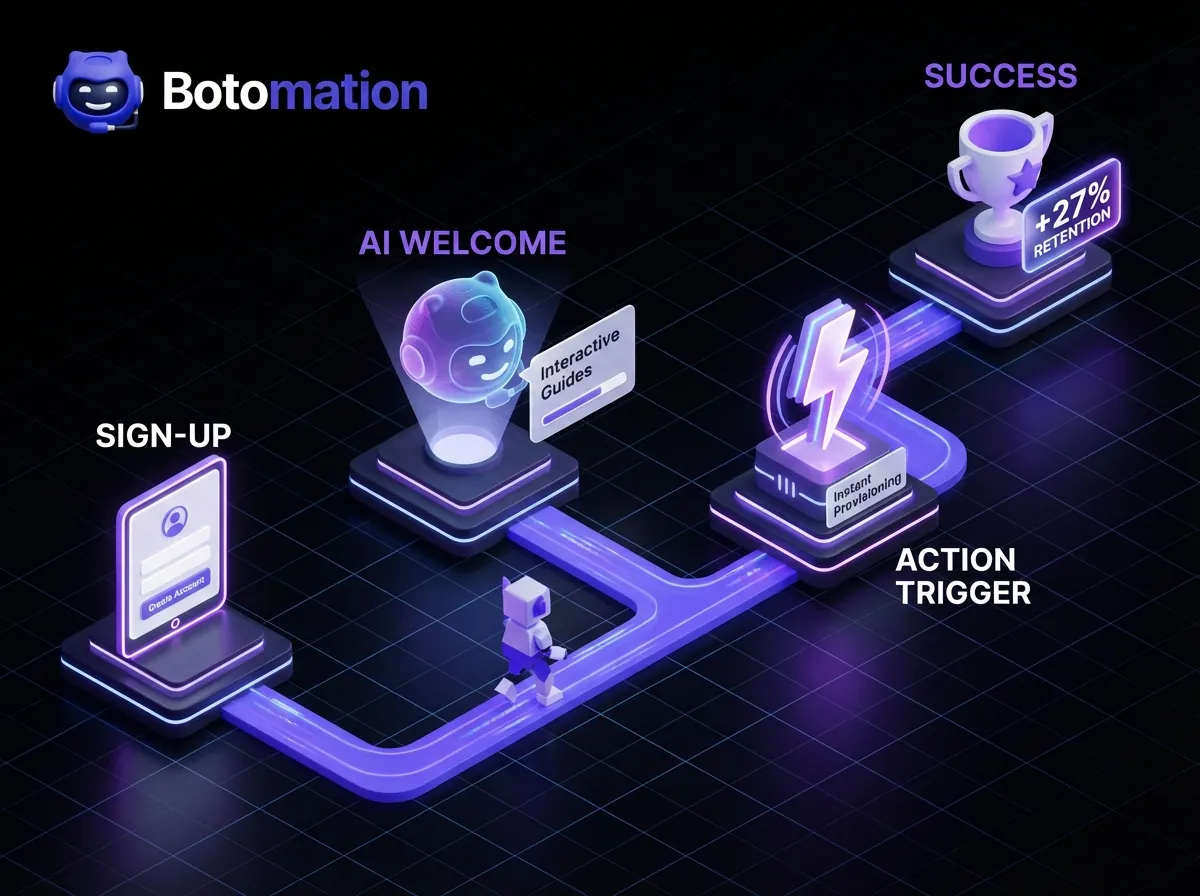
An effective automated onboarding workflow starts the moment a user signs up. Instead of a generic welcome email, we implement automated sequences that are triggered by specific user actions. For example, if a user hasn't set up their profile within 24 hours, the system sends a personalized video guide (potentially generated by Sora 2) showing them exactly how to do it. Progressive onboarding with in-app guidance ensures that users aren't overwhelmed by every feature at once; instead, they are guided through the core value proposition of the product step-by-step.
Automated milestone recognition is another powerful tool for engagement. When a user reaches a specific goal—like sending their first invoice or inviting their first team member—the system can automatically send a congratulatory message or unlock a temporary "pro" feature. This creates a positive feedback loop that encourages continued usage. Performance-based onboarding adjustments allow the system to speed up or slow down the guidance based on how quickly the user is moving through the setup process, providing a truly bespoke experience without human intervention.
Proactive Customer Success Monitoring
Customer success should not be a reactive department that only handles complaints. It should be a proactive engine that prevents issues before they occur. Automated usage analytics provide real-time insights into how your customers are actually using the software. If the data shows that a high-value account hasn't logged in for a week, an AI agent can flag this to a success manager or automatically send a "check-in" email with a helpful tip related to their specific industry.
Predictive churn models are the "holy grail" of SaaS operations. By analyzing historical data, these models can identify the behavioral patterns that typically precede a cancellation. Our team at Botomation builds these models into your operational stack, allowing you to intervene with targeted offers or support before the customer makes the decision to leave. Intelligent customer touchpoint automation ensures that your brand stays top-of-mind without your team having to manually manage a calendar of thousands of follow-up emails.
Expert Insight: The goal of automation in customer success is not to remove the human element, but to ensure that humans only step in when they can provide the most value. Let the AI handle the 95% of routine check-ins so your team can focus on the 5% of complex, high-stakes relationship building.
Billing, Payment, and Financial Operations Automation
As a SaaS company grows, the complexity of its financial operations grows exponentially. Managing thousands of different renewal dates, handling failed credit card payments, and accurately recognizing revenue according to GAAP standards can quickly become a full-time job for an entire finance department. This is an area where manual errors are not just annoying; they are expensive. A single mistake in a billing script can lead to thousands of dollars in lost revenue or, worse, a PR nightmare with overcharged customers.
We often recommend solutions like OneStream for companies looking to scale their finance operations, but the real power comes from how these systems are integrated into your custom codebase. Our expertise in automating billing and project management ensures that your financial workflows are error-free and scalable. Automating subscription management and billing ensures that your revenue is collected accurately and on time. Dunning automation—the process of communicating with customers when their payment fails—can recover up to 15% of potentially lost revenue without any manual intervention. This is "found money" that goes straight to your bottom line.
Subscription Management Systems
A robust subscription management system must handle more than just monthly charges. It needs to manage automated plan changes, upgrades, and downgrades seamlessly. If a customer wants to move from your "Pro" plan to your "Enterprise" plan in the middle of a billing cycle, the system should automatically calculate the pro-rated amount and update their access permissions instantly. Doing this manually is a recipe for disaster and a massive waste of time for your billing team.
Multi-subscription management is another challenge, especially for B2B SaaS companies where a single organization might have multiple departments using different products under different contracts. Automated trial conversions and cancellations are also vital. You want a system that automatically converts a trial user to a paid subscriber at the exact moment their trial ends, while also handling the cancellation of users who choose not to continue, ensuring you aren't paying for infrastructure for users who aren't paying you.
Payment and Dunning Automation
Failed payments are an inevitable part of the SaaS business, but they don't have to lead to churn. Smart dunning sequences use AI to determine the best time to retry a credit card and the most effective messaging to use when reaching out to the customer. For instance, an AI agent might notice that a customer's payment usually fails on the 30th of the month but succeeds on the 1st (payday). The system can then automatically adjust the retry logic to align with the customer's cash flow.
Handling alternative payment methods like ACH, SEPA, or crypto is also becoming more important in 2026. Automating the reconciliation of these payments into your main financial dashboard saves hours of manual data entry. Finally, chargeback and dispute management can be largely automated. When a dispute is raised, an AI agent can automatically gather the necessary evidence—such as login logs and signed contracts—and submit it to the payment processor, significantly increasing your chances of winning the dispute without requiring a human to dig through files.
Step-by-Step: Setting Up a High-Recovery Dunning Workflow
- Trigger the Initial Failure: The moment a payment fails, the system logs the error code (e.g., "insufficient funds" vs. "expired card").
- Immediate Smart Retry: For "soft" declines, the system retries the card at an off-peak hour within 12 hours.
- The "Soft" Notification: If the second attempt fails, send a friendly, non-urgent email or in-app notification asking the user to check their billing details.
- The Escalation: After 3 days, if the payment still hasn't cleared, the AI agent sends a more urgent notification, perhaps offering a 24-hour grace period before service interruption.
- The Final Recovery Offer: On day 7, the system can automatically offer a one-time discount or a move to a lower-cost tier to prevent total churn.
- Automated Suspension: If all else fails, the system revokes access but preserves the user's data for 30 days to make "win-back" campaigns easier.
Customer Support and Service Automation
In the "Old Way" of scaling, a 2x increase in users meant a 2x increase in the support team. In 2026, that math is obsolete. Implementing customer service automation through AI chatbots allows you to handle thousands of tickets without increasing your support team. AI-powered support systems now handle the vast majority of customer inquiries with a level of nuance that was previously impossible. We leverage agentic AI that doesn't just point users to a help article; it actually performs the troubleshooting steps for them. If a user says, "I can't connect my Slack integration," the AI agent can check the API logs, identify the specific error, and guide the user through the fix—or even fix it for them if given permission.
The integration of Samsung Galaxy AI features has also revolutionized multilingual support. You no longer need to hire native speakers for every market you enter. Real-time, high-fidelity translation allows your core support team to communicate perfectly with customers in dozens of languages. This allows you to scale globally with a fraction of the headcount that was required just a few years ago.
AI-Powered Support Agents
The key to a successful AI support agent is natural language processing (NLP) that truly understands the context of a query. We move beyond keyword matching to intent recognition. When a customer is frustrated, the AI detects the sentiment and adjusts its tone accordingly, or triggers an intelligent escalation protocol to a human supervisor if the situation requires a delicate touch. This ensures that customers never feel like they are shouting into a void.
Contextual knowledge base integration is where the real magic happens. The AI agent has access to your entire product documentation, previous support tickets, and even your Slack history (if permitted). This allows it to provide answers that are specifically tailored to the user's current setup and history. With the multilingual capabilities of Samsung Galaxy AI, this level of sophisticated support is available to your customers regardless of what language they speak, providing a truly world-class experience at a negligible cost per ticket.
Self-Service Support Optimization
The best support ticket is the one that is never opened. Self-service optimization uses AI to make your help center more than just a list of articles. Intelligent search and content recommendations ensure that the most relevant information is always front and center. If a user starts typing a question in the search bar, the AI can predict what they are looking for and present an interactive troubleshooting guide or a video tutorial immediately.
Interactive demos and "walk-throughs" allow users to learn the product at their own pace. Community forum automation is another area where we see massive efficiency gains. AI agents can monitor your community forums, answering common questions, flagging bugs for the dev team, and even moderating content to ensure it stays helpful and on-brand. This turns your user community into a self-sustaining support ecosystem, further reducing the load on your internal staff.
Data Analytics and Reporting Automation
You cannot scale what you cannot measure. For a SaaS company, metrics like MRR, CAC, Churn, and NRR are the vital signs of the business. However, many founders spend their weekends manually cobbling together reports from Stripe, Google Analytics, and their own database. This is not only a poor use of a founder's time but also leads to "data lag," where you are making decisions based on what happened two weeks ago rather than what is happening right now.
A study from MIT showed that workplace training in data and automation delivers a staggering 250% return on investment. By automating your reporting to tools like Google Sheets, you ensure that every stakeholder in your company has access to real-time, accurate information. Our experts at Botomation build custom dashboards that pull data from every corner of your business, presenting it in a way that highlights insights rather than just dumping numbers. This allows you to spot trends, identify problems, and capitalize on opportunities faster than your competitors.
SaaS-Specific KPI Automation
Monthly Recurring Revenue (MRR) tracking should be instantaneous. Your dashboard should show you not just the total MRR, but the breakdown of new MRR, expansion MRR, and churned MRR in real-time. Customer Acquisition Cost (CAC) optimization is another critical area. By automating the tracking of your marketing spend against your actual sign-ups, you can see exactly which channels are delivering the best ROI and adjust your budget accordingly.
Churn rate and cohort analysis are often the most difficult metrics to calculate manually, but they are the most important for long-term health. Automated systems can track user cohorts over time, showing you exactly when and why users are dropping off. Net Revenue Retention (NRR) calculations are also automated, giving you a clear picture of how much your existing customer base is growing. When these numbers are always at your fingertips, you can lead your company with a level of confidence that is impossible when you're guessing based on incomplete data.
Predictive Analytics and Forecasting
The future of SaaS operations lies in predictive analytics. Instead of just looking at what happened last month, we use AI to forecast what will happen next month. Revenue forecasting models take into account historical trends, seasonality, and current pipeline data to give you a highly accurate prediction of your future cash flow. This is essential for resource planning and deciding when (and if) you actually need to hire.
Customer lifetime value (LTV) prediction allows you to identify your most valuable customers early in their lifecycle, so you can give them the attention they deserve. Market demand forecasting helps you stay ahead of the curve, identifying emerging trends before they become mainstream. By automating resource planning and allocation, you ensure that your infrastructure and your team are always perfectly aligned with the current needs of the business, preventing both over-hiring and under-performance.
The Financial Impact of Operational Automation
| Metric | Before Automation (Manual) | After Botomation Implementation |
|---|---|---|
| **Cost per Support Ticket** | $15.00 (Human Agent) | $0.45 (AI Agent) |
| **Onboarding Time** | 3-5 Days (Scheduled Calls) | Instant (AI-Guided) |
| **Recovery of Failed Payments** | 40% (Manual Follow-up) | 85% (Smart Dunning) |
| **Monthly Reporting Time** | 20 Hours (Manual Export) | 0 Hours (Real-time Dashboard) |
| **Developer Productivity** | 40 Hours / Week | 65 Hours / Week (Equiv. Output) |
Frequently Asked Questions
Will automating my operations make my SaaS feel impersonal?
Actually, the opposite is usually true. By automating routine tasks, your human team has more time to engage in high-value, deeply personal interactions with your customers. Furthermore, 2026-era AI is capable of a level of personalization that manual processes can't match, such as remembering a user's specific preferences and history across every interaction.
Is it expensive to implement these kinds of automated systems?
While there is an initial investment in partnering with an agency like Botomation, the long-term savings are massive. When you compare the cost of a one-time automation setup against the recurring annual salary and benefits of a new hire ($60,000 - $120,000+), the ROI is usually realized within the first six months.
How do I know which processes I should automate first?
We recommend starting with "high-volume, low-complexity" tasks. Look at where your team spends the most time doing repetitive work—usually support, billing, or data entry. These areas provide the fastest "win" and the most immediate relief for your staff.
Can AI really handle complex technical support?
Yes. With the advent of agentic AI and specialized LLMs, systems can now be trained on your specific codebase and documentation. They can perform logical troubleshooting steps, read error logs, and even provide code snippets to help users resolve technical issues without human intervention.
Is my data safe when using these AI automation tools?
Security is a top priority for our team. We implement enterprise-grade security protocols, ensuring that your data is encrypted and that AI models are used in a way that complies with GDPR, SOC2, and other relevant regulations. We focus on building private, secure environments for our clients' automation stacks.
The era of scaling a SaaS company by simply adding more desks and more salaries is over. In 2026, the competitive edge belongs to the lean, the fast, and the automated. By replacing slow legacy systems with lightning-fast custom code and manual tasks with 24/7 AI agents, you aren't just saving money—you're building a revenue engine that can scale to infinity without the friction of traditional growth.
At Botomation, we don't just give you a tool and walk away. We are a premium agency of experts who partner with you to bridge the gap between complex AI technology and practical business results. We've seen firsthand how the "Old Way" of manual operations holds back brilliant founders, and we've made it our mission to provide the "New Way" of enterprise-grade efficiency at an accessible price point. The choice is clear: you can continue to hire your way through every growth spurt, or you can build a system that grows with you. Partnering with Botomation is the most logical, strategic move for any founder serious about scaling in 2026.
Ready to automate your growth? Stop losing money today and book a call below.
The growth trajectory of a SaaS company in 2026 is no longer measured solely by the velocity of recruitment. In fact, the most successful founders we partner with at Botomation are finding ways to scale business operations without hiring more staff. They are actively seeking strategies to decouple revenue growth from headcount expansion. While the "Rule of 40" remains the gold standard for SaaS health, achieving it has become increasingly difficult as customer acquisition costs rise and the talent market for specialized operations roles remains tight and expensive. When a company hits the scaling phase, the immediate instinct is often to "throw bodies at the problem" to manage the influx of support tickets, onboarding sessions, and billing queries. However, this approach creates a bloated organizational structure that erodes margins and slows down critical decision-making. This guide provides the roadmap to increase operational efficiency without more employees.
Operational efficiency isn't just a buzzword for us; it is the foundation of a sustainable software business. Recent 2026 industry benchmarks suggest that roughly 60% of all employees could save more than 30% of their time by implementing sophisticated workflow automation. For a SaaS company, that 30% represents the difference between a team drowning in manual data entry and a team focused on high-level product strategy and customer delight. By choosing to automate repetitive business tasks with AI agents, you empower your staff to focus on high-impact work. The challenge lies in the transition. Most companies are stuck with legacy processes that were "good enough" at the seed stage but are now breaking under the pressure of scale. This is where the shift toward intelligent, agentic automation becomes a necessity rather than a luxury.
By moving away from manual, repetitive tasks and toward 24/7 AI agents, SaaS companies can maintain a lean, agile core team while their operational capacity expands infinitely. Our team at Botomation specializes in bridging this gap, replacing legacy systems with custom web development and high-speed, custom-coded automation. This article explores how you can navigate this transition, ensuring your infrastructure grows alongside your user base without the traditional overhead—allowing you to scale business operations without hiring more staff.
Understanding How to Scale Business Operations without Hiring More Staff
Scaling a SaaS business is fundamentally different from scaling a traditional service or manufacturing company. In a traditional model, costs often scale linearly with output. In SaaS, we strive for exponential growth with sub-linear costs. However, the operational reality often involves hidden complexities that trap founders into hiring more staff than they actually need. The demand for customer retention is just as high as the demand for acquisition, and both require significant operational resources. If your onboarding process is manual, every new customer represents an additional hour of work for a human employee. Over time, this creates a ceiling on your growth.
Customer retention rates can increase by as much as 27% when a CRM system is properly integrated into the operational workflow, yet many companies still treat their CRM as a glorified spreadsheet. The complexity of managing thousands of subscriptions, each with different tiers, renewal dates, and usage limits, creates a massive administrative burden. When you add the need for 24/7 technical support and proactive customer success monitoring, the operational weight becomes immense. Without automation, your "software" company starts looking a lot like a "services" company, which is exactly what investors want to avoid.
Operational Differences in SaaS vs. Traditional Businesses
The recurring revenue model is the heartbeat of SaaS, but it introduces a layer of continuous operational demand that traditional one-time sales models don't face. In a traditional business, once the product is shipped, the transaction is largely complete. In SaaS, the transaction is just the beginning of a long-term relationship that requires constant maintenance. Customer onboarding and setup processes must be frictionless; otherwise, you face high churn rates in the first 90 days. If a human has to manually provision every account or send out every welcome email, the system will eventually fail during a period of rapid growth.
Continuous support and success requirements also set SaaS apart. Customers expect the software to work perfectly every minute of every day. Data management and security considerations add another layer of complexity. As you scale, the volume of data you handle grows exponentially, requiring automated systems for governance, compliance, and protection. Our experts at Botomation often find that companies are still using manual workflows for data auditing, which is not only slow but also prone to human error that could lead to catastrophic security breaches.
Common Scaling Bottlenecks in SaaS Operations
Technical support is usually the first area to break during a growth phase. As your user base doubles, your ticket volume often triples because new users are less familiar with the platform. If you don't have automated routing and AI-driven resolution systems, you'll find yourself hiring support agents every month just to keep your head above water. Similarly, billing and payment processing become a nightmare as you introduce more complex pricing models, such as usage-based billing or multi-currency support.
Customer success and onboarding are the next major bottlenecks. If your "high-touch" onboarding model requires a 30-minute call for every $50/month user, you are losing money on every sale. Data analytics and reporting also become a drag on resources. Founders need real-time insights into MRR, churn, and CAC, but if an analyst has to spend three days a week pulling data from various sources into a master spreadsheet, your leadership team is making decisions based on old information. These bottlenecks are the primary reason companies feel forced to hire more staff, even when the work itself is repetitive and low-value.
| Operational Area | The Manual "Old Way" | The Botomation "New Way" |
|---|---|---|
| **Customer Onboarding** | Human-led calls and manual account setup. | AI-driven interactive guides and instant provisioning. |
| **Support Tickets** | First-come, first-served queue with human triage. | Agentic AI resolves 80% of queries; instant routing for the rest. |
| **Billing & Dunning** | Manual follow-ups on failed credit cards. | Automated, smart-retry sequences and dunning emails. |
| **Data Reporting** | Weekly manual exports and spreadsheet merging. | Real-time dashboards with predictive growth modeling. |
| **Code Maintenance** | Manual bug hunting and legacy debt accumulation. | AI-assisted code reviews and autonomous refactoring. |
Leveraging AI to Scale Business Operations without Hiring More Staff
The landscape of AI in 2026 has moved far beyond simple chatbots. We are now in the era of agentic AI—systems that don't just answer questions but actually perform tasks across different software environments. For SaaS companies, this means you can deploy agents that act as virtual employees. Instead of using generic software, our team implements the best AI marketing tools and specialized solutions like GitHub Copilot for code automation. These aren't just gadgets; they are core components of a modern revenue engine.
Customer support automation has also evolved. With the release of GPT-5 and specialized agentic frameworks, AI can now navigate your product's UI to help a user solve a problem in real-time. Tools like the OpenAI Atlas Browser allow AI agents to perform research and gather information from across the web or your internal documentation without human intervention. This level of autonomy allows your existing staff to focus on strategy while the AI handles the execution of routine workflows.
Development and Code Automation
In 2026, the speed of your development cycle is a competitive advantage. GitHub Copilot's Agent Mode has changed the way our developers work, allowing for autonomous coding of routine features and bug fixes. When we build custom solutions for our clients, we utilize these tools to ensure the code is not only written faster but is also more robust. Code review and quality automation tools can now catch edge cases that human reviewers might miss, significantly reducing the time spent in the QA phase.
Continuous integration and deployment (CI/CD) automation have also become more sophisticated. We can now automate the entire pipeline from code commit to production deployment with minimal human oversight. Furthermore, for marketing and product teams, OpenAI Sora 2 has made it possible to create high-fidelity product demonstration videos from simple text descriptions. This eliminates the need for expensive video production teams and allows you to update your product demos every time you release a new feature, ensuring your marketing always reflects the current state of your software.
Marketing and Customer Engagement Automation
Marketing is often a massive headcount sink for SaaS companies. Between content creation, social media management, and lead nurturing, it’s easy to end up with a team of ten people doing work that could be handled by two people and the right automation stack. Adobe Firefly allows for the automated creation of marketing assets that are on-brand and tailored to specific audience segments. Meanwhile, the Miro AI Innovation Workspace has streamlined the way teams collaborate on product roadmaps and campaign strategies, using AI to cluster ideas and generate actionable tasks.
Automated social media and campaign management systems can now handle the distribution and optimization of content across a dozen platforms simultaneously. Lead scoring and nurturing have also become more intelligent. Instead of basic "if-then" logic, AI-driven lead scoring models analyze thousands of data points to identify which prospects are most likely to convert. This allows your sales team to stop chasing cold leads and focus their energy on high-value opportunities, effectively scaling your sales capacity without adding a single salesperson.
Customer Onboarding and Success Automation
The first experience a customer has with your SaaS product determines whether they will stay for years or churn within days. Most companies struggle here because they rely on human-led onboarding. While "high-touch" sounds premium, it is often slow and creates a bottleneck. If a customer has to wait three days for an onboarding call, they’ve already lost interest. Automation allows you to provide a "high-tech" experience that feels personalized but scales infinitely.
Interestingly, 83% of SMEs report significant cost reductions from outsourcing their operational automation to specialized agencies rather than trying to build everything in-house. By automating the client onboarding process, you ensure every customer receives the same high-quality introduction to your product. We use AI to monitor customer behavior during those first critical days, identifying exactly where a user gets stuck and proactively offering help before they even realize they need it. This proactive approach is the key to maintaining high retention rates during periods of rapid growth.
Automated Customer Onboarding Workflows
An effective automated onboarding workflow starts the moment a user signs up. Instead of a generic welcome email, we implement automated sequences that are triggered by specific user actions. For example, if a user hasn't set up their profile within 24 hours, the system sends a personalized video guide (potentially generated by Sora 2) showing them exactly how to do it. Progressive onboarding with in-app guidance ensures that users aren't overwhelmed by every feature at once; instead, they are guided through the core value proposition of the product step-by-step.
Automated milestone recognition is another powerful tool for engagement. When a user reaches a specific goal—like sending their first invoice or inviting their first team member—the system can automatically send a congratulatory message or unlock a temporary "pro" feature. This creates a positive feedback loop that encourages continued usage. Performance-based onboarding adjustments allow the system to speed up or slow down the guidance based on how quickly the user is moving through the setup process, providing a truly bespoke experience without human intervention.
Proactive Customer Success Monitoring
Customer success should not be a reactive department that only handles complaints. It should be a proactive engine that prevents issues before they occur. Automated usage analytics provide real-time insights into how your customers are actually using the software. If the data shows that a high-value account hasn't logged in for a week, an AI agent can flag this to a success manager or automatically send a "check-in" email with a helpful tip related to their specific industry.
Predictive churn models are the "holy grail" of SaaS operations. By analyzing historical data, these models can identify the behavioral patterns that typically precede a cancellation. Our team at Botomation builds these models into your operational stack, allowing you to intervene with targeted offers or support before the customer makes the decision to leave. Intelligent customer touchpoint automation ensures that your brand stays top-of-mind without your team having to manually manage a calendar of thousands of follow-up emails.
Expert Insight: The goal of automation in customer success is not to remove the human element, but to ensure that humans only step in when they can provide the most value. Let the AI handle the 95% of routine check-ins so your team can focus on the 5% of complex, high-stakes relationship building.
Billing, Payment, and Financial Operations Automation
As a SaaS company grows, the complexity of its financial operations grows exponentially. Managing thousands of different renewal dates, handling failed credit card payments, and accurately recognizing revenue according to GAAP standards can quickly become a full-time job for an entire finance department. This is an area where manual errors are not just annoying; they are expensive. A single mistake in a billing script can lead to thousands of dollars in lost revenue or, worse, a PR nightmare with overcharged customers.
We often recommend solutions like OneStream for companies looking to scale their finance operations, but the real power comes from how these systems are integrated into your custom codebase. Our expertise in automating billing and project management ensures that your financial workflows are error-free and scalable. Automating subscription management and billing ensures that your revenue is collected accurately and on time. Dunning automation—the process of communicating with customers when their payment fails—can recover up to 15% of potentially lost revenue without any manual intervention. This is "found money" that goes straight to your bottom line.
Subscription Management Systems
A robust subscription management system must handle more than just monthly charges. It needs to manage automated plan changes, upgrades, and downgrades seamlessly. If a customer wants to move from your "Pro" plan to your "Enterprise" plan in the middle of a billing cycle, the system should automatically calculate the pro-rated amount and update their access permissions instantly. Doing this manually is a recipe for disaster and a massive waste of time for your billing team.
Multi-subscription management is another challenge, especially for B2B SaaS companies where a single organization might have multiple departments using different products under different contracts. Automated trial conversions and cancellations are also vital. You want a system that automatically converts a trial user to a paid subscriber at the exact moment their trial ends, while also handling the cancellation of users who choose not to continue, ensuring you aren't paying for infrastructure for users who aren't paying you.
Payment and Dunning Automation
Failed payments are an inevitable part of the SaaS business, but they don't have to lead to churn. Smart dunning sequences use AI to determine the best time to retry a credit card and the most effective messaging to use when reaching out to the customer. For instance, an AI agent might notice that a customer's payment usually fails on the 30th of the month but succeeds on the 1st (payday). The system can then automatically adjust the retry logic to align with the customer's cash flow.
Handling alternative payment methods like ACH, SEPA, or crypto is also becoming more important in 2026. Automating the reconciliation of these payments into your main financial dashboard saves hours of manual data entry. Finally, chargeback and dispute management can be largely automated. When a dispute is raised, an AI agent can automatically gather the necessary evidence—such as login logs and signed contracts—and submit it to the payment processor, significantly increasing your chances of winning the dispute without requiring a human to dig through files.
Step-by-Step: Setting Up a High-Recovery Dunning Workflow
- Trigger the Initial Failure: The moment a payment fails, the system logs the error code (e.g., "insufficient funds" vs. "expired card").
- Immediate Smart Retry: For "soft" declines, the system retries the card at an off-peak hour within 12 hours.
- The "Soft" Notification: If the second attempt fails, send a friendly, non-urgent email or in-app notification asking the user to check their billing details.
- The Escalation: After 3 days, if the payment still hasn't cleared, the AI agent sends a more urgent notification, perhaps offering a 24-hour grace period before service interruption.
- The Final Recovery Offer: On day 7, the system can automatically offer a one-time discount or a move to a lower-cost tier to prevent total churn.
- Automated Suspension: If all else fails, the system revokes access but preserves the user's data for 30 days to make "win-back" campaigns easier.
Customer Support and Service Automation
In the "Old Way" of scaling, a 2x increase in users meant a 2x increase in the support team. In 2026, that math is obsolete. Implementing customer service automation through AI chatbots allows you to handle thousands of tickets without increasing your support team. AI-powered support systems now handle the vast majority of customer inquiries with a level of nuance that was previously impossible. We leverage agentic AI that doesn't just point users to a help article; it actually performs the troubleshooting steps for them. If a user says, "I can't connect my Slack integration," the AI agent can check the API logs, identify the specific error, and guide the user through the fix—or even fix it for them if given permission.
The integration of Samsung Galaxy AI features has also revolutionized multilingual support. You no longer need to hire native speakers for every market you enter. Real-time, high-fidelity translation allows your core support team to communicate perfectly with customers in dozens of languages. This allows you to scale globally with a fraction of the headcount that was required just a few years ago.
AI-Powered Support Agents
The key to a successful AI support agent is natural language processing (NLP) that truly understands the context of a query. We move beyond keyword matching to intent recognition. When a customer is frustrated, the AI detects the sentiment and adjusts its tone accordingly, or triggers an intelligent escalation protocol to a human supervisor if the situation requires a delicate touch. This ensures that customers never feel like they are shouting into a void.
Contextual knowledge base integration is where the real magic happens. The AI agent has access to your entire product documentation, previous support tickets, and even your Slack history (if permitted). This allows it to provide answers that are specifically tailored to the user's current setup and history. With the multilingual capabilities of Samsung Galaxy AI, this level of sophisticated support is available to your customers regardless of what language they speak, providing a truly world-class experience at a negligible cost per ticket.
Self-Service Support Optimization
The best support ticket is the one that is never opened. Self-service optimization uses AI to make your help center more than just a list of articles. Intelligent search and content recommendations ensure that the most relevant information is always front and center. If a user starts typing a question in the search bar, the AI can predict what they are looking for and present an interactive troubleshooting guide or a video tutorial immediately.
Interactive demos and "walk-throughs" allow users to learn the product at their own pace. Community forum automation is another area where we see massive efficiency gains. AI agents can monitor your community forums, answering common questions, flagging bugs for the dev team, and even moderating content to ensure it stays helpful and on-brand. This turns your user community into a self-sustaining support ecosystem, further reducing the load on your internal staff.
Data Analytics and Reporting Automation
You cannot scale what you cannot measure. For a SaaS company, metrics like MRR, CAC, Churn, and NRR are the vital signs of the business. However, many founders spend their weekends manually cobbling together reports from Stripe, Google Analytics, and their own database. This is not only a poor use of a founder's time but also leads to "data lag," where you are making decisions based on what happened two weeks ago rather than what is happening right now.
A study from MIT showed that workplace training in data and automation delivers a staggering 250% return on investment. By automating your reporting to tools like Google Sheets, you ensure that every stakeholder in your company has access to real-time, accurate information. Our experts at Botomation build custom dashboards that pull data from every corner of your business, presenting it in a way that highlights insights rather than just dumping numbers. This allows you to spot trends, identify problems, and capitalize on opportunities faster than your competitors.
SaaS-Specific KPI Automation
Monthly Recurring Revenue (MRR) tracking should be instantaneous. Your dashboard should show you not just the total MRR, but the breakdown of new MRR, expansion MRR, and churned MRR in real-time. Customer Acquisition Cost (CAC) optimization is another critical area. By automating the tracking of your marketing spend against your actual sign-ups, you can see exactly which channels are delivering the best ROI and adjust your budget accordingly.
Churn rate and cohort analysis are often the most difficult metrics to calculate manually, but they are the most important for long-term health. Automated systems can track user cohorts over time, showing you exactly when and why users are dropping off. Net Revenue Retention (NRR) calculations are also automated, giving you a clear picture of how much your existing customer base is growing. When these numbers are always at your fingertips, you can lead your company with a level of confidence that is impossible when you're guessing based on incomplete data.
Predictive Analytics and Forecasting
The future of SaaS operations lies in predictive analytics. Instead of just looking at what happened last month, we use AI to forecast what will happen next month. Revenue forecasting models take into account historical trends, seasonality, and current pipeline data to give you a highly accurate prediction of your future cash flow. This is essential for resource planning and deciding when (and if) you actually need to hire.
Customer lifetime value (LTV) prediction allows you to identify your most valuable customers early in their lifecycle, so you can give them the attention they deserve. Market demand forecasting helps you stay ahead of the curve, identifying emerging trends before they become mainstream. By automating resource planning and allocation, you ensure that your infrastructure and your team are always perfectly aligned with the current needs of the business, preventing both over-hiring and under-performance.
The Financial Impact of Operational Automation
| Metric | Before Automation (Manual) | After Botomation Implementation |
|---|---|---|
| **Cost per Support Ticket** | $15.00 (Human Agent) | $0.45 (AI Agent) |
| **Onboarding Time** | 3-5 Days (Scheduled Calls) | Instant (AI-Guided) |
| **Recovery of Failed Payments** | 40% (Manual Follow-up) | 85% (Smart Dunning) |
| **Monthly Reporting Time** | 20 Hours (Manual Export) | 0 Hours (Real-time Dashboard) |
| **Developer Productivity** | 40 Hours / Week | 65 Hours / Week (Equiv. Output) |
Frequently Asked Questions
Will automating my operations make my SaaS feel impersonal?
Actually, the opposite is usually true. By automating routine tasks, your human team has more time to engage in high-value, deeply personal interactions with your customers. Furthermore, 2026-era AI is capable of a level of personalization that manual processes can't match, such as remembering a user's specific preferences and history across every interaction.
Is it expensive to implement these kinds of automated systems?
While there is an initial investment in partnering with an agency like Botomation, the long-term savings are massive. When you compare the cost of a one-time automation setup against the recurring annual salary and benefits of a new hire ($60,000 - $120,000+), the ROI is usually realized within the first six months.
How do I know which processes I should automate first?
We recommend starting with "high-volume, low-complexity" tasks. Look at where your team spends the most time doing repetitive work—usually support, billing, or data entry. These areas provide the fastest "win" and the most immediate relief for your staff.
Can AI really handle complex technical support?
Yes. With the advent of agentic AI and specialized LLMs, systems can now be trained on your specific codebase and documentation. They can perform logical troubleshooting steps, read error logs, and even provide code snippets to help users resolve technical issues without human intervention.
Is my data safe when using these AI automation tools?
Security is a top priority for our team. We implement enterprise-grade security protocols, ensuring that your data is encrypted and that AI models are used in a way that complies with GDPR, SOC2, and other relevant regulations. We focus on building private, secure environments for our clients' automation stacks.
The era of scaling a SaaS company by simply adding more desks and more salaries is over. In 2026, the competitive edge belongs to the lean, the fast, and the automated. By replacing slow legacy systems with lightning-fast custom code and manual tasks with 24/7 AI agents, you aren't just saving money—you're building a revenue engine that can scale to infinity without the friction of traditional growth.
At Botomation, we don't just give you a tool and walk away. We are a premium agency of experts who partner with you to bridge the gap between complex AI technology and practical business results. We've seen firsthand how the "Old Way" of manual operations holds back brilliant founders, and we've made it our mission to provide the "New Way" of enterprise-grade efficiency at an accessible price point. The choice is clear: you can continue to hire your way through every growth spurt, or you can build a system that grows with you. Partnering with Botomation is the most logical, strategic move for any founder serious about scaling in 2026.
Ready to automate your growth? Stop losing money today and book a call below.
Get Started
Book a FREE Consultation Right NOW!
Schedule a Call with Our Team To Make Your Business More Efficient with AI Instantly.
Read More
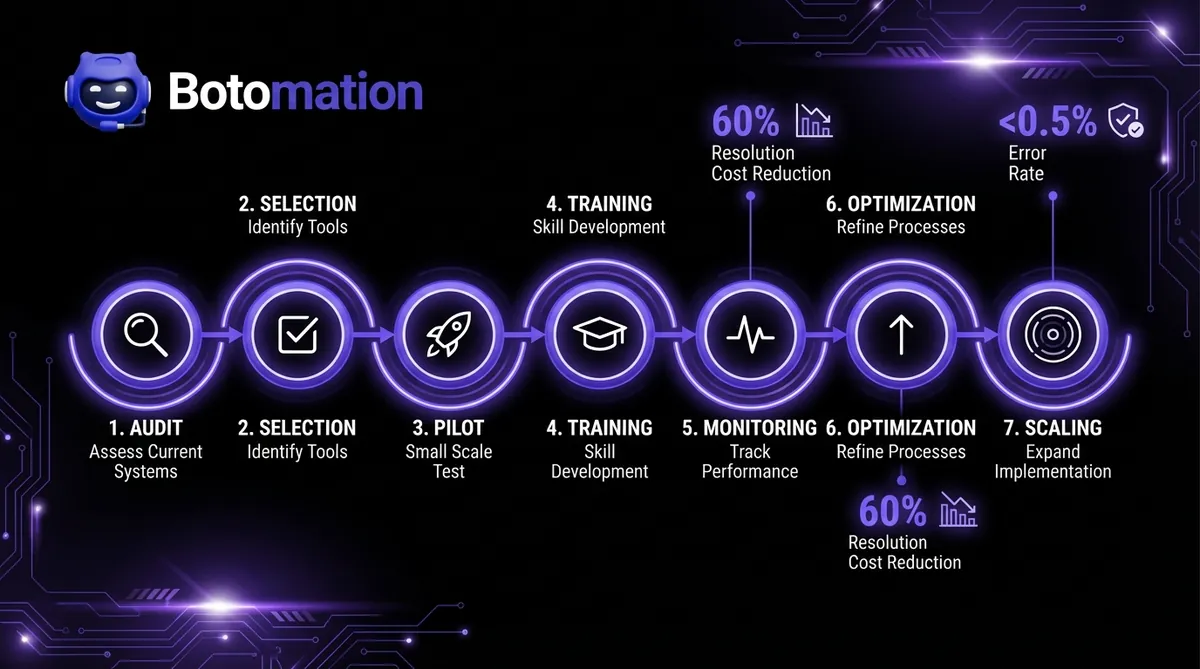
How to Scale Business Operations without Hiring More Staff in 2026
Scale business operations without hiring more staff using AI agents and SaaS automation. Boost efficiency and build a high-speed revenue engine.
7 Steps to Scale Business Operations with RPA and AI 2026
Learn how WhatsApp AI slashes support costs for e-commerce & SaaS. Proven strategies to boost sales, recover carts, and scale 24/7 service.