Scale Business Operations with AI Automation - 2026 Guide
Feb 17, 2026
AI Automation
Business Growth
Operations
AI Automation
Business Growth
Operations
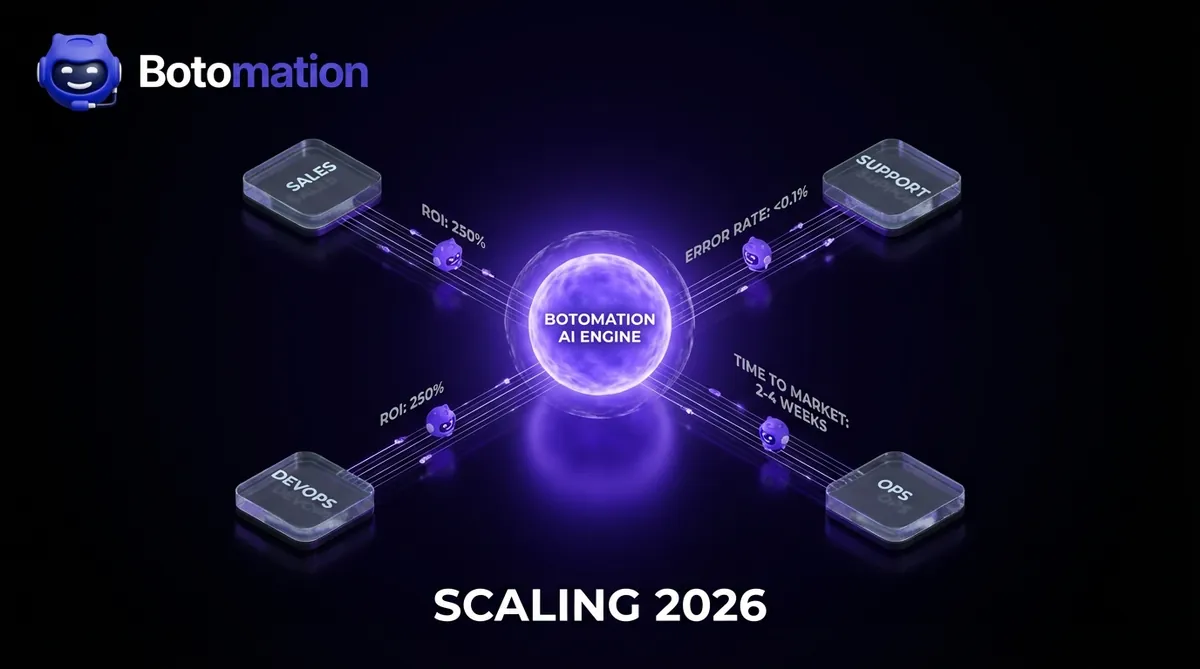
Growth in 2026 is no longer defined by how many people you can hire, but by how many processes you can orchestrate. For years, the standard playbook for scaling involved a linear relationship between revenue and headcount. If you wanted to double your output, you doubled your staff—a move that inevitably led to bloated overhead, management complexity, and cultural dilution. Today, that model is obsolete. We have entered an era where operational efficiency is driven by intelligent agents that work alongside human talent to eliminate the friction of traditional business growth.
The current state of scaling centers on the concept of the "autonomous enterprise." This isn't about replacing people with cold algorithms; it is about empowering your existing team to focus on high-level strategy while AI handles the heavy lifting of execution. McKinsey recently estimated that 60% of employees could save over 30% of their time by implementing workflow automation. When you extrapolate that across an entire organization, you aren't just saving hours; you are reclaiming the intellectual capacity of your best people.
Our team at Botomation sees this transition every day as we help companies scale SaaS operations without adding headcount. Founders and COOs are moving away from "AI curiosity" and toward "AI necessity." The tools available in late 2026, from agentic systems to multimodal generative models, allow businesses to scale business operations with AI automation at a fraction of the historical cost. By replacing legacy systems with custom web development and 24/7 AI agents, companies are achieving enterprise-grade speed without the enterprise-grade price tag.
Understanding AI Automation in Business Scaling
Scaling is often misunderstood as simply "doing more." In reality, scaling is the ability to handle an increased workload without a proportional increase in costs. Traditional automation focused on simple "if-this-then-that" logic, which worked for basic data entry but failed when faced with nuance or decision-making. AI automation in 2026 is fundamentally different because it incorporates reasoning. It understands context, learns from feedback, and adapts to changing variables in real-time.
Tools like OpenAI Sora 2 have moved beyond simple video generation into the realm of operational training and simulation. Adobe Firefly has evolved into a comprehensive asset engine that manages brand consistency across thousands of touchpoints automatically. Even GitHub Copilot has transitioned from a coding assistant to a full-scale development partner that can architect entire systems. These technologies allow a small team to perform like a global corporation by automating the creative and technical bottlenecks that used to take weeks to resolve.
The financial implications are staggering. MIT research indicates that workplace training focused on these advanced systems delivers a 250% return on investment. This ROI doesn't just come from speed; it comes from the drastic reduction in human error and the ability to operate 24/7 without fatigue. While a human team might struggle with data consistency during a midnight surge in orders, an AI-driven operational layer maintains perfect accuracy regardless of the volume.
| Scaling Metric | Traditional Manual Approach | AI-Automated Approach (Botomation) |
|---|---|---|
| Time to Market | 3-6 Months | 2-4 Weeks |
| Error Rate | 5-10% Human Margin | <0.1% System Precision |
| Operational Cost | Increases with Headcount | Decreases via Efficiency |
| Scalability Limit | Capped by Hiring Speed | Virtually Unlimited |
| Data Processing | Manual Analysis | Real-time AI Insights |
What is Agentic AI and How It Differs from Traditional Automation
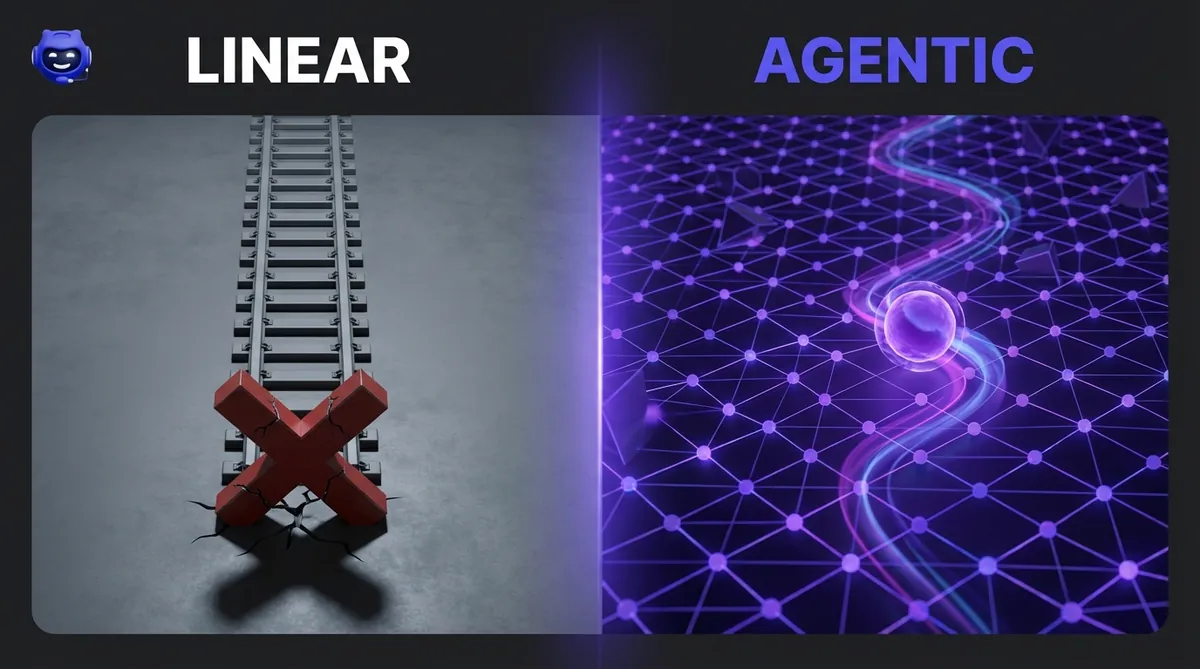
To truly scale business operations with AI automation, you must understand the shift from "tools" to agents and learn how to automate repetitive business tasks with AI agents. Traditional automation is like a train on a track; it can only go where the rails are laid. If there is a blockage or a fork in the road it wasn't programmed for, it stops. Agentic AI, such as the latest GitHub Copilot Agent Mode, functions more like a self-driving vehicle. You give it a destination, and it navigates the traffic, chooses the best route, and handles unexpected obstacles autonomously.
These agents make decisions within a set of predefined parameters. For instance, an AI agent managing an inventory system doesn't just flag a low stock level. It can analyze market trends, compare vendor pricing, check shipping lead times, and draft a purchase order for approval. Microsoft Windows 11 Copilot features now allow these agents to interact directly with your local files and cross-app workflows, creating a cohesive operational fabric that requires minimal human intervention.
The difference lies in the level of supervision required. Rule-based systems need constant maintenance as business conditions change. Agentic systems, however, are designed to be goal-oriented. When our experts at Botomation deploy these agents for clients, we aren't just setting up a script. We are building a digital workforce that understands the underlying business objectives and works proactively to achieve them.
The Business Case for AI-Driven Scaling
The decision to automate is often driven by the bottom line, and the data in 2026 is undeniable. When you compare the cost of an AI-driven operational layer to the cost of additional headcount, the savings are immediate, often allowing firms to reduce operational costs by 40%. A mid-level operations manager in a high-growth market might cost $120,000 annually when you include benefits and overhead. A custom AI agent ecosystem can often perform the repetitive aspects of that role for a fraction of that cost while working 168 hours a week instead of 40.
Statistics show that 83% of SMEs report significant cost reductions from outsourcing specific functions, but the new trend is "insourcing" those functions through AI. By keeping operations in-house but automated, you retain total control over your data and quality while enjoying the cost benefits of an external team. This approach also mitigates the risk of "knowledge silos" that occur when key employees leave. An automated process is documented in code and logic, making your business more resilient and easier to value during an exit or acquisition.
Beyond the direct cost savings, AI provides a level of risk mitigation that manual scaling cannot match. Human teams are prone to burnout during periods of rapid growth, leading to turnover and quality drops at the exact moment the company needs stability. AI systems do not experience burnout. They provide a consistent foundation that allows your human leadership to stay focused on the "big picture" without being dragged into the weeds of daily execution.
Leveraging Technology and Automation for Operational Growth
The first step in any scaling journey is identifying which processes are actually holding you back. Many leaders make the mistake of trying to automate everything at once, which leads to confusion and technical debt. Instead, you should look for "high-volume, low-complexity" tasks that consume the most human hours. This might include invoice processing, automated lead qualification, or basic customer inquiries. Once these are handled, you can move toward more complex "agentic" workflows.
In 2026, the landscape of tools has matured significantly. We are no longer dealing with experimental beta software. We have robust models like GPT-5 and Claude 4.5 that can process massive amounts of data with incredible nuance. Implementing these tools requires a strategic approach that goes beyond just buying a subscription. For many, this starts with a comprehensive guide to implementing AI in small to medium businesses, ensuring clean data pipelines and custom API integrations.
Best practices for AI adoption involve a "crawl, walk, run" methodology. Start by using AI to assist humans in their current roles. For example, use Gemini 2.5 Pro to draft responses or summarize long meetings. As the team becomes comfortable, transition to "human-in-the-loop" automation where the AI does the work and a human provides a final check. Finally, move to full automation for verified processes. This gradual shift ensures that your team remains engaged and that the quality of your output never wavers.
Top AI Automation Tools for 2026
The current software ecosystem is dominated by platforms that have moved from "generative" to "functional." GitHub Copilot now supports multiple models, allowing developers to switch between GPT-5 for creative logic and Claude Sonnet 4.5 for technical precision. This flexibility is crucial for building custom business logic that doesn't break under pressure. Meanwhile, Adobe Firefly Image Model 5 has revolutionized marketing operations, allowing for the instant generation of localized ad sets that used to take design teams days to produce.
Miro AI Innovation Workspace has also become a staple for operational scaling. It doesn't just provide a digital whiteboard; it acts as a strategic partner that can cluster ideas, identify project risks, and even generate initial project timelines based on a team's brainstorming session. These tools are no longer silos; they are interconnected via sophisticated APIs that allow data to flow seamlessly from a creative session in Miro to a development sprint in GitHub.
Pricing models have also shifted toward "usage-based" or "value-based" structures. This is a massive advantage for scaling businesses because it allows you to start small and pay only as you grow. Instead of a massive upfront investment in legacy enterprise software, you can build a lean, high-performance stack that scales its costs directly with its output. Our team at Botomation specializes in selecting and integrating these specific versions to ensure our clients are always on the leading edge of what is possible.
Implementing AI in Your Business Processes
Implementation is where most companies struggle, often because they lack a clear roadmap. The process must begin with a thorough audit of your current workflows to identify "friction points." These are the moments where a process slows down because it requires a manual handoff or a repetitive decision. Once identified, you can map out the logic required for an AI agent to handle that specific task.
Staff training is the most overlooked component of a successful rollout. You cannot simply drop a new AI agent into a department and expect it to work. You must educate your team on how to "prompt" the agent, how to verify its output, and how to report issues. Change management is a human challenge, not a technical one. By framing AI as a "force multiplier" rather than a replacement, you foster a culture of innovation where employees actively look for more things to automate.
Success metrics should be established before the first line of code is written. Are you looking to reduce response times, decrease error rates, or simply free up 20 hours a week for your lead designer? By tracking these KPIs, you can prove the ROI of your automation efforts and justify further investment. At Botomation, we focus on building "revenue engines" where every automated task contributes directly to the bottom line, whether through cost savings or increased conversion rates.
"The goal of automation is not to make the human obsolete, but to make the human more impactful by removing the mundane from their daily routine." — Senior Operational Consultant at Botomation.
Embracing Outsourcing and Strategic Partnerships for Scale
While AI can handle a vast majority of operational tasks, there is still a vital role for human expertise. The most successful companies in 2026 use a hybrid model that combines AI automation with strategic outsourcing. This allows them to maintain a lean core team while accessing specialized talent for high-level projects. The key is using AI as the "connective tissue" that manages these external relationships.
Agentic AI can now act as a project manager for outsourced teams. It can track deadlines, verify that deliverables meet brand guidelines, and even handle the initial "onboarding" of a new freelancer by providing them with the necessary context and files. This reduces the management overhead that typically makes outsourcing difficult to scale. When you have an AI agent handling the logistics, you can work with ten partners as easily as you could work with one.
Customer retention is another area where strategic partnerships and AI collide. Data shows that customer retention rates increase by 27% when businesses implement modern CRM systems that are tightly integrated with automated support. By partnering with an agency like Botomation, you aren't just getting a developer; you are getting a partner who understands how to weave these different threads—AI, human talent, and software—into a single, high-performance machine.
Outsourcing vs. Automation: When to Use Each
Deciding whether to automate a task or outsource it to a human comes down to two factors: complexity and empathy. Tasks that are highly repetitive and data-driven should almost always be automated. For example, reconciling accounts or generating weekly reports is a perfect job for an AI agent. However, tasks that require deep emotional intelligence, complex negotiation, or high-stakes creative direction are often better suited for human outsourcing.
A cost analysis often reveals that while AI has a higher "setup" cost, its "marginal" cost is nearly zero. Outsourcing has a lower setup cost but a consistent marginal cost for every hour worked. Therefore, if a task is going to be performed thousands of times, automation is the clear winner. If a task is a one-off project or requires a "human touch" to close a major deal, outsourcing is the more strategic choice.
The most effective modern strategy is the hybrid approach. Use AI to handle the 80% of a task that is "grunt work," and then hand off the final 20% to a specialized human partner. This ensures that you get the speed and cost-effectiveness of AI without losing the nuance and quality that only a human expert can provide. This is the exact model we use at Botomation to deliver enterprise-grade results at an accessible price point.
Managing Virtual Teams with AI Tools
Managing a remote or virtual team used to be a full-time job in itself. In 2026, you can automate project management and billing through AI-powered tools that have taken over the administrative burden. These systems can automatically prioritize tasks based on deadlines and team capacity, identify potential bottlenecks before they happen, and even suggest which team member is best suited for a specific assignment based on their past performance.
Communication platforms have also evolved. We no longer just use Slack for chatting; we use AI-integrated hubs that can summarize long threads, track action items, and provide real-time translations for global teams. This levels the playing field, allowing a company in New York to work seamlessly with talent in Tokyo or Berlin without language or time zone barriers.
Performance tracking has become more objective and less intrusive. Instead of "monitoring" employees, AI tools analyze the flow of work to identify where the system is failing the person. If a developer is consistently stuck on a certain type of task, the AI can suggest training or provide a "Copilot" to help them through it. This creates a culture of support rather than a culture of surveillance, which is essential for maintaining morale in a remote environment.
Implementing Self-Service Tools and Customer Automation
One of the biggest drains on operational resources is customer support. As a business scales, the volume of inquiries can quickly overwhelm a human team, leading to slow response times and frustrated customers. The solution in 2026 is a robust "self-service" ecosystem powered by AI. By implementing an AI chatbot for e-commerce customer support, businesses can provide intelligent portals that actually solve problems for the user.
Samsung Galaxy AI has introduced features that businesses are now adopting at scale, such as "Chat Assist" and "Note Assist." These aren't just for individual use; they represent a shift in how we interact with information. Businesses can now offer "Transcript Assist" for their support calls, allowing customers to get a written summary of their solution instantly. These features reduce the need for follow-up calls and empower the customer to help themselves.
By automating the "first touch" of customer service, you ensure that your human agents are only dealing with the most complex and high-value issues. This not only reduces costs but also improves the job satisfaction of your support team, as they are no longer stuck answering the same five questions all day. The result is a faster, leaner, and more responsive organization that can scale its customer base without a linear increase in support staff.
Building Customer Self-Service Portals
An effective self-service portal is more than just an FAQ page. It is a dynamic environment where an AI chatbot can access a customer's account, understand their history, and perform actions on their behalf. If a customer wants to change their subscription or track a package, they shouldn't have to talk to a person. An agentic AI can verify their identity and execute the change in seconds.
The key components of these portals include a natural language search interface, an interactive troubleshooting guide, and a seamless "escalation" path to a human if the AI cannot resolve the issue. Integrating tools like Chat Assist ensures that the tone of the interaction remains professional and helpful, mirroring the brand's voice perfectly. When done correctly, these portals become the preferred method of contact for customers because they are faster and more convenient than waiting on hold.
Measuring the success of these portals involves looking at "deflection rates"—the percentage of inquiries that were resolved without human intervention. However, you must also track customer satisfaction (CSAT) scores. Speed is useless if the customer feels unheard. At Botomation, we focus on building portals that are "human-centric," using custom code to ensure the AI feels like a helpful assistant rather than a robotic barrier.
AI-Powered Support Systems
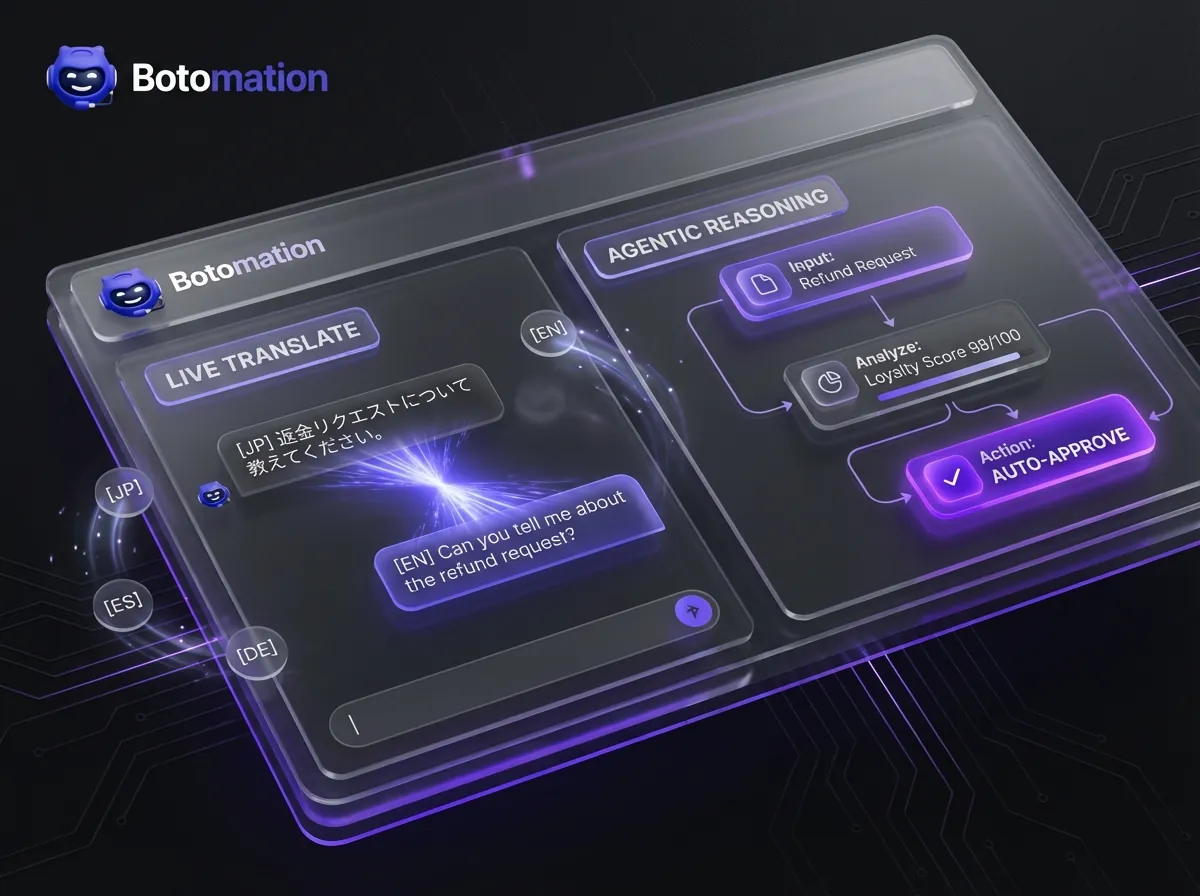
For global businesses, the "Live Translate" and "Interpreter" features of 2026 have changed the game. You no longer need to hire native speakers for every market you enter. An AI-powered support system can translate a customer's query in real-time and allow your agent to respond in their own language, with the AI handling the translation back to the customer. This allows for a truly global operation from day one.
Implementing agentic AI for complex issues involves giving the AI the authority to "reason" through a problem. For example, if a customer is complaining about a defective product, the AI can analyze the customer's loyalty, the cost of the item, and the shipping logistics to decide whether to offer an instant refund or a replacement. This happens in milliseconds, providing the customer with an immediate resolution that would have previously taken hours of internal emails.
Escalation protocols are the safety net of customer automation. The AI must be smart enough to know when it is out of its depth. If it detects frustration in a customer's tone or if the issue is highly technical, it should immediately transition the conversation to a human expert, providing that expert with a full summary of what has already been discussed. This "warm handoff" ensures that the customer never has to repeat themselves, maintaining a high-quality experience even during a transition.
| Feature | Impact on Operations | Business Value |
|---|---|---|
| Live Translate | Removes language barriers | Global market expansion |
| Chat Assist | Refines communication | Brand consistency |
| Transcript Assist | Automates documentation | Legal/Compliance safety |
| Note Assist | Summarizes complex data | Faster decision making |
Unlocking Employee Potential Through AI Reskilling
The greatest fear surrounding AI is the displacement of human workers. However, in a scaling business, AI is the key to unlocking latent potential. When you automate the "busy work," you don't just save money; you give your employees their careers back. A marketing manager who used to spend 20 hours a week on data entry can now spend that time on high-level campaign strategy and creative experimentation.
Reskilling is the process of teaching your team how to work with AI rather than against it. This involves training on specific tools, but more importantly, it involves a shift in mindset. Employees need to become "AI Orchestrators" who can manage a fleet of digital agents. This shift often leads to higher employee satisfaction, as the work becomes more engaging and less repetitive.
Productivity metrics post-automation often show a "J-curve." There is a slight dip as the team learns the new systems, followed by a massive, sustained increase in output. By creating new roles—such as "AI Operations Manager" or "Prompt Engineer"—you provide your top talent with a clear path for advancement in a modernized economy. Companies that embrace this reskilling see lower turnover and a much more agile workforce.
Reskilling Your Workforce for an AI-Powered Future
The first step in reskilling is identifying the skills gaps created by your new operational model. Do your project managers know how to use AI to forecast timelines? Do your writers know how to use LLMs to conduct deep research? Once you identify these gaps, you can implement targeted training programs. These shouldn't be boring seminars; they should be hands-on workshops where employees build their own mini-automations.
The ROI of these programs is significant. Not only do you get a more capable team, but you also avoid the massive costs associated with hiring new talent from the outside. In 2026, "AI fluency" is the most valuable skill an employee can have. By providing this training, you are increasing the "market value" of your employees, which, counter-intuitively, often leads to higher loyalty because they feel the company is invested in their future.
Career advancement in an AI-automated environment looks different. It’s less about climbing a ladder of "tasks" and more about expanding a "sphere of influence." An entry-level employee who masters AI automation can quickly become a critical strategic asset. At Botomation, we encourage our clients to view AI as a talent-retention tool. When people feel like they are working with the best technology in the world, they are much less likely to look for the exit.
Retaining Top Talent Through AI Transformation
Burnout is the silent killer of scaling businesses. When a company grows quickly, the workload often grows faster than the team can handle. AI automation acts as a pressure-release valve. By automating the most draining tasks, you keep your team in the "flow state" where they are challenged but not overwhelmed. This is the key to retaining the "A-players" who are essential for long-term success.
Communicating the benefits of AI is crucial. If the team thinks the AI is there to replace them, they will resist it. If they see that the AI is there to take the tasks they hate off their plate, they will embrace it. Transparency is the best policy. Share the vision of how the company will look after the transformation and explain exactly how each person's role will evolve for the better.
Measuring employee satisfaction during this transition is just as important as measuring revenue. Use anonymous surveys to gauge how the team feels about the new tools. Are they saving time? Is their work more interesting? By listening to this feedback and adjusting your implementation accordingly, you build a culture of trust. A team that feels supported by technology is a team that will drive your business forward for years to come.
Identifying and Avoiding Common Scaling Pitfalls
Scaling with AI is not without its dangers. The most common mistake is "over-automation"—trying to force a complex, human process into a rigid digital box. This often leads to a "broken" customer experience and internal chaos. You must remember that AI is a tool, not a cure-all. If a process is fundamentally flawed, automating it will only make it fail faster.
Security and compliance are also major considerations in 2026. As you integrate more AI agents into your operations, you are creating more "surface area" for potential data leaks. It is essential to work with experts who understand how to build secure, private AI environments. You cannot simply feed your proprietary business data into a public model without safeguards. This is one of the primary reasons why partnering with a specialized agency like Botomation is superior to a "DIY" approach.
Finally, you must avoid the "set it and forget it" mentality. AI models require ongoing monitoring and "tuning." Language models can drift, APIs can change, and business goals can shift. A successful scaling strategy includes a plan for continuous improvement, where the systems are regularly reviewed and updated to ensure they are still delivering maximum value.
Technical Implementation Pitfalls
One of the most frequent technical errors is insufficient testing. AI agents can behave unpredictably when faced with "edge cases" that weren't in the training data. Before deploying an agent to a live environment, it must be put through a rigorous "sandbox" phase where it is tested against every possible scenario. This prevents costly errors that can damage your brand's reputation.
Data quality is the fuel for AI. If your internal data is messy, inconsistent, or outdated, your AI will produce poor results. "Garbage in, garbage out" has never been more true. Before you can scale business operations with AI automation, you must first clean and organize your data. This often involves building custom data pipelines that ensure the AI always has access to the "single source of truth."
Integration challenges are another hurdle. Many businesses end up with a "Frankenstein" stack of different AI tools that don't talk to each other. This creates new silos and manual workarounds that defeat the purpose of automation. A professional implementation focuses on "interoperability," ensuring that your CRM, your project management tool, and your AI agents are all part of a single, cohesive ecosystem.
Organizational Scaling Challenges
The biggest obstacle to scaling is often not technical, but cultural. If the leadership team is not fully committed to the AI transformation, the rest of the organization will follow suit. AI adoption must be driven from the top down, with clear goals and a unified vision. Resistance to change is a natural human reaction, but it can be overcome through education and early "wins" that demonstrate the value of the new system.
Underestimating the training requirement is another common pitfall. You cannot assume that because someone uses ChatGPT at home, they know how to manage an enterprise AI agent. Training must be ongoing and specific to your business's workflows. This is not a one-time event; it is a continuous process of learning and adaptation as the technology evolves.
Finally, there is the risk of losing the "human touch." As you automate more of your operations, you must be intentional about where you keep humans involved. Scaling should never come at the expense of the relationships that built your business in the first place. The most successful automated companies are those that use the time they save to dive deeper into human connection, not move further away from it.
Frequently Asked Questions
Will AI automation replace my existing employees?
No. In our experience, AI is most effective as a "force multiplier." It handles the repetitive, low-value tasks that lead to burnout, allowing your team to focus on high-value strategy and creative work. Scaling with AI is about increasing your output without needing to hire a new person for every incremental gain in revenue.
How long does it take to see a return on investment from AI automation?
While initial setup can take a few weeks, most businesses start seeing time-savings immediately. Financial ROI typically manifests within the first 3 to 6 months as operational costs stabilize while revenue continues to climb. The MIT-reported 250% ROI is a realistic target for businesses that implement a comprehensive strategy.
Is my business data safe when using AI agents?
Data security is a top priority. When you partner with Botomation, we don't use public, "open" models for your sensitive data. We build secure, enterprise-grade environments using private API instances and custom code to ensure your proprietary information stays within your organization and is never used to train public models.
Do I need a large technical team to manage these AI systems?
Not if you partner with the right agency. Botomation acts as your external technical department. We build, integrate, and maintain the systems for you. Our goal is to provide you with a "turnkey" revenue engine that your existing operations team can manage with minimal training.
What is the first step to scaling business operations with AI automation?
The first step is a "friction audit." Identify the one or two processes that are currently causing the most stress or taking up the most time for your team. By starting with a specific, high-impact problem, you can prove the concept and build momentum for a wider rollout across the company.
Scaling a business in 2026 is a choice between two paths. You can continue with the "Old Way"—hiring more people, dealing with more management overhead, and watching your margins shrink as you grow. Or, you can embrace the "New Way"—building a lean, high-performance organization powered by custom code and intelligent AI agents. This isn't just about technology; it's about the freedom to grow your business without the traditional limits.
At Botomation, we specialize in making this transition seamless. We don't just sell software; we provide the expertise and the custom-built engines that turn growth from a challenge into a certainty. We bridge the gap between complex AI and practical business results, replacing slow legacy systems with lightning-fast solutions that work for you 24/7. The future of your operations is autonomous, and the time to build that future is now.
Ready to automate your growth? Book a free consultation call below.
Growth in 2026 is no longer defined by how many people you can hire, but by how many processes you can orchestrate. For years, the standard playbook for scaling involved a linear relationship between revenue and headcount. If you wanted to double your output, you doubled your staff—a move that inevitably led to bloated overhead, management complexity, and cultural dilution. Today, that model is obsolete. We have entered an era where operational efficiency is driven by intelligent agents that work alongside human talent to eliminate the friction of traditional business growth.
The current state of scaling centers on the concept of the "autonomous enterprise." This isn't about replacing people with cold algorithms; it is about empowering your existing team to focus on high-level strategy while AI handles the heavy lifting of execution. McKinsey recently estimated that 60% of employees could save over 30% of their time by implementing workflow automation. When you extrapolate that across an entire organization, you aren't just saving hours; you are reclaiming the intellectual capacity of your best people.
Our team at Botomation sees this transition every day as we help companies scale SaaS operations without adding headcount. Founders and COOs are moving away from "AI curiosity" and toward "AI necessity." The tools available in late 2026, from agentic systems to multimodal generative models, allow businesses to scale business operations with AI automation at a fraction of the historical cost. By replacing legacy systems with custom web development and 24/7 AI agents, companies are achieving enterprise-grade speed without the enterprise-grade price tag.
Understanding AI Automation in Business Scaling
Scaling is often misunderstood as simply "doing more." In reality, scaling is the ability to handle an increased workload without a proportional increase in costs. Traditional automation focused on simple "if-this-then-that" logic, which worked for basic data entry but failed when faced with nuance or decision-making. AI automation in 2026 is fundamentally different because it incorporates reasoning. It understands context, learns from feedback, and adapts to changing variables in real-time.
Tools like OpenAI Sora 2 have moved beyond simple video generation into the realm of operational training and simulation. Adobe Firefly has evolved into a comprehensive asset engine that manages brand consistency across thousands of touchpoints automatically. Even GitHub Copilot has transitioned from a coding assistant to a full-scale development partner that can architect entire systems. These technologies allow a small team to perform like a global corporation by automating the creative and technical bottlenecks that used to take weeks to resolve.
The financial implications are staggering. MIT research indicates that workplace training focused on these advanced systems delivers a 250% return on investment. This ROI doesn't just come from speed; it comes from the drastic reduction in human error and the ability to operate 24/7 without fatigue. While a human team might struggle with data consistency during a midnight surge in orders, an AI-driven operational layer maintains perfect accuracy regardless of the volume.
| Scaling Metric | Traditional Manual Approach | AI-Automated Approach (Botomation) |
|---|---|---|
| Time to Market | 3-6 Months | 2-4 Weeks |
| Error Rate | 5-10% Human Margin | <0.1% System Precision |
| Operational Cost | Increases with Headcount | Decreases via Efficiency |
| Scalability Limit | Capped by Hiring Speed | Virtually Unlimited |
| Data Processing | Manual Analysis | Real-time AI Insights |
What is Agentic AI and How It Differs from Traditional Automation
To truly scale business operations with AI automation, you must understand the shift from "tools" to agents and learn how to automate repetitive business tasks with AI agents. Traditional automation is like a train on a track; it can only go where the rails are laid. If there is a blockage or a fork in the road it wasn't programmed for, it stops. Agentic AI, such as the latest GitHub Copilot Agent Mode, functions more like a self-driving vehicle. You give it a destination, and it navigates the traffic, chooses the best route, and handles unexpected obstacles autonomously.
These agents make decisions within a set of predefined parameters. For instance, an AI agent managing an inventory system doesn't just flag a low stock level. It can analyze market trends, compare vendor pricing, check shipping lead times, and draft a purchase order for approval. Microsoft Windows 11 Copilot features now allow these agents to interact directly with your local files and cross-app workflows, creating a cohesive operational fabric that requires minimal human intervention.
The difference lies in the level of supervision required. Rule-based systems need constant maintenance as business conditions change. Agentic systems, however, are designed to be goal-oriented. When our experts at Botomation deploy these agents for clients, we aren't just setting up a script. We are building a digital workforce that understands the underlying business objectives and works proactively to achieve them.
The Business Case for AI-Driven Scaling
The decision to automate is often driven by the bottom line, and the data in 2026 is undeniable. When you compare the cost of an AI-driven operational layer to the cost of additional headcount, the savings are immediate, often allowing firms to reduce operational costs by 40%. A mid-level operations manager in a high-growth market might cost $120,000 annually when you include benefits and overhead. A custom AI agent ecosystem can often perform the repetitive aspects of that role for a fraction of that cost while working 168 hours a week instead of 40.
Statistics show that 83% of SMEs report significant cost reductions from outsourcing specific functions, but the new trend is "insourcing" those functions through AI. By keeping operations in-house but automated, you retain total control over your data and quality while enjoying the cost benefits of an external team. This approach also mitigates the risk of "knowledge silos" that occur when key employees leave. An automated process is documented in code and logic, making your business more resilient and easier to value during an exit or acquisition.
Beyond the direct cost savings, AI provides a level of risk mitigation that manual scaling cannot match. Human teams are prone to burnout during periods of rapid growth, leading to turnover and quality drops at the exact moment the company needs stability. AI systems do not experience burnout. They provide a consistent foundation that allows your human leadership to stay focused on the "big picture" without being dragged into the weeds of daily execution.
Leveraging Technology and Automation for Operational Growth
The first step in any scaling journey is identifying which processes are actually holding you back. Many leaders make the mistake of trying to automate everything at once, which leads to confusion and technical debt. Instead, you should look for "high-volume, low-complexity" tasks that consume the most human hours. This might include invoice processing, automated lead qualification, or basic customer inquiries. Once these are handled, you can move toward more complex "agentic" workflows.
In 2026, the landscape of tools has matured significantly. We are no longer dealing with experimental beta software. We have robust models like GPT-5 and Claude 4.5 that can process massive amounts of data with incredible nuance. Implementing these tools requires a strategic approach that goes beyond just buying a subscription. For many, this starts with a comprehensive guide to implementing AI in small to medium businesses, ensuring clean data pipelines and custom API integrations.
Best practices for AI adoption involve a "crawl, walk, run" methodology. Start by using AI to assist humans in their current roles. For example, use Gemini 2.5 Pro to draft responses or summarize long meetings. As the team becomes comfortable, transition to "human-in-the-loop" automation where the AI does the work and a human provides a final check. Finally, move to full automation for verified processes. This gradual shift ensures that your team remains engaged and that the quality of your output never wavers.
Top AI Automation Tools for 2026
The current software ecosystem is dominated by platforms that have moved from "generative" to "functional." GitHub Copilot now supports multiple models, allowing developers to switch between GPT-5 for creative logic and Claude Sonnet 4.5 for technical precision. This flexibility is crucial for building custom business logic that doesn't break under pressure. Meanwhile, Adobe Firefly Image Model 5 has revolutionized marketing operations, allowing for the instant generation of localized ad sets that used to take design teams days to produce.
Miro AI Innovation Workspace has also become a staple for operational scaling. It doesn't just provide a digital whiteboard; it acts as a strategic partner that can cluster ideas, identify project risks, and even generate initial project timelines based on a team's brainstorming session. These tools are no longer silos; they are interconnected via sophisticated APIs that allow data to flow seamlessly from a creative session in Miro to a development sprint in GitHub.
Pricing models have also shifted toward "usage-based" or "value-based" structures. This is a massive advantage for scaling businesses because it allows you to start small and pay only as you grow. Instead of a massive upfront investment in legacy enterprise software, you can build a lean, high-performance stack that scales its costs directly with its output. Our team at Botomation specializes in selecting and integrating these specific versions to ensure our clients are always on the leading edge of what is possible.
Implementing AI in Your Business Processes
Implementation is where most companies struggle, often because they lack a clear roadmap. The process must begin with a thorough audit of your current workflows to identify "friction points." These are the moments where a process slows down because it requires a manual handoff or a repetitive decision. Once identified, you can map out the logic required for an AI agent to handle that specific task.
Staff training is the most overlooked component of a successful rollout. You cannot simply drop a new AI agent into a department and expect it to work. You must educate your team on how to "prompt" the agent, how to verify its output, and how to report issues. Change management is a human challenge, not a technical one. By framing AI as a "force multiplier" rather than a replacement, you foster a culture of innovation where employees actively look for more things to automate.
Success metrics should be established before the first line of code is written. Are you looking to reduce response times, decrease error rates, or simply free up 20 hours a week for your lead designer? By tracking these KPIs, you can prove the ROI of your automation efforts and justify further investment. At Botomation, we focus on building "revenue engines" where every automated task contributes directly to the bottom line, whether through cost savings or increased conversion rates.
"The goal of automation is not to make the human obsolete, but to make the human more impactful by removing the mundane from their daily routine." — Senior Operational Consultant at Botomation.
Embracing Outsourcing and Strategic Partnerships for Scale
While AI can handle a vast majority of operational tasks, there is still a vital role for human expertise. The most successful companies in 2026 use a hybrid model that combines AI automation with strategic outsourcing. This allows them to maintain a lean core team while accessing specialized talent for high-level projects. The key is using AI as the "connective tissue" that manages these external relationships.
Agentic AI can now act as a project manager for outsourced teams. It can track deadlines, verify that deliverables meet brand guidelines, and even handle the initial "onboarding" of a new freelancer by providing them with the necessary context and files. This reduces the management overhead that typically makes outsourcing difficult to scale. When you have an AI agent handling the logistics, you can work with ten partners as easily as you could work with one.
Customer retention is another area where strategic partnerships and AI collide. Data shows that customer retention rates increase by 27% when businesses implement modern CRM systems that are tightly integrated with automated support. By partnering with an agency like Botomation, you aren't just getting a developer; you are getting a partner who understands how to weave these different threads—AI, human talent, and software—into a single, high-performance machine.
Outsourcing vs. Automation: When to Use Each
Deciding whether to automate a task or outsource it to a human comes down to two factors: complexity and empathy. Tasks that are highly repetitive and data-driven should almost always be automated. For example, reconciling accounts or generating weekly reports is a perfect job for an AI agent. However, tasks that require deep emotional intelligence, complex negotiation, or high-stakes creative direction are often better suited for human outsourcing.
A cost analysis often reveals that while AI has a higher "setup" cost, its "marginal" cost is nearly zero. Outsourcing has a lower setup cost but a consistent marginal cost for every hour worked. Therefore, if a task is going to be performed thousands of times, automation is the clear winner. If a task is a one-off project or requires a "human touch" to close a major deal, outsourcing is the more strategic choice.
The most effective modern strategy is the hybrid approach. Use AI to handle the 80% of a task that is "grunt work," and then hand off the final 20% to a specialized human partner. This ensures that you get the speed and cost-effectiveness of AI without losing the nuance and quality that only a human expert can provide. This is the exact model we use at Botomation to deliver enterprise-grade results at an accessible price point.
Managing Virtual Teams with AI Tools
Managing a remote or virtual team used to be a full-time job in itself. In 2026, you can automate project management and billing through AI-powered tools that have taken over the administrative burden. These systems can automatically prioritize tasks based on deadlines and team capacity, identify potential bottlenecks before they happen, and even suggest which team member is best suited for a specific assignment based on their past performance.
Communication platforms have also evolved. We no longer just use Slack for chatting; we use AI-integrated hubs that can summarize long threads, track action items, and provide real-time translations for global teams. This levels the playing field, allowing a company in New York to work seamlessly with talent in Tokyo or Berlin without language or time zone barriers.
Performance tracking has become more objective and less intrusive. Instead of "monitoring" employees, AI tools analyze the flow of work to identify where the system is failing the person. If a developer is consistently stuck on a certain type of task, the AI can suggest training or provide a "Copilot" to help them through it. This creates a culture of support rather than a culture of surveillance, which is essential for maintaining morale in a remote environment.
Implementing Self-Service Tools and Customer Automation
One of the biggest drains on operational resources is customer support. As a business scales, the volume of inquiries can quickly overwhelm a human team, leading to slow response times and frustrated customers. The solution in 2026 is a robust "self-service" ecosystem powered by AI. By implementing an AI chatbot for e-commerce customer support, businesses can provide intelligent portals that actually solve problems for the user.
Samsung Galaxy AI has introduced features that businesses are now adopting at scale, such as "Chat Assist" and "Note Assist." These aren't just for individual use; they represent a shift in how we interact with information. Businesses can now offer "Transcript Assist" for their support calls, allowing customers to get a written summary of their solution instantly. These features reduce the need for follow-up calls and empower the customer to help themselves.
By automating the "first touch" of customer service, you ensure that your human agents are only dealing with the most complex and high-value issues. This not only reduces costs but also improves the job satisfaction of your support team, as they are no longer stuck answering the same five questions all day. The result is a faster, leaner, and more responsive organization that can scale its customer base without a linear increase in support staff.
Building Customer Self-Service Portals
An effective self-service portal is more than just an FAQ page. It is a dynamic environment where an AI chatbot can access a customer's account, understand their history, and perform actions on their behalf. If a customer wants to change their subscription or track a package, they shouldn't have to talk to a person. An agentic AI can verify their identity and execute the change in seconds.
The key components of these portals include a natural language search interface, an interactive troubleshooting guide, and a seamless "escalation" path to a human if the AI cannot resolve the issue. Integrating tools like Chat Assist ensures that the tone of the interaction remains professional and helpful, mirroring the brand's voice perfectly. When done correctly, these portals become the preferred method of contact for customers because they are faster and more convenient than waiting on hold.
Measuring the success of these portals involves looking at "deflection rates"—the percentage of inquiries that were resolved without human intervention. However, you must also track customer satisfaction (CSAT) scores. Speed is useless if the customer feels unheard. At Botomation, we focus on building portals that are "human-centric," using custom code to ensure the AI feels like a helpful assistant rather than a robotic barrier.
AI-Powered Support Systems
For global businesses, the "Live Translate" and "Interpreter" features of 2026 have changed the game. You no longer need to hire native speakers for every market you enter. An AI-powered support system can translate a customer's query in real-time and allow your agent to respond in their own language, with the AI handling the translation back to the customer. This allows for a truly global operation from day one.
Implementing agentic AI for complex issues involves giving the AI the authority to "reason" through a problem. For example, if a customer is complaining about a defective product, the AI can analyze the customer's loyalty, the cost of the item, and the shipping logistics to decide whether to offer an instant refund or a replacement. This happens in milliseconds, providing the customer with an immediate resolution that would have previously taken hours of internal emails.
Escalation protocols are the safety net of customer automation. The AI must be smart enough to know when it is out of its depth. If it detects frustration in a customer's tone or if the issue is highly technical, it should immediately transition the conversation to a human expert, providing that expert with a full summary of what has already been discussed. This "warm handoff" ensures that the customer never has to repeat themselves, maintaining a high-quality experience even during a transition.
| Feature | Impact on Operations | Business Value |
|---|---|---|
| Live Translate | Removes language barriers | Global market expansion |
| Chat Assist | Refines communication | Brand consistency |
| Transcript Assist | Automates documentation | Legal/Compliance safety |
| Note Assist | Summarizes complex data | Faster decision making |
Unlocking Employee Potential Through AI Reskilling
The greatest fear surrounding AI is the displacement of human workers. However, in a scaling business, AI is the key to unlocking latent potential. When you automate the "busy work," you don't just save money; you give your employees their careers back. A marketing manager who used to spend 20 hours a week on data entry can now spend that time on high-level campaign strategy and creative experimentation.
Reskilling is the process of teaching your team how to work with AI rather than against it. This involves training on specific tools, but more importantly, it involves a shift in mindset. Employees need to become "AI Orchestrators" who can manage a fleet of digital agents. This shift often leads to higher employee satisfaction, as the work becomes more engaging and less repetitive.
Productivity metrics post-automation often show a "J-curve." There is a slight dip as the team learns the new systems, followed by a massive, sustained increase in output. By creating new roles—such as "AI Operations Manager" or "Prompt Engineer"—you provide your top talent with a clear path for advancement in a modernized economy. Companies that embrace this reskilling see lower turnover and a much more agile workforce.
Reskilling Your Workforce for an AI-Powered Future
The first step in reskilling is identifying the skills gaps created by your new operational model. Do your project managers know how to use AI to forecast timelines? Do your writers know how to use LLMs to conduct deep research? Once you identify these gaps, you can implement targeted training programs. These shouldn't be boring seminars; they should be hands-on workshops where employees build their own mini-automations.
The ROI of these programs is significant. Not only do you get a more capable team, but you also avoid the massive costs associated with hiring new talent from the outside. In 2026, "AI fluency" is the most valuable skill an employee can have. By providing this training, you are increasing the "market value" of your employees, which, counter-intuitively, often leads to higher loyalty because they feel the company is invested in their future.
Career advancement in an AI-automated environment looks different. It’s less about climbing a ladder of "tasks" and more about expanding a "sphere of influence." An entry-level employee who masters AI automation can quickly become a critical strategic asset. At Botomation, we encourage our clients to view AI as a talent-retention tool. When people feel like they are working with the best technology in the world, they are much less likely to look for the exit.
Retaining Top Talent Through AI Transformation
Burnout is the silent killer of scaling businesses. When a company grows quickly, the workload often grows faster than the team can handle. AI automation acts as a pressure-release valve. By automating the most draining tasks, you keep your team in the "flow state" where they are challenged but not overwhelmed. This is the key to retaining the "A-players" who are essential for long-term success.
Communicating the benefits of AI is crucial. If the team thinks the AI is there to replace them, they will resist it. If they see that the AI is there to take the tasks they hate off their plate, they will embrace it. Transparency is the best policy. Share the vision of how the company will look after the transformation and explain exactly how each person's role will evolve for the better.
Measuring employee satisfaction during this transition is just as important as measuring revenue. Use anonymous surveys to gauge how the team feels about the new tools. Are they saving time? Is their work more interesting? By listening to this feedback and adjusting your implementation accordingly, you build a culture of trust. A team that feels supported by technology is a team that will drive your business forward for years to come.
Identifying and Avoiding Common Scaling Pitfalls
Scaling with AI is not without its dangers. The most common mistake is "over-automation"—trying to force a complex, human process into a rigid digital box. This often leads to a "broken" customer experience and internal chaos. You must remember that AI is a tool, not a cure-all. If a process is fundamentally flawed, automating it will only make it fail faster.
Security and compliance are also major considerations in 2026. As you integrate more AI agents into your operations, you are creating more "surface area" for potential data leaks. It is essential to work with experts who understand how to build secure, private AI environments. You cannot simply feed your proprietary business data into a public model without safeguards. This is one of the primary reasons why partnering with a specialized agency like Botomation is superior to a "DIY" approach.
Finally, you must avoid the "set it and forget it" mentality. AI models require ongoing monitoring and "tuning." Language models can drift, APIs can change, and business goals can shift. A successful scaling strategy includes a plan for continuous improvement, where the systems are regularly reviewed and updated to ensure they are still delivering maximum value.
Technical Implementation Pitfalls
One of the most frequent technical errors is insufficient testing. AI agents can behave unpredictably when faced with "edge cases" that weren't in the training data. Before deploying an agent to a live environment, it must be put through a rigorous "sandbox" phase where it is tested against every possible scenario. This prevents costly errors that can damage your brand's reputation.
Data quality is the fuel for AI. If your internal data is messy, inconsistent, or outdated, your AI will produce poor results. "Garbage in, garbage out" has never been more true. Before you can scale business operations with AI automation, you must first clean and organize your data. This often involves building custom data pipelines that ensure the AI always has access to the "single source of truth."
Integration challenges are another hurdle. Many businesses end up with a "Frankenstein" stack of different AI tools that don't talk to each other. This creates new silos and manual workarounds that defeat the purpose of automation. A professional implementation focuses on "interoperability," ensuring that your CRM, your project management tool, and your AI agents are all part of a single, cohesive ecosystem.
Organizational Scaling Challenges
The biggest obstacle to scaling is often not technical, but cultural. If the leadership team is not fully committed to the AI transformation, the rest of the organization will follow suit. AI adoption must be driven from the top down, with clear goals and a unified vision. Resistance to change is a natural human reaction, but it can be overcome through education and early "wins" that demonstrate the value of the new system.
Underestimating the training requirement is another common pitfall. You cannot assume that because someone uses ChatGPT at home, they know how to manage an enterprise AI agent. Training must be ongoing and specific to your business's workflows. This is not a one-time event; it is a continuous process of learning and adaptation as the technology evolves.
Finally, there is the risk of losing the "human touch." As you automate more of your operations, you must be intentional about where you keep humans involved. Scaling should never come at the expense of the relationships that built your business in the first place. The most successful automated companies are those that use the time they save to dive deeper into human connection, not move further away from it.
Frequently Asked Questions
Will AI automation replace my existing employees?
No. In our experience, AI is most effective as a "force multiplier." It handles the repetitive, low-value tasks that lead to burnout, allowing your team to focus on high-value strategy and creative work. Scaling with AI is about increasing your output without needing to hire a new person for every incremental gain in revenue.
How long does it take to see a return on investment from AI automation?
While initial setup can take a few weeks, most businesses start seeing time-savings immediately. Financial ROI typically manifests within the first 3 to 6 months as operational costs stabilize while revenue continues to climb. The MIT-reported 250% ROI is a realistic target for businesses that implement a comprehensive strategy.
Is my business data safe when using AI agents?
Data security is a top priority. When you partner with Botomation, we don't use public, "open" models for your sensitive data. We build secure, enterprise-grade environments using private API instances and custom code to ensure your proprietary information stays within your organization and is never used to train public models.
Do I need a large technical team to manage these AI systems?
Not if you partner with the right agency. Botomation acts as your external technical department. We build, integrate, and maintain the systems for you. Our goal is to provide you with a "turnkey" revenue engine that your existing operations team can manage with minimal training.
What is the first step to scaling business operations with AI automation?
The first step is a "friction audit." Identify the one or two processes that are currently causing the most stress or taking up the most time for your team. By starting with a specific, high-impact problem, you can prove the concept and build momentum for a wider rollout across the company.
Scaling a business in 2026 is a choice between two paths. You can continue with the "Old Way"—hiring more people, dealing with more management overhead, and watching your margins shrink as you grow. Or, you can embrace the "New Way"—building a lean, high-performance organization powered by custom code and intelligent AI agents. This isn't just about technology; it's about the freedom to grow your business without the traditional limits.
At Botomation, we specialize in making this transition seamless. We don't just sell software; we provide the expertise and the custom-built engines that turn growth from a challenge into a certainty. We bridge the gap between complex AI and practical business results, replacing slow legacy systems with lightning-fast solutions that work for you 24/7. The future of your operations is autonomous, and the time to build that future is now.
Ready to automate your growth? Book a free consultation call below.
Get Started
Book a FREE Consultation Right NOW!
Schedule a Call with Our Team To Make Your Business More Efficient with AI Instantly.
Read More
Scale Business Operations with AI Automation - 2026 Guide
Scale business operations with AI automation in 2026. Leverage agentic AI, Botomation tools, and workflow automation for peak operational efficiency.
Website Speed Conversion Optimization 2026 Growth Guide
Learn how WhatsApp AI slashes support costs for e-commerce & SaaS. Proven strategies to boost sales, recover carts, and scale 24/7 service.