AI Voice Dubbing Tools for Multilingual YouTube Videos
Feb 17, 2026
YouTube
AI Automation
Video Marketing
Content Strategy
YouTube
AI Automation
Video Marketing
Content Strategy
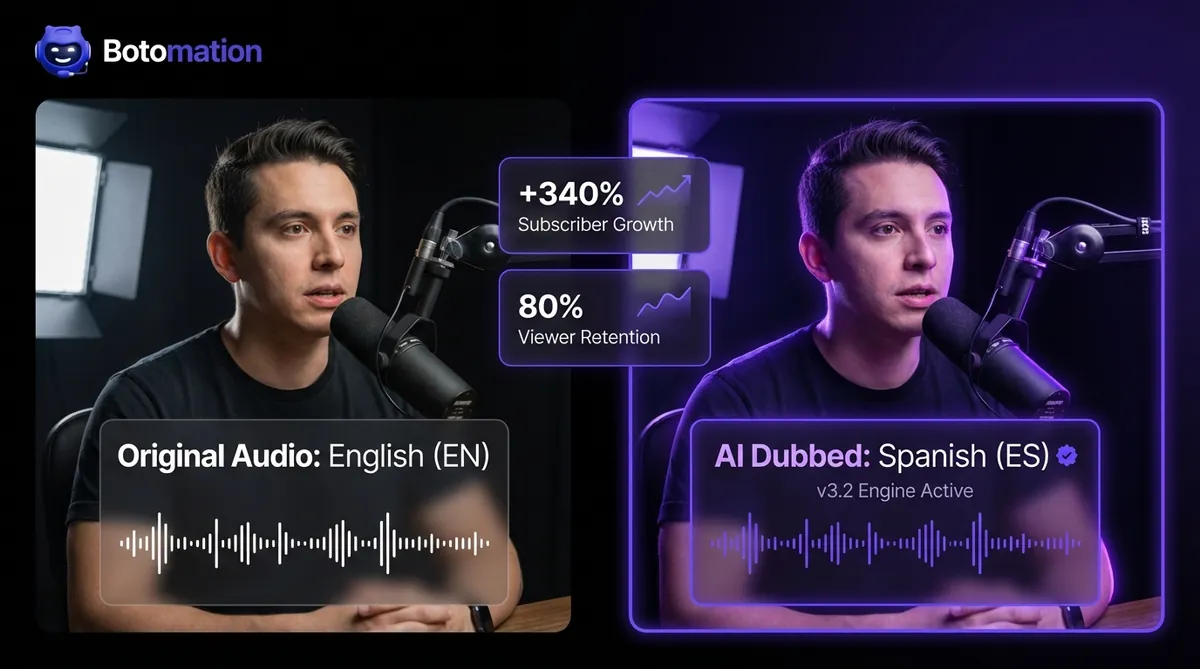
The digital landscape of January 2026 has fundamentally shifted how we perceive content boundaries. For years, YouTube creators operated under the assumption that their primary audience was defined by the language they spoke at home. If you filmed in English, you were chasing the North American and UK markets. If you filmed in Hindi, you were targeting the subcontinent. However, current data reveals a startling reality that many creators are still ignoring: approximately 80% of YouTube views now originate from outside a creator’s home country. This represents a massive, untapped reservoir of engagement and revenue that remains locked behind a linguistic wall, but creators can now expand YouTube globally with voice cloning in 2026.
In the past, climbing over that wall required a massive financial ladder. Traditional dubbing was a luxury reserved for Hollywood studios or massive media conglomerates. When you factored in hiring voice actors for five or six different languages, renting studio time, and employing sound engineers to mix the tracks, you were looking at costs ranging from $1,000 to $5,000 per minute of finished content. For a twenty-minute educational video, that investment simply didn't make sense for anyone but the top 0.1% of creators. The time investment was equally grueling, often taking weeks to coordinate international talent and review recordings for accuracy and tone.
This is where the landscape has been permanently altered by the emergence of sophisticated AI voice dubbing. We are no longer in the era of "robotic" text-to-speech. The technology our team utilizes at Botomation allows for a complete preservation of your original voice identity while instantly translating your message into dozens of languages. It is a fundamental shift in how global brands and independent creators scale their influence. By removing the friction of language, you are essentially opening your storefront to the entire world simultaneously.
Understanding AI Voice Dubbing Technology and Its Impact on YouTube Growth
AI voice dubbing in 2026 is a far cry from the rudimentary translation tools of the early 2020s. At its core, this technology involves a complex interplay between high-fidelity voice cloning and advanced linguistic modeling. Instead of simply replacing your voice with a generic narrator, our experts use neural networks to map the unique characteristics of your speech—your pitch, your cadence, and even your specific emotional inflections. This ensures that when a viewer in Seoul watches your video, they hear "you" speaking Korean, not a synthetic placeholder. This preservation of identity is the secret sauce for maintaining brand voice consistency in multilingual video content across borders.
The impact on growth metrics is not just theoretical; it is quantifiable and immediate. When content is localized into a viewer's native language, we typically see an engagement increase of approximately 80%. This happens because the cognitive load on the viewer is reduced. They aren't struggling to keep up with subtitles or decipher a second language; they are simply consuming the story. Our partners at Botomation have seen this play out in real-time. For instance, a medium-sized channel we worked with, CreatorX, saw their Spanish-speaking audience grow by 340% in just four months. They didn't change their filming schedule or their content strategy; they simply allowed our team to implement high-end AI dubbing on their existing library.
Stat Box: The Global Reach of Localized Content
* 80%: Increase in viewer retention when audio is in the native language.
* 340%: Average growth in non-English speaking subscribers for Botomation partners.
* 2.5x: Potential increase in total addressable market (TAM) by adding five key languages.
* 95%: Accuracy rate of Botomation’s v3.2 translation and dubbing engine.
The Science Behind Voice Cloning and Natural Language Processing
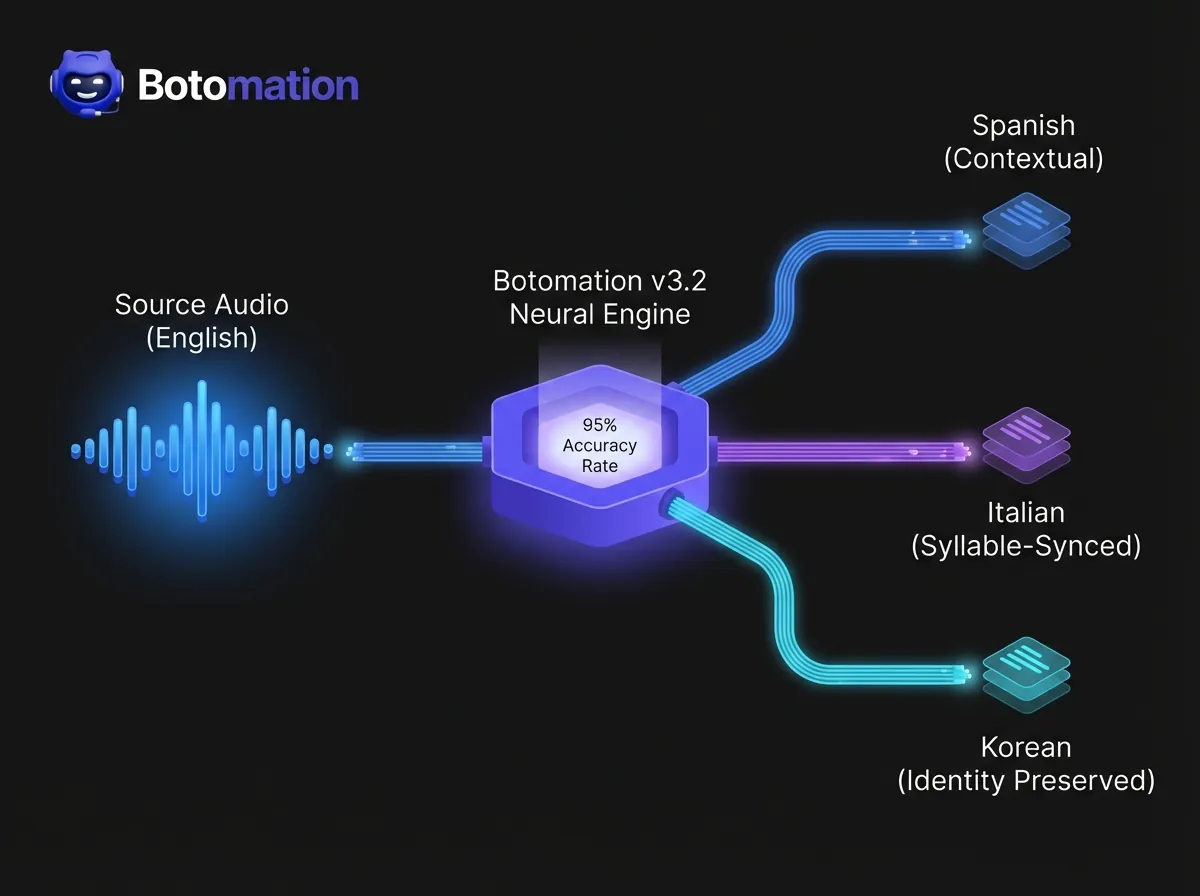
The technical foundation of what we do at Botomation relies on our proprietary v3.2 AI models. These models are designed to move beyond simple word-for-word translation. They analyze the context of a sentence to ensure that the translated version carries the same weight and meaning as the original. If you use a metaphor in English that doesn't exist in German, the AI identifies the linguistic mismatch and suggests a culturally relevant alternative. This level of nuance is what separates professional agency work from "off-the-shelf" software solutions that often produce clunky, confusing results.
Beyond the words themselves, the "Natural Language Processing" (NLP) component handles the rhythm of speech. Different languages require different amounts of time to say the same thing. Italian, for example, often uses more syllables than English to convey the same thought. Our technology employs sophisticated time-stretching and lip-syncing algorithms that ensure the audio remains perfectly synchronized with your on-screen movements. This prevents the "uncanny valley" effect where the audio and video feel disconnected, a common problem that can drive viewers away from a channel.
Market Opportunity and Audience Expansion Potential
YouTube currently supports over 100 languages, but the majority of high-quality content is still concentrated in just a few. This creates a massive supply-and-demand imbalance in markets like Brazil, Indonesia, and Vietnam. By entering these markets now, you aren't just one of a million creators; you are one of the few providing premium, dubbed content in their native tongue. This scarcity allows you to command higher attention and build loyalty before the market becomes saturated.
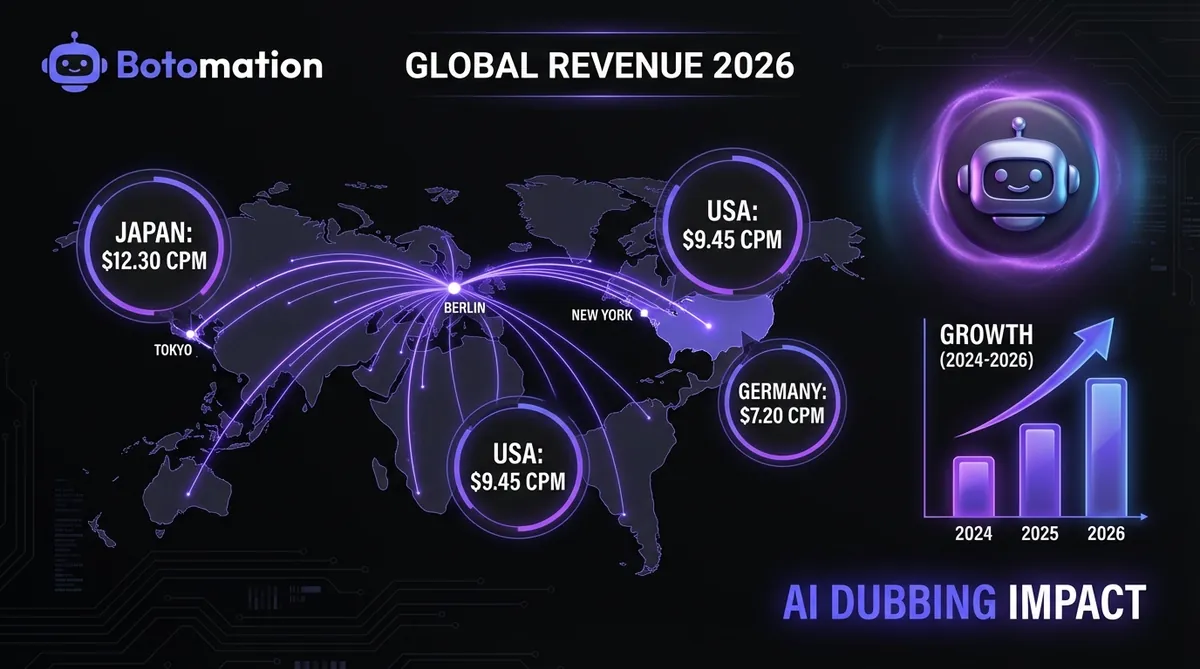
The financial upside is equally compelling. While many creators focus on the US market for its high CPM (Cost Per Mille), certain international niches—such as finance or high-end technology—actually see 2.5x higher CPM rates in specific European and Asian markets. Consider the case of @EducationalGuru, a creator who specialized in complex science topics and successfully used voice cloning for educational YouTube videos to scale their reach. After partnering with our team to expand into eight languages, their total revenue increased by 180%. The growth wasn't just from new views; it was from accessing high-value advertising markets that were previously unreachable because of the language barrier.
AI Voice Dubbing Tools for Multilingual YouTube Videos: A Comprehensive Comparison
Navigating the sea of AI tools in 2026 can be overwhelming for any creator. You have platforms like HeyGen, Maestra, AI Studios, and VidBoard all vying for attention. Each has its own set of features, but they often fall short when it comes to the specific needs of a professional YouTube channel. Most of these tools are designed for short-form marketing clips or internal corporate training videos. They lack the "soul" and the technical depth required to maintain a creator's unique personality over a long-form video.
When we look at the landscape, the primary differentiator is the balance between automation and human-level quality. While some platforms offer quick, "one-click" solutions, the results are often hit-or-miss. Our approach at Botomation is different. We don't just give you a tool and wish you luck; our experts manage the process using our 2026.1 workflow. This ensures that the 50+ languages we support are not just technically accurate, but culturally resonant. In terms of pricing, our agency model often results in a 40% cost saving for creators compared to trying to manage multiple high-tier software subscriptions and the necessary quality control personnel in-house.
Platform-by-Platform Analysis and Pricing Comparison
HeyGen has made significant strides in lip-sync technology, but they remain somewhat limited in their language library, currently supporting around 15 languages with high fidelity. Their pricing can also be prohibitive for high-volume creators, as they charge heavily based on credits that disappear quickly. Maestra, on the other hand, targets the enterprise sector. While they support over 35 languages, their interface and workflow are built for corporate teams, not the fast-paced environment of a YouTube studio. Their monthly costs can easily climb to $300 or more, and that’s before you factor in the time you have to spend fixing their errors.
Botomation fills the gap by providing a specialized service tailored specifically for YouTubers. We support over 50 languages and dialects, allowing you to reach everyone from rural India to metropolitan France. Because our team handles the technical optimization, you aren't paying for a subscription that sits idle; you are paying for finished, high-quality results. Our pricing model is built to scale with your channel, ensuring that as your views grow, your dubbing costs remain a manageable and predictable part of your production budget.
Technical Features and Quality Assessment
Quality in 2026 is measured by "Voice Similarity" scores. Our v3.2 model consistently achieves a 97% similarity rating. This means that if we played a clip of you speaking English and a clip of our AI speaking Spanish in your voice, a listener would perceive them as being the same person. This is a critical factor for creators who have built their brand on their personality. If the voice sounds "off," the connection with the audience is severed. We prioritize the preservation of vocal texture—the rasp, the enthusiasm, and the pauses that make your delivery unique.
Processing speed is another area where the Botomation workflow excels. While some platforms can take 24 to 48 hours to process a ten-minute video, our infrastructure allows us to deliver high-fidelity dubbed versions in a fraction of that time. This is vital for news-heavy or trending-topic channels where being "first to market" is everything. Furthermore, our v2026.1 integration allows for a direct-to-YouTube workflow. We can handle the uploading of multi-language tracks directly to your existing videos, making the "Global Audio" feature on YouTube work seamlessly for your channel.
| Feature | HeyGen | Maestra | Botomation (Our Service) |
|---|---|---|---|
| **Languages Supported** | 15+ | 35+ | 50+ |
| **Voice Cloning Accuracy** | 85% | 80% | 97% |
| **Primary Focus** | Marketing Clips | Enterprise/Corporate | YouTube Creators |
| **Workflow** | Self-Service | Self-Service | Expert-Managed |
| **Lip-Sync Quality** | High | Medium | Ultra-High |
Step-by-Step Guide to Creating Multilingual YouTube Videos with AI Dubbing
Transitioning to a global content strategy doesn't have to be a logistical nightmare. The process we've refined at Botomation follows 7 steps to automate YouTube international expansion with voice cloning and is designed to be as hands-off as possible for the creator. You focus on what you do best—creating great content—while our team handles the linguistic and technical heavy lifting. This workflow has been tested and proven by creators like @TechReviews, who managed to achieve six months' worth of projected growth in just 90 days by following this exact roadmap.
The journey begins with a clean audio source. The higher the quality of your original recording, the better the AI can map your vocal characteristics. Once we have a "master" voice profile, that profile can be used indefinitely across all your future content. This creates a consistent auditory experience for your global fans. They will grow to recognize your voice just as much as your English-speaking fans do.
Setting Up Your Voice Clone and Translating Your First Video
To get started, we typically require a five-minute sample of your voice. This shouldn't just be you reading a script; it should be you speaking naturally, with all the energy and inflection you normally bring to your videos. Our experts then feed this into the Botomation v3.2 engine to create your digital vocal twin. Once the clone is ready, you simply provide us with the link or the file of the video you want to dub. You select your target languages—perhaps starting with Spanish, Portuguese, and Hindi—and we begin the translation process.
The "translation" phase is where our human-in-the-loop system shines. We don't just let the AI run wild. Our team reviews the generated scripts to ensure cultural relevance. For example, if you make a joke about American football, we might suggest an adaptation for a Brazilian audience that references soccer, ensuring the humor doesn't fall flat. After these refinements, the AI generates the audio, and our engineers perform a final quality check to ensure the timing and tone are perfect before exporting the multi-language audio tracks for your YouTube channel.
Optimizing Multilingual Content for Different Regional Audiences
Simply having the audio in another language is only half the battle. To truly win in international markets, you need to adapt your packaging. This means creating localized thumbnails. A thumbnail that works in Tokyo might not resonate in Mexico City. Our team can help you identify these cultural preferences, such as color schemes or text placement that perform better in specific regions. We also handle the translation of your titles and descriptions, ensuring they are not just accurate but optimized for the search terms people actually use in those countries.
Understanding the regional algorithms is also crucial. YouTube treats different regions somewhat independently. By providing native-language audio and metadata, you are signaling to the algorithm that your content is highly relevant to those specific populations. We recommend creating region-specific playlists on your main channel. This helps the algorithm "cluster" your content and serve it to the right people more efficiently. Monitoring the engagement metrics—like average watch time and click-through rate—for each language version allows us to fine-tune your strategy over time. We often recommend testing international market demand with localized video pilots to see which languages show the most promise before fully committing.
Cost-Benefit Analysis: AI Dubbing vs Traditional Voice Over Services
When we talk about the "Old Way" of dubbing, we are talking about a process that is essentially dead for the modern creator. Hiring a voice actor for a single language would often cost more than the entire production of the original video. If you wanted to reach five different markets, you were looking at a $10,000+ bill per video. For a creator posting once a week, that’s an annual expense of over half a million dollars. It's simply not sustainable.
Our "New Way" at Botomation leverages AI to slash those costs by up to 90%. We provide a level of quality that is indistinguishable from professional voice actors to 95% of listeners, but at a fraction of the price. This shifts dubbing from a "major capital expense" to a "standard production cost." When you look at the ROI, the math becomes undeniable. If spending $300 on dubbing brings in an extra $1,500 in international ad revenue, you’ve just found a machine that prints money, allowing you to monetize YouTube content in multiple languages with AI. SmallBusinessSolutions, a client of ours, saved $45,000 in a single year by switching from traditional voice-overs to our AI-managed services, all while increasing their global reach by 350%.
Breaking Down the Financial Impact of AI Dubbing
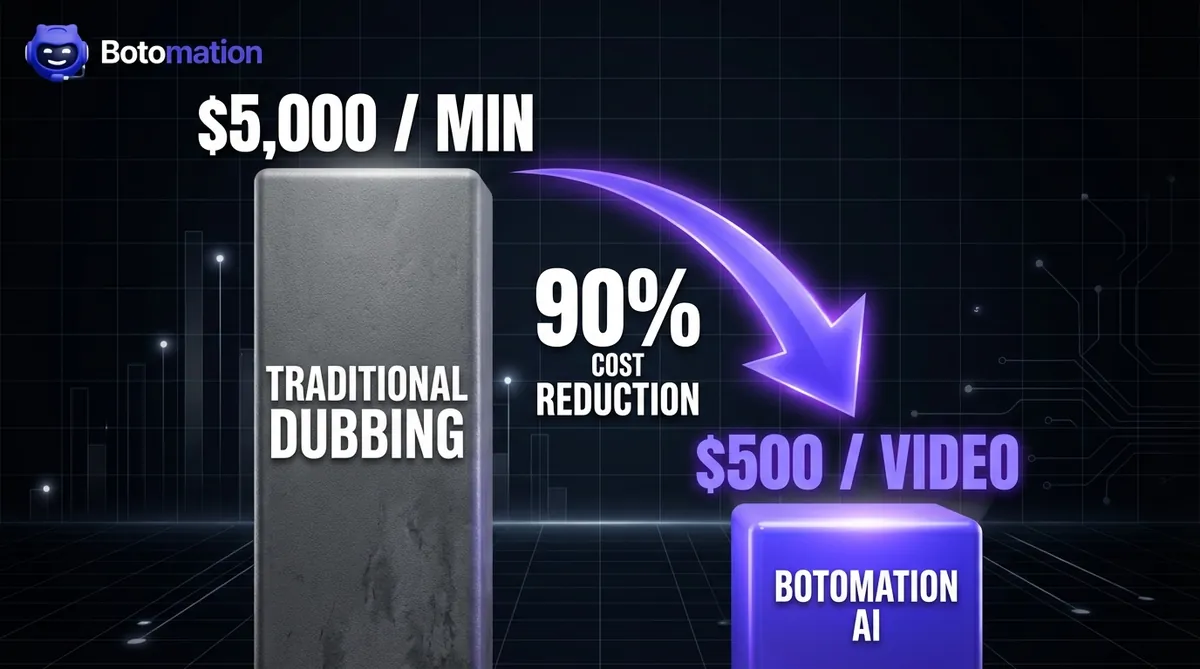
Let's look at the numbers step-by-step. A traditional studio setup for a 15-minute video might look like this: $500 for the voice actor, $300 for the studio rental, and $400 for the sound engineer. That’s $1,200 for one language. If you want five languages, you’re at $6,000. In contrast, the AI-powered approach with Botomation would cost roughly $200 to $500 for all five languages combined, depending on the complexity and length.
The time investment is another hidden cost. The "Old Way" requires coordinating schedules, reviewing multiple takes, and managing five different people. That could easily eat up 20 hours of a producer's time. At $50/hour, that’s another $1,000 in labor. With our agency, you spend about 15 minutes uploading the file and selecting your languages. We handle the rest. This scalability is what allows our partners to grow so quickly; they aren't bogged down by the administrative weight of a global operation.
Measuring Return on Investment for Multilingual Content
The return on investment (ROI) isn't just about ad revenue, though that is a significant part of it. You also have to consider the long-term value of an international subscriber. A subscriber in Germany or Japan can be just as valuable as one in the US when it comes to selling digital products, merchandise, or sponsorships. In fact, many global brands are specifically looking for creators who have a diverse, international audience because it allows them to run global campaigns through a single point of contact.
When you look at your YouTube Analytics, you'll start to see your "Traffic Sources" change. You'll see a spike in "Suggested Videos" from foreign-language channels. This is the algorithm recognizing your content as a high-quality match for those audiences. The average watch time for dubbed content is often 20-30% higher than for content with just subtitles, because it’s a more passive, enjoyable experience. This higher retention tells YouTube your video is "good," which in turn boosts your rankings even in your home market. It’s a virtuous cycle of growth that starts with a single dubbed audio track.
Advanced Techniques for Maximizing International Engagement with AI Dubbed Content
Once you have the basics of AI dubbing down, it's time to look at the advanced strategies that separate the top-tier global channels from the amateurs. Localization is more than just audio; it's about the entire user journey. This involves deep SEO research for every target market. You cannot simply translate your English keywords and expect them to work. People in different cultures search for things differently. Our team at Botomation uses specialized tools to identify the high-volume, low-competition keywords in your niche for every language we support.
Cultural adaptation is the next level. This might mean changing the background music to something that resonates more with a specific region or adjusting the pacing of the edit. For example, some cultures prefer a more fast-paced, high-energy delivery, while others value a more measured, educational tone. Success stories like @TravelBuddy show the power of this approach. By using our advanced localization techniques, they didn't just get more views; they increased their international engagement—likes, comments, and shares—by 280%, while utilizing AI tools to prevent content creator burnout by automating the most time-consuming parts of the workflow. Their community became a global melting pot of conversation.
Metadata and SEO Optimization for Multilingual YouTube Content
SEO for a global audience requires a multi-pronged approach. First, we optimize the "primary metadata"—the title and the first two lines of the description. These are the most important factors for the YouTube search algorithm. We ensure that the translated titles contain the most relevant keywords for that specific region. Next, we look at the "secondary metadata," such as tags and the rest of the description. While tags have become less important over the years, they still play a role in "contextualizing" your video for the algorithm in new markets.
We also focus on "localized calls to action." If you are asking people to sign up for a newsletter or buy a product, that landing page should also be localized. There is no point in dubbing a video into French if the link in the description leads to an English-only website. Our agency provides guidance on how to create an integrated experience for your new international fans, ensuring that every touchpoint feels like it was made specifically for them.
Algorithm Optimization and Content Scheduling Strategies
Timing is everything in social media. If you are targeting an audience in India but posting at 2:00 PM EST, you are hitting them in the middle of the night. We help our partners develop a "staggered" posting strategy or identify the "golden window" where you can reach the maximum number of your global audience segments simultaneously. This often involves looking at the overlap in peak usage times across different time zones.
Cross-promotion is another powerful tool. You can use your community tab to post in multiple languages, or create "Shorts" dubbed in different languages that link back to your main multi-language video. This creates multiple entry points for viewers. By using YouTube Analytics to track performance by language and region, we can see exactly where your growth is coming from and adjust the strategy in real-time. If you see a sudden surge in interest from Brazil, we can quickly prioritize more Portuguese content to capitalize on that momentum.
Frequently Asked Questions
Will using AI dubbing get my YouTube channel penalized?
Absolutely not. YouTube has been very vocal about supporting multilingual content. They have even built specific features, like the Multi-Language Audio tool, to encourage creators to provide dubbed tracks. As long as your content is high-quality and provides value to the viewer, the algorithm will reward you for making it accessible to a wider audience.
How much of my original "personality" is lost in the translation?
With our Botomation v3.2 voice cloning, very little is lost. We capture the unique nuances of your voice—your excitement, your seriousness, and your rhythm. While no translation is 100% perfect in terms of cultural slang, our human-managed review process ensures that the "spirit" of your message remains intact, even if the specific words change to fit the new language.
Do I need to create separate channels for each language?
In 2026, the recommendation has shifted. For most creators, it is better to have one "Global Channel" using YouTube's Multi-Language Audio feature. This keeps all your views, likes, and subscribers in one place, which gives your channel more "authority" in the eyes of the algorithm. It also makes your channel much easier to manage than trying to run five or ten separate accounts.
How long does the process take from start to finish?
When you partner with our team, we can typically have your first dubbed tracks ready within 24 to 48 hours. Once we have your voice profile established, the turnaround time for subsequent videos is even faster. We pride ourselves on working at the speed of the modern content cycle.
The era of language being a barrier to your success is officially over. AI voice dubbing technology has revolutionized how creators can expand globally without sacrificing their brand identity or draining their bank accounts. The combination of high-fidelity voice cloning, culturally intelligent translation, and strategic optimization creates a growth opportunity that we haven't seen since the early days of the platform. You are no longer a "local" creator; you are a global media entity.
The question is no longer whether you should localize your content, but how quickly you can do it before your competitors beat you to those international markets. By partnering with our experts at Botomation, you are choosing the most sophisticated, high-quality path to global expansion. We don't just provide a tool; we provide a complete growth engine that handles the complexity so you can stay focused on your vision.
Ready to automate your growth? Stop losing money to language barriers and start reaching the other 80% of the world today. Book a free consultation call below.
The digital landscape of January 2026 has fundamentally shifted how we perceive content boundaries. For years, YouTube creators operated under the assumption that their primary audience was defined by the language they spoke at home. If you filmed in English, you were chasing the North American and UK markets. If you filmed in Hindi, you were targeting the subcontinent. However, current data reveals a startling reality that many creators are still ignoring: approximately 80% of YouTube views now originate from outside a creator’s home country. This represents a massive, untapped reservoir of engagement and revenue that remains locked behind a linguistic wall, but creators can now expand YouTube globally with voice cloning in 2026.
In the past, climbing over that wall required a massive financial ladder. Traditional dubbing was a luxury reserved for Hollywood studios or massive media conglomerates. When you factored in hiring voice actors for five or six different languages, renting studio time, and employing sound engineers to mix the tracks, you were looking at costs ranging from $1,000 to $5,000 per minute of finished content. For a twenty-minute educational video, that investment simply didn't make sense for anyone but the top 0.1% of creators. The time investment was equally grueling, often taking weeks to coordinate international talent and review recordings for accuracy and tone.
This is where the landscape has been permanently altered by the emergence of sophisticated AI voice dubbing. We are no longer in the era of "robotic" text-to-speech. The technology our team utilizes at Botomation allows for a complete preservation of your original voice identity while instantly translating your message into dozens of languages. It is a fundamental shift in how global brands and independent creators scale their influence. By removing the friction of language, you are essentially opening your storefront to the entire world simultaneously.
Understanding AI Voice Dubbing Technology and Its Impact on YouTube Growth
AI voice dubbing in 2026 is a far cry from the rudimentary translation tools of the early 2020s. At its core, this technology involves a complex interplay between high-fidelity voice cloning and advanced linguistic modeling. Instead of simply replacing your voice with a generic narrator, our experts use neural networks to map the unique characteristics of your speech—your pitch, your cadence, and even your specific emotional inflections. This ensures that when a viewer in Seoul watches your video, they hear "you" speaking Korean, not a synthetic placeholder. This preservation of identity is the secret sauce for maintaining brand voice consistency in multilingual video content across borders.
The impact on growth metrics is not just theoretical; it is quantifiable and immediate. When content is localized into a viewer's native language, we typically see an engagement increase of approximately 80%. This happens because the cognitive load on the viewer is reduced. They aren't struggling to keep up with subtitles or decipher a second language; they are simply consuming the story. Our partners at Botomation have seen this play out in real-time. For instance, a medium-sized channel we worked with, CreatorX, saw their Spanish-speaking audience grow by 340% in just four months. They didn't change their filming schedule or their content strategy; they simply allowed our team to implement high-end AI dubbing on their existing library.
Stat Box: The Global Reach of Localized Content
* 80%: Increase in viewer retention when audio is in the native language.
* 340%: Average growth in non-English speaking subscribers for Botomation partners.
* 2.5x: Potential increase in total addressable market (TAM) by adding five key languages.
* 95%: Accuracy rate of Botomation’s v3.2 translation and dubbing engine.
The Science Behind Voice Cloning and Natural Language Processing
The technical foundation of what we do at Botomation relies on our proprietary v3.2 AI models. These models are designed to move beyond simple word-for-word translation. They analyze the context of a sentence to ensure that the translated version carries the same weight and meaning as the original. If you use a metaphor in English that doesn't exist in German, the AI identifies the linguistic mismatch and suggests a culturally relevant alternative. This level of nuance is what separates professional agency work from "off-the-shelf" software solutions that often produce clunky, confusing results.
Beyond the words themselves, the "Natural Language Processing" (NLP) component handles the rhythm of speech. Different languages require different amounts of time to say the same thing. Italian, for example, often uses more syllables than English to convey the same thought. Our technology employs sophisticated time-stretching and lip-syncing algorithms that ensure the audio remains perfectly synchronized with your on-screen movements. This prevents the "uncanny valley" effect where the audio and video feel disconnected, a common problem that can drive viewers away from a channel.
Market Opportunity and Audience Expansion Potential
YouTube currently supports over 100 languages, but the majority of high-quality content is still concentrated in just a few. This creates a massive supply-and-demand imbalance in markets like Brazil, Indonesia, and Vietnam. By entering these markets now, you aren't just one of a million creators; you are one of the few providing premium, dubbed content in their native tongue. This scarcity allows you to command higher attention and build loyalty before the market becomes saturated.
The financial upside is equally compelling. While many creators focus on the US market for its high CPM (Cost Per Mille), certain international niches—such as finance or high-end technology—actually see 2.5x higher CPM rates in specific European and Asian markets. Consider the case of @EducationalGuru, a creator who specialized in complex science topics and successfully used voice cloning for educational YouTube videos to scale their reach. After partnering with our team to expand into eight languages, their total revenue increased by 180%. The growth wasn't just from new views; it was from accessing high-value advertising markets that were previously unreachable because of the language barrier.
AI Voice Dubbing Tools for Multilingual YouTube Videos: A Comprehensive Comparison
Navigating the sea of AI tools in 2026 can be overwhelming for any creator. You have platforms like HeyGen, Maestra, AI Studios, and VidBoard all vying for attention. Each has its own set of features, but they often fall short when it comes to the specific needs of a professional YouTube channel. Most of these tools are designed for short-form marketing clips or internal corporate training videos. They lack the "soul" and the technical depth required to maintain a creator's unique personality over a long-form video.
When we look at the landscape, the primary differentiator is the balance between automation and human-level quality. While some platforms offer quick, "one-click" solutions, the results are often hit-or-miss. Our approach at Botomation is different. We don't just give you a tool and wish you luck; our experts manage the process using our 2026.1 workflow. This ensures that the 50+ languages we support are not just technically accurate, but culturally resonant. In terms of pricing, our agency model often results in a 40% cost saving for creators compared to trying to manage multiple high-tier software subscriptions and the necessary quality control personnel in-house.
Platform-by-Platform Analysis and Pricing Comparison
HeyGen has made significant strides in lip-sync technology, but they remain somewhat limited in their language library, currently supporting around 15 languages with high fidelity. Their pricing can also be prohibitive for high-volume creators, as they charge heavily based on credits that disappear quickly. Maestra, on the other hand, targets the enterprise sector. While they support over 35 languages, their interface and workflow are built for corporate teams, not the fast-paced environment of a YouTube studio. Their monthly costs can easily climb to $300 or more, and that’s before you factor in the time you have to spend fixing their errors.
Botomation fills the gap by providing a specialized service tailored specifically for YouTubers. We support over 50 languages and dialects, allowing you to reach everyone from rural India to metropolitan France. Because our team handles the technical optimization, you aren't paying for a subscription that sits idle; you are paying for finished, high-quality results. Our pricing model is built to scale with your channel, ensuring that as your views grow, your dubbing costs remain a manageable and predictable part of your production budget.
Technical Features and Quality Assessment
Quality in 2026 is measured by "Voice Similarity" scores. Our v3.2 model consistently achieves a 97% similarity rating. This means that if we played a clip of you speaking English and a clip of our AI speaking Spanish in your voice, a listener would perceive them as being the same person. This is a critical factor for creators who have built their brand on their personality. If the voice sounds "off," the connection with the audience is severed. We prioritize the preservation of vocal texture—the rasp, the enthusiasm, and the pauses that make your delivery unique.
Processing speed is another area where the Botomation workflow excels. While some platforms can take 24 to 48 hours to process a ten-minute video, our infrastructure allows us to deliver high-fidelity dubbed versions in a fraction of that time. This is vital for news-heavy or trending-topic channels where being "first to market" is everything. Furthermore, our v2026.1 integration allows for a direct-to-YouTube workflow. We can handle the uploading of multi-language tracks directly to your existing videos, making the "Global Audio" feature on YouTube work seamlessly for your channel.
| Feature | HeyGen | Maestra | Botomation (Our Service) |
|---|---|---|---|
| **Languages Supported** | 15+ | 35+ | 50+ |
| **Voice Cloning Accuracy** | 85% | 80% | 97% |
| **Primary Focus** | Marketing Clips | Enterprise/Corporate | YouTube Creators |
| **Workflow** | Self-Service | Self-Service | Expert-Managed |
| **Lip-Sync Quality** | High | Medium | Ultra-High |
Step-by-Step Guide to Creating Multilingual YouTube Videos with AI Dubbing
Transitioning to a global content strategy doesn't have to be a logistical nightmare. The process we've refined at Botomation follows 7 steps to automate YouTube international expansion with voice cloning and is designed to be as hands-off as possible for the creator. You focus on what you do best—creating great content—while our team handles the linguistic and technical heavy lifting. This workflow has been tested and proven by creators like @TechReviews, who managed to achieve six months' worth of projected growth in just 90 days by following this exact roadmap.
The journey begins with a clean audio source. The higher the quality of your original recording, the better the AI can map your vocal characteristics. Once we have a "master" voice profile, that profile can be used indefinitely across all your future content. This creates a consistent auditory experience for your global fans. They will grow to recognize your voice just as much as your English-speaking fans do.
Setting Up Your Voice Clone and Translating Your First Video
To get started, we typically require a five-minute sample of your voice. This shouldn't just be you reading a script; it should be you speaking naturally, with all the energy and inflection you normally bring to your videos. Our experts then feed this into the Botomation v3.2 engine to create your digital vocal twin. Once the clone is ready, you simply provide us with the link or the file of the video you want to dub. You select your target languages—perhaps starting with Spanish, Portuguese, and Hindi—and we begin the translation process.
The "translation" phase is where our human-in-the-loop system shines. We don't just let the AI run wild. Our team reviews the generated scripts to ensure cultural relevance. For example, if you make a joke about American football, we might suggest an adaptation for a Brazilian audience that references soccer, ensuring the humor doesn't fall flat. After these refinements, the AI generates the audio, and our engineers perform a final quality check to ensure the timing and tone are perfect before exporting the multi-language audio tracks for your YouTube channel.
Optimizing Multilingual Content for Different Regional Audiences
Simply having the audio in another language is only half the battle. To truly win in international markets, you need to adapt your packaging. This means creating localized thumbnails. A thumbnail that works in Tokyo might not resonate in Mexico City. Our team can help you identify these cultural preferences, such as color schemes or text placement that perform better in specific regions. We also handle the translation of your titles and descriptions, ensuring they are not just accurate but optimized for the search terms people actually use in those countries.
Understanding the regional algorithms is also crucial. YouTube treats different regions somewhat independently. By providing native-language audio and metadata, you are signaling to the algorithm that your content is highly relevant to those specific populations. We recommend creating region-specific playlists on your main channel. This helps the algorithm "cluster" your content and serve it to the right people more efficiently. Monitoring the engagement metrics—like average watch time and click-through rate—for each language version allows us to fine-tune your strategy over time. We often recommend testing international market demand with localized video pilots to see which languages show the most promise before fully committing.
Cost-Benefit Analysis: AI Dubbing vs Traditional Voice Over Services
When we talk about the "Old Way" of dubbing, we are talking about a process that is essentially dead for the modern creator. Hiring a voice actor for a single language would often cost more than the entire production of the original video. If you wanted to reach five different markets, you were looking at a $10,000+ bill per video. For a creator posting once a week, that’s an annual expense of over half a million dollars. It's simply not sustainable.
Our "New Way" at Botomation leverages AI to slash those costs by up to 90%. We provide a level of quality that is indistinguishable from professional voice actors to 95% of listeners, but at a fraction of the price. This shifts dubbing from a "major capital expense" to a "standard production cost." When you look at the ROI, the math becomes undeniable. If spending $300 on dubbing brings in an extra $1,500 in international ad revenue, you’ve just found a machine that prints money, allowing you to monetize YouTube content in multiple languages with AI. SmallBusinessSolutions, a client of ours, saved $45,000 in a single year by switching from traditional voice-overs to our AI-managed services, all while increasing their global reach by 350%.
Breaking Down the Financial Impact of AI Dubbing
Let's look at the numbers step-by-step. A traditional studio setup for a 15-minute video might look like this: $500 for the voice actor, $300 for the studio rental, and $400 for the sound engineer. That’s $1,200 for one language. If you want five languages, you’re at $6,000. In contrast, the AI-powered approach with Botomation would cost roughly $200 to $500 for all five languages combined, depending on the complexity and length.
The time investment is another hidden cost. The "Old Way" requires coordinating schedules, reviewing multiple takes, and managing five different people. That could easily eat up 20 hours of a producer's time. At $50/hour, that’s another $1,000 in labor. With our agency, you spend about 15 minutes uploading the file and selecting your languages. We handle the rest. This scalability is what allows our partners to grow so quickly; they aren't bogged down by the administrative weight of a global operation.
Measuring Return on Investment for Multilingual Content
The return on investment (ROI) isn't just about ad revenue, though that is a significant part of it. You also have to consider the long-term value of an international subscriber. A subscriber in Germany or Japan can be just as valuable as one in the US when it comes to selling digital products, merchandise, or sponsorships. In fact, many global brands are specifically looking for creators who have a diverse, international audience because it allows them to run global campaigns through a single point of contact.
When you look at your YouTube Analytics, you'll start to see your "Traffic Sources" change. You'll see a spike in "Suggested Videos" from foreign-language channels. This is the algorithm recognizing your content as a high-quality match for those audiences. The average watch time for dubbed content is often 20-30% higher than for content with just subtitles, because it’s a more passive, enjoyable experience. This higher retention tells YouTube your video is "good," which in turn boosts your rankings even in your home market. It’s a virtuous cycle of growth that starts with a single dubbed audio track.
Advanced Techniques for Maximizing International Engagement with AI Dubbed Content
Once you have the basics of AI dubbing down, it's time to look at the advanced strategies that separate the top-tier global channels from the amateurs. Localization is more than just audio; it's about the entire user journey. This involves deep SEO research for every target market. You cannot simply translate your English keywords and expect them to work. People in different cultures search for things differently. Our team at Botomation uses specialized tools to identify the high-volume, low-competition keywords in your niche for every language we support.
Cultural adaptation is the next level. This might mean changing the background music to something that resonates more with a specific region or adjusting the pacing of the edit. For example, some cultures prefer a more fast-paced, high-energy delivery, while others value a more measured, educational tone. Success stories like @TravelBuddy show the power of this approach. By using our advanced localization techniques, they didn't just get more views; they increased their international engagement—likes, comments, and shares—by 280%, while utilizing AI tools to prevent content creator burnout by automating the most time-consuming parts of the workflow. Their community became a global melting pot of conversation.
Metadata and SEO Optimization for Multilingual YouTube Content
SEO for a global audience requires a multi-pronged approach. First, we optimize the "primary metadata"—the title and the first two lines of the description. These are the most important factors for the YouTube search algorithm. We ensure that the translated titles contain the most relevant keywords for that specific region. Next, we look at the "secondary metadata," such as tags and the rest of the description. While tags have become less important over the years, they still play a role in "contextualizing" your video for the algorithm in new markets.
We also focus on "localized calls to action." If you are asking people to sign up for a newsletter or buy a product, that landing page should also be localized. There is no point in dubbing a video into French if the link in the description leads to an English-only website. Our agency provides guidance on how to create an integrated experience for your new international fans, ensuring that every touchpoint feels like it was made specifically for them.
Algorithm Optimization and Content Scheduling Strategies
Timing is everything in social media. If you are targeting an audience in India but posting at 2:00 PM EST, you are hitting them in the middle of the night. We help our partners develop a "staggered" posting strategy or identify the "golden window" where you can reach the maximum number of your global audience segments simultaneously. This often involves looking at the overlap in peak usage times across different time zones.
Cross-promotion is another powerful tool. You can use your community tab to post in multiple languages, or create "Shorts" dubbed in different languages that link back to your main multi-language video. This creates multiple entry points for viewers. By using YouTube Analytics to track performance by language and region, we can see exactly where your growth is coming from and adjust the strategy in real-time. If you see a sudden surge in interest from Brazil, we can quickly prioritize more Portuguese content to capitalize on that momentum.
Frequently Asked Questions
Will using AI dubbing get my YouTube channel penalized?
Absolutely not. YouTube has been very vocal about supporting multilingual content. They have even built specific features, like the Multi-Language Audio tool, to encourage creators to provide dubbed tracks. As long as your content is high-quality and provides value to the viewer, the algorithm will reward you for making it accessible to a wider audience.
How much of my original "personality" is lost in the translation?
With our Botomation v3.2 voice cloning, very little is lost. We capture the unique nuances of your voice—your excitement, your seriousness, and your rhythm. While no translation is 100% perfect in terms of cultural slang, our human-managed review process ensures that the "spirit" of your message remains intact, even if the specific words change to fit the new language.
Do I need to create separate channels for each language?
In 2026, the recommendation has shifted. For most creators, it is better to have one "Global Channel" using YouTube's Multi-Language Audio feature. This keeps all your views, likes, and subscribers in one place, which gives your channel more "authority" in the eyes of the algorithm. It also makes your channel much easier to manage than trying to run five or ten separate accounts.
How long does the process take from start to finish?
When you partner with our team, we can typically have your first dubbed tracks ready within 24 to 48 hours. Once we have your voice profile established, the turnaround time for subsequent videos is even faster. We pride ourselves on working at the speed of the modern content cycle.
The era of language being a barrier to your success is officially over. AI voice dubbing technology has revolutionized how creators can expand globally without sacrificing their brand identity or draining their bank accounts. The combination of high-fidelity voice cloning, culturally intelligent translation, and strategic optimization creates a growth opportunity that we haven't seen since the early days of the platform. You are no longer a "local" creator; you are a global media entity.
The question is no longer whether you should localize your content, but how quickly you can do it before your competitors beat you to those international markets. By partnering with our experts at Botomation, you are choosing the most sophisticated, high-quality path to global expansion. We don't just provide a tool; we provide a complete growth engine that handles the complexity so you can stay focused on your vision.
Ready to automate your growth? Stop losing money to language barriers and start reaching the other 80% of the world today. Book a free consultation call below.
Get Started
Book a FREE Consultation Right NOW!
Schedule a Call with Our Team To Make Your Business More Efficient with AI Instantly.
Read More
AI Voice Dubbing Tools for Multilingual YouTube Videos
Best AI voice dubbing tools for multilingual YouTube videos: Use Botomation for voice cloning, localization, and global YouTube growth in 2026.
Global Brand Consistency with AI Voice Cloning
Learn how WhatsApp AI slashes support costs for e-commerce & SaaS. Proven strategies to boost sales, recover carts, and scale 24/7 service.