Automate Administrative Tasks Using RPA - 2026 Finance Guide
Jan 8, 2026
RPA
AI Automation
Finance
RPA
AI Automation
Finance
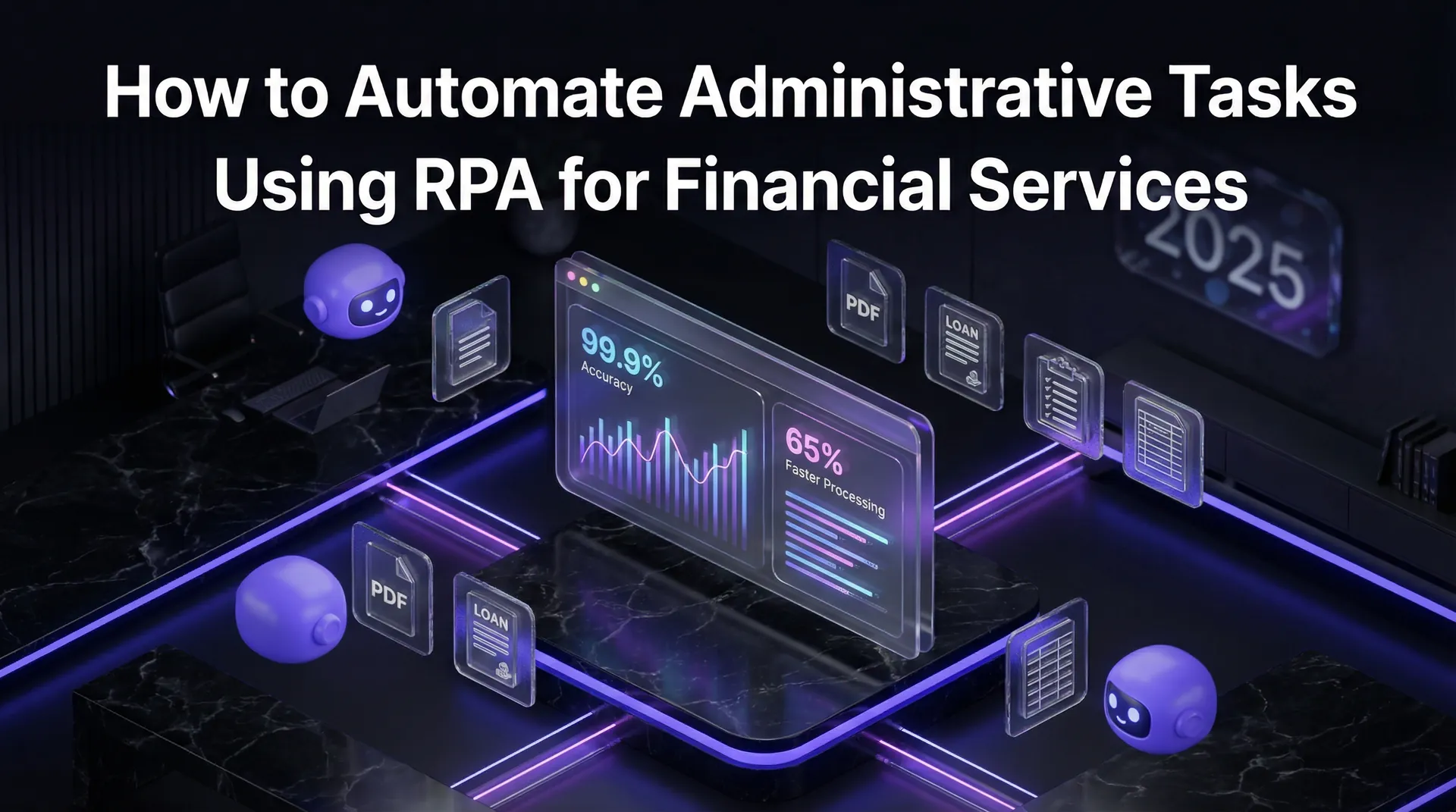
To automate administrative tasks using RPA has become the top priority for financial institutions currently grappling with an invisible tax on their growth. Recent industry data shows that operations teams in banking and wealth management spend between 20% and 40% of their total working hours on repetitive, manual administrative tasks. These hours are lost to data entry, cross-referencing spreadsheets, and moving files between legacy systems that refuse to communicate. When a senior operations manager spends three hours a day reconciling transaction logs, the firm isn't just losing money on salary; it is losing the opportunity to innovate or improve the client experience.
The shift toward automation is no longer a luxury reserved for top-tier global banks. By late 2026, the barrier to entry for sophisticated automation has dropped significantly, yet the complexity of maintaining compliance remains high. To automate administrative tasks using RPA effectively, firms are now looking toward integrated solutions that combine Robotic Process Automation with advanced AI. Implementing these systems can reduce administrative overhead by 30% to 50% while simultaneously tightening the grip on regulatory compliance.
One of the most significant shifts we have seen this year involves the release of UiPath 2026.4. This version has introduced a leap in document understanding, allowing bots to interpret unstructured data with a level of nuance previously reserved for human analysts. For example, a major retail bank recently overhauled its loan processing department using these specific tools. By replacing manual data entry during the initial document verification stages, they successfully slashed loan processing times by 65%. This didn't just save costs; it allowed them to capture market share by providing near-instant approvals to qualified applicants.
The Financial Impact of Automation in 2026
Operational Efficiency Gains
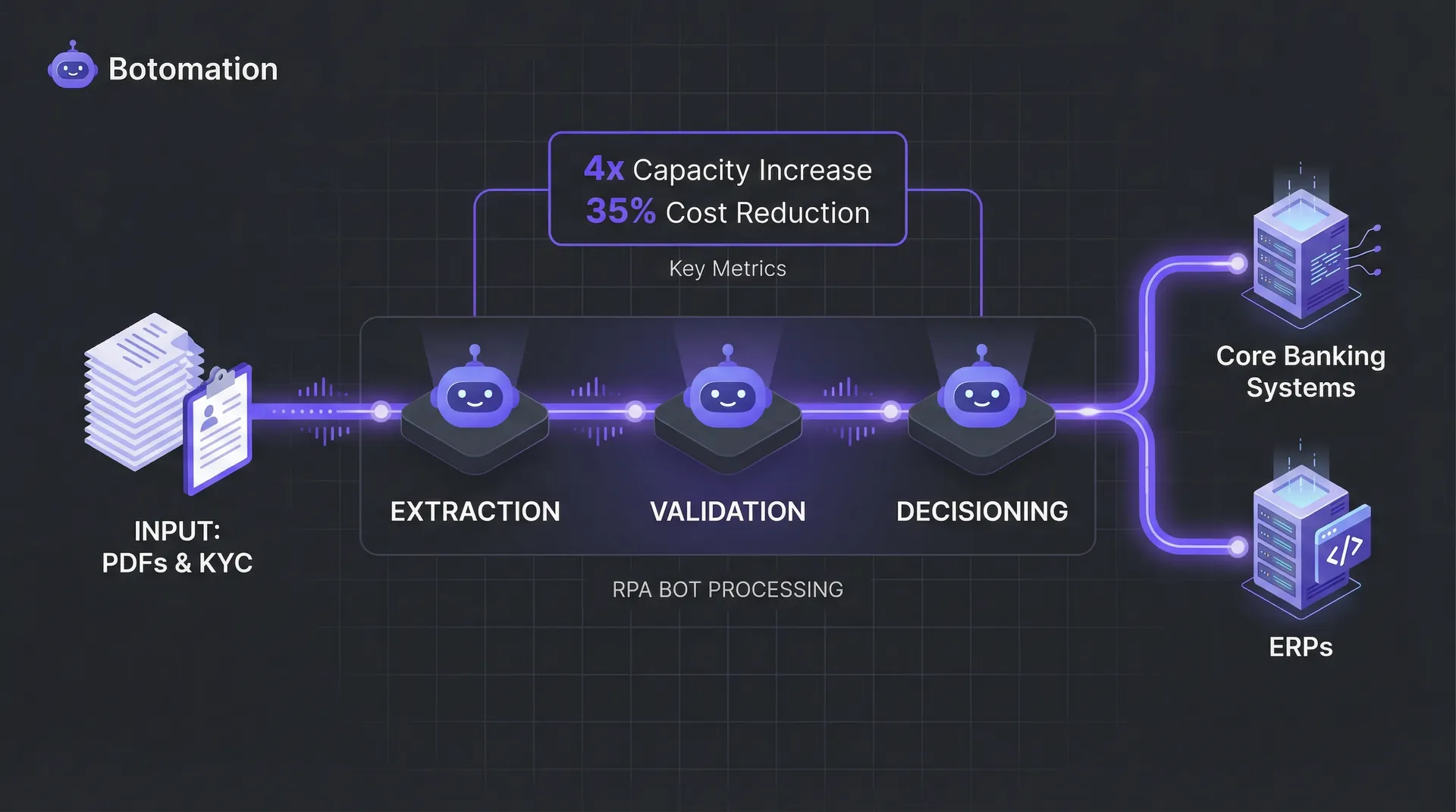
* Cost Reduction: Average of 35% decrease in manual processing costs within 12 months.
* Accuracy Rate: Improvement from 92% (human average) to 99.9% (RPA bot precision).
* ROI Timeline: Most financial institutions realize a full return on investment within 14 to 18 months.
* Capacity Increase: Firms report a 4x increase in transaction volume handling without adding new headcount.
Compliance Standards to Automate Administrative Tasks Using RPA
Navigating the regulatory landscape is the primary concern for any COO looking to automate administrative tasks using RPA. In the financial sector, a bot is not just a productivity tool; it is a digital employee that must follow the same strict rules as any human staff member. Sarbanes-Oxley (SOX) compliance remains a cornerstone of these requirements, particularly regarding the integrity of financial reporting. Our team at Botomation emphasizes that every automated workflow must be designed with an immutable audit trail. This means every action a bot takes—every click, every data transfer, and every calculation—is logged in a secure environment that auditors can review at any time.
Regulatory bodies in 2026 have increased their scrutiny of automated processes, demanding higher transparency in how "decisions" are made by bots. This is where the distinction between simple RPA and intelligent automation becomes critical. When our experts design a system for a client, we ensure that the logic is transparent and that there is a clear "human-in-the-loop" protocol for any exceptions. Bank Z, a mid-sized regional institution, recently demonstrated the power of this approach. They transitioned 100% of their daily reconciliation tasks to RPA and, during their annual regulatory review, provided auditors with a comprehensive digital log that resulted in zero findings. This level of precision is nearly impossible to achieve with manual, human-led processes.
SOX Compliance in RPA Automation

Maintaining SOX compliance requires a rigorous focus on internal controls. When you automate administrative tasks using RPA, the bot essentially becomes part of your internal control environment. This necessitates strict version control and change management protocols. If a bot's script is updated to reflect a new tax law, that change must be documented, tested, and approved through the same governance framework used for core banking software. Our agency works with clients to establish these protocols early, ensuring that automation scales without creating a compliance nightmare.
Segregation of duties is another area where many firms stumble when trying to go the "DIY" route with software. You cannot have the same bot (or the same person managing the bot) initiating a payment and also approving it. We design workflows that enforce these boundaries digitally. By hard-coding the separation of duties into the automation architecture, financial firms can actually improve their security posture. A bot cannot be "conned" into bypassing a security check or coerced into ignoring a suspicious transaction, making it a powerful ally in the fight against internal fraud.
Data Privacy and Security Standards
Data privacy requirements like GDPR and the updated 2026 security mandates for financial data have made encryption non-negotiable. When a bot processes customer information, that data must remain encrypted both at rest and in transit. Furthermore, RPA bots must be treated as distinct identities within your network. Instead of giving a bot "god-mode" access to all systems, our team applies the principle of least privilege. Each bot receives its own unique credentials and is only granted access to the specific folders and databases required for its task.
For payment processing, PCI DSS compliance adds another layer of complexity. Automated workflows must ensure that sensitive cardholder data is never stored in plain text or logged in the bot's execution history. We utilize advanced vaulting techniques to manage credentials and sensitive tokens, ensuring that even if a bot's logs are intercepted, no actionable financial data is compromised. This focus on security is why many firms choose to partner with an expert agency like Botomation rather than attempting to stitch together disparate software tools on their own.
How to Automate Administrative Tasks Using RPA for Document Processing
The sheer volume of paperwork in financial services is staggering. From invoices and tax forms to loan applications and KYC documents, the need to reduce admin tasks in service operations is a constant drag on resources. In 2026, the "Old Way" of handling these documents involves manual data entry, where an employee looks at a PDF on one screen and types the information into a CRM or ERP on another. This is slow, expensive, and prone to the kind of fatigue-related errors that lead to costly financial discrepancies.
Partnering with Botomation allows firms to move to the "New Way." We implement advanced Document Understanding (DU) models, such as those found in UiPath DU v3.0, which boast 99.5% accuracy even with handwritten notes or non-standardized layouts. These bots act as the glue between your incoming documents and your core systems. They can identify an invoice, extract the vendor name, match it against a purchase order, and flag any discrepancies for human review—all in a matter of seconds. An insurance company we recently worked with utilized this technology to reduce their claims processing time by 55%, directly impacting their bottom line and customer satisfaction scores.
Invoice and Payment Processing Automation
Invoice processing is often the first "win" for companies looking to automate administrative tasks using RPA. The workflow is predictable but high-volume, making it a perfect candidate for automation. A bot can monitor a dedicated "Accounts Payable" email inbox, download attachments, and use OCR (Optical Character Recognition) to pull relevant data. Beyond just reading the numbers, the bot can verify the vendor's tax ID against a master database to prevent fraudulent payments.
Once the data is validated to reduce errors, the bot interacts with your accounting software—whether it is NetSuite, SAP, or a specialized financial tool—to create the payment record. If the invoice amount is within a pre-approved threshold, the bot can even schedule the payment. If it exceeds the limit, the bot automatically routes the request to the appropriate manager for a digital signature. This seamless operation eliminates the "copy-paste" cycle and ensures that vendors are paid on time, every time, without an admin assistant spending their entire Friday morning on data entry.
Loan and Credit Application Processing
The credit approval process is another area where RPA delivers massive value. Traditionally, a loan officer might spend hours gathering credit scores, verifying income documents, and checking debt-to-income ratios. By the time the file is ready for a decision, the applicant might have already moved on to a faster competitor. RPA changes the tempo of this process. A bot can be triggered the moment an application is submitted online, instantly pulling the applicant's credit history from bureaus and verifying their income via API integrations.
By the time a human underwriter opens the file, all the data is already organized, verified, and cross-referenced against the firm's lending criteria. The bot can even provide a "pre-score" based on internal risk models. This doesn't replace the human decision-maker; it empowers them to focus on the edge cases that require actual judgment. The result is a 60% faster turnaround on loan applications, which is a significant competitive advantage in a market where speed is often the deciding factor for consumers.
RPA Implementation Roadmap for Financial Institutions
Success in automation is rarely about the software itself; it is about the strategy behind the deployment. Many firms fail because they try to automate everything at once, leading to technical debt and employee pushback. A phased approach is essential to minimize disruption and ensure that the organization can handle the change. Our team at Botomation follows a 7-step roadmap to scale business operations with RPA that prioritizes high-impact, low-complexity tasks first to build momentum and prove value.
The 2026 landscape offers tools like the Blue Prism Digital Exchange, which provides pre-built financial services templates. These templates act as a starting point, but they still require expert configuration to fit the specific nuances of your business logic. We focus on creating a "Center of Excellence" within the client's organization, ensuring that there is a clear understanding of how bots are monitored and maintained. This proactive approach leads to a much higher success rate, with early adopters seeing a 35% reduction in manual processing time within the first few months.
Phase 1: Discovery and Pilot Program
The first step is identifying which administrative tasks are actually worth automating. We look for processes that are repetitive, high-volume, and rule-based. During this 4-to-6-week discovery phase, we conduct deep-dive interviews with operations managers to map out the current "as-is" process. We then identify the "to-be" automated state, highlighting exactly where the bot will step in and where human intervention is required.
A pilot program is then launched, focusing on a single, low-risk process—such as daily cash positioning or internal report generation. This pilot serves as a "proof of concept" to demonstrate that the RPA can navigate the firm's specific IT infrastructure and security protocols. It is during this phase that we refine the risk assessment and ensure all compliance requirements are met. Successfully completing a pilot builds the internal trust necessary to move on to more complex, client-facing automations.
How to Implement RPA: A Step-by-Step Guide
- Process Identification: List all manual tasks and rank them by frequency and the time they consume.
- Feasibility Study: Determine if the task is rule-based or requires subjective human judgment.
- Tool Selection: Choose between platforms like UiPath or Blue Prism based on your specific security and scaling needs.
- Bot Development: Our experts script the bot's actions, ensuring it can handle common exceptions and errors.
- Testing and QA: Run the bot in a "sandbox" environment with real-world data to ensure it behaves as expected.
- Deployment: Move the bot to the production environment with a dedicated monitor for the first 48 hours.
- Performance Review: Compare the bot's output and speed against the previous manual benchmarks.
Top RPA Platforms for Financial Services in 2026
Choosing the right platform is a critical decision that will affect your firm's scalability for years. In 2026, the market is dominated by three main players: UiPath, Blue Prism, and Automation Anywhere. Each has its strengths, but they all now feature heavily integrated AI capabilities. UiPath remains the leader for firms that need a user-friendly interface and a massive ecosystem of pre-built integrations. Their 2026.4 release is particularly impressive for its "Autopilot" feature, which helps developers build bots using natural language commands.
Blue Prism, on the other hand, is often the preferred choice for large-scale enterprise banking due to its "security-first" architecture. It treats every bot as a digital worker with a full audit trail baked into the core of the platform. Automation Anywhere has made significant strides in cloud-native automation, offering a highly flexible model for firms that are moving away from on-premise servers. When you partner with our team, we help you navigate these choices, ensuring you don't overpay for features you don't need while maintaining the performance required for financial operations.
| Feature | UiPath 2026.4 | Blue Prism Enterprise | Automation Anywhere 3000 |
|---|---|---|---|
| **Best For** | Rapid deployment & AI | High-security banking | Cloud-first organizations |
| **AI Integration** | Advanced (Autopilot) | Strong (Digital Exchange) | Integrated (AARI) |
| **Compliance Focus** | High | Very High | High |
| **Ease of Use** | Excellent | Moderate | Good |
| **Scalability** | High | Extreme | High |
Enterprise RPA Platforms Comparison
UiPath’s financial services industry pack is a standout feature this year. It includes pre-configured workflows for common tasks like KYC verification and anti-money laundering (AML) checks. This significantly reduces the development time for our team, allowing us to deliver results for our clients much faster than in previous years. The platform’s ability to handle "attended automation"—where a bot works alongside a human, popping up to ask for a decision—is particularly useful in front-office banking roles.
Blue Prism continues to dominate in environments where the "Digital Worker" concept is central to the business strategy. Their focus on "no-code" development for business users has evolved, but for financial services, the real value lies in their control room capabilities. The ability to manage a fleet of 500+ bots with granular visibility into the health and compliance of each one is why many global investment banks stick with Blue Prism. Regardless of the platform, the goal is always the same: to create a stable, invisible workforce that handles the "grunt work" so your team can focus on high-value strategy.
Specialized Financial RPA Solutions
Beyond the big three, we are seeing the rise of specialized automation tools designed specifically for the banking and insurance sectors. These tools often come with built-in connectors for core banking systems like Fiserv or Jack Henry. While these specialized tools can be powerful, they often lack the flexibility of a general-purpose RPA platform. Our experts usually recommend a "hybrid" approach—using a robust platform like UiPath for the heavy lifting while utilizing specialized APIs for specific data transfers.
The key to a successful implementation is not just the tool, but how that tool is integrated into your existing ecosystem. A bot that can't talk to your CRM or your legacy database is just another siloed piece of software. Our mission at Botomation is to act as the glue, ensuring that your disparate systems finally work together. This integration is what allows a regional bank to reduce its processing costs by 35% while maintaining the same level of service as its much larger competitors.
ROI and Cost-Benefit Analysis for Financial RPA Implementation
The most common question we hear from COOs is: "When will this pay for itself?" To answer that, we have to look beyond just the subscription cost of the software. A true ROI calculation must include the cost of development, the reduction in error-related losses, and the value of freed-up employee time. In 2026, the average financial RPA project achieves a full ROI in about 18 months. However, the indirect benefits—such as improved compliance and faster customer response times—often provide value that is harder to quantify but just as important for long-term growth.
Consider a firm with an administrative team of 10 people, each earning an average of $60,000 per year. If automation can handle 40% of their manual tasks, the firm effectively gains the capacity of 4 additional full-time employees without increasing payroll. That is a $240,000 annual "capacity gift." When you add in the elimination of human error—which can cost a bank thousands in "re-work" and regulatory fines—the financial argument for automation becomes overwhelming. One investment firm we partnered with realized $2M in annual savings after a comprehensive RPA rollout across their back-office operations.
Direct Cost Savings Calculation
To see the real impact, let's break down the numbers for a single process: Manual Invoice Entry.
- Old Way (Manual): 2,000 invoices/month * 10 minutes/invoice = 333 hours. At $30/hour (including benefits), that is $9,990 per month.
- New Way (RPA): 2,000 invoices/month * 30 seconds/invoice = 16.6 hours. Bot operating cost (pro-rated) = $800 per month.
- Monthly Savings: $9,190.
- Annual Savings: $110,280.
This calculation doesn't even account for the cost of fixing the 2-3% of invoices that are typically entered incorrectly by humans. When a bot does the work, the error rate drops to near zero, saving the accounting team from the "detective work" required to find and fix discrepancies during month-end closing. This is why we say that Botomation doesn't just save you time; it erases the friction that slows down your entire business.
Indirect Benefits and Risk Reduction
The risk mitigation aspect of RPA is often undervalued until an audit occurs. When a human processes a transaction, there is always a risk of a "short-cut" being taken to save time. A bot never takes a short-cut. It follows the rules exactly as they are written, 100% of the time. This consistency is a massive benefit for compliance officers who need to ensure that every AML check was performed and every disclosure was sent.
Furthermore, the scalability RPA provides is a significant market advantage. If your business grows by 50% next year, you don't necessarily need to grow your admin team by 50%. You simply scale your bot capacity. This decoupling of business growth from headcount growth is the holy grail of scaling business operations with AI. It allows you to be more agile, moving into new markets or launching new products without the fear of being buried under a mountain of new paperwork.
Frequently Asked Questions
Can RPA bots work with our older "legacy" banking software?
Yes, that is one of the primary strengths of RPA. Unlike traditional API-based integrations that require modern software, RPA bots interact with the user interface just like a human would. They can log in, click buttons, and scrape data from "green-screen" terminal applications or older Windows-based systems that don't have modern integration points.
How do we handle "exceptions" where a bot isn't sure what to do?
We design every automation with an "Exception Handling" protocol. If a bot encounters a document it can't read or a data point that doesn't make sense, it doesn't just guess. It flags the specific item, puts it into a "pending" queue, and notifies a human supervisor. The human makes the decision, and the bot then continues with the rest of its tasks.
Is RPA secure enough for sensitive financial data?
Absolutely. In fact, RPA is often more secure than manual processing. Bots don't "see" data the way humans do; they process it in encrypted memory. By using unique credentials, strict access logs, and integrated credential vaults (like CyberArk), we ensure that your sensitive data is handled with a level of security that exceeds standard human-led processes.
How long does it take to see the first results?
While a full-scale transformation takes time, a pilot program can typically be up and running in 4 to 6 weeks. This allows you to see the bot in action and measure the initial time savings almost immediately. Most of our clients see significant operational improvements within the first 90 days of our partnership.
The window for manual administration in financial services is closing. As we move through 2026, the gap between firms that have embraced automation and those still relying on spreadsheets is widening into a chasm. By choosing to automate administrative tasks using RPA, you aren't just cutting costs; you are building a resilient, scalable foundation for the future of your business. The "Old Way" of manual entry is a relic of the past that brings unnecessary risk and sluggishness to your operations.
Partnering with the expert team at Botomation ensures that your transition to the "New Way" is smooth, secure, and highly profitable. We don't just provide software; we provide a comprehensive service that connects your entire business, making your operations run on autopilot. Our experts handle the complexity of compliance, the nuances of bot development, and the long-term maintenance of your digital workforce. This allows your human team to focus on what they do best: building relationships and growing the firm.
Ready to automate your growth? Book a call below.
To automate administrative tasks using RPA has become the top priority for financial institutions currently grappling with an invisible tax on their growth. Recent industry data shows that operations teams in banking and wealth management spend between 20% and 40% of their total working hours on repetitive, manual administrative tasks. These hours are lost to data entry, cross-referencing spreadsheets, and moving files between legacy systems that refuse to communicate. When a senior operations manager spends three hours a day reconciling transaction logs, the firm isn't just losing money on salary; it is losing the opportunity to innovate or improve the client experience.
The shift toward automation is no longer a luxury reserved for top-tier global banks. By late 2026, the barrier to entry for sophisticated automation has dropped significantly, yet the complexity of maintaining compliance remains high. To automate administrative tasks using RPA effectively, firms are now looking toward integrated solutions that combine Robotic Process Automation with advanced AI. Implementing these systems can reduce administrative overhead by 30% to 50% while simultaneously tightening the grip on regulatory compliance.
One of the most significant shifts we have seen this year involves the release of UiPath 2026.4. This version has introduced a leap in document understanding, allowing bots to interpret unstructured data with a level of nuance previously reserved for human analysts. For example, a major retail bank recently overhauled its loan processing department using these specific tools. By replacing manual data entry during the initial document verification stages, they successfully slashed loan processing times by 65%. This didn't just save costs; it allowed them to capture market share by providing near-instant approvals to qualified applicants.
The Financial Impact of Automation in 2026
Operational Efficiency Gains
* Cost Reduction: Average of 35% decrease in manual processing costs within 12 months.
* Accuracy Rate: Improvement from 92% (human average) to 99.9% (RPA bot precision).
* ROI Timeline: Most financial institutions realize a full return on investment within 14 to 18 months.
* Capacity Increase: Firms report a 4x increase in transaction volume handling without adding new headcount.
Compliance Standards to Automate Administrative Tasks Using RPA
Navigating the regulatory landscape is the primary concern for any COO looking to automate administrative tasks using RPA. In the financial sector, a bot is not just a productivity tool; it is a digital employee that must follow the same strict rules as any human staff member. Sarbanes-Oxley (SOX) compliance remains a cornerstone of these requirements, particularly regarding the integrity of financial reporting. Our team at Botomation emphasizes that every automated workflow must be designed with an immutable audit trail. This means every action a bot takes—every click, every data transfer, and every calculation—is logged in a secure environment that auditors can review at any time.
Regulatory bodies in 2026 have increased their scrutiny of automated processes, demanding higher transparency in how "decisions" are made by bots. This is where the distinction between simple RPA and intelligent automation becomes critical. When our experts design a system for a client, we ensure that the logic is transparent and that there is a clear "human-in-the-loop" protocol for any exceptions. Bank Z, a mid-sized regional institution, recently demonstrated the power of this approach. They transitioned 100% of their daily reconciliation tasks to RPA and, during their annual regulatory review, provided auditors with a comprehensive digital log that resulted in zero findings. This level of precision is nearly impossible to achieve with manual, human-led processes.
SOX Compliance in RPA Automation
Maintaining SOX compliance requires a rigorous focus on internal controls. When you automate administrative tasks using RPA, the bot essentially becomes part of your internal control environment. This necessitates strict version control and change management protocols. If a bot's script is updated to reflect a new tax law, that change must be documented, tested, and approved through the same governance framework used for core banking software. Our agency works with clients to establish these protocols early, ensuring that automation scales without creating a compliance nightmare.
Segregation of duties is another area where many firms stumble when trying to go the "DIY" route with software. You cannot have the same bot (or the same person managing the bot) initiating a payment and also approving it. We design workflows that enforce these boundaries digitally. By hard-coding the separation of duties into the automation architecture, financial firms can actually improve their security posture. A bot cannot be "conned" into bypassing a security check or coerced into ignoring a suspicious transaction, making it a powerful ally in the fight against internal fraud.
Data Privacy and Security Standards
Data privacy requirements like GDPR and the updated 2026 security mandates for financial data have made encryption non-negotiable. When a bot processes customer information, that data must remain encrypted both at rest and in transit. Furthermore, RPA bots must be treated as distinct identities within your network. Instead of giving a bot "god-mode" access to all systems, our team applies the principle of least privilege. Each bot receives its own unique credentials and is only granted access to the specific folders and databases required for its task.
For payment processing, PCI DSS compliance adds another layer of complexity. Automated workflows must ensure that sensitive cardholder data is never stored in plain text or logged in the bot's execution history. We utilize advanced vaulting techniques to manage credentials and sensitive tokens, ensuring that even if a bot's logs are intercepted, no actionable financial data is compromised. This focus on security is why many firms choose to partner with an expert agency like Botomation rather than attempting to stitch together disparate software tools on their own.
How to Automate Administrative Tasks Using RPA for Document Processing
The sheer volume of paperwork in financial services is staggering. From invoices and tax forms to loan applications and KYC documents, the need to reduce admin tasks in service operations is a constant drag on resources. In 2026, the "Old Way" of handling these documents involves manual data entry, where an employee looks at a PDF on one screen and types the information into a CRM or ERP on another. This is slow, expensive, and prone to the kind of fatigue-related errors that lead to costly financial discrepancies.
Partnering with Botomation allows firms to move to the "New Way." We implement advanced Document Understanding (DU) models, such as those found in UiPath DU v3.0, which boast 99.5% accuracy even with handwritten notes or non-standardized layouts. These bots act as the glue between your incoming documents and your core systems. They can identify an invoice, extract the vendor name, match it against a purchase order, and flag any discrepancies for human review—all in a matter of seconds. An insurance company we recently worked with utilized this technology to reduce their claims processing time by 55%, directly impacting their bottom line and customer satisfaction scores.
Invoice and Payment Processing Automation
Invoice processing is often the first "win" for companies looking to automate administrative tasks using RPA. The workflow is predictable but high-volume, making it a perfect candidate for automation. A bot can monitor a dedicated "Accounts Payable" email inbox, download attachments, and use OCR (Optical Character Recognition) to pull relevant data. Beyond just reading the numbers, the bot can verify the vendor's tax ID against a master database to prevent fraudulent payments.
Once the data is validated to reduce errors, the bot interacts with your accounting software—whether it is NetSuite, SAP, or a specialized financial tool—to create the payment record. If the invoice amount is within a pre-approved threshold, the bot can even schedule the payment. If it exceeds the limit, the bot automatically routes the request to the appropriate manager for a digital signature. This seamless operation eliminates the "copy-paste" cycle and ensures that vendors are paid on time, every time, without an admin assistant spending their entire Friday morning on data entry.
Loan and Credit Application Processing
The credit approval process is another area where RPA delivers massive value. Traditionally, a loan officer might spend hours gathering credit scores, verifying income documents, and checking debt-to-income ratios. By the time the file is ready for a decision, the applicant might have already moved on to a faster competitor. RPA changes the tempo of this process. A bot can be triggered the moment an application is submitted online, instantly pulling the applicant's credit history from bureaus and verifying their income via API integrations.
By the time a human underwriter opens the file, all the data is already organized, verified, and cross-referenced against the firm's lending criteria. The bot can even provide a "pre-score" based on internal risk models. This doesn't replace the human decision-maker; it empowers them to focus on the edge cases that require actual judgment. The result is a 60% faster turnaround on loan applications, which is a significant competitive advantage in a market where speed is often the deciding factor for consumers.
RPA Implementation Roadmap for Financial Institutions
Success in automation is rarely about the software itself; it is about the strategy behind the deployment. Many firms fail because they try to automate everything at once, leading to technical debt and employee pushback. A phased approach is essential to minimize disruption and ensure that the organization can handle the change. Our team at Botomation follows a 7-step roadmap to scale business operations with RPA that prioritizes high-impact, low-complexity tasks first to build momentum and prove value.
The 2026 landscape offers tools like the Blue Prism Digital Exchange, which provides pre-built financial services templates. These templates act as a starting point, but they still require expert configuration to fit the specific nuances of your business logic. We focus on creating a "Center of Excellence" within the client's organization, ensuring that there is a clear understanding of how bots are monitored and maintained. This proactive approach leads to a much higher success rate, with early adopters seeing a 35% reduction in manual processing time within the first few months.
Phase 1: Discovery and Pilot Program
The first step is identifying which administrative tasks are actually worth automating. We look for processes that are repetitive, high-volume, and rule-based. During this 4-to-6-week discovery phase, we conduct deep-dive interviews with operations managers to map out the current "as-is" process. We then identify the "to-be" automated state, highlighting exactly where the bot will step in and where human intervention is required.
A pilot program is then launched, focusing on a single, low-risk process—such as daily cash positioning or internal report generation. This pilot serves as a "proof of concept" to demonstrate that the RPA can navigate the firm's specific IT infrastructure and security protocols. It is during this phase that we refine the risk assessment and ensure all compliance requirements are met. Successfully completing a pilot builds the internal trust necessary to move on to more complex, client-facing automations.
How to Implement RPA: A Step-by-Step Guide
- Process Identification: List all manual tasks and rank them by frequency and the time they consume.
- Feasibility Study: Determine if the task is rule-based or requires subjective human judgment.
- Tool Selection: Choose between platforms like UiPath or Blue Prism based on your specific security and scaling needs.
- Bot Development: Our experts script the bot's actions, ensuring it can handle common exceptions and errors.
- Testing and QA: Run the bot in a "sandbox" environment with real-world data to ensure it behaves as expected.
- Deployment: Move the bot to the production environment with a dedicated monitor for the first 48 hours.
- Performance Review: Compare the bot's output and speed against the previous manual benchmarks.
Top RPA Platforms for Financial Services in 2026
Choosing the right platform is a critical decision that will affect your firm's scalability for years. In 2026, the market is dominated by three main players: UiPath, Blue Prism, and Automation Anywhere. Each has its strengths, but they all now feature heavily integrated AI capabilities. UiPath remains the leader for firms that need a user-friendly interface and a massive ecosystem of pre-built integrations. Their 2026.4 release is particularly impressive for its "Autopilot" feature, which helps developers build bots using natural language commands.
Blue Prism, on the other hand, is often the preferred choice for large-scale enterprise banking due to its "security-first" architecture. It treats every bot as a digital worker with a full audit trail baked into the core of the platform. Automation Anywhere has made significant strides in cloud-native automation, offering a highly flexible model for firms that are moving away from on-premise servers. When you partner with our team, we help you navigate these choices, ensuring you don't overpay for features you don't need while maintaining the performance required for financial operations.
| Feature | UiPath 2026.4 | Blue Prism Enterprise | Automation Anywhere 3000 |
|---|---|---|---|
| **Best For** | Rapid deployment & AI | High-security banking | Cloud-first organizations |
| **AI Integration** | Advanced (Autopilot) | Strong (Digital Exchange) | Integrated (AARI) |
| **Compliance Focus** | High | Very High | High |
| **Ease of Use** | Excellent | Moderate | Good |
| **Scalability** | High | Extreme | High |
Enterprise RPA Platforms Comparison
UiPath’s financial services industry pack is a standout feature this year. It includes pre-configured workflows for common tasks like KYC verification and anti-money laundering (AML) checks. This significantly reduces the development time for our team, allowing us to deliver results for our clients much faster than in previous years. The platform’s ability to handle "attended automation"—where a bot works alongside a human, popping up to ask for a decision—is particularly useful in front-office banking roles.
Blue Prism continues to dominate in environments where the "Digital Worker" concept is central to the business strategy. Their focus on "no-code" development for business users has evolved, but for financial services, the real value lies in their control room capabilities. The ability to manage a fleet of 500+ bots with granular visibility into the health and compliance of each one is why many global investment banks stick with Blue Prism. Regardless of the platform, the goal is always the same: to create a stable, invisible workforce that handles the "grunt work" so your team can focus on high-value strategy.
Specialized Financial RPA Solutions
Beyond the big three, we are seeing the rise of specialized automation tools designed specifically for the banking and insurance sectors. These tools often come with built-in connectors for core banking systems like Fiserv or Jack Henry. While these specialized tools can be powerful, they often lack the flexibility of a general-purpose RPA platform. Our experts usually recommend a "hybrid" approach—using a robust platform like UiPath for the heavy lifting while utilizing specialized APIs for specific data transfers.
The key to a successful implementation is not just the tool, but how that tool is integrated into your existing ecosystem. A bot that can't talk to your CRM or your legacy database is just another siloed piece of software. Our mission at Botomation is to act as the glue, ensuring that your disparate systems finally work together. This integration is what allows a regional bank to reduce its processing costs by 35% while maintaining the same level of service as its much larger competitors.
ROI and Cost-Benefit Analysis for Financial RPA Implementation
The most common question we hear from COOs is: "When will this pay for itself?" To answer that, we have to look beyond just the subscription cost of the software. A true ROI calculation must include the cost of development, the reduction in error-related losses, and the value of freed-up employee time. In 2026, the average financial RPA project achieves a full ROI in about 18 months. However, the indirect benefits—such as improved compliance and faster customer response times—often provide value that is harder to quantify but just as important for long-term growth.
Consider a firm with an administrative team of 10 people, each earning an average of $60,000 per year. If automation can handle 40% of their manual tasks, the firm effectively gains the capacity of 4 additional full-time employees without increasing payroll. That is a $240,000 annual "capacity gift." When you add in the elimination of human error—which can cost a bank thousands in "re-work" and regulatory fines—the financial argument for automation becomes overwhelming. One investment firm we partnered with realized $2M in annual savings after a comprehensive RPA rollout across their back-office operations.
Direct Cost Savings Calculation
To see the real impact, let's break down the numbers for a single process: Manual Invoice Entry.
- Old Way (Manual): 2,000 invoices/month * 10 minutes/invoice = 333 hours. At $30/hour (including benefits), that is $9,990 per month.
- New Way (RPA): 2,000 invoices/month * 30 seconds/invoice = 16.6 hours. Bot operating cost (pro-rated) = $800 per month.
- Monthly Savings: $9,190.
- Annual Savings: $110,280.
This calculation doesn't even account for the cost of fixing the 2-3% of invoices that are typically entered incorrectly by humans. When a bot does the work, the error rate drops to near zero, saving the accounting team from the "detective work" required to find and fix discrepancies during month-end closing. This is why we say that Botomation doesn't just save you time; it erases the friction that slows down your entire business.
Indirect Benefits and Risk Reduction
The risk mitigation aspect of RPA is often undervalued until an audit occurs. When a human processes a transaction, there is always a risk of a "short-cut" being taken to save time. A bot never takes a short-cut. It follows the rules exactly as they are written, 100% of the time. This consistency is a massive benefit for compliance officers who need to ensure that every AML check was performed and every disclosure was sent.
Furthermore, the scalability RPA provides is a significant market advantage. If your business grows by 50% next year, you don't necessarily need to grow your admin team by 50%. You simply scale your bot capacity. This decoupling of business growth from headcount growth is the holy grail of scaling business operations with AI. It allows you to be more agile, moving into new markets or launching new products without the fear of being buried under a mountain of new paperwork.
Frequently Asked Questions
Can RPA bots work with our older "legacy" banking software?
Yes, that is one of the primary strengths of RPA. Unlike traditional API-based integrations that require modern software, RPA bots interact with the user interface just like a human would. They can log in, click buttons, and scrape data from "green-screen" terminal applications or older Windows-based systems that don't have modern integration points.
How do we handle "exceptions" where a bot isn't sure what to do?
We design every automation with an "Exception Handling" protocol. If a bot encounters a document it can't read or a data point that doesn't make sense, it doesn't just guess. It flags the specific item, puts it into a "pending" queue, and notifies a human supervisor. The human makes the decision, and the bot then continues with the rest of its tasks.
Is RPA secure enough for sensitive financial data?
Absolutely. In fact, RPA is often more secure than manual processing. Bots don't "see" data the way humans do; they process it in encrypted memory. By using unique credentials, strict access logs, and integrated credential vaults (like CyberArk), we ensure that your sensitive data is handled with a level of security that exceeds standard human-led processes.
How long does it take to see the first results?
While a full-scale transformation takes time, a pilot program can typically be up and running in 4 to 6 weeks. This allows you to see the bot in action and measure the initial time savings almost immediately. Most of our clients see significant operational improvements within the first 90 days of our partnership.
The window for manual administration in financial services is closing. As we move through 2026, the gap between firms that have embraced automation and those still relying on spreadsheets is widening into a chasm. By choosing to automate administrative tasks using RPA, you aren't just cutting costs; you are building a resilient, scalable foundation for the future of your business. The "Old Way" of manual entry is a relic of the past that brings unnecessary risk and sluggishness to your operations.
Partnering with the expert team at Botomation ensures that your transition to the "New Way" is smooth, secure, and highly profitable. We don't just provide software; we provide a comprehensive service that connects your entire business, making your operations run on autopilot. Our experts handle the complexity of compliance, the nuances of bot development, and the long-term maintenance of your digital workforce. This allows your human team to focus on what they do best: building relationships and growing the firm.
Ready to automate your growth? Book a call below.
Get Started
Book a FREE Consultation Right NOW!
Schedule a Call with Our Team To Make Your Business More Efficient with AI Instantly.
Read More

Automate Administrative Tasks Using RPA - 2026 Finance Guide
Automate administrative tasks using RPA to scale financial services. Improve SOX compliance, ROI, and document processing with Botomation's 2026 guide.
Automate Administrative Tasks - 2026 Guide & ROI Framework
Learn how WhatsApp AI slashes support costs for e-commerce & SaaS. Proven strategies to boost sales, recover carts, and scale 24/7 service.