Best WhatsApp Automation Tools for E-commerce in 2026
Jan 8, 2026
AI Automation
E-commerce
AI Automation
E-commerce
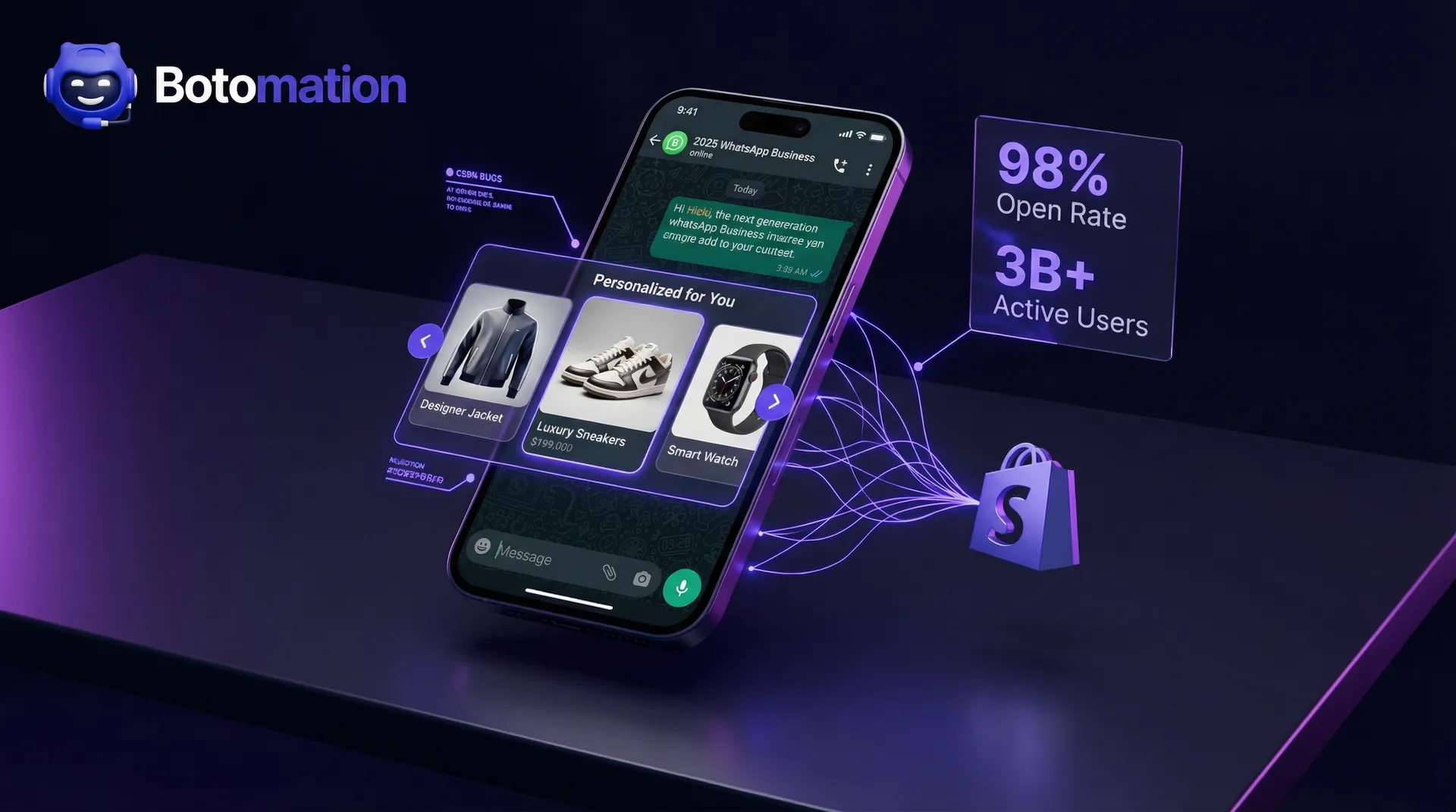
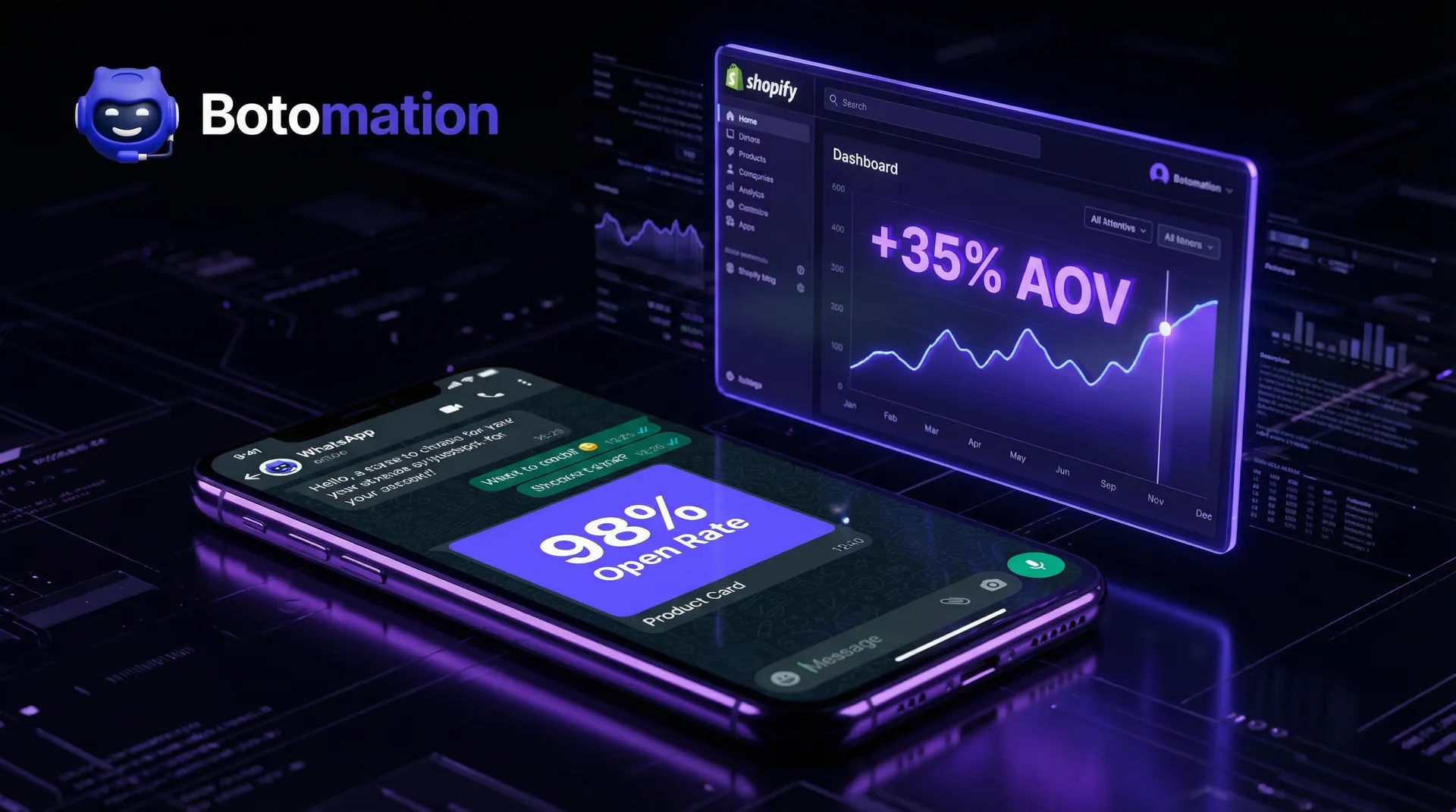
The landscape of digital commerce has shifted dramatically as we move through January 2026. With WhatsApp having surpassed 3 billion active users, the platform has evolved from a simple messaging app into a sophisticated global sales engine. For Shopify store owners and DTC brands, the 98% open rate of WhatsApp messages is no longer a secret; it is now a baseline requirement for market survival. The real competitive advantage currently lies in how effectively a brand can deploy the best whatsapp automation tools for ecommerce product recommendations to drive revenue without increasing headcount.
Recent updates to the WhatsApp Business API in late 2024 and throughout 2026 have introduced native support for advanced AI-driven product carousels and interactive catalogs. These features allow for a level of personalization that was previously reserved for high-end web experiences. Today, a customer can receive a tailored recommendation based on their specific browsing history, ask nuanced questions about sizing or materials, and complete a checkout—all within a single chat thread. This frictionless journey is exactly what modern consumers demand in a mobile-first economy.
While the technology is widely available, the challenge for most e-commerce managers is selecting the right stack. Tools like ZöTok, AiSensy, TheBotMode, and Zoko have all staked their claim in the market, each offering distinct strengths in recommendation logic and automation. However, simply purchasing a subscription to a tool is rarely sufficient to see a significant return. Success requires a strategic implementation that aligns your product data with real-time customer intent.
Our team at Botomation has observed that the most successful brands are moving away from generic broadcast messages. They are instead focusing on hyper-personalized "segments of one" where every recommendation feels like a suggestion from a professional personal shopper. By integrating sophisticated AI agents directly into your Shopify store, you can automate these complex interactions and transform your WhatsApp channel into your most profitable sales representative.
Comparing Top WhatsApp Automation Tools for Product Recommendations
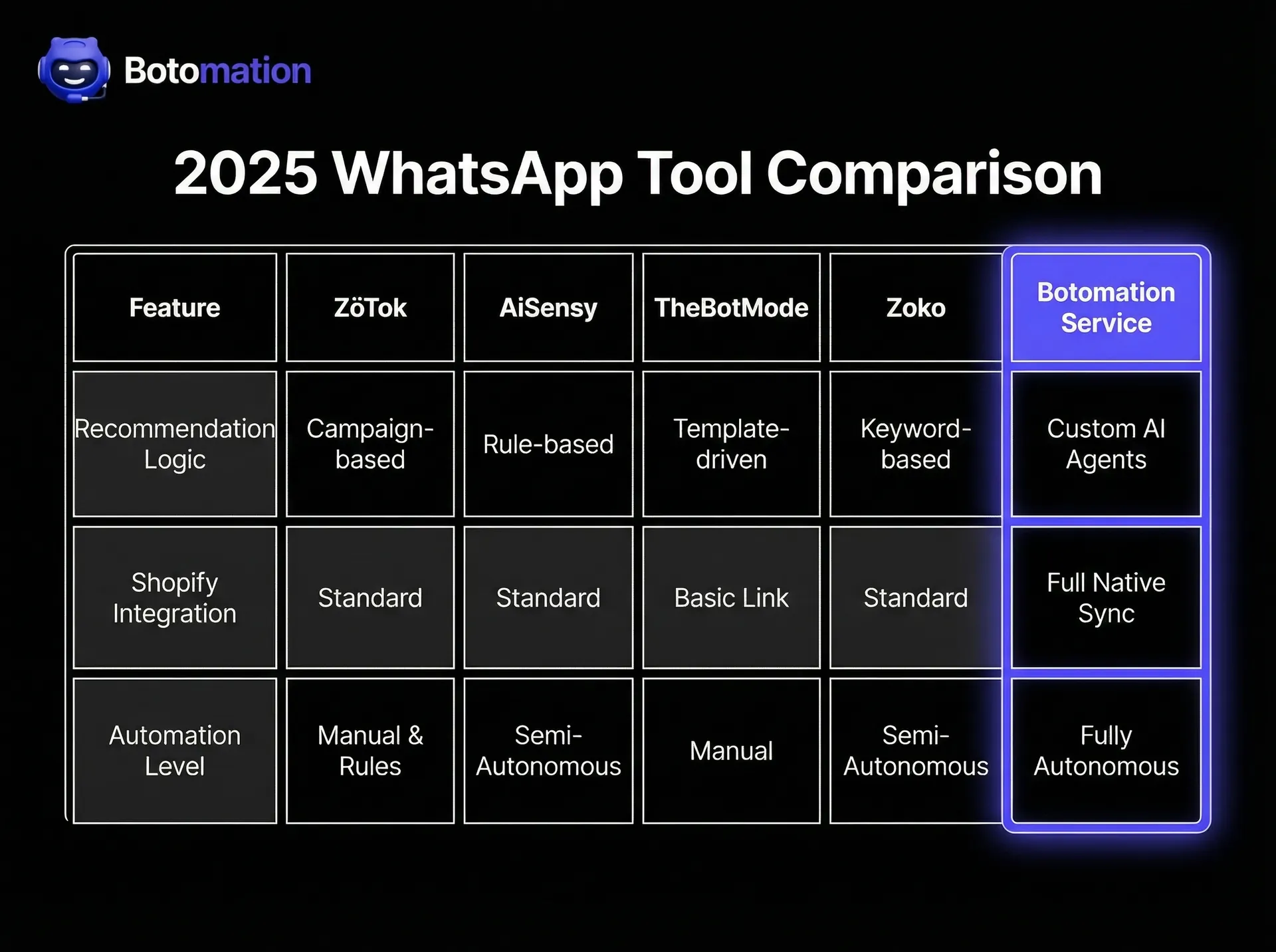
Selecting the best whatsapp automation tools for ecommerce product recommendations requires a deep understanding of how each platform handles data synchronization. In 2026, the distinction between a "chatbot" and an "AI agent" has become definitive. While a WhatsApp AI chatbot for e-commerce customer support can handle basic tasks, a true AI agent, like those we implement at Botomation, understands context and adapts to the user. When comparing platforms, you must look beyond the sticker price and evaluate the underlying machine learning capabilities that drive their recommendation engines.
Most off-the-shelf tools provide a basic integration with Shopify, allowing you to pull your product catalog into the WhatsApp environment. Implementing a Shopify WhatsApp integration for product suggestions ensures that your catalog is presented to users with the level of sophistication required for modern commerce. Some tools rely on manual triggers or simple "if-then" logic, which quickly becomes unmanageable as your SKU count grows. Others utilize more advanced algorithms that can predict what a customer might want based on their previous three purchases and current seasonal trends.
Scalability is another critical factor that separates the market leaders from the followers. A tool that works for a small boutique with fifty orders a month will likely crumble under the weight of a Black Friday surge for a major DTC brand. You need a solution that can handle thousands of concurrent conversations without latency. Furthermore, the ability to track the direct impact of a recommendation on your bottom line is essential for justifying the investment.
| Feature | ZöTok | AiSensy | TheBotMode | Zoko | Botomation Service |
|---|---|---|---|---|---|
| Recommendation Logic | Campaign-based | Algorithm-driven | Conversational AI | Post-purchase focus | Custom AI Agents |
| Shopify Integration | Deep | Standard | API-heavy | Plugin-based | Full Native Sync |
| Automation Level | High | Medium | High | Medium | Fully Autonomous |
| Setup Complexity | Moderate | Low | High | Low | Handled by Experts |
| Primary Strength | Bulk Campaigns | User Segmentation | Natural Language | Upsell Workflows | Revenue Optimization |
ZöTok and AiSensy Feature Analysis
ZöTok has gained significant traction in 2026 through its ZöCampaign feature, which focuses heavily on automating the recommendation process via scheduled broadcasts. It allows merchants to create segments based on purchase history and then push out tailored product carousels. While effective for massive sales events, it can sometimes feel less personal than a true one-on-one conversation. Their Shopify integration is stable, but it often requires manual oversight to ensure the right products are being shown to the right people.
AiSensy, on the other hand, has invested heavily in its AI-powered personalization algorithms. They offer a more dynamic approach where the system learns from user interactions over time. This makes it one of the better choices for brands that have a high volume of repeat customers. Their analytics dashboard provides a clear view of how different recommendation sets are performing, though the initial configuration of these "smart" segments can be a hurdle for teams without a dedicated technical lead.
TheBotMode and Zoko Capabilities
TheBotMode differentiates itself by focusing on the conversational aspect of the shopping experience. Instead of just pushing a product link, their system uses natural language processing to understand why a customer is looking for a specific item. This allows for a much more natural recommendation flow, such as suggesting a matching accessory when a customer asks about a dress. However, this level of sophistication often comes with a higher technical requirement for setup and maintenance.
Zoko remains a popular choice for smaller e-commerce entities that want to focus specifically on post-purchase upsells. You can automate Shopify post-purchase follow-up with an AI chatbot to trigger messages immediately after checkout, suggesting complementary items that can be added to the existing order. While it lacks the broad AI capabilities of more expensive platforms, it excels at this one specific high-value task. The onboarding process is relatively quick, making it an attractive "quick win" for stores just starting their WhatsApp journey.
How AI Powered Recommendation Features Work in 2026
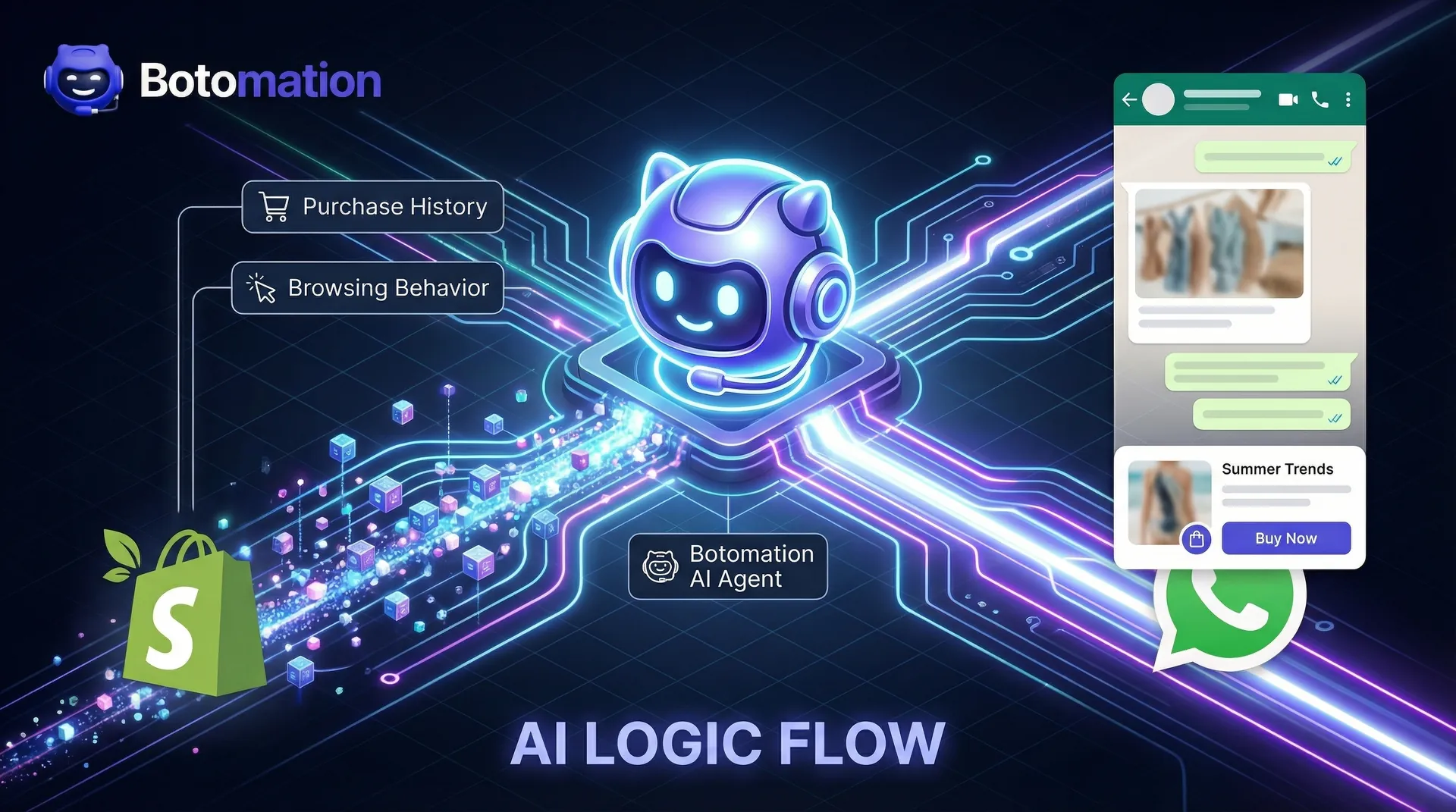
The core of any successful recommendation strategy in late 2026 is the underlying machine learning model. We have moved past simple keyword matching. Modern AI agents now utilize GPT-5 level processing to understand the nuance of a customer's request. If a customer says they need something "sophisticated for a late-autumn wedding," the best whatsapp automation tools for ecommerce product recommendations don't just search for "wedding" in the tags; they understand the aesthetic requirements of that specific context.
These tools now employ complex collaborative filtering, which analyzes patterns across your entire customer base to find similarities. If Customer A and Customer B both bought a specific leather jacket, and Customer A then bought a certain pair of boots, the AI will intelligently suggest those boots to Customer B. This "people also bought" logic is now executed in real-time within the WhatsApp chat, creating a highly persuasive shopping environment.
### 2026 E-commerce Performance Stats
* Average WhatsApp Open Rate: 98.2%
* AOV Increase with AI Recommendations: 35%
* Post-Purchase Conversion Rate: 12.4%
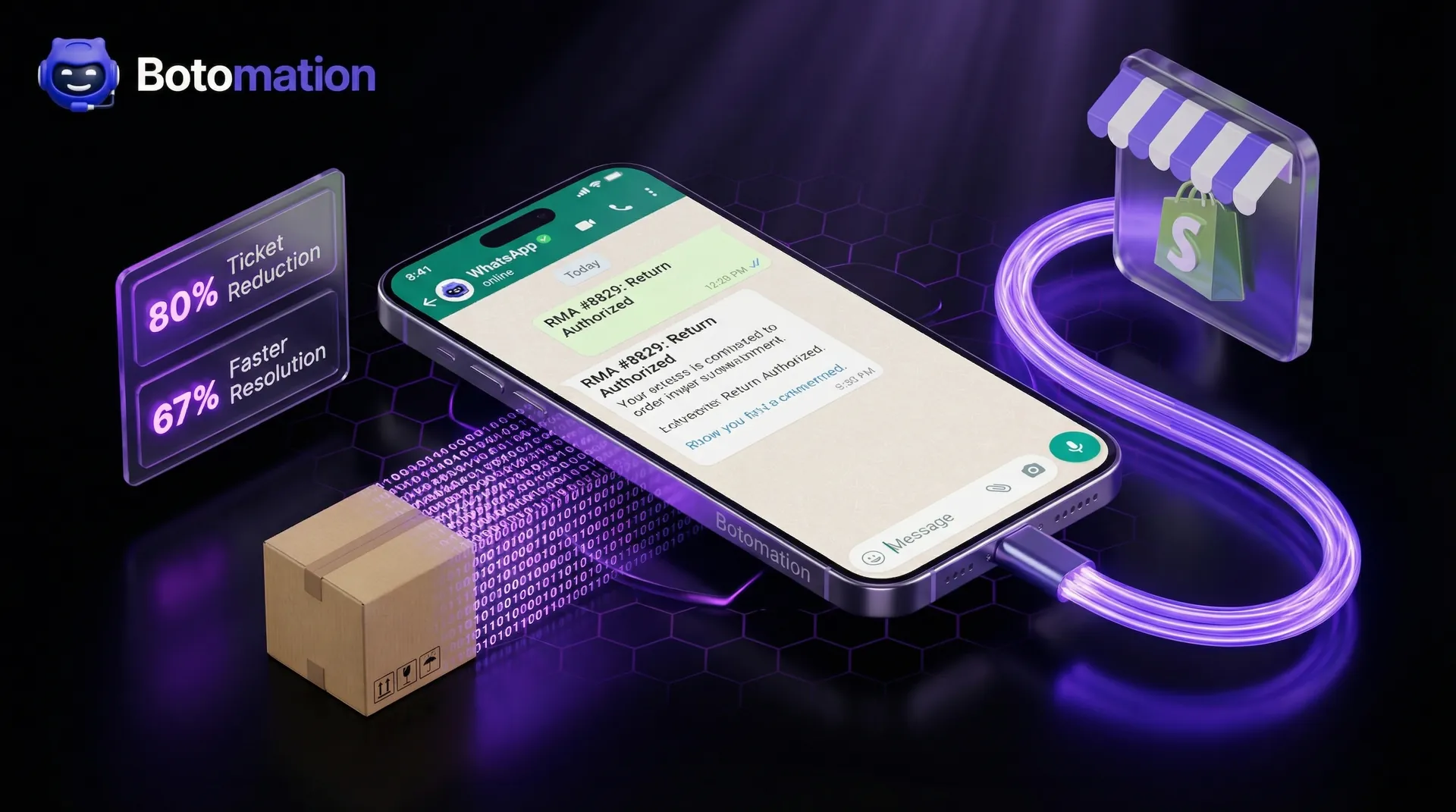
* Reduction in Manual Support Tickets: 80%
Implementing these features correctly can increase Shopify AOV by 35% in 2026. This isn't just a theoretical number; it is the result of moving from passive order taking to active, intelligent selling. By analyzing browsing data and purchase history simultaneously, the AI can present the right product at the exact moment the customer is most likely to buy. This level of precision is why the "Old Way" of manual marketing is rapidly becoming obsolete.
Machine Learning Capabilities
The most advanced platforms currently use hybrid AI models that combine content-based filtering with behavioral analysis. Content-based filtering looks at the attributes of the products themselves—color, material, price point—to find matches. Behavioral analysis looks at what the user is actually doing. If a user spends three minutes looking at high-end watches on your Shopify site, the AI agent on WhatsApp will prioritize your luxury collection in its recommendations.
This real-time learning is what makes the 2026 iteration of these tools so powerful. The system doesn't wait for a weekly data sync; it updates its understanding of the customer with every click and every message. Our experts at Botomation focus on fine-tuning these models so that they don't just recommend products, but do so in a way that aligns with your brand's unique voice and tone. This ensures that the automation never feels "robotic" or intrusive.
Personalization Techniques
Personalization in 2026 goes far beyond just using the customer's first name. It involves demographic-based suggestions that account for local trends, weather patterns, and even current social media movements. If a specific style is trending in Mexico City, the AI can automatically prioritize those items for customers located in that region. This level of localized intelligence is a major driver of conversion rates for international DTC brands.
Furthermore, the optimization of cross-selling and upselling algorithms has become much more subtle. Instead of a jarring "Buy This Too" message, the AI weaves the recommendation into the natural flow of the support or sales conversation. It might mention that a certain skincare product works best when paired with a specific cleanser the customer just asked about. This helpful, consultative approach builds trust and long-term customer lifetime value (LTV) rather than just a one-time sale.
The Implementation Process for Your New Automation Tool
Deploying the best whatsapp automation tools for ecommerce product recommendations is a multi-stage process that requires both technical precision and strategic planning. You cannot simply flip a switch and expect your revenue to double. The first step involves securing your WhatsApp Business API credentials, which is a more rigorous process than setting up a standard business account. This ensures your brand is verified and can handle the high messaging volumes required for automated recommendations.
Once the API is active, the focus shifts to the deep integration with your e-commerce platform, typically Shopify. This isn't just about syncing a product list; it's about mapping every data point from your store to the AI's logic. This includes inventory levels, pricing tiers, customer tags, and historical order data. Without this deep data connection, your recommendations will be generic and likely irrelevant to the customer's actual needs.
Technical specifications also include setting up webhooks that trigger specific AI behaviors. For example, when a customer abandons a cart, a webhook should notify the WhatsApp AI agent to initiate a recovery sequence. Brands can recover 70% of abandoned carts on Shopify with WhatsApp automation by including personalized recommendations or limited-time incentives in the follow-up. Managing these technical layers is where many brands struggle, often resulting in broken experiences that frustrate customers. This is why partnering with an agency like Botomation is a strategic move to ensure a flawless execution.
Setup and Onboarding Process
The onboarding journey starts with account verification and the creation of message templates that comply with Meta's strict guidelines. These templates must be carefully crafted to be engaging while still meeting the technical requirements for automated approval. Once the foundation is laid, the Shopify integration is established, allowing for a two-way flow of information. The AI needs to know when a product is out of stock so it doesn't recommend items that can't be fulfilled.
Customizing the recommendation algorithms is the next critical phase. This involves setting the "rules of engagement" for the AI agents. You might decide that the AI should never recommend a lower-priced item when a customer is looking at a premium product, or that it should prioritize high-margin items during a specific promotional period. These business rules are layered on top of the machine learning models to ensure the automation serves your specific financial goals.
Configuration and Optimization
After the initial setup, the AI model requires a period of training using your historical store data. By feeding the system your last twelve months of sales and interaction history, it can begin to identify the patterns that lead to successful conversions. This training phase is essential for the AI to understand the nuances of your specific niche, whether you are selling high-fashion apparel or technical hardware.
Continuous performance monitoring is the final, ongoing step in the configuration process. You must regularly review how the recommendation algorithms are performing and adjust the parameters as needed. This might involve A/B testing different recommendation styles or changing the timing of follow-up messages. Our team provides this level of constant optimization, ensuring that your automation stack never becomes stagnant or outdated in the fast-moving 2026 market.
Understanding the Pricing and ROI of WhatsApp Tools
When evaluating the cost of the best whatsapp automation tools for ecommerce product recommendations, it is vital to look at the total cost of ownership. Most platforms operate on a tiered subscription model, often starting around $200 to $500 per month for basic features, but quickly scaling as your contact list and message volume grow. In 2026, many providers have also introduced AI surcharges for access to their most advanced recommendation engines and GPT-5 integrations.
However, the real way to view these costs is through the lens of Return on Investment (ROI). If a tool costs you $1,000 a month but generates an additional $15,000 in revenue through recovered carts and upsells, the cost is negligible. The math is straightforward: if your current AOV is $100 and the AI increases it to $135 (a standard 35% lift), you only need a small percentage of your customers to engage with the recommendations to see a massive return.
| Expense Category | Estimated Monthly Cost | Potential Revenue Lift |
|---|---|---|
| Platform Subscription | $300 - $1,200 | N/A |
| Meta Conversation Fees | Variable (per chat) | N/A |
| AI Integration & Management | $1,500 - $5,000 | 25% - 40% AOV Increase |
| Support Labor Savings | ($2,500) Saved | N/A |
Calculating the reduction in customer acquisition costs (CAC) is another part of the ROI equation. Because WhatsApp allows for direct, personalized communication, you can often re-engage existing customers at a fraction of the cost of running new Facebook or Google ads. By using intelligent recommendations to drive repeat purchases, you are significantly increasing the Lifetime Value (LTV) of every customer you acquire, making your entire marketing spend more efficient.
Subscription Models and Pricing Tiers
Most SaaS tools in this space offer a "Starter" tier that includes basic broadcast features and a limited number of contacts. As you move up to "Pro" or "Enterprise" levels, you gain access to the advanced AI features we have been discussing. These higher tiers are usually where the real value lies for e-commerce brands, as they include the machine learning capabilities necessary for truly effective product recommendations. It is important to carefully check the fine print regarding message limits and additional fees for API calls.
Enterprise solutions are often custom-quoted and include dedicated support and higher rate limits for messaging. For a brand doing millions in annual revenue, these enterprise plans are necessary to ensure the stability of the channel. While the upfront cost is higher, the level of customization and the ability to integrate with complex back-end systems (like ERPs or custom CRMs) provide a level of utility that basic tools simply cannot match.
ROI Calculation and Value Analysis
To truly understand the value, let's look at a practical calculation. Suppose a store has 5,000 monthly active customers on WhatsApp. Without automation, perhaps 2% of them make a repeat purchase each month. With the best whatsapp automation tools for ecommerce product recommendations, that repeat purchase rate often jumps to 5% or 6%. That is an additional 150 to 200 orders per month purely from intelligent re-engagement.
If those extra orders have a 35% higher AOV due to smart upselling, the revenue impact is substantial. Furthermore, you must factor in the soft ROI of reduced support overhead. If our AI agents at Botomation are handling 80% of routine inquiries about order status and product details, your human team is free to focus on high-value sales. This strategy can reduce Shopify support tickets by 78% with WhatsApp automation, providing significant operational relief. This efficiency gain is often enough to cover the entire cost of the automation service on its own.
Tracking Analytics and Performance for Real Growth
In the data-driven world of January 2026, feeling like your recommendations are working is not enough. You need granular analytics that show exactly how every message contributes to your bottom line. The best whatsapp automation tools for ecommerce product recommendations provide detailed tracking of KPIs such as CTR and conversion rates. Beyond sales, you can also automate Shopify order tracking via WhatsApp to provide a complete customer experience while tracking engagement across every touchpoint.
One of the most important metrics to watch is the Recommendation Accuracy score. This is a measure of how often a customer actually interacts with or purchases a suggested item. If this score is low, it indicates that your AI model needs further training or that your product tags are not correctly aligned with customer intent. By constantly iterating on these data points, you can refine your strategy to ensure that every message sent is as relevant as possible.
Effective performance tracking also involves monitoring customer sentiment. Modern analytics tools can use natural language processing to determine if customers are finding the recommendations helpful or annoying. If the sentiment starts to trend negative, it is a sign that you are messaging too frequently or that your recommendations are missing the mark. Balancing sales drive with a positive user experience is the key to long-term success on a personal platform like WhatsApp.
Performance Metrics and KPIs
Click-through rate (CTR) is your first major hurdle. If customers aren't clicking on the product carousels, the rest of the funnel doesn't matter. In 2026, a healthy CTR for a personalized WhatsApp recommendation is typically between 15% and 25%, which is significantly higher than email or SMS. If your rates are lower, it usually suggests a problem with the hook or the initial personalization of the message.
Conversion rate from recommendation to purchase is the ultimate KPI. This tells you if the AI is actually closing the deal. We typically look for a conversion rate of at least 8% to 12% on these targeted messages. When combined with an increase in Average Order Value, these metrics provide a clear picture of the channel's health. Tracking these numbers in real-time allows you to pivot quickly if a certain product line or promotional strategy isn't resonating with your audience.
Analytics Integration and Reporting
For a holistic view of your business, your WhatsApp analytics must be integrated with your Shopify dashboard and other external platforms like Google Analytics 4. This allows you to see the entire customer journey, from the first ad click to the final WhatsApp checkout. Understanding how these channels interact—for instance, how a WhatsApp recommendation might lead to a web purchase three days later—is crucial for accurate attribution.
Advanced reporting should also include predictive analytics. By looking at current engagement trends, the system can forecast future sales and identify which products are likely to be "hot" in the coming weeks. This information is invaluable for inventory planning and marketing strategy. Our team at Botomation specializes in setting up these custom reporting environments, giving you a clear, data-backed roadmap for your e-commerce growth.
Success Stories from the Front Lines of AI Commerce
The impact of intelligent automation is most evident when looking at real-world results. In early 2026, a group of mid-sized e-commerce brands began implementing these advanced AI recommendation tools to target their mobile-first audience. One fashion retailer reported a staggering 35% uplift in total sales within the first ninety days of deployment. By replacing their manual blast messages with AI-driven suggestions, they were able to recover 22% of their abandoned carts and significantly increase their repeat purchase rate.
Another case study involves a supplement brand that used post-purchase upsells to drive a 10% increase in AOV. Their AI agent would wait three days after a delivery and then reach out to the customer to ask how they liked the product, followed by a personalized recommendation for a complementary supplement. This check-in felt like high-touch customer service rather than a sales pitch, leading to a much higher conversion rate than traditional email follow-ups.
These success stories share a common thread: they moved away from the Old Way of generic marketing and embraced the New Way of AI-driven, personalized conversations. They didn't just buy a tool; they invested in a strategy that put the customer's needs at the center of the experience. By doing so, they transformed WhatsApp from a support burden into a primary revenue driver.
Quantified Success Stories
The numbers across the industry are consistent for those who execute correctly. We have seen brands recover up to 30% of lost sales through automated cart recovery sequences that include smart product alternatives. If an item is out of stock, the AI doesn't just stop; it suggests the closest match, often saving a sale that would have otherwise been lost to a competitor. This level of persistence, handled autonomously, is a game-changer for lean e-commerce teams.
In the post-purchase phase, the results are equally impressive. Brands reporting a 4% to 10% conversion rate on "thank you" page upsells are now seeing those numbers double when the offer is moved to a personalized WhatsApp message. The intimacy of the platform, combined with the timing of the AI, creates a perfect storm for conversion. These are the kinds of results that move the needle for a business and provide a massive competitive advantage in a crowded market.
Implementation Best Practices
To achieve these results, timing is everything. Sending a recommendation too soon can feel pushy, while waiting too long can mean the customer has already moved on. The best whatsapp automation tools for ecommerce product recommendations use behavioral triggers to find the ideal window for messaging. For example, initiating a conversation thirty minutes after a cart abandonment has proven to be the most effective window for recovery.
Catalog management is another often-overlooked best practice. Your AI is only as good as the data you give it. Ensuring that your Shopify products have detailed tags, high-quality images, and accurate descriptions is essential for the AI to make meaningful connections. Finally, always include an easy way for customers to opt-out or speak to a human. Maintaining the human element of the brand, even within an automated flow, is vital for preserving the trust that makes WhatsApp such a powerful tool in the first place.
Frequently Asked Questions
What makes WhatsApp better than email for product recommendations?
WhatsApp currently sees open rates of over 95%, whereas email often struggles to reach 20%. The real-time, conversational nature of WhatsApp allows for a back-and-forth interaction that email cannot replicate. This leads to higher engagement, faster decision-making, and significantly better conversion rates for personalized product suggestions.
How do I ensure my WhatsApp recommendations don't feel like spam?
The key is hyper-personalization and timing. By using the best whatsapp automation tools for ecommerce product recommendations, you ensure that every message is based on the customer's actual behavior and needs. When a message is relevant and helpful—such as suggesting a matching item for a recent purchase—it is viewed as a service rather than an interruption.
Can these tools handle international customers and different languages?
Yes, the advanced AI agents we use in 2026 are multilingual and can automatically detect and respond in the customer's preferred language. They can also adjust recommendations based on regional availability, currency, and local trends, making them ideal for brands with a global footprint.
How much time does it take to manage these AI agents?
While the initial setup is intensive, the goal of a Botomation integration is to create a fully autonomous system. Once the rules of engagement are set and the AI is trained on your data, the system handles the vast majority of interactions without human intervention. Your team only needs to step in for complex customer service issues that the AI flags for human attention.
The shift toward automated, AI-driven commerce is no longer a future prediction—it is the current reality of January 2026. Choosing the best whatsapp automation tools for ecommerce product recommendations is a foundational step, but the real magic happens in the implementation. A tool is just software, but a strategically deployed AI agent is a high-performing employee that never sleeps, never misses a lead, and constantly learns how to sell your products more effectively.
By moving away from manual processes and embracing the New Way of autonomous commerce, you can achieve the 35% AOV increases and 80% support ticket reductions that are now possible. The gap between the brands that use these tools and those that don't is widening every day. Don't let your store fall behind because you're tied to the Old Way of doing things. Partnering with the experts at Botomation ensures that your Shopify store is at the absolute forefront of this technological revolution.
Ready to automate your growth? Book a call below.
The landscape of digital commerce has shifted dramatically as we move through January 2026. With WhatsApp having surpassed 3 billion active users, the platform has evolved from a simple messaging app into a sophisticated global sales engine. For Shopify store owners and DTC brands, the 98% open rate of WhatsApp messages is no longer a secret; it is now a baseline requirement for market survival. The real competitive advantage currently lies in how effectively a brand can deploy the best whatsapp automation tools for ecommerce product recommendations to drive revenue without increasing headcount.
Recent updates to the WhatsApp Business API in late 2024 and throughout 2026 have introduced native support for advanced AI-driven product carousels and interactive catalogs. These features allow for a level of personalization that was previously reserved for high-end web experiences. Today, a customer can receive a tailored recommendation based on their specific browsing history, ask nuanced questions about sizing or materials, and complete a checkout—all within a single chat thread. This frictionless journey is exactly what modern consumers demand in a mobile-first economy.
While the technology is widely available, the challenge for most e-commerce managers is selecting the right stack. Tools like ZöTok, AiSensy, TheBotMode, and Zoko have all staked their claim in the market, each offering distinct strengths in recommendation logic and automation. However, simply purchasing a subscription to a tool is rarely sufficient to see a significant return. Success requires a strategic implementation that aligns your product data with real-time customer intent.
Our team at Botomation has observed that the most successful brands are moving away from generic broadcast messages. They are instead focusing on hyper-personalized "segments of one" where every recommendation feels like a suggestion from a professional personal shopper. By integrating sophisticated AI agents directly into your Shopify store, you can automate these complex interactions and transform your WhatsApp channel into your most profitable sales representative.
Comparing Top WhatsApp Automation Tools for Product Recommendations
Selecting the best whatsapp automation tools for ecommerce product recommendations requires a deep understanding of how each platform handles data synchronization. In 2026, the distinction between a "chatbot" and an "AI agent" has become definitive. While a WhatsApp AI chatbot for e-commerce customer support can handle basic tasks, a true AI agent, like those we implement at Botomation, understands context and adapts to the user. When comparing platforms, you must look beyond the sticker price and evaluate the underlying machine learning capabilities that drive their recommendation engines.
Most off-the-shelf tools provide a basic integration with Shopify, allowing you to pull your product catalog into the WhatsApp environment. Implementing a Shopify WhatsApp integration for product suggestions ensures that your catalog is presented to users with the level of sophistication required for modern commerce. Some tools rely on manual triggers or simple "if-then" logic, which quickly becomes unmanageable as your SKU count grows. Others utilize more advanced algorithms that can predict what a customer might want based on their previous three purchases and current seasonal trends.
Scalability is another critical factor that separates the market leaders from the followers. A tool that works for a small boutique with fifty orders a month will likely crumble under the weight of a Black Friday surge for a major DTC brand. You need a solution that can handle thousands of concurrent conversations without latency. Furthermore, the ability to track the direct impact of a recommendation on your bottom line is essential for justifying the investment.
| Feature | ZöTok | AiSensy | TheBotMode | Zoko | Botomation Service |
|---|---|---|---|---|---|
| Recommendation Logic | Campaign-based | Algorithm-driven | Conversational AI | Post-purchase focus | Custom AI Agents |
| Shopify Integration | Deep | Standard | API-heavy | Plugin-based | Full Native Sync |
| Automation Level | High | Medium | High | Medium | Fully Autonomous |
| Setup Complexity | Moderate | Low | High | Low | Handled by Experts |
| Primary Strength | Bulk Campaigns | User Segmentation | Natural Language | Upsell Workflows | Revenue Optimization |
ZöTok and AiSensy Feature Analysis
ZöTok has gained significant traction in 2026 through its ZöCampaign feature, which focuses heavily on automating the recommendation process via scheduled broadcasts. It allows merchants to create segments based on purchase history and then push out tailored product carousels. While effective for massive sales events, it can sometimes feel less personal than a true one-on-one conversation. Their Shopify integration is stable, but it often requires manual oversight to ensure the right products are being shown to the right people.
AiSensy, on the other hand, has invested heavily in its AI-powered personalization algorithms. They offer a more dynamic approach where the system learns from user interactions over time. This makes it one of the better choices for brands that have a high volume of repeat customers. Their analytics dashboard provides a clear view of how different recommendation sets are performing, though the initial configuration of these "smart" segments can be a hurdle for teams without a dedicated technical lead.
TheBotMode and Zoko Capabilities
TheBotMode differentiates itself by focusing on the conversational aspect of the shopping experience. Instead of just pushing a product link, their system uses natural language processing to understand why a customer is looking for a specific item. This allows for a much more natural recommendation flow, such as suggesting a matching accessory when a customer asks about a dress. However, this level of sophistication often comes with a higher technical requirement for setup and maintenance.
Zoko remains a popular choice for smaller e-commerce entities that want to focus specifically on post-purchase upsells. You can automate Shopify post-purchase follow-up with an AI chatbot to trigger messages immediately after checkout, suggesting complementary items that can be added to the existing order. While it lacks the broad AI capabilities of more expensive platforms, it excels at this one specific high-value task. The onboarding process is relatively quick, making it an attractive "quick win" for stores just starting their WhatsApp journey.
How AI Powered Recommendation Features Work in 2026
The core of any successful recommendation strategy in late 2026 is the underlying machine learning model. We have moved past simple keyword matching. Modern AI agents now utilize GPT-5 level processing to understand the nuance of a customer's request. If a customer says they need something "sophisticated for a late-autumn wedding," the best whatsapp automation tools for ecommerce product recommendations don't just search for "wedding" in the tags; they understand the aesthetic requirements of that specific context.
These tools now employ complex collaborative filtering, which analyzes patterns across your entire customer base to find similarities. If Customer A and Customer B both bought a specific leather jacket, and Customer A then bought a certain pair of boots, the AI will intelligently suggest those boots to Customer B. This "people also bought" logic is now executed in real-time within the WhatsApp chat, creating a highly persuasive shopping environment.
### 2026 E-commerce Performance Stats
* Average WhatsApp Open Rate: 98.2%
* AOV Increase with AI Recommendations: 35%
* Post-Purchase Conversion Rate: 12.4%
* Reduction in Manual Support Tickets: 80%
Implementing these features correctly can increase Shopify AOV by 35% in 2026. This isn't just a theoretical number; it is the result of moving from passive order taking to active, intelligent selling. By analyzing browsing data and purchase history simultaneously, the AI can present the right product at the exact moment the customer is most likely to buy. This level of precision is why the "Old Way" of manual marketing is rapidly becoming obsolete.
Machine Learning Capabilities
The most advanced platforms currently use hybrid AI models that combine content-based filtering with behavioral analysis. Content-based filtering looks at the attributes of the products themselves—color, material, price point—to find matches. Behavioral analysis looks at what the user is actually doing. If a user spends three minutes looking at high-end watches on your Shopify site, the AI agent on WhatsApp will prioritize your luxury collection in its recommendations.
This real-time learning is what makes the 2026 iteration of these tools so powerful. The system doesn't wait for a weekly data sync; it updates its understanding of the customer with every click and every message. Our experts at Botomation focus on fine-tuning these models so that they don't just recommend products, but do so in a way that aligns with your brand's unique voice and tone. This ensures that the automation never feels "robotic" or intrusive.
Personalization Techniques
Personalization in 2026 goes far beyond just using the customer's first name. It involves demographic-based suggestions that account for local trends, weather patterns, and even current social media movements. If a specific style is trending in Mexico City, the AI can automatically prioritize those items for customers located in that region. This level of localized intelligence is a major driver of conversion rates for international DTC brands.
Furthermore, the optimization of cross-selling and upselling algorithms has become much more subtle. Instead of a jarring "Buy This Too" message, the AI weaves the recommendation into the natural flow of the support or sales conversation. It might mention that a certain skincare product works best when paired with a specific cleanser the customer just asked about. This helpful, consultative approach builds trust and long-term customer lifetime value (LTV) rather than just a one-time sale.
The Implementation Process for Your New Automation Tool
Deploying the best whatsapp automation tools for ecommerce product recommendations is a multi-stage process that requires both technical precision and strategic planning. You cannot simply flip a switch and expect your revenue to double. The first step involves securing your WhatsApp Business API credentials, which is a more rigorous process than setting up a standard business account. This ensures your brand is verified and can handle the high messaging volumes required for automated recommendations.
Once the API is active, the focus shifts to the deep integration with your e-commerce platform, typically Shopify. This isn't just about syncing a product list; it's about mapping every data point from your store to the AI's logic. This includes inventory levels, pricing tiers, customer tags, and historical order data. Without this deep data connection, your recommendations will be generic and likely irrelevant to the customer's actual needs.
Technical specifications also include setting up webhooks that trigger specific AI behaviors. For example, when a customer abandons a cart, a webhook should notify the WhatsApp AI agent to initiate a recovery sequence. Brands can recover 70% of abandoned carts on Shopify with WhatsApp automation by including personalized recommendations or limited-time incentives in the follow-up. Managing these technical layers is where many brands struggle, often resulting in broken experiences that frustrate customers. This is why partnering with an agency like Botomation is a strategic move to ensure a flawless execution.
Setup and Onboarding Process
The onboarding journey starts with account verification and the creation of message templates that comply with Meta's strict guidelines. These templates must be carefully crafted to be engaging while still meeting the technical requirements for automated approval. Once the foundation is laid, the Shopify integration is established, allowing for a two-way flow of information. The AI needs to know when a product is out of stock so it doesn't recommend items that can't be fulfilled.
Customizing the recommendation algorithms is the next critical phase. This involves setting the "rules of engagement" for the AI agents. You might decide that the AI should never recommend a lower-priced item when a customer is looking at a premium product, or that it should prioritize high-margin items during a specific promotional period. These business rules are layered on top of the machine learning models to ensure the automation serves your specific financial goals.
Configuration and Optimization
After the initial setup, the AI model requires a period of training using your historical store data. By feeding the system your last twelve months of sales and interaction history, it can begin to identify the patterns that lead to successful conversions. This training phase is essential for the AI to understand the nuances of your specific niche, whether you are selling high-fashion apparel or technical hardware.
Continuous performance monitoring is the final, ongoing step in the configuration process. You must regularly review how the recommendation algorithms are performing and adjust the parameters as needed. This might involve A/B testing different recommendation styles or changing the timing of follow-up messages. Our team provides this level of constant optimization, ensuring that your automation stack never becomes stagnant or outdated in the fast-moving 2026 market.
Understanding the Pricing and ROI of WhatsApp Tools
When evaluating the cost of the best whatsapp automation tools for ecommerce product recommendations, it is vital to look at the total cost of ownership. Most platforms operate on a tiered subscription model, often starting around $200 to $500 per month for basic features, but quickly scaling as your contact list and message volume grow. In 2026, many providers have also introduced AI surcharges for access to their most advanced recommendation engines and GPT-5 integrations.
However, the real way to view these costs is through the lens of Return on Investment (ROI). If a tool costs you $1,000 a month but generates an additional $15,000 in revenue through recovered carts and upsells, the cost is negligible. The math is straightforward: if your current AOV is $100 and the AI increases it to $135 (a standard 35% lift), you only need a small percentage of your customers to engage with the recommendations to see a massive return.
| Expense Category | Estimated Monthly Cost | Potential Revenue Lift |
|---|---|---|
| Platform Subscription | $300 - $1,200 | N/A |
| Meta Conversation Fees | Variable (per chat) | N/A |
| AI Integration & Management | $1,500 - $5,000 | 25% - 40% AOV Increase |
| Support Labor Savings | ($2,500) Saved | N/A |
Calculating the reduction in customer acquisition costs (CAC) is another part of the ROI equation. Because WhatsApp allows for direct, personalized communication, you can often re-engage existing customers at a fraction of the cost of running new Facebook or Google ads. By using intelligent recommendations to drive repeat purchases, you are significantly increasing the Lifetime Value (LTV) of every customer you acquire, making your entire marketing spend more efficient.
Subscription Models and Pricing Tiers
Most SaaS tools in this space offer a "Starter" tier that includes basic broadcast features and a limited number of contacts. As you move up to "Pro" or "Enterprise" levels, you gain access to the advanced AI features we have been discussing. These higher tiers are usually where the real value lies for e-commerce brands, as they include the machine learning capabilities necessary for truly effective product recommendations. It is important to carefully check the fine print regarding message limits and additional fees for API calls.
Enterprise solutions are often custom-quoted and include dedicated support and higher rate limits for messaging. For a brand doing millions in annual revenue, these enterprise plans are necessary to ensure the stability of the channel. While the upfront cost is higher, the level of customization and the ability to integrate with complex back-end systems (like ERPs or custom CRMs) provide a level of utility that basic tools simply cannot match.
ROI Calculation and Value Analysis
To truly understand the value, let's look at a practical calculation. Suppose a store has 5,000 monthly active customers on WhatsApp. Without automation, perhaps 2% of them make a repeat purchase each month. With the best whatsapp automation tools for ecommerce product recommendations, that repeat purchase rate often jumps to 5% or 6%. That is an additional 150 to 200 orders per month purely from intelligent re-engagement.
If those extra orders have a 35% higher AOV due to smart upselling, the revenue impact is substantial. Furthermore, you must factor in the soft ROI of reduced support overhead. If our AI agents at Botomation are handling 80% of routine inquiries about order status and product details, your human team is free to focus on high-value sales. This strategy can reduce Shopify support tickets by 78% with WhatsApp automation, providing significant operational relief. This efficiency gain is often enough to cover the entire cost of the automation service on its own.
Tracking Analytics and Performance for Real Growth
In the data-driven world of January 2026, feeling like your recommendations are working is not enough. You need granular analytics that show exactly how every message contributes to your bottom line. The best whatsapp automation tools for ecommerce product recommendations provide detailed tracking of KPIs such as CTR and conversion rates. Beyond sales, you can also automate Shopify order tracking via WhatsApp to provide a complete customer experience while tracking engagement across every touchpoint.
One of the most important metrics to watch is the Recommendation Accuracy score. This is a measure of how often a customer actually interacts with or purchases a suggested item. If this score is low, it indicates that your AI model needs further training or that your product tags are not correctly aligned with customer intent. By constantly iterating on these data points, you can refine your strategy to ensure that every message sent is as relevant as possible.
Effective performance tracking also involves monitoring customer sentiment. Modern analytics tools can use natural language processing to determine if customers are finding the recommendations helpful or annoying. If the sentiment starts to trend negative, it is a sign that you are messaging too frequently or that your recommendations are missing the mark. Balancing sales drive with a positive user experience is the key to long-term success on a personal platform like WhatsApp.
Performance Metrics and KPIs
Click-through rate (CTR) is your first major hurdle. If customers aren't clicking on the product carousels, the rest of the funnel doesn't matter. In 2026, a healthy CTR for a personalized WhatsApp recommendation is typically between 15% and 25%, which is significantly higher than email or SMS. If your rates are lower, it usually suggests a problem with the hook or the initial personalization of the message.
Conversion rate from recommendation to purchase is the ultimate KPI. This tells you if the AI is actually closing the deal. We typically look for a conversion rate of at least 8% to 12% on these targeted messages. When combined with an increase in Average Order Value, these metrics provide a clear picture of the channel's health. Tracking these numbers in real-time allows you to pivot quickly if a certain product line or promotional strategy isn't resonating with your audience.
Analytics Integration and Reporting
For a holistic view of your business, your WhatsApp analytics must be integrated with your Shopify dashboard and other external platforms like Google Analytics 4. This allows you to see the entire customer journey, from the first ad click to the final WhatsApp checkout. Understanding how these channels interact—for instance, how a WhatsApp recommendation might lead to a web purchase three days later—is crucial for accurate attribution.
Advanced reporting should also include predictive analytics. By looking at current engagement trends, the system can forecast future sales and identify which products are likely to be "hot" in the coming weeks. This information is invaluable for inventory planning and marketing strategy. Our team at Botomation specializes in setting up these custom reporting environments, giving you a clear, data-backed roadmap for your e-commerce growth.
Success Stories from the Front Lines of AI Commerce
The impact of intelligent automation is most evident when looking at real-world results. In early 2026, a group of mid-sized e-commerce brands began implementing these advanced AI recommendation tools to target their mobile-first audience. One fashion retailer reported a staggering 35% uplift in total sales within the first ninety days of deployment. By replacing their manual blast messages with AI-driven suggestions, they were able to recover 22% of their abandoned carts and significantly increase their repeat purchase rate.
Another case study involves a supplement brand that used post-purchase upsells to drive a 10% increase in AOV. Their AI agent would wait three days after a delivery and then reach out to the customer to ask how they liked the product, followed by a personalized recommendation for a complementary supplement. This check-in felt like high-touch customer service rather than a sales pitch, leading to a much higher conversion rate than traditional email follow-ups.
These success stories share a common thread: they moved away from the Old Way of generic marketing and embraced the New Way of AI-driven, personalized conversations. They didn't just buy a tool; they invested in a strategy that put the customer's needs at the center of the experience. By doing so, they transformed WhatsApp from a support burden into a primary revenue driver.
Quantified Success Stories
The numbers across the industry are consistent for those who execute correctly. We have seen brands recover up to 30% of lost sales through automated cart recovery sequences that include smart product alternatives. If an item is out of stock, the AI doesn't just stop; it suggests the closest match, often saving a sale that would have otherwise been lost to a competitor. This level of persistence, handled autonomously, is a game-changer for lean e-commerce teams.
In the post-purchase phase, the results are equally impressive. Brands reporting a 4% to 10% conversion rate on "thank you" page upsells are now seeing those numbers double when the offer is moved to a personalized WhatsApp message. The intimacy of the platform, combined with the timing of the AI, creates a perfect storm for conversion. These are the kinds of results that move the needle for a business and provide a massive competitive advantage in a crowded market.
Implementation Best Practices
To achieve these results, timing is everything. Sending a recommendation too soon can feel pushy, while waiting too long can mean the customer has already moved on. The best whatsapp automation tools for ecommerce product recommendations use behavioral triggers to find the ideal window for messaging. For example, initiating a conversation thirty minutes after a cart abandonment has proven to be the most effective window for recovery.
Catalog management is another often-overlooked best practice. Your AI is only as good as the data you give it. Ensuring that your Shopify products have detailed tags, high-quality images, and accurate descriptions is essential for the AI to make meaningful connections. Finally, always include an easy way for customers to opt-out or speak to a human. Maintaining the human element of the brand, even within an automated flow, is vital for preserving the trust that makes WhatsApp such a powerful tool in the first place.
Frequently Asked Questions
What makes WhatsApp better than email for product recommendations?
WhatsApp currently sees open rates of over 95%, whereas email often struggles to reach 20%. The real-time, conversational nature of WhatsApp allows for a back-and-forth interaction that email cannot replicate. This leads to higher engagement, faster decision-making, and significantly better conversion rates for personalized product suggestions.
How do I ensure my WhatsApp recommendations don't feel like spam?
The key is hyper-personalization and timing. By using the best whatsapp automation tools for ecommerce product recommendations, you ensure that every message is based on the customer's actual behavior and needs. When a message is relevant and helpful—such as suggesting a matching item for a recent purchase—it is viewed as a service rather than an interruption.
Can these tools handle international customers and different languages?
Yes, the advanced AI agents we use in 2026 are multilingual and can automatically detect and respond in the customer's preferred language. They can also adjust recommendations based on regional availability, currency, and local trends, making them ideal for brands with a global footprint.
How much time does it take to manage these AI agents?
While the initial setup is intensive, the goal of a Botomation integration is to create a fully autonomous system. Once the rules of engagement are set and the AI is trained on your data, the system handles the vast majority of interactions without human intervention. Your team only needs to step in for complex customer service issues that the AI flags for human attention.
The shift toward automated, AI-driven commerce is no longer a future prediction—it is the current reality of January 2026. Choosing the best whatsapp automation tools for ecommerce product recommendations is a foundational step, but the real magic happens in the implementation. A tool is just software, but a strategically deployed AI agent is a high-performing employee that never sleeps, never misses a lead, and constantly learns how to sell your products more effectively.
By moving away from manual processes and embracing the New Way of autonomous commerce, you can achieve the 35% AOV increases and 80% support ticket reductions that are now possible. The gap between the brands that use these tools and those that don't is widening every day. Don't let your store fall behind because you're tied to the Old Way of doing things. Partnering with the experts at Botomation ensures that your Shopify store is at the absolute forefront of this technological revolution.
Ready to automate your growth? Book a call below.
Get Started
Book a FREE Consultation Right NOW!
Schedule a Call with Our Team To Make Your Business More Efficient with AI Instantly.
Read More
Best WhatsApp Automation Tools for E-commerce in 2026
Discover the best whatsapp automation tools for ecommerce product recommendations. Scale Shopify sales, recover carts, and use AI agents in Jan 2026.
Shopify WhatsApp Bot for Personalized Product Suggestions
Learn how WhatsApp AI slashes support costs for e-commerce & SaaS. Proven strategies to boost sales, recover carts, and scale 24/7 service.