Shopify WhatsApp Bot for Personalized Product Suggestions
Jan 8, 2026
AI Automation
E-commerce
AI Automation
E-commerce
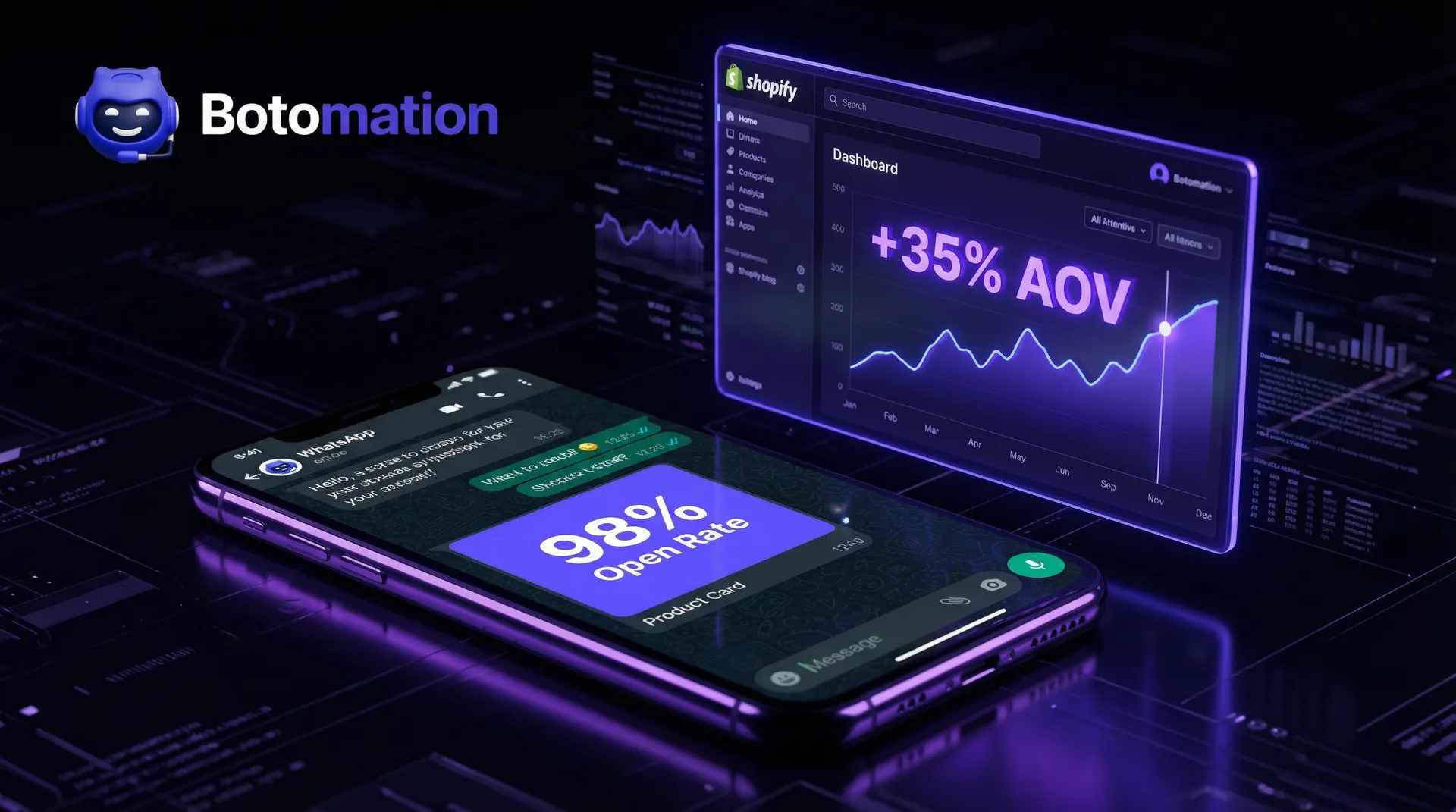
The e-commerce landscape in January 2026 has moved beyond the era of simple transactional emails. While traditional email marketing remains a staple, the shift toward conversational commerce over email is driven by the sheer volume of noise in a customer's inbox. Today, 98% of WhatsApp messages are opened—a statistic that makes it the most potent channel for direct consumer communication. For Shopify store owners, this isn't just about sending shipping updates; it is about transforming a messaging app into a high-converting sales engine. By integrating a shopify whatsapp bot for personalized product suggestions, brands are no longer waiting for customers to return to their site. Instead, they are bringing the storefront directly to the customer's pocket.
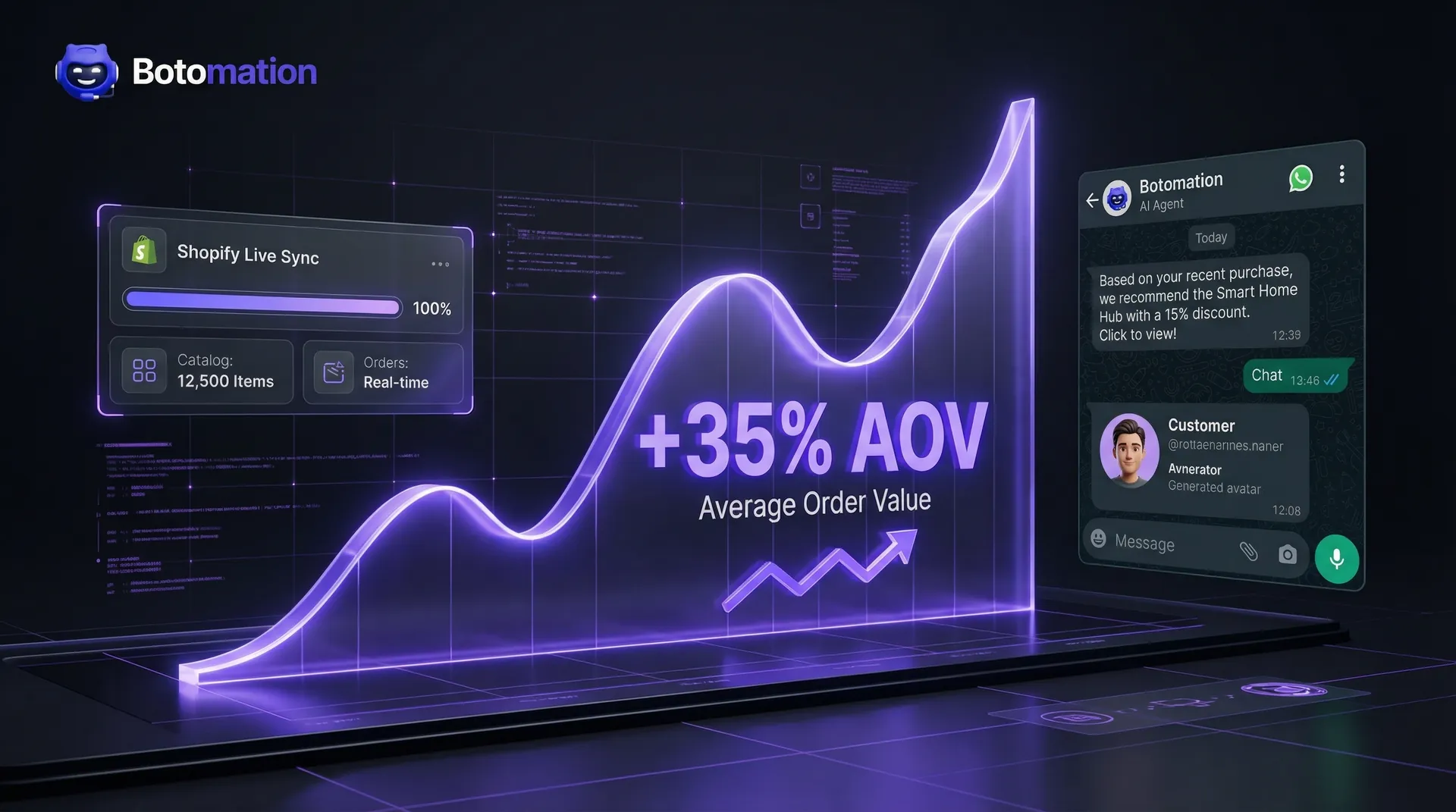
Our team at Botomation has seen Shopify stores increase their average order value (AOV) by 35% simply by shifting from generic marketing to AI-powered WhatsApp automation. Recent updates to the WhatsApp Business API have introduced sophisticated AI capabilities that allow for hyper-personalized suggestions based on real-time browsing data and past purchase behavior. In markets like Mexico, early adopters who have moved away from basic chatbots toward sophisticated AI agents are reporting unprecedented levels of customer loyalty. The "Old Way" of marketing relied on broad segments and hope; the "New Way," pioneered by Botomation, uses predictive modeling to ensure every recommendation feels like a helpful suggestion from a friend rather than a sales pitch.
| Feature | The Old Way (Manual/Email) | The Botomation Way (AI WhatsApp) |
|---|---|---|
| **Open Rates** | 15% - 20% | 98% |
| **Response Time** | Hours or Days | Instant (Under 2 seconds) |
| **Personalization** | Basic tags (First Name) | Deep behavioral AI analysis |
| **Conversion Rate** | 1% - 2% | 8% - 12% |
| **Scalability** | Requires more staff | Infinite with AI agents |
Shopify WhatsApp Bot for Personalized Product Suggestions: Overview
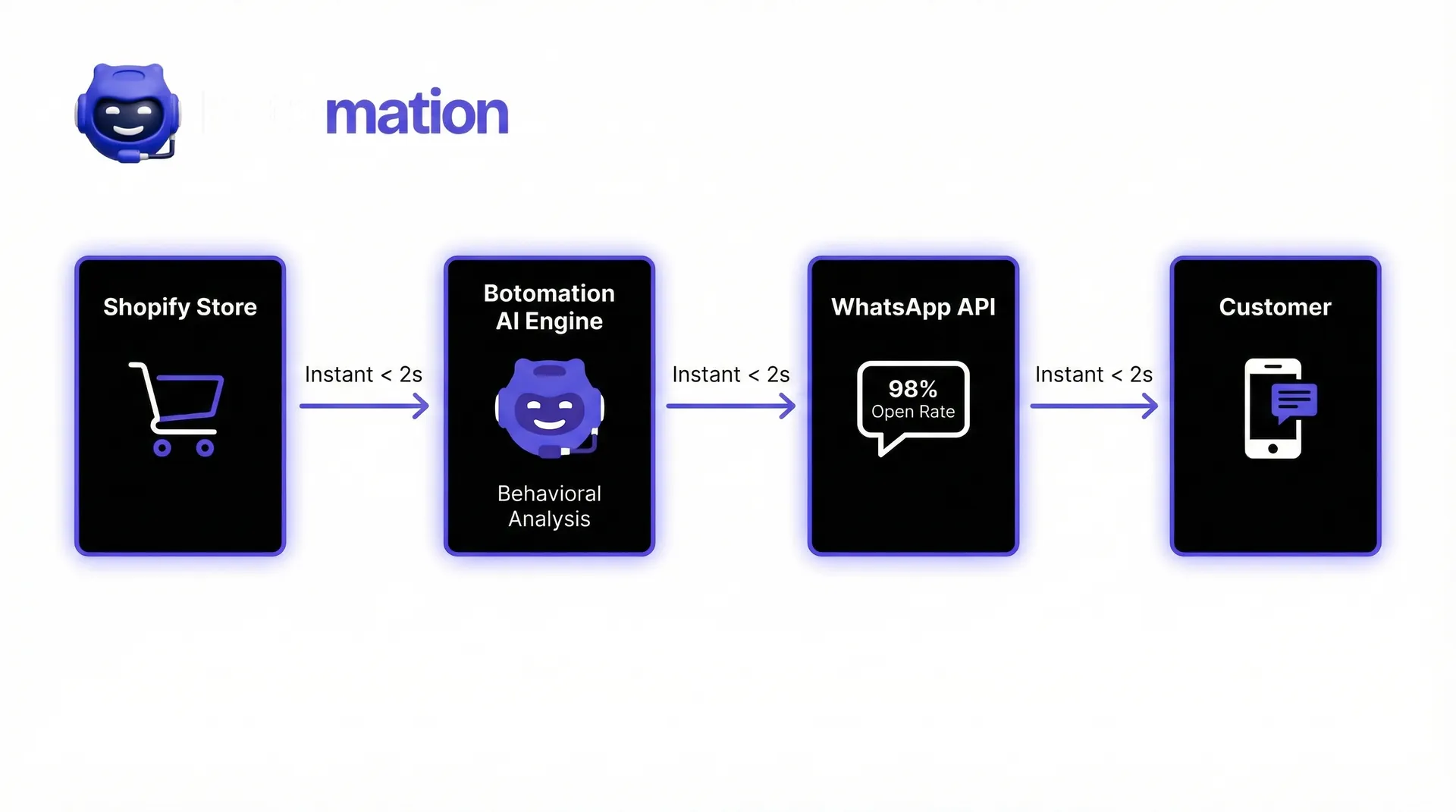
Before you can start sending automated product recommendations, you need to understand the structural foundation of a professional integration. Many store owners make the mistake of trying to use the standard WhatsApp Business App. However, for a shopify whatsapp bot for personalized product suggestions to function effectively at scale, the WhatsApp Business API is mandatory. This API allows for the connection of third-party AI logic, such as the custom agents we build at Botomation, directly into your Shopify backend. This setup ensures that your inventory, customer profiles, and messaging are always in sync, preventing the common frustration of recommending out-of-stock items.
The technical architecture of this integration relies on a secure bridge between Shopify’s Liquid-based environment and Meta’s API infrastructure. This requires a verified business presence and a clear understanding of how data flows between your store and the messaging interface. It is not merely about installing a plugin; it is about creating a data pipeline that respects customer privacy while maximizing utility. Compliance with 2026 data protection standards is non-negotiable. Our experts ensure that every interaction begins with explicit customer consent, protecting your brand from potential penalties while building a foundation of trust with your audience.
Technical Requirements
To begin the integration process, your store must be running on a supported Shopify plan that allows for API access. You will also need a registered WhatsApp Business Account (WABA) tied to a dedicated phone number that is not currently associated with a personal WhatsApp account. This number serves as your official brand identity on the platform. Furthermore, Meta requires a verified Facebook Business Manager account to grant API access. This verification process involves submitting legal business documentation to prove the legitimacy of your operation.
From a technical standpoint, your domain must be HTTPS-enabled to handle the webhooks that trigger messages. Webhooks are the "listeners" that tell your shopify whatsapp bot for personalized product suggestions when a customer has performed a specific action, such as adding an item to their cart or completing a purchase. Without a stable webhook configuration, your automation will suffer from lag, leading to a poor user experience. Our team handles the heavy lifting of this configuration, ensuring that the handshake between Shopify and WhatsApp is instantaneous and secure.
Platform Compatibility
When selecting an automation partner, compatibility is the most critical factor. Many off-the-shelf apps from the Shopify App Store offer basic functionality but lack the deep integration required for true AI-driven recommendations. A shopify whatsapp bot for personalized product suggestions needs to communicate fluently with your existing CRM, such as Klaviyo or Gorgias, to ensure that the customer journey is consistent across all touchpoints. If a customer is already chatting with a support agent, the AI should be smart enough to pause automated marketing sequences to avoid confusion.
Product catalog synchronization is another pillar of a successful setup. Your WhatsApp Commerce Manager must reflect your Shopify inventory in real-time. This includes price changes, new product launches, and stock levels. If you are using specialized payment gateways or regional shipping providers, the integration must account for these variables to provide accurate delivery estimates within the chat. Botomation specializes in creating these multi-layered connections, ensuring that your WhatsApp bot acts as a fully informed extension of your sales team rather than a standalone silo.
2026 E-commerce Insight
Brands that implement AI-driven WhatsApp automation see an average 80% reduction in "Where is my order?" tickets within the first 60 days of deployment.
Setting Up a Shopify WhatsApp Bot for Personalized Product Suggestions
Transitioning to the WhatsApp Business API is a significant step up from the consumer-grade tools most small businesses use. The process begins within the Meta Events Manager, where you must link your Shopify store's data to your WhatsApp Business Account. This connection is what allows the AI to see what a customer is doing on your site and react accordingly. Unlike the standard app, the API does not have a user interface; it is a pipe through which data travels. This is why partnering with an agency like Botomation is essential—we provide the "brain" that sits at the end of that pipe, interpreting data and generating human-like responses.
Configuring message templates is perhaps the most scrutinized part of the setup. Meta requires that all business-initiated messages follow pre-approved templates to prevent spam. These templates must be carefully crafted to be engaging while adhering to Meta’s strict formatting rules. For product recommendations, these templates often include interactive buttons and list messages that allow customers to browse your collection without ever leaving the chat. Our experts handle the submission and approval process for these templates, ensuring they are optimized for the highest possible engagement rates.
Account Creation Process
The journey starts by registering your business through the Facebook Business Manager. You will need to provide your business name, address, and website URL for Meta’s review. Once the business is verified, you can create your WhatsApp Business Account. During this stage, you will also need to choose your display name, which must closely match your brand name to pass Meta’s verification. This display name is what customers will see at the top of their chat screen, so it must be professional and recognizable.
After the account is established, the focus shifts to the WhatsApp Business Management API. This is where we define the settings for your shopify whatsapp bot for personalized product suggestions. We configure the profile settings, including your business description, email, and category. The most critical part of this phase is the creation of "Message Templates." These are the specific scripts the bot will use for things like order confirmations or "Back in Stock" alerts. Each template must be categorized (e.g., Marketing, Utility, or Authentication) and submitted for approval, a process that usually takes anywhere from a few minutes to 24 hours.
API Configuration
Once the account and templates are ready, we move into the actual API configuration. This involves generating permanent access tokens that allow our AI systems to communicate with Meta’s servers on your behalf. We set up the authentication headers and ensure that all data transmitted is encrypted, meeting the highest security standards. This is not a "set it and forget it" task; it requires ongoing monitoring to ensure the tokens remain valid and the connection remains stable.
The next step is configuring the webhooks. We set up endpoints that listen for specific events from Shopify—like a checkout_started or order_fulfilled event. When these events occur, Shopify sends a notification to our system, which then triggers the shopify whatsapp bot for personalized product suggestions to send the appropriate message. Using GPT-5 powered natural language processing, the bot can understand complex questions and provide relevant product suggestions in a way that feels natural and helpful, rather than robotic.
Building AI-Powered Product Recommendation Workflows
The true power of a shopify whatsapp bot for personalized product suggestions lies in its ability to think. Anyone can set up a bot to send a "Thank You" message, but it takes sophisticated AI to look at a customer's history and say, "I noticed you bought the leather boots last month; would you like to see the matching care kit that just arrived?" These workflows are designed to mimic the behavior of a high-end personal shopper. By analyzing patterns in your Shopify data, our AI identifies the perfect moment to reach out, ensuring the message is welcomed rather than ignored.
Designing these workflows requires a deep understanding of the customer journey. We start by mapping out the various touchpoints where a recommendation makes sense. For instance, if a customer spends five minutes looking at a specific category of products but doesn't buy, the AI can trigger a "Browse Abandonment" sequence. This isn't just a generic "Come back" message; it includes a dynamic gallery of the specific items they were viewing, paired with a limited-time incentive. This level of relevance is what drives the 35% increase in AOV that our clients experience.
Recommendation Triggers and Automation
Triggers are the catalysts for every conversation. In the Botomation ecosystem, we move beyond simple "if-this-then-that" logic. Our triggers are behavioral. For example, a "Browse Abandonment" trigger is activated when a customer visits your site at least three times in 48 hours without making a purchase. The AI recognizes this high-intent behavior and reaches out via WhatsApp with a personalized selection of products. This feels proactive and helpful to the customer, often answering questions they didn't even know they had.
Cart abandonment is another critical trigger. While email cart recovery is standard, WhatsApp cart recovery is revolutionary. When a customer leaves items in their cart, our Shopify WhatsApp bot for personalized product suggestions sends a message within 30 minutes. Because the message is in their favorite chat app, the friction to complete the purchase is virtually zero. We can even include a "Buy Now" button that takes them directly to a pre-filled checkout page. This sequence alone often recovers 20% to 30% of lost revenue, providing an immediate return on investment for the integration.
AI Algorithm Configuration
At the heart of our service is the configuration of machine learning models tailored to your specific niche. We don't use a one-size-fits-all approach. For a fashion brand, the AI might prioritize "Collaborative Filtering," which suggests items that other customers with similar tastes have purchased. For a technical or hardware brand, the AI might focus on "Complementary Logic," ensuring that if a customer buys a drill, they are recommended the correct set of bits and a spare battery.
Defining these parameters involves feeding the AI your historical Shopify data. The more data the AI has, the more accurate its suggestions become. We constantly test and optimize these algorithms, looking for "false positives" where the bot might suggest something irrelevant. By refining the model, we ensure that the shopify whatsapp bot for personalized product suggestions becomes more intelligent over time, learning from every interaction. This continuous improvement is a hallmark of the Botomation service, moving you away from static software and toward a dynamic, evolving sales asset.
Implementing Post-Purchase Upsell Sequences
The relationship with a customer shouldn't end at the "Thank You" page; in fact, that is where the most profitable phase begins. Post-purchase upsell sequences are designed to capitalize on the "buyer's high"—that moment of excitement immediately after a purchase. By using a shopify whatsapp bot for personalized product suggestions, you can reach customers when their engagement with your brand is at its peak. Our data shows that these sequences can achieve conversion rates of 4% to 10%, which is significantly higher than any other marketing channel.
Timing and frequency are the keys to success here. You don't want to bombard a customer with sales pitches the second they've spent money. Instead, the Botomation approach is to blend utility with commerce. We start with a helpful message—like a shipping update—and then naturally transition into a recommendation. For example, "Your coffee machine is on its way! While you wait, would you like to see our most popular organic bean blends to get you started?" This approach feels like a service, not an advertisement, which is why it is so effective at driving repeat business.
Post-Purchase Communication Strategy
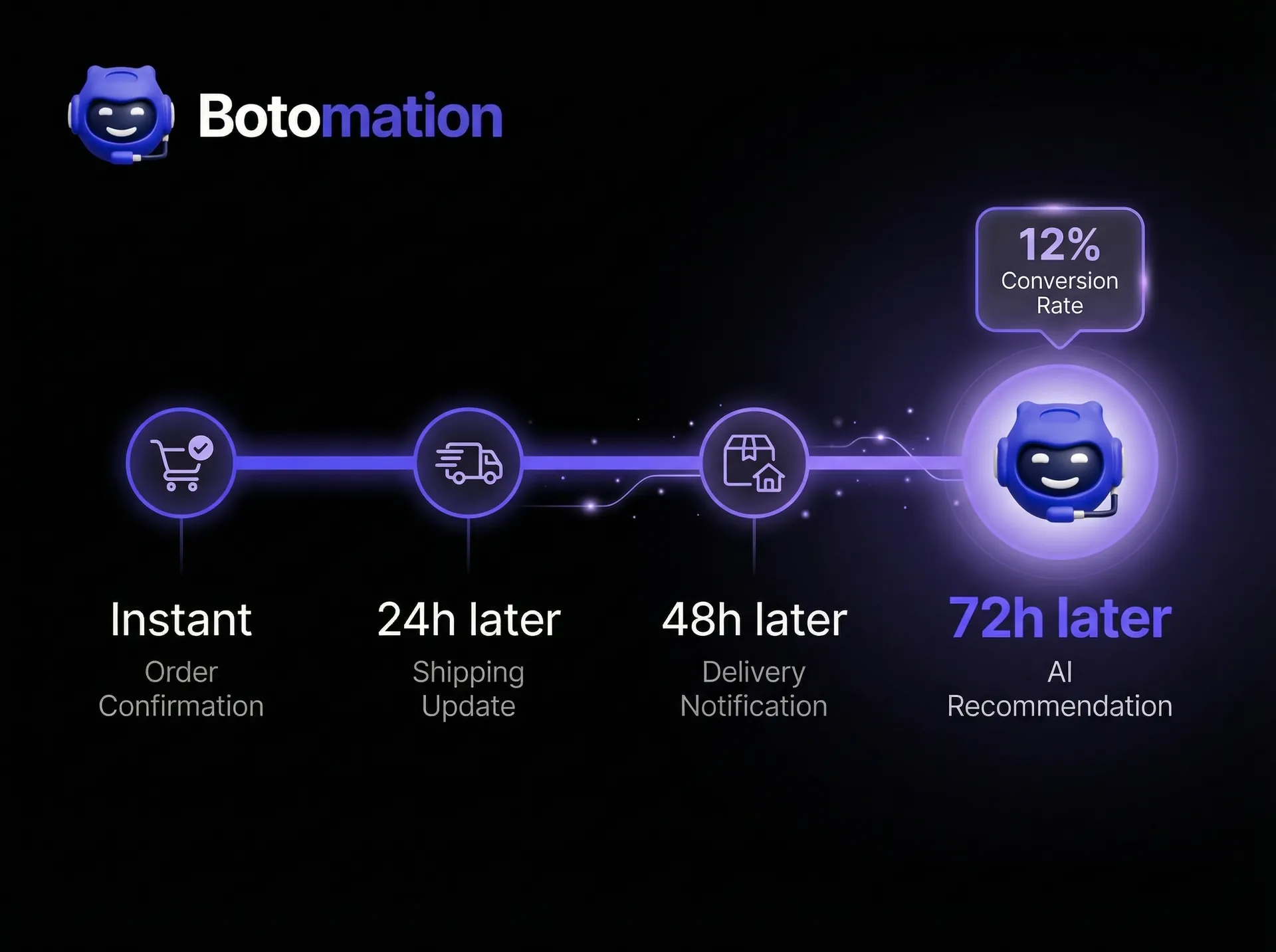
A successful post-purchase strategy is built on a series of helpful touchpoints. The first is the order confirmation, which should be sent via WhatsApp immediately. This provides the customer with instant peace of mind and an easy way to ask questions. Next, we implement automated shipping updates. Instead of a boring tracking number, the bot sends a friendly message when the package is out for delivery. This keeps your brand top-of-mind and builds anticipation.
The actual recommendation usually happens 24 to 48 hours after delivery. The bot checks in to see if the customer is happy with their purchase. This "Satisfaction Check" serves two purposes: it allows you to catch any potential issues before they become negative reviews, and it provides a natural opening for a complementary suggestion. If a customer bought a skincare serum, the bot might suggest a moisturizer that enhances the serum's effects. This "Solution-Based Selling" is far more effective than generic cross-selling and is a core part of the Botomation methodology.
Upsell Sequence Optimization
Optimization is an ongoing process of analyzing how customers interact with your upsell messages. We look at the "Time to Purchase" metric—how long after the initial buy does the customer make their second purchase? If we find that most people buy the accessory within three days, we adjust the timing of the shopify whatsapp bot for personalized product suggestions to hit that sweet spot. We also test different bundling strategies. Sometimes, offering a 10% discount on a bundle is more effective than suggesting a single item.
Testing different messaging styles is also vital. Some audiences respond better to a direct, professional tone, while others prefer a more casual, emoji-rich approach. Our AI agents can even adapt their tone based on the customer's own writing style. If a customer uses a lot of exclamation points and informal language, the bot will mirror that energy. This level of psychological alignment is what makes our AI integrations feel human and engaging, leading to the high conversion rates that define the "New Way" of e-commerce.
The Impact of WhatsApp Automation in 2026
- Average Open Rate: 98%
- Average Click-Through Rate: 25% - 45%
- AOV Increase: 35% via AI recommendations
- Customer Retention: 2x increase in repeat purchase rate
- Support Costs: 80% reduction in manual ticket handling
Catalog Management and Dynamic Product Suggestions
For a shopify whatsapp bot for personalized product suggestions to be truly effective, it must have a perfect understanding of your inventory. There is nothing more damaging to customer trust than a bot recommending a product that is out of stock. This is why Botomation focuses heavily on the "Sync Layer"—the connection between your Shopify catalog and the WhatsApp Commerce Manager. We ensure that every time an item is sold or restocked on your site, that information is instantly pushed to the WhatsApp environment.
Dynamic suggestions take this a step further by using rich media to present products. Instead of a simple text link, the bot can send a "Multi-Product Message" (MPM). This allows the customer to swipe through a carousel of up to 30 items, complete with images, prices, and descriptions, all within the WhatsApp interface. They can add items to a "WhatsApp Cart" and then seamlessly transition to your Shopify checkout. This frictionless shopping experience is exactly what modern consumers demand, and it is a key differentiator for brands partnering with our agency.
Catalog Setup Process
The setup begins by exporting your Shopify product feed and importing it into the Meta Commerce Manager. While Shopify has a native integration for this, it often requires manual tweaking to ensure that the product categories and attributes are mapped correctly for the AI's recommendation engine. We define specific "Sets" within your catalog—such as "Best Sellers," "New Arrivals," or "Summer Collection"—which the bot can then call upon during conversations.
We also pay close attention to product attributes. To provide high-quality recommendations, the AI needs to know more than just the product name; it needs to understand the color, material, size, and use case. We help you optimize your Shopify metadata so the shopify whatsapp bot for personalized product suggestions can make intelligent connections. For example, if a customer mentions they are looking for something "breathable for running," the AI can filter your catalog for those specific attributes and present the most relevant options instantly.
Dynamic Recommendations
Dynamic recommendations are the pinnacle of AI commerce. These are not pre-written scripts; they are generated in real-time based on the specific context of the conversation. If a customer asks, "Do you have anything that goes well with the blue dress I bought?" the AI scans your catalog for items tagged with "blue" or "complementary colors" and presents a curated selection. This level of responsiveness was impossible just a few years ago, but with the 2026 updates to the WhatsApp API and GPT-5 integration, it is now the gold standard.
We also implement "Price Sensitivity" logic. If a customer typically buys items in the $50-$100 range, the bot won't frustrate them by suggesting a $500 luxury item. Conversely, it won't "leave money on the table" by suggesting a $10 item to a high-spending customer. By learning individual customer preferences, the shopify whatsapp bot for personalized product suggestions becomes an expert salesperson that knows exactly what to offer and when. This personalized touch is why brands that move away from generic SaaS tools to our bespoke agency services see such a dramatic shift in their performance metrics.
Step-by-Step Tutorial: Launching Your First Recommendation Campaign
- Audit Your Shopify Data: Ensure your product titles, descriptions, and tags are clean and descriptive. The AI is only as good as the data it reads.
- Verify Your Meta Business Account: Complete the "Business Verification" in your Meta Business Suite. You will need your tax ID and official business documents.
- Connect Your Phone Number: Choose a clean number (not used on personal WhatsApp) and link it to the WhatsApp Business API through your chosen provider.
- Sync the Catalog: Use a robust connector to push your Shopify products into the Meta Commerce Manager. Check for errors in image aspect ratios or missing prices.
- Develop AI Logic: Partner with Botomation to design your recommendation triggers. Decide which actions (like a "View Content" event) should trigger a message.
- Submit Templates: Draft and submit your first "Marketing" templates for approval. Keep them conversational and benefit-oriented.
- Run a Pilot Test: Start with a small segment of your audience (e.g., 5% of recent visitors) to monitor the bot's accuracy and the customer's response.
- Scale and Optimize: Once the pilot shows positive ROI, roll out the shopify whatsapp bot for personalized product suggestions to your entire customer base.
Testing, Optimization, and Performance Tracking
The final stage of a successful integration is the transition from "launch" to "growth." A shopify whatsapp bot for personalized product suggestions is not a static tool; it is a living part of your sales team that requires regular coaching. At Botomation, we don't just set up the bot and walk away. We stay on as your strategic partners, constantly analyzing the data to find opportunities for improvement. We look at everything from the time of day messages are sent to the specific words that trigger a purchase.
A/B testing is a critical component of this phase. We might test two different versions of a recommendation message: one that focuses on a "Limited Time Offer" and another that focuses on "Social Proof" (e.g., "1,000 other people bought this with your item"). By measuring which version leads to more sales, we can refine the AI's approach. This data-driven mindset is what separates successful 2026 brands from those that are still guessing. We also ensure that your bot remains compliant with evolving privacy laws, such as GDPR or CCPA, while handling complex tasks like automated returns and exchanges with precision.
Performance Analytics
To measure the success of your shopify whatsapp bot for personalized product suggestions, we look at several key performance indicators (KPIs). The first is the "Read Rate," which tells us if our messages are getting through. Next is the "Click-Through Rate" (CTR) on the product links. However, the most important metric is the "Conversion Rate"—the percentage of people who received a recommendation and went on to make a purchase.
We also track "Customer Satisfaction" (CSAT) scores. After a bot interaction, we often send a quick one-question survey: "Was this recommendation helpful?" This feedback loop is essential for training the AI. If the AI sees that a certain type of recommendation is consistently rated poorly, it will automatically adjust its logic to avoid making that mistake in the future. This self-correcting behavior is a major advantage of the AI-first approach we take at Botomation, ensuring your brand always puts its best foot forward.
Optimization Strategies
Optimization also involves technical refinement. We monitor the "Latency" of the bot—how long it takes to respond to a customer. In 2026, anything over three seconds is considered too slow. We optimize our server architecture to ensure that the shopify whatsapp bot for personalized product suggestions feels like a real-time conversation. We also look at "Drop-off Points" in the conversation flow. If customers are leaving the chat after being asked for their size, we might simplify that step or provide a more intuitive size guide within the chat.
Finally, we focus on "Segment-Specific Optimization." Not all customers are the same. A first-time visitor needs a different approach than a VIP customer who has spent thousands of dollars. We create specialized logic for different customer tiers, ensuring that your most valuable clients receive a "White Glove" experience. By treating every customer as an individual, our shopify whatsapp bot for personalized product suggestions builds the kind of brand affinity that keeps people coming back for years.
Frequently Asked Questions
Will using a WhatsApp bot make my brand feel impersonal?
Quite the opposite. When implemented by experts, a shopify whatsapp bot for personalized product suggestions feels more personal than email because it provides instant, relevant help. Our AI agents use GPT-5 to understand context and tone, allowing them to engage in natural conversations. Instead of a generic "Buy this," the bot might say, "I saw you were looking at the blue sneakers; did you know they also come in a waterproof version which might be better for the current weather in your area?"
Is it difficult to manage the WhatsApp Business API?
The API itself is complex and requires technical expertise to set up and maintain. This is why most brands choose to partner with an agency like Botomation. We handle the entire technical stack, from Meta verification and API configuration to AI training and daily optimization. You don't need to write a single line of code; you simply reap the benefits of the increased sales and reduced support volume.
How do I ensure I'm not spamming my customers?
Compliance is a core part of our service. We implement strict opt-in procedures where customers must explicitly agree to receive WhatsApp messages. Furthermore, the AI is programmed to be respectful of frequency. We don't send daily blasts; we send high-value, event-triggered messages that provide genuine utility. Because the content is so relevant to the customer's current needs, these messages are viewed as helpful service rather than intrusive spam.
What happens if the AI doesn't know the answer to a question?
Our shopify whatsapp bot for personalized product suggestions is designed with a "Human-in-the-Loop" fallback system. If the AI encounters a question it can't answer with high confidence, it seamlessly hands the conversation over to a human support agent. The agent receives the full context of the chat so the customer doesn't have to repeat themselves. This ensures that every customer gets the help they need, while still automating 80% or more of your total volume.
The integration of a shopify whatsapp bot for personalized product suggestions is no longer a luxury for e-commerce brands; it is a strategic necessity. As we move through 2026, the gap between brands that embrace AI-driven conversation and those that stick to traditional methods will only widen. By bringing your store to the platform where your customers spend their most valuable time, you are removing the barriers to purchase and building a relationship based on convenience and relevance.
Implementing this technology requires a blend of technical precision, creative strategy, and ongoing optimization. From the initial API setup to the complex configuration of AI recommendation models, every step must be executed with the customer's experience in mind. The "Old Way" of manual support and generic marketing is slow, expensive, and increasingly ineffective. The "New Way"—the Botomation way—is automated, instant, and hyper-personalized.
Ready to automate your growth? Book a call below.
The e-commerce landscape in January 2026 has moved beyond the era of simple transactional emails. While traditional email marketing remains a staple, the shift toward conversational commerce over email is driven by the sheer volume of noise in a customer's inbox. Today, 98% of WhatsApp messages are opened—a statistic that makes it the most potent channel for direct consumer communication. For Shopify store owners, this isn't just about sending shipping updates; it is about transforming a messaging app into a high-converting sales engine. By integrating a shopify whatsapp bot for personalized product suggestions, brands are no longer waiting for customers to return to their site. Instead, they are bringing the storefront directly to the customer's pocket.
Our team at Botomation has seen Shopify stores increase their average order value (AOV) by 35% simply by shifting from generic marketing to AI-powered WhatsApp automation. Recent updates to the WhatsApp Business API have introduced sophisticated AI capabilities that allow for hyper-personalized suggestions based on real-time browsing data and past purchase behavior. In markets like Mexico, early adopters who have moved away from basic chatbots toward sophisticated AI agents are reporting unprecedented levels of customer loyalty. The "Old Way" of marketing relied on broad segments and hope; the "New Way," pioneered by Botomation, uses predictive modeling to ensure every recommendation feels like a helpful suggestion from a friend rather than a sales pitch.
| Feature | The Old Way (Manual/Email) | The Botomation Way (AI WhatsApp) |
|---|---|---|
| **Open Rates** | 15% - 20% | 98% |
| **Response Time** | Hours or Days | Instant (Under 2 seconds) |
| **Personalization** | Basic tags (First Name) | Deep behavioral AI analysis |
| **Conversion Rate** | 1% - 2% | 8% - 12% |
| **Scalability** | Requires more staff | Infinite with AI agents |
Shopify WhatsApp Bot for Personalized Product Suggestions: Overview
Before you can start sending automated product recommendations, you need to understand the structural foundation of a professional integration. Many store owners make the mistake of trying to use the standard WhatsApp Business App. However, for a shopify whatsapp bot for personalized product suggestions to function effectively at scale, the WhatsApp Business API is mandatory. This API allows for the connection of third-party AI logic, such as the custom agents we build at Botomation, directly into your Shopify backend. This setup ensures that your inventory, customer profiles, and messaging are always in sync, preventing the common frustration of recommending out-of-stock items.
The technical architecture of this integration relies on a secure bridge between Shopify’s Liquid-based environment and Meta’s API infrastructure. This requires a verified business presence and a clear understanding of how data flows between your store and the messaging interface. It is not merely about installing a plugin; it is about creating a data pipeline that respects customer privacy while maximizing utility. Compliance with 2026 data protection standards is non-negotiable. Our experts ensure that every interaction begins with explicit customer consent, protecting your brand from potential penalties while building a foundation of trust with your audience.
Technical Requirements
To begin the integration process, your store must be running on a supported Shopify plan that allows for API access. You will also need a registered WhatsApp Business Account (WABA) tied to a dedicated phone number that is not currently associated with a personal WhatsApp account. This number serves as your official brand identity on the platform. Furthermore, Meta requires a verified Facebook Business Manager account to grant API access. This verification process involves submitting legal business documentation to prove the legitimacy of your operation.
From a technical standpoint, your domain must be HTTPS-enabled to handle the webhooks that trigger messages. Webhooks are the "listeners" that tell your shopify whatsapp bot for personalized product suggestions when a customer has performed a specific action, such as adding an item to their cart or completing a purchase. Without a stable webhook configuration, your automation will suffer from lag, leading to a poor user experience. Our team handles the heavy lifting of this configuration, ensuring that the handshake between Shopify and WhatsApp is instantaneous and secure.
Platform Compatibility
When selecting an automation partner, compatibility is the most critical factor. Many off-the-shelf apps from the Shopify App Store offer basic functionality but lack the deep integration required for true AI-driven recommendations. A shopify whatsapp bot for personalized product suggestions needs to communicate fluently with your existing CRM, such as Klaviyo or Gorgias, to ensure that the customer journey is consistent across all touchpoints. If a customer is already chatting with a support agent, the AI should be smart enough to pause automated marketing sequences to avoid confusion.
Product catalog synchronization is another pillar of a successful setup. Your WhatsApp Commerce Manager must reflect your Shopify inventory in real-time. This includes price changes, new product launches, and stock levels. If you are using specialized payment gateways or regional shipping providers, the integration must account for these variables to provide accurate delivery estimates within the chat. Botomation specializes in creating these multi-layered connections, ensuring that your WhatsApp bot acts as a fully informed extension of your sales team rather than a standalone silo.
2026 E-commerce Insight
Brands that implement AI-driven WhatsApp automation see an average 80% reduction in "Where is my order?" tickets within the first 60 days of deployment.
Setting Up a Shopify WhatsApp Bot for Personalized Product Suggestions
Transitioning to the WhatsApp Business API is a significant step up from the consumer-grade tools most small businesses use. The process begins within the Meta Events Manager, where you must link your Shopify store's data to your WhatsApp Business Account. This connection is what allows the AI to see what a customer is doing on your site and react accordingly. Unlike the standard app, the API does not have a user interface; it is a pipe through which data travels. This is why partnering with an agency like Botomation is essential—we provide the "brain" that sits at the end of that pipe, interpreting data and generating human-like responses.
Configuring message templates is perhaps the most scrutinized part of the setup. Meta requires that all business-initiated messages follow pre-approved templates to prevent spam. These templates must be carefully crafted to be engaging while adhering to Meta’s strict formatting rules. For product recommendations, these templates often include interactive buttons and list messages that allow customers to browse your collection without ever leaving the chat. Our experts handle the submission and approval process for these templates, ensuring they are optimized for the highest possible engagement rates.
Account Creation Process
The journey starts by registering your business through the Facebook Business Manager. You will need to provide your business name, address, and website URL for Meta’s review. Once the business is verified, you can create your WhatsApp Business Account. During this stage, you will also need to choose your display name, which must closely match your brand name to pass Meta’s verification. This display name is what customers will see at the top of their chat screen, so it must be professional and recognizable.
After the account is established, the focus shifts to the WhatsApp Business Management API. This is where we define the settings for your shopify whatsapp bot for personalized product suggestions. We configure the profile settings, including your business description, email, and category. The most critical part of this phase is the creation of "Message Templates." These are the specific scripts the bot will use for things like order confirmations or "Back in Stock" alerts. Each template must be categorized (e.g., Marketing, Utility, or Authentication) and submitted for approval, a process that usually takes anywhere from a few minutes to 24 hours.
API Configuration
Once the account and templates are ready, we move into the actual API configuration. This involves generating permanent access tokens that allow our AI systems to communicate with Meta’s servers on your behalf. We set up the authentication headers and ensure that all data transmitted is encrypted, meeting the highest security standards. This is not a "set it and forget it" task; it requires ongoing monitoring to ensure the tokens remain valid and the connection remains stable.
The next step is configuring the webhooks. We set up endpoints that listen for specific events from Shopify—like a checkout_started or order_fulfilled event. When these events occur, Shopify sends a notification to our system, which then triggers the shopify whatsapp bot for personalized product suggestions to send the appropriate message. Using GPT-5 powered natural language processing, the bot can understand complex questions and provide relevant product suggestions in a way that feels natural and helpful, rather than robotic.
Building AI-Powered Product Recommendation Workflows
The true power of a shopify whatsapp bot for personalized product suggestions lies in its ability to think. Anyone can set up a bot to send a "Thank You" message, but it takes sophisticated AI to look at a customer's history and say, "I noticed you bought the leather boots last month; would you like to see the matching care kit that just arrived?" These workflows are designed to mimic the behavior of a high-end personal shopper. By analyzing patterns in your Shopify data, our AI identifies the perfect moment to reach out, ensuring the message is welcomed rather than ignored.
Designing these workflows requires a deep understanding of the customer journey. We start by mapping out the various touchpoints where a recommendation makes sense. For instance, if a customer spends five minutes looking at a specific category of products but doesn't buy, the AI can trigger a "Browse Abandonment" sequence. This isn't just a generic "Come back" message; it includes a dynamic gallery of the specific items they were viewing, paired with a limited-time incentive. This level of relevance is what drives the 35% increase in AOV that our clients experience.
Recommendation Triggers and Automation
Triggers are the catalysts for every conversation. In the Botomation ecosystem, we move beyond simple "if-this-then-that" logic. Our triggers are behavioral. For example, a "Browse Abandonment" trigger is activated when a customer visits your site at least three times in 48 hours without making a purchase. The AI recognizes this high-intent behavior and reaches out via WhatsApp with a personalized selection of products. This feels proactive and helpful to the customer, often answering questions they didn't even know they had.
Cart abandonment is another critical trigger. While email cart recovery is standard, WhatsApp cart recovery is revolutionary. When a customer leaves items in their cart, our Shopify WhatsApp bot for personalized product suggestions sends a message within 30 minutes. Because the message is in their favorite chat app, the friction to complete the purchase is virtually zero. We can even include a "Buy Now" button that takes them directly to a pre-filled checkout page. This sequence alone often recovers 20% to 30% of lost revenue, providing an immediate return on investment for the integration.
AI Algorithm Configuration
At the heart of our service is the configuration of machine learning models tailored to your specific niche. We don't use a one-size-fits-all approach. For a fashion brand, the AI might prioritize "Collaborative Filtering," which suggests items that other customers with similar tastes have purchased. For a technical or hardware brand, the AI might focus on "Complementary Logic," ensuring that if a customer buys a drill, they are recommended the correct set of bits and a spare battery.
Defining these parameters involves feeding the AI your historical Shopify data. The more data the AI has, the more accurate its suggestions become. We constantly test and optimize these algorithms, looking for "false positives" where the bot might suggest something irrelevant. By refining the model, we ensure that the shopify whatsapp bot for personalized product suggestions becomes more intelligent over time, learning from every interaction. This continuous improvement is a hallmark of the Botomation service, moving you away from static software and toward a dynamic, evolving sales asset.
Implementing Post-Purchase Upsell Sequences
The relationship with a customer shouldn't end at the "Thank You" page; in fact, that is where the most profitable phase begins. Post-purchase upsell sequences are designed to capitalize on the "buyer's high"—that moment of excitement immediately after a purchase. By using a shopify whatsapp bot for personalized product suggestions, you can reach customers when their engagement with your brand is at its peak. Our data shows that these sequences can achieve conversion rates of 4% to 10%, which is significantly higher than any other marketing channel.
Timing and frequency are the keys to success here. You don't want to bombard a customer with sales pitches the second they've spent money. Instead, the Botomation approach is to blend utility with commerce. We start with a helpful message—like a shipping update—and then naturally transition into a recommendation. For example, "Your coffee machine is on its way! While you wait, would you like to see our most popular organic bean blends to get you started?" This approach feels like a service, not an advertisement, which is why it is so effective at driving repeat business.
Post-Purchase Communication Strategy
A successful post-purchase strategy is built on a series of helpful touchpoints. The first is the order confirmation, which should be sent via WhatsApp immediately. This provides the customer with instant peace of mind and an easy way to ask questions. Next, we implement automated shipping updates. Instead of a boring tracking number, the bot sends a friendly message when the package is out for delivery. This keeps your brand top-of-mind and builds anticipation.
The actual recommendation usually happens 24 to 48 hours after delivery. The bot checks in to see if the customer is happy with their purchase. This "Satisfaction Check" serves two purposes: it allows you to catch any potential issues before they become negative reviews, and it provides a natural opening for a complementary suggestion. If a customer bought a skincare serum, the bot might suggest a moisturizer that enhances the serum's effects. This "Solution-Based Selling" is far more effective than generic cross-selling and is a core part of the Botomation methodology.
Upsell Sequence Optimization
Optimization is an ongoing process of analyzing how customers interact with your upsell messages. We look at the "Time to Purchase" metric—how long after the initial buy does the customer make their second purchase? If we find that most people buy the accessory within three days, we adjust the timing of the shopify whatsapp bot for personalized product suggestions to hit that sweet spot. We also test different bundling strategies. Sometimes, offering a 10% discount on a bundle is more effective than suggesting a single item.
Testing different messaging styles is also vital. Some audiences respond better to a direct, professional tone, while others prefer a more casual, emoji-rich approach. Our AI agents can even adapt their tone based on the customer's own writing style. If a customer uses a lot of exclamation points and informal language, the bot will mirror that energy. This level of psychological alignment is what makes our AI integrations feel human and engaging, leading to the high conversion rates that define the "New Way" of e-commerce.
The Impact of WhatsApp Automation in 2026
- Average Open Rate: 98%
- Average Click-Through Rate: 25% - 45%
- AOV Increase: 35% via AI recommendations
- Customer Retention: 2x increase in repeat purchase rate
- Support Costs: 80% reduction in manual ticket handling
Catalog Management and Dynamic Product Suggestions
For a shopify whatsapp bot for personalized product suggestions to be truly effective, it must have a perfect understanding of your inventory. There is nothing more damaging to customer trust than a bot recommending a product that is out of stock. This is why Botomation focuses heavily on the "Sync Layer"—the connection between your Shopify catalog and the WhatsApp Commerce Manager. We ensure that every time an item is sold or restocked on your site, that information is instantly pushed to the WhatsApp environment.
Dynamic suggestions take this a step further by using rich media to present products. Instead of a simple text link, the bot can send a "Multi-Product Message" (MPM). This allows the customer to swipe through a carousel of up to 30 items, complete with images, prices, and descriptions, all within the WhatsApp interface. They can add items to a "WhatsApp Cart" and then seamlessly transition to your Shopify checkout. This frictionless shopping experience is exactly what modern consumers demand, and it is a key differentiator for brands partnering with our agency.
Catalog Setup Process
The setup begins by exporting your Shopify product feed and importing it into the Meta Commerce Manager. While Shopify has a native integration for this, it often requires manual tweaking to ensure that the product categories and attributes are mapped correctly for the AI's recommendation engine. We define specific "Sets" within your catalog—such as "Best Sellers," "New Arrivals," or "Summer Collection"—which the bot can then call upon during conversations.
We also pay close attention to product attributes. To provide high-quality recommendations, the AI needs to know more than just the product name; it needs to understand the color, material, size, and use case. We help you optimize your Shopify metadata so the shopify whatsapp bot for personalized product suggestions can make intelligent connections. For example, if a customer mentions they are looking for something "breathable for running," the AI can filter your catalog for those specific attributes and present the most relevant options instantly.
Dynamic Recommendations
Dynamic recommendations are the pinnacle of AI commerce. These are not pre-written scripts; they are generated in real-time based on the specific context of the conversation. If a customer asks, "Do you have anything that goes well with the blue dress I bought?" the AI scans your catalog for items tagged with "blue" or "complementary colors" and presents a curated selection. This level of responsiveness was impossible just a few years ago, but with the 2026 updates to the WhatsApp API and GPT-5 integration, it is now the gold standard.
We also implement "Price Sensitivity" logic. If a customer typically buys items in the $50-$100 range, the bot won't frustrate them by suggesting a $500 luxury item. Conversely, it won't "leave money on the table" by suggesting a $10 item to a high-spending customer. By learning individual customer preferences, the shopify whatsapp bot for personalized product suggestions becomes an expert salesperson that knows exactly what to offer and when. This personalized touch is why brands that move away from generic SaaS tools to our bespoke agency services see such a dramatic shift in their performance metrics.
Step-by-Step Tutorial: Launching Your First Recommendation Campaign
- Audit Your Shopify Data: Ensure your product titles, descriptions, and tags are clean and descriptive. The AI is only as good as the data it reads.
- Verify Your Meta Business Account: Complete the "Business Verification" in your Meta Business Suite. You will need your tax ID and official business documents.
- Connect Your Phone Number: Choose a clean number (not used on personal WhatsApp) and link it to the WhatsApp Business API through your chosen provider.
- Sync the Catalog: Use a robust connector to push your Shopify products into the Meta Commerce Manager. Check for errors in image aspect ratios or missing prices.
- Develop AI Logic: Partner with Botomation to design your recommendation triggers. Decide which actions (like a "View Content" event) should trigger a message.
- Submit Templates: Draft and submit your first "Marketing" templates for approval. Keep them conversational and benefit-oriented.
- Run a Pilot Test: Start with a small segment of your audience (e.g., 5% of recent visitors) to monitor the bot's accuracy and the customer's response.
- Scale and Optimize: Once the pilot shows positive ROI, roll out the shopify whatsapp bot for personalized product suggestions to your entire customer base.
Testing, Optimization, and Performance Tracking
The final stage of a successful integration is the transition from "launch" to "growth." A shopify whatsapp bot for personalized product suggestions is not a static tool; it is a living part of your sales team that requires regular coaching. At Botomation, we don't just set up the bot and walk away. We stay on as your strategic partners, constantly analyzing the data to find opportunities for improvement. We look at everything from the time of day messages are sent to the specific words that trigger a purchase.
A/B testing is a critical component of this phase. We might test two different versions of a recommendation message: one that focuses on a "Limited Time Offer" and another that focuses on "Social Proof" (e.g., "1,000 other people bought this with your item"). By measuring which version leads to more sales, we can refine the AI's approach. This data-driven mindset is what separates successful 2026 brands from those that are still guessing. We also ensure that your bot remains compliant with evolving privacy laws, such as GDPR or CCPA, while handling complex tasks like automated returns and exchanges with precision.
Performance Analytics
To measure the success of your shopify whatsapp bot for personalized product suggestions, we look at several key performance indicators (KPIs). The first is the "Read Rate," which tells us if our messages are getting through. Next is the "Click-Through Rate" (CTR) on the product links. However, the most important metric is the "Conversion Rate"—the percentage of people who received a recommendation and went on to make a purchase.
We also track "Customer Satisfaction" (CSAT) scores. After a bot interaction, we often send a quick one-question survey: "Was this recommendation helpful?" This feedback loop is essential for training the AI. If the AI sees that a certain type of recommendation is consistently rated poorly, it will automatically adjust its logic to avoid making that mistake in the future. This self-correcting behavior is a major advantage of the AI-first approach we take at Botomation, ensuring your brand always puts its best foot forward.
Optimization Strategies
Optimization also involves technical refinement. We monitor the "Latency" of the bot—how long it takes to respond to a customer. In 2026, anything over three seconds is considered too slow. We optimize our server architecture to ensure that the shopify whatsapp bot for personalized product suggestions feels like a real-time conversation. We also look at "Drop-off Points" in the conversation flow. If customers are leaving the chat after being asked for their size, we might simplify that step or provide a more intuitive size guide within the chat.
Finally, we focus on "Segment-Specific Optimization." Not all customers are the same. A first-time visitor needs a different approach than a VIP customer who has spent thousands of dollars. We create specialized logic for different customer tiers, ensuring that your most valuable clients receive a "White Glove" experience. By treating every customer as an individual, our shopify whatsapp bot for personalized product suggestions builds the kind of brand affinity that keeps people coming back for years.
Frequently Asked Questions
Will using a WhatsApp bot make my brand feel impersonal?
Quite the opposite. When implemented by experts, a shopify whatsapp bot for personalized product suggestions feels more personal than email because it provides instant, relevant help. Our AI agents use GPT-5 to understand context and tone, allowing them to engage in natural conversations. Instead of a generic "Buy this," the bot might say, "I saw you were looking at the blue sneakers; did you know they also come in a waterproof version which might be better for the current weather in your area?"
Is it difficult to manage the WhatsApp Business API?
The API itself is complex and requires technical expertise to set up and maintain. This is why most brands choose to partner with an agency like Botomation. We handle the entire technical stack, from Meta verification and API configuration to AI training and daily optimization. You don't need to write a single line of code; you simply reap the benefits of the increased sales and reduced support volume.
How do I ensure I'm not spamming my customers?
Compliance is a core part of our service. We implement strict opt-in procedures where customers must explicitly agree to receive WhatsApp messages. Furthermore, the AI is programmed to be respectful of frequency. We don't send daily blasts; we send high-value, event-triggered messages that provide genuine utility. Because the content is so relevant to the customer's current needs, these messages are viewed as helpful service rather than intrusive spam.
What happens if the AI doesn't know the answer to a question?
Our shopify whatsapp bot for personalized product suggestions is designed with a "Human-in-the-Loop" fallback system. If the AI encounters a question it can't answer with high confidence, it seamlessly hands the conversation over to a human support agent. The agent receives the full context of the chat so the customer doesn't have to repeat themselves. This ensures that every customer gets the help they need, while still automating 80% or more of your total volume.
The integration of a shopify whatsapp bot for personalized product suggestions is no longer a luxury for e-commerce brands; it is a strategic necessity. As we move through 2026, the gap between brands that embrace AI-driven conversation and those that stick to traditional methods will only widen. By bringing your store to the platform where your customers spend their most valuable time, you are removing the barriers to purchase and building a relationship based on convenience and relevance.
Implementing this technology requires a blend of technical precision, creative strategy, and ongoing optimization. From the initial API setup to the complex configuration of AI recommendation models, every step must be executed with the customer's experience in mind. The "Old Way" of manual support and generic marketing is slow, expensive, and increasingly ineffective. The "New Way"—the Botomation way—is automated, instant, and hyper-personalized.
Ready to automate your growth? Book a call below.
Get Started
Book a FREE Consultation Right NOW!
Schedule a Call with Our Team To Make Your Business More Efficient with AI Instantly.
Read More
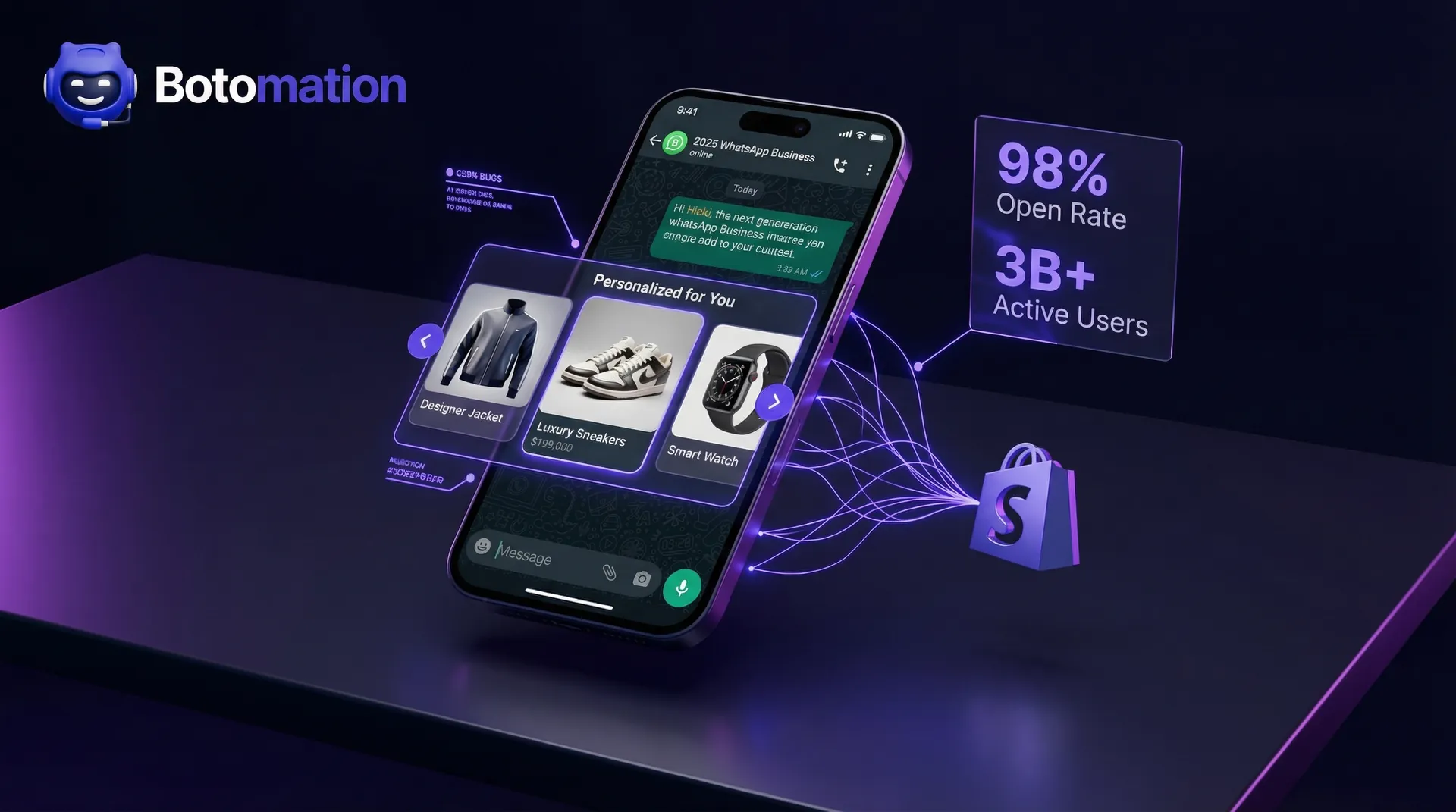
Shopify WhatsApp Bot for Personalized Product Suggestions
Use a shopify whatsapp bot for personalized product suggestions to automate AI recommendations, recover carts, and reduce support tickets in 2026.
Boost Shopify AOV with AI WhatsApp Product Recommendations
Learn how WhatsApp AI slashes support costs for e-commerce & SaaS. Proven strategies to boost sales, recover carts, and scale 24/7 service.