Brand Voice Consistency in Multilingual Video Content 2026
Feb 17, 2026
YouTube
AI Automation
Video Localization
YouTube
AI Automation
Video Localization
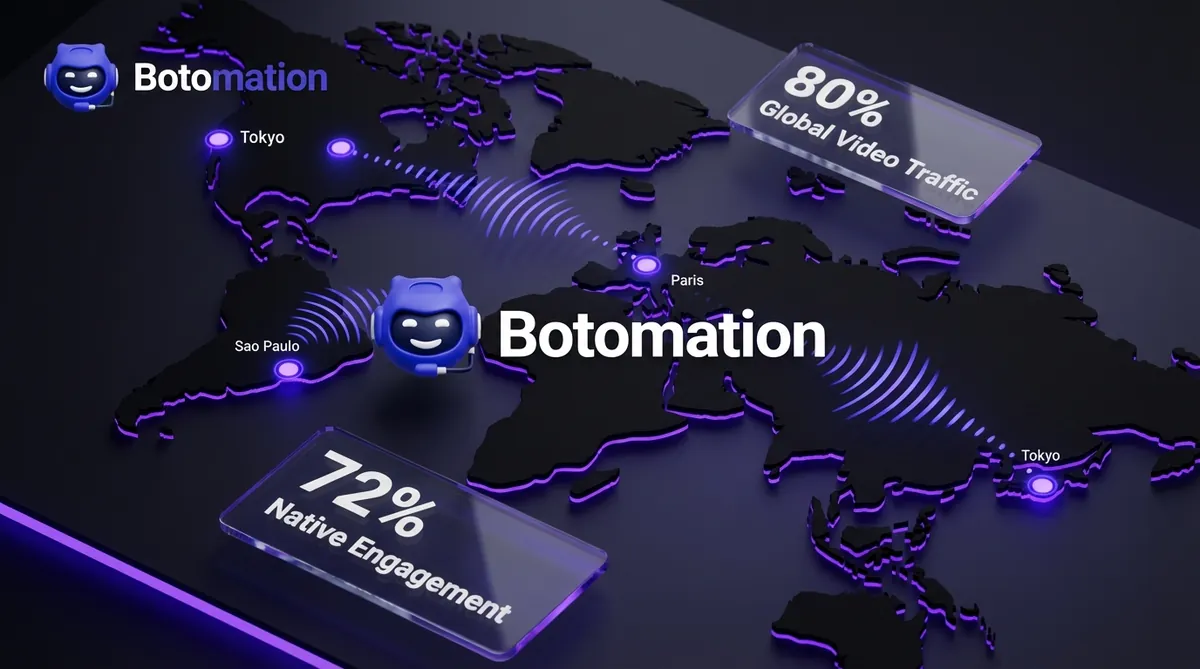
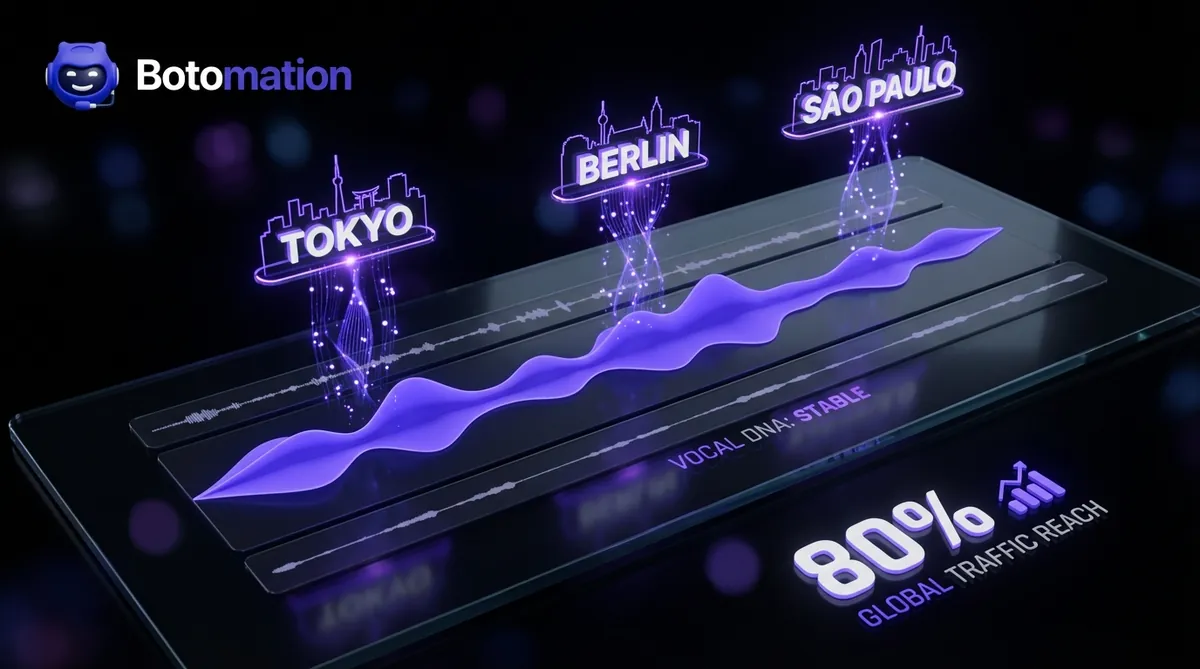
As we navigate the 2026 media landscape, the imperative for international expansion has never been more critical for creators and brands. Producing video content exclusively in one language effectively overlooks billions of potential viewers who prefer consuming media in their native tongue. Current data indicates that 80% of all online traffic is now driven by video, establishing it as the primary currency of digital communication. However, linguistic translation alone is no longer sufficient to succeed in global markets. Statistics demonstrate that customers are 72% more likely to engage with content presented in their native language, but that engagement hinges on a frequently underestimated factor: the ability to maintain voice personality in video localization.
When you expand your reach, you face a significant risk of eroding the unique personality that defined your brand's success. For years, traditional methods relied on hiring various voice actors who, while talented, often failed to capture the specific cadence, humor, or authority of the original speaker. This auditory disconnect results in a discordant viewer experience, leading to a loss of trust. If your English-speaking persona is energetic and youthful, but your Spanish dub sounds like a somber news anchor, your brand identity collapses.
Modern AI voice cloning technologies, like the specialized services provided by Botomation, have definitively solved this dilemma. We prioritize AI voice cloning for global brand identity and authenticity, allowing us to preserve your original voice across dozens of languages, ensuring that your unique "vocal fingerprint" remains intact whether you are speaking to an audience in Tokyo, Paris, or Sao Paulo. This consistency serves as the bridge between being a local creator and becoming a global authority.
Understanding Brand Voice vs. Tone in Multilingual Video Contexts
Maintaining a coherent identity requires a sophisticated understanding of the distinction between voice and tone. Think of your brand voice as your personality—it is steady, predictable, and foundational. Your tone, conversely, is the emotional inflection applied to that voice based on the specific situation or the cultural context of your audience. In the world of multilingual video, your voice must remain identical across all borders, while your tone requires the flexibility to respect local sensibilities.
Video adds layers of complexity that text-based content does not. You must account for visual cues, facial expressions, and the rhythmic timing of the audio. If the translated audio does not match the intensity of the speaker’s gestures, the content feels "uncanny" and artificial. By prioritizing voice consistency, we ensure that the core personality of the brand remains unchanged even when linguistic nuances shift to accommodate a new market.
Defining Voice Identity Across Language Barriers
Your voice identity is comprised of specific traits that must be documented and guarded. Is your brand witty, authoritative, or perhaps comforting? These traits must survive the translation process. Our experts at Botomation work with you to identify these core characteristics before any localization begins. We establish comprehensive voice guidelines that serve as a North Star for every language version produced.
Cultural sensitivity plays a massive role in this process. For example, a luxury fashion house we recently partnered with discovered that their original high-energy, fast-paced English videos felt "aggressive" to their Japanese audience. By maintaining the original speaker's sophisticated voice but adjusting the delivery to be more measured and respectful, they achieved a 40% increase in audience engagement compared to previous attempts at generic translations. This proves that consistency is not about being identical; it is about being authentic to your identity while remaining relevant to the listener.
Tone Adaptation for Cultural Relevance
While the voice remains the same, the tone must be fluid. In some cultures, a direct and blunt tone is viewed as a sign of expertise and honesty. In others, that same approach is perceived as unprofessional. Successful international video campaigns understand how to pivot the tone without losing the brand's soul.
A global tech brand might utilize a playful tone in American marketing to appear "disruptive," but when entering the German market, they may shift toward a more technical and precise tone to build credibility. The voice—the actual sound and personality of the brand—remains the same, but the delivery of the message is adapted. This balance prevents the brand from appearing like a "tourist" in a new market and instead positions it as a local participant.
"Consistency in voice builds the trust necessary for a global audience to move from being casual viewers to loyal brand advocates." — Senior Strategy Consultant at Botomation.
Common Brand Voice Challenges in Multilingual Video Content
The road to global expansion is littered with brands that failed because they treated localization as a purely technical task rather than a creative one. Direct translations are the most common pitfall. When you translate a script word-for-word, you often lose the emotional impact, the humor, and the specific brand "flavor" that your audience loves. Idioms and cultural references rarely survive literal translation, often leading to confusion or offense.
Beyond the script, the human element of voice talent presents its own set of challenges. Traditional dubbing requires finding a different actor for every language, introducing massive variability. One actor might have a naturally higher pitch, while another might have a slower speaking rate. These small differences aggregate into a fragmented brand image that feels inconsistent to global viewers who encounter your content across multiple languages.
Translation vs. Localization Pitfalls
Literal translation is the enemy of brand voice. We often see companies attempt to save costs by using basic translation tools, only to end up with content that sounds robotic or nonsensical. A famous example involves a major soft-drink company that translated its slogan into Chinese; the literal translation read as "Bring your ancestors back to life," which was not only culturally insensitive but completely ruined the emotional connection the brand intended to build with its "joyful" campaign.
To avoid these mistakes, our team utilizes a process of "transcreation." This involves rewriting the message to evoke the same emotion in the target language, even if the words change entirely. We look for technical ways to match the syllable count and the emotional beats of the original video, ensuring that the visual and audio remain in perfect harmony.
Voice Talent Consistency Issues
Securing the right voice talent is an expensive and time-consuming ordeal. If you are targeting ten different markets, you traditionally need ten different actors. The cost of this is staggering.
Traditional Dubbing Cost Calculation:
- Base rate for professional voice talent: $500 per language
- Studio recording and engineering fees: $350 per language
- Project management and coordination: $200 per language
- Total for 10 languages: $10,500 per video
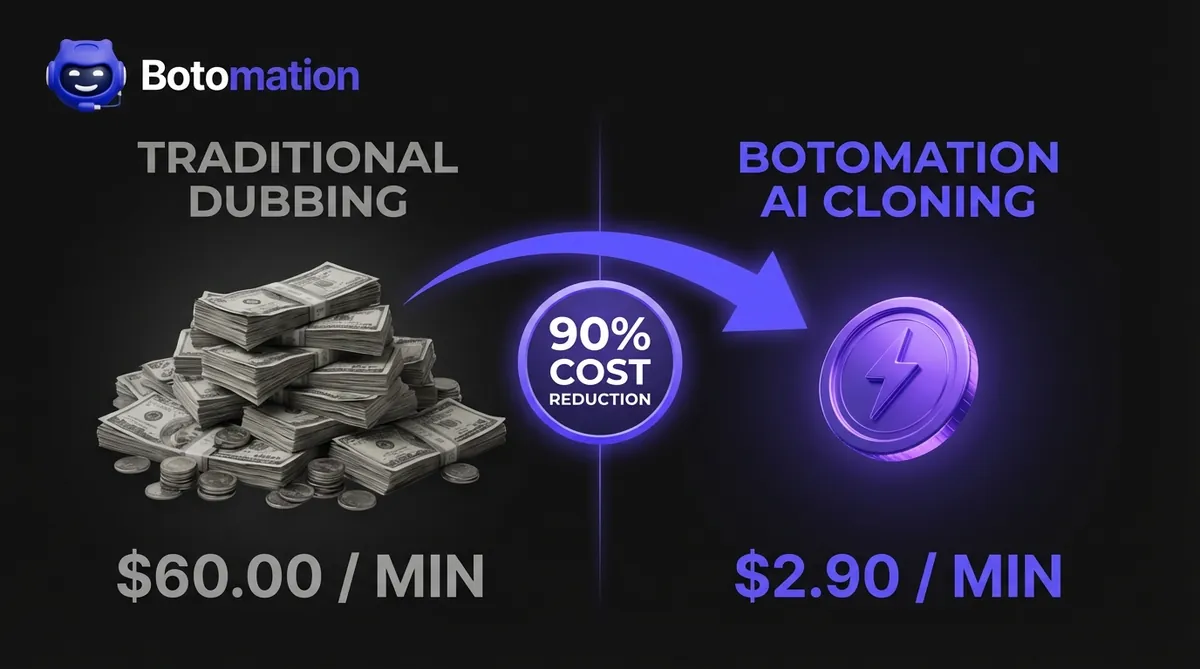
Beyond the $10,500 price tag, you face the headache of managing ten different personalities and schedules. If one actor departs or changes their style, your brand consistency in that region vanishes. This is why many creators remain restricted to their home market; the barrier to entry is simply too high, though creators can now reduce video localization costs by 90% with AI voice cloning to mitigate these risks.
AI Voice Cloning Technology for Global Brand Consistency
The arrival of sophisticated AI voice cloning has revolutionized international reach. This is not the "text-to-speech" of the past that sounded like a GPS navigation system. Modern cloning technology, as utilized by Botomation, captures the unique nuances of a person's voice—their breath, their pauses, and their specific way of emphasizing certain vowels.
This technology allows us to take a sample of your original voice and "teach" it to speak a new language. The result is a video where you, the creator, appear to be speaking Spanish, French, or Mandarin fluently, with your own voice. This preserves the emotional connection you’ve built with your audience and ensures that your brand identity remains 100% consistent across every border.
Technical Capabilities of Modern Voice Cloning
The technical depth of our voice cloning service goes far beyond simple pitch matching. We use neural networks that analyze thousands of data points in your speech patterns, including the "micro-emotions" that make a voice sound human—the slight quiver of excitement or the downward inflection of a serious point.
Because our models are trained on professional-quality audio, the output is indistinguishable from a studio recording. This precision allows us to deliver commercial-grade voiceovers in multiple languages simultaneously. For global brands, this means you can launch a product worldwide on the same day, with the same spokesperson, speaking every language perfectly. Our workflows are designed to integrate with your existing video production, allowing us to take your finished English file and return localized versions in a fraction of the time traditional dubbing would require.
Implementation Strategies for Content Creators
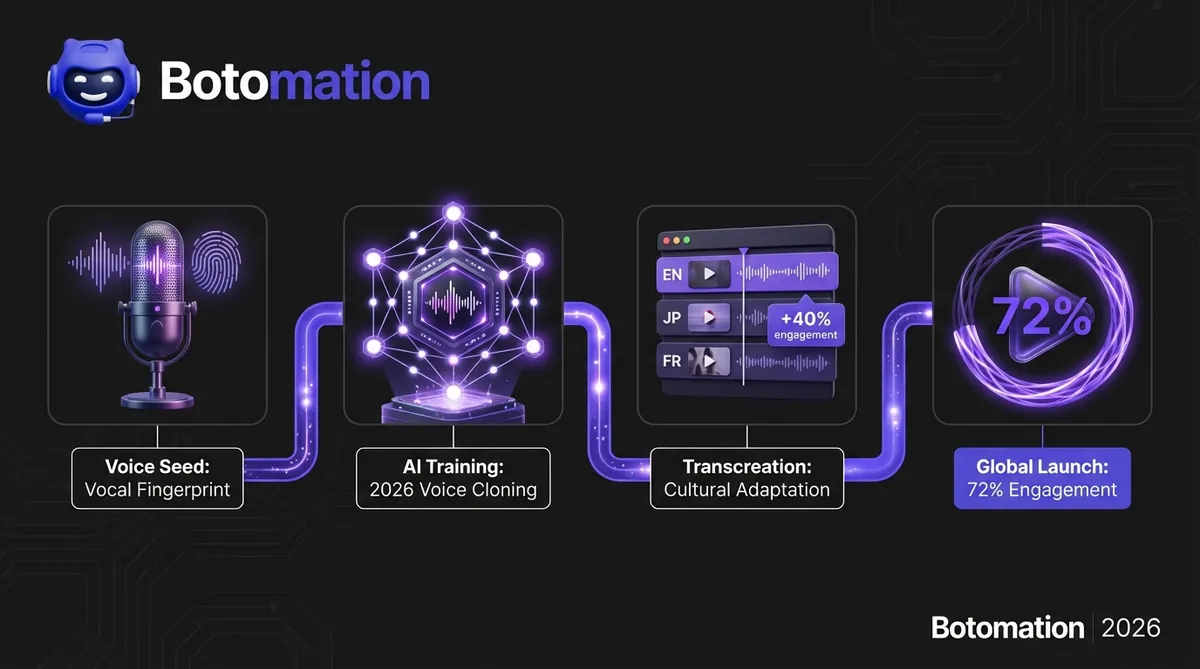
For creators looking to utilize this technology, the process is straightforward but requires a strategic approach. We begin by building a high-fidelity "Voice Seed" from your best audio recordings, which serves as the foundation for all future translations.
Once the model is built, we implement a multi-stage quality control process. Every localized video is reviewed by native speakers who ensure the AI has captured the correct cultural nuances and that the voice sounds natural. We also recommend A/B testing your scripts; sometimes a slightly different tone works better in one region than another. This is a critical component of testing international market demand with video pilots, and our technology allows you to swap out tones and delivery styles without needing to step back into a recording booth. This agility allows our clients to scale their content libraries across dozens of channels without compromising their budget or brand integrity.
Best Practices for YouTube Channel Brand Consistency Across Languages
YouTube is the ultimate proving ground for brand consistency. For those looking to expand YouTube globally with voice cloning in 2026, the platform's multi-track audio features and regional channels offer massive growth opportunities. However, many creators make the mistake of focusing only on the audio while ignoring the visual and metadata elements of their brand.
To truly succeed, you must align your visual branding with your localized voice. By following steps to automate YouTube international expansion with voice cloning, you can ensure that if a viewer clicks on a Spanish-dubbed video, every element from the thumbnail to the audio feels cohesive. Consistency must extend through every touchpoint, from the channel art to the "About" section. Leading OTT platforms like Netflix and Disney+ provide the blueprint for this; they ensure that the user experience is localized so thoroughly that the viewer forgets the content was originally produced in another language.
Visual and Audio Consistency Strategies
Our experts recommend a "Template-First" approach to visual branding. This involves creating thumbnail and graphic templates that can be easily adapted for different languages while maintaining the same layout, color palette, and font styles. When your visual identity is consistent, it reinforces the authority of the voice the viewer is hearing.
We also assist our clients in adapting their metadata—titles, descriptions, and tags—to reflect the localized brand voice. This is not just about SEO; it is about ensuring the "vibe" of the channel remains consistent. If your English channel is known for its quirky and humorous titles, your French channel should mirror that wit rather than using dry, descriptive titles. This holistic approach ensures that your brand feels like a cohesive global entity rather than a collection of disconnected regional accounts.
Channel Management and Analytics
Managing multiple language channels requires a data-driven mindset. You need to track viewer engagement across every region to see where your brand voice is resonating most effectively. Are your Spanish viewers dropping off at a certain point? Perhaps the tone in that section needs adjustment.
We help our clients use analytics to measure brand recall and recognition in international markets. By comparing the performance of localized channels against the "parent" channel, we can optimize the voice consistency strategy in real-time. We also evaluate cross-promotion tactics; if you have a loyal following in the US, you can use your main channel to drive traffic to your localized channels, but only if the transition feels natural. If the voice on the new channel matches the voice they already love, the conversion rate is significantly higher.
Measuring and Maintaining Brand Voice Effectiveness Globally
Consistency is not a "set it and forget it" task. As your brand evolves, your multilingual content must evolve with it. Regular audits are necessary to automate brand voice consistency in 2026 and ensure that the standards you set on day one are still being met six months or a year later. This is especially true for multinational corporations that use localized video for internal training. If the "corporate voice" feels different in the European branch than it does in the Asia-Pacific branch, it can lead to a fragmented company culture.
We provide our clients with a framework for gathering feedback from international audiences. This qualitative data is often more valuable than raw numbers. Hearing from a viewer in Brazil that they "felt like the creator was talking directly to them" is the ultimate proof that the voice cloning and localization strategy is working.
Key Performance Indicators for Brand Voice
How do you quantify "consistency"? We look at several Key Performance Indicators (KPIs) to evaluate success. Audience retention is a major metric; if viewers are staying until the end of the video, it indicates the voice and content are engaging. We also track brand association—do viewers in different markets describe the brand using the same core adjectives?
ROI measurement is also critical. We compare the cost of our localized voice services against the projected cost of traditional dubbing and the resulting increase in ad revenue or lead generation from new markets. Most of our clients see a positive ROI within the first three months of localized expansion, as the cost of reaching an additional 100 million people is significantly lower than their initial domestic acquisition costs.
Quality Assurance and Audit Processes
Our team at Botomation maintains a rigorous QA protocol. We do not just generate a voice and deliver it; every project undergoes a series of checks for audio clarity, emotional accuracy, and sync precision. We also maintain a "Voice Library" for our clients, documenting the specific settings and models used for their brand to ensure that a video produced today sounds exactly like a video produced a year from now.
For large organizations, we manage the localization of training and internal communication videos. This ensures that every employee, regardless of their location, receives the same message in the same brand voice. This consistency fosters a sense of unity and ensures that the company’s core values are not "lost in translation."
How to Get Started with Global Voice Cloning
If you are ready to take your content global without sacrificing your identity, follow this step-by-step guide to partnering with our experts.
- Initial Voice Audit: Our team reviews your existing content to identify the core traits of your brand voice and determine which languages offer the highest growth potential for your niche.
- Voice Model Creation: We collect high-quality audio samples from your original content to build a bespoke AI voice clone that captures your unique personality and cadence.
- Script Transcreation: Instead of literal translation, our linguists adapt your scripts to ensure the humor, idioms, and emotional beats resonate with the target culture.
- Localization & Syncing: We generate the localized audio using your cloned voice and perfectly sync it to your original video, ensuring a natural and professional look.
- Quality Review & Launch: Every video is vetted by native speakers before we assist you in deploying the content across your international channels.
Frequently Asked Questions
Does the cloned voice really sound exactly like me?
Yes. Our advanced neural cloning technology captures the specific frequencies, timbre, and speech patterns that make your voice unique. While traditional AI sounds flat, our models include the emotional nuances and human imperfections that make a voice recognizable and trustworthy.
How many languages can you dub my content into?
We currently support over 40 languages, including major markets like Spanish, French, German, Mandarin, Japanese, Portuguese, and Arabic. Our team is constantly expanding our linguistic capabilities to help you reach virtually any audience on the planet.
Will YouTube penalize me for using AI-generated voices?
No. YouTube’s policies are focused on the quality and authenticity of the content. Because our service provides a high-quality, professional dub that improves the user experience for non-English speakers, it is viewed as a positive localization effort. We ensure all content meets platform guidelines.
How long does the localization process take?
Unlike traditional dubbing which can take weeks per video, our team can typically deliver localized versions of your content in a matter of days. This allows you to maintain a consistent posting schedule across all your global channels simultaneously.
Can I adjust the "energy" of the voice for different languages?
Absolutely. Part of our service involves fine-tuning the delivery. If you want to sound more authoritative in one language and more casual in another, our experts can adjust the model's parameters to achieve the perfect tone while keeping the voice consistent.
The "Old Way" of global expansion—hiring expensive voice actors, managing complex recording schedules, and hoping the brand voice doesn't get lost—is obsolete. It was a slow, expensive process that kept high-quality content locked behind language barriers. Partnering with the expert team at Botomation is the "New Way." We provide a premium, white-glove service that handles the technical and creative heavy lifting of localization, allowing you to focus on creating great content.
By utilizing our advanced voice cloning technology, you aren't just translating your videos; you are duplicating your influence. You are ensuring that your brand’s soul, its wit, and its authority remain intact as you scale across the globe. The data is clear: the future of video is multilingual, and the future of branding is consistency. Don't let your message be muffled by a generic voiceover.
Ready to automate your growth? Book a call below.
As we navigate the 2026 media landscape, the imperative for international expansion has never been more critical for creators and brands. Producing video content exclusively in one language effectively overlooks billions of potential viewers who prefer consuming media in their native tongue. Current data indicates that 80% of all online traffic is now driven by video, establishing it as the primary currency of digital communication. However, linguistic translation alone is no longer sufficient to succeed in global markets. Statistics demonstrate that customers are 72% more likely to engage with content presented in their native language, but that engagement hinges on a frequently underestimated factor: the ability to maintain voice personality in video localization.
When you expand your reach, you face a significant risk of eroding the unique personality that defined your brand's success. For years, traditional methods relied on hiring various voice actors who, while talented, often failed to capture the specific cadence, humor, or authority of the original speaker. This auditory disconnect results in a discordant viewer experience, leading to a loss of trust. If your English-speaking persona is energetic and youthful, but your Spanish dub sounds like a somber news anchor, your brand identity collapses.
Modern AI voice cloning technologies, like the specialized services provided by Botomation, have definitively solved this dilemma. We prioritize AI voice cloning for global brand identity and authenticity, allowing us to preserve your original voice across dozens of languages, ensuring that your unique "vocal fingerprint" remains intact whether you are speaking to an audience in Tokyo, Paris, or Sao Paulo. This consistency serves as the bridge between being a local creator and becoming a global authority.
Understanding Brand Voice vs. Tone in Multilingual Video Contexts
Maintaining a coherent identity requires a sophisticated understanding of the distinction between voice and tone. Think of your brand voice as your personality—it is steady, predictable, and foundational. Your tone, conversely, is the emotional inflection applied to that voice based on the specific situation or the cultural context of your audience. In the world of multilingual video, your voice must remain identical across all borders, while your tone requires the flexibility to respect local sensibilities.
Video adds layers of complexity that text-based content does not. You must account for visual cues, facial expressions, and the rhythmic timing of the audio. If the translated audio does not match the intensity of the speaker’s gestures, the content feels "uncanny" and artificial. By prioritizing voice consistency, we ensure that the core personality of the brand remains unchanged even when linguistic nuances shift to accommodate a new market.
Defining Voice Identity Across Language Barriers
Your voice identity is comprised of specific traits that must be documented and guarded. Is your brand witty, authoritative, or perhaps comforting? These traits must survive the translation process. Our experts at Botomation work with you to identify these core characteristics before any localization begins. We establish comprehensive voice guidelines that serve as a North Star for every language version produced.
Cultural sensitivity plays a massive role in this process. For example, a luxury fashion house we recently partnered with discovered that their original high-energy, fast-paced English videos felt "aggressive" to their Japanese audience. By maintaining the original speaker's sophisticated voice but adjusting the delivery to be more measured and respectful, they achieved a 40% increase in audience engagement compared to previous attempts at generic translations. This proves that consistency is not about being identical; it is about being authentic to your identity while remaining relevant to the listener.
Tone Adaptation for Cultural Relevance
While the voice remains the same, the tone must be fluid. In some cultures, a direct and blunt tone is viewed as a sign of expertise and honesty. In others, that same approach is perceived as unprofessional. Successful international video campaigns understand how to pivot the tone without losing the brand's soul.
A global tech brand might utilize a playful tone in American marketing to appear "disruptive," but when entering the German market, they may shift toward a more technical and precise tone to build credibility. The voice—the actual sound and personality of the brand—remains the same, but the delivery of the message is adapted. This balance prevents the brand from appearing like a "tourist" in a new market and instead positions it as a local participant.
"Consistency in voice builds the trust necessary for a global audience to move from being casual viewers to loyal brand advocates." — Senior Strategy Consultant at Botomation.
Common Brand Voice Challenges in Multilingual Video Content
The road to global expansion is littered with brands that failed because they treated localization as a purely technical task rather than a creative one. Direct translations are the most common pitfall. When you translate a script word-for-word, you often lose the emotional impact, the humor, and the specific brand "flavor" that your audience loves. Idioms and cultural references rarely survive literal translation, often leading to confusion or offense.
Beyond the script, the human element of voice talent presents its own set of challenges. Traditional dubbing requires finding a different actor for every language, introducing massive variability. One actor might have a naturally higher pitch, while another might have a slower speaking rate. These small differences aggregate into a fragmented brand image that feels inconsistent to global viewers who encounter your content across multiple languages.
Translation vs. Localization Pitfalls
Literal translation is the enemy of brand voice. We often see companies attempt to save costs by using basic translation tools, only to end up with content that sounds robotic or nonsensical. A famous example involves a major soft-drink company that translated its slogan into Chinese; the literal translation read as "Bring your ancestors back to life," which was not only culturally insensitive but completely ruined the emotional connection the brand intended to build with its "joyful" campaign.
To avoid these mistakes, our team utilizes a process of "transcreation." This involves rewriting the message to evoke the same emotion in the target language, even if the words change entirely. We look for technical ways to match the syllable count and the emotional beats of the original video, ensuring that the visual and audio remain in perfect harmony.
Voice Talent Consistency Issues
Securing the right voice talent is an expensive and time-consuming ordeal. If you are targeting ten different markets, you traditionally need ten different actors. The cost of this is staggering.
Traditional Dubbing Cost Calculation:
- Base rate for professional voice talent: $500 per language
- Studio recording and engineering fees: $350 per language
- Project management and coordination: $200 per language
- Total for 10 languages: $10,500 per video
Beyond the $10,500 price tag, you face the headache of managing ten different personalities and schedules. If one actor departs or changes their style, your brand consistency in that region vanishes. This is why many creators remain restricted to their home market; the barrier to entry is simply too high, though creators can now reduce video localization costs by 90% with AI voice cloning to mitigate these risks.
AI Voice Cloning Technology for Global Brand Consistency
The arrival of sophisticated AI voice cloning has revolutionized international reach. This is not the "text-to-speech" of the past that sounded like a GPS navigation system. Modern cloning technology, as utilized by Botomation, captures the unique nuances of a person's voice—their breath, their pauses, and their specific way of emphasizing certain vowels.
This technology allows us to take a sample of your original voice and "teach" it to speak a new language. The result is a video where you, the creator, appear to be speaking Spanish, French, or Mandarin fluently, with your own voice. This preserves the emotional connection you’ve built with your audience and ensures that your brand identity remains 100% consistent across every border.
Technical Capabilities of Modern Voice Cloning
The technical depth of our voice cloning service goes far beyond simple pitch matching. We use neural networks that analyze thousands of data points in your speech patterns, including the "micro-emotions" that make a voice sound human—the slight quiver of excitement or the downward inflection of a serious point.
Because our models are trained on professional-quality audio, the output is indistinguishable from a studio recording. This precision allows us to deliver commercial-grade voiceovers in multiple languages simultaneously. For global brands, this means you can launch a product worldwide on the same day, with the same spokesperson, speaking every language perfectly. Our workflows are designed to integrate with your existing video production, allowing us to take your finished English file and return localized versions in a fraction of the time traditional dubbing would require.
Implementation Strategies for Content Creators
For creators looking to utilize this technology, the process is straightforward but requires a strategic approach. We begin by building a high-fidelity "Voice Seed" from your best audio recordings, which serves as the foundation for all future translations.
Once the model is built, we implement a multi-stage quality control process. Every localized video is reviewed by native speakers who ensure the AI has captured the correct cultural nuances and that the voice sounds natural. We also recommend A/B testing your scripts; sometimes a slightly different tone works better in one region than another. This is a critical component of testing international market demand with video pilots, and our technology allows you to swap out tones and delivery styles without needing to step back into a recording booth. This agility allows our clients to scale their content libraries across dozens of channels without compromising their budget or brand integrity.
Best Practices for YouTube Channel Brand Consistency Across Languages
YouTube is the ultimate proving ground for brand consistency. For those looking to expand YouTube globally with voice cloning in 2026, the platform's multi-track audio features and regional channels offer massive growth opportunities. However, many creators make the mistake of focusing only on the audio while ignoring the visual and metadata elements of their brand.
To truly succeed, you must align your visual branding with your localized voice. By following steps to automate YouTube international expansion with voice cloning, you can ensure that if a viewer clicks on a Spanish-dubbed video, every element from the thumbnail to the audio feels cohesive. Consistency must extend through every touchpoint, from the channel art to the "About" section. Leading OTT platforms like Netflix and Disney+ provide the blueprint for this; they ensure that the user experience is localized so thoroughly that the viewer forgets the content was originally produced in another language.
Visual and Audio Consistency Strategies
Our experts recommend a "Template-First" approach to visual branding. This involves creating thumbnail and graphic templates that can be easily adapted for different languages while maintaining the same layout, color palette, and font styles. When your visual identity is consistent, it reinforces the authority of the voice the viewer is hearing.
We also assist our clients in adapting their metadata—titles, descriptions, and tags—to reflect the localized brand voice. This is not just about SEO; it is about ensuring the "vibe" of the channel remains consistent. If your English channel is known for its quirky and humorous titles, your French channel should mirror that wit rather than using dry, descriptive titles. This holistic approach ensures that your brand feels like a cohesive global entity rather than a collection of disconnected regional accounts.
Channel Management and Analytics
Managing multiple language channels requires a data-driven mindset. You need to track viewer engagement across every region to see where your brand voice is resonating most effectively. Are your Spanish viewers dropping off at a certain point? Perhaps the tone in that section needs adjustment.
We help our clients use analytics to measure brand recall and recognition in international markets. By comparing the performance of localized channels against the "parent" channel, we can optimize the voice consistency strategy in real-time. We also evaluate cross-promotion tactics; if you have a loyal following in the US, you can use your main channel to drive traffic to your localized channels, but only if the transition feels natural. If the voice on the new channel matches the voice they already love, the conversion rate is significantly higher.
Measuring and Maintaining Brand Voice Effectiveness Globally
Consistency is not a "set it and forget it" task. As your brand evolves, your multilingual content must evolve with it. Regular audits are necessary to automate brand voice consistency in 2026 and ensure that the standards you set on day one are still being met six months or a year later. This is especially true for multinational corporations that use localized video for internal training. If the "corporate voice" feels different in the European branch than it does in the Asia-Pacific branch, it can lead to a fragmented company culture.
We provide our clients with a framework for gathering feedback from international audiences. This qualitative data is often more valuable than raw numbers. Hearing from a viewer in Brazil that they "felt like the creator was talking directly to them" is the ultimate proof that the voice cloning and localization strategy is working.
Key Performance Indicators for Brand Voice
How do you quantify "consistency"? We look at several Key Performance Indicators (KPIs) to evaluate success. Audience retention is a major metric; if viewers are staying until the end of the video, it indicates the voice and content are engaging. We also track brand association—do viewers in different markets describe the brand using the same core adjectives?
ROI measurement is also critical. We compare the cost of our localized voice services against the projected cost of traditional dubbing and the resulting increase in ad revenue or lead generation from new markets. Most of our clients see a positive ROI within the first three months of localized expansion, as the cost of reaching an additional 100 million people is significantly lower than their initial domestic acquisition costs.
Quality Assurance and Audit Processes
Our team at Botomation maintains a rigorous QA protocol. We do not just generate a voice and deliver it; every project undergoes a series of checks for audio clarity, emotional accuracy, and sync precision. We also maintain a "Voice Library" for our clients, documenting the specific settings and models used for their brand to ensure that a video produced today sounds exactly like a video produced a year from now.
For large organizations, we manage the localization of training and internal communication videos. This ensures that every employee, regardless of their location, receives the same message in the same brand voice. This consistency fosters a sense of unity and ensures that the company’s core values are not "lost in translation."
How to Get Started with Global Voice Cloning
If you are ready to take your content global without sacrificing your identity, follow this step-by-step guide to partnering with our experts.
- Initial Voice Audit: Our team reviews your existing content to identify the core traits of your brand voice and determine which languages offer the highest growth potential for your niche.
- Voice Model Creation: We collect high-quality audio samples from your original content to build a bespoke AI voice clone that captures your unique personality and cadence.
- Script Transcreation: Instead of literal translation, our linguists adapt your scripts to ensure the humor, idioms, and emotional beats resonate with the target culture.
- Localization & Syncing: We generate the localized audio using your cloned voice and perfectly sync it to your original video, ensuring a natural and professional look.
- Quality Review & Launch: Every video is vetted by native speakers before we assist you in deploying the content across your international channels.
Frequently Asked Questions
Does the cloned voice really sound exactly like me?
Yes. Our advanced neural cloning technology captures the specific frequencies, timbre, and speech patterns that make your voice unique. While traditional AI sounds flat, our models include the emotional nuances and human imperfections that make a voice recognizable and trustworthy.
How many languages can you dub my content into?
We currently support over 40 languages, including major markets like Spanish, French, German, Mandarin, Japanese, Portuguese, and Arabic. Our team is constantly expanding our linguistic capabilities to help you reach virtually any audience on the planet.
Will YouTube penalize me for using AI-generated voices?
No. YouTube’s policies are focused on the quality and authenticity of the content. Because our service provides a high-quality, professional dub that improves the user experience for non-English speakers, it is viewed as a positive localization effort. We ensure all content meets platform guidelines.
How long does the localization process take?
Unlike traditional dubbing which can take weeks per video, our team can typically deliver localized versions of your content in a matter of days. This allows you to maintain a consistent posting schedule across all your global channels simultaneously.
Can I adjust the "energy" of the voice for different languages?
Absolutely. Part of our service involves fine-tuning the delivery. If you want to sound more authoritative in one language and more casual in another, our experts can adjust the model's parameters to achieve the perfect tone while keeping the voice consistent.
The "Old Way" of global expansion—hiring expensive voice actors, managing complex recording schedules, and hoping the brand voice doesn't get lost—is obsolete. It was a slow, expensive process that kept high-quality content locked behind language barriers. Partnering with the expert team at Botomation is the "New Way." We provide a premium, white-glove service that handles the technical and creative heavy lifting of localization, allowing you to focus on creating great content.
By utilizing our advanced voice cloning technology, you aren't just translating your videos; you are duplicating your influence. You are ensuring that your brand’s soul, its wit, and its authority remain intact as you scale across the globe. The data is clear: the future of video is multilingual, and the future of branding is consistency. Don't let your message be muffled by a generic voiceover.
Ready to automate your growth? Book a call below.
Get Started
Book a FREE Consultation Right NOW!
Schedule a Call with Our Team To Make Your Business More Efficient with AI Instantly.
Read More
Brand Voice Consistency in Multilingual Video Content 2026
Master brand voice consistency in multilingual video content with AI voice cloning. Scale YouTube dubbing and localization for global reach in 2026.
AI Voice Cloning for Video Localization - Save 90% in 2026
Learn how WhatsApp AI slashes support costs for e-commerce & SaaS. Proven strategies to boost sales, recover carts, and scale 24/7 service.