Data Entry Validation Best Practices 2026 Expert Guide
Jan 8, 2026
Data Management
AI Automation
Operational Excellence
Data Management
AI Automation
Operational Excellence
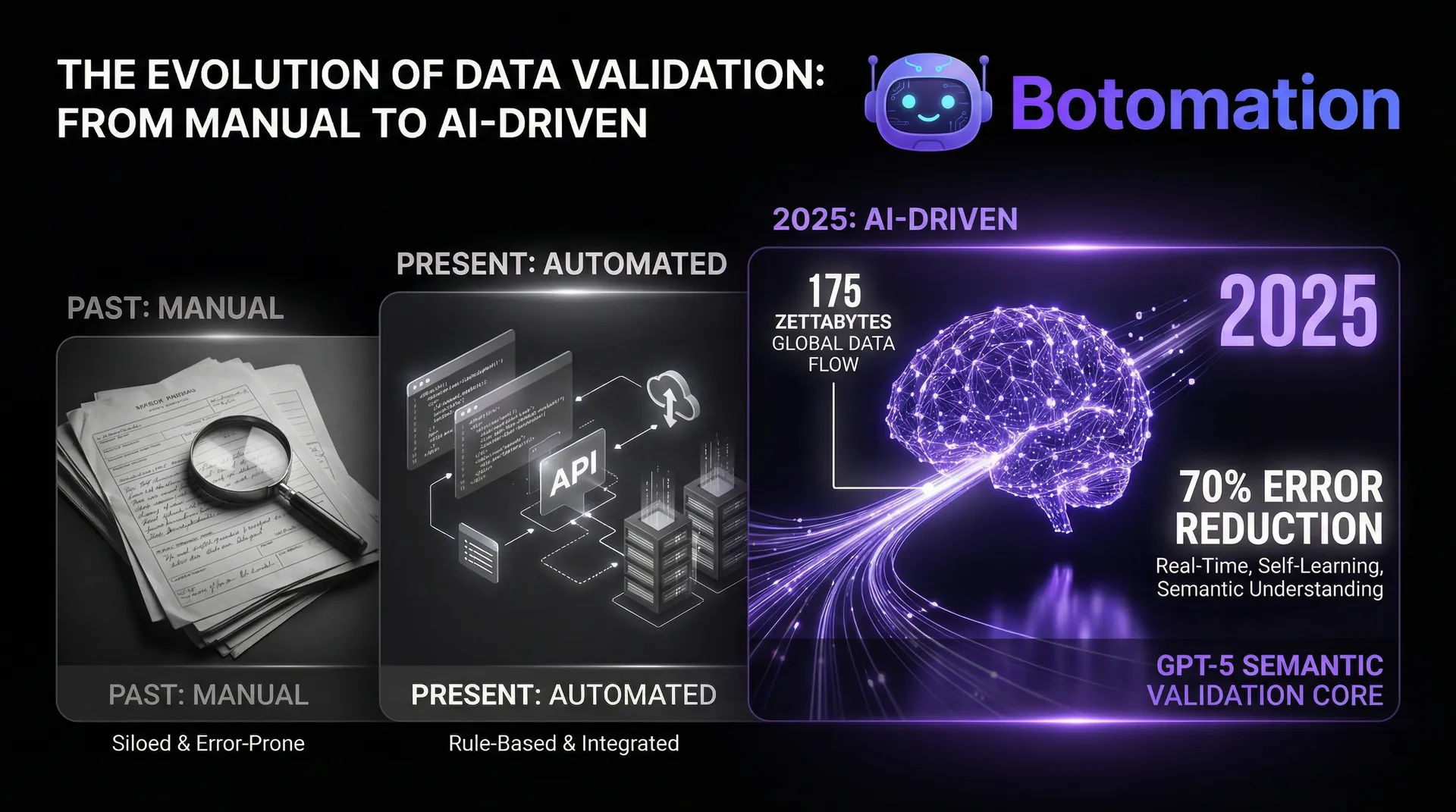
The landscape of administrative operations has shifted from managing personnel to managing the intelligent flow of information. In January 2026, data entry validation best practices have evolved far beyond simple spell-checks or mandatory field requirements. Organizations that have successfully integrated sophisticated validation protocols are experiencing a massive 70% reduction in data processing errors, which directly translates to reclaimed hours for operations teams. For a COO or an operations manager, the objective is no longer merely "getting the data in," but ensuring that every piece of information entering the ecosystem is verified, cleaned, and formatted the moment it enters the system.
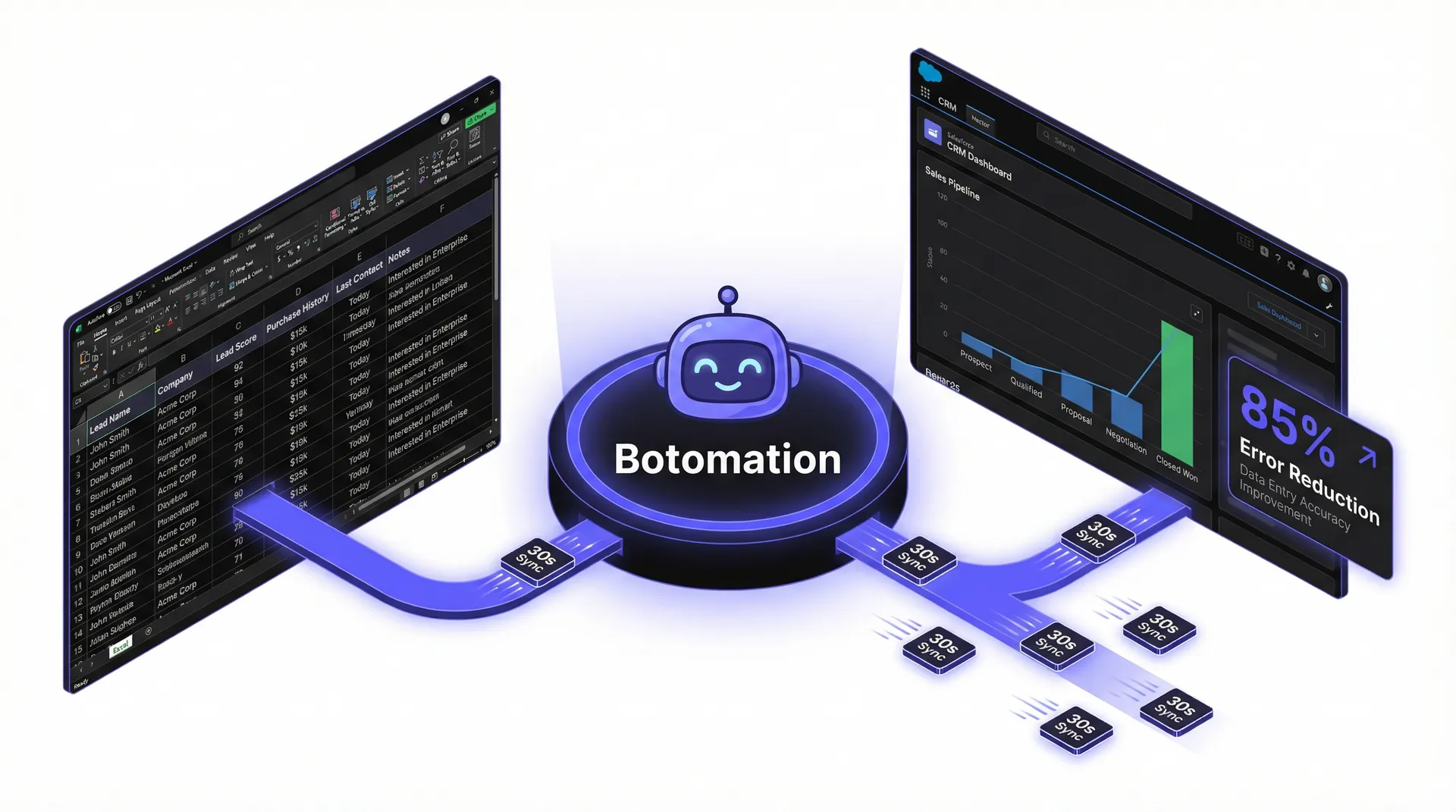
This guide explores the essential frameworks for administrative task automation as they exist today. We are moving away from the era of "garbage in, garbage out" by building intelligent filters that prevent the garbage from ever entering the pipeline. By focusing on practical implementation, our team at Botomation helps businesses bridge the gap between fragmented software tools and a unified, error-free operational flow. The focus here is on real-time, autonomous validation that acts as a silent guardian for your CRM, ERP, and financial spreadsheets, often achieved through automated data sync.
Modern administrative workflows require a level of precision that manual entry simply cannot provide. When a team member copy-pastes a client's email address or an invoice number, the risk of a typo is statistically significant. In a high-volume environment, these small errors compound into massive operational bottlenecks, leading to failed deliveries, missed payments, and frustrated clients. By implementing these 2026 standards, you are not just "fixing" data; you are installing a foundational layer of operational integrity that allows your business to scale without adding more administrative headcount.
Evolution of Data Validation: From Manual Checks to AI-Driven Real-Time Systems
The history of data management is a story of increasing speed and decreasing human intervention. Twenty years ago, data validation meant a second employee reviewing a paper form against a computer screen. This was slow, expensive, and prone to the same human errors it sought to correct. As we move through 2026, the volume of data being generated globally is staggering, with estimates reaching 175 zettabytes. No human team, regardless of size, can manually validate this volume of information without the aid of sophisticated automation, especially as AI agents replace manual data entry work in modern back-offices.
The transition from batch processing to real-time validation represents the most significant leap in this evolution. In the past, companies would run "clean-up" scripts at the end of the week or month to catch errors. This reactive approach meant that for thirty days, the business was operating on flawed information. Today, the standard is "at-the-edge" validation. This means the data is checked the millisecond it is submitted, providing instant feedback to the user or the API. This shift ensures that downstream systems—like your billing software or shipping provider—never receive a single byte of incorrect data.
From Manual to Automated: Validation Timeline
The journey began with basic field-level constraints in early database software, where a field might be restricted to "numbers only." This evolved into regular expressions (Regex) that could check for specific patterns, such as an email format or a zip code. While these tools were helpful, they were rigid and lacked context. If a user entered a valid-looking but non-existent email address, the system would accept it.
By the early 2020s, we saw the rise of third-party verification APIs. These services allowed systems to check an address against postal records or a credit card against a banking network in real-time. In 2026, we have integrated GPT-5 and specialized machine learning models that can perform semantic validation. These models do not just check if a field is filled; they verify if the content makes sense within the context of the entire document. Our experts at Botomation utilize these advanced models to ensure that even complex, unstructured data is validated with a high degree of accuracy before it enters your workflow.
Technology Drivers for 2026 Validation Practices
Cloud computing has provided the raw processing power necessary to run complex validation logic without slowing down the user experience. In the past, running a dozen validation checks might cause a noticeable lag in a form submission. Now, with microservices and serverless architecture, these checks happen in parallel and finish in milliseconds. This scalability is crucial for service businesses that experience seasonal spikes in administrative volume.
Parallel to this, the maturation of API ecosystems has made it easier than ever to connect disparate tools. A modern validation system might pull data from a CRM, check it against a government database, and verify it with an internal spreadsheet simultaneously. This interconnectedness is the "glue" that Botomation provides, ensuring that your various software tools are not just talking to each other, but are speaking a language of verified, accurate data by connecting disparate software tools into a unified ecosystem.
data entry validation best practices 2026 Primary Keyword and Core Principles
To master data entry validation best practices 2026, one must embrace real-time data entry validation and the principle of "Active Interception." This means designing systems that proactively catch errors before they are committed to the database. The core philosophy centers on user experience; if a validation rule is too strict or the feedback is confusing, users will find workarounds that compromise data integrity. The goal is to create a "pave the path" experience where the easiest way to enter data is also the correct way.
Another pillar of 2026 validation is adaptability. Business rules change, and a rigid validation system becomes a liability when it prevents legitimate data from being recorded. Modern practices involve using "soft" and "hard" validation rules. A hard rule prevents submission (e.g., a missing required field), while a soft rule flags a potential error for human review (e.g., an unusually high invoice amount). This balance ensures that the system remains robust without becoming a bottleneck for the operations team.
Stat Box: The Cost of Dirty Data
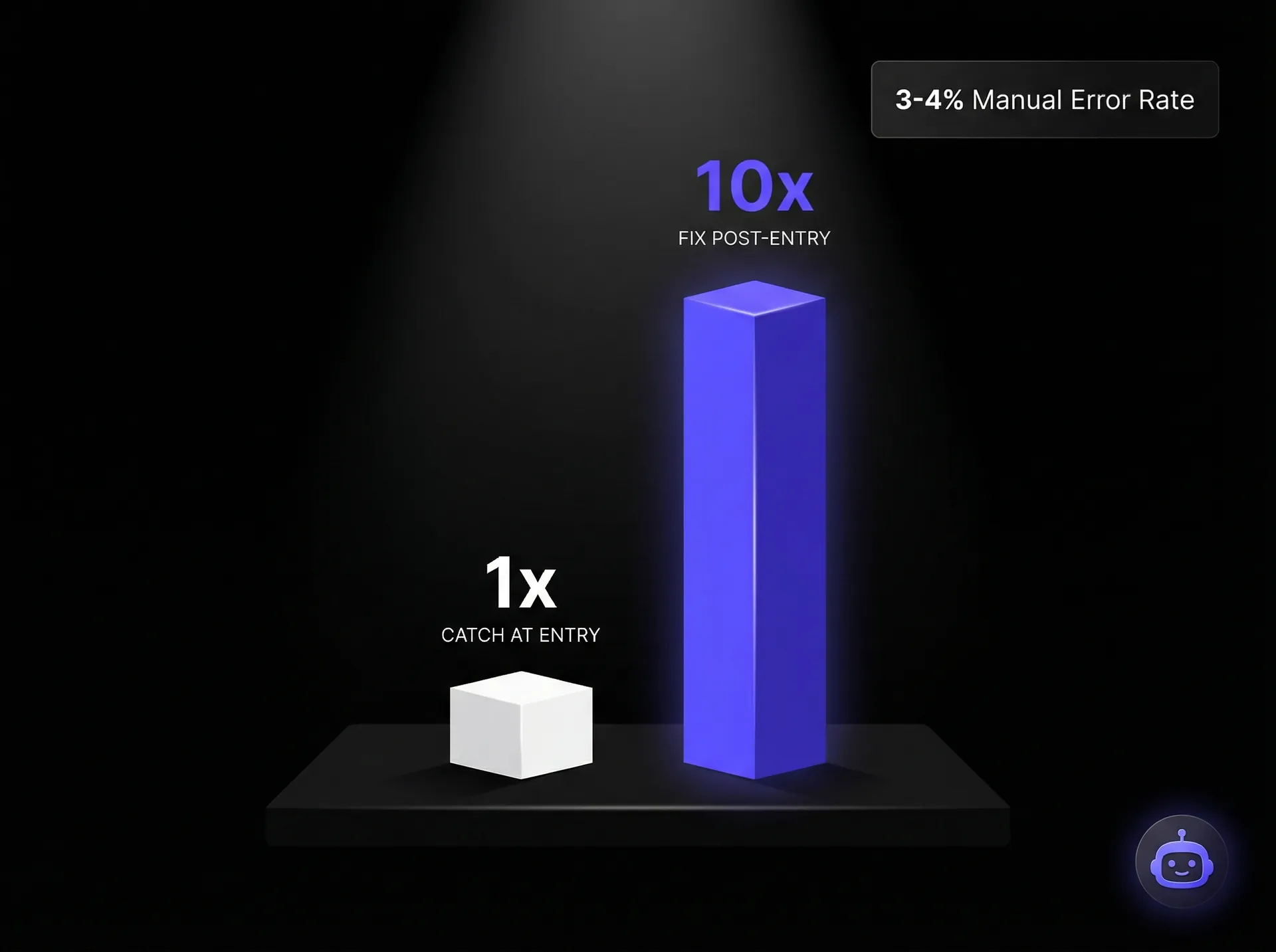
* Average Error Rate: Manual data entry typically sees a 3-4% error rate.
* Cost to Correct: Fixing a single error after it has entered the system costs 10x more than catching it at entry.
* Operational Impact: 60% of COOs report that poor data quality is the primary hurdle to successful AI implementation.
* Botomation Result: Our clients typically see a 95% reduction in "downstream" errors after implementing our automated validation frameworks.
Core Principles of 2026 Validation Practices
Real-time feedback is the most visible principle in modern validation. Instead of waiting for a "Submit" button to be clicked, the system should validate fields as they are completed. If a phone number is missing a digit, the field should highlight immediately. This instant correction loop prevents the cognitive load of having to go back and find errors in a long form. It turns data entry into a guided conversation rather than a test of accuracy.
Beyond simple formatting, 2026 practices include cross-field validation. This ensures that data in one field is logical when compared to another. For example, if a "Service Type" is selected as "Premium," the "Price" field should not allow a value below a certain threshold. This logic requires a deep understanding of the business's operational rules, which is where a partnership with a specialized agency like Botomation becomes invaluable. We do not just install tools; we map your business logic into the automation layer.
Balancing Rigor and Efficiency in Validation
Maintaining the balance between strictness and speed is a constant challenge for operations managers. If you validate too many parameters, the system might become slow or reject valid edge cases. We recommend a tiered approach where critical data (like financial figures or contact info) undergoes rigorous multi-step validation, while secondary data (like internal notes) is subject to lighter, semantic checks. This ensures that the system's resources are focused where they matter most.
Performance optimization is also a key consideration. In 2026, we use edge computing to handle validation logic closer to the user. This minimizes latency and ensures that the real-time feedback feels truly instantaneous. For our clients, this means that even as their data volumes grow, their administrative workflows remain snappy and efficient. We focus on building systems that do not just work, but work at the speed of modern business.
| Validation Method | 2020 Standard (Manual/Batch) | 2026 Standard (Real-Time/AI) | Business Impact |
|---|---|---|---|
| **Email Verification** | Format check (Regex) | SMTP handshake & MX record check | 99% reduction in bounced emails |
| **Address Entry** | Manual typing | Auto-complete with USPS/Google Maps API | Eliminated shipping errors |
| **Financial Data** | Monthly reconciliation | Real-time budget & threshold alerts | Instant cash flow visibility |
| **Customer Names** | No validation | Identity matching & deduplication | Single source of truth in CRM |
| **Document Scanning** | Manual OCR correction | AI-driven semantic verification | 80% faster invoice processing |
Technical Implementation of Real-Time Validation Systems
Building a real-time validation system requires a shift in how we think about software architecture, often following 7 steps to automate data entry validation to ensure technical reliability. Rather than a single, monolithic application, we favor a microservices-based approach. Each validation rule can be treated as a small, independent service. This allows our team to update a specific business rule—such as a change in tax calculation—without needing to rebuild the entire administrative system. It provides the flexibility that modern service businesses need to stay agile.
API design is the heartbeat of these systems. When your CRM needs to validate a new lead, it sends a request to a validation endpoint. This endpoint might then query several other services before returning a "Valid" or "Invalid" response. To keep this process fast, we implement intelligent caching. If the system has recently validated a specific zip code, it doesn't need to query the external database again; it can pull the result from a high-speed cache like Redis, saving both time and API costs.
System Architecture for Real-Time Validation
When designing these systems, we prioritize high availability. If the validation service goes down, the entire data entry process could grind to a halt. We solve this by using redundant, geographically distributed servers. If one node fails, another immediately takes over, ensuring that your operations team never experiences downtime. This level of reliability is what separates a professional, agency-led implementation from a "DIY" automation attempt.
Furthermore, we utilize asynchronous processing for complex validation tasks. If a validation check requires a heavy calculation or a slow external lookup, we do not make the user wait. Instead, we accept the data, mark it as "Pending Validation," and notify the user once the check is complete. This keeps the workflow moving while still maintaining the integrity of the data. It is about creating a seamless experience where technology supports the human worker.
API Design for Validation Services
The design of the API itself must be robust and forward-compatible. We use RESTful principles to ensure that the validation services can be easily consumed by any tool in your stack, whether it is a custom-built web form or a third-party app like Zapier or Make. Versioning is a critical part of this; as we update the validation logic to meet 2026 standards, we ensure that older integrations continue to function perfectly.
Monitoring and logging are the final pieces of the technical puzzle. Every validation request and its result are logged in a centralized dashboard. This allows COOs to see exactly where errors are occurring. If a specific form field is consistently failing validation, it is a sign that the instructions are unclear or the field is poorly designed. These insights allow for continuous, data-driven improvements to the administrative process, ensuring the system evolves alongside the business.
Human Factors and User Experience in Validation Design
The most advanced validation system in the world is useless if your employees find it cumbersome. Human factors are often the most overlooked aspect of administrative automation. When a system rejects an entry, it should not just display a red box; it should explain why it was rejected and how to fix it. Instead of "Invalid Date," a helpful system might say, "Please enter a date that is not in the past." This small shift in language reduces user frustration and speeds up the correction process.
Training and change management are also vital. When we partner with a client at Botomation, we do not just hand over a new system. We work with the staff to explain how the new validation rules will actually make their jobs easier. By removing the fear of making a mistake, we empower employees to work faster and with more confidence. The goal is to move the administrative team away from "data entry" and toward "data management," where they oversee the automated systems rather than doing the heavy lifting themselves.
User-Centric Validation Interface Design
Good design is invisible. In a well-designed validation interface, the user feels guided rather than restricted. We use visual cues like progress bars and checkmarks to provide positive reinforcement as fields are correctly filled. If an error does occur, we use "inline" messaging, placing the error text directly next to the problematic field so the user does not have to hunt for it. This reduces the time spent on each form and improves the overall quality of life for the admin team.
Accessibility is another non-negotiable factor in 2026. Validation systems must be usable by everyone, including those using screen readers or other assistive technologies. This means using proper ARIA labels and ensuring that color is not the only way an error is communicated. A system that is accessible is, by definition, a system that is better designed for everyone. Our experts ensure that every implementation meets these modern standards of inclusivity.
Change Management and User Adoption
Resistance to new technology is natural, especially in established businesses with deep-rooted manual processes. We address this by involving key stakeholders early in the design process. By listening to the pain points of the people actually performing the data entry, we can build validation rules that solve their specific problems. This creates a sense of ownership and makes the transition to an automated system much smoother.
Continuous feedback loops are essential for long-term success. We recommend setting up a "Validation Feedback" channel where users can report "false positives"—times when the system rejected valid data. This allows our team to fine-tune the rules in real-time. Administrative automation is not a "set it and forget it" project; it is a living system that requires ongoing attention to remain effective.
Compliance and Security in Validation Systems
In 2026, data validation is not just about accuracy; it is about legality. With regulations like GDPR, HIPAA, and various state-level privacy laws, how you handle data during the validation process is critical. If your validation service is sending sensitive customer information to a third-party API for checking, that process must be encrypted and compliant with all relevant standards. Our agency takes a "Security-First" approach, ensuring that every automation we build acts as a fortress for your business data.
Audit trails are a mandatory requirement for many industries. A robust validation system should log not just the final data, but also the "pre-validated" version and the reason for any changes. This transparency is vital during a financial audit or a compliance review. It proves that the business has taken reasonable steps to ensure data integrity and that no unauthorized changes were made to critical records.
Regulatory Compliance for Validation Systems
Different industries have different "North Stars" for compliance. In healthcare, validation might focus on ensuring that patient IDs match across systems to prevent medical errors. In finance, the focus might be on "Know Your Customer" (KYC) protocols. We tailor our validation frameworks to meet these specific regulatory needs, ensuring that your automation is not just efficient, but also fully compliant with your industry's standards.
Documentation is the often-ignored sibling of compliance. We provide comprehensive documentation for every validation rule we implement. This includes the logic behind the rule, the data sources used, and the expected outcome. This documentation is a valuable asset for any COO, providing a clear map of the business's data governance policies.
Security Considerations in Validation
Security must be baked into the validation process from day one. We use end-to-end encryption for all data in transit and at rest. Furthermore, we implement strict access controls, ensuring that only authorized systems and personnel can modify the validation rules. This prevents "logic tampering," where an attacker might try to bypass validation to inject malicious data into your systems.
Protecting sensitive data (PII) during validation is a top priority. We use techniques like data masking and tokenization so that the validation service can check the data without ever "seeing" the actual sensitive values. For example, we can validate that a credit card number is correct without storing the full number in our logs. This minimizes the impact of any potential security breach and keeps your customers' data safe.
Measuring Success with Data Entry Validation Best Practices 2026
You cannot manage what you cannot measure. To understand the impact of your data entry validation best practices 2026, you need clear Key Performance Indicators (KPIs). We look at metrics like the "First-Pass Yield"—the percentage of records that pass validation on the first attempt. A low yield indicates that your data sources or user instructions need work. By tracking these numbers over time, COOs can see the tangible ROI of their automation investment.
Continuous improvement is the final stage of the validation lifecycle. As your business grows, you will encounter new types of data and new edge cases. A system that worked perfectly for 100 entries a day might struggle at 10,000. We provide ongoing support to scale business operations with AI automation and refine your validation rules, ensuring that your administrative engine continues to run smoothly regardless of your growth rate.
Key Performance Indicators for Validation Systems
The most important metric is the reduction in "Downstream Error Rate." This measures how many errors are found after the validation step. Our goal is to get this number as close to zero as possible. We also track "Correction Time"—the time it takes for a user to fix a validation error. By optimizing the UI and error messaging, we can significantly reduce this time, further increasing the efficiency of the operations team.
Step-by-Step: Implementing a Real-Time Validation Workflow
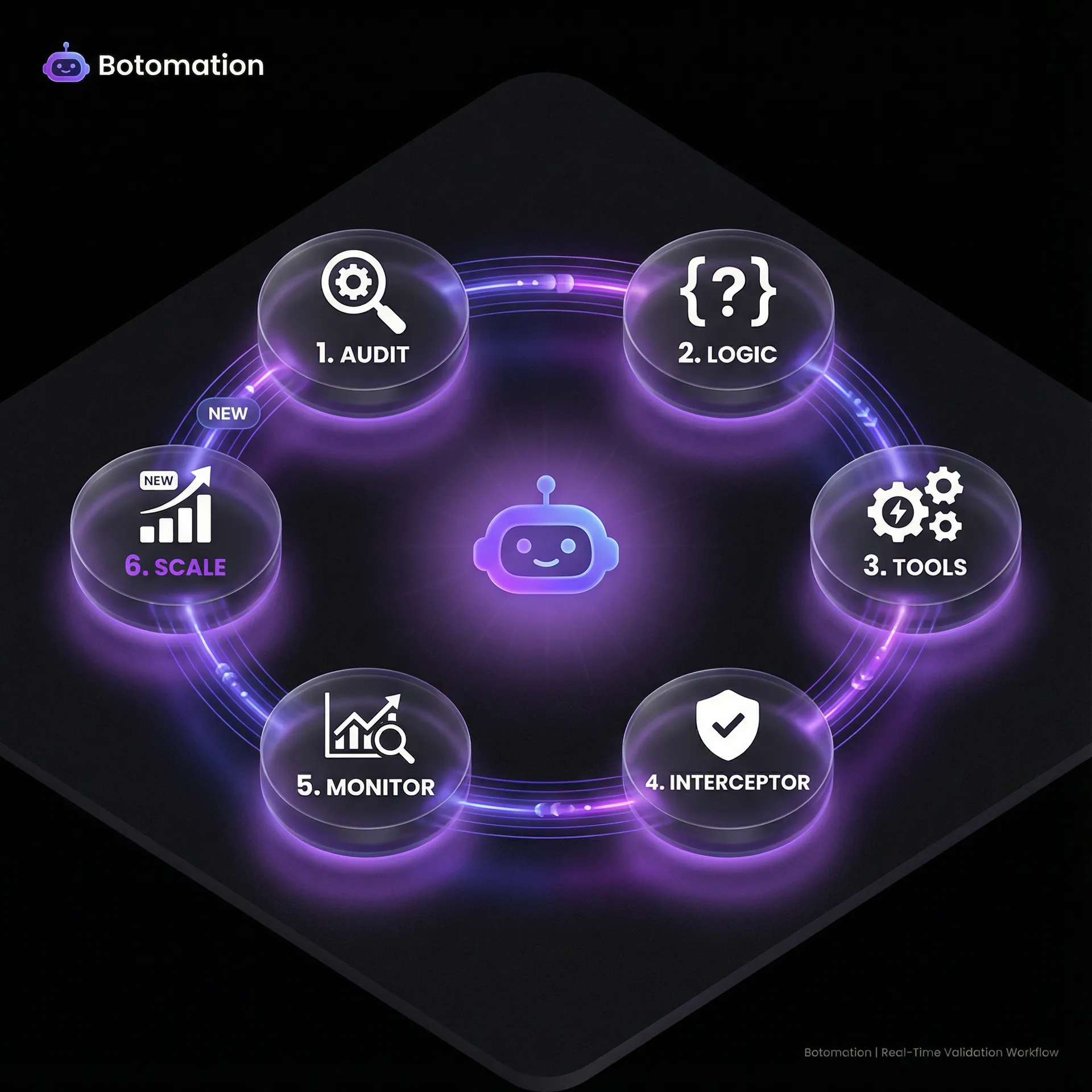
1. Audit Your Data: Identify the top 5 fields where errors currently occur in your CRM or spreadsheets, such as verifying lead information during initial entry.
2. Define the Logic: For each field, write down the "Perfect State" (e.g., "Must be a 10-digit number starting with 04").
3. Choose Your Tools: Select the APIs or ML models needed to verify that logic (e.g., a phone validation service).
4. Build the Interceptor: Create a middle layer that catches the data after entry but before it hits your main database.
5. Deploy and Monitor: Launch the validation for one department first, track the error rates, and refine based on staff feedback.
6. Scale: Roll out the validated workflow to the rest of the organization.
Continuous Improvement and Optimization
The world of 2026 moves fast, and your validation rules must keep up. We recommend a quarterly review of all validation logic. This is the time to ask: Are these rules still relevant? Are they too strict? Have new tools emerged that could do this better? This proactive approach ensures that your administrative task automation remains a competitive advantage rather than a legacy burden.
Return on Investment (ROI) is the ultimate measure of success. Consider this: if an admin staff member earning $45,000 a year spends 20% of their time fixing data errors, that is $9,000 in lost productivity per year, per employee. For a team of five, that is $45,000—the cost of a whole new hire. By automating this validation, we effectively give that money back to the business. Partnering with Botomation is not an expense; it is a strategic move to reclaim your operational budget.
Frequently Asked Questions
Will real-time validation slow down my team's data entry?
On the contrary, while it might feel like it adds a step, it actually speeds up the overall process. By catching errors immediately, it prevents the hours of "detective work" required to find and fix an error later in the week. Our use of high-speed caching and edge computing ensures that the validation happens in the blink of an eye.
Can we automate validation for handwritten or scanned documents?
Yes, using advanced AI-driven OCR (Optical Character Recognition) and semantic models like GPT-5, we can validate data from physical documents with incredible accuracy. The system does not just read the text; it understands the context, such as verifying that an extracted invoice total matches the sum of the individual line items.
How do we handle valid data that the system thinks is an error?
This is where "Exceptions Management" comes in. We build an override process for authorized supervisors. If a piece of data is truly an edge case that fails standard validation, a supervisor can review and "force-approve" it. This ensures that the system remains flexible and does not block legitimate business activity.
Do we need to replace our current CRM to implement these practices?
No. One of the primary benefits of partnering with Botomation is our ability to act as the "glue." We build validation layers that sit on top of or between your existing tools. Whether you use Salesforce, HubSpot, or a custom SQL database, we can integrate real-time validation without requiring a total system overhaul.
Implementing these best practices is no longer optional for businesses that want to remain competitive in 2026. The shift toward real-time, AI-driven validation represents a fundamental change in how administrative work is performed. By balancing technical rigor with a deep understanding of human factors and compliance, you can build an operational engine that is both fast and flawless. Research consistently shows that a 70% reduction in data processing errors is achievable for those who move away from manual checks and embrace the "New Way" of automated integrity to reduce admin tasks in service operations.
Maintaining an effective validation system requires constant adaptation and a commitment to excellence. As the volume and complexity of data continue to grow, the gap between businesses using manual entry and those using automated validation will only widen. The choice is clear: continue to struggle with the "Old Way" of repetitive errors and manual fixes, or embrace the future of seamless, autonomous operations.
Ready to automate your growth? Stop losing money to manual errors and disconnected systems today. Partnering with Botomation is the most logical choice to turn your back-office into a high-speed, error-free engine. Book a call below.
The landscape of administrative operations has shifted from managing personnel to managing the intelligent flow of information. In January 2026, data entry validation best practices have evolved far beyond simple spell-checks or mandatory field requirements. Organizations that have successfully integrated sophisticated validation protocols are experiencing a massive 70% reduction in data processing errors, which directly translates to reclaimed hours for operations teams. For a COO or an operations manager, the objective is no longer merely "getting the data in," but ensuring that every piece of information entering the ecosystem is verified, cleaned, and formatted the moment it enters the system.
This guide explores the essential frameworks for administrative task automation as they exist today. We are moving away from the era of "garbage in, garbage out" by building intelligent filters that prevent the garbage from ever entering the pipeline. By focusing on practical implementation, our team at Botomation helps businesses bridge the gap between fragmented software tools and a unified, error-free operational flow. The focus here is on real-time, autonomous validation that acts as a silent guardian for your CRM, ERP, and financial spreadsheets, often achieved through automated data sync.
Modern administrative workflows require a level of precision that manual entry simply cannot provide. When a team member copy-pastes a client's email address or an invoice number, the risk of a typo is statistically significant. In a high-volume environment, these small errors compound into massive operational bottlenecks, leading to failed deliveries, missed payments, and frustrated clients. By implementing these 2026 standards, you are not just "fixing" data; you are installing a foundational layer of operational integrity that allows your business to scale without adding more administrative headcount.
Evolution of Data Validation: From Manual Checks to AI-Driven Real-Time Systems
The history of data management is a story of increasing speed and decreasing human intervention. Twenty years ago, data validation meant a second employee reviewing a paper form against a computer screen. This was slow, expensive, and prone to the same human errors it sought to correct. As we move through 2026, the volume of data being generated globally is staggering, with estimates reaching 175 zettabytes. No human team, regardless of size, can manually validate this volume of information without the aid of sophisticated automation, especially as AI agents replace manual data entry work in modern back-offices.
The transition from batch processing to real-time validation represents the most significant leap in this evolution. In the past, companies would run "clean-up" scripts at the end of the week or month to catch errors. This reactive approach meant that for thirty days, the business was operating on flawed information. Today, the standard is "at-the-edge" validation. This means the data is checked the millisecond it is submitted, providing instant feedback to the user or the API. This shift ensures that downstream systems—like your billing software or shipping provider—never receive a single byte of incorrect data.
From Manual to Automated: Validation Timeline
The journey began with basic field-level constraints in early database software, where a field might be restricted to "numbers only." This evolved into regular expressions (Regex) that could check for specific patterns, such as an email format or a zip code. While these tools were helpful, they were rigid and lacked context. If a user entered a valid-looking but non-existent email address, the system would accept it.
By the early 2020s, we saw the rise of third-party verification APIs. These services allowed systems to check an address against postal records or a credit card against a banking network in real-time. In 2026, we have integrated GPT-5 and specialized machine learning models that can perform semantic validation. These models do not just check if a field is filled; they verify if the content makes sense within the context of the entire document. Our experts at Botomation utilize these advanced models to ensure that even complex, unstructured data is validated with a high degree of accuracy before it enters your workflow.
Technology Drivers for 2026 Validation Practices
Cloud computing has provided the raw processing power necessary to run complex validation logic without slowing down the user experience. In the past, running a dozen validation checks might cause a noticeable lag in a form submission. Now, with microservices and serverless architecture, these checks happen in parallel and finish in milliseconds. This scalability is crucial for service businesses that experience seasonal spikes in administrative volume.
Parallel to this, the maturation of API ecosystems has made it easier than ever to connect disparate tools. A modern validation system might pull data from a CRM, check it against a government database, and verify it with an internal spreadsheet simultaneously. This interconnectedness is the "glue" that Botomation provides, ensuring that your various software tools are not just talking to each other, but are speaking a language of verified, accurate data by connecting disparate software tools into a unified ecosystem.
data entry validation best practices 2026 Primary Keyword and Core Principles
To master data entry validation best practices 2026, one must embrace real-time data entry validation and the principle of "Active Interception." This means designing systems that proactively catch errors before they are committed to the database. The core philosophy centers on user experience; if a validation rule is too strict or the feedback is confusing, users will find workarounds that compromise data integrity. The goal is to create a "pave the path" experience where the easiest way to enter data is also the correct way.
Another pillar of 2026 validation is adaptability. Business rules change, and a rigid validation system becomes a liability when it prevents legitimate data from being recorded. Modern practices involve using "soft" and "hard" validation rules. A hard rule prevents submission (e.g., a missing required field), while a soft rule flags a potential error for human review (e.g., an unusually high invoice amount). This balance ensures that the system remains robust without becoming a bottleneck for the operations team.
Stat Box: The Cost of Dirty Data
* Average Error Rate: Manual data entry typically sees a 3-4% error rate.
* Cost to Correct: Fixing a single error after it has entered the system costs 10x more than catching it at entry.
* Operational Impact: 60% of COOs report that poor data quality is the primary hurdle to successful AI implementation.
* Botomation Result: Our clients typically see a 95% reduction in "downstream" errors after implementing our automated validation frameworks.
Core Principles of 2026 Validation Practices
Real-time feedback is the most visible principle in modern validation. Instead of waiting for a "Submit" button to be clicked, the system should validate fields as they are completed. If a phone number is missing a digit, the field should highlight immediately. This instant correction loop prevents the cognitive load of having to go back and find errors in a long form. It turns data entry into a guided conversation rather than a test of accuracy.
Beyond simple formatting, 2026 practices include cross-field validation. This ensures that data in one field is logical when compared to another. For example, if a "Service Type" is selected as "Premium," the "Price" field should not allow a value below a certain threshold. This logic requires a deep understanding of the business's operational rules, which is where a partnership with a specialized agency like Botomation becomes invaluable. We do not just install tools; we map your business logic into the automation layer.
Balancing Rigor and Efficiency in Validation
Maintaining the balance between strictness and speed is a constant challenge for operations managers. If you validate too many parameters, the system might become slow or reject valid edge cases. We recommend a tiered approach where critical data (like financial figures or contact info) undergoes rigorous multi-step validation, while secondary data (like internal notes) is subject to lighter, semantic checks. This ensures that the system's resources are focused where they matter most.
Performance optimization is also a key consideration. In 2026, we use edge computing to handle validation logic closer to the user. This minimizes latency and ensures that the real-time feedback feels truly instantaneous. For our clients, this means that even as their data volumes grow, their administrative workflows remain snappy and efficient. We focus on building systems that do not just work, but work at the speed of modern business.
| Validation Method | 2020 Standard (Manual/Batch) | 2026 Standard (Real-Time/AI) | Business Impact |
|---|---|---|---|
| **Email Verification** | Format check (Regex) | SMTP handshake & MX record check | 99% reduction in bounced emails |
| **Address Entry** | Manual typing | Auto-complete with USPS/Google Maps API | Eliminated shipping errors |
| **Financial Data** | Monthly reconciliation | Real-time budget & threshold alerts | Instant cash flow visibility |
| **Customer Names** | No validation | Identity matching & deduplication | Single source of truth in CRM |
| **Document Scanning** | Manual OCR correction | AI-driven semantic verification | 80% faster invoice processing |
Technical Implementation of Real-Time Validation Systems
Building a real-time validation system requires a shift in how we think about software architecture, often following 7 steps to automate data entry validation to ensure technical reliability. Rather than a single, monolithic application, we favor a microservices-based approach. Each validation rule can be treated as a small, independent service. This allows our team to update a specific business rule—such as a change in tax calculation—without needing to rebuild the entire administrative system. It provides the flexibility that modern service businesses need to stay agile.
API design is the heartbeat of these systems. When your CRM needs to validate a new lead, it sends a request to a validation endpoint. This endpoint might then query several other services before returning a "Valid" or "Invalid" response. To keep this process fast, we implement intelligent caching. If the system has recently validated a specific zip code, it doesn't need to query the external database again; it can pull the result from a high-speed cache like Redis, saving both time and API costs.
System Architecture for Real-Time Validation
When designing these systems, we prioritize high availability. If the validation service goes down, the entire data entry process could grind to a halt. We solve this by using redundant, geographically distributed servers. If one node fails, another immediately takes over, ensuring that your operations team never experiences downtime. This level of reliability is what separates a professional, agency-led implementation from a "DIY" automation attempt.
Furthermore, we utilize asynchronous processing for complex validation tasks. If a validation check requires a heavy calculation or a slow external lookup, we do not make the user wait. Instead, we accept the data, mark it as "Pending Validation," and notify the user once the check is complete. This keeps the workflow moving while still maintaining the integrity of the data. It is about creating a seamless experience where technology supports the human worker.
API Design for Validation Services
The design of the API itself must be robust and forward-compatible. We use RESTful principles to ensure that the validation services can be easily consumed by any tool in your stack, whether it is a custom-built web form or a third-party app like Zapier or Make. Versioning is a critical part of this; as we update the validation logic to meet 2026 standards, we ensure that older integrations continue to function perfectly.
Monitoring and logging are the final pieces of the technical puzzle. Every validation request and its result are logged in a centralized dashboard. This allows COOs to see exactly where errors are occurring. If a specific form field is consistently failing validation, it is a sign that the instructions are unclear or the field is poorly designed. These insights allow for continuous, data-driven improvements to the administrative process, ensuring the system evolves alongside the business.
Human Factors and User Experience in Validation Design
The most advanced validation system in the world is useless if your employees find it cumbersome. Human factors are often the most overlooked aspect of administrative automation. When a system rejects an entry, it should not just display a red box; it should explain why it was rejected and how to fix it. Instead of "Invalid Date," a helpful system might say, "Please enter a date that is not in the past." This small shift in language reduces user frustration and speeds up the correction process.
Training and change management are also vital. When we partner with a client at Botomation, we do not just hand over a new system. We work with the staff to explain how the new validation rules will actually make their jobs easier. By removing the fear of making a mistake, we empower employees to work faster and with more confidence. The goal is to move the administrative team away from "data entry" and toward "data management," where they oversee the automated systems rather than doing the heavy lifting themselves.
User-Centric Validation Interface Design
Good design is invisible. In a well-designed validation interface, the user feels guided rather than restricted. We use visual cues like progress bars and checkmarks to provide positive reinforcement as fields are correctly filled. If an error does occur, we use "inline" messaging, placing the error text directly next to the problematic field so the user does not have to hunt for it. This reduces the time spent on each form and improves the overall quality of life for the admin team.
Accessibility is another non-negotiable factor in 2026. Validation systems must be usable by everyone, including those using screen readers or other assistive technologies. This means using proper ARIA labels and ensuring that color is not the only way an error is communicated. A system that is accessible is, by definition, a system that is better designed for everyone. Our experts ensure that every implementation meets these modern standards of inclusivity.
Change Management and User Adoption
Resistance to new technology is natural, especially in established businesses with deep-rooted manual processes. We address this by involving key stakeholders early in the design process. By listening to the pain points of the people actually performing the data entry, we can build validation rules that solve their specific problems. This creates a sense of ownership and makes the transition to an automated system much smoother.
Continuous feedback loops are essential for long-term success. We recommend setting up a "Validation Feedback" channel where users can report "false positives"—times when the system rejected valid data. This allows our team to fine-tune the rules in real-time. Administrative automation is not a "set it and forget it" project; it is a living system that requires ongoing attention to remain effective.
Compliance and Security in Validation Systems
In 2026, data validation is not just about accuracy; it is about legality. With regulations like GDPR, HIPAA, and various state-level privacy laws, how you handle data during the validation process is critical. If your validation service is sending sensitive customer information to a third-party API for checking, that process must be encrypted and compliant with all relevant standards. Our agency takes a "Security-First" approach, ensuring that every automation we build acts as a fortress for your business data.
Audit trails are a mandatory requirement for many industries. A robust validation system should log not just the final data, but also the "pre-validated" version and the reason for any changes. This transparency is vital during a financial audit or a compliance review. It proves that the business has taken reasonable steps to ensure data integrity and that no unauthorized changes were made to critical records.
Regulatory Compliance for Validation Systems
Different industries have different "North Stars" for compliance. In healthcare, validation might focus on ensuring that patient IDs match across systems to prevent medical errors. In finance, the focus might be on "Know Your Customer" (KYC) protocols. We tailor our validation frameworks to meet these specific regulatory needs, ensuring that your automation is not just efficient, but also fully compliant with your industry's standards.
Documentation is the often-ignored sibling of compliance. We provide comprehensive documentation for every validation rule we implement. This includes the logic behind the rule, the data sources used, and the expected outcome. This documentation is a valuable asset for any COO, providing a clear map of the business's data governance policies.
Security Considerations in Validation
Security must be baked into the validation process from day one. We use end-to-end encryption for all data in transit and at rest. Furthermore, we implement strict access controls, ensuring that only authorized systems and personnel can modify the validation rules. This prevents "logic tampering," where an attacker might try to bypass validation to inject malicious data into your systems.
Protecting sensitive data (PII) during validation is a top priority. We use techniques like data masking and tokenization so that the validation service can check the data without ever "seeing" the actual sensitive values. For example, we can validate that a credit card number is correct without storing the full number in our logs. This minimizes the impact of any potential security breach and keeps your customers' data safe.
Measuring Success with Data Entry Validation Best Practices 2026
You cannot manage what you cannot measure. To understand the impact of your data entry validation best practices 2026, you need clear Key Performance Indicators (KPIs). We look at metrics like the "First-Pass Yield"—the percentage of records that pass validation on the first attempt. A low yield indicates that your data sources or user instructions need work. By tracking these numbers over time, COOs can see the tangible ROI of their automation investment.
Continuous improvement is the final stage of the validation lifecycle. As your business grows, you will encounter new types of data and new edge cases. A system that worked perfectly for 100 entries a day might struggle at 10,000. We provide ongoing support to scale business operations with AI automation and refine your validation rules, ensuring that your administrative engine continues to run smoothly regardless of your growth rate.
Key Performance Indicators for Validation Systems
The most important metric is the reduction in "Downstream Error Rate." This measures how many errors are found after the validation step. Our goal is to get this number as close to zero as possible. We also track "Correction Time"—the time it takes for a user to fix a validation error. By optimizing the UI and error messaging, we can significantly reduce this time, further increasing the efficiency of the operations team.
Step-by-Step: Implementing a Real-Time Validation Workflow
1. Audit Your Data: Identify the top 5 fields where errors currently occur in your CRM or spreadsheets, such as verifying lead information during initial entry.
2. Define the Logic: For each field, write down the "Perfect State" (e.g., "Must be a 10-digit number starting with 04").
3. Choose Your Tools: Select the APIs or ML models needed to verify that logic (e.g., a phone validation service).
4. Build the Interceptor: Create a middle layer that catches the data after entry but before it hits your main database.
5. Deploy and Monitor: Launch the validation for one department first, track the error rates, and refine based on staff feedback.
6. Scale: Roll out the validated workflow to the rest of the organization.
Continuous Improvement and Optimization
The world of 2026 moves fast, and your validation rules must keep up. We recommend a quarterly review of all validation logic. This is the time to ask: Are these rules still relevant? Are they too strict? Have new tools emerged that could do this better? This proactive approach ensures that your administrative task automation remains a competitive advantage rather than a legacy burden.
Return on Investment (ROI) is the ultimate measure of success. Consider this: if an admin staff member earning $45,000 a year spends 20% of their time fixing data errors, that is $9,000 in lost productivity per year, per employee. For a team of five, that is $45,000—the cost of a whole new hire. By automating this validation, we effectively give that money back to the business. Partnering with Botomation is not an expense; it is a strategic move to reclaim your operational budget.
Frequently Asked Questions
Will real-time validation slow down my team's data entry?
On the contrary, while it might feel like it adds a step, it actually speeds up the overall process. By catching errors immediately, it prevents the hours of "detective work" required to find and fix an error later in the week. Our use of high-speed caching and edge computing ensures that the validation happens in the blink of an eye.
Can we automate validation for handwritten or scanned documents?
Yes, using advanced AI-driven OCR (Optical Character Recognition) and semantic models like GPT-5, we can validate data from physical documents with incredible accuracy. The system does not just read the text; it understands the context, such as verifying that an extracted invoice total matches the sum of the individual line items.
How do we handle valid data that the system thinks is an error?
This is where "Exceptions Management" comes in. We build an override process for authorized supervisors. If a piece of data is truly an edge case that fails standard validation, a supervisor can review and "force-approve" it. This ensures that the system remains flexible and does not block legitimate business activity.
Do we need to replace our current CRM to implement these practices?
No. One of the primary benefits of partnering with Botomation is our ability to act as the "glue." We build validation layers that sit on top of or between your existing tools. Whether you use Salesforce, HubSpot, or a custom SQL database, we can integrate real-time validation without requiring a total system overhaul.
Implementing these best practices is no longer optional for businesses that want to remain competitive in 2026. The shift toward real-time, AI-driven validation represents a fundamental change in how administrative work is performed. By balancing technical rigor with a deep understanding of human factors and compliance, you can build an operational engine that is both fast and flawless. Research consistently shows that a 70% reduction in data processing errors is achievable for those who move away from manual checks and embrace the "New Way" of automated integrity to reduce admin tasks in service operations.
Maintaining an effective validation system requires constant adaptation and a commitment to excellence. As the volume and complexity of data continue to grow, the gap between businesses using manual entry and those using automated validation will only widen. The choice is clear: continue to struggle with the "Old Way" of repetitive errors and manual fixes, or embrace the future of seamless, autonomous operations.
Ready to automate your growth? Stop losing money to manual errors and disconnected systems today. Partnering with Botomation is the most logical choice to turn your back-office into a high-speed, error-free engine. Book a call below.
Get Started
Book a FREE Consultation Right NOW!
Schedule a Call with Our Team To Make Your Business More Efficient with AI Instantly.
Read More
Data Entry Validation Best Practices 2026 Expert Guide
Master data entry validation best practices 2026. Boost accuracy with real-time AI automation, seamless CRM integration, and error-free workflows.
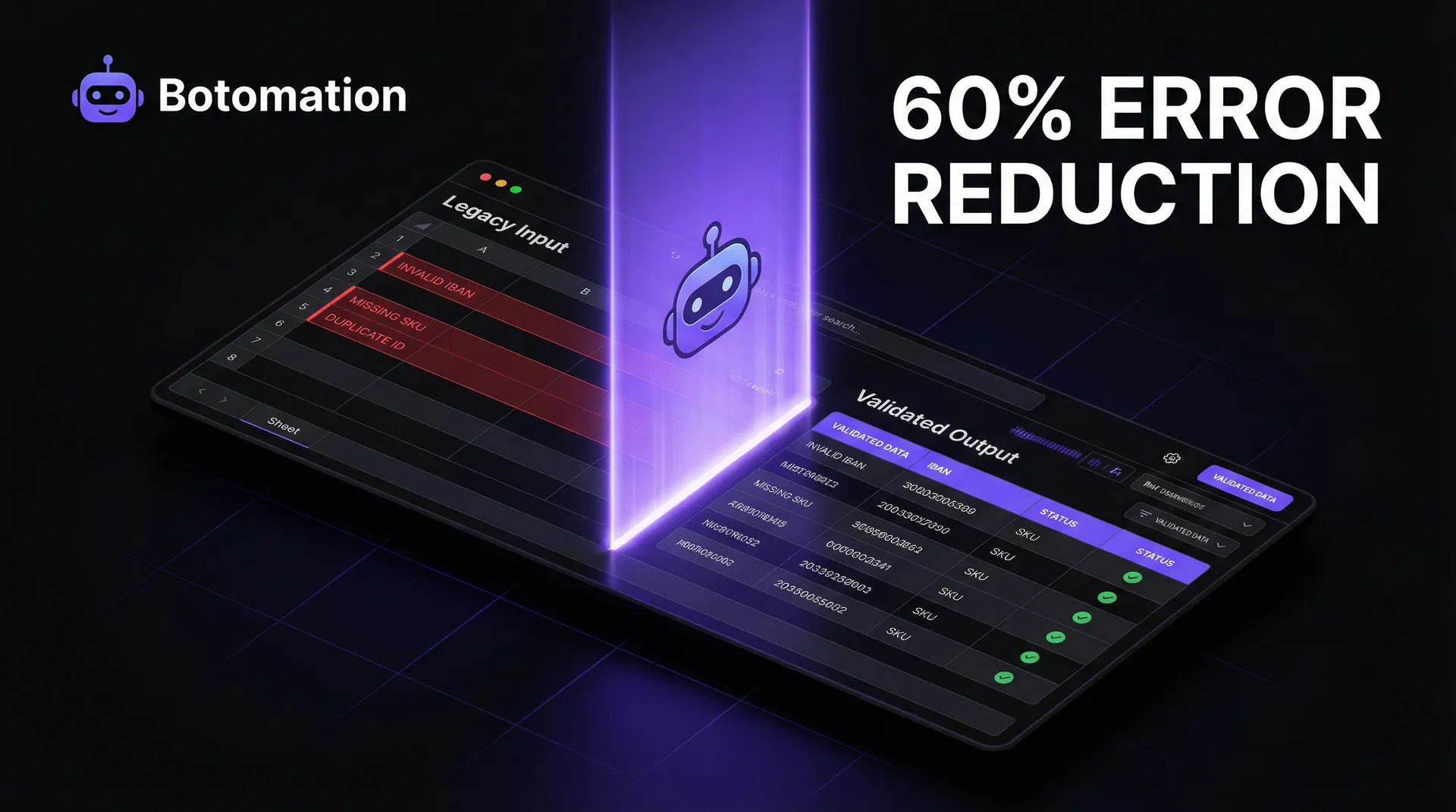
Automate Data Entry Validation Business Operations in 2026
Learn how WhatsApp AI slashes support costs for e-commerce & SaaS. Proven strategies to boost sales, recover carts, and scale 24/7 service.