Enterprise-Grade Solutions for Small Businesses 2026 Guide
Feb 17, 2026
AI Automation
Business Scaling
Software Strategy
AI Automation
Business Scaling
Software Strategy
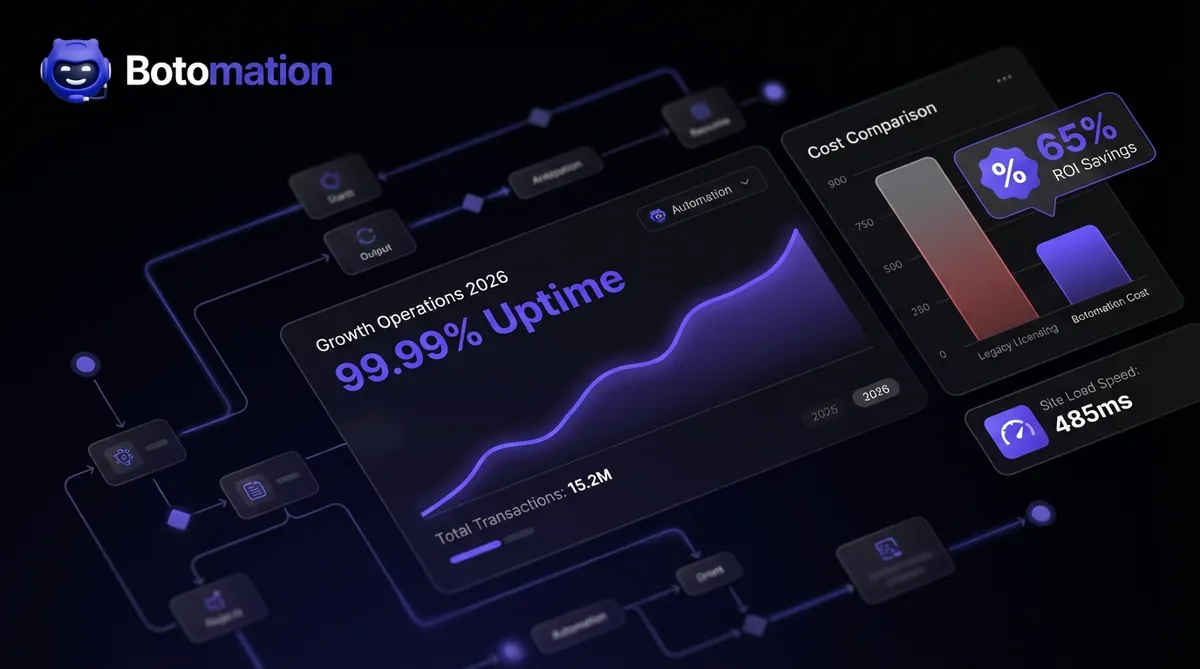
Scaling a business in January 2026 feels like upgrading a jet engine mid-flight. You have the momentum, customers are flooding in, and your team is working harder than ever, but the systems that supported your early growth are beginning to rattle. Most founders reach a crossroads where they realize manual processes and basic off-the-shelf tools can no longer sustain their ambitions. They need the power, security, and automation of a Fortune 500 company without the $500,000 annual budget for legacy software or a massive IT department.
The gap between standard tools and enterprise-grade solutions for small businesses has historically been a chasm that swallowed promising startups. In the past, you either suffered with "lite" versions of apps that lacked critical features or overpaid for bloated platforms that took eighteen months to implement. However, the landscape has shifted. Today, the "Old Way" of doing business—relying on massive, slow-moving software suites—is being replaced by agile, high-speed custom code and intelligent AI agents as more companies replace legacy systems with custom web development.
This guide provides a roadmap for CEOs and COOs ready to stop playing small. We explore how to secure your infrastructure, automate expensive manual tasks, and leverage data like a global titan, all while maintaining the lean efficiency of a growth-focused agency partner. Achieving enterprise-grade efficiency isn't about how much you spend; it is about how intelligently you architect your operations for the modern era by finding accessible pricing for enterprise-grade software.
Enterprise-Grade Solutions for Small Businesses: Understanding the Software Gap
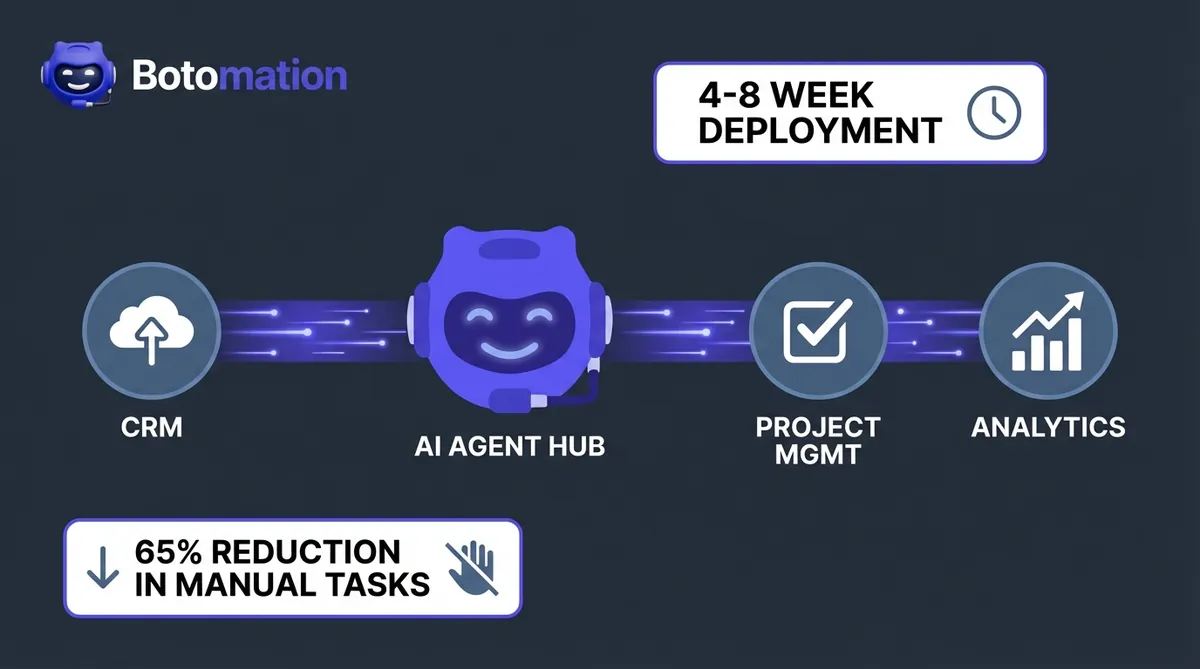
The definition of "enterprise-grade" has evolved significantly over the last twenty-four months. It no longer means "expensive and complicated." Instead, it refers to systems that offer 99.99% uptime, deep cross-platform integration, and the ability to process massive datasets without human intervention. For a growing business, the goal is to capture these benefits without inheriting the technical debt that typically accompanies them.
Traditional enterprise solutions are often overkill, built for corporations with 10,000 employees and dozens of regional offices. They include thousands of features you will never use, each adding a layer of complexity that slows down your team. When you choose these legacy platforms, you aren't just paying for software; you are paying for the privilege of hiring specialized consultants just to keep the system running.
Growing companies actually require three core pillars: speed, reliability, and scalability. You need a website that loads in under 500 milliseconds to maintain high conversion rates, AI agents that handle customer inquiries while your team sleeps, and a data stack that identifies exactly where your next dollar is coming from. Everything else is noise that distracts from your primary mission of revenue growth.
"The mistake most founders make is thinking they need to buy their way into the big leagues. True enterprise efficiency is built through custom automation and lean architecture, not by adding more subscription seats to a bloated SaaS platform." — Senior Operations Consultant at Botomation.
Consider a mid-sized e-commerce brand we recently partnered with. They were spending nearly $250,000 annually on a fragmented stack of "enterprise" tools and the manual labor required to sync data between them. By migrating to a custom-coded environment with integrated AI agents, they eliminated the need for four manual data-entry roles and cut software licensing fees by 65%. They didn't lose functionality; they gained a system tailored to their specific workflow.
Core Feature Differences Between Enterprise and SMB Solutions
When evaluating enterprise-grade solutions for small businesses, it is essential to distinguish between complexity and capability. Enterprise systems are designed for high-level governance and strict departmental silos. They offer granular permission settings for thousands of users and audit logs that track every click. For a team of fifty or a hundred, this level of bureaucracy is a productivity killer.
SMB-focused tools prioritize rapid deployment. The "New Way" of operating involves using these agile tools as a foundation and layering on custom automation to bridge the gaps. This approach allows you to move faster than a giant corporation while maintaining the same level of operational integrity.
| Feature Category | Legacy Enterprise Way | Modern Botomation Way |
|---|---|---|
| **Deployment Speed** | 6 to 18 months | 4 to 8 weeks |
| **Customization** | Requires expensive specialized devs | Built-in custom code and AI flexibility |
| **User Experience** | Clunky, dated, and hard to learn | Intuitive, high-speed, and mobile-first |
| **Integration** | Limited to specific "partner" apps | Universal via custom API connectors and business automation tools |
| **Scalability** | Costs increase exponentially with users | Costs scale linearly with actual usage |
Cost Analysis: Enterprise vs SMB Total Ownership in 2026
The sticker price of a software subscription is only the tip of the iceberg. To understand the true cost, you must look at the Total Cost of Ownership (TCO). Enterprise solutions often average $150 to $300 per user per month. For a 50-person team, that is $15,000 a month just for the license. When you add in $50,000 implementation fees and $20,000 in annual maintenance, the numbers become unsustainable for companies trying to maximize their runway. Finding accessible pricing for enterprise-grade software is the only way to scale sustainably.
SMB equivalents usually range from $15 to $50 per user, but they often lack the "connective tissue" that makes a business run smoothly. This is where the gap exists. The "Old Way" was to hire more people to fill that gap. The "New Way" is to partner with an agency like Botomation to build custom AI agents that act as that connective tissue.
The Math for a Typical Service-Based Business:
- Base Software Cost: $20,000/year (SMB tools) vs. $120,000/year (Enterprise).
- Manual Labor to Bridge Gaps: $150,000/year (3 admins at $50k each).
- Total Old Way Cost: $170,000 to $270,000.
- Botomation Strategy: $20,000 (Software) + $40,000 (Custom AI Automation) = $60,000 total.
By choosing SMB-focused tools and enhancing them with professional automation, you maintain 80% to 90% of enterprise functionality while you reduce operational costs by 40% or more. These savings can then be reinvested directly into marketing or product development, further accelerating your growth.
Best Affordable Enterprise Software for Startups in 2026
In 2026, the market for high-performance software has democratized. You no longer need a massive contract to access tools once reserved for the Fortune 500. The key is knowing which tools provide a solid foundation and which are merely distractions. We recommend focusing on a "Core Four" stack: CRM, enterprise-grade project management, Business Intelligence, and Communication.
Modern tools now come with native AI features that rival custom-built solutions from just a few years ago. Many platforms now include GPT-5 or Claude 3.5 integrations that can draft emails, summarize meetings, and even predict customer churn. When you combine these with the custom-coded revenue engines built by our team, you create a system that is virtually indistinguishable from an enterprise setup.
CRM and Customer Management Solutions
Your CRM is the heart of your business. If it is disorganized, growth will be stunted. HubSpot CRM remains a top contender in 2026 due to its "start for free, scale as you grow" model. While their enterprise tier is expensive, their professional tier offers sophisticated automation that handles lead nurturing and sales pipelines with incredible precision.
Zoho CRM is another powerful alternative that often gets overlooked. It includes Zia, an AI-powered assistant providing lead scoring and customer insights. For businesses that need a highly visual way to manage work, Monday.com has evolved from a simple project board into a full-scale work OS. It allows you to build custom dashboards that provide a bird's-eye view of your entire operation—a feature that previously cost tens of thousands in custom development.
Business Intelligence and Analytics Tools
Data is the most valuable asset a growing company has, yet most businesses are "data rich but insight poor." To achieve enterprise-grade efficiency, you must move beyond basic spreadsheets by implementing affordable BI tools for growing companies. Power BI Pro has become the gold standard for budget-conscious companies, offering enterprise-level dashboards for approximately $10 per user.
Google Analytics 4 (GA4) paired with Looker Studio is another potent combination. GA4 provides the raw data on user behavior, while Looker Studio allows you to visualize that data for actionable decision-making. If your team is more visually oriented, Tableau Public or lower-tier Tableau licenses offer advanced analytics with community-driven templates that can be deployed in days rather than months.
Enterprise-Grade Solutions for Small Businesses: Security on a Budget
Security is often the first thing sacrificed when a company is growing fast, which is a dangerous mistake. In 2026, cyber threats are more sophisticated than ever, and a single data breach can bankrupt a small business. The good news is that you don't need a multi-million dollar security operations center to protect your assets.
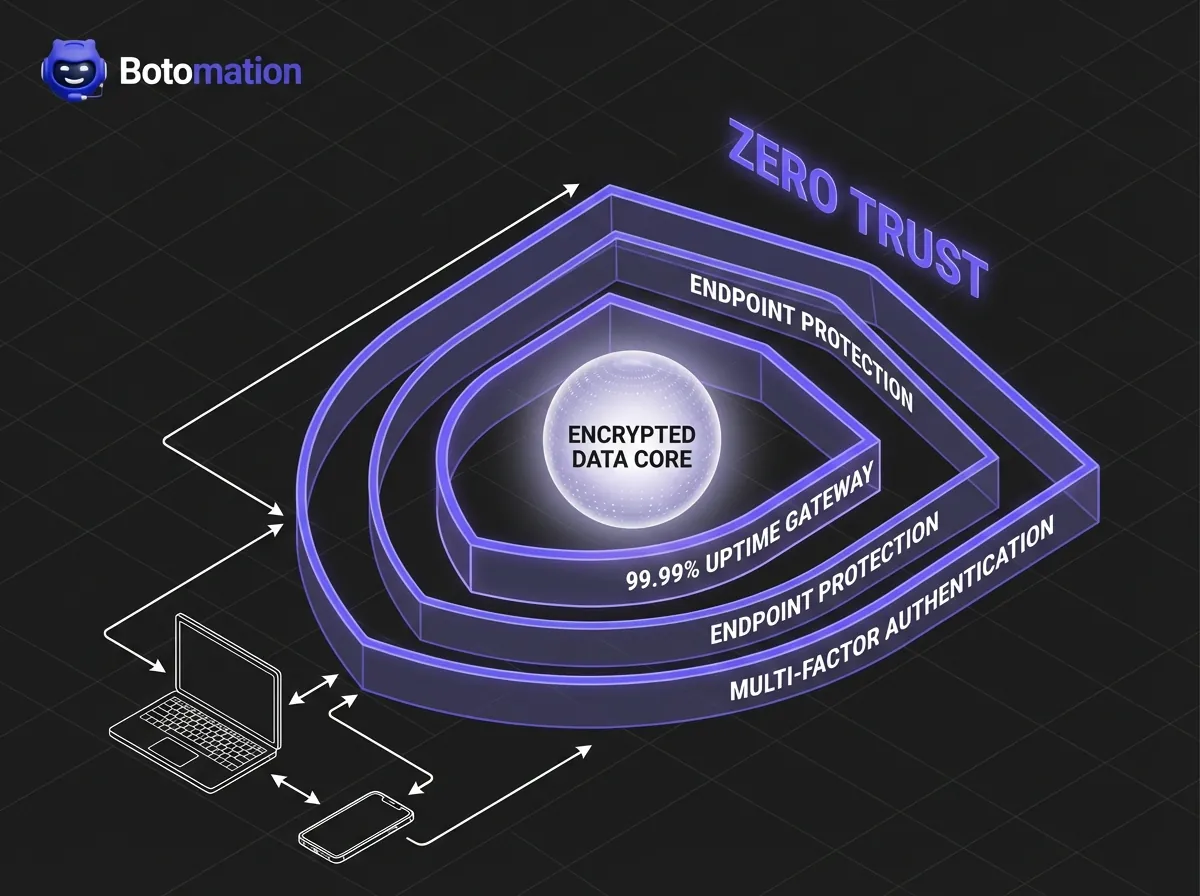
The shift toward cloud-based security has made enterprise-grade protection accessible to everyone. You no longer need to manage physical servers or complex firewalls. By partnering with the right experts, you can implement a "Zero Trust" architecture where every user and device must be verified before accessing data. This is the same standard used by the world's largest banks and tech companies.
Essential Security Infrastructure for Growing Companies
The foundation of your security should be Multi-Factor Authentication (MFA) and a robust Endpoint Protection solution. Tools like CrowdStrike or SentinelOne now offer "SME" packages that provide the same AI-driven threat detection they use for their largest clients. These systems monitor behavior to stop "zero-day" attacks before they can cause damage.
Another critical component is managed Identity and Access Management (IAM). Instead of having fifty different passwords for fifty different apps, your team should use a Single Sign-On (SSO) provider like Okta or JumpCloud. This improves security and makes offboarding employees much faster and safer. When someone leaves, you revoke access in one place, instantly locking them out of every company system.
Compliance and Data Protection Strategies
If you operate in healthcare, finance, or serve international customers, compliance is non-negotiable. Achieving SOC 2 or GDPR compliance used to be a grueling, year-long process. In 2026, platforms like Vanta or Drata have automated the compliance process. They connect to your existing tools, monitor your security posture in real-time, and generate the reports required for audits.
Efficiency Insight: The Compliance Math
* Manual Compliance: 400+ hours of staff time + $60k consultant fees.
* Automated Compliance: 40 hours of staff time + $10k platform fee.
* Result: 90% reduction in manual overhead and a faster path to enterprise contracts.
Data encryption is another area where you can achieve enterprise standards easily. Most modern cloud databases offer "encryption at rest" as a standard feature. Your job is to ensure that "encryption in transit" is also active across all custom web applications. At Botomation, we build these security protocols into the core of every custom revenue engine we develop, ensuring your customer data is locked down from day one.
High-Performance Business Systems and Automation Strategies
Automation is the great equalizer in 2026. It allows a five-person team to handle the volume of a fifty-person team. However, most businesses approach automation the "Old Way"—by using basic tools like Zapier to connect two apps and hoping they don't break. Enterprise-grade automation involves learning how to automate repetitive business tasks with AI agents to build resilient, self-healing workflows that can handle complex logic and exceptions.
This is where AI agents become a competitive advantage. Unlike a simple script that follows a rigid rule, an AI agent understands context. It can read a customer's frustrated email, check their order history in your CRM, see that their package is delayed in the warehouse, and draft a personalized apology with a discount code—all without human intervention.
Automating Customer Service and Support
Customer support is usually the first department to buckle under the weight of growth. Hiring more people is the traditional solution, but it is expensive and difficult to scale. The "New Way" involves deploying AI-powered agents trained specifically on your company's knowledge base. These are sophisticated agents that can resolve 70% to 80% of common inquiries instantly.
By implementing an automated ticketing system with intelligent routing, you ensure that complex issues are sent to the right human expert immediately. This reduces your "Time to First Response" from hours to seconds. Our team focuses on building these custom AI interfaces that integrate directly with your custom web code, providing a seamless experience for your customers while slashing operational costs.
Streamlining Operations and Project Management
Internal operations are often a mess of spreadsheets and Slack messages. To achieve enterprise efficiency, you need to automate the "hand-offs" between departments. When a salesperson closes a deal in the CRM, the system should automate project management and billing to automatically create the client folder, generate the initial invoice, and assign the first task to the fulfillment team.
Workflow automation tools like Make.com offer significant power, allowing for complex branching logic and data manipulation. When you combine these tools with custom-coded internal portals, you eliminate the "human middleware" that causes delays and errors. You stop paying people to move data from Point A to Point B and start paying them to do the high-value work they were actually hired for.
Scaling Business Intelligence with Scalable Business Tools
If you can't measure it, you can't manage it. As your business grows, you need more than just a feeling about how things are going. You need real-time data that tells you which marketing channels are profitable, which products have the highest margins, and where your team is losing time. Enterprise-grade BI used to require a dedicated data science team, but today, it is about having a clean data pipeline.
The biggest challenge isn't visualizing the data; it's eliminating data silos to get all your critical information into one place. This is the process of ETL (Extract, Transform, Load). While data warehouses like Snowflake are excellent, many growing businesses can now achieve similar results using cloud-based tools that connect directly to their SMB software stack.
Affordable Dashboard and Reporting Solutions
A good dashboard should answer your most important business questions in ten seconds or less. We see too many founders drowning in vanity metrics like social media likes or total website visits. Enterprise-grade efficiency focuses on actionable metrics like Customer Acquisition Cost (CAC), Lifetime Value (LTV), and Net Promoter Score (NPS).
By using tools like Power BI or Looker Studio, you can create collaborative dashboards that different departments can use to track their own performance. The key is to ensure everyone is looking at the same "source of truth." When sales and finance look at different numbers, you have an efficiency problem. We help our partners consolidate these data streams into a single, high-speed interface that makes decision-making effortless.
Data Integration and Management Strategies
To scale your intelligence, you need to move away from siloed data. Your marketing data needs to talk to your sales data, which needs to talk to your fulfillment data. This is achieved through API integrations. Most modern tools have open APIs, but they don't always communicate effectively out of the box.
This is where custom code becomes essential. Instead of relying on a generic integration that only syncs half the fields you need, our agency builds custom connectors that ensure 100% of your data flows accurately across your entire stack. We also implement automated data cleaning workflows to ensure data integrity, which separates the amateurs from the enterprises.
Implementation Guide: Migrating to Enterprise Features for Startups
Moving from basic tools to an enterprise-grade setup is a journey, not a single event. If you try to change everything at once, you will break your business. The goal is a phased, AI-powered legacy system migration that allows your team to adapt to new workflows without losing productivity. Prioritize the changes that will have the biggest impact on your bottom line first.
The most successful migrations follow a specific sequence: secure the foundation, automate the bottlenecks, and then scale the intelligence. By following this roadmap, you minimize risk and ensure that each new system is actually adopted by your team.
Planning Your Enterprise-Grade Migration
Before writing code or signing a new contract, conduct a thorough audit of your current processes. Identify which tasks are taking the most time and which tools cause the most frustration. This isn't just about tech; it's about people. If your sales team dislikes your CRM, they won't use it, regardless of its features.
- Inventory Your Stack: List every tool you pay for and how many people actually use it.
- Map Your Workflows: Document how a lead becomes a paid client. Where are the manual steps?
- Define Your Goals: Do you want to reduce support tickets by 50%? Increase website speed by 3x?
- Set a Budget: Include the cost of training and the temporary dip in productivity during the transition.
Execution and Change Management
Once you have a plan, start with a Pilot Program. Choose one department or one specific workflow to upgrade first. This allows you to work out the kinks in a controlled environment. For example, you might implement a custom AI support agent for just one product line before rolling it out to your entire customer base.
Training is the most overlooked part of any migration. You can build the most sophisticated revenue engine in the world, but if your team doesn't know how to drive it, the investment is wasted. We provide comprehensive documentation and hands-on support to ensure your team feels empowered by the new technology.
Step-by-Step: The Botomation Migration Framework
1. The Audit: We analyze legacy systems and identify high-cost manual tasks.
2. The Blueprint: We design a custom architecture combining high-speed code and AI agents.
3. The Build: Our developers replace slow, off-the-shelf components with custom-coded solutions.
4. The Training: We onboard your team and fine-tune AI agents based on real-world feedback.
5. The Optimization: We monitor performance metrics and continuously refine the system for maximum ROI.
Frequently Asked Questions
Isn't custom code more expensive than just buying a SaaS subscription?
In the short term, the initial investment for custom code is higher. However, over a 2-3 year horizon, custom code is almost always more cost-effective. You stop paying per-user fees that punish growth and eliminate the need for expensive third-party integrations. More importantly, custom code gives you a proprietary asset your competitors cannot buy off the shelf.
How long does it take to see a return on investment from AI automation?
Most of our partners see a positive ROI within 3 to 6 months. This stems from direct cost savings (reducing the need for new hires) and increased revenue (higher conversion rates from faster websites and instant AI responses). The "soft" ROI, such as improved employee morale and customer satisfaction, is often felt within the first 30 days.
Will AI agents replace my human staff?
The goal of enterprise-grade efficiency isn't to replace your best people; it's to liberate them. By automating repetitive, mundane tasks, you allow your team to focus on high-level strategy, creative problem-solving, and building deep relationships with clients. AI handles the volume; humans handle the value.
Do I need a full-time CTO to manage these systems?
No. This is exactly why companies partner with an agency like Botomation. We act as your external CTO and engineering team. You get the benefit of a full department of experts without the $500,000+ annual overhead of hiring them in-house. We build the systems, maintain them, and ensure they evolve as your business grows.
Achieving enterprise-grade efficiency in 2026 is no longer a luxury reserved for the corporate elite. It is a fundamental requirement for any business that wants to thrive in an increasingly competitive market. The "Old Way" of throwing more people and bloated software at your problems is a recipe for stagnation. The "New Way" is about precision, speed, and intelligent automation.
By strategically selecting your software stack, securing your data, and building custom AI-driven workflows, you can create a business that operates with the power of a giant while maintaining the agility of a startup. You don't need a massive budget; you need a massive vision and the right partner to help you build it.
Ready to automate your growth? Stop losing money to manual tasks and slow legacy systems today. Partner with the experts at Botomation to rebuild your business into a high-speed revenue engine. Book a call below.
Scaling a business in January 2026 feels like upgrading a jet engine mid-flight. You have the momentum, customers are flooding in, and your team is working harder than ever, but the systems that supported your early growth are beginning to rattle. Most founders reach a crossroads where they realize manual processes and basic off-the-shelf tools can no longer sustain their ambitions. They need the power, security, and automation of a Fortune 500 company without the $500,000 annual budget for legacy software or a massive IT department.
The gap between standard tools and enterprise-grade solutions for small businesses has historically been a chasm that swallowed promising startups. In the past, you either suffered with "lite" versions of apps that lacked critical features or overpaid for bloated platforms that took eighteen months to implement. However, the landscape has shifted. Today, the "Old Way" of doing business—relying on massive, slow-moving software suites—is being replaced by agile, high-speed custom code and intelligent AI agents as more companies replace legacy systems with custom web development.
This guide provides a roadmap for CEOs and COOs ready to stop playing small. We explore how to secure your infrastructure, automate expensive manual tasks, and leverage data like a global titan, all while maintaining the lean efficiency of a growth-focused agency partner. Achieving enterprise-grade efficiency isn't about how much you spend; it is about how intelligently you architect your operations for the modern era by finding accessible pricing for enterprise-grade software.
Enterprise-Grade Solutions for Small Businesses: Understanding the Software Gap
The definition of "enterprise-grade" has evolved significantly over the last twenty-four months. It no longer means "expensive and complicated." Instead, it refers to systems that offer 99.99% uptime, deep cross-platform integration, and the ability to process massive datasets without human intervention. For a growing business, the goal is to capture these benefits without inheriting the technical debt that typically accompanies them.
Traditional enterprise solutions are often overkill, built for corporations with 10,000 employees and dozens of regional offices. They include thousands of features you will never use, each adding a layer of complexity that slows down your team. When you choose these legacy platforms, you aren't just paying for software; you are paying for the privilege of hiring specialized consultants just to keep the system running.
Growing companies actually require three core pillars: speed, reliability, and scalability. You need a website that loads in under 500 milliseconds to maintain high conversion rates, AI agents that handle customer inquiries while your team sleeps, and a data stack that identifies exactly where your next dollar is coming from. Everything else is noise that distracts from your primary mission of revenue growth.
"The mistake most founders make is thinking they need to buy their way into the big leagues. True enterprise efficiency is built through custom automation and lean architecture, not by adding more subscription seats to a bloated SaaS platform." — Senior Operations Consultant at Botomation.
Consider a mid-sized e-commerce brand we recently partnered with. They were spending nearly $250,000 annually on a fragmented stack of "enterprise" tools and the manual labor required to sync data between them. By migrating to a custom-coded environment with integrated AI agents, they eliminated the need for four manual data-entry roles and cut software licensing fees by 65%. They didn't lose functionality; they gained a system tailored to their specific workflow.
Core Feature Differences Between Enterprise and SMB Solutions
When evaluating enterprise-grade solutions for small businesses, it is essential to distinguish between complexity and capability. Enterprise systems are designed for high-level governance and strict departmental silos. They offer granular permission settings for thousands of users and audit logs that track every click. For a team of fifty or a hundred, this level of bureaucracy is a productivity killer.
SMB-focused tools prioritize rapid deployment. The "New Way" of operating involves using these agile tools as a foundation and layering on custom automation to bridge the gaps. This approach allows you to move faster than a giant corporation while maintaining the same level of operational integrity.
| Feature Category | Legacy Enterprise Way | Modern Botomation Way |
|---|---|---|
| **Deployment Speed** | 6 to 18 months | 4 to 8 weeks |
| **Customization** | Requires expensive specialized devs | Built-in custom code and AI flexibility |
| **User Experience** | Clunky, dated, and hard to learn | Intuitive, high-speed, and mobile-first |
| **Integration** | Limited to specific "partner" apps | Universal via custom API connectors and business automation tools |
| **Scalability** | Costs increase exponentially with users | Costs scale linearly with actual usage |
Cost Analysis: Enterprise vs SMB Total Ownership in 2026
The sticker price of a software subscription is only the tip of the iceberg. To understand the true cost, you must look at the Total Cost of Ownership (TCO). Enterprise solutions often average $150 to $300 per user per month. For a 50-person team, that is $15,000 a month just for the license. When you add in $50,000 implementation fees and $20,000 in annual maintenance, the numbers become unsustainable for companies trying to maximize their runway. Finding accessible pricing for enterprise-grade software is the only way to scale sustainably.
SMB equivalents usually range from $15 to $50 per user, but they often lack the "connective tissue" that makes a business run smoothly. This is where the gap exists. The "Old Way" was to hire more people to fill that gap. The "New Way" is to partner with an agency like Botomation to build custom AI agents that act as that connective tissue.
The Math for a Typical Service-Based Business:
- Base Software Cost: $20,000/year (SMB tools) vs. $120,000/year (Enterprise).
- Manual Labor to Bridge Gaps: $150,000/year (3 admins at $50k each).
- Total Old Way Cost: $170,000 to $270,000.
- Botomation Strategy: $20,000 (Software) + $40,000 (Custom AI Automation) = $60,000 total.
By choosing SMB-focused tools and enhancing them with professional automation, you maintain 80% to 90% of enterprise functionality while you reduce operational costs by 40% or more. These savings can then be reinvested directly into marketing or product development, further accelerating your growth.
Best Affordable Enterprise Software for Startups in 2026
In 2026, the market for high-performance software has democratized. You no longer need a massive contract to access tools once reserved for the Fortune 500. The key is knowing which tools provide a solid foundation and which are merely distractions. We recommend focusing on a "Core Four" stack: CRM, enterprise-grade project management, Business Intelligence, and Communication.
Modern tools now come with native AI features that rival custom-built solutions from just a few years ago. Many platforms now include GPT-5 or Claude 3.5 integrations that can draft emails, summarize meetings, and even predict customer churn. When you combine these with the custom-coded revenue engines built by our team, you create a system that is virtually indistinguishable from an enterprise setup.
CRM and Customer Management Solutions
Your CRM is the heart of your business. If it is disorganized, growth will be stunted. HubSpot CRM remains a top contender in 2026 due to its "start for free, scale as you grow" model. While their enterprise tier is expensive, their professional tier offers sophisticated automation that handles lead nurturing and sales pipelines with incredible precision.
Zoho CRM is another powerful alternative that often gets overlooked. It includes Zia, an AI-powered assistant providing lead scoring and customer insights. For businesses that need a highly visual way to manage work, Monday.com has evolved from a simple project board into a full-scale work OS. It allows you to build custom dashboards that provide a bird's-eye view of your entire operation—a feature that previously cost tens of thousands in custom development.
Business Intelligence and Analytics Tools
Data is the most valuable asset a growing company has, yet most businesses are "data rich but insight poor." To achieve enterprise-grade efficiency, you must move beyond basic spreadsheets by implementing affordable BI tools for growing companies. Power BI Pro has become the gold standard for budget-conscious companies, offering enterprise-level dashboards for approximately $10 per user.
Google Analytics 4 (GA4) paired with Looker Studio is another potent combination. GA4 provides the raw data on user behavior, while Looker Studio allows you to visualize that data for actionable decision-making. If your team is more visually oriented, Tableau Public or lower-tier Tableau licenses offer advanced analytics with community-driven templates that can be deployed in days rather than months.
Enterprise-Grade Solutions for Small Businesses: Security on a Budget
Security is often the first thing sacrificed when a company is growing fast, which is a dangerous mistake. In 2026, cyber threats are more sophisticated than ever, and a single data breach can bankrupt a small business. The good news is that you don't need a multi-million dollar security operations center to protect your assets.
The shift toward cloud-based security has made enterprise-grade protection accessible to everyone. You no longer need to manage physical servers or complex firewalls. By partnering with the right experts, you can implement a "Zero Trust" architecture where every user and device must be verified before accessing data. This is the same standard used by the world's largest banks and tech companies.
Essential Security Infrastructure for Growing Companies
The foundation of your security should be Multi-Factor Authentication (MFA) and a robust Endpoint Protection solution. Tools like CrowdStrike or SentinelOne now offer "SME" packages that provide the same AI-driven threat detection they use for their largest clients. These systems monitor behavior to stop "zero-day" attacks before they can cause damage.
Another critical component is managed Identity and Access Management (IAM). Instead of having fifty different passwords for fifty different apps, your team should use a Single Sign-On (SSO) provider like Okta or JumpCloud. This improves security and makes offboarding employees much faster and safer. When someone leaves, you revoke access in one place, instantly locking them out of every company system.
Compliance and Data Protection Strategies
If you operate in healthcare, finance, or serve international customers, compliance is non-negotiable. Achieving SOC 2 or GDPR compliance used to be a grueling, year-long process. In 2026, platforms like Vanta or Drata have automated the compliance process. They connect to your existing tools, monitor your security posture in real-time, and generate the reports required for audits.
Efficiency Insight: The Compliance Math
* Manual Compliance: 400+ hours of staff time + $60k consultant fees.
* Automated Compliance: 40 hours of staff time + $10k platform fee.
* Result: 90% reduction in manual overhead and a faster path to enterprise contracts.
Data encryption is another area where you can achieve enterprise standards easily. Most modern cloud databases offer "encryption at rest" as a standard feature. Your job is to ensure that "encryption in transit" is also active across all custom web applications. At Botomation, we build these security protocols into the core of every custom revenue engine we develop, ensuring your customer data is locked down from day one.
High-Performance Business Systems and Automation Strategies
Automation is the great equalizer in 2026. It allows a five-person team to handle the volume of a fifty-person team. However, most businesses approach automation the "Old Way"—by using basic tools like Zapier to connect two apps and hoping they don't break. Enterprise-grade automation involves learning how to automate repetitive business tasks with AI agents to build resilient, self-healing workflows that can handle complex logic and exceptions.
This is where AI agents become a competitive advantage. Unlike a simple script that follows a rigid rule, an AI agent understands context. It can read a customer's frustrated email, check their order history in your CRM, see that their package is delayed in the warehouse, and draft a personalized apology with a discount code—all without human intervention.
Automating Customer Service and Support
Customer support is usually the first department to buckle under the weight of growth. Hiring more people is the traditional solution, but it is expensive and difficult to scale. The "New Way" involves deploying AI-powered agents trained specifically on your company's knowledge base. These are sophisticated agents that can resolve 70% to 80% of common inquiries instantly.
By implementing an automated ticketing system with intelligent routing, you ensure that complex issues are sent to the right human expert immediately. This reduces your "Time to First Response" from hours to seconds. Our team focuses on building these custom AI interfaces that integrate directly with your custom web code, providing a seamless experience for your customers while slashing operational costs.
Streamlining Operations and Project Management
Internal operations are often a mess of spreadsheets and Slack messages. To achieve enterprise efficiency, you need to automate the "hand-offs" between departments. When a salesperson closes a deal in the CRM, the system should automate project management and billing to automatically create the client folder, generate the initial invoice, and assign the first task to the fulfillment team.
Workflow automation tools like Make.com offer significant power, allowing for complex branching logic and data manipulation. When you combine these tools with custom-coded internal portals, you eliminate the "human middleware" that causes delays and errors. You stop paying people to move data from Point A to Point B and start paying them to do the high-value work they were actually hired for.
Scaling Business Intelligence with Scalable Business Tools
If you can't measure it, you can't manage it. As your business grows, you need more than just a feeling about how things are going. You need real-time data that tells you which marketing channels are profitable, which products have the highest margins, and where your team is losing time. Enterprise-grade BI used to require a dedicated data science team, but today, it is about having a clean data pipeline.
The biggest challenge isn't visualizing the data; it's eliminating data silos to get all your critical information into one place. This is the process of ETL (Extract, Transform, Load). While data warehouses like Snowflake are excellent, many growing businesses can now achieve similar results using cloud-based tools that connect directly to their SMB software stack.
Affordable Dashboard and Reporting Solutions
A good dashboard should answer your most important business questions in ten seconds or less. We see too many founders drowning in vanity metrics like social media likes or total website visits. Enterprise-grade efficiency focuses on actionable metrics like Customer Acquisition Cost (CAC), Lifetime Value (LTV), and Net Promoter Score (NPS).
By using tools like Power BI or Looker Studio, you can create collaborative dashboards that different departments can use to track their own performance. The key is to ensure everyone is looking at the same "source of truth." When sales and finance look at different numbers, you have an efficiency problem. We help our partners consolidate these data streams into a single, high-speed interface that makes decision-making effortless.
Data Integration and Management Strategies
To scale your intelligence, you need to move away from siloed data. Your marketing data needs to talk to your sales data, which needs to talk to your fulfillment data. This is achieved through API integrations. Most modern tools have open APIs, but they don't always communicate effectively out of the box.
This is where custom code becomes essential. Instead of relying on a generic integration that only syncs half the fields you need, our agency builds custom connectors that ensure 100% of your data flows accurately across your entire stack. We also implement automated data cleaning workflows to ensure data integrity, which separates the amateurs from the enterprises.
Implementation Guide: Migrating to Enterprise Features for Startups
Moving from basic tools to an enterprise-grade setup is a journey, not a single event. If you try to change everything at once, you will break your business. The goal is a phased, AI-powered legacy system migration that allows your team to adapt to new workflows without losing productivity. Prioritize the changes that will have the biggest impact on your bottom line first.
The most successful migrations follow a specific sequence: secure the foundation, automate the bottlenecks, and then scale the intelligence. By following this roadmap, you minimize risk and ensure that each new system is actually adopted by your team.
Planning Your Enterprise-Grade Migration
Before writing code or signing a new contract, conduct a thorough audit of your current processes. Identify which tasks are taking the most time and which tools cause the most frustration. This isn't just about tech; it's about people. If your sales team dislikes your CRM, they won't use it, regardless of its features.
- Inventory Your Stack: List every tool you pay for and how many people actually use it.
- Map Your Workflows: Document how a lead becomes a paid client. Where are the manual steps?
- Define Your Goals: Do you want to reduce support tickets by 50%? Increase website speed by 3x?
- Set a Budget: Include the cost of training and the temporary dip in productivity during the transition.
Execution and Change Management
Once you have a plan, start with a Pilot Program. Choose one department or one specific workflow to upgrade first. This allows you to work out the kinks in a controlled environment. For example, you might implement a custom AI support agent for just one product line before rolling it out to your entire customer base.
Training is the most overlooked part of any migration. You can build the most sophisticated revenue engine in the world, but if your team doesn't know how to drive it, the investment is wasted. We provide comprehensive documentation and hands-on support to ensure your team feels empowered by the new technology.
Step-by-Step: The Botomation Migration Framework
1. The Audit: We analyze legacy systems and identify high-cost manual tasks.
2. The Blueprint: We design a custom architecture combining high-speed code and AI agents.
3. The Build: Our developers replace slow, off-the-shelf components with custom-coded solutions.
4. The Training: We onboard your team and fine-tune AI agents based on real-world feedback.
5. The Optimization: We monitor performance metrics and continuously refine the system for maximum ROI.
Frequently Asked Questions
Isn't custom code more expensive than just buying a SaaS subscription?
In the short term, the initial investment for custom code is higher. However, over a 2-3 year horizon, custom code is almost always more cost-effective. You stop paying per-user fees that punish growth and eliminate the need for expensive third-party integrations. More importantly, custom code gives you a proprietary asset your competitors cannot buy off the shelf.
How long does it take to see a return on investment from AI automation?
Most of our partners see a positive ROI within 3 to 6 months. This stems from direct cost savings (reducing the need for new hires) and increased revenue (higher conversion rates from faster websites and instant AI responses). The "soft" ROI, such as improved employee morale and customer satisfaction, is often felt within the first 30 days.
Will AI agents replace my human staff?
The goal of enterprise-grade efficiency isn't to replace your best people; it's to liberate them. By automating repetitive, mundane tasks, you allow your team to focus on high-level strategy, creative problem-solving, and building deep relationships with clients. AI handles the volume; humans handle the value.
Do I need a full-time CTO to manage these systems?
No. This is exactly why companies partner with an agency like Botomation. We act as your external CTO and engineering team. You get the benefit of a full department of experts without the $500,000+ annual overhead of hiring them in-house. We build the systems, maintain them, and ensure they evolve as your business grows.
Achieving enterprise-grade efficiency in 2026 is no longer a luxury reserved for the corporate elite. It is a fundamental requirement for any business that wants to thrive in an increasingly competitive market. The "Old Way" of throwing more people and bloated software at your problems is a recipe for stagnation. The "New Way" is about precision, speed, and intelligent automation.
By strategically selecting your software stack, securing your data, and building custom AI-driven workflows, you can create a business that operates with the power of a giant while maintaining the agility of a startup. You don't need a massive budget; you need a massive vision and the right partner to help you build it.
Ready to automate your growth? Stop losing money to manual tasks and slow legacy systems today. Partner with the experts at Botomation to rebuild your business into a high-speed revenue engine. Book a call below.
Get Started
Book a FREE Consultation Right NOW!
Schedule a Call with Our Team To Make Your Business More Efficient with AI Instantly.
Read More
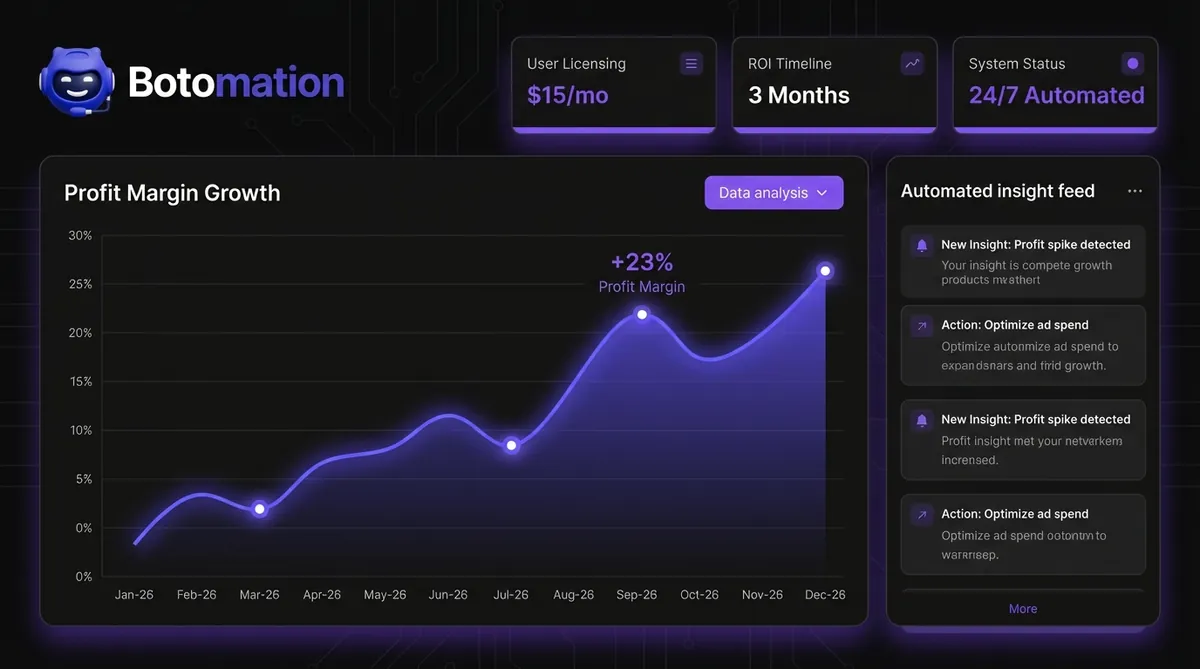
Enterprise-Grade Solutions for Small Businesses 2026 Guide
Scale with enterprise-grade solutions for small businesses. Use AI agents, custom code, and automation to boost efficiency and cut costs in 2026.
AI Marketing Tools for Business Growth 2026 ROI Guide
Learn how WhatsApp AI slashes support costs for e-commerce & SaaS. Proven strategies to boost sales, recover carts, and scale 24/7 service.