AI Marketing Tools for Business Growth 2026 ROI Guide
Feb 17, 2026
AI Automation
Marketing Strategy
Business Growth
AI Automation
Marketing Strategy
Business Growth
The marketing landscape in late 2026 has transitioned far beyond the initial generative AI hype. Selecting the right AI marketing tools for business growth has become the primary focus for executives looking to scale efficiently. We have entered an era where AI integration is no longer a competitive advantage but a baseline requirement for operational survival. For founders and CEOs, the strategic focus has shifted from whether AI works to how it can be woven into the very fabric of their revenue engines. According to recent data from the Content Marketing Institute, 73% of marketers have already committed to scaling their AI investments this year. This shift reflects a move away from experimental use toward permanent, automated workflows that manage everything from predictive lead scoring to hyper-personalized video content at scale.
As we analyze the current state of the industry, the transformation is most visible in the restructuring of marketing functions. The legacy model—relying on massive teams for manual content production and data analysis—is being replaced by lean, high-output teams supported by specialized AI agents. These agents do not merely assist with tasks; they own entire segments of the conversion funnel. By partnering with experts capable of replacing legacy systems with custom web development, businesses are achieving a fundamental shift in their unit economics. We are witnessing a complete overhaul of traditional marketing roles, where the focus has moved from execution to orchestration and high-level strategy.
What Are the Top AI Marketing Tools for Business Growth Trends in 2026?
The marketing environment in 2026 is defined by precision and velocity. We have moved past the clunky, hallucination-prone outputs of 2023. Today, the focus is on "agentic" workflows where tools like GPT-5 and Claude 3.5 Sonnet interact with live business data to make real-time decisions. This technical maturity has triggered a significant shift in budget allocation and a massive surge in AI marketing automation adoption. Current benchmarks show that forward-thinking companies are now dedicating between 15% and 25% of their total marketing budgets specifically to AI tools and the expert services required to implement them. This is more than software spend; it is an investment in operational infrastructure that replaces slow, manual processes with automated precision.
2026 AI Marketing Adoption Statistics
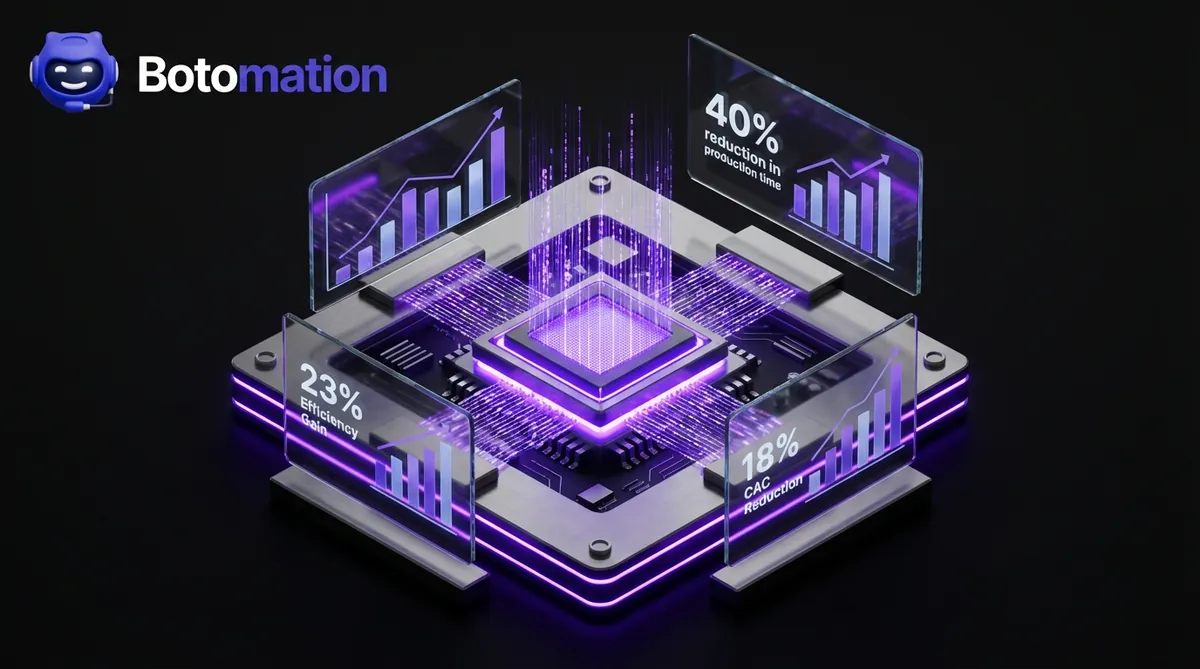
The data illustrates a market that has matured rapidly. While the Content Marketing Institute reports that 73% of marketers are increasing their AI budgets, the real story lies in the resulting efficiency gains. On average, companies implementing comprehensive AI strategies report a 23% increase in overall marketing efficiency AI. This is not a subjective improvement; it translates to a 40% reduction in the time required to move a content piece from initial ideation to final publication.
2026 Marketing Efficiency Snapshot
* Budget Increase: 73% of organizations are scaling AI investment.
* Efficiency Gain: 23% average improvement in team output.
* Cost Reduction: 18% average decrease in Customer Acquisition Cost (CAC).
* Time Savings: 40% less time spent on manual content production.
Beyond time savings, the impact on the bottom line is undeniable. Organizations that have successfully integrated AI into their customer acquisition funnels have achieved an average reduction in CAC of 18%. This occurs because AI tools identify high-intent leads with far greater accuracy than manual review, ensuring that ad spend and sales efforts are focused exclusively on the most likely buyers.
Latest AI Marketing Technologies
In 2026, the technical stack for a modern marketing department looks vastly different than it did eighteen months ago. Midjourney v7 has become the industry standard for visual brand consistency, allowing companies to generate high-fidelity assets that adhere strictly to brand guidelines without constant human retouching. For long-form content and complex SEO strategies, Claude 3.5 Sonnet has emerged as the preferred choice due to its nuanced tone and ability to process massive context windows.
We are also seeing the rise of specialized video tools such as Descript for rapid editing and Synthesia for personalized video messaging at scale. These are no longer standalone applications; they are integrated into larger tech stacks via custom APIs. This is where the true value lies—not in using a single tool, but in building a cohesive system where these technologies communicate seamlessly. Many businesses still struggle with this integration, which is why our team focuses on bridging the gap between complex technologies and practical, revenue-generating results.
How Do AI Content Creation Tools Drive Marketing AI ROI?
The "Old Way" of content marketing involved a grueling cycle of brainstorming, drafting, multiple rounds of revisions, and manual SEO optimization. It was slow, expensive, and difficult to scale without significant hiring. In 2026, the "New Way" leverages high-speed custom code and AI agents to handle the heavy lifting. This allows a single strategist to oversee the output that previously required an entire department. When evaluating the best marketing AI tools for content, the ROI on this transition is staggering, with an average return of $12 for every $1 invested in AI-driven content systems. This contributes significantly to the overall marketing AI ROI for the enterprise.
ChatGPT vs Claude vs Specialized Content Tools
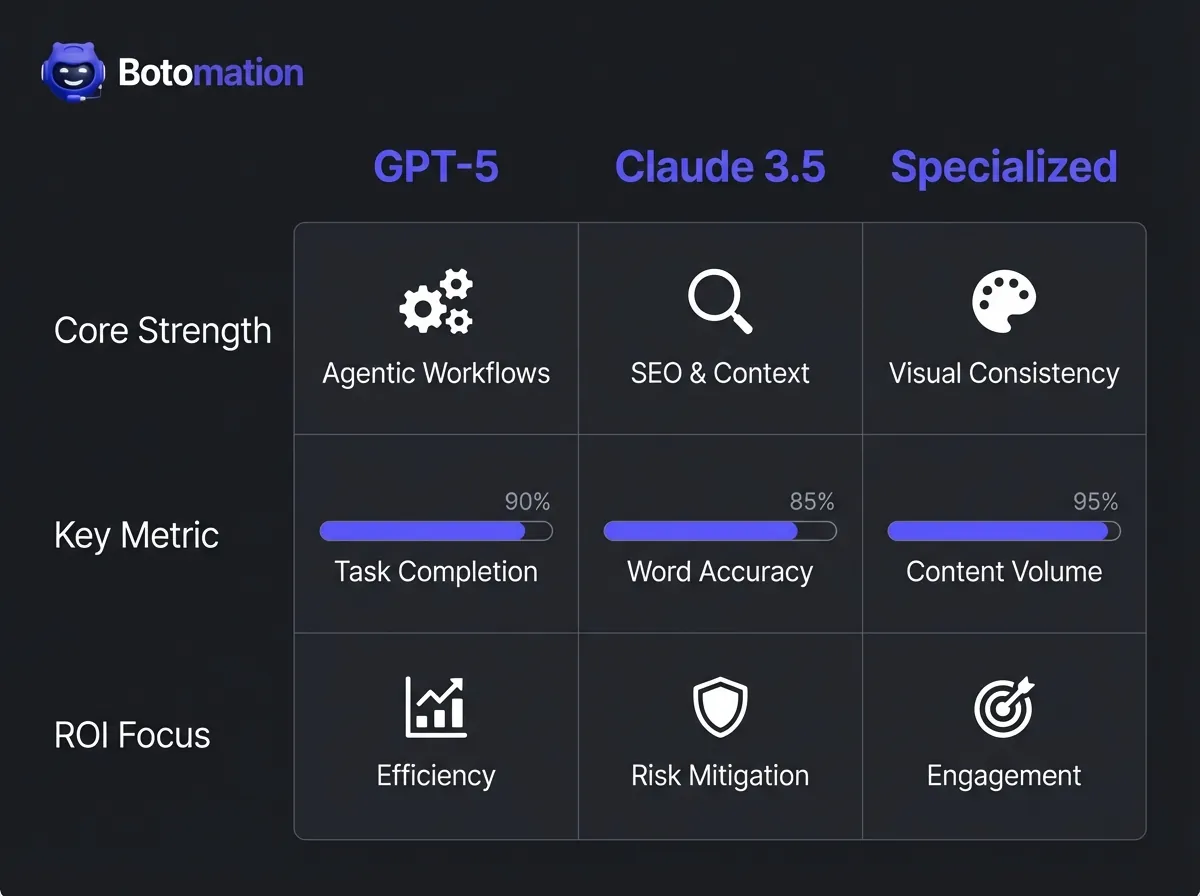
When comparing the leading models, the choice depends on the specific use case and the depth of integration required. ChatGPT (GPT-5) remains the powerhouse for raw data processing and multi-modal tasks, while Claude 3.5 Sonnet is frequently preferred for its more human-centric writing style in long-form articles. Meanwhile, specialized tools like Copy.ai or Jasper have pivoted to focus on "Brand Voices," allowing companies to train the AI on their entire history of marketing materials to ensure stylistic consistency.
| Feature | ChatGPT (GPT-5) | Claude 3.5 Sonnet | Specialized Tools (Jasper/Copy.ai) |
|---|---|---|---|
| **Primary Strength** | Logic & Data Analysis | Natural Brand Voice | Workflow Automation |
| **SEO Integration** | Moderate | High | Native |
| **Context Window** | 128k+ tokens | 200k+ tokens | Variable |
| **Business Pricing** | $20 - $30/user | $20 - $30/user | $40 - $100+/user |
| **Best Use Case** | Technical docs & coding | Blogs & creative copy | Social media & ad copy |
While these tools are powerful, they are still just components. The real magic happens when they are integrated into a custom-built revenue engine. For example, a business paying for various subscriptions might see a minor speed increase, but a business that partners with an agency to build a custom content pipeline can see exponential growth.
Case Study: AI Content Creation ROI
Consider a mid-sized marketing agency we recently analyzed that employed 25 full-time content creators. They were struggling to meet the demand for high-quality SEO content and social media updates. By implementing a custom-built workflow using ChatGPT Enterprise and Copy.ai, they transformed their operations. Their content output increased by 340% within the first quarter.
The financial breakdown was even more impressive. By automating the research and first-draft phases, they reduced their per-article cost by 60%. Instead of spending 10 hours on a 2,000-word guide, their writers now spend 2 hours directing the AI and 1 hour on final polish and fact-checking. This shift allowed them to scale their client base without increasing headcount, effectively decoupling revenue growth from payroll expenses. This is the exact type of operational efficiency that our experts provide, moving companies from a "hire more" mentality to a "build better systems" approach.
Which AI Marketing Tools for Business Growth Are Best for Customer Segmentation?
Personalization used to mean simple tag replacement in an email. In 2026, that is considered the "Old Way"—and it is largely ignored by consumers. The "New Way" involves leveraging AI for customer acquisition through dynamic content that changes in real-time based on user behavior, past purchases, and environmental factors like local weather or market trends. To achieve this, businesses are moving toward content personalization AI engines like Salesforce Einstein, HubSpot AI, and Segment.
Customer Segmentation Tools Comparison
The landscape of segmentation tools has bifurcated into two camps: all-in-one CRM giants and specialized data platforms. Salesforce Einstein and HubSpot AI offer the advantage of having data and execution tools in one place. They use predictive analytics to identify customers likely to churn or those ready for an upsell. Conversely, Segment (by Twilio) acts as a high-speed data pipeline, cleaning and routing customer information to multiple tools simultaneously.
Accuracy in these systems has reached new heights, with average segment identification improvements of 92%. The AI identifies patterns in your data that a human analyst might miss—such as the fact that customers visiting a pricing page on a Tuesday morning via a mobile device are 40% more likely to convert if they receive a specific case study via SMS within ten minutes. Implementing these systems requires technical expertise to ensure data privacy and compliance, but the payoff in conversion rates is significant.
Personalization Implementation Strategies
The goal of personalization is to make every customer feel like your only customer. We recently worked with an e-commerce brand that was stagnant at a 2.1% conversion rate. By implementing an AI-driven personalization layer that adjusted homepage products and email offers based on individual browsing history, their conversion rate climbed to 4.7% in just four months.
This was the result of a systematic data approach:
- Data Centralization: We consolidated data from their website, email, and POS system into a single source of truth.
- Behavioral Triggers: We deployed AI agents to monitor for specific intent signals.
- Dynamic Content: The website was re-coded to allow for modular sections that change based on the visitor's profile.
This level of sophistication separates market leaders from laggards. While legacy systems are slow and clunky, the custom-coded solutions we build at Botomation are designed for high-speed, intelligent interaction.
How Should You Compare Lead Scoring and Management AI Tools?
For B2B companies and SaaS providers, leveraging specialized AI B2B prospecting tools is vital because lead management is often the primary bottleneck to growth. Sales teams are frequently buried under low-quality leads, while high-value prospects go cold due to slow follow-up. Lead scoring AI tools like Marketo, Pardot, and custom-developed AI agents solve this by analyzing hundreds of data points in milliseconds to rank every prospect.
Lead Scoring AI Tools Comparison
The performance gap between traditional lead scoring and AI-driven intent patterns is vast. Modern systems achieve accuracy rates between 85% and 96% for identifying sales-ready leads. Marketo and Pardot remain industry standards for enterprise organizations, offering deep integration with sales workflows. However, many of our clients find these "Old Way" platforms to be overly complex and slow to implement.
For companies requiring speed and efficiency, custom AI agents often provide a superior alternative. These agents can be trained on your specific sales data and integrated directly into your custom-coded website. This avoids the bloat of massive SaaS platforms while providing more accurate, business-specific results. Pricing for these solutions has also become more accessible, moving away from per-contact models that penalize growth.
Lead Management Optimization with AI
The real ROI in lead management comes from reducing time-to-first-touch. A SaaS company we partnered with was struggling with a 24-hour lead response time, which was damaging their conversion rates. We implemented an AI-driven follow-up sequence that categorized leads instantly. Companies that reduce lead response time with WhatsApp automation can ensure high-intent leads are immediately routed to a live salesperson in under two minutes. with a full brief, while lower-intent leads were entered into an automated, AI-generated nurturing sequence.
The results were transformative:
- 65% improvement in lead qualification accuracy.
- 42% increase in sales-qualified leads (SQLs).
- 28% reduction in follow-up time.
Consider the cost of a human hire for this task. A junior SDR might cost $56,250 a year including benefits. An AI agent does the same work 24/7, with zero downtime and perfect memory, for a fraction of the cost. This is how you automate repetitive business tasks with AI agents to scale operations without increasing headcount—a core philosophy of our agency.
What Are the Best AI Strategies for Social Media and Email Marketing?
Social media and email remain the most effective channels for direct engagement, but they are also the most labor-intensive. In 2026, the "Old Way" of manually scheduling posts and guessing at subject lines is obsolete. AI tools like Hootsuite and Buffer have integrated deep learning to predict exactly when your audience is most likely to engage, while email platforms use send-time optimization to ensure your message hits the inbox at the perfect moment for each individual subscriber.
Social Media AI Tools and Capabilities
Today's social media AI doesn't just schedule posts; it creates them. By using AI agents to monitor trending topics and sentiment in real-time, brands can generate and post relevant content in minutes. This allows for a level of cultural relevance that was previously impossible for large organizations. Furthermore, visual AI ensures that every image is perfectly on-brand, allowing brands to scale social media content with automation and maintain a consistent aesthetic across platforms without the need for a full-time graphic designer.
Engagement tracking has also been automated. AI agents now handle basic community management, responding to common questions and flagging potential PR issues before they escalate. This frees your social media manager to focus on high-level strategy and partnerships rather than the comments section.
Email Marketing Optimization with AI
In email marketing, personalization is the difference between a deletion and a click. AI-driven subject line optimization has been shown to increase open rates by an average of 28%. But the real power lies in dynamic content insertion. Instead of sending the same newsletter to everyone, AI assembles a custom email for every subscriber, featuring products and articles they are statistically most likely to care about.
A retail company we studied implemented this "New Way" and saw a 45% increase in email-driven revenue. They stopped sending blasts and started sending "segments of one." By using send-time prediction, the AI ensured that morning people received emails at 7:00 AM, while night owls received theirs at 9:00 PM. This level of attention builds long-term customer loyalty and drives consistent growth.
How Do You Measure the ROI of Your Marketing AI Tools?
You cannot manage what you cannot measure. One of the biggest mistakes founders make is implementing AI tools without a clear framework for tracking success. To understand the impact of AI on your business, you must look beyond vanity metrics and focus on hard financial data. The average return we see across our client base is $15.20 for every $1 invested in marketing AI—but you have to know where to look.
Marketing AI KPIs and Measurement Framework
A robust measurement framework should cover three main areas: efficiency, effectiveness, and economics.
- Efficiency: Track the reduction in human hours required for specific tasks. If your team was spending 40 hours a week on social media and now spends 10, those 30 hours have a specific dollar value.
- Effectiveness: Look at conversion rate improvements, open rates, and lead quality scores. These are the leading indicators of revenue.
- Economics: This is the bottom-line data—Customer Acquisition Cost (CAC) and Customer Lifetime Value (LTV).
The AI ROI Formula
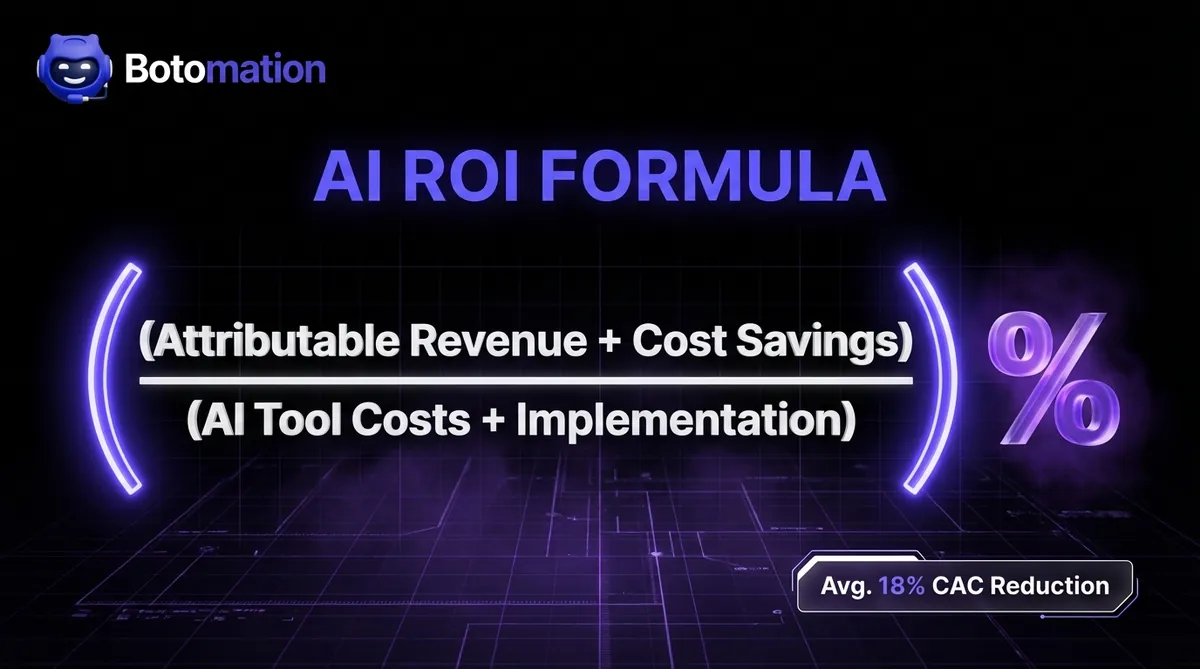
(Attributable Revenue Increase + Cost Savings) / (AI Tool Costs + Implementation Fees) = ROI
By using this formula, you can move away from gut feelings and make data-driven decisions. Most companies see a return on content tools within 2-4 months, while more complex systems like lead scoring typically take 4-6 months to show their full impact.
Calculating and Optimizing Marketing AI ROI
To maximize ROI, you must iterate. Data provided by your AI agents will often highlight bottlenecks you didn't know existed. For example, you might find that while your AI is generating 300% more leads, your sales team's closing rate has dropped because they are overwhelmed. This is a signal to implement AI in the next part of the funnel—perhaps an automated scheduling tool or a custom-coded sales dashboard.
A mid-market manufacturing company used this iterative approach to overhaul their marketing department. They started with simple content automation, saving $5,000 a month in freelance fees. They reinvested those savings into an AI lead scoring system, which increased SQLs by 30%. By year-end, their total marketing ROI had increased by 400%, all without adding a single employee to the team.
Step-by-Step Tutorial: Implementing Your First AI Marketing Agent
Ready to move from theory to practice? Here is a framework for implementing a custom AI agent for initial lead qualification.
- Identify the Data Source: Connect your website's contact form to a central database or high-speed CRM.
- Define the Scoring Logic: List the "must-have" qualities of a perfect lead (e.g., company size, budget, specific pain points).
- Prompt the Agent: Create a system prompt for your AI (using an API like GPT-5) that instructs it to analyze incoming leads against your criteria.
- Automate the Action: Use a tool like Zapier or a custom script to route "High Value" leads to Slack and "Low Value" leads to a nurture sequence.
- Monitor and Refine: Review the agent's decisions weekly and adjust the instructions to improve accuracy.
This is the "New Way" workflow that replaces legacy, manual systems with lightning-fast automation.
Frequently Asked Questions
Is AI marketing expensive to implement for a growing business?
The cost of not implementing AI is actually higher when you consider manual labor and lost opportunities. While enterprise SaaS platforms can be pricey, partnering with an agency to build custom-coded, lean AI solutions is often more cost-effective and provides a faster ROI. You can start small with one function and scale as you see the returns.
Will AI-generated content hurt my SEO rankings?
In 2026, search engines prioritize helpful content regardless of its origin. The key is to use AI as a high-speed drafting tool, followed by human oversight for fact-checking and brand voice. When done correctly, AI-assisted content is often superior because it can be more data-rich and better structured for search intent.
How do I ensure my customer data stays private when using AI?
Privacy is a top priority. When we build custom solutions, we prioritize enterprise-grade security and ensure that data is processed through secure APIs that do not use your proprietary information to train public models. Always look for solutions that offer data encryption and comply with current regulations like GDPR and CCPA.
Do I need to fire my marketing team to use AI?
Absolutely not. The goal of AI is to augment your team. By automating repetitive, low-value tasks, your team can focus on high-level strategy, creative direction, and building human relationships. AI makes your existing team 10x more productive, allowing you to scale without the traditional growing pains of massive hiring rounds.
How long does it take to see ROI from AI marketing tools?
Most businesses see a return on simple content automation tools within 2 to 4 months. More complex systems, such as predictive lead scoring or advanced customer segmentation, typically take 4 to 6 months to show their full financial impact as the models learn from your specific data.
The marketing landscape of 2026 demands a choice: continue with the slow, expensive "Old Way" of manual processes, or embrace the "New Way" of automated, high-speed growth. The data is clear—the efficiency gains and ROI are too significant to ignore.
However, the secret to success isn't just buying more software subscriptions. It is about building a cohesive, custom-coded revenue engine that leverages the full power of AI agents. This is where most businesses struggle, and it is exactly where we excel. At Botomation, we don't just give you tools; our team of experts builds the custom infrastructure that drives real, measurable business results. We replace slow legacy systems with lightning-fast code and 24/7 AI agents that work while you sleep.
Ready to automate your growth? Stop losing money to manual processes and outdated systems today. Book a call below to see how our experts can build your 2026 revenue engine.
The marketing landscape in late 2026 has transitioned far beyond the initial generative AI hype. Selecting the right AI marketing tools for business growth has become the primary focus for executives looking to scale efficiently. We have entered an era where AI integration is no longer a competitive advantage but a baseline requirement for operational survival. For founders and CEOs, the strategic focus has shifted from whether AI works to how it can be woven into the very fabric of their revenue engines. According to recent data from the Content Marketing Institute, 73% of marketers have already committed to scaling their AI investments this year. This shift reflects a move away from experimental use toward permanent, automated workflows that manage everything from predictive lead scoring to hyper-personalized video content at scale.
As we analyze the current state of the industry, the transformation is most visible in the restructuring of marketing functions. The legacy model—relying on massive teams for manual content production and data analysis—is being replaced by lean, high-output teams supported by specialized AI agents. These agents do not merely assist with tasks; they own entire segments of the conversion funnel. By partnering with experts capable of replacing legacy systems with custom web development, businesses are achieving a fundamental shift in their unit economics. We are witnessing a complete overhaul of traditional marketing roles, where the focus has moved from execution to orchestration and high-level strategy.
What Are the Top AI Marketing Tools for Business Growth Trends in 2026?
The marketing environment in 2026 is defined by precision and velocity. We have moved past the clunky, hallucination-prone outputs of 2023. Today, the focus is on "agentic" workflows where tools like GPT-5 and Claude 3.5 Sonnet interact with live business data to make real-time decisions. This technical maturity has triggered a significant shift in budget allocation and a massive surge in AI marketing automation adoption. Current benchmarks show that forward-thinking companies are now dedicating between 15% and 25% of their total marketing budgets specifically to AI tools and the expert services required to implement them. This is more than software spend; it is an investment in operational infrastructure that replaces slow, manual processes with automated precision.
2026 AI Marketing Adoption Statistics
The data illustrates a market that has matured rapidly. While the Content Marketing Institute reports that 73% of marketers are increasing their AI budgets, the real story lies in the resulting efficiency gains. On average, companies implementing comprehensive AI strategies report a 23% increase in overall marketing efficiency AI. This is not a subjective improvement; it translates to a 40% reduction in the time required to move a content piece from initial ideation to final publication.
2026 Marketing Efficiency Snapshot
* Budget Increase: 73% of organizations are scaling AI investment.
* Efficiency Gain: 23% average improvement in team output.
* Cost Reduction: 18% average decrease in Customer Acquisition Cost (CAC).
* Time Savings: 40% less time spent on manual content production.
Beyond time savings, the impact on the bottom line is undeniable. Organizations that have successfully integrated AI into their customer acquisition funnels have achieved an average reduction in CAC of 18%. This occurs because AI tools identify high-intent leads with far greater accuracy than manual review, ensuring that ad spend and sales efforts are focused exclusively on the most likely buyers.
Latest AI Marketing Technologies
In 2026, the technical stack for a modern marketing department looks vastly different than it did eighteen months ago. Midjourney v7 has become the industry standard for visual brand consistency, allowing companies to generate high-fidelity assets that adhere strictly to brand guidelines without constant human retouching. For long-form content and complex SEO strategies, Claude 3.5 Sonnet has emerged as the preferred choice due to its nuanced tone and ability to process massive context windows.
We are also seeing the rise of specialized video tools such as Descript for rapid editing and Synthesia for personalized video messaging at scale. These are no longer standalone applications; they are integrated into larger tech stacks via custom APIs. This is where the true value lies—not in using a single tool, but in building a cohesive system where these technologies communicate seamlessly. Many businesses still struggle with this integration, which is why our team focuses on bridging the gap between complex technologies and practical, revenue-generating results.
How Do AI Content Creation Tools Drive Marketing AI ROI?
The "Old Way" of content marketing involved a grueling cycle of brainstorming, drafting, multiple rounds of revisions, and manual SEO optimization. It was slow, expensive, and difficult to scale without significant hiring. In 2026, the "New Way" leverages high-speed custom code and AI agents to handle the heavy lifting. This allows a single strategist to oversee the output that previously required an entire department. When evaluating the best marketing AI tools for content, the ROI on this transition is staggering, with an average return of $12 for every $1 invested in AI-driven content systems. This contributes significantly to the overall marketing AI ROI for the enterprise.
ChatGPT vs Claude vs Specialized Content Tools
When comparing the leading models, the choice depends on the specific use case and the depth of integration required. ChatGPT (GPT-5) remains the powerhouse for raw data processing and multi-modal tasks, while Claude 3.5 Sonnet is frequently preferred for its more human-centric writing style in long-form articles. Meanwhile, specialized tools like Copy.ai or Jasper have pivoted to focus on "Brand Voices," allowing companies to train the AI on their entire history of marketing materials to ensure stylistic consistency.
| Feature | ChatGPT (GPT-5) | Claude 3.5 Sonnet | Specialized Tools (Jasper/Copy.ai) |
|---|---|---|---|
| **Primary Strength** | Logic & Data Analysis | Natural Brand Voice | Workflow Automation |
| **SEO Integration** | Moderate | High | Native |
| **Context Window** | 128k+ tokens | 200k+ tokens | Variable |
| **Business Pricing** | $20 - $30/user | $20 - $30/user | $40 - $100+/user |
| **Best Use Case** | Technical docs & coding | Blogs & creative copy | Social media & ad copy |
While these tools are powerful, they are still just components. The real magic happens when they are integrated into a custom-built revenue engine. For example, a business paying for various subscriptions might see a minor speed increase, but a business that partners with an agency to build a custom content pipeline can see exponential growth.
Case Study: AI Content Creation ROI
Consider a mid-sized marketing agency we recently analyzed that employed 25 full-time content creators. They were struggling to meet the demand for high-quality SEO content and social media updates. By implementing a custom-built workflow using ChatGPT Enterprise and Copy.ai, they transformed their operations. Their content output increased by 340% within the first quarter.
The financial breakdown was even more impressive. By automating the research and first-draft phases, they reduced their per-article cost by 60%. Instead of spending 10 hours on a 2,000-word guide, their writers now spend 2 hours directing the AI and 1 hour on final polish and fact-checking. This shift allowed them to scale their client base without increasing headcount, effectively decoupling revenue growth from payroll expenses. This is the exact type of operational efficiency that our experts provide, moving companies from a "hire more" mentality to a "build better systems" approach.
Which AI Marketing Tools for Business Growth Are Best for Customer Segmentation?
Personalization used to mean simple tag replacement in an email. In 2026, that is considered the "Old Way"—and it is largely ignored by consumers. The "New Way" involves leveraging AI for customer acquisition through dynamic content that changes in real-time based on user behavior, past purchases, and environmental factors like local weather or market trends. To achieve this, businesses are moving toward content personalization AI engines like Salesforce Einstein, HubSpot AI, and Segment.
Customer Segmentation Tools Comparison
The landscape of segmentation tools has bifurcated into two camps: all-in-one CRM giants and specialized data platforms. Salesforce Einstein and HubSpot AI offer the advantage of having data and execution tools in one place. They use predictive analytics to identify customers likely to churn or those ready for an upsell. Conversely, Segment (by Twilio) acts as a high-speed data pipeline, cleaning and routing customer information to multiple tools simultaneously.
Accuracy in these systems has reached new heights, with average segment identification improvements of 92%. The AI identifies patterns in your data that a human analyst might miss—such as the fact that customers visiting a pricing page on a Tuesday morning via a mobile device are 40% more likely to convert if they receive a specific case study via SMS within ten minutes. Implementing these systems requires technical expertise to ensure data privacy and compliance, but the payoff in conversion rates is significant.
Personalization Implementation Strategies
The goal of personalization is to make every customer feel like your only customer. We recently worked with an e-commerce brand that was stagnant at a 2.1% conversion rate. By implementing an AI-driven personalization layer that adjusted homepage products and email offers based on individual browsing history, their conversion rate climbed to 4.7% in just four months.
This was the result of a systematic data approach:
- Data Centralization: We consolidated data from their website, email, and POS system into a single source of truth.
- Behavioral Triggers: We deployed AI agents to monitor for specific intent signals.
- Dynamic Content: The website was re-coded to allow for modular sections that change based on the visitor's profile.
This level of sophistication separates market leaders from laggards. While legacy systems are slow and clunky, the custom-coded solutions we build at Botomation are designed for high-speed, intelligent interaction.
How Should You Compare Lead Scoring and Management AI Tools?
For B2B companies and SaaS providers, leveraging specialized AI B2B prospecting tools is vital because lead management is often the primary bottleneck to growth. Sales teams are frequently buried under low-quality leads, while high-value prospects go cold due to slow follow-up. Lead scoring AI tools like Marketo, Pardot, and custom-developed AI agents solve this by analyzing hundreds of data points in milliseconds to rank every prospect.
Lead Scoring AI Tools Comparison
The performance gap between traditional lead scoring and AI-driven intent patterns is vast. Modern systems achieve accuracy rates between 85% and 96% for identifying sales-ready leads. Marketo and Pardot remain industry standards for enterprise organizations, offering deep integration with sales workflows. However, many of our clients find these "Old Way" platforms to be overly complex and slow to implement.
For companies requiring speed and efficiency, custom AI agents often provide a superior alternative. These agents can be trained on your specific sales data and integrated directly into your custom-coded website. This avoids the bloat of massive SaaS platforms while providing more accurate, business-specific results. Pricing for these solutions has also become more accessible, moving away from per-contact models that penalize growth.
Lead Management Optimization with AI
The real ROI in lead management comes from reducing time-to-first-touch. A SaaS company we partnered with was struggling with a 24-hour lead response time, which was damaging their conversion rates. We implemented an AI-driven follow-up sequence that categorized leads instantly. Companies that reduce lead response time with WhatsApp automation can ensure high-intent leads are immediately routed to a live salesperson in under two minutes. with a full brief, while lower-intent leads were entered into an automated, AI-generated nurturing sequence.
The results were transformative:
- 65% improvement in lead qualification accuracy.
- 42% increase in sales-qualified leads (SQLs).
- 28% reduction in follow-up time.
Consider the cost of a human hire for this task. A junior SDR might cost $56,250 a year including benefits. An AI agent does the same work 24/7, with zero downtime and perfect memory, for a fraction of the cost. This is how you automate repetitive business tasks with AI agents to scale operations without increasing headcount—a core philosophy of our agency.
What Are the Best AI Strategies for Social Media and Email Marketing?
Social media and email remain the most effective channels for direct engagement, but they are also the most labor-intensive. In 2026, the "Old Way" of manually scheduling posts and guessing at subject lines is obsolete. AI tools like Hootsuite and Buffer have integrated deep learning to predict exactly when your audience is most likely to engage, while email platforms use send-time optimization to ensure your message hits the inbox at the perfect moment for each individual subscriber.
Social Media AI Tools and Capabilities
Today's social media AI doesn't just schedule posts; it creates them. By using AI agents to monitor trending topics and sentiment in real-time, brands can generate and post relevant content in minutes. This allows for a level of cultural relevance that was previously impossible for large organizations. Furthermore, visual AI ensures that every image is perfectly on-brand, allowing brands to scale social media content with automation and maintain a consistent aesthetic across platforms without the need for a full-time graphic designer.
Engagement tracking has also been automated. AI agents now handle basic community management, responding to common questions and flagging potential PR issues before they escalate. This frees your social media manager to focus on high-level strategy and partnerships rather than the comments section.
Email Marketing Optimization with AI
In email marketing, personalization is the difference between a deletion and a click. AI-driven subject line optimization has been shown to increase open rates by an average of 28%. But the real power lies in dynamic content insertion. Instead of sending the same newsletter to everyone, AI assembles a custom email for every subscriber, featuring products and articles they are statistically most likely to care about.
A retail company we studied implemented this "New Way" and saw a 45% increase in email-driven revenue. They stopped sending blasts and started sending "segments of one." By using send-time prediction, the AI ensured that morning people received emails at 7:00 AM, while night owls received theirs at 9:00 PM. This level of attention builds long-term customer loyalty and drives consistent growth.
How Do You Measure the ROI of Your Marketing AI Tools?
You cannot manage what you cannot measure. One of the biggest mistakes founders make is implementing AI tools without a clear framework for tracking success. To understand the impact of AI on your business, you must look beyond vanity metrics and focus on hard financial data. The average return we see across our client base is $15.20 for every $1 invested in marketing AI—but you have to know where to look.
Marketing AI KPIs and Measurement Framework
A robust measurement framework should cover three main areas: efficiency, effectiveness, and economics.
- Efficiency: Track the reduction in human hours required for specific tasks. If your team was spending 40 hours a week on social media and now spends 10, those 30 hours have a specific dollar value.
- Effectiveness: Look at conversion rate improvements, open rates, and lead quality scores. These are the leading indicators of revenue.
- Economics: This is the bottom-line data—Customer Acquisition Cost (CAC) and Customer Lifetime Value (LTV).
The AI ROI Formula
(Attributable Revenue Increase + Cost Savings) / (AI Tool Costs + Implementation Fees) = ROI
By using this formula, you can move away from gut feelings and make data-driven decisions. Most companies see a return on content tools within 2-4 months, while more complex systems like lead scoring typically take 4-6 months to show their full impact.
Calculating and Optimizing Marketing AI ROI
To maximize ROI, you must iterate. Data provided by your AI agents will often highlight bottlenecks you didn't know existed. For example, you might find that while your AI is generating 300% more leads, your sales team's closing rate has dropped because they are overwhelmed. This is a signal to implement AI in the next part of the funnel—perhaps an automated scheduling tool or a custom-coded sales dashboard.
A mid-market manufacturing company used this iterative approach to overhaul their marketing department. They started with simple content automation, saving $5,000 a month in freelance fees. They reinvested those savings into an AI lead scoring system, which increased SQLs by 30%. By year-end, their total marketing ROI had increased by 400%, all without adding a single employee to the team.
Step-by-Step Tutorial: Implementing Your First AI Marketing Agent
Ready to move from theory to practice? Here is a framework for implementing a custom AI agent for initial lead qualification.
- Identify the Data Source: Connect your website's contact form to a central database or high-speed CRM.
- Define the Scoring Logic: List the "must-have" qualities of a perfect lead (e.g., company size, budget, specific pain points).
- Prompt the Agent: Create a system prompt for your AI (using an API like GPT-5) that instructs it to analyze incoming leads against your criteria.
- Automate the Action: Use a tool like Zapier or a custom script to route "High Value" leads to Slack and "Low Value" leads to a nurture sequence.
- Monitor and Refine: Review the agent's decisions weekly and adjust the instructions to improve accuracy.
This is the "New Way" workflow that replaces legacy, manual systems with lightning-fast automation.
Frequently Asked Questions
Is AI marketing expensive to implement for a growing business?
The cost of not implementing AI is actually higher when you consider manual labor and lost opportunities. While enterprise SaaS platforms can be pricey, partnering with an agency to build custom-coded, lean AI solutions is often more cost-effective and provides a faster ROI. You can start small with one function and scale as you see the returns.
Will AI-generated content hurt my SEO rankings?
In 2026, search engines prioritize helpful content regardless of its origin. The key is to use AI as a high-speed drafting tool, followed by human oversight for fact-checking and brand voice. When done correctly, AI-assisted content is often superior because it can be more data-rich and better structured for search intent.
How do I ensure my customer data stays private when using AI?
Privacy is a top priority. When we build custom solutions, we prioritize enterprise-grade security and ensure that data is processed through secure APIs that do not use your proprietary information to train public models. Always look for solutions that offer data encryption and comply with current regulations like GDPR and CCPA.
Do I need to fire my marketing team to use AI?
Absolutely not. The goal of AI is to augment your team. By automating repetitive, low-value tasks, your team can focus on high-level strategy, creative direction, and building human relationships. AI makes your existing team 10x more productive, allowing you to scale without the traditional growing pains of massive hiring rounds.
How long does it take to see ROI from AI marketing tools?
Most businesses see a return on simple content automation tools within 2 to 4 months. More complex systems, such as predictive lead scoring or advanced customer segmentation, typically take 4 to 6 months to show their full financial impact as the models learn from your specific data.
The marketing landscape of 2026 demands a choice: continue with the slow, expensive "Old Way" of manual processes, or embrace the "New Way" of automated, high-speed growth. The data is clear—the efficiency gains and ROI are too significant to ignore.
However, the secret to success isn't just buying more software subscriptions. It is about building a cohesive, custom-coded revenue engine that leverages the full power of AI agents. This is where most businesses struggle, and it is exactly where we excel. At Botomation, we don't just give you tools; our team of experts builds the custom infrastructure that drives real, measurable business results. We replace slow legacy systems with lightning-fast code and 24/7 AI agents that work while you sleep.
Ready to automate your growth? Stop losing money to manual processes and outdated systems today. Book a call below to see how our experts can build your 2026 revenue engine.
Get Started
Book a FREE Consultation Right NOW!
Schedule a Call with Our Team To Make Your Business More Efficient with AI Instantly.
Read More
AI Marketing Tools for Business Growth 2026 ROI Guide
Master AI marketing tools for business growth in 2026. Maximize ROI using automated lead scoring, content agents, and high-speed custom code systems.
Implementing AI in Small to Medium Businesses - 2026 Guide
Learn how WhatsApp AI slashes support costs for e-commerce & SaaS. Proven strategies to boost sales, recover carts, and scale 24/7 service.