Legacy vs Custom Dev - 2026 Cost-Benefit Analysis
Jan 7, 2026
Legacy Systems
Custom Development
AI Automation
Legacy Systems
Custom Development
AI Automation
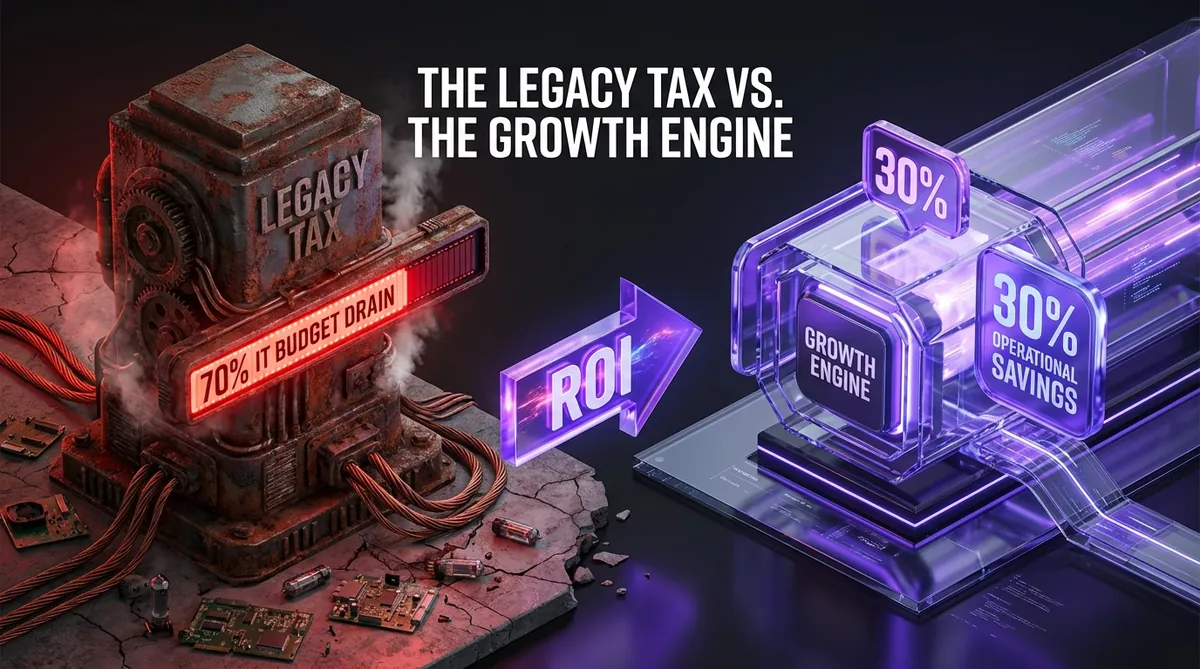
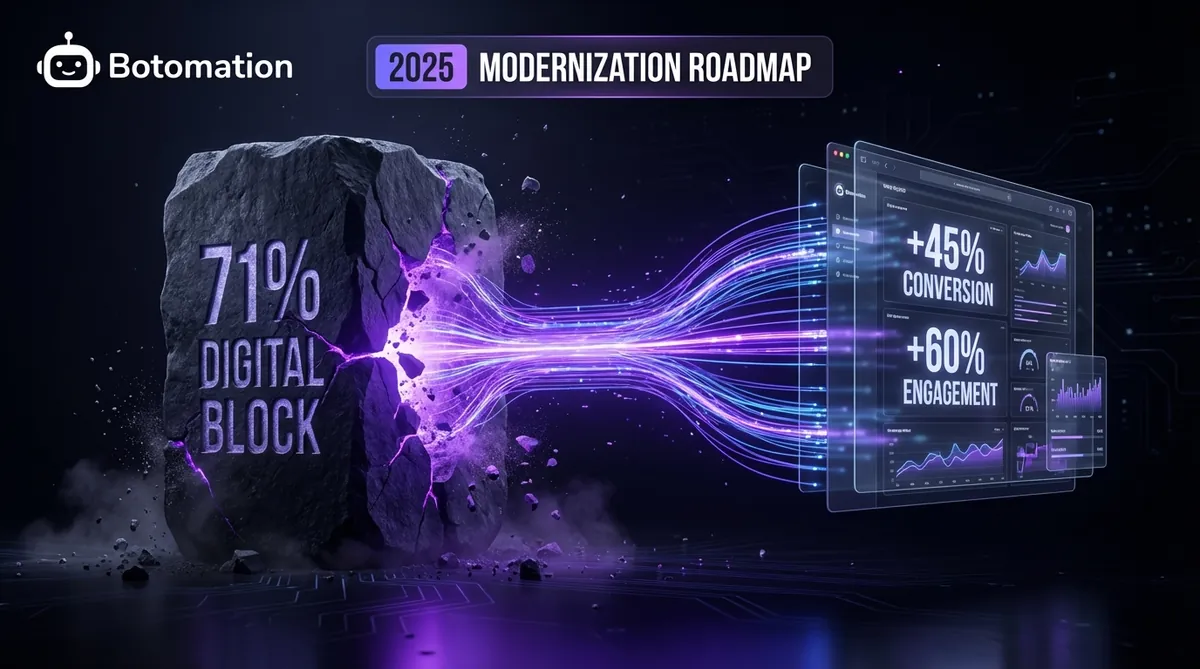
Business leaders in January 2026 face a recurring financial drain that often goes unnoticed until it begins to cripple the bottom line. Recent data from Statista indicates that a staggering 71% of businesses fail to achieve their primary digital objectives specifically because they are tethered to legacy systems. These aging frameworks act as an anchor, dragging down innovation while siphoning off resources that should be directed toward growth. For many organizations, the cost of maintaining legacy systems vs custom development has reached a breaking point where the price of "keeping the lights on" far exceeds the investment required for total modernization.
The financial reality is stark for any COO or CEO. Industry benchmarks show that legacy maintenance can consume up to 70% of a total IT budget, leaving a mere 30% for actual innovation or new feature development. This imbalance creates a cycle of stagnation where companies pay more every year for a system that delivers diminishing value. However, the landscape of 2026 offers a new path forward. By partnering with experts who utilize high-speed AI-powered legacy system migration tools like GPT-5 and advanced specialized LLMs, companies are now seeing migration times cut in half. New case studies reveal that organizations choosing to replace legacy systems with custom web development are achieving immediate operational cost reductions of 30% while realizing significant long-term savings.
This analysis provides a deep dive into the financial mechanics of modernizing your digital infrastructure. We will look past surface-level licensing fees to uncover the hidden taxes of technical debt and lost market opportunities. By the end of this breakdown, it will become clear why the most successful firms are shifting their capital from defensive maintenance to offensive custom development. The goal is no longer just to maintain a website or an internal portal; the goal is to build a high-performance revenue engine, often requiring a shift from standard templates to custom performance-first architecture, that operates with the efficiency of modern AI automation.
The Hidden Cost of Maintaining Legacy Systems vs Custom Development
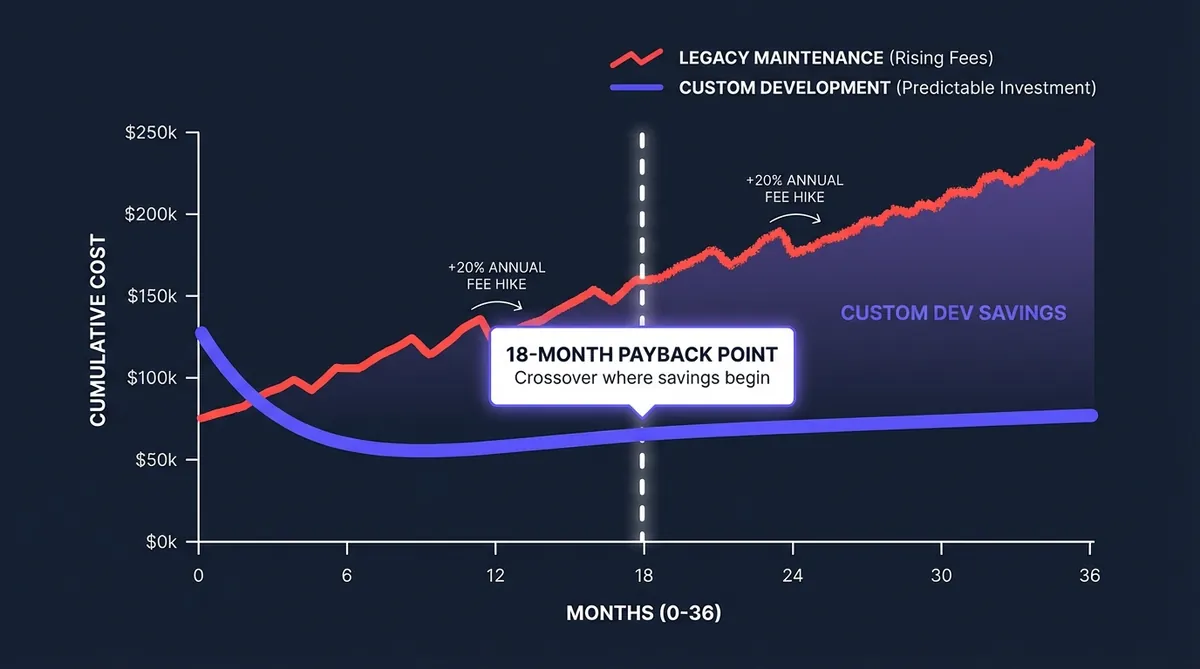
When we evaluate the cost of maintaining legacy systems vs custom development, the conversation often starts with the most visible line items. Direct costs like annual licensing fees, server hosting for on-premises hardware, and specialized support contracts are easy to track on a balance sheet. However, these figures represent only the tip of the iceberg. In 2026, the most dangerous costs are the ones that lack a dedicated line item but manifest as friction across every department.
Legacy systems often rely on "zombie technology"—software that is no longer receiving updates or has been moved to "extended support" by the vendor. This necessitates hiring specialized consultants or maintaining a dedicated internal team whose only job is to patch holes and manage fires. These developers are often paid a premium because their skillset is becoming rare, yet their work adds zero new features to the business, whereas modern firms automate these data-heavy admin tasks with AI to reclaim that budget. You are essentially paying for a highly skilled mechanic to keep a 1990s sedan running when you could be investing that same capital into a fleet of modern, automated vehicles.
Beyond payroll, there is the mounting weight of technical debt. Every time your team builds a "workaround" to facilitate custom software integration with legacy systems, the complexity of your codebase increases. This creates a slower development velocity where even simple changes take weeks instead of hours. The risk of a catastrophic system failure also looms larger every year. When an outdated system fails, recovery time is significantly longer because modern recovery tools often lack compatibility with the old architecture.
Direct Financial Costs of Legacy Maintenance
The most immediate drain on your capital comes from the recurring fees required to keep aging software functional. Many legacy platform vendors have shifted to aggressive pricing models for their "legacy" tiers, effectively penalizing customers who haven't migrated. These annual licensing fees can jump by 15% to 20% annually as vendors try to force a transition or recoup the costs of maintaining old server environments. Alongside these fees, the physical infrastructure costs for on-premises servers or private clouds are often double what you would pay for modern, serverless architecture.
Vendor support contracts for discontinued systems are another significant expense. Once a product reaches its end-of-life stage, getting a human on the phone who understands the architecture requires "Platinum" or "Premier" support tiers that cost tens of thousands of dollars per year. If you don't pay, you are left at the mercy of community forums or a dwindling pool of independent contractors. These emergency maintenance costs are unpredictable and almost always occur at the worst possible time.
Hidden and Indirect Costs
The true "legacy tax" is paid in lost productivity and missed opportunities. When your staff spends four hours a day fighting with a slow, unresponsive interface, you are losing a massive percentage of your payroll to inefficiency. Modern web applications built with frameworks like NestJS and optimized with AI agents can automate 24/7 tasks, effectively demonstrating how AI agents replace manual data entry in your legacy setup. Without custom web development for marketing, the inability to integrate with modern tools like Midjourney v7 or the latest CRM platforms means your sales teams are operating with one hand tied behind their backs.
Security vulnerabilities represent perhaps the highest indirect cost. Outdated systems are the primary targets for ransomware and data breaches because their security protocols were designed for a different era of threats. A single breach can lead to millions in fines, legal fees, and remediation costs, not to mention the irreparable damage to your brand reputation. Compliance risks also grow as global data protection laws evolve; an old system may simply be incapable of meeting new requirements without a total overhaul.
Expert Insight: "Legacy systems are not just a technical problem; they are a financial liability. Every dollar spent on patching a 10-year-old system is a dollar that isn't being used to outpace your competition." — Senior Consultant at Botomation.
ROI Analysis: The Cost of Maintaining Legacy Systems vs Custom Development
Shifting your strategy toward custom web development is not merely an IT upgrade; it is a strategic move to reclaim your operational budget. By investing in a custom solution, you are building a platform tailored specifically to your business logic, eliminating the bloat of "all-in-one" legacy software. In 2026, the ROI on these projects is more transparent than ever. Organizations that modernize their stack report a 60% increase in user engagement because the "New Way" of development prioritizes speed, accessibility, and intuitive UX that legacy systems cannot replicate.
The financial impact of this transition is felt across the entire organization. We have seen companies reduce operational costs by 40% simply by replacing manual, repetitive tasks with integrated AI agents. There are numerous benefits of custom web development over legacy systems, particularly when leveraging custom web development for business automation to reduce manual overhead. These agents handle everything from automated B2B lead qualification to complex data synthesis, working 24/7 without the need for human intervention.
Long-term competitive advantage comes from the flexibility of custom architecture. Unlike legacy systems that act as a "black box," a custom solution developed by an expert agency is modular. This means when a new technology emerges—like a more powerful AI model or a new payment protocol—it can be integrated in days, not months. This agility allows you to respond to market shifts instantly, capturing revenue that your competitors, stuck in their legacy ecosystems, simply cannot reach.
Quantifiable Performance Improvements
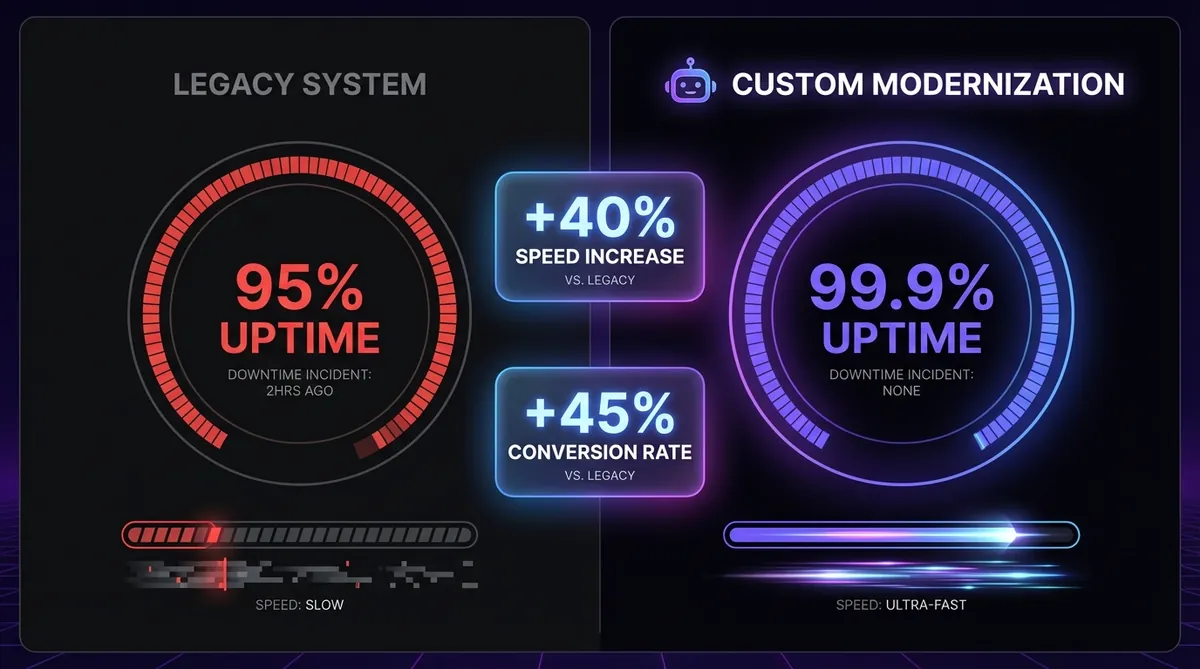
Performance is directly tied to revenue. In the modern digital economy, a one-second delay in page load time can result in a 7% reduction in conversions; understanding how to improve website speed is critical for maintaining a competitive edge. Custom web development allows for surgical optimization that legacy systems cannot match, often achieving a perfect 100 PageSpeed score with 40% faster load times and a 65% reduction in server response times. These aren't just technical metrics; they are the difference between a customer completing a purchase or bouncing to a competitor's site.
Reliability is the other side of the performance coin. While legacy systems often struggle with "micro-downtime" and slow-downs during peak hours, modern custom solutions are built for 99.9% uptime using auto-scaling cloud infrastructure. For e-commerce businesses, this stability has led to a 35% reduction in cart abandonment. When the system is fast and reliable, users trust it more, leading to the 45% higher conversion rates we consistently see in our modernization projects.
Long-term Financial Benefits
The most significant long-term benefit is the drastic reduction in ongoing maintenance costs. Modern, well-documented code is infinitely easier and cheaper to maintain than a "spaghetti" legacy codebase. Furthermore, because custom solutions are built to scale, you won't need a major rewrite when your user base grows. The system grows with you, keeping your per-user operational costs stable rather than exponential.
Integration capabilities are another massive cost-saver. A custom-built engine can talk to any modern API, allowing you to eliminate data silos between business applications and automate the flow of data between your website, your CRM, and your inventory management. This eliminates the need for manual data entry, utilizing automated lead verification tools to reduce human error and free up your staff for high-value tasks. On average, our clients see a full payback on their custom development investment within 18 months, after which the savings contribute directly to the net profit margin.
| Metric | Legacy System (The Old Way) | Custom Development (The New Way) |
|---|---|---|
| **Annual Maintenance** | $50,000 - $150,000+ | $5,000 - $15,000 |
| **Development Velocity** | Slow (Weeks for minor changes) | Fast (Days for new features) |
| **System Uptime** | 95% - 98% (Unreliable) | 99.9% (Enterprise-grade) |
| **Security Risk** | High (Outdated patches) | Low (Proactive, modern protocols) |
| **Scalability Cost** | Exponential (Hardware intensive) | Linear (Cloud-native auto-scaling) |
| **AI Integration** | Difficult/Impossible | Native / AI-Agent Ready |
2026 Cost Comparison: Legacy vs Modern Solutions
To truly understand the financial choice, we must look at a 5-year cost projection. The "Old Way" of maintaining legacy systems often looks cheaper in the first six months because there is no large upfront capital expenditure. However, the cost curve for legacy systems is upward-sloping. As technology ages, the talent pool shrinks and the number of required patches increases. Modernizing business systems with custom development is the only way to ensure these costs remain stable and predictable as your company scales.
In contrast, the cost curve for custom development starts with an initial investment but levels off quickly. Because the system is built on modern standards, maintenance is proactive rather than reactive. Scalability costs are also significantly lower. In a legacy environment, doubling your traffic might require a massive investment in new server hardware or a complex database migration. In a modern custom environment, cloud-native architecture handles that growth automatically with a linear, predictable increase in hosting costs.
Security costs follow a similar pattern. Maintaining a legacy system requires a "fortress" approach—constantly building walls around a vulnerable core. Modern custom solutions use a "secure by design" approach, utilizing the latest encryption and authentication standards from day one. This proactive stance reduces the need for expensive third-party security audits and emergency patching, saving the business thousands of dollars in potential liability and specialized security consulting fees.
Total Cost of Ownership Analysis
A true Total Cost of Ownership (TCO) analysis compares the all-in costs over a multi-year period. For a legacy system, this includes licensing, specialized payroll, downtime losses, and the "innovation tax" of being unable to launch new features. For custom development, it includes the initial build, transition/training costs, and a much smaller ongoing maintenance fee. When you break down the numbers, the "expensive" custom build often becomes the cheaper option by the end of the second year.
Consider a mid-sized enterprise spending $100,000 a year on legacy maintenance and support. Over five years, that is $500,000 spent just to stay in the same place. If a custom modernization project costs $200,000 upfront and $10,000 a year to maintain, the 5-year total is $250,000. The business saves a quarter-million dollars while gaining a faster, more secure, and AI-ready platform. This does not even account for revenue gains from improved conversion rates and faster time-to-market.
Risk Assessment and Contingency Costs
Risk is a financial variable that must be priced into your decision. Legacy systems carry a high "failure cost." If your core system goes down for 48 hours, what is the cost in lost sales, labor, and customer churn? For many businesses, a single major failure can cost more than the entire price of a modern custom solution. You are essentially self-insuring a high-risk asset every day you stay on legacy hardware.
Compliance and insurance are also becoming major factors in 2026. Cyber insurance premiums are skyrocketing for companies running outdated software. Some insurers are even refusing to cover businesses that use systems past their end-of-life dates. By modernizing, you not only reduce the risk of a breach but also lower your insurance premiums and ensure you are fully compliant with global regulations. This risk mitigation has a direct, positive impact on the company's valuation.
Stat Box: According to 2024-2026 industry data, 83% of businesses that transitioned from legacy systems to custom web solutions reported a positive ROI within the first 24 months, with an average operational cost saving of 28%.
Real-World Financial Impact from 2024-2026 Modernization Projects
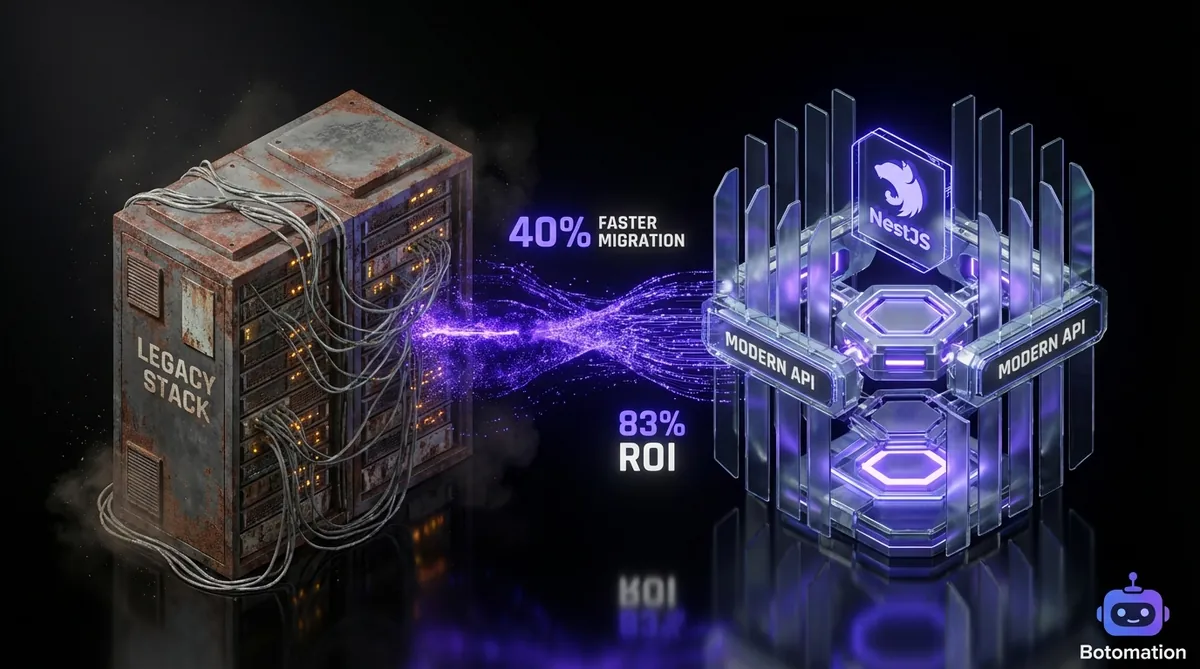
The theory of cost savings is backed by aggressive real-world results from the past 18 months. We have seen a massive shift in how migration projects are handled. By using AI-assisted modernization techniques, our team can now analyze legacy codebases and refactor them into modern frameworks like NestJS with incredible precision. Case studies from this year show a significant ROI of legacy system modernization when companies move toward cloud-native architectures.
A notable B2B retail case study involved a company struggling with a 15-year-old ordering system. They were spending roughly $12,000 a month on specialized support and hosting. The system was so slow that sales reps were using Excel sheets instead of the portal. After partnering with our experts to build a custom, AI-integrated platform, their monthly maintenance dropped to $1,500. More importantly, development velocity tripled, allowing them to launch a new mobile app and a customer loyalty program in months rather than years.
Enterprise-level transformations show even larger numbers. By applying enterprise-grade solutions for small businesses, companies like Capital One have famously saved millions by migrating from massive data centers to streamlined, custom cloud architectures. While your business may not be the size of a global bank, the principles remain the same. Modernization is the key to unlocking capital that is currently trapped in your IT department. Industry metrics now show that AI-assisted projects are completing 40% faster than traditional manual migrations.
B2B Retail Platform Financial Transformation
Let's look at the specific numbers for the B2B retail platform mentioned above. Their pre-migration costs were $144,000 per year in direct maintenance. They also estimated a loss of $200,000 in annual revenue due to the slow checkout process and lack of mobile optimization. Total "Legacy Cost" was $344,000 per year. The investment in a custom Botomation solution was $250,000.
In the first year post-migration, their maintenance costs dropped to $18,000. Their revenue increased by 20% ($400,000) due to the improved user experience and AI-driven product recommendations.
- Year 1 Investment: $250,000 (Build) + $18,000 (Maint) = $268,000
- Year 1 Gains: $126,000 (Maint Savings) + $400,000 (Revenue Increase) = $526,000
- Net Benefit Year 1: $258,000
The project paid for itself in less than seven months. This is the power of replacing a "cost center" legacy system with a "revenue engine" custom solution.
Enterprise-Level Cost Transformations
Large-scale migrations provide a blueprint for what is possible. In 2026, even mid-market enterprises are seeing 30% cost reductions through AI-assisted modernization. By using AI to automate the repetitive parts of coding—like data mapping and basic CRUD operations—our team focuses on high-level architecture and business logic. This ensures that the custom solution isn't just a copy of the old system but a fundamentally better version of it.
The average 18-month payback period we see for custom solutions is a conservative estimate. When you factor in the 35% reduction in critical bugs and the 3x improvement in development velocity, the "soft" benefits often outweigh the direct financial ones. Your team is more productive, your customers are more engaged, and your business is finally positioned to leverage the latest AI tools without being held back by a database structure from 2012.
Building a Business Case for Legacy System Replacement
If you are a founder or a COO, you know that "it's old" is not enough to get a budget approved. You need a data-driven business case that speaks the language of the board. Your first step should be a thorough legacy system replacement cost analysis that accounts for both direct expenses and lost innovation opportunities. Document every dollar currently spent on the legacy system, including the hours your team spends on "firefighting."
Next, you must quantify the business impact of your current limitations. How many customers are you losing because your site takes 5 seconds to load? How much more could you sell if you had AI agents handling customer queries 24/7, or used AI-powered lead qualification tools to focus your sales team? These aren't just guesses; you can use industry benchmarks to create credible projections. When you present these numbers alongside the projected costs of a custom solution, the decision becomes a matter of simple arithmetic.
Finally, present a risk-adjusted financial model. Show the "Cost of Inaction" and how you can scale business operations with AI automation to offset these risks. If you do nothing, your maintenance costs will continue to rise, and your competitive position will continue to erode. By framing the custom development project as a strategic investment in a "revenue engine," you shift the conversation from "how much does this cost" to "how much is this going to make us."
Quantifying Current System Costs
To build your case, start with a detailed audit of the last 12 months. Include:
- Software licensing and "extended support" fees.
- Infrastructure and hosting costs (including physical server maintenance).
- Payroll for staff dedicated to legacy maintenance (estimate % of time).
- Fees paid to outside consultants for emergency fixes.
- Calculated cost of any system downtime.
- Estimated cost of "workarounds" (manual data entry that should be automated).
Totaling these numbers often shocks leadership. It is not uncommon for a "stable" legacy system to cost a mid-sized company $200,000 to $500,000 a year in combined direct and indirect expenses. When you realize you are paying that much for a system that is actively holding you back, the move to custom development becomes an urgent priority.
Projecting Custom Solution Benefits
Once current costs are clear, project the "New Way" benefits. Working with an agency like Botomation, you can get a fixed-price estimate for the modernization project. Combine this with the projected 80-90% reduction in maintenance fees. Then, add the "Growth Alpha"—the additional revenue generated by a faster site, better UX, and AI automation.
For example, if a custom solution increases your conversion rate from 2% to 2.5%, and your annual online revenue is $5 million, that is an extra $1.25 million in revenue every year. When you add that to the $100,000 saved on maintenance, the ROI is undeniable. This is the "aha moment" where stakeholders realize that staying on the legacy system is actually the most expensive choice they can make.
Frequently Asked Questions
Why is custom development better than just upgrading to a newer SaaS platform?
Off-the-shelf SaaS platforms often come with "feature bloat" and high monthly per-user fees that scale poorly as you grow. Many firms find that a migration from WordPress to custom web development provides the performance and ownership that SaaS platforms lack. A custom solution built by Botomation gives you 100% ownership of your code, zero per-user fees, and a system that fits your business logic perfectly without unnecessary complexity.
How long does a typical migration from a legacy system take in 2026?
Thanks to our AI-assisted development workflow, we have cut traditional migration times in half. Most mid-sized systems can be modernized in 3 to 6 months, compared to the 12+ months it used to take with manual-only coding.
Is custom code harder to maintain than a legacy platform?
Quite the opposite. We use modern, industry-standard frameworks like NestJS and React that are well-documented and supported by millions of developers. This makes it far easier to find talent and make updates than it is for specialized, aging legacy languages.
Can we modernize our system in phases to manage the budget?
Yes. We often recommend a "Strangler Fig" approach where we replace the most critical or high-cost components of your legacy system first. This allows you to start seeing ROI and operational savings almost immediately while we systematically phase out the old architecture.
What is the average ROI for a legacy system replacement?
Most organizations see a full return on investment within 18 to 24 months. This calculation includes direct maintenance savings, reduced server costs, and the revenue gains associated with improved site performance and conversion rates.
The financial case for replacing legacy systems with custom development is no longer a matter of debate; it is a mathematical certainty. In January 2026, the "legacy tax" is too high for any growth-oriented business to pay. Organizations that make the leap are seeing 20-30% cost savings and 83% ROI improvements, all while gaining the ability to leverage the latest AI automation tools. By moving away from the "Old Way" of reactive maintenance and embracing the "New Way" of high-speed custom development, you aren't just upgrading your software—you are upgrading your entire business model.
Partnering with a premium agency like Botomation ensures that your transition is handled by experts who understand how to bridge the gap between complex AI and practical business results. We don't just build websites; we build revenue engines designed to scale without increasing your headcount. The data is clear: the cost of maintaining legacy systems vs custom development favors the bold who choose to innovate.
Ready to automate your growth? Book a call below.
Business leaders in January 2026 face a recurring financial drain that often goes unnoticed until it begins to cripple the bottom line. Recent data from Statista indicates that a staggering 71% of businesses fail to achieve their primary digital objectives specifically because they are tethered to legacy systems. These aging frameworks act as an anchor, dragging down innovation while siphoning off resources that should be directed toward growth. For many organizations, the cost of maintaining legacy systems vs custom development has reached a breaking point where the price of "keeping the lights on" far exceeds the investment required for total modernization.
The financial reality is stark for any COO or CEO. Industry benchmarks show that legacy maintenance can consume up to 70% of a total IT budget, leaving a mere 30% for actual innovation or new feature development. This imbalance creates a cycle of stagnation where companies pay more every year for a system that delivers diminishing value. However, the landscape of 2026 offers a new path forward. By partnering with experts who utilize high-speed AI-powered legacy system migration tools like GPT-5 and advanced specialized LLMs, companies are now seeing migration times cut in half. New case studies reveal that organizations choosing to replace legacy systems with custom web development are achieving immediate operational cost reductions of 30% while realizing significant long-term savings.
This analysis provides a deep dive into the financial mechanics of modernizing your digital infrastructure. We will look past surface-level licensing fees to uncover the hidden taxes of technical debt and lost market opportunities. By the end of this breakdown, it will become clear why the most successful firms are shifting their capital from defensive maintenance to offensive custom development. The goal is no longer just to maintain a website or an internal portal; the goal is to build a high-performance revenue engine, often requiring a shift from standard templates to custom performance-first architecture, that operates with the efficiency of modern AI automation.
The Hidden Cost of Maintaining Legacy Systems vs Custom Development
When we evaluate the cost of maintaining legacy systems vs custom development, the conversation often starts with the most visible line items. Direct costs like annual licensing fees, server hosting for on-premises hardware, and specialized support contracts are easy to track on a balance sheet. However, these figures represent only the tip of the iceberg. In 2026, the most dangerous costs are the ones that lack a dedicated line item but manifest as friction across every department.
Legacy systems often rely on "zombie technology"—software that is no longer receiving updates or has been moved to "extended support" by the vendor. This necessitates hiring specialized consultants or maintaining a dedicated internal team whose only job is to patch holes and manage fires. These developers are often paid a premium because their skillset is becoming rare, yet their work adds zero new features to the business, whereas modern firms automate these data-heavy admin tasks with AI to reclaim that budget. You are essentially paying for a highly skilled mechanic to keep a 1990s sedan running when you could be investing that same capital into a fleet of modern, automated vehicles.
Beyond payroll, there is the mounting weight of technical debt. Every time your team builds a "workaround" to facilitate custom software integration with legacy systems, the complexity of your codebase increases. This creates a slower development velocity where even simple changes take weeks instead of hours. The risk of a catastrophic system failure also looms larger every year. When an outdated system fails, recovery time is significantly longer because modern recovery tools often lack compatibility with the old architecture.
Direct Financial Costs of Legacy Maintenance
The most immediate drain on your capital comes from the recurring fees required to keep aging software functional. Many legacy platform vendors have shifted to aggressive pricing models for their "legacy" tiers, effectively penalizing customers who haven't migrated. These annual licensing fees can jump by 15% to 20% annually as vendors try to force a transition or recoup the costs of maintaining old server environments. Alongside these fees, the physical infrastructure costs for on-premises servers or private clouds are often double what you would pay for modern, serverless architecture.
Vendor support contracts for discontinued systems are another significant expense. Once a product reaches its end-of-life stage, getting a human on the phone who understands the architecture requires "Platinum" or "Premier" support tiers that cost tens of thousands of dollars per year. If you don't pay, you are left at the mercy of community forums or a dwindling pool of independent contractors. These emergency maintenance costs are unpredictable and almost always occur at the worst possible time.
Hidden and Indirect Costs
The true "legacy tax" is paid in lost productivity and missed opportunities. When your staff spends four hours a day fighting with a slow, unresponsive interface, you are losing a massive percentage of your payroll to inefficiency. Modern web applications built with frameworks like NestJS and optimized with AI agents can automate 24/7 tasks, effectively demonstrating how AI agents replace manual data entry in your legacy setup. Without custom web development for marketing, the inability to integrate with modern tools like Midjourney v7 or the latest CRM platforms means your sales teams are operating with one hand tied behind their backs.
Security vulnerabilities represent perhaps the highest indirect cost. Outdated systems are the primary targets for ransomware and data breaches because their security protocols were designed for a different era of threats. A single breach can lead to millions in fines, legal fees, and remediation costs, not to mention the irreparable damage to your brand reputation. Compliance risks also grow as global data protection laws evolve; an old system may simply be incapable of meeting new requirements without a total overhaul.
Expert Insight: "Legacy systems are not just a technical problem; they are a financial liability. Every dollar spent on patching a 10-year-old system is a dollar that isn't being used to outpace your competition." — Senior Consultant at Botomation.
ROI Analysis: The Cost of Maintaining Legacy Systems vs Custom Development
Shifting your strategy toward custom web development is not merely an IT upgrade; it is a strategic move to reclaim your operational budget. By investing in a custom solution, you are building a platform tailored specifically to your business logic, eliminating the bloat of "all-in-one" legacy software. In 2026, the ROI on these projects is more transparent than ever. Organizations that modernize their stack report a 60% increase in user engagement because the "New Way" of development prioritizes speed, accessibility, and intuitive UX that legacy systems cannot replicate.
The financial impact of this transition is felt across the entire organization. We have seen companies reduce operational costs by 40% simply by replacing manual, repetitive tasks with integrated AI agents. There are numerous benefits of custom web development over legacy systems, particularly when leveraging custom web development for business automation to reduce manual overhead. These agents handle everything from automated B2B lead qualification to complex data synthesis, working 24/7 without the need for human intervention.
Long-term competitive advantage comes from the flexibility of custom architecture. Unlike legacy systems that act as a "black box," a custom solution developed by an expert agency is modular. This means when a new technology emerges—like a more powerful AI model or a new payment protocol—it can be integrated in days, not months. This agility allows you to respond to market shifts instantly, capturing revenue that your competitors, stuck in their legacy ecosystems, simply cannot reach.
Quantifiable Performance Improvements
Performance is directly tied to revenue. In the modern digital economy, a one-second delay in page load time can result in a 7% reduction in conversions; understanding how to improve website speed is critical for maintaining a competitive edge. Custom web development allows for surgical optimization that legacy systems cannot match, often achieving a perfect 100 PageSpeed score with 40% faster load times and a 65% reduction in server response times. These aren't just technical metrics; they are the difference between a customer completing a purchase or bouncing to a competitor's site.
Reliability is the other side of the performance coin. While legacy systems often struggle with "micro-downtime" and slow-downs during peak hours, modern custom solutions are built for 99.9% uptime using auto-scaling cloud infrastructure. For e-commerce businesses, this stability has led to a 35% reduction in cart abandonment. When the system is fast and reliable, users trust it more, leading to the 45% higher conversion rates we consistently see in our modernization projects.
Long-term Financial Benefits
The most significant long-term benefit is the drastic reduction in ongoing maintenance costs. Modern, well-documented code is infinitely easier and cheaper to maintain than a "spaghetti" legacy codebase. Furthermore, because custom solutions are built to scale, you won't need a major rewrite when your user base grows. The system grows with you, keeping your per-user operational costs stable rather than exponential.
Integration capabilities are another massive cost-saver. A custom-built engine can talk to any modern API, allowing you to eliminate data silos between business applications and automate the flow of data between your website, your CRM, and your inventory management. This eliminates the need for manual data entry, utilizing automated lead verification tools to reduce human error and free up your staff for high-value tasks. On average, our clients see a full payback on their custom development investment within 18 months, after which the savings contribute directly to the net profit margin.
| Metric | Legacy System (The Old Way) | Custom Development (The New Way) |
|---|---|---|
| **Annual Maintenance** | $50,000 - $150,000+ | $5,000 - $15,000 |
| **Development Velocity** | Slow (Weeks for minor changes) | Fast (Days for new features) |
| **System Uptime** | 95% - 98% (Unreliable) | 99.9% (Enterprise-grade) |
| **Security Risk** | High (Outdated patches) | Low (Proactive, modern protocols) |
| **Scalability Cost** | Exponential (Hardware intensive) | Linear (Cloud-native auto-scaling) |
| **AI Integration** | Difficult/Impossible | Native / AI-Agent Ready |
2026 Cost Comparison: Legacy vs Modern Solutions
To truly understand the financial choice, we must look at a 5-year cost projection. The "Old Way" of maintaining legacy systems often looks cheaper in the first six months because there is no large upfront capital expenditure. However, the cost curve for legacy systems is upward-sloping. As technology ages, the talent pool shrinks and the number of required patches increases. Modernizing business systems with custom development is the only way to ensure these costs remain stable and predictable as your company scales.
In contrast, the cost curve for custom development starts with an initial investment but levels off quickly. Because the system is built on modern standards, maintenance is proactive rather than reactive. Scalability costs are also significantly lower. In a legacy environment, doubling your traffic might require a massive investment in new server hardware or a complex database migration. In a modern custom environment, cloud-native architecture handles that growth automatically with a linear, predictable increase in hosting costs.
Security costs follow a similar pattern. Maintaining a legacy system requires a "fortress" approach—constantly building walls around a vulnerable core. Modern custom solutions use a "secure by design" approach, utilizing the latest encryption and authentication standards from day one. This proactive stance reduces the need for expensive third-party security audits and emergency patching, saving the business thousands of dollars in potential liability and specialized security consulting fees.
Total Cost of Ownership Analysis
A true Total Cost of Ownership (TCO) analysis compares the all-in costs over a multi-year period. For a legacy system, this includes licensing, specialized payroll, downtime losses, and the "innovation tax" of being unable to launch new features. For custom development, it includes the initial build, transition/training costs, and a much smaller ongoing maintenance fee. When you break down the numbers, the "expensive" custom build often becomes the cheaper option by the end of the second year.
Consider a mid-sized enterprise spending $100,000 a year on legacy maintenance and support. Over five years, that is $500,000 spent just to stay in the same place. If a custom modernization project costs $200,000 upfront and $10,000 a year to maintain, the 5-year total is $250,000. The business saves a quarter-million dollars while gaining a faster, more secure, and AI-ready platform. This does not even account for revenue gains from improved conversion rates and faster time-to-market.
Risk Assessment and Contingency Costs
Risk is a financial variable that must be priced into your decision. Legacy systems carry a high "failure cost." If your core system goes down for 48 hours, what is the cost in lost sales, labor, and customer churn? For many businesses, a single major failure can cost more than the entire price of a modern custom solution. You are essentially self-insuring a high-risk asset every day you stay on legacy hardware.
Compliance and insurance are also becoming major factors in 2026. Cyber insurance premiums are skyrocketing for companies running outdated software. Some insurers are even refusing to cover businesses that use systems past their end-of-life dates. By modernizing, you not only reduce the risk of a breach but also lower your insurance premiums and ensure you are fully compliant with global regulations. This risk mitigation has a direct, positive impact on the company's valuation.
Stat Box: According to 2024-2026 industry data, 83% of businesses that transitioned from legacy systems to custom web solutions reported a positive ROI within the first 24 months, with an average operational cost saving of 28%.
Real-World Financial Impact from 2024-2026 Modernization Projects
The theory of cost savings is backed by aggressive real-world results from the past 18 months. We have seen a massive shift in how migration projects are handled. By using AI-assisted modernization techniques, our team can now analyze legacy codebases and refactor them into modern frameworks like NestJS with incredible precision. Case studies from this year show a significant ROI of legacy system modernization when companies move toward cloud-native architectures.
A notable B2B retail case study involved a company struggling with a 15-year-old ordering system. They were spending roughly $12,000 a month on specialized support and hosting. The system was so slow that sales reps were using Excel sheets instead of the portal. After partnering with our experts to build a custom, AI-integrated platform, their monthly maintenance dropped to $1,500. More importantly, development velocity tripled, allowing them to launch a new mobile app and a customer loyalty program in months rather than years.
Enterprise-level transformations show even larger numbers. By applying enterprise-grade solutions for small businesses, companies like Capital One have famously saved millions by migrating from massive data centers to streamlined, custom cloud architectures. While your business may not be the size of a global bank, the principles remain the same. Modernization is the key to unlocking capital that is currently trapped in your IT department. Industry metrics now show that AI-assisted projects are completing 40% faster than traditional manual migrations.
B2B Retail Platform Financial Transformation
Let's look at the specific numbers for the B2B retail platform mentioned above. Their pre-migration costs were $144,000 per year in direct maintenance. They also estimated a loss of $200,000 in annual revenue due to the slow checkout process and lack of mobile optimization. Total "Legacy Cost" was $344,000 per year. The investment in a custom Botomation solution was $250,000.
In the first year post-migration, their maintenance costs dropped to $18,000. Their revenue increased by 20% ($400,000) due to the improved user experience and AI-driven product recommendations.
- Year 1 Investment: $250,000 (Build) + $18,000 (Maint) = $268,000
- Year 1 Gains: $126,000 (Maint Savings) + $400,000 (Revenue Increase) = $526,000
- Net Benefit Year 1: $258,000
The project paid for itself in less than seven months. This is the power of replacing a "cost center" legacy system with a "revenue engine" custom solution.
Enterprise-Level Cost Transformations
Large-scale migrations provide a blueprint for what is possible. In 2026, even mid-market enterprises are seeing 30% cost reductions through AI-assisted modernization. By using AI to automate the repetitive parts of coding—like data mapping and basic CRUD operations—our team focuses on high-level architecture and business logic. This ensures that the custom solution isn't just a copy of the old system but a fundamentally better version of it.
The average 18-month payback period we see for custom solutions is a conservative estimate. When you factor in the 35% reduction in critical bugs and the 3x improvement in development velocity, the "soft" benefits often outweigh the direct financial ones. Your team is more productive, your customers are more engaged, and your business is finally positioned to leverage the latest AI tools without being held back by a database structure from 2012.
Building a Business Case for Legacy System Replacement
If you are a founder or a COO, you know that "it's old" is not enough to get a budget approved. You need a data-driven business case that speaks the language of the board. Your first step should be a thorough legacy system replacement cost analysis that accounts for both direct expenses and lost innovation opportunities. Document every dollar currently spent on the legacy system, including the hours your team spends on "firefighting."
Next, you must quantify the business impact of your current limitations. How many customers are you losing because your site takes 5 seconds to load? How much more could you sell if you had AI agents handling customer queries 24/7, or used AI-powered lead qualification tools to focus your sales team? These aren't just guesses; you can use industry benchmarks to create credible projections. When you present these numbers alongside the projected costs of a custom solution, the decision becomes a matter of simple arithmetic.
Finally, present a risk-adjusted financial model. Show the "Cost of Inaction" and how you can scale business operations with AI automation to offset these risks. If you do nothing, your maintenance costs will continue to rise, and your competitive position will continue to erode. By framing the custom development project as a strategic investment in a "revenue engine," you shift the conversation from "how much does this cost" to "how much is this going to make us."
Quantifying Current System Costs
To build your case, start with a detailed audit of the last 12 months. Include:
- Software licensing and "extended support" fees.
- Infrastructure and hosting costs (including physical server maintenance).
- Payroll for staff dedicated to legacy maintenance (estimate % of time).
- Fees paid to outside consultants for emergency fixes.
- Calculated cost of any system downtime.
- Estimated cost of "workarounds" (manual data entry that should be automated).
Totaling these numbers often shocks leadership. It is not uncommon for a "stable" legacy system to cost a mid-sized company $200,000 to $500,000 a year in combined direct and indirect expenses. When you realize you are paying that much for a system that is actively holding you back, the move to custom development becomes an urgent priority.
Projecting Custom Solution Benefits
Once current costs are clear, project the "New Way" benefits. Working with an agency like Botomation, you can get a fixed-price estimate for the modernization project. Combine this with the projected 80-90% reduction in maintenance fees. Then, add the "Growth Alpha"—the additional revenue generated by a faster site, better UX, and AI automation.
For example, if a custom solution increases your conversion rate from 2% to 2.5%, and your annual online revenue is $5 million, that is an extra $1.25 million in revenue every year. When you add that to the $100,000 saved on maintenance, the ROI is undeniable. This is the "aha moment" where stakeholders realize that staying on the legacy system is actually the most expensive choice they can make.
Frequently Asked Questions
Why is custom development better than just upgrading to a newer SaaS platform?
Off-the-shelf SaaS platforms often come with "feature bloat" and high monthly per-user fees that scale poorly as you grow. Many firms find that a migration from WordPress to custom web development provides the performance and ownership that SaaS platforms lack. A custom solution built by Botomation gives you 100% ownership of your code, zero per-user fees, and a system that fits your business logic perfectly without unnecessary complexity.
How long does a typical migration from a legacy system take in 2026?
Thanks to our AI-assisted development workflow, we have cut traditional migration times in half. Most mid-sized systems can be modernized in 3 to 6 months, compared to the 12+ months it used to take with manual-only coding.
Is custom code harder to maintain than a legacy platform?
Quite the opposite. We use modern, industry-standard frameworks like NestJS and React that are well-documented and supported by millions of developers. This makes it far easier to find talent and make updates than it is for specialized, aging legacy languages.
Can we modernize our system in phases to manage the budget?
Yes. We often recommend a "Strangler Fig" approach where we replace the most critical or high-cost components of your legacy system first. This allows you to start seeing ROI and operational savings almost immediately while we systematically phase out the old architecture.
What is the average ROI for a legacy system replacement?
Most organizations see a full return on investment within 18 to 24 months. This calculation includes direct maintenance savings, reduced server costs, and the revenue gains associated with improved site performance and conversion rates.
The financial case for replacing legacy systems with custom development is no longer a matter of debate; it is a mathematical certainty. In January 2026, the "legacy tax" is too high for any growth-oriented business to pay. Organizations that make the leap are seeing 20-30% cost savings and 83% ROI improvements, all while gaining the ability to leverage the latest AI automation tools. By moving away from the "Old Way" of reactive maintenance and embracing the "New Way" of high-speed custom development, you aren't just upgrading your software—you are upgrading your entire business model.
Partnering with a premium agency like Botomation ensures that your transition is handled by experts who understand how to bridge the gap between complex AI and practical business results. We don't just build websites; we build revenue engines designed to scale without increasing your headcount. The data is clear: the cost of maintaining legacy systems vs custom development favors the bold who choose to innovate.
Ready to automate your growth? Book a call below.
Get Started
Book a FREE Consultation Right NOW!
Schedule a Call with Our Team To Make Your Business More Efficient with AI Instantly.
Read More
Legacy vs Custom Dev - 2026 Cost-Benefit Analysis
Analyze the cost of maintaining legacy systems vs custom development. Maximize ROI, cut technical debt, and leverage AI automation for efficiency.
How to Replace Legacy Systems with Custom Web Development
Learn how WhatsApp AI slashes support costs for e-commerce & SaaS. Proven strategies to boost sales, recover carts, and scale 24/7 service.