Website Speed Conversion Optimization 2026 Growth Guide
Feb 17, 2026
Website Speed
AI Automation
E-commerce
Website Speed
AI Automation
E-commerce
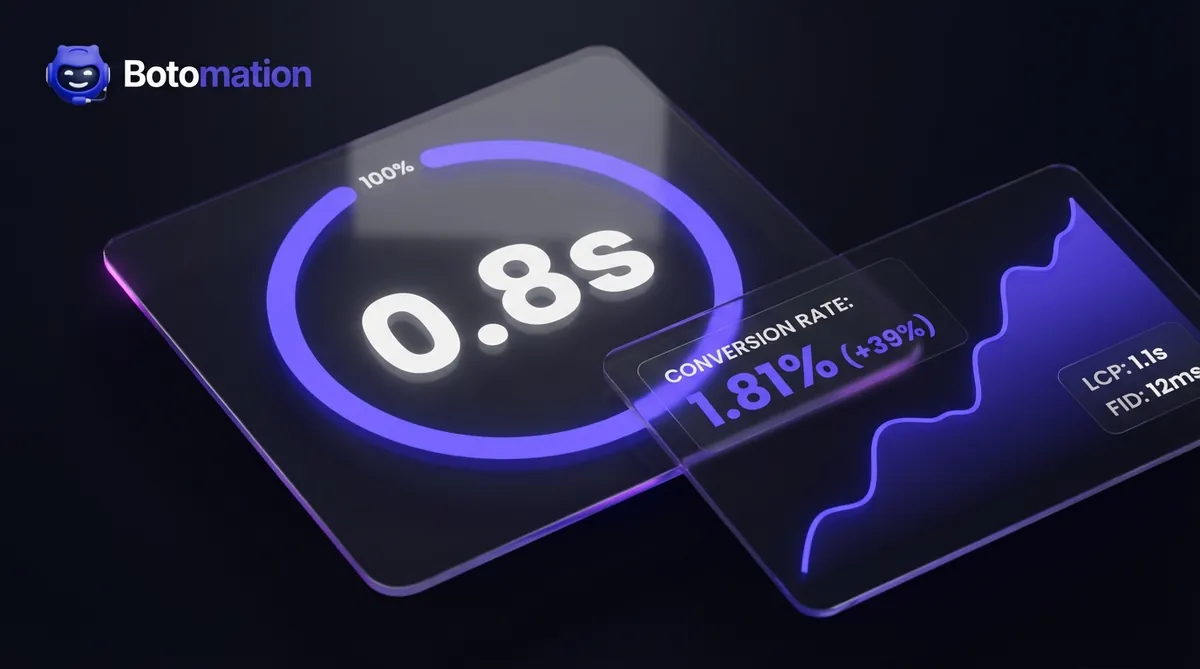
In the competitive digital landscape of January 2026, mastering website speed conversion optimization is no longer a technical luxury; it is a business necessity. User patience is now measured in milliseconds, and the page load speed impact on your bottom line is immediate. For founders and executives looking to scale, understanding these website performance metrics is the key to stopping revenue leaks. When a site takes longer than a heartbeat to respond, it drains potential profit before a customer even sees your value proposition.
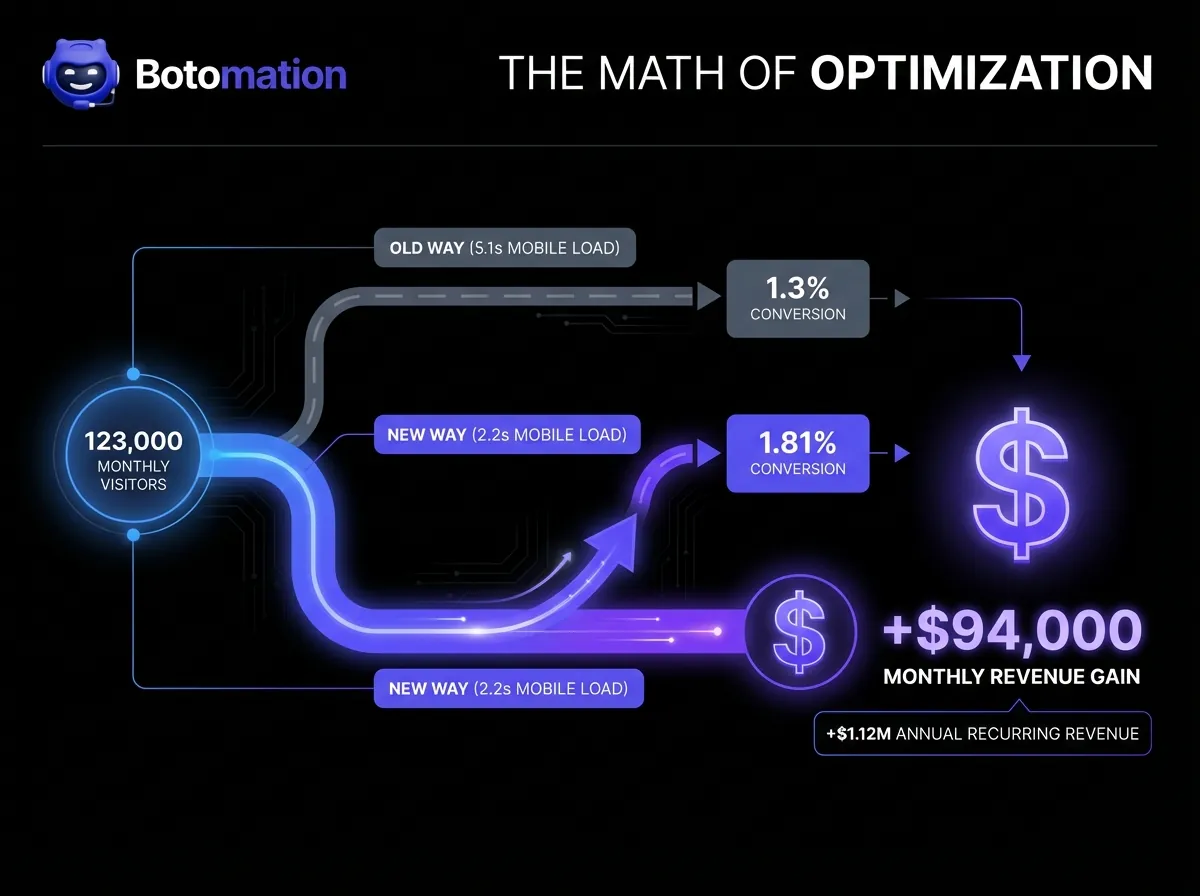
Recent industry data confirms that the stakes have shifted dramatically over the last year. Sites that manage to load in under one second are currently seeing conversion rates triple compared to those that linger in the three-to-five-second range. This isn't just a theoretical benchmark for developers to chase. A major retail partner recently demonstrated the financial reality of this shift by reducing their mobile load time from 5.1 seconds down to 2.2 seconds. This technical refinement led to a 39% surge in conversion rates, moving their baseline from 1.3% to 1.81%.
When you translate these percentages into cold, hard cash, the impact becomes undeniable. For a business processing a moderate volume of traffic, that 39% increase resulted in an additional monthly revenue gain of $94,000. This was achieved without increasing their ad spend or hiring more sales staff. They simply fixed the "Old Way" of handling web traffic—relying on bloated, legacy frameworks—and replaced legacy systems with custom web development to move toward high-performance, optimized infrastructure.
The technical environment of 2026 offers tools that were barely in beta a few years ago. We are now seeing the widespread adoption of HTTP/3, WebAssembly (WASM), and AI-driven predictive prefetching as the new standards for enterprise-grade performance. Partnering with our team at Botomation allows businesses to bypass the steep learning curve of these technologies and go straight to the results. We don't just build websites; we build revenue engines through custom web development for 100 PageSpeed scores to ensure your business never loses a lead to a loading spinner.
How Does Website Speed Conversion Optimization Impact Your Bottom Line?
The psychology of the modern consumer is unforgiving. As we navigate late 2026, statistical evidence shows that 70% of consumers will abandon a website if it takes more than three seconds to load. This abandonment isn't just a lost session; it is often a permanent loss of a customer to a faster competitor. When a site is slow, it signals a lack of professionalism and reliability, damaging your brand equity before the user even reads your first headline.
To understand the financial weight of these seconds, let's look at the specific case study of a mid-sized online retailer. By focusing on mobile optimization, they cut their load time by more than half. The resulting 39% conversion increase was the catalyst for an extra $1,128,000 in annual recurring revenue. This level of growth is rarely achievable through marketing alone, as even the best ad campaigns will fail if the landing page is a bottleneck.
Mobile users are particularly sensitive to these delays. Current data suggests that 53% of mobile users will exit a page that takes longer than three seconds to fully render. In an era where mobile traffic accounts for the vast majority of web interactions, a slow mobile site is essentially a "closed" sign on your digital storefront. While the average conversion rate across all industries sits around 2.35%, sites that have been aggressively optimized for website speed conversion optimization are consistently achieving 4% or higher.
Speed Statistics That Drive Business Decisions
The data provided by Google and other major analytics providers paints a clear picture of the risks associated with latency. Bounce rates—the percentage of visitors who leave after viewing only one page—increase by 32% when page load time rises from a single second to just three seconds. If your site takes five seconds to load, that bounce rate probability leaps to over 90%. You are effectively paying for traffic that never actually arrives at your content.
"A one-second delay in page load time is no longer a minor inconvenience; it's a 7% reduction in conversions that compounds every single day your site remains unoptimized."
The correlation between a one-second load time and a 3x increase in conversion rates is the most compelling argument for immediate action. Sites that load in under two seconds maintain an average conversion rate of 3.5%. Once you cross the five-second threshold, that rate plummets to 1.2%. This disparity represents the difference between a business that is thriving and one that is struggling to stay afloat despite having a great product.
2026 Conversion Rate Benchmarks by Industry
Understanding where your business stands requires looking at the specific benchmarks for your sector. In the e-commerce world, the average conversion rate is 2.35%, but top-tier performers who prioritize speed are hitting 6% regularly. These leaders aren't necessarily selling better products; they are simply providing a frictionless buying experience that doesn't give the customer time to second-guess their purchase.
The travel industry sees an average of 3.2%, with the potential to reach 8% through heavy optimization of search and booking engines. For B2B SaaS companies, the benchmark for subscriptions is 6.69%, reflecting a more intentional, research-driven buyer. Lead generation sites, however, have the most to gain, with speed improvements often pushing conversion rates from a 5.08% average to well over 10%.
| Industry Segment | Average Conversion Rate | Optimized Conversion Rate | Potential Revenue Uplift |
|---|---|---|---|
| E-commerce | 2.35% | 5.10% | 117% |
| B2B SaaS | 6.69% | 9.40% | 40% |
| Travel/Hospitality | 3.20% | 7.50% | 134% |
| Lead Generation | 5.08% | 11.20% | 120% |
What are the Latest Technical Updates for Website Speed Conversion Optimization in 2026?
The "Old Way" of building websites involved stacking plugins and heavy JavaScript libraries on top of outdated servers. In 2026, our experts at Botomation have moved toward a "New Way" that utilizes cutting-edge protocols like HTTP/3 and QUIC. These protocols eliminate the "head-of-line blocking" issues found in older versions, allowing multiple files to download simultaneously without getting stuck behind one large, slow-loading resource.
Another massive shift is the rise of WebAssembly (WASM). Traditionally, websites relied entirely on JavaScript, which can be slow to parse and execute. WASM allows us to run high-performance code at near-native speeds, often performing 10 to 100 times faster than traditional JavaScript for complex tasks. This is particularly useful for interactive tools, calculators, or data-heavy dashboards that previously would have bogged down a user's browser.
We are also seeing a revolution in how visual content is handled. New image formats like AVIF and JPEG XL offer far better compression than WebP or the ancient JPEG format. By switching to these formats, we can reduce image file sizes by another 30-50% without any visible loss in quality. When combined with zero-runtime frameworks like Astro or Qwik, which strip away unnecessary JavaScript, the result is a website that feels instantaneous to the user.
Next-Generation Protocols and Formats
HTTP/3 is the most significant update to how data moves across the internet in a decade. By using the QUIC protocol, it handles packet loss much more efficiently than TCP, which was the standard for years. This means that even users on shaky mobile connections or public Wi-Fi will experience a stable, fast-loading site. It effectively "multiplexes" the connection, so your images, CSS, and scripts all arrive in a coordinated stream rather than a congested line.
The adoption of AVIF is another "quick win" for performance. It supports progressive decoding, meaning the image starts showing up as it's being downloaded, and it includes alpha channel support for transparency. For businesses with high-resolution product galleries, switching to AVIF and JPEG XL is the difference between a page that "pops" into existence and one that slowly crawls down the screen.
AI-Driven Performance Technologies
Artificial intelligence has moved beyond just generating text; it is now actively managing how websites load. Predictive prefetching uses machine learning to analyze how users move through your site. If the AI sees that 80% of people who land on your homepage go to the "Pricing" page next, it will begin preloading the pricing data in the background. By the time the user clicks the link, the page is already sitting in their browser's cache, ready to display instantly.
Our team also utilizes AI-powered Content Delivery Networks (CDNs) that make real-time routing decisions. These systems don't just send data from the nearest server; they analyze global internet traffic patterns to find the path with the least latency. Furthermore, context-aware image compression now uses perceptual quality metrics. The AI determines which parts of an image the human eye focuses on and maintains high detail there while aggressively compressing the background, resulting in tiny file sizes that still look perfect to the customer.
What Do Real-World Case Studies Reveal About Speed Optimization Success?
To see the "New Way" in action, we only need to look at the transformation of a major national retailer. They were struggling with a mobile load time of over five seconds, which was killing their holiday sales. By partnering with experts to implement custom web development for conversion rate optimization, they brought that load time down to 2.2 seconds using lazy-loading and deferred JavaScript. This 56% improvement in speed didn't just make the site feel better; it directly correlated to a 39% increase in their conversion rate.
Another powerful example comes from World of Wonder, which used AI-powered optimization to boost conversion rates by 20% across all their landing pages. They moved away from a generic, one-size-fits-all approach and implemented dynamic resource allocation. By serving only the code necessary for each specific user's device and connection speed, they ensured a premium experience for everyone, regardless of whether they were on a high-end desktop or a budget smartphone.
In the competitive world of fashion, one brand achieved a staggering 104% month-over-month growth in premium trial sign-ups. They didn't change their offer or their pricing; they simply refined their digital marketing approach by focusing on the "speed-to-lead" pipeline. By making their sign-up flow load in under 800 milliseconds, they removed the friction that was causing potential customers to drop off during the registration process.
Transforming the Retail Experience
The impact of speed isn't limited to digital-only brands. New Balance Chicago saw a 200% surge in in-store sales by refining their digital marketing and website performance. By ensuring their local store pages and inventory checkers loaded instantly on mobile devices, they captured "high-intent" shoppers who were looking for products while on the go. This proves that website speed is a bridge between the digital and physical worlds.
For this retailer, the technical overhaul focused on the Largest Contentful Paint (LCP). They moved their LCP from a sluggish 3.5 seconds to a crisp 2.8 seconds. By prioritizing the rendering of the main product image and the "Add to Cart" button, they ensured that the most important elements were interactive almost immediately. This strategic focus resulted in the $94,050 monthly revenue gain mentioned earlier, providing an ROI that was fully realized within the first 90 days of the project.
E-commerce Platform Success Stories
Small and medium-sized businesses often feel they can't compete with the speed of giants like Amazon. However, a fashion accessories brand using a standard Shopify setup proved this wrong by implementing custom front-end optimizations. They focused on trust signals and speed, resulting in a 5.3% surge in their overall conversion rate. They achieved this by stripping out unnecessary third-party apps that were bloating their code and replacing them with streamlined, custom-coded features.
A company with approximately 200,000 monthly visitors took a data-driven approach by running extensive A/B tests on their load sequences. They discovered that by simply changing the order in which their CSS files loaded, they could reduce the "perceived" load time by nearly a second. This minor adjustment, which cost almost nothing to implement, led to a significant decrease in checkout abandonment, moving their rate from 64% down to 42%.
How Can You Master Core Web Vitals Optimization for Maximum Conversions?
Google's Core Web Vitals are the industry standard for measuring user experience, and in late 2026, they are more critical than ever. The first metric to master is Largest Contentful Paint (LCP), which measures how long it takes for the main content of a page to become visible. To be in the "good" category, your LCP must be under 2.5 seconds. Our team at Botomation consistently aims for under 1.5 seconds to stay ahead of the curve. Effective conversion rate optimization requires a holistic view of the user journey, starting with these foundational metrics.
The second metric, Interaction to Next Paint (INP), has replaced the old First Input Delay (FID) as the primary measure of responsiveness. INP tracks the latency of every single interaction a user has with your page, not just the first one. A target of 100 milliseconds or less is required to ensure the site feels "snappy." Finally, Cumulative Layout Shift (CLS) measures visual stability. There is nothing more frustrating for a user than trying to click a button only for the page to jump, causing them to click an ad or a different link by mistake. Strategic Core Web Vitals optimization techniques directly correlate with 15-25% conversion increases.
The Math of Optimization:
123,000 monthly visitors * 1.3% conversion rate = 1,599 orders.
123,000 monthly visitors * 1.81% conversion rate (after speed fix) = 2,226 orders.
627 additional orders * $150 average order value = $94,050 additional monthly revenue.
Techniques for Improving LCP
To optimize LCP, you must identify the largest element on your page—usually a hero image or a large block of text—and prioritize its delivery. This involves using "resource hints" like link rel="preload" to tell the browser to start downloading that specific image before it even parses the rest of the HTML. Additionally, implementing lazy-loading for any images that are "below the fold" ensures that the browser doesn't waste bandwidth on things the user can't see yet.
Server response times are the foundation of a good LCP score. If your server takes 500ms just to acknowledge a request, you've already lost 20% of your time budget. We solve this by implementing aggressive CDN caching and using "Edge Computing" to process requests as close to the user as possible. This reduces the physical distance data has to travel, which is a major factor in reducing latency.
Strategies for INP and CLS
Improving your INP score requires a deep dive into your JavaScript execution. By focusing on custom JavaScript optimization, we ensure that even if your main thread is busy processing code, it doesn't prevent the browser from responding to user clicks. We address this by breaking up long tasks into smaller chunks and using "idle periods" to handle non-essential background processing. This ensures that the browser is always ready to react to a user's input instantly.
For CLS, the solution is often found in your CSS. By explicitly defining the height and width of images and ad containers, you reserve that space on the page before the asset even loads. This prevents the content from "jumping" once the image finally appears. We also recommend using font-display: swap, which allows the browser to show a system font while your custom brand font is still loading, preventing the "Flash of Invisible Text" that can ruin a user's initial impression.
What is the Ultimate Step-by-Step Mobile Website Speed Optimization Guide?
Mobile optimization is no longer an optional "extra"; it is the core of modern web development. Mobile-specific techniques can drive conversion rates up to 40% higher than standard responsive designs. The "New Way" involves moving beyond just making things fit on a small screen and toward creating a mobile-first experience that accounts for slower processors and variable data speeds. Achieving high mobile website speed is the most effective way to capture high-intent traffic.
One of the most effective strategies is the implementation of Progressive Web App (PWA) features. By using "service workers," we can cache the core structure of your site on the user's phone. This allows the site to load almost instantly on subsequent visits, even if the user has a poor connection. It also enables features like push notifications and offline access, which significantly increase user engagement and return visits.
Optimizing Mobile Images and Assets
Mobile devices often struggle with high-resolution images meant for desktop monitors. To solve this, we use the srcset attribute, which allows the browser to choose the perfect image size based on the device's screen density. Implementing advanced image optimization techniques ensures there is no reason to send a 4000-pixel image to a phone that only has an 800-pixel display. This simple change can save megabytes of data transfer per session.
Minification and compression are also vital for mobile performance. By stripping out all unnecessary characters from your CSS and JavaScript files, we can reduce their size significantly. When combined with Brotli compression—which is more efficient than the older Gzip standard—the result is a lean, fast-moving site that doesn't eat up a user's data plan or battery life.
Advanced Mobile Performance Techniques
For content-heavy pages like blogs or news feeds, we follow 7 steps to fast loading custom websites for marketing to implement a streamlined version for mobile users. This doesn't mean cutting content; it means cutting the "fluff" in the code that mobile browsers find difficult to process. We also focus on reducing third-party scripts. Every tracking pixel, chat widget, and social media button adds weight to your page. We audit these scripts to ensure they are only loading when absolutely necessary.
Testing is the final, crucial step. We don't just test on the latest iPhone; we test on mid-range Android devices and throttled 4G connections. This "real-world" testing ensures that your site performs for everyone, not just people with the fastest hardware. By optimizing for the "lowest common denominator," you create a lightning-fast experience for your most advanced users while still serving your entire audience effectively.
How to Audit Your Website Speed Using Modern Website Speed Tools
- Run a Lighthouse Report: Open your Chrome browser, go to the "Inspect" tool, and run a Lighthouse audit to get your baseline Core Web Vitals scores.
- Identify Large Assets: Use professional website speed tools like WebPageTest or the "Network" tab to see which files are taking the longest to download.
- Check Your Hosting Response: Look for the "Time to First Byte" (TTFB); if it's over 200ms, you likely need a better hosting solution or a more robust CDN.
- Audit Your Plugins and Scripts: Disable any third-party tools that aren't providing a direct, measurable benefit to your conversion rate.
- Implement Next-Gen Formats: Convert your existing image library to AVIF and ensure your server is configured to handle HTTP/3 requests.
Frequently Asked Questions
How much does speed optimization actually cost?
The cost varies depending on the complexity of your current site, but it is better to view it as an investment rather than an expense. When you consider that a one-second improvement can lead to a 7% increase in revenue, the optimization work often pays for itself within the first few months. Partnering with an agency like Botomation ensures you get enterprise-grade results without the overhead of a full-time in-house dev team.
Can I just use a plugin to fix my site speed?
While some plugins can help with basic tasks like image compression, they often add their own layer of bloat to your site. A plugin is a "band-aid" solution. The "New Way" involves clean, custom-coded foundations that don't rely on third-party tools that can break or slow down over time. True performance comes from the architecture of the site, not just a few settings in a dashboard.
How long does it take to see results from these updates?
Technical speed improvements are indexed by Google and felt by users almost immediately. While it may take a few weeks for your search engine rankings to reflect the better Core Web Vitals, the impact on your conversion rate and bounce rate is usually visible in your analytics within days of the deployment.
Is mobile speed more important than desktop speed?
In 2026, mobile speed is the priority because Google uses "mobile-first indexing." This means Google evaluates your site based on its mobile performance, even for desktop search results. Furthermore, since mobile devices have less processing power, a site that is fast on mobile will naturally be incredibly fast on desktop, but the reverse is rarely true.
What is the most important metric for conversion optimization?
While all Core Web Vitals matter, Interaction to Next Paint (INP) is increasingly vital in 2026. It measures the tactile feel of your site. If a user clicks a button and nothing happens for 200ms, they lose trust. Keeping INP under 100ms is the gold standard for a high-converting experience.
The evidence is clear: website speed is the most undervalued lever for business growth in 2026. We have moved past the era where a "good enough" website was sufficient to compete. Today, your site's performance is a direct reflection of your operational efficiency. By moving away from the "Old Way" of slow, manual, and bloated legacy systems, you position your business to capture the revenue that your competitors are leaving on the table.
The transition to a high-performance digital presence doesn't have to be a multi-year struggle. Our experts at Botomation specialize in replacing slow legacy systems with lightning-fast custom code and intelligent AI automation. We don't just fix your load times; we transform your website into a 24/7 revenue engine that operates with enterprise-grade efficiency. Whether it's implementing the latest HTTP/3 protocols or deploying AI agents to handle repetitive tasks, we bridge the gap between complex technology and practical business results.
Stop losing money to slow load times and outdated infrastructure today. The $94,050 monthly revenue gain we discussed isn't an anomaly; it's the standard result of moving from a neglected site to a performance-optimized machine. Your customers are waiting, but they won't wait for long.
Ready to automate your growth? Book a call below.
In the competitive digital landscape of January 2026, mastering website speed conversion optimization is no longer a technical luxury; it is a business necessity. User patience is now measured in milliseconds, and the page load speed impact on your bottom line is immediate. For founders and executives looking to scale, understanding these website performance metrics is the key to stopping revenue leaks. When a site takes longer than a heartbeat to respond, it drains potential profit before a customer even sees your value proposition.
Recent industry data confirms that the stakes have shifted dramatically over the last year. Sites that manage to load in under one second are currently seeing conversion rates triple compared to those that linger in the three-to-five-second range. This isn't just a theoretical benchmark for developers to chase. A major retail partner recently demonstrated the financial reality of this shift by reducing their mobile load time from 5.1 seconds down to 2.2 seconds. This technical refinement led to a 39% surge in conversion rates, moving their baseline from 1.3% to 1.81%.
When you translate these percentages into cold, hard cash, the impact becomes undeniable. For a business processing a moderate volume of traffic, that 39% increase resulted in an additional monthly revenue gain of $94,000. This was achieved without increasing their ad spend or hiring more sales staff. They simply fixed the "Old Way" of handling web traffic—relying on bloated, legacy frameworks—and replaced legacy systems with custom web development to move toward high-performance, optimized infrastructure.
The technical environment of 2026 offers tools that were barely in beta a few years ago. We are now seeing the widespread adoption of HTTP/3, WebAssembly (WASM), and AI-driven predictive prefetching as the new standards for enterprise-grade performance. Partnering with our team at Botomation allows businesses to bypass the steep learning curve of these technologies and go straight to the results. We don't just build websites; we build revenue engines through custom web development for 100 PageSpeed scores to ensure your business never loses a lead to a loading spinner.
How Does Website Speed Conversion Optimization Impact Your Bottom Line?
The psychology of the modern consumer is unforgiving. As we navigate late 2026, statistical evidence shows that 70% of consumers will abandon a website if it takes more than three seconds to load. This abandonment isn't just a lost session; it is often a permanent loss of a customer to a faster competitor. When a site is slow, it signals a lack of professionalism and reliability, damaging your brand equity before the user even reads your first headline.
To understand the financial weight of these seconds, let's look at the specific case study of a mid-sized online retailer. By focusing on mobile optimization, they cut their load time by more than half. The resulting 39% conversion increase was the catalyst for an extra $1,128,000 in annual recurring revenue. This level of growth is rarely achievable through marketing alone, as even the best ad campaigns will fail if the landing page is a bottleneck.
Mobile users are particularly sensitive to these delays. Current data suggests that 53% of mobile users will exit a page that takes longer than three seconds to fully render. In an era where mobile traffic accounts for the vast majority of web interactions, a slow mobile site is essentially a "closed" sign on your digital storefront. While the average conversion rate across all industries sits around 2.35%, sites that have been aggressively optimized for website speed conversion optimization are consistently achieving 4% or higher.
Speed Statistics That Drive Business Decisions
The data provided by Google and other major analytics providers paints a clear picture of the risks associated with latency. Bounce rates—the percentage of visitors who leave after viewing only one page—increase by 32% when page load time rises from a single second to just three seconds. If your site takes five seconds to load, that bounce rate probability leaps to over 90%. You are effectively paying for traffic that never actually arrives at your content.
"A one-second delay in page load time is no longer a minor inconvenience; it's a 7% reduction in conversions that compounds every single day your site remains unoptimized."
The correlation between a one-second load time and a 3x increase in conversion rates is the most compelling argument for immediate action. Sites that load in under two seconds maintain an average conversion rate of 3.5%. Once you cross the five-second threshold, that rate plummets to 1.2%. This disparity represents the difference between a business that is thriving and one that is struggling to stay afloat despite having a great product.
2026 Conversion Rate Benchmarks by Industry
Understanding where your business stands requires looking at the specific benchmarks for your sector. In the e-commerce world, the average conversion rate is 2.35%, but top-tier performers who prioritize speed are hitting 6% regularly. These leaders aren't necessarily selling better products; they are simply providing a frictionless buying experience that doesn't give the customer time to second-guess their purchase.
The travel industry sees an average of 3.2%, with the potential to reach 8% through heavy optimization of search and booking engines. For B2B SaaS companies, the benchmark for subscriptions is 6.69%, reflecting a more intentional, research-driven buyer. Lead generation sites, however, have the most to gain, with speed improvements often pushing conversion rates from a 5.08% average to well over 10%.
| Industry Segment | Average Conversion Rate | Optimized Conversion Rate | Potential Revenue Uplift |
|---|---|---|---|
| E-commerce | 2.35% | 5.10% | 117% |
| B2B SaaS | 6.69% | 9.40% | 40% |
| Travel/Hospitality | 3.20% | 7.50% | 134% |
| Lead Generation | 5.08% | 11.20% | 120% |
What are the Latest Technical Updates for Website Speed Conversion Optimization in 2026?
The "Old Way" of building websites involved stacking plugins and heavy JavaScript libraries on top of outdated servers. In 2026, our experts at Botomation have moved toward a "New Way" that utilizes cutting-edge protocols like HTTP/3 and QUIC. These protocols eliminate the "head-of-line blocking" issues found in older versions, allowing multiple files to download simultaneously without getting stuck behind one large, slow-loading resource.
Another massive shift is the rise of WebAssembly (WASM). Traditionally, websites relied entirely on JavaScript, which can be slow to parse and execute. WASM allows us to run high-performance code at near-native speeds, often performing 10 to 100 times faster than traditional JavaScript for complex tasks. This is particularly useful for interactive tools, calculators, or data-heavy dashboards that previously would have bogged down a user's browser.
We are also seeing a revolution in how visual content is handled. New image formats like AVIF and JPEG XL offer far better compression than WebP or the ancient JPEG format. By switching to these formats, we can reduce image file sizes by another 30-50% without any visible loss in quality. When combined with zero-runtime frameworks like Astro or Qwik, which strip away unnecessary JavaScript, the result is a website that feels instantaneous to the user.
Next-Generation Protocols and Formats
HTTP/3 is the most significant update to how data moves across the internet in a decade. By using the QUIC protocol, it handles packet loss much more efficiently than TCP, which was the standard for years. This means that even users on shaky mobile connections or public Wi-Fi will experience a stable, fast-loading site. It effectively "multiplexes" the connection, so your images, CSS, and scripts all arrive in a coordinated stream rather than a congested line.
The adoption of AVIF is another "quick win" for performance. It supports progressive decoding, meaning the image starts showing up as it's being downloaded, and it includes alpha channel support for transparency. For businesses with high-resolution product galleries, switching to AVIF and JPEG XL is the difference between a page that "pops" into existence and one that slowly crawls down the screen.
AI-Driven Performance Technologies
Artificial intelligence has moved beyond just generating text; it is now actively managing how websites load. Predictive prefetching uses machine learning to analyze how users move through your site. If the AI sees that 80% of people who land on your homepage go to the "Pricing" page next, it will begin preloading the pricing data in the background. By the time the user clicks the link, the page is already sitting in their browser's cache, ready to display instantly.
Our team also utilizes AI-powered Content Delivery Networks (CDNs) that make real-time routing decisions. These systems don't just send data from the nearest server; they analyze global internet traffic patterns to find the path with the least latency. Furthermore, context-aware image compression now uses perceptual quality metrics. The AI determines which parts of an image the human eye focuses on and maintains high detail there while aggressively compressing the background, resulting in tiny file sizes that still look perfect to the customer.
What Do Real-World Case Studies Reveal About Speed Optimization Success?
To see the "New Way" in action, we only need to look at the transformation of a major national retailer. They were struggling with a mobile load time of over five seconds, which was killing their holiday sales. By partnering with experts to implement custom web development for conversion rate optimization, they brought that load time down to 2.2 seconds using lazy-loading and deferred JavaScript. This 56% improvement in speed didn't just make the site feel better; it directly correlated to a 39% increase in their conversion rate.
Another powerful example comes from World of Wonder, which used AI-powered optimization to boost conversion rates by 20% across all their landing pages. They moved away from a generic, one-size-fits-all approach and implemented dynamic resource allocation. By serving only the code necessary for each specific user's device and connection speed, they ensured a premium experience for everyone, regardless of whether they were on a high-end desktop or a budget smartphone.
In the competitive world of fashion, one brand achieved a staggering 104% month-over-month growth in premium trial sign-ups. They didn't change their offer or their pricing; they simply refined their digital marketing approach by focusing on the "speed-to-lead" pipeline. By making their sign-up flow load in under 800 milliseconds, they removed the friction that was causing potential customers to drop off during the registration process.
Transforming the Retail Experience
The impact of speed isn't limited to digital-only brands. New Balance Chicago saw a 200% surge in in-store sales by refining their digital marketing and website performance. By ensuring their local store pages and inventory checkers loaded instantly on mobile devices, they captured "high-intent" shoppers who were looking for products while on the go. This proves that website speed is a bridge between the digital and physical worlds.
For this retailer, the technical overhaul focused on the Largest Contentful Paint (LCP). They moved their LCP from a sluggish 3.5 seconds to a crisp 2.8 seconds. By prioritizing the rendering of the main product image and the "Add to Cart" button, they ensured that the most important elements were interactive almost immediately. This strategic focus resulted in the $94,050 monthly revenue gain mentioned earlier, providing an ROI that was fully realized within the first 90 days of the project.
E-commerce Platform Success Stories
Small and medium-sized businesses often feel they can't compete with the speed of giants like Amazon. However, a fashion accessories brand using a standard Shopify setup proved this wrong by implementing custom front-end optimizations. They focused on trust signals and speed, resulting in a 5.3% surge in their overall conversion rate. They achieved this by stripping out unnecessary third-party apps that were bloating their code and replacing them with streamlined, custom-coded features.
A company with approximately 200,000 monthly visitors took a data-driven approach by running extensive A/B tests on their load sequences. They discovered that by simply changing the order in which their CSS files loaded, they could reduce the "perceived" load time by nearly a second. This minor adjustment, which cost almost nothing to implement, led to a significant decrease in checkout abandonment, moving their rate from 64% down to 42%.
How Can You Master Core Web Vitals Optimization for Maximum Conversions?
Google's Core Web Vitals are the industry standard for measuring user experience, and in late 2026, they are more critical than ever. The first metric to master is Largest Contentful Paint (LCP), which measures how long it takes for the main content of a page to become visible. To be in the "good" category, your LCP must be under 2.5 seconds. Our team at Botomation consistently aims for under 1.5 seconds to stay ahead of the curve. Effective conversion rate optimization requires a holistic view of the user journey, starting with these foundational metrics.
The second metric, Interaction to Next Paint (INP), has replaced the old First Input Delay (FID) as the primary measure of responsiveness. INP tracks the latency of every single interaction a user has with your page, not just the first one. A target of 100 milliseconds or less is required to ensure the site feels "snappy." Finally, Cumulative Layout Shift (CLS) measures visual stability. There is nothing more frustrating for a user than trying to click a button only for the page to jump, causing them to click an ad or a different link by mistake. Strategic Core Web Vitals optimization techniques directly correlate with 15-25% conversion increases.
The Math of Optimization:
123,000 monthly visitors * 1.3% conversion rate = 1,599 orders.
123,000 monthly visitors * 1.81% conversion rate (after speed fix) = 2,226 orders.
627 additional orders * $150 average order value = $94,050 additional monthly revenue.
Techniques for Improving LCP
To optimize LCP, you must identify the largest element on your page—usually a hero image or a large block of text—and prioritize its delivery. This involves using "resource hints" like link rel="preload" to tell the browser to start downloading that specific image before it even parses the rest of the HTML. Additionally, implementing lazy-loading for any images that are "below the fold" ensures that the browser doesn't waste bandwidth on things the user can't see yet.
Server response times are the foundation of a good LCP score. If your server takes 500ms just to acknowledge a request, you've already lost 20% of your time budget. We solve this by implementing aggressive CDN caching and using "Edge Computing" to process requests as close to the user as possible. This reduces the physical distance data has to travel, which is a major factor in reducing latency.
Strategies for INP and CLS
Improving your INP score requires a deep dive into your JavaScript execution. By focusing on custom JavaScript optimization, we ensure that even if your main thread is busy processing code, it doesn't prevent the browser from responding to user clicks. We address this by breaking up long tasks into smaller chunks and using "idle periods" to handle non-essential background processing. This ensures that the browser is always ready to react to a user's input instantly.
For CLS, the solution is often found in your CSS. By explicitly defining the height and width of images and ad containers, you reserve that space on the page before the asset even loads. This prevents the content from "jumping" once the image finally appears. We also recommend using font-display: swap, which allows the browser to show a system font while your custom brand font is still loading, preventing the "Flash of Invisible Text" that can ruin a user's initial impression.
What is the Ultimate Step-by-Step Mobile Website Speed Optimization Guide?
Mobile optimization is no longer an optional "extra"; it is the core of modern web development. Mobile-specific techniques can drive conversion rates up to 40% higher than standard responsive designs. The "New Way" involves moving beyond just making things fit on a small screen and toward creating a mobile-first experience that accounts for slower processors and variable data speeds. Achieving high mobile website speed is the most effective way to capture high-intent traffic.
One of the most effective strategies is the implementation of Progressive Web App (PWA) features. By using "service workers," we can cache the core structure of your site on the user's phone. This allows the site to load almost instantly on subsequent visits, even if the user has a poor connection. It also enables features like push notifications and offline access, which significantly increase user engagement and return visits.
Optimizing Mobile Images and Assets
Mobile devices often struggle with high-resolution images meant for desktop monitors. To solve this, we use the srcset attribute, which allows the browser to choose the perfect image size based on the device's screen density. Implementing advanced image optimization techniques ensures there is no reason to send a 4000-pixel image to a phone that only has an 800-pixel display. This simple change can save megabytes of data transfer per session.
Minification and compression are also vital for mobile performance. By stripping out all unnecessary characters from your CSS and JavaScript files, we can reduce their size significantly. When combined with Brotli compression—which is more efficient than the older Gzip standard—the result is a lean, fast-moving site that doesn't eat up a user's data plan or battery life.
Advanced Mobile Performance Techniques
For content-heavy pages like blogs or news feeds, we follow 7 steps to fast loading custom websites for marketing to implement a streamlined version for mobile users. This doesn't mean cutting content; it means cutting the "fluff" in the code that mobile browsers find difficult to process. We also focus on reducing third-party scripts. Every tracking pixel, chat widget, and social media button adds weight to your page. We audit these scripts to ensure they are only loading when absolutely necessary.
Testing is the final, crucial step. We don't just test on the latest iPhone; we test on mid-range Android devices and throttled 4G connections. This "real-world" testing ensures that your site performs for everyone, not just people with the fastest hardware. By optimizing for the "lowest common denominator," you create a lightning-fast experience for your most advanced users while still serving your entire audience effectively.
How to Audit Your Website Speed Using Modern Website Speed Tools
- Run a Lighthouse Report: Open your Chrome browser, go to the "Inspect" tool, and run a Lighthouse audit to get your baseline Core Web Vitals scores.
- Identify Large Assets: Use professional website speed tools like WebPageTest or the "Network" tab to see which files are taking the longest to download.
- Check Your Hosting Response: Look for the "Time to First Byte" (TTFB); if it's over 200ms, you likely need a better hosting solution or a more robust CDN.
- Audit Your Plugins and Scripts: Disable any third-party tools that aren't providing a direct, measurable benefit to your conversion rate.
- Implement Next-Gen Formats: Convert your existing image library to AVIF and ensure your server is configured to handle HTTP/3 requests.
Frequently Asked Questions
How much does speed optimization actually cost?
The cost varies depending on the complexity of your current site, but it is better to view it as an investment rather than an expense. When you consider that a one-second improvement can lead to a 7% increase in revenue, the optimization work often pays for itself within the first few months. Partnering with an agency like Botomation ensures you get enterprise-grade results without the overhead of a full-time in-house dev team.
Can I just use a plugin to fix my site speed?
While some plugins can help with basic tasks like image compression, they often add their own layer of bloat to your site. A plugin is a "band-aid" solution. The "New Way" involves clean, custom-coded foundations that don't rely on third-party tools that can break or slow down over time. True performance comes from the architecture of the site, not just a few settings in a dashboard.
How long does it take to see results from these updates?
Technical speed improvements are indexed by Google and felt by users almost immediately. While it may take a few weeks for your search engine rankings to reflect the better Core Web Vitals, the impact on your conversion rate and bounce rate is usually visible in your analytics within days of the deployment.
Is mobile speed more important than desktop speed?
In 2026, mobile speed is the priority because Google uses "mobile-first indexing." This means Google evaluates your site based on its mobile performance, even for desktop search results. Furthermore, since mobile devices have less processing power, a site that is fast on mobile will naturally be incredibly fast on desktop, but the reverse is rarely true.
What is the most important metric for conversion optimization?
While all Core Web Vitals matter, Interaction to Next Paint (INP) is increasingly vital in 2026. It measures the tactile feel of your site. If a user clicks a button and nothing happens for 200ms, they lose trust. Keeping INP under 100ms is the gold standard for a high-converting experience.
The evidence is clear: website speed is the most undervalued lever for business growth in 2026. We have moved past the era where a "good enough" website was sufficient to compete. Today, your site's performance is a direct reflection of your operational efficiency. By moving away from the "Old Way" of slow, manual, and bloated legacy systems, you position your business to capture the revenue that your competitors are leaving on the table.
The transition to a high-performance digital presence doesn't have to be a multi-year struggle. Our experts at Botomation specialize in replacing slow legacy systems with lightning-fast custom code and intelligent AI automation. We don't just fix your load times; we transform your website into a 24/7 revenue engine that operates with enterprise-grade efficiency. Whether it's implementing the latest HTTP/3 protocols or deploying AI agents to handle repetitive tasks, we bridge the gap between complex technology and practical business results.
Stop losing money to slow load times and outdated infrastructure today. The $94,050 monthly revenue gain we discussed isn't an anomaly; it's the standard result of moving from a neglected site to a performance-optimized machine. Your customers are waiting, but they won't wait for long.
Ready to automate your growth? Book a call below.
Get Started
Book a FREE Consultation Right NOW!
Schedule a Call with Our Team To Make Your Business More Efficient with AI Instantly.
Read More
Website Speed Conversion Optimization 2026 Growth Guide
Master website speed conversion optimization in 2026. Use AI automation, HTTP/3, and Core Web Vitals to boost ROI and scale business operations now.
How AI Agents Can Replace Manual Data Entry Work in 2026
Learn how WhatsApp AI slashes support costs for e-commerce & SaaS. Proven strategies to boost sales, recover carts, and scale 24/7 service.