How to Maintain Fresh Lead Lists for Growth Marketing
Feb 17, 2026
Growth Marketing
Lead Generation
AI Automation
Growth Marketing
Lead Generation
AI Automation
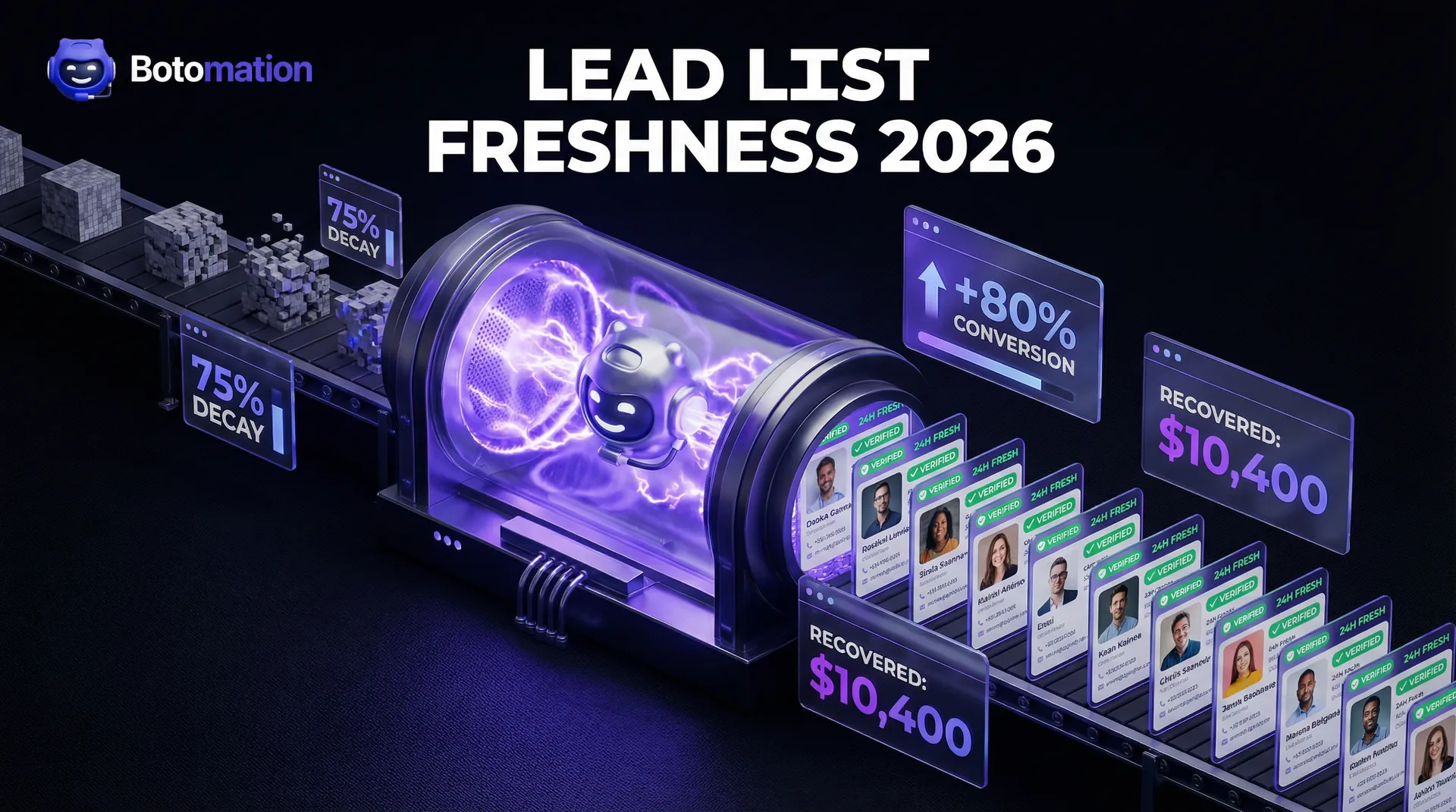
To scale effectively in January 2026, you must maintain fresh lead lists for growth marketing to avoid the pitfalls of outdated "spray and pray" tactics. The success of any outbound or performance marketing campaign hinges entirely on the quality of the data feeding your engine. If you are operating with data that is even a few months old, you are likely burning your marketing budget on ghost profiles and inactive inboxes. The reality of the current landscape is clear: lead lists are not static assets; they are perishable goods that require a proactive strategy to prevent lead list decay.
Recent industry data suggests that nearly 75% of B2B leads go stale within just 90 days. This decay happens because the professional world is more fluid than ever. People change roles, companies restructure, and email protocols evolve. When three-quarters of your database loses its accuracy every quarter, your sales team spends more time fighting "undeliverable" notices than closing deals. This is where most growth strategies fail—not in the creative or the offer, but in the foundation of the list itself.
Maintaining fresh lead lists for growth marketing is no longer a manual chore you can assign to an intern once a month. Since AI agents can now replace manual data entry, it requires a sophisticated, automated approach to data hygiene and prospecting. By shifting from static list-building to AI-powered B2B prospecting, businesses can ensure their message always lands in front of a relevant, active decision-maker. Our team at Botomation specializes in building these automated systems, replacing the "Old Way" of manual research with custom tools that scan the web and deliver qualified prospects to your desk every morning.
Understanding Lead List Decay and How to Maintain Fresh Lead Lists for Growth Marketing
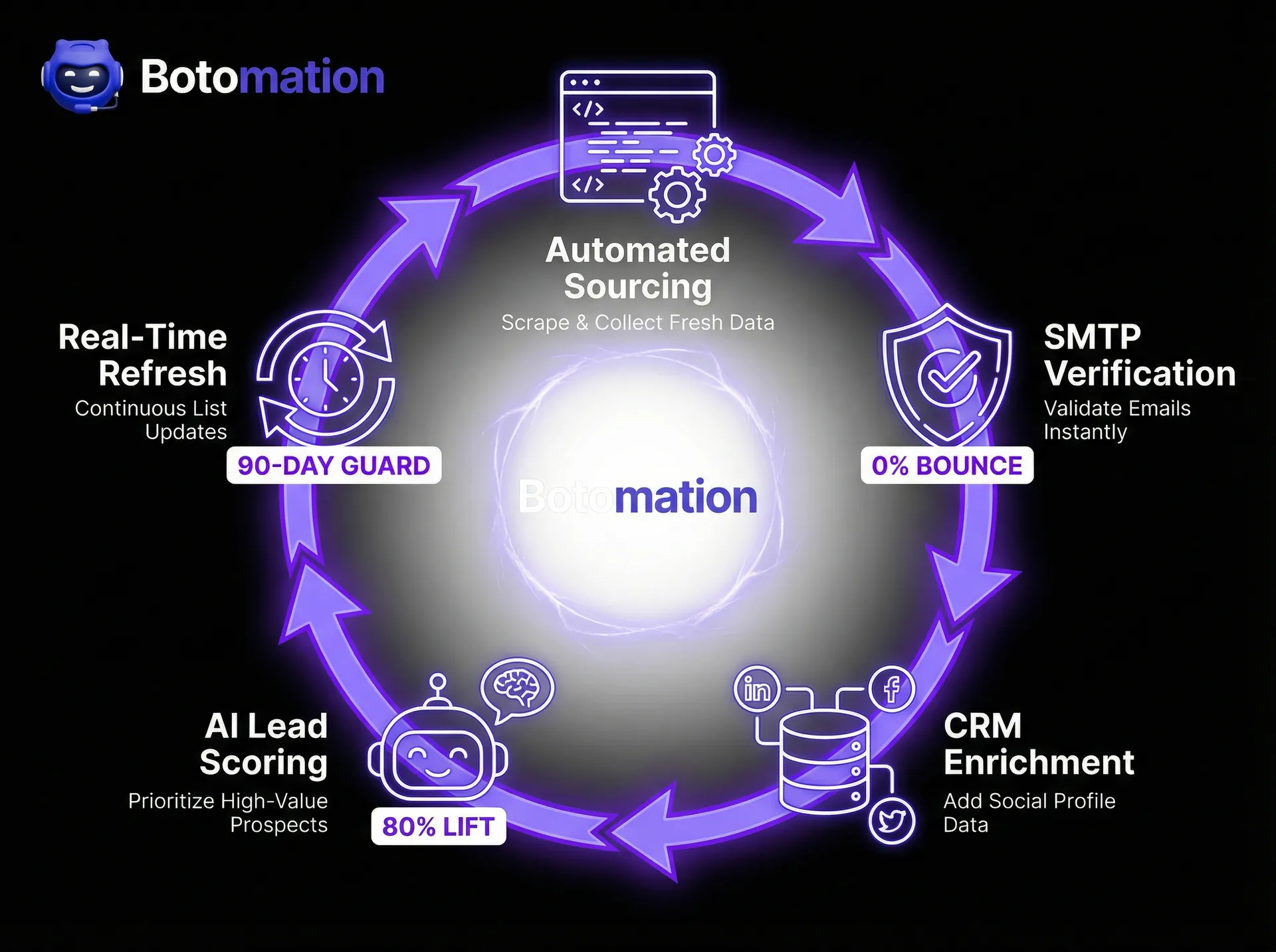
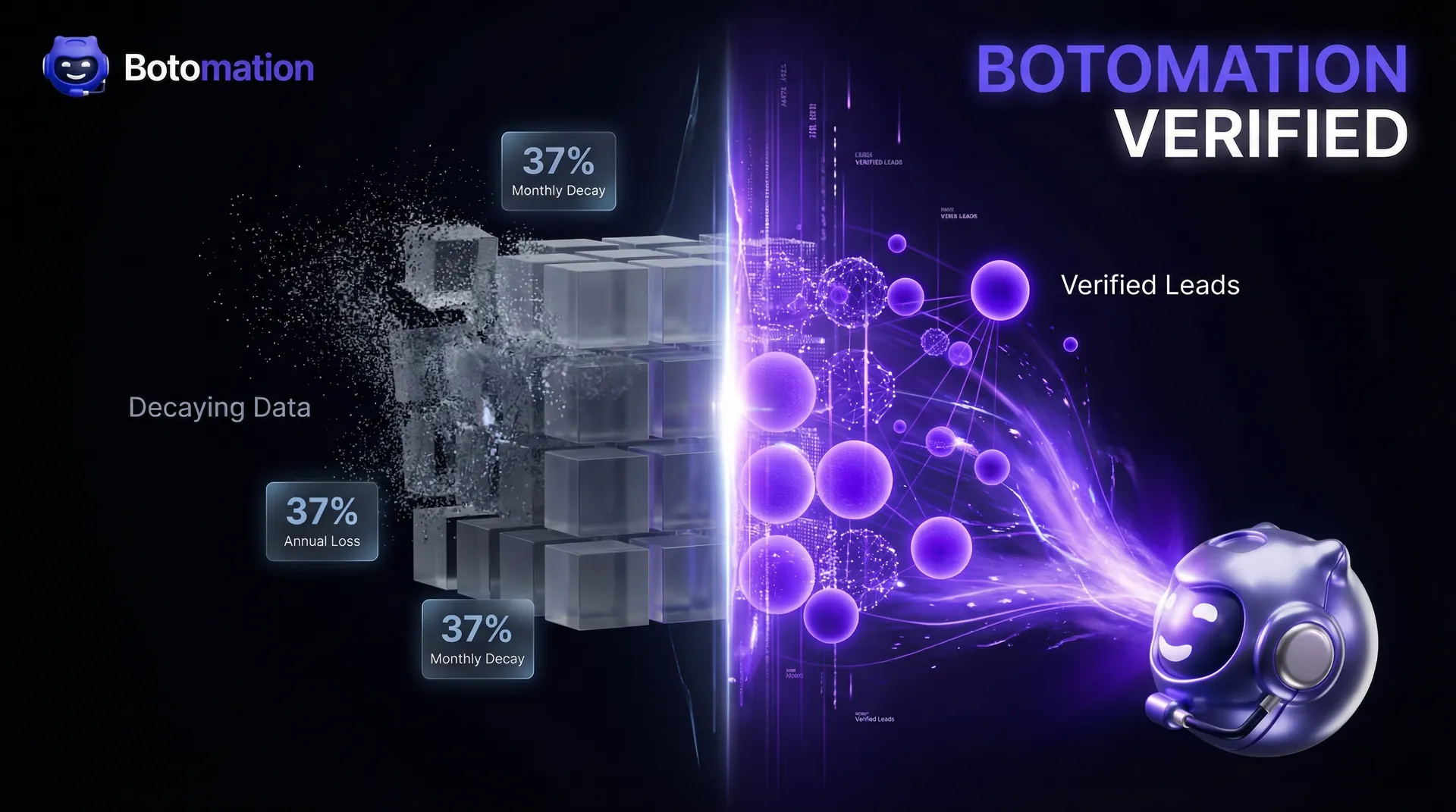
Lead list decay is the silent killer of ROI. It refers to the gradual degradation of contact data accuracy over time. In a typical B2B environment, data decays at an average rate of 2% to 3% per month. While that might sound manageable, the compounding effect over a year means nearly a third of your database becomes useless. In 2026, with the rise of remote work and rapid career pivoting, this rate has accelerated in specific sectors like tech and finance.
The real-world impact on conversion rates is devastating. When your sales team reaches out to outdated contacts, they aren't just failing to make a sale; they are damaging your sender reputation. High bounce rates signal to email providers that you are a spammer, which can lead to your primary domain being blacklisted. We recently observed a case study involving a mid-sized insurance company that illustrates this perfectly. They were working with a legacy database where lead scoring hadn't been updated in six months. The result was an 80% reduction in conversions for their low-scoring, older leads compared to the fresh data they acquired through automated prospecting.
Stat Box: The Cost of Stale Data
* Decay Rate: 75% of B2B leads become inaccurate within 90 days.
* Conversion Drop: Leads older than 6 months show an 80% lower conversion rate than 24-hour-old leads.
* Waste Calculation: If a sales rep earns $40/hour and spends 5 hours a week chasing dead leads, the company loses $10,400 per rep, per year in pure labor waste.
What Causes Lead List Decay in 2026
The primary driver of data decay today is the frequency of job role changes. Professionals no longer stay at a single company for a decade. In the current economy, mid-level managers and executives move every 18 to 24 months. Every time a prospect moves, their corporate email address disappears. If your list isn't updated to reflect their new role at a new company, you've lost the connection.
Company restructurings also play a massive role. Mergers and acquisitions are happening at a record pace, often resulting in entire departments being renamed or dissolved. Furthermore, the technical side of contact information is shifting. Many companies are moving away from traditional "firstname.lastname" email formats to more secure or alias-based systems to combat automated spam, making older, guessed email patterns obsolete.
Financial Impact of Stale Lead Lists
The financial drain of stale data goes beyond just missed sales. Think about the resource waste in your marketing department. If you are running LinkedIn ad campaigns or retargeting based on an old list, you are paying for impressions that will never convert because the user is no longer in the target role.
The cost of pursuing invalid leads includes the subscription costs for CRM seats that are filled with "junk" data and the opportunity cost of your sales team. If your SDRs are spending their first two hours every morning manually checking if a prospect still works at a company, they aren't selling. This inefficiency creates a bottleneck that prevents scaling. By the time you realize a list is bad, you’ve already spent thousands on tools and salaries to "process" it.
Best Automated Tools to Maintain Fresh Lead Lists for Growth Marketing
To combat decay, you need a stack that doesn't just store data but actively validates it. The 2026 landscape offers several powerful tools, but the key is how they integrate. The "Old Way" was to buy a massive list from a provider and hope for the best. The "New Way"—the Botomation way—is to use specific tools for specific tasks, tied together by automation.
In 2026, tools like Woodpecker have evolved significantly. They are no longer just cold email platforms; they have become comprehensive outreach engines. Woodpecker’s LinkedIn Outreach Automation, a feature perfected this year, allows for multi-channel touches that help verify if a prospect is active. If a prospect doesn't engage on LinkedIn but has an "Active" status, it provides a different signal than an account that hasn't been posted to in three years.
Woodpecker and Advanced Outreach Automation
Woodpecker’s 2026 updates include a sophisticated "warm-up" capability and free email verification. This is crucial because it checks the validity of an email address before the message is sent. It also integrates natively with platforms like Clay and Persana. These integrations allow you to pull in deep data points—like a prospect’s recent podcast appearance or a company’s new funding round—and use that to verify they are still in a position of influence.
When we partner with clients, we often set up these workflows so that the outreach tool acts as the final gatekeeper. If the tool detects a "soft bounce," it automatically triggers a research task to find the prospect's new location. This prevents the "dead end" scenario that kills most growth marketing campaigns.
Alternative Lead Database Solutions
While Woodpecker handles the outreach, you need a source for the data. Apollo.io remains a staple for LinkedIn contact extraction, but in 2026, its AI-filtering has become much more granular. You can now filter by "Intent," seeing which companies are actively searching for solutions like yours. ZoomInfo continues to lead for enterprise-level organizational charting, providing a clear view of who reports to whom, which is vital when a lead leaves and you need to find their replacement.
Clearbit has also stepped up its game with real-time data updates. Instead of a static database, Clearbit’s "Enrichment" API can refresh your entire CRM in minutes. If a lead’s title changes on LinkedIn, Clearbit can push that update to your HubSpot or Salesforce instance automatically, ensuring your sales team is always using the correct prefix and title.
Enterprise Lead Management Platforms
For larger operations, the integration between Pipedrive or HubSpot and automation tools like Zapier is where the magic happens. You can create a workflow where any lead that hasn't been "touched" in 45 days is sent back through a verification loop. If the verification fails, the lead is archived, and a new prospect from the same company is automatically sourced. This keeps your CRM clean and your sales pipeline flowing with high-probability opportunities.
Real-Time Lead Database Updating Strategies
The most effective way to maintain fresh lead lists for growth marketing is to stop thinking about "lists" and start thinking about "flows." A list is a snapshot in time; a flow is a continuous stream of data. Real-time updating ensures that your team is never working with information that is more than 24 hours old.
We see this work exceptionally well in the VTT Technical Research Center case study. They moved away from quarterly data cleanups and implemented an automated system that monitored their target accounts for changes. By using automated triggers, they achieved 100% lead reach. When a key contact moved, the system identified the successor within 48 hours. This proactive stance is the difference between leading the market and chasing it.
Automated Data Refresh Workflows
Setting up a refresh workflow starts with defining your triggers. By utilizing automated lead verification tools, a trigger could be a "bounce" notification, a change in a LinkedIn profile, or simply a time-based rule (e.g., "verify every 60 days"). Once a trigger is hit, the system should automatically send the contact to a verification tool like NeverBounce or ZeroBounce.
If the email is marked as "Invalid," the next step in the workflow should be an automated search for the new person in that role. This is where Botomation’s custom agents excel. Instead of a human spending 20 minutes on LinkedIn, our tools scan for the new "Head of Marketing" at Company X and pull their verified contact info into the CRM instantly.
Integration with CRM Systems
The biggest hurdle for most agencies is data silos. Your marketing team has one list, your sales team has another, and your CRM is a graveyard of both. Implementing a proper CRM email integration guide is essential to eliminate these silos and automate growth. To solve this, you must have a "Single Source of Truth." All your verification tools must write back to the CRM.
Using Zapier or Make.com, you can ensure that when a lead is updated in Apollo, it is instantly reflected in HubSpot. This consistency prevents the embarrassing mistake of two different reps calling the same person with different titles. It also allows for automated pipeline building, as you can see exactly which sources provide the most "durable" leads—those that stay in their roles the longest.
Lead Scoring and Verification Best Practices
Not all leads are created equal, and in 2026, lead scoring has become an AI-driven discipline. Modern teams automate lead scoring for B2B prospecting to move beyond simple metrics like "opened an email" or "visited a website." Modern scoring looks at "fit" and "intent" simultaneously. If a lead is a perfect fit but has zero intent, they are a long-term play. If they have high intent but a poor fit, they are a waste of time.
AI-powered lead scoring can now predict conversion probability with up to 90% accuracy. By analyzing engagement patterns across thousands of successful deals, these models can tell you that a prospect who visits your "Pricing" page twice in 24 hours is 10x more likely to close than someone who just downloaded a whitepaper.
AI-Powered Lead Scoring Techniques
By 2026, machine learning algorithms have become accessible to mid-sized businesses. These systems don't just look at what the prospect is doing; they look at what the company is doing. If a target company just posted five new job openings for "DevOps Engineers," and you sell a DevOps tool, their lead score should skyrocket.
This dynamic scoring adjusts in real-time. If a lead stops engaging with your emails, their score drops. This allows your sales team to prioritize their day based on who is "hot" right now, rather than just going through an alphabetical list. Companies using these AI-driven methods often see a 30% increase in conversion rates because they are striking while the iron is hot.
Email Verification and Validation Methods
Before any lead is scored, it must be validated. This involves a three-step process:
- Syntax Check: Ensuring the email is formatted correctly (e.g., no spaces, has an @ sign).
- Domain Verification: Checking that the domain actually exists and has a mail server.
- SMTP Handshake: The verification tool "talks" to the mail server to see if the specific inbox exists without actually sending an email.
This process also filters out "disposable" emails (like those from 10-minute mail services) and "role-based" emails (like info@ or sales@) which rarely lead to a direct decision-maker. By cleaning these out, you ensure your engagement metrics are based on real human interactions.
Preventing Lead List Decay: Proactive Strategies
The best way to handle lead decay is to prevent it from happening in the first place. This requires a shift in how you engage with your database. If you only talk to a lead when you want to sell them something, you will lose track of them. Proactive engagement keeps the relationship—and the data—alive.
We worked with a client who saw a 40% increase in lead generation simply by implementing a "Value-First" re-engagement sequence. Instead of asking for a meeting, they sent high-quality industry reports every 30 days. When an email bounced, they knew immediately that the person had moved, allowing them to find the replacement before their competitors even realized there was a vacancy.
Regular Engagement Campaigns
A re-engagement sequence shouldn't be a sales pitch. It should be a "pulse check." By offering a piece of useful content, you encourage a click. That click refreshes the "Last Activity" date in your CRM and confirms the lead is still active. If they don't click or open after three attempts, that's a signal to move them to a "Verification Needed" bucket.
These touchpoints should be automated but feel personal. Using 2026 AI writing tools, you can reference specific industry trends relevant to their specific role, making the engagement feel like a one-to-one conversation rather than a mass blast.
Data Hygiene Protocols
Hygiene is about consistency. You need a set of protocols that run in the background. This includes:
- Duplicate Removal: Ensuring you don't have the same person listed three times under different email aliases.
- Standardization: Making sure all titles are consistent (e.g., "VP" vs "Vice President") so your filters work correctly.
- Archive Rules: Automatically moving leads that haven't engaged in 6 months to a "Dormant" list to keep your active CRM lean and fast.
By following these protocols, you reduce the "noise" in your data. A smaller, cleaner list is always more valuable than a massive, dirty one.
Measuring and Optimizing Lead List Quality
You cannot improve what you do not measure. To maintain fresh lead lists for growth marketing, you need a dashboard that shows the health of your data. This isn't just about the number of leads; it's about the "velocity" and "integrity" of those leads.
Agencies that use AI tools to monitor these metrics see an average 25% increase in conversion rates. They aren't just getting more leads; they are getting better ones. They track how long a lead stays "active" and which sources produce the most "stable" data. If leads from LinkedIn stay in their roles longer than leads from a specific trade show list, the marketing budget is shifted accordingly.
Key Metrics for Lead Quality
There are three main KPIs you should track:
- Deliverability Rate: This should always be above 95%. If it drops, your list is decaying or your domain is in trouble.
- Engagement Rate: Are people opening and clicking? A drop here suggests your "freshness" is fading, even if the emails are still valid.
- Lead-to-Opportunity Ratio: How many of your "verified" leads actually turn into a real sales conversation?
If your deliverability is high but your engagement is low, your data is "fresh" but your targeting is off. If both are low, your list is stale and needs a total refresh.
Optimization and Testing Strategies
Growth marketing is an iterative process. You should constantly be A/B testing your verification methods. For example, does a "Real-Time" verification at the point of entry result in better long-term deliverability than a "Batch" verification once a week?
You can also test your scoring models. If your "High Score" leads aren't converting, you need to look at the feedback from the sales team. Maybe the model is overvaluing webinar signups and undervaluing direct LinkedIn engagement. This feedback loop is essential for keeping the system accurate.
Step-by-Step Tutorial: Setting Up an Automated Lead Refresh System
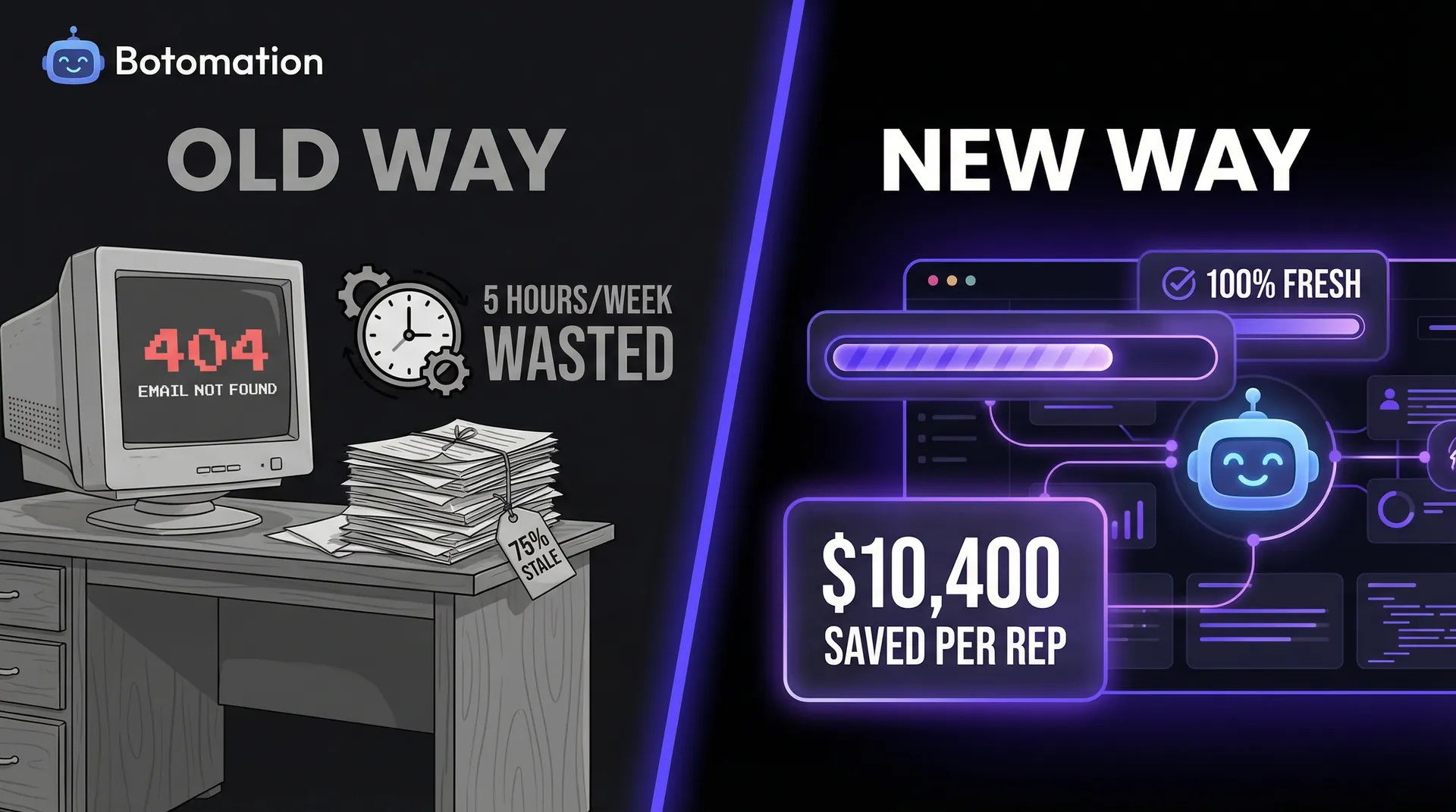
Setting up a system to maintain fresh lead lists for growth marketing doesn't have to be overly complex. Here is a simple framework to get started:
- Connect Your Data Source: Link your lead source (e.g., Apollo or a custom Botomation scraper) to a central repository like a Google Sheet or CRM.
- Define the "Stale" Trigger: Set a rule in Zapier or Make.com that identifies any lead that hasn't been updated in 60 days.
- Automate Verification: Send those "stale" leads to a tool like Woodpecker or NeverBounce for a status check.
- Handle the Results:
* If Valid: Update the "Last Verified" date and keep them in the sequence.
* If Invalid: Trigger a search for the new person in that role.
- Update the CRM: Ensure the new information is pushed back to your sales team's view immediately.
- Review and Repeat: Once a month, check your bounce rates and adjust the "Stale" trigger timing if necessary.
| Feature | Old Way (Manual) | New Way (Botomation) |
|---|---|---|
| **Lead Sourcing** | Manual LinkedIn searches | Custom automated web scrapers |
| **Data Refresh** | Quarterly manual cleanup | Real-time automated triggers |
| **Verification** | Sending and hoping | Multi-step SMTP validation |
| **Lead Scoring** | Basic "Gut feeling" | AI-driven intent modeling |
| **Cost** | High (Salary + Waste) | Low (Efficient Automation) |
Frequently Asked Questions
How often should I refresh my lead list?
In the 2026 business environment, we recommend a deep verification every 30 to 60 days. However, if you are in a high-turnover industry like SaaS or recruitment, a 30-day cycle is safer to prevent your bounce rate from climbing.
Can't I just buy a new list every month?
Buying lists is the "Old Way." These lists are often sold to dozens of companies simultaneously, meaning the prospects are already overwhelmed with spam by the time you get to them. Building a custom, automated "flow" ensures you have exclusive, fresh data that your competitors haven't touched yet.
What is the biggest sign that my list is stale?
The most obvious sign is a sudden drop in your email open rates or a spike in "Hard Bounces." If you notice that your sales team is frequently hearing "That person no longer works here," your list is already in a state of advanced decay.
Do automated tools replace the need for a sales team?
Not at all. Automation replaces the grunt work. By automating the prospecting and verification, you allow your sales team to focus on what they do best: building relationships and closing deals. Our goal at Botomation is to make sure your team only talks to people who actually exist and are in a position to buy.
Is AI lead scoring actually accurate?
Yes, provided it has good data to work with. AI models like those we implement use historical data to find patterns. They are much better than humans at spotting "hidden" signals, such as the specific combination of page visits and social media interactions that precede a purchase.
The strategies outlined here represent the modern standard for growth marketing. Relying on manual processes or static databases is no longer a viable option if you want to scale. The "Old Way" of marketing is slow, expensive, and increasingly ineffective as data decay accelerates.
By contrast, the "New Way" leverages automation to create a self-sustaining engine of fresh, qualified leads. This approach doesn't just save time; it protects your brand's reputation and ensures your sales team is always focused on the highest-value opportunities. Maintaining fresh lead lists for growth marketing is the single most important technical hurdle you must clear to achieve consistent growth in 2026.
At Botomation, we don't just provide a tool; we provide a partnership. Our team of experts builds custom automated systems tailored to your specific industry and goals. We handle the technical complexity of web scanning, data enrichment, and real-time verification so you can focus on your core business. Partnering with us means moving away from the frustration of stale lists and toward a future of predictable, automated growth.
Ready to automate your growth? Stop losing money on stale data today. Book a call below.
To scale effectively in January 2026, you must maintain fresh lead lists for growth marketing to avoid the pitfalls of outdated "spray and pray" tactics. The success of any outbound or performance marketing campaign hinges entirely on the quality of the data feeding your engine. If you are operating with data that is even a few months old, you are likely burning your marketing budget on ghost profiles and inactive inboxes. The reality of the current landscape is clear: lead lists are not static assets; they are perishable goods that require a proactive strategy to prevent lead list decay.
Recent industry data suggests that nearly 75% of B2B leads go stale within just 90 days. This decay happens because the professional world is more fluid than ever. People change roles, companies restructure, and email protocols evolve. When three-quarters of your database loses its accuracy every quarter, your sales team spends more time fighting "undeliverable" notices than closing deals. This is where most growth strategies fail—not in the creative or the offer, but in the foundation of the list itself.
Maintaining fresh lead lists for growth marketing is no longer a manual chore you can assign to an intern once a month. Since AI agents can now replace manual data entry, it requires a sophisticated, automated approach to data hygiene and prospecting. By shifting from static list-building to AI-powered B2B prospecting, businesses can ensure their message always lands in front of a relevant, active decision-maker. Our team at Botomation specializes in building these automated systems, replacing the "Old Way" of manual research with custom tools that scan the web and deliver qualified prospects to your desk every morning.
Understanding Lead List Decay and How to Maintain Fresh Lead Lists for Growth Marketing
Lead list decay is the silent killer of ROI. It refers to the gradual degradation of contact data accuracy over time. In a typical B2B environment, data decays at an average rate of 2% to 3% per month. While that might sound manageable, the compounding effect over a year means nearly a third of your database becomes useless. In 2026, with the rise of remote work and rapid career pivoting, this rate has accelerated in specific sectors like tech and finance.
The real-world impact on conversion rates is devastating. When your sales team reaches out to outdated contacts, they aren't just failing to make a sale; they are damaging your sender reputation. High bounce rates signal to email providers that you are a spammer, which can lead to your primary domain being blacklisted. We recently observed a case study involving a mid-sized insurance company that illustrates this perfectly. They were working with a legacy database where lead scoring hadn't been updated in six months. The result was an 80% reduction in conversions for their low-scoring, older leads compared to the fresh data they acquired through automated prospecting.
Stat Box: The Cost of Stale Data
* Decay Rate: 75% of B2B leads become inaccurate within 90 days.
* Conversion Drop: Leads older than 6 months show an 80% lower conversion rate than 24-hour-old leads.
* Waste Calculation: If a sales rep earns $40/hour and spends 5 hours a week chasing dead leads, the company loses $10,400 per rep, per year in pure labor waste.
What Causes Lead List Decay in 2026
The primary driver of data decay today is the frequency of job role changes. Professionals no longer stay at a single company for a decade. In the current economy, mid-level managers and executives move every 18 to 24 months. Every time a prospect moves, their corporate email address disappears. If your list isn't updated to reflect their new role at a new company, you've lost the connection.
Company restructurings also play a massive role. Mergers and acquisitions are happening at a record pace, often resulting in entire departments being renamed or dissolved. Furthermore, the technical side of contact information is shifting. Many companies are moving away from traditional "firstname.lastname" email formats to more secure or alias-based systems to combat automated spam, making older, guessed email patterns obsolete.
Financial Impact of Stale Lead Lists
The financial drain of stale data goes beyond just missed sales. Think about the resource waste in your marketing department. If you are running LinkedIn ad campaigns or retargeting based on an old list, you are paying for impressions that will never convert because the user is no longer in the target role.
The cost of pursuing invalid leads includes the subscription costs for CRM seats that are filled with "junk" data and the opportunity cost of your sales team. If your SDRs are spending their first two hours every morning manually checking if a prospect still works at a company, they aren't selling. This inefficiency creates a bottleneck that prevents scaling. By the time you realize a list is bad, you’ve already spent thousands on tools and salaries to "process" it.
Best Automated Tools to Maintain Fresh Lead Lists for Growth Marketing
To combat decay, you need a stack that doesn't just store data but actively validates it. The 2026 landscape offers several powerful tools, but the key is how they integrate. The "Old Way" was to buy a massive list from a provider and hope for the best. The "New Way"—the Botomation way—is to use specific tools for specific tasks, tied together by automation.
In 2026, tools like Woodpecker have evolved significantly. They are no longer just cold email platforms; they have become comprehensive outreach engines. Woodpecker’s LinkedIn Outreach Automation, a feature perfected this year, allows for multi-channel touches that help verify if a prospect is active. If a prospect doesn't engage on LinkedIn but has an "Active" status, it provides a different signal than an account that hasn't been posted to in three years.
Woodpecker and Advanced Outreach Automation
Woodpecker’s 2026 updates include a sophisticated "warm-up" capability and free email verification. This is crucial because it checks the validity of an email address before the message is sent. It also integrates natively with platforms like Clay and Persana. These integrations allow you to pull in deep data points—like a prospect’s recent podcast appearance or a company’s new funding round—and use that to verify they are still in a position of influence.
When we partner with clients, we often set up these workflows so that the outreach tool acts as the final gatekeeper. If the tool detects a "soft bounce," it automatically triggers a research task to find the prospect's new location. This prevents the "dead end" scenario that kills most growth marketing campaigns.
Alternative Lead Database Solutions
While Woodpecker handles the outreach, you need a source for the data. Apollo.io remains a staple for LinkedIn contact extraction, but in 2026, its AI-filtering has become much more granular. You can now filter by "Intent," seeing which companies are actively searching for solutions like yours. ZoomInfo continues to lead for enterprise-level organizational charting, providing a clear view of who reports to whom, which is vital when a lead leaves and you need to find their replacement.
Clearbit has also stepped up its game with real-time data updates. Instead of a static database, Clearbit’s "Enrichment" API can refresh your entire CRM in minutes. If a lead’s title changes on LinkedIn, Clearbit can push that update to your HubSpot or Salesforce instance automatically, ensuring your sales team is always using the correct prefix and title.
Enterprise Lead Management Platforms
For larger operations, the integration between Pipedrive or HubSpot and automation tools like Zapier is where the magic happens. You can create a workflow where any lead that hasn't been "touched" in 45 days is sent back through a verification loop. If the verification fails, the lead is archived, and a new prospect from the same company is automatically sourced. This keeps your CRM clean and your sales pipeline flowing with high-probability opportunities.
Real-Time Lead Database Updating Strategies
The most effective way to maintain fresh lead lists for growth marketing is to stop thinking about "lists" and start thinking about "flows." A list is a snapshot in time; a flow is a continuous stream of data. Real-time updating ensures that your team is never working with information that is more than 24 hours old.
We see this work exceptionally well in the VTT Technical Research Center case study. They moved away from quarterly data cleanups and implemented an automated system that monitored their target accounts for changes. By using automated triggers, they achieved 100% lead reach. When a key contact moved, the system identified the successor within 48 hours. This proactive stance is the difference between leading the market and chasing it.
Automated Data Refresh Workflows
Setting up a refresh workflow starts with defining your triggers. By utilizing automated lead verification tools, a trigger could be a "bounce" notification, a change in a LinkedIn profile, or simply a time-based rule (e.g., "verify every 60 days"). Once a trigger is hit, the system should automatically send the contact to a verification tool like NeverBounce or ZeroBounce.
If the email is marked as "Invalid," the next step in the workflow should be an automated search for the new person in that role. This is where Botomation’s custom agents excel. Instead of a human spending 20 minutes on LinkedIn, our tools scan for the new "Head of Marketing" at Company X and pull their verified contact info into the CRM instantly.
Integration with CRM Systems
The biggest hurdle for most agencies is data silos. Your marketing team has one list, your sales team has another, and your CRM is a graveyard of both. Implementing a proper CRM email integration guide is essential to eliminate these silos and automate growth. To solve this, you must have a "Single Source of Truth." All your verification tools must write back to the CRM.
Using Zapier or Make.com, you can ensure that when a lead is updated in Apollo, it is instantly reflected in HubSpot. This consistency prevents the embarrassing mistake of two different reps calling the same person with different titles. It also allows for automated pipeline building, as you can see exactly which sources provide the most "durable" leads—those that stay in their roles the longest.
Lead Scoring and Verification Best Practices
Not all leads are created equal, and in 2026, lead scoring has become an AI-driven discipline. Modern teams automate lead scoring for B2B prospecting to move beyond simple metrics like "opened an email" or "visited a website." Modern scoring looks at "fit" and "intent" simultaneously. If a lead is a perfect fit but has zero intent, they are a long-term play. If they have high intent but a poor fit, they are a waste of time.
AI-powered lead scoring can now predict conversion probability with up to 90% accuracy. By analyzing engagement patterns across thousands of successful deals, these models can tell you that a prospect who visits your "Pricing" page twice in 24 hours is 10x more likely to close than someone who just downloaded a whitepaper.
AI-Powered Lead Scoring Techniques
By 2026, machine learning algorithms have become accessible to mid-sized businesses. These systems don't just look at what the prospect is doing; they look at what the company is doing. If a target company just posted five new job openings for "DevOps Engineers," and you sell a DevOps tool, their lead score should skyrocket.
This dynamic scoring adjusts in real-time. If a lead stops engaging with your emails, their score drops. This allows your sales team to prioritize their day based on who is "hot" right now, rather than just going through an alphabetical list. Companies using these AI-driven methods often see a 30% increase in conversion rates because they are striking while the iron is hot.
Email Verification and Validation Methods
Before any lead is scored, it must be validated. This involves a three-step process:
- Syntax Check: Ensuring the email is formatted correctly (e.g., no spaces, has an @ sign).
- Domain Verification: Checking that the domain actually exists and has a mail server.
- SMTP Handshake: The verification tool "talks" to the mail server to see if the specific inbox exists without actually sending an email.
This process also filters out "disposable" emails (like those from 10-minute mail services) and "role-based" emails (like info@ or sales@) which rarely lead to a direct decision-maker. By cleaning these out, you ensure your engagement metrics are based on real human interactions.
Preventing Lead List Decay: Proactive Strategies
The best way to handle lead decay is to prevent it from happening in the first place. This requires a shift in how you engage with your database. If you only talk to a lead when you want to sell them something, you will lose track of them. Proactive engagement keeps the relationship—and the data—alive.
We worked with a client who saw a 40% increase in lead generation simply by implementing a "Value-First" re-engagement sequence. Instead of asking for a meeting, they sent high-quality industry reports every 30 days. When an email bounced, they knew immediately that the person had moved, allowing them to find the replacement before their competitors even realized there was a vacancy.
Regular Engagement Campaigns
A re-engagement sequence shouldn't be a sales pitch. It should be a "pulse check." By offering a piece of useful content, you encourage a click. That click refreshes the "Last Activity" date in your CRM and confirms the lead is still active. If they don't click or open after three attempts, that's a signal to move them to a "Verification Needed" bucket.
These touchpoints should be automated but feel personal. Using 2026 AI writing tools, you can reference specific industry trends relevant to their specific role, making the engagement feel like a one-to-one conversation rather than a mass blast.
Data Hygiene Protocols
Hygiene is about consistency. You need a set of protocols that run in the background. This includes:
- Duplicate Removal: Ensuring you don't have the same person listed three times under different email aliases.
- Standardization: Making sure all titles are consistent (e.g., "VP" vs "Vice President") so your filters work correctly.
- Archive Rules: Automatically moving leads that haven't engaged in 6 months to a "Dormant" list to keep your active CRM lean and fast.
By following these protocols, you reduce the "noise" in your data. A smaller, cleaner list is always more valuable than a massive, dirty one.
Measuring and Optimizing Lead List Quality
You cannot improve what you do not measure. To maintain fresh lead lists for growth marketing, you need a dashboard that shows the health of your data. This isn't just about the number of leads; it's about the "velocity" and "integrity" of those leads.
Agencies that use AI tools to monitor these metrics see an average 25% increase in conversion rates. They aren't just getting more leads; they are getting better ones. They track how long a lead stays "active" and which sources produce the most "stable" data. If leads from LinkedIn stay in their roles longer than leads from a specific trade show list, the marketing budget is shifted accordingly.
Key Metrics for Lead Quality
There are three main KPIs you should track:
- Deliverability Rate: This should always be above 95%. If it drops, your list is decaying or your domain is in trouble.
- Engagement Rate: Are people opening and clicking? A drop here suggests your "freshness" is fading, even if the emails are still valid.
- Lead-to-Opportunity Ratio: How many of your "verified" leads actually turn into a real sales conversation?
If your deliverability is high but your engagement is low, your data is "fresh" but your targeting is off. If both are low, your list is stale and needs a total refresh.
Optimization and Testing Strategies
Growth marketing is an iterative process. You should constantly be A/B testing your verification methods. For example, does a "Real-Time" verification at the point of entry result in better long-term deliverability than a "Batch" verification once a week?
You can also test your scoring models. If your "High Score" leads aren't converting, you need to look at the feedback from the sales team. Maybe the model is overvaluing webinar signups and undervaluing direct LinkedIn engagement. This feedback loop is essential for keeping the system accurate.
Step-by-Step Tutorial: Setting Up an Automated Lead Refresh System
Setting up a system to maintain fresh lead lists for growth marketing doesn't have to be overly complex. Here is a simple framework to get started:
- Connect Your Data Source: Link your lead source (e.g., Apollo or a custom Botomation scraper) to a central repository like a Google Sheet or CRM.
- Define the "Stale" Trigger: Set a rule in Zapier or Make.com that identifies any lead that hasn't been updated in 60 days.
- Automate Verification: Send those "stale" leads to a tool like Woodpecker or NeverBounce for a status check.
- Handle the Results:
* If Valid: Update the "Last Verified" date and keep them in the sequence.
* If Invalid: Trigger a search for the new person in that role.
- Update the CRM: Ensure the new information is pushed back to your sales team's view immediately.
- Review and Repeat: Once a month, check your bounce rates and adjust the "Stale" trigger timing if necessary.
| Feature | Old Way (Manual) | New Way (Botomation) |
|---|---|---|
| **Lead Sourcing** | Manual LinkedIn searches | Custom automated web scrapers |
| **Data Refresh** | Quarterly manual cleanup | Real-time automated triggers |
| **Verification** | Sending and hoping | Multi-step SMTP validation |
| **Lead Scoring** | Basic "Gut feeling" | AI-driven intent modeling |
| **Cost** | High (Salary + Waste) | Low (Efficient Automation) |
Frequently Asked Questions
How often should I refresh my lead list?
In the 2026 business environment, we recommend a deep verification every 30 to 60 days. However, if you are in a high-turnover industry like SaaS or recruitment, a 30-day cycle is safer to prevent your bounce rate from climbing.
Can't I just buy a new list every month?
Buying lists is the "Old Way." These lists are often sold to dozens of companies simultaneously, meaning the prospects are already overwhelmed with spam by the time you get to them. Building a custom, automated "flow" ensures you have exclusive, fresh data that your competitors haven't touched yet.
What is the biggest sign that my list is stale?
The most obvious sign is a sudden drop in your email open rates or a spike in "Hard Bounces." If you notice that your sales team is frequently hearing "That person no longer works here," your list is already in a state of advanced decay.
Do automated tools replace the need for a sales team?
Not at all. Automation replaces the grunt work. By automating the prospecting and verification, you allow your sales team to focus on what they do best: building relationships and closing deals. Our goal at Botomation is to make sure your team only talks to people who actually exist and are in a position to buy.
Is AI lead scoring actually accurate?
Yes, provided it has good data to work with. AI models like those we implement use historical data to find patterns. They are much better than humans at spotting "hidden" signals, such as the specific combination of page visits and social media interactions that precede a purchase.
The strategies outlined here represent the modern standard for growth marketing. Relying on manual processes or static databases is no longer a viable option if you want to scale. The "Old Way" of marketing is slow, expensive, and increasingly ineffective as data decay accelerates.
By contrast, the "New Way" leverages automation to create a self-sustaining engine of fresh, qualified leads. This approach doesn't just save time; it protects your brand's reputation and ensures your sales team is always focused on the highest-value opportunities. Maintaining fresh lead lists for growth marketing is the single most important technical hurdle you must clear to achieve consistent growth in 2026.
At Botomation, we don't just provide a tool; we provide a partnership. Our team of experts builds custom automated systems tailored to your specific industry and goals. We handle the technical complexity of web scanning, data enrichment, and real-time verification so you can focus on your core business. Partnering with us means moving away from the frustration of stale lists and toward a future of predictable, automated growth.
Ready to automate your growth? Stop losing money on stale data today. Book a call below.
Get Started
Book a FREE Consultation Right NOW!
Schedule a Call with Our Team To Make Your Business More Efficient with AI Instantly.
Read More
How to Maintain Fresh Lead Lists for Growth Marketing
Maintain fresh lead lists for growth marketing using automated prospecting. Stop B2B lead decay with data hygiene, CRM tools, and Botomation systems.

7 Steps to Automate Lead Verification and Updating Tools
Learn how WhatsApp AI slashes support costs for e-commerce & SaaS. Proven strategies to boost sales, recover carts, and scale 24/7 service.