How to Prevent Lead List Decay Marketing - 2026 Guide
Feb 17, 2026
Growth Marketing
AI Automation
Lead Generation
Growth Marketing
AI Automation
Lead Generation

Learning how to prevent lead list decay marketing is the single most important task for B2B growth marketers in January 2026. Imagine waking up to a CRM filled with thousands of contacts, only to realize that nearly half of those individuals no longer work at the companies listed. This is not a hypothetical scenario; it is a daily reality that quietly erodes the ROI of every campaign you launch. Lead list decay is the silent killer of growth marketing, acting as a slow leak in your sales pipeline that drains resources, time, and team morale.
Statistics from the final quarter of 2024 revealed that the average B2B database decays at a rate of roughly 3% per month. While that might sound manageable in the short term, the compounding effect means that by the end of a single year, more than a third of your database is essentially useless. If you are relying on lead lists that have not been refreshed in six months, you are effectively throwing 20% of your marketing budget directly into the trash. Preventing this decay is not just about "cleaning" data; it is about maintaining fresh lead lists for growth marketing to ensure your sales team is always swinging at live targets.
This guide explores the underlying mechanics of lead decay and provides a strategic blueprint for maintaining a pristine database in late 2026. We will examine how automation, expert-led research, and cultural shifts within your organization can transform your lead generation from a game of chance into a predictable engine for revenue. By the time you finish reading, you will understand why the "old way" of manual data entry is failing and how partnering with experts like our team at Botomation can secure your competitive edge.
Why is Understanding How to Prevent Lead List Decay Marketing Essential?
The B2B landscape in January 2026 moves at a velocity we have never seen before, driven by rapid shifts in the labor market and the constant restructuring of tech-heavy organizations. Lead list decay occurs because the data we collect is a snapshot of a specific moment, but the professionals behind that data are constantly in motion. In the B2B sector, individuals change roles, earn promotions, or move to entirely different industries with increasing frequency. When a contact moves, the data point you hold becomes a "ghost" in your system—a record that looks valid but leads nowhere.
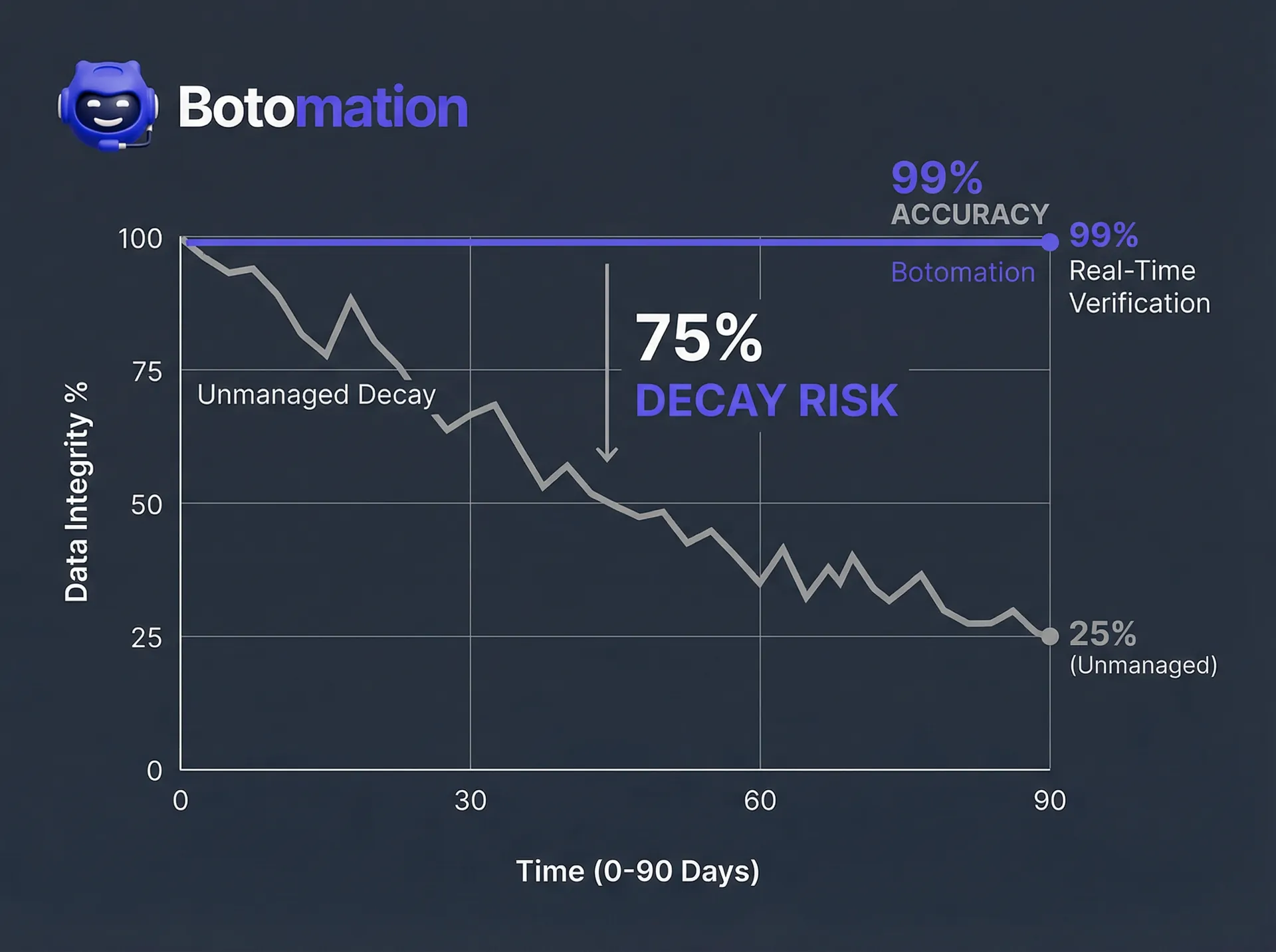
Our analysis of current industry trends shows that decay rates are not uniform across sectors. High-growth industries like SaaS and Fintech experience much higher volatility compared to traditional manufacturing or legal services. In fact, recent data suggests a staggering 75% decay rate within 90 days for certain high-churn roles, such as junior sales development representatives or mid-level marketing managers. If you are not updating these records almost in real-time, your outreach is destined for the "undeliverable" folder.
### Key Metrics on Data Degradation
* Annual Decay Rate: 30% to 37% for B2B lists globally.
* Job Change Impact: 22% of professionals in the tech sector change roles every 12 months.
* Email Invalidation: Over 15% of business email addresses become inactive within half a year.
* Economic Shift: Company mergers and acquisitions account for 10% of domain-level data changes.
Common Causes of Lead Decay
The most frequent driver of lead decay is the natural career progression of your prospects. Professionals no longer stay in the same seat for five years; they often stay for eighteen months before pursuing new challenges. When a Key Decision Maker (KDM) leaves a company, you do not just lose a contact; you lose the historical context and the relationship you have built. If your CRM is not alerted to this change immediately, your sales team will continue to send personalized videos and emails to an inbox that has been deactivated.
Beyond individual moves, company-wide restructurings and domain changes play a massive role in data degradation. In the current economic climate, startups are being acquired or rebranded at a record pace. A company that was "Acme Solutions" on Monday might become "Global Tech Corp" by Friday, rendering every @acmesolutions.com email address in your list obsolete. Inaccuracies also creep in through manual data entry errors, where a single typo in a domain name can lead to a hard bounce that damages your sender reputation for weeks.
Industry-Specific Decay Patterns
When we compare the tech industry to more traditional sectors, the contrast is stark. The tech world is characterized by frequent "job hopping" and rapid scaling, meaning your lead lists here have the shortest shelf life. If you are targeting CTOs at Series A startups, you should assume that 10% of your list will be incorrect every single month. Traditional sectors like construction or healthcare tend to be more stable, but they suffer from a different type of decay: the "outdated tech" factor. In these industries, contacts might keep their jobs, but their companies might migrate from legacy email servers to modern cloud solutions, changing their email formats without warning.
We also see significant differences in decay rates based on role seniority. C-suite executives tend to stay in their positions longer than entry-level or mid-management employees. However, when a C-suite executive does move, the impact on your sales pipeline is far more devastating. Our experts at Botomation have found that while lower-level lists decay faster in volume, the decay of high-level lists has a much higher financial cost. This is why a "one-size-fits-all" cleaning schedule never works; you need a tiered approach that prioritizes your most valuable segments.
How Does Lead Decay Impact Your Marketing Performance?
The consequences of lead decay go far beyond a simple "return to sender" notification. When your marketing team operates on stale data, every metric that matters starts to trend in the wrong direction. Open rates drop, click-through rates plummet, and your cost-per-acquisition (CPA) begins to climb. The most dangerous part of this process is that it is often gradual; you might not notice a 2% drop this month, but after six months of neglect, your entire lead generation engine will be struggling to perform.
A case study involving a Mid-Sized Insurance Company illustrated this perfectly. They were working with a legacy list of 50,000 prospects that had been manually compiled over two years. Upon analysis, we found that their conversion rates for leads older than six months were 80% lower than their fresh leads. The sales team was spending 40 hours a week calling disconnected numbers and emailing people who had retired. This was not just a marketing failure; it was a massive drain on the company's operational efficiency and employee morale.
Conversion Rate Impact
Freshness is the single greatest predictor of conversion success in growth marketing. A lead that has been verified within the last 24 hours is significantly more likely to engage than one sourced three months ago. When your data is old, the "relevance gap" widens. You might reach out to a "Director of Marketing" who was promoted to VP three months ago; by using their old title, you immediately signal that you have not done your homework, destroying any chance of building trust.
Furthermore, stale leads result in longer sales cycles. If your SDRs must spend the first five minutes of every interaction verifying that they are speaking to the right person, the momentum of the call is lost. High-quality, fresh data allows for frictionless entry into a conversation. When the data is accurate, the sales representative can focus entirely on the prospect's pain points rather than administrative details. The difference between a 2% and a 5% conversion rate often comes down to nothing more than the age of the lead list.
Financial Impact Analysis
Let's break down the math of manual verification and the cost of pursuing bad leads. Understanding how AI agents replace manual data entry work is crucial here; if an SDR earns a base salary of $45,000 plus $11,250 in benefits, their total cost to the company is $56,250 per year. This breaks down to roughly $28 per hour. If that SDR spends just 10 hours a week manually checking LinkedIn profiles to see if prospects still work at a company, you are losing $280 per week, or over $14,000 per year, per rep. This is a conservative estimate that does not even account for the opportunity cost of the sales they could have been closing during that time.
The financial damage also extends to your technical infrastructure. High bounce rates from stale lists trigger red flags with Email Service Providers (ESPs) like Google and Microsoft. If your bounce rate exceeds 10%, your entire domain can be blacklisted, meaning even your emails to existing clients will start landing in the spam folder. The cost of "fixing" a burned domain can run into the tens of thousands of dollars in lost revenue and consultant fees. Partnering with a specialized agency to automate this process is not just an expense; it is a defensive investment that protects your most valuable digital assets.
How to Prevent Lead List Decay Marketing Using Proactive Strategies?
The most successful growth marketing teams in 2026 have moved away from "reactive cleaning" and toward "proactive prevention." Reactive cleaning is like trying to bail water out of a leaking boat; proactive prevention is fixing the hull before you ever leave the dock. Instead of waiting for your bounce rates to spike before taking action, you must implement systems that verify and enrich data at the moment of entry and at regular intervals thereafter. This shift in mindset is what separates market leaders from those who are constantly struggling to hit their numbers.
Consider the example of the VTT Technical Research Center. By moving away from static lists and implementing an automated system that scanned for organizational changes, they achieved nearly 100% lead reach. They stopped buying bulk lists and started investing in dynamic data flows. This approach ensures that the sales team only ever interacts with "live" prospects. At Botomation, we emphasize this modern methodology, where custom-built tools do the heavy lifting so your human talent can focus on closing deals.
Source Quality Control
The battle against lead decay begins at the source. If you are sourcing leads from low-quality, "scrape-and-dump" databases, you are essentially importing decay into your CRM from day one. You need to implement strict validation rules for any lead capture form on your website. Using real-time API lookups can prevent users from entering "test@test.com" or using personal Gmail addresses when you require a business email. By filtering out the noise at the point of entry, you ensure that your database remains high-fidelity.
Equally important is the selection of your lead sources. Not all data providers are created equal. Some providers refresh their data every 90 days, while others use AI-driven models to track job changes in real-time. When choosing a partner or a tool, you should prioritize those that offer "live" verification. Our team at Botomation takes this a step further by utilizing AI B2B prospecting tools that scan the web specifically for your target criteria, ensuring that the leads you receive this morning were verified this morning.
Regular Engagement Strategies
A lead that is never contacted is a lead that is guaranteed to decay. One of the best ways to keep your list "warm" and verify its accuracy is through regular, value-driven engagement. This does not mean spamming your list with weekly newsletters. Instead, it means using "micro-touchpoints" to stay on the radar. If a lead does not engage with your content for 60 days, they should be moved into a specific re-engagement sequence designed to verify their current status.
These re-engagement campaigns serve a dual purpose. First, they provide value to the prospect, keeping your brand top-of-mind. Second, they act as a diagnostic tool. If an email bounces during a re-engagement campaign, it is an immediate signal to remove that contact or find their replacement. By optimizing your touchpoint frequency, you create a self-cleaning mechanism for your database. You are essentially using your marketing activity to audit your data quality in real-time.
Which Technical Solutions Help You Prevent Lead List Decay Marketing?
In 2026, the tools available for lead management have reached a level of sophistication that makes manual list management obsolete. We are seeing the rise of "autonomous data hygiene" platforms that do not just tell you a lead is bad, but actually go out and find the new contact person who replaced them. These systems integrate directly with your CRM, working in the background to swap out old titles, update new company domains, and even track when a prospect moves from a competitor to a target account.
One of the most significant advancements this year is the integration of tools like Woodpecker’s 2026 LinkedIn Outreach Automation features. These tools allow for a multi-channel approach where the system checks the prospect's LinkedIn status before sending an email. If the system detects a "congratulations on the new role" trigger on LinkedIn, it can automatically pause the email sequence and alert the sales rep to update the lead's information. This level of automation can save a sales team upwards of 25 hours per week, which we have seen firsthand in our client implementations.
2026 Lead Management Tool Capabilities
The current crop of lead management tools is heavily reliant on GPT-5 powered intent analysis and real-time verification. Modern systems can now perform "deep verification" which goes beyond checking if an email server exists. By incorporating daily market intelligence automation, they can analyze social signals, press releases, and SEC filings to determine if a company is going through a merger or a layoff. This allows you to segment your leads not just by "who they are," but by "what is happening to them right now."
Automatic data enrichment is another feature that has become a standard requirement. In the past, you might have had only a name and an email. Today, our custom tools at Botomation can take that single data point and flesh it out with the prospect's tech stack, their recent LinkedIn posts, and even their company's current hiring trends. This level of detail allows for hyper-personalization that was previously impossible at scale. When your data is this rich and this fresh, the concept of "decay" becomes almost irrelevant because the system is constantly regenerating the lead's profile.
Integration and Automation Workflows
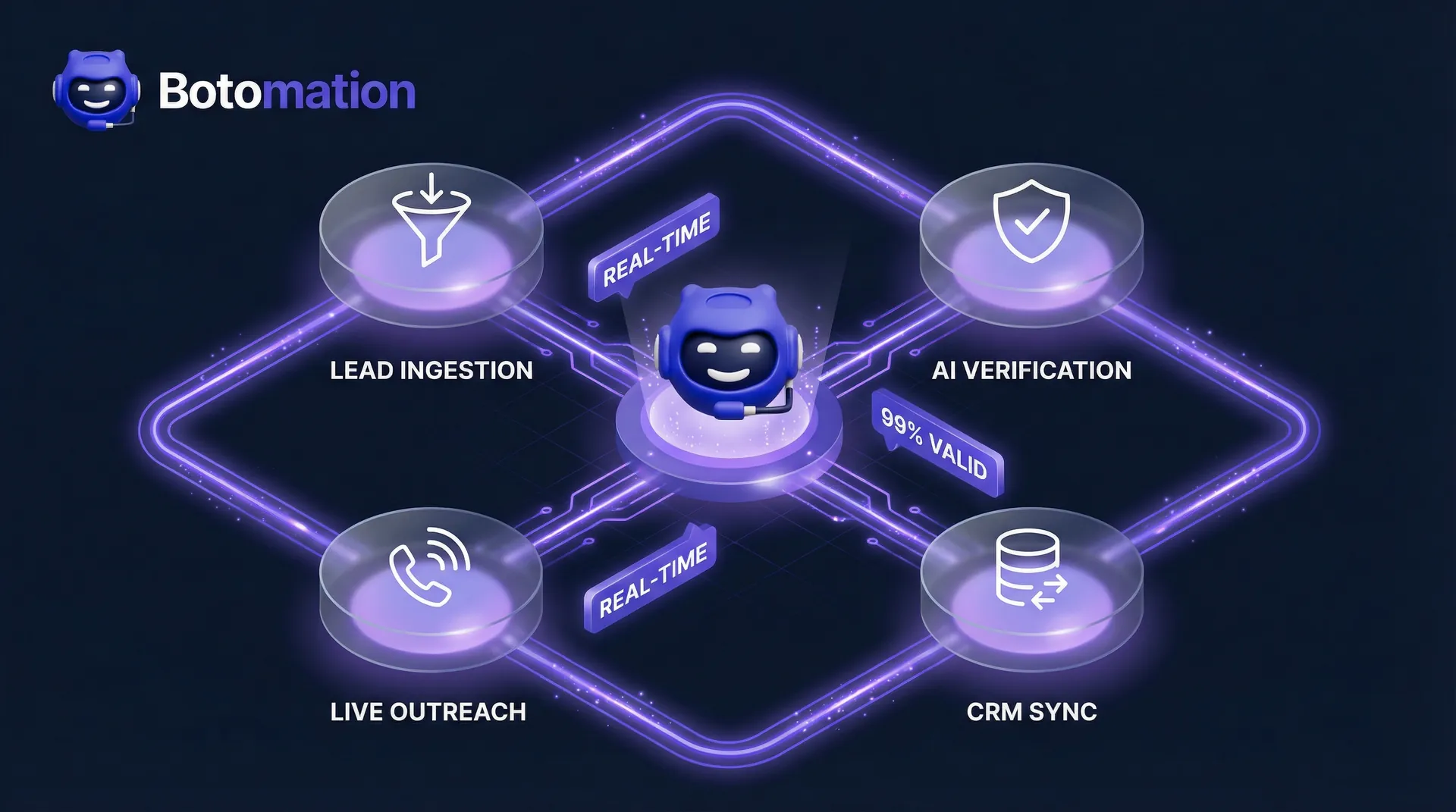
The real power of these tools is only realized when they are properly integrated into a seamless workflow. A siloed verification tool is just another tab your team has to check. The goal should be a "closed-loop" system where you implement automated lead verification and updating tools so your CRM and outreach platforms are all communicating via API. When a lead is marked as "moved" in your verification tool, that change should propagate across your entire stack instantly through a proper CRM email integration.
We often help clients set up automated cleanup workflows. For example, you can set a rule that any lead with a "bounce" status is automatically moved to a "Research Needed" queue for an automated agent to find their replacement. This ensures that your sales pipeline never actually shrinks; it just evolves. By removing the manual "busy work" of data cleanup, you allow your growth marketers to focus on strategy and your sales reps to focus on human-to-human connection. This is the Botomation Way—using technology to amplify human potential, not replace it.
How Can You Maintain Lead Quality Through Regular Audits?
Even with advanced automation in place, periodic human-led audits are essential to ensure the system is functioning correctly. Think of it like a high-performance vehicle; the sensors and computers do most of the work, but you still need a mechanic to check the oil and tires occasionally. Regular audits allow you to spot patterns that automation might miss, such as a specific lead source that is consistently providing low-quality data or a CRM field that is being misused by the sales team.
Our experts have observed that companies implementing regular data hygiene practices see a significant boost in their bottom line. In one instance, a client saw a 40% increase in lead generation simply by cleaning their existing database and automating the prospecting of new, similar profiles. They were not spending more on ads; they were just making better use of the data they already had. Building quality into your ongoing processes is far more effective than trying to "fix" a broken database once a year.
Regular Data Auditing Processes
A robust auditing schedule should be divided into monthly, quarterly, and annual tasks. On a monthly basis, you should perform a "health check" on your bounce rates and engagement metrics. If you see a sudden spike in bounces from a specific segment, you can investigate immediately. Quarterly audits should be more comprehensive, involving a deep dive into your lead sources. This is the time to ask: "Is this expensive data provider actually delivering leads that convert, or are they just filling our CRM with junk?"
Once a year, it is vital to conduct a total data strategy review. This is where you look at your overall "Ideal Customer Profile" (ICP) and ensure your data collection methods still align with your business goals. As markets shift, your ICP might change, rendering parts of your database irrelevant even if the contact info is technically correct. At Botomation, we assist our partners in these deep-dive reviews, ensuring that their lead generation strategy is always pointing toward the highest possible ROI.
Quality Scoring and Monitoring
Implementing a lead quality scoring system is a highly effective way to monitor the health of your database in real-time. Just as you automate lead scoring for B2B prospecting based on fit and intent, you should also score them based on "data confidence" to trigger automatic refreshes. A lead with a verified business email, a recent LinkedIn update, and a matching phone number receives a high confidence score. A lead that has not been verified in six months receives a low score and should be flagged for an automated refresh.
Tracking these quality metrics over time allows you to see the "velocity of decay" in your specific industry. If you know that your tech leads lose 5% of their quality score every month, you can set an automated trigger to refresh them every 20 days. This data-driven approach takes the guesswork out of maintenance. You stop wondering if your list is good and start knowing exactly how much of your pipeline is ready for outreach.
How to Build a Culture of Lead Quality in Marketing Teams?
The best tools and processes in the world will fail if your team does not value data quality. Lead decay is often accelerated by poor data entry habits or a lack of communication between marketing and sales. If marketing is focused solely on the quantity of leads and sales is focused solely on closing, the quality of the data often falls through the cracks. You must foster a culture where everyone understands that a small, high-quality list is infinitely more valuable than a massive, decaying one.
Aligning marketing and sales on quality expectations is the first step. Both teams need to agree on what constitutes a "sales-ready" lead and what data points are non-negotiable. If the sales team finds a stale lead, they should have a simple, one-click process to flag it for the marketing team or the automated system to fix. When sales sees that marketing is committed to providing them with fresh, actionable data, the friction between the two departments vanishes.
Team Processes and Protocols
Establishing clear lead handling procedures is essential for maintaining a clean database. Every member of the team should know exactly how to enter a new lead, how to update an existing one, and how to handle a bounce. These protocols should be documented and easily accessible. For example, if an SDR discovers a prospect has changed companies, the protocol should be to "Close-Lost" the old record and create a new "Prospect" record for the new company, rather than just overwriting the old data. This preserves your historical reporting while keeping the current pipeline clean.
Standardizing definitions is also crucial. What does "verified" mean to your team? Does it mean the email did not bounce, or does it mean a human actually confirmed the person is still in that role? By removing ambiguity, you ensure that everyone is working toward the same standard of excellence. Our agency often works with clients to draft these "Data Manifestos," creating a shared language that simplifies lead management across the entire organization.
Training and Education
Investment in training is the final piece of the puzzle. Your team needs to understand the "why" behind data hygiene, not just the "how." When a growth marketer understands that a 10% bounce rate can get the company's domain blacklisted, they become much more diligent about verification. Training should also cover the effective use of your tech stack. Many teams have powerful automation tools but only use 10% of their features because they have never been properly trained on the advanced settings.
As the landscape of late 2026 continues to evolve, staying educated on new trends and tools is a competitive necessity. We encourage our partners to treat lead generation as a continuous learning process. By staying curious and proactive, your team can turn lead list management from a chore into a strategic advantage. When you have a team that cares about quality, backed by the custom automation tools we provide at Botomation, you become unstoppable in your market.
Frequently Asked Questions
How often should I realistically refresh my B2B lead list?
In the 2026 landscape, a quarterly refresh is the absolute minimum for most industries. However, for high-volatility sectors like Tech or Startups, we recommend a monthly audit or, ideally, implementing a real-time verification system that checks lead status every time a new campaign is launched.
Can't I just use a "bulk cleaner" tool to fix my list?
Bulk cleaners are effective for identifying hard bounces, but they often fail to identify role changes. A contact might have a valid email address that does not bounce, but if they have moved to a different department or company, your marketing message will still fail. You need a solution that combines technical verification with real-world role tracking.
Does lead decay affect my SEO or website authority?
Indirectly, yes. If your email marketing results in high bounce rates and low engagement, it signals to service providers that your brand may be low-quality or spammy. This can negatively impact your overall digital reputation, making it harder for your organic content to rank and reach your audience.
Is it better to buy new lists or fix old ones?
Buying off-the-shelf lists is almost always a losing strategy in 2026 because those lists start decaying the moment they are compiled. The superior approach is to fix your existing high-intent data and use custom-built prospecting tools—like the ones we create at Botomation—to find fresh, live leads that match your specific criteria.
What are the main signs that my lead list is decaying?
The most obvious signs include a steady increase in hard bounce rates, a decrease in email open rates, and sales representatives reporting that they are reaching the wrong people or disconnected phone numbers. If your conversion rate from lead to discovery call is dropping despite consistent effort, data decay is likely the culprit.
Maintaining lead quality is an ongoing battle, but it is one you can win with the right approach. By understanding the science of decay, implementing proactive technical solutions, and fostering a culture of data excellence, you can ensure your growth marketing efforts are always built on a foundation of truth. The manual way of research and stale spreadsheets is over. The new way is automated, intelligent, and relentlessly fresh.
At Botomation, we specialize in building the custom engines that power this modern approach. Our team of experts does not just give you a tool; we partner with you to automate your prospecting, track your competitors, and deliver qualified leads to your sales team every single morning. We handle the technical complexity of data hygiene so you can focus on what you do best: growing your business.
Ready to automate your growth? Book a free consultation call below.
Learning how to prevent lead list decay marketing is the single most important task for B2B growth marketers in January 2026. Imagine waking up to a CRM filled with thousands of contacts, only to realize that nearly half of those individuals no longer work at the companies listed. This is not a hypothetical scenario; it is a daily reality that quietly erodes the ROI of every campaign you launch. Lead list decay is the silent killer of growth marketing, acting as a slow leak in your sales pipeline that drains resources, time, and team morale.
Statistics from the final quarter of 2024 revealed that the average B2B database decays at a rate of roughly 3% per month. While that might sound manageable in the short term, the compounding effect means that by the end of a single year, more than a third of your database is essentially useless. If you are relying on lead lists that have not been refreshed in six months, you are effectively throwing 20% of your marketing budget directly into the trash. Preventing this decay is not just about "cleaning" data; it is about maintaining fresh lead lists for growth marketing to ensure your sales team is always swinging at live targets.
This guide explores the underlying mechanics of lead decay and provides a strategic blueprint for maintaining a pristine database in late 2026. We will examine how automation, expert-led research, and cultural shifts within your organization can transform your lead generation from a game of chance into a predictable engine for revenue. By the time you finish reading, you will understand why the "old way" of manual data entry is failing and how partnering with experts like our team at Botomation can secure your competitive edge.
Why is Understanding How to Prevent Lead List Decay Marketing Essential?
The B2B landscape in January 2026 moves at a velocity we have never seen before, driven by rapid shifts in the labor market and the constant restructuring of tech-heavy organizations. Lead list decay occurs because the data we collect is a snapshot of a specific moment, but the professionals behind that data are constantly in motion. In the B2B sector, individuals change roles, earn promotions, or move to entirely different industries with increasing frequency. When a contact moves, the data point you hold becomes a "ghost" in your system—a record that looks valid but leads nowhere.
Our analysis of current industry trends shows that decay rates are not uniform across sectors. High-growth industries like SaaS and Fintech experience much higher volatility compared to traditional manufacturing or legal services. In fact, recent data suggests a staggering 75% decay rate within 90 days for certain high-churn roles, such as junior sales development representatives or mid-level marketing managers. If you are not updating these records almost in real-time, your outreach is destined for the "undeliverable" folder.
### Key Metrics on Data Degradation
* Annual Decay Rate: 30% to 37% for B2B lists globally.
* Job Change Impact: 22% of professionals in the tech sector change roles every 12 months.
* Email Invalidation: Over 15% of business email addresses become inactive within half a year.
* Economic Shift: Company mergers and acquisitions account for 10% of domain-level data changes.
Common Causes of Lead Decay
The most frequent driver of lead decay is the natural career progression of your prospects. Professionals no longer stay in the same seat for five years; they often stay for eighteen months before pursuing new challenges. When a Key Decision Maker (KDM) leaves a company, you do not just lose a contact; you lose the historical context and the relationship you have built. If your CRM is not alerted to this change immediately, your sales team will continue to send personalized videos and emails to an inbox that has been deactivated.
Beyond individual moves, company-wide restructurings and domain changes play a massive role in data degradation. In the current economic climate, startups are being acquired or rebranded at a record pace. A company that was "Acme Solutions" on Monday might become "Global Tech Corp" by Friday, rendering every @acmesolutions.com email address in your list obsolete. Inaccuracies also creep in through manual data entry errors, where a single typo in a domain name can lead to a hard bounce that damages your sender reputation for weeks.
Industry-Specific Decay Patterns
When we compare the tech industry to more traditional sectors, the contrast is stark. The tech world is characterized by frequent "job hopping" and rapid scaling, meaning your lead lists here have the shortest shelf life. If you are targeting CTOs at Series A startups, you should assume that 10% of your list will be incorrect every single month. Traditional sectors like construction or healthcare tend to be more stable, but they suffer from a different type of decay: the "outdated tech" factor. In these industries, contacts might keep their jobs, but their companies might migrate from legacy email servers to modern cloud solutions, changing their email formats without warning.
We also see significant differences in decay rates based on role seniority. C-suite executives tend to stay in their positions longer than entry-level or mid-management employees. However, when a C-suite executive does move, the impact on your sales pipeline is far more devastating. Our experts at Botomation have found that while lower-level lists decay faster in volume, the decay of high-level lists has a much higher financial cost. This is why a "one-size-fits-all" cleaning schedule never works; you need a tiered approach that prioritizes your most valuable segments.
How Does Lead Decay Impact Your Marketing Performance?
The consequences of lead decay go far beyond a simple "return to sender" notification. When your marketing team operates on stale data, every metric that matters starts to trend in the wrong direction. Open rates drop, click-through rates plummet, and your cost-per-acquisition (CPA) begins to climb. The most dangerous part of this process is that it is often gradual; you might not notice a 2% drop this month, but after six months of neglect, your entire lead generation engine will be struggling to perform.
A case study involving a Mid-Sized Insurance Company illustrated this perfectly. They were working with a legacy list of 50,000 prospects that had been manually compiled over two years. Upon analysis, we found that their conversion rates for leads older than six months were 80% lower than their fresh leads. The sales team was spending 40 hours a week calling disconnected numbers and emailing people who had retired. This was not just a marketing failure; it was a massive drain on the company's operational efficiency and employee morale.
Conversion Rate Impact
Freshness is the single greatest predictor of conversion success in growth marketing. A lead that has been verified within the last 24 hours is significantly more likely to engage than one sourced three months ago. When your data is old, the "relevance gap" widens. You might reach out to a "Director of Marketing" who was promoted to VP three months ago; by using their old title, you immediately signal that you have not done your homework, destroying any chance of building trust.
Furthermore, stale leads result in longer sales cycles. If your SDRs must spend the first five minutes of every interaction verifying that they are speaking to the right person, the momentum of the call is lost. High-quality, fresh data allows for frictionless entry into a conversation. When the data is accurate, the sales representative can focus entirely on the prospect's pain points rather than administrative details. The difference between a 2% and a 5% conversion rate often comes down to nothing more than the age of the lead list.
Financial Impact Analysis
Let's break down the math of manual verification and the cost of pursuing bad leads. Understanding how AI agents replace manual data entry work is crucial here; if an SDR earns a base salary of $45,000 plus $11,250 in benefits, their total cost to the company is $56,250 per year. This breaks down to roughly $28 per hour. If that SDR spends just 10 hours a week manually checking LinkedIn profiles to see if prospects still work at a company, you are losing $280 per week, or over $14,000 per year, per rep. This is a conservative estimate that does not even account for the opportunity cost of the sales they could have been closing during that time.
The financial damage also extends to your technical infrastructure. High bounce rates from stale lists trigger red flags with Email Service Providers (ESPs) like Google and Microsoft. If your bounce rate exceeds 10%, your entire domain can be blacklisted, meaning even your emails to existing clients will start landing in the spam folder. The cost of "fixing" a burned domain can run into the tens of thousands of dollars in lost revenue and consultant fees. Partnering with a specialized agency to automate this process is not just an expense; it is a defensive investment that protects your most valuable digital assets.
How to Prevent Lead List Decay Marketing Using Proactive Strategies?
The most successful growth marketing teams in 2026 have moved away from "reactive cleaning" and toward "proactive prevention." Reactive cleaning is like trying to bail water out of a leaking boat; proactive prevention is fixing the hull before you ever leave the dock. Instead of waiting for your bounce rates to spike before taking action, you must implement systems that verify and enrich data at the moment of entry and at regular intervals thereafter. This shift in mindset is what separates market leaders from those who are constantly struggling to hit their numbers.
Consider the example of the VTT Technical Research Center. By moving away from static lists and implementing an automated system that scanned for organizational changes, they achieved nearly 100% lead reach. They stopped buying bulk lists and started investing in dynamic data flows. This approach ensures that the sales team only ever interacts with "live" prospects. At Botomation, we emphasize this modern methodology, where custom-built tools do the heavy lifting so your human talent can focus on closing deals.
Source Quality Control
The battle against lead decay begins at the source. If you are sourcing leads from low-quality, "scrape-and-dump" databases, you are essentially importing decay into your CRM from day one. You need to implement strict validation rules for any lead capture form on your website. Using real-time API lookups can prevent users from entering "test@test.com" or using personal Gmail addresses when you require a business email. By filtering out the noise at the point of entry, you ensure that your database remains high-fidelity.
Equally important is the selection of your lead sources. Not all data providers are created equal. Some providers refresh their data every 90 days, while others use AI-driven models to track job changes in real-time. When choosing a partner or a tool, you should prioritize those that offer "live" verification. Our team at Botomation takes this a step further by utilizing AI B2B prospecting tools that scan the web specifically for your target criteria, ensuring that the leads you receive this morning were verified this morning.
Regular Engagement Strategies
A lead that is never contacted is a lead that is guaranteed to decay. One of the best ways to keep your list "warm" and verify its accuracy is through regular, value-driven engagement. This does not mean spamming your list with weekly newsletters. Instead, it means using "micro-touchpoints" to stay on the radar. If a lead does not engage with your content for 60 days, they should be moved into a specific re-engagement sequence designed to verify their current status.
These re-engagement campaigns serve a dual purpose. First, they provide value to the prospect, keeping your brand top-of-mind. Second, they act as a diagnostic tool. If an email bounces during a re-engagement campaign, it is an immediate signal to remove that contact or find their replacement. By optimizing your touchpoint frequency, you create a self-cleaning mechanism for your database. You are essentially using your marketing activity to audit your data quality in real-time.
Which Technical Solutions Help You Prevent Lead List Decay Marketing?
In 2026, the tools available for lead management have reached a level of sophistication that makes manual list management obsolete. We are seeing the rise of "autonomous data hygiene" platforms that do not just tell you a lead is bad, but actually go out and find the new contact person who replaced them. These systems integrate directly with your CRM, working in the background to swap out old titles, update new company domains, and even track when a prospect moves from a competitor to a target account.
One of the most significant advancements this year is the integration of tools like Woodpecker’s 2026 LinkedIn Outreach Automation features. These tools allow for a multi-channel approach where the system checks the prospect's LinkedIn status before sending an email. If the system detects a "congratulations on the new role" trigger on LinkedIn, it can automatically pause the email sequence and alert the sales rep to update the lead's information. This level of automation can save a sales team upwards of 25 hours per week, which we have seen firsthand in our client implementations.
2026 Lead Management Tool Capabilities
The current crop of lead management tools is heavily reliant on GPT-5 powered intent analysis and real-time verification. Modern systems can now perform "deep verification" which goes beyond checking if an email server exists. By incorporating daily market intelligence automation, they can analyze social signals, press releases, and SEC filings to determine if a company is going through a merger or a layoff. This allows you to segment your leads not just by "who they are," but by "what is happening to them right now."
Automatic data enrichment is another feature that has become a standard requirement. In the past, you might have had only a name and an email. Today, our custom tools at Botomation can take that single data point and flesh it out with the prospect's tech stack, their recent LinkedIn posts, and even their company's current hiring trends. This level of detail allows for hyper-personalization that was previously impossible at scale. When your data is this rich and this fresh, the concept of "decay" becomes almost irrelevant because the system is constantly regenerating the lead's profile.
Integration and Automation Workflows
The real power of these tools is only realized when they are properly integrated into a seamless workflow. A siloed verification tool is just another tab your team has to check. The goal should be a "closed-loop" system where you implement automated lead verification and updating tools so your CRM and outreach platforms are all communicating via API. When a lead is marked as "moved" in your verification tool, that change should propagate across your entire stack instantly through a proper CRM email integration.
We often help clients set up automated cleanup workflows. For example, you can set a rule that any lead with a "bounce" status is automatically moved to a "Research Needed" queue for an automated agent to find their replacement. This ensures that your sales pipeline never actually shrinks; it just evolves. By removing the manual "busy work" of data cleanup, you allow your growth marketers to focus on strategy and your sales reps to focus on human-to-human connection. This is the Botomation Way—using technology to amplify human potential, not replace it.
How Can You Maintain Lead Quality Through Regular Audits?
Even with advanced automation in place, periodic human-led audits are essential to ensure the system is functioning correctly. Think of it like a high-performance vehicle; the sensors and computers do most of the work, but you still need a mechanic to check the oil and tires occasionally. Regular audits allow you to spot patterns that automation might miss, such as a specific lead source that is consistently providing low-quality data or a CRM field that is being misused by the sales team.
Our experts have observed that companies implementing regular data hygiene practices see a significant boost in their bottom line. In one instance, a client saw a 40% increase in lead generation simply by cleaning their existing database and automating the prospecting of new, similar profiles. They were not spending more on ads; they were just making better use of the data they already had. Building quality into your ongoing processes is far more effective than trying to "fix" a broken database once a year.
Regular Data Auditing Processes
A robust auditing schedule should be divided into monthly, quarterly, and annual tasks. On a monthly basis, you should perform a "health check" on your bounce rates and engagement metrics. If you see a sudden spike in bounces from a specific segment, you can investigate immediately. Quarterly audits should be more comprehensive, involving a deep dive into your lead sources. This is the time to ask: "Is this expensive data provider actually delivering leads that convert, or are they just filling our CRM with junk?"
Once a year, it is vital to conduct a total data strategy review. This is where you look at your overall "Ideal Customer Profile" (ICP) and ensure your data collection methods still align with your business goals. As markets shift, your ICP might change, rendering parts of your database irrelevant even if the contact info is technically correct. At Botomation, we assist our partners in these deep-dive reviews, ensuring that their lead generation strategy is always pointing toward the highest possible ROI.
Quality Scoring and Monitoring
Implementing a lead quality scoring system is a highly effective way to monitor the health of your database in real-time. Just as you automate lead scoring for B2B prospecting based on fit and intent, you should also score them based on "data confidence" to trigger automatic refreshes. A lead with a verified business email, a recent LinkedIn update, and a matching phone number receives a high confidence score. A lead that has not been verified in six months receives a low score and should be flagged for an automated refresh.
Tracking these quality metrics over time allows you to see the "velocity of decay" in your specific industry. If you know that your tech leads lose 5% of their quality score every month, you can set an automated trigger to refresh them every 20 days. This data-driven approach takes the guesswork out of maintenance. You stop wondering if your list is good and start knowing exactly how much of your pipeline is ready for outreach.
How to Build a Culture of Lead Quality in Marketing Teams?
The best tools and processes in the world will fail if your team does not value data quality. Lead decay is often accelerated by poor data entry habits or a lack of communication between marketing and sales. If marketing is focused solely on the quantity of leads and sales is focused solely on closing, the quality of the data often falls through the cracks. You must foster a culture where everyone understands that a small, high-quality list is infinitely more valuable than a massive, decaying one.
Aligning marketing and sales on quality expectations is the first step. Both teams need to agree on what constitutes a "sales-ready" lead and what data points are non-negotiable. If the sales team finds a stale lead, they should have a simple, one-click process to flag it for the marketing team or the automated system to fix. When sales sees that marketing is committed to providing them with fresh, actionable data, the friction between the two departments vanishes.
Team Processes and Protocols
Establishing clear lead handling procedures is essential for maintaining a clean database. Every member of the team should know exactly how to enter a new lead, how to update an existing one, and how to handle a bounce. These protocols should be documented and easily accessible. For example, if an SDR discovers a prospect has changed companies, the protocol should be to "Close-Lost" the old record and create a new "Prospect" record for the new company, rather than just overwriting the old data. This preserves your historical reporting while keeping the current pipeline clean.
Standardizing definitions is also crucial. What does "verified" mean to your team? Does it mean the email did not bounce, or does it mean a human actually confirmed the person is still in that role? By removing ambiguity, you ensure that everyone is working toward the same standard of excellence. Our agency often works with clients to draft these "Data Manifestos," creating a shared language that simplifies lead management across the entire organization.
Training and Education
Investment in training is the final piece of the puzzle. Your team needs to understand the "why" behind data hygiene, not just the "how." When a growth marketer understands that a 10% bounce rate can get the company's domain blacklisted, they become much more diligent about verification. Training should also cover the effective use of your tech stack. Many teams have powerful automation tools but only use 10% of their features because they have never been properly trained on the advanced settings.
As the landscape of late 2026 continues to evolve, staying educated on new trends and tools is a competitive necessity. We encourage our partners to treat lead generation as a continuous learning process. By staying curious and proactive, your team can turn lead list management from a chore into a strategic advantage. When you have a team that cares about quality, backed by the custom automation tools we provide at Botomation, you become unstoppable in your market.
Frequently Asked Questions
How often should I realistically refresh my B2B lead list?
In the 2026 landscape, a quarterly refresh is the absolute minimum for most industries. However, for high-volatility sectors like Tech or Startups, we recommend a monthly audit or, ideally, implementing a real-time verification system that checks lead status every time a new campaign is launched.
Can't I just use a "bulk cleaner" tool to fix my list?
Bulk cleaners are effective for identifying hard bounces, but they often fail to identify role changes. A contact might have a valid email address that does not bounce, but if they have moved to a different department or company, your marketing message will still fail. You need a solution that combines technical verification with real-world role tracking.
Does lead decay affect my SEO or website authority?
Indirectly, yes. If your email marketing results in high bounce rates and low engagement, it signals to service providers that your brand may be low-quality or spammy. This can negatively impact your overall digital reputation, making it harder for your organic content to rank and reach your audience.
Is it better to buy new lists or fix old ones?
Buying off-the-shelf lists is almost always a losing strategy in 2026 because those lists start decaying the moment they are compiled. The superior approach is to fix your existing high-intent data and use custom-built prospecting tools—like the ones we create at Botomation—to find fresh, live leads that match your specific criteria.
What are the main signs that my lead list is decaying?
The most obvious signs include a steady increase in hard bounce rates, a decrease in email open rates, and sales representatives reporting that they are reaching the wrong people or disconnected phone numbers. If your conversion rate from lead to discovery call is dropping despite consistent effort, data decay is likely the culprit.
Maintaining lead quality is an ongoing battle, but it is one you can win with the right approach. By understanding the science of decay, implementing proactive technical solutions, and fostering a culture of data excellence, you can ensure your growth marketing efforts are always built on a foundation of truth. The manual way of research and stale spreadsheets is over. The new way is automated, intelligent, and relentlessly fresh.
At Botomation, we specialize in building the custom engines that power this modern approach. Our team of experts does not just give you a tool; we partner with you to automate your prospecting, track your competitors, and deliver qualified leads to your sales team every single morning. We handle the technical complexity of data hygiene so you can focus on what you do best: growing your business.
Ready to automate your growth? Book a free consultation call below.
Get Started
Book a FREE Consultation Right NOW!
Schedule a Call with Our Team To Make Your Business More Efficient with AI Instantly.
Read More

How to Prevent Lead List Decay Marketing - 2026 Guide
Learn how to prevent lead list decay marketing with B2B CRM data hygiene. Improve growth marketing ROI using automated prospecting and fresh leads.
How to Maintain Fresh Lead Lists for Growth Marketing
Learn how WhatsApp AI slashes support costs for e-commerce & SaaS. Proven strategies to boost sales, recover carts, and scale 24/7 service.