Implementing AI in Small to Medium Businesses - 2026 Guide
Feb 17, 2026
AI Automation
SME Strategy
Business Efficiency
AI Automation
SME Strategy
Business Efficiency
The business landscape in late 2026 looks fundamentally different than it did even eighteen months ago. For forward-thinking leaders, implementing AI in small to medium businesses has become the primary differentiator between companies that scale effortlessly and those that buckle under the weight of their own manual processes. Traditional growth strategies, which relied on increasing headcount to solve operational bottlenecks, have hit a wall of diminishing returns. Rising labor costs and the sheer speed of market shifts mean that throwing more personnel at a problem is often the fastest way to erode your margins while hindering sustainable AI business growth.
As we move through January 2026, data indicates a massive shift in how the most successful mid-market companies operate. The shift toward small business automation is undeniable; they aren't just using AI to draft emails; they are rebuilding their entire operational core around intelligent automation. This guide provides a comprehensive roadmap for implementing these technologies, moving beyond the hype of basic chatbots to the reality of revenue-generating AI agents. We will explore a proven seven-step framework and examine real-world case studies where businesses have successfully bridged the gap between complex technology and practical, bottom-line results.
The 2026 Landscape for Implementing AI in Small to Medium Businesses
The era of "experimenting" with AI is officially over for the mid-market. According to recent 2026 research from McKinsey & Company, 68% of SMEs have now integrated AI into at least one core business function. This is no longer a trend; it is a structural realignment of the economy. In previous years, high-level automation was the exclusive playground of Fortune 500 companies with multi-million dollar R&D budgets. Today, the democratization of enterprise-grade intelligence means a 50-person manufacturing firm can deploy the same level of cognitive automation as a global conglomerate.
The technical bar has shifted significantly with the widespread adoption of GPT-5 and its sophisticated reasoning capabilities. Unlike its predecessors, GPT-5 allows for complex, multi-step problem solving that handles nuance and brand voice with startling accuracy. For SMEs, this means the "Old Way" of using disconnected SaaS tools that lack interoperability is being replaced by unified AI ecosystems. Our team at Botomation sees this daily: businesses are moving away from bloated legacy software and toward custom-coded environments where AI agents handle the heavy lifting 24/7.
What Are the Current Trends for Implementing AI in Small to Medium Businesses?
The 68% adoption rate among SMEs hides a deeper story about where value is actually being created. Customer service remains the leading edge of this transition, with 78% of automated businesses using AI customer service tools to handle first-tier and second-tier support inquiries. Marketing follows closely at 65%, where the focus has shifted from simple content generation to hyper-personalized lead nurturing. Operations and supply chain management sit at 52%, representing the fastest-growing sector as companies realize that predictive logistics can save millions in overhead.
Regional data suggests that while North American and European SMEs led the initial charge, we are seeing a massive surge in the Asia-Pacific region as they skip legacy software entirely in favor of AI-first infrastructure. Success metrics have also matured. Companies are no longer viewing "time saved" as a nebulous concept. They are tracking "Resolution Cost Per Ticket" and "Lead-to-Close Velocity," finding that AI implementation often reduces the former by 60% while increasing the latter by 30% or more.
Which AI Tools Drive Business Efficiency AI in 2026?
The release of GPT-5 has introduced "Agentic Workflows" to the average business owner. These are not merely chatbots that answer questions; they are agents capable of browsing the web, accessing internal databases, and executing tasks across different software platforms. For example, an AI agent can now receive an invoice, verify it against a purchase order in your ERP, flag discrepancies to a human manager, and schedule the payment once approved. This level of autonomy was unthinkable for a small business just a few years ago.
Visual content has seen a similar leap with Midjourney v7, which now offers perfect brand consistency and high-fidelity rendering for product photography. SMEs are using these AI tools for SMEs to generate entire marketing catalogs in hours rather than weeks, eliminating the need for expensive, time-consuming photoshoots. Furthermore, new niche tools released in 2026 have focused specifically on "Small Data" AI—systems that provide deep insights from the limited data sets typical of a medium-sized business, rather than requiring the massive "Big Data" repositories of the past.
| Implementation Metric | Traditional Manual Approach | Botomation AI Framework |
|---|---|---|
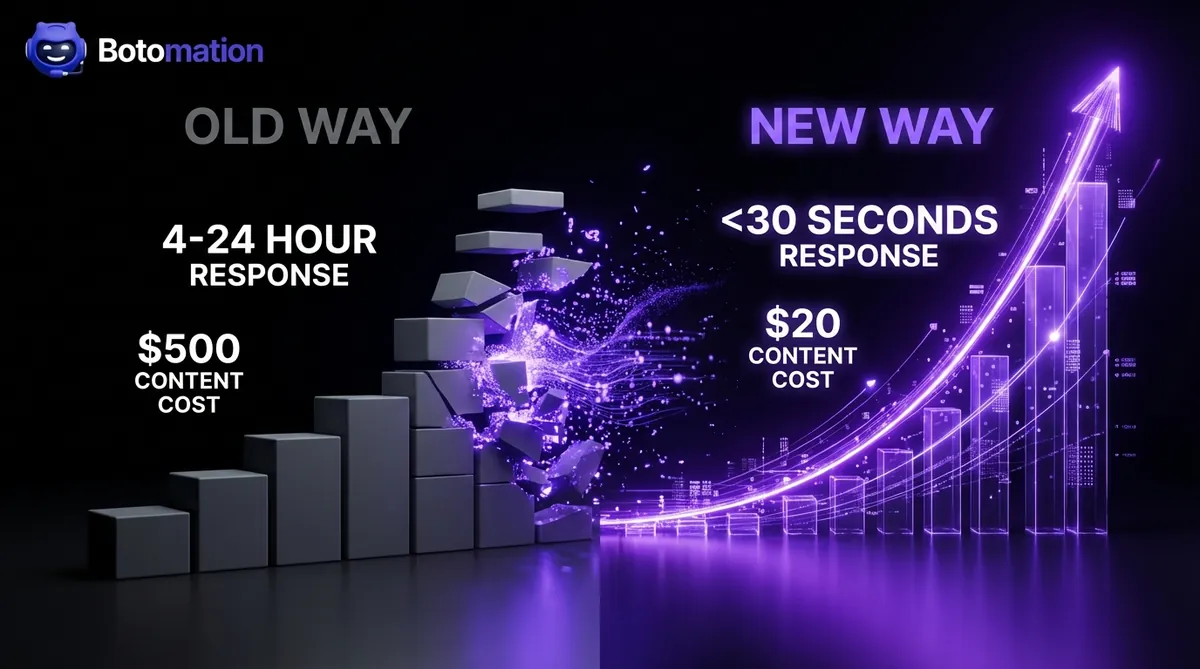
| Customer Support Response Time | 4 - 24 Hours | < 30 Seconds |
| Content Production Cost | $150 - $500 per piece | $5 - $20 per piece |
| Operational Error Rate | 5% - 8% (Human Error) | < 0.5% (Systematic) |
| Lead Response Speed | 2+ Hours | Instant (24/7) |
| Scalability Potential | Linear (Requires more staff) | Exponential (Requires more compute) |
A 7-Step Framework for Implementing AI in Small to Medium Businesses
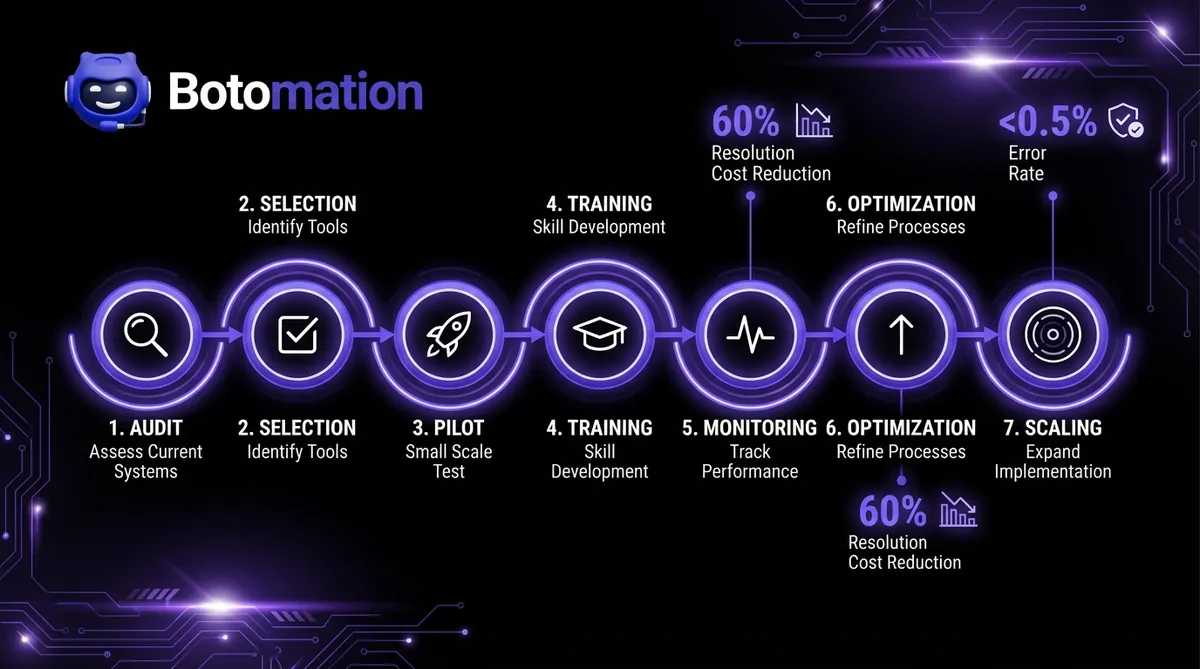
Successfully integrating AI into a growing business requires more than just a subscription to a few tools; it requires a fundamental shift in how you view business processes. At Botomation, we transition our partners away from the "Old Way"—a patchwork of slow, expensive manual tasks—to the "New Way," where custom code and AI agents act as a force multiplier for your existing team. This transition is best handled through a structured, phased approach that minimizes risk while maximizing early wins.
One of our partners, a mid-sized logistics firm, recently followed this framework to overhaul their dispatching and billing using automated workflows. By the end of the implementation, they saw a 35% increase in overall productivity without adding a single new head to their administrative team. The key was not just the technology; it was the systematic AI implementation strategy used during the transition.
How Do You Start a Small Business Automation Project?
The first mistake many founders make is trying to "AI-ify" everything at once. This leads to complexity and employee burnout. Instead, start by auditing your current workflows to find high-impact, low-effort opportunities. Look for tasks that are repetitive, data-heavy, and prone to human error. A classic example is a retail company that identified inventory management as its primary bottleneck. By focusing AI implementation solely on predicting stockouts and automating reorders, they solved their most painful problem first before moving on to other departments.
How Do You Select an AI Implementation Strategy?
Once you know what to fix, you need to decide how to fix it. The market is flooded with "AI-powered" SaaS apps, but many are thin wrappers around basic models that offer little real value. For an SME, the choice is usually between off-the-shelf software or partnering with an agency like Botomation to build a custom solution. Custom solutions are almost always superior because they integrate directly with your existing legacy systems and can be tailored to your specific brand voice and data privacy requirements.
What Are the Phased Steps for Successful AI Integration?
- Phase the Rollout: Start with a pilot program in one department. This allows you to resolve technical challenges in a controlled environment before a company-wide launch.
- Employee Training: AI should be viewed as a "co-pilot" rather than a replacement. Comprehensive training ensures your team knows how to prompt the AI and, more importantly, how to verify its output.
- Establish KPIs: You cannot manage what you do not measure. Track specific metrics like "Human Intervention Rate" to determine how often your team must assist the AI.
- Data Feedback Loops: Use the errors identified in the monitoring phase to retrain your models. This creates a system that grows more intelligent through usage.
- Scale and Iterate: Once the pilot is successful, move the framework into the next department, using lessons learned to accelerate subsequent implementations.
Real-World Case Studies: AI Success Stories from Small and Medium Businesses
The power of AI is best understood through the lens of those who have already crossed the chasm. We see a consistent pattern: businesses that embrace custom AI agents stop competing on price and start competing on efficiency and experience. When you can respond to a lead in four seconds while your competitor takes four hours, the "Old Way" of doing business simply cannot compete. These case studies highlight how different industries are utilizing these tools to achieve outsized results.
Average time savings across these implementations often hover around 15 hours per week per employee. Imagine what your senior leadership could accomplish if they regained two full workdays every week. This is not just about speed; it is about shifting your most expensive human capital away from "busy work" and toward high-level strategy and relationship building.
Marketing Agency Case Study: 42% Revenue Growth
A 50-employee marketing agency was struggling with the classic "scale-up" problem. As they acquired more clients, their overhead for content creation and client reporting exploded, eroding profit margins. They were trapped in a cycle of hiring more junior writers just to maintain operations. By partnering with our experts, they replaced their manual drafting process with a custom AI content engine that understood each client's unique brand guidelines.
The results were transformative. They achieved a 42% increase in revenue because they could suddenly handle nearly double the client load with the same staff. Content creation time dropped by 60%, and because the AI could analyze campaign data in real-time, their client reporting became more accurate and proactive. The turning point came when they realized they could now offer premium, data-driven services that were previously too labor-intensive to be profitable.
Manufacturing SME Case Study: 28% Cost Reduction
In the manufacturing sector, margins are often razor-thin, and operational errors can be devastating. A medium-sized parts manufacturer was facing rising costs and a 7% defect rate that was damaging their reputation. They implemented a two-pronged AI strategy: predictive maintenance for machinery and an AI-driven vision system for quality control. This was not a generic software fix; it was a custom integration that communicated directly with their floor hardware.
In the first year alone, they saw a $2.3M reduction in operational costs. Predictive maintenance allowed them to repair machines before they failed, eliminating unplanned downtime that previously cost $15,000 per hour. The quality control AI reduced their defect rate from 7% to less than 1%, nearly eliminating expensive product returns and warranty claims. This case study proves that AI has a massive, tangible impact on the physical world of production.
Key Takeaway: AI implementation is not an "all or nothing" proposition. The most successful SMEs start with a specific, measurable pain point and build outward once they have proven the ROI.
AI Tools by Business Function: Comprehensive Comparison for SMEs
Choosing the right tech stack is where many SMEs get bogged down. The 2026 market offers everything from $10/month browser extensions to $50,000/month enterprise platforms. For a growing business, the ideal choice lies in tools that offer deep integration capabilities. You do not want another "island of data"; you want a connected system where your customer service AI knows what your sales AI just promised a client. Leveraging business efficiency AI means ensuring these tools talk to each other.
The return on investment for these tools is no longer theoretical. Based on our 2026 analysis, the best AI marketing tools are delivering an average of $4.50 for every $1 invested. This is driven by better lead scoring and the ability to send the right message at the exact moment a prospect is ready to buy. When compared to the "Old Way" of manual email blasts and cold calling, the efficiency gap is staggering.
Customer Service AI Tools Comparison
The landscape of customer support has been revolutionized by "Reasoning Agents." While tools like Zendesk AI and Intercom have made great strides, we often find that SMEs benefit most from custom AI agents that can actually take actions in the company's backend. A standard chatbot might tell a customer where their package is; a Botomation-built agent can actually process the refund or change the shipping address without human intervention.
Success metrics for these implementations are at an all-time high, with a 78% average customer satisfaction rate for AI-powered support. The key is the "Seamless Handoff"—the ability for the AI to recognize when a human touch is required and pass the conversation over with a full summary of the interaction. This prevents the frustration of repetitive explanations that kills customer loyalty.
Marketing and Sales AI Tools Analysis
In 2026, marketing AI has moved far beyond simple copywriting. Tools like HubSpot AI and advanced custom integrations now focus on "Predictive Intent." They analyze user behavior across your website and social media to identify which leads are actually ready to purchase, allowing your sales team to focus their energy where it matters most. This lead scoring is now so accurate that it can predict a conversion with over 85% certainty.
The integration of these tools with your existing CRM is the most critical factor for success. If your AI marketing tool doesn't know that a customer just had a negative support experience, it might send a review request at the wrong time. A unified approach, which is the cornerstone of our services at Botomation, ensures that every piece of the business works in harmony, creating a "revenue engine" rather than just a collection of apps.
Measuring ROI and Success: AI Investment Tracking Framework
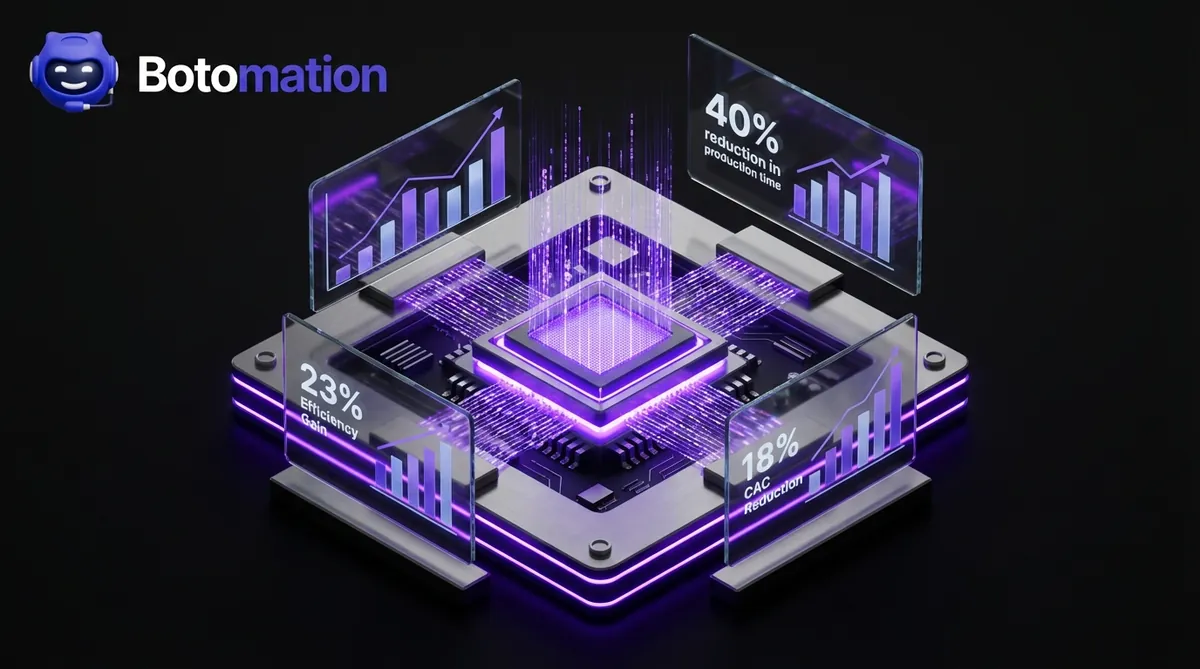
How do you know if your AI investment is actually working? Many business owners look at their bank account at the end of the month, but that is a lagging indicator. To truly understand the impact of AI, you need to track leading indicators of efficiency and value. We have observed that the average SME can expect a 32% time savings in automated departments and an 18% revenue increase within the first year of a proper implementation.
Calculating the ROI of AI requires looking at both direct cost savings and "opportunity value." If your head of operations is no longer spending 10 hours a week on manual reporting, what is the value of those 10 hours applied to strategic growth? Most businesses undervalue this "recovered time," but it is often where the real transformation occurs.
What Are the Best KPIs for Measuring AI Success?
To obtain a clear picture of success, you must track a mix of quantitative and qualitative metrics. Quantifiable metrics include hours saved by replacing manual data entry, reduction in error rates, and the "Cost Per Automated Task." If a human employee costs $45 per hour and an AI agent can perform the same task for $0.10, the math is simple and compelling. However, do not ignore qualitative measures like employee engagement. When you remove the "drudge work" from your team's plate, job satisfaction and retention rates typically skyrocket.
Visualizing these KPIs over time is essential. We recommend a simple dashboard that shows the "Human vs. AI" workload split. As the AI takes on more of the routine tasks, you should see your human team's output shifting toward higher-value activities. If you do not see this shift, it suggests you haven't properly reallocated your human resources after the AI implementation.
How to Calculate AI ROI for Small Businesses?
Calculating AI ROI for small businesses is more straightforward than many realize. Let's look at a typical customer service example for an SME.
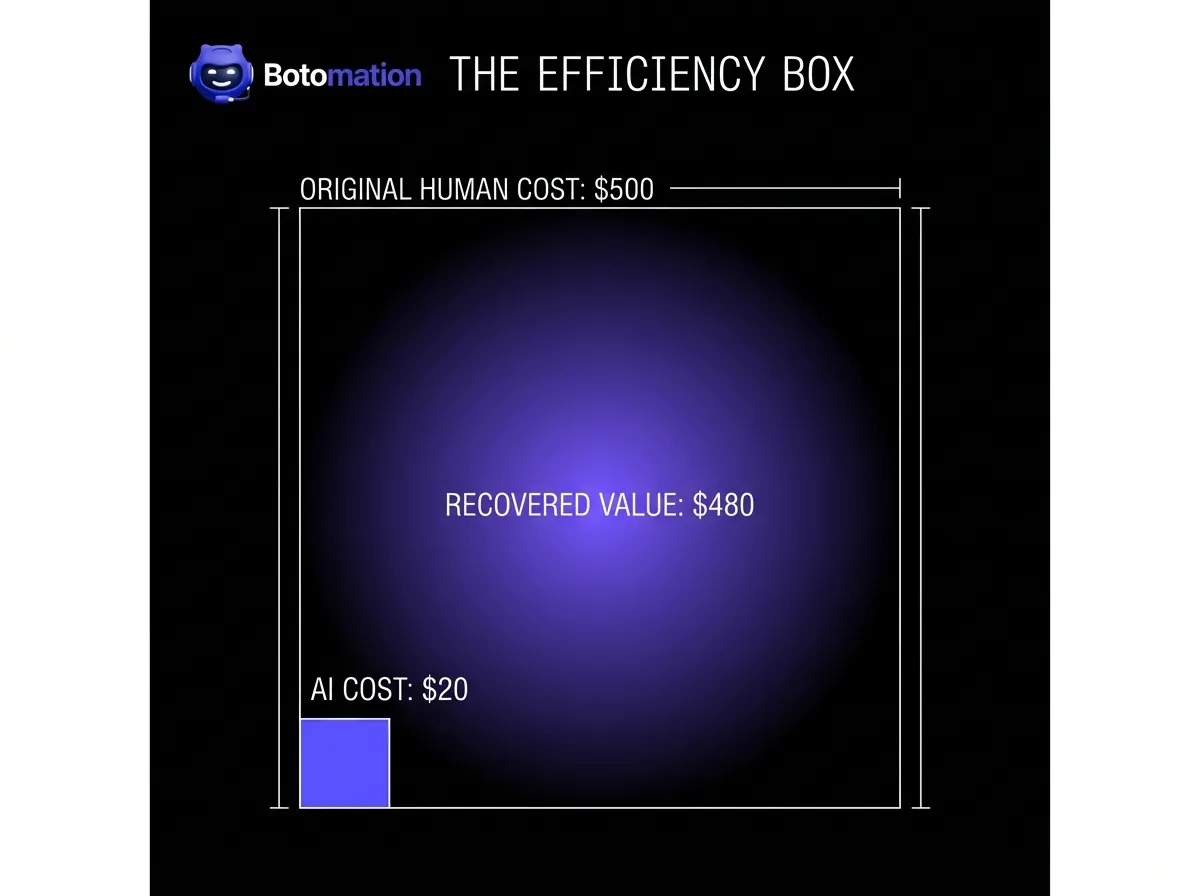
The Botomation Efficiency Box: ROI Calculation
- Human Cost: One support rep earns $45,000 base + $11,250 in benefits/taxes = $56,250 total annual cost.
- Capacity: That rep handles 8,000 tickets per year. Cost per ticket = $7.03.
- AI Implementation: A custom AI agent handles 60% of these tickets (4,800 tickets) with zero human intervention.
- AI Operating Cost: Including maintenance and API fees, the cost is roughly $0.50 per ticket.
- Annual Savings: (4,800 tickets $7.03) - (4,800 tickets $0.50) = $31,344 saved per rep.
- Total Impact: For a team of 5 reps, that is $156,720 in annual recovered value.
The timeline for seeing these returns varies by department. Customer service usually shows a positive ROI within 3 to 6 months because the volume of tasks is high. Sales and marketing may take 6 to 12 months to show full results, as the AI needs time to learn the nuances of your customer base and optimize the lead-to-close journey.
Best Practices for AI Integration and Change Management
The biggest hurdle to AI adoption is not the technology; it is the people. Change management is the "secret sauce" of successful implementation. If your team fears that the AI is there to replace them, they may subconsciously or consciously sabotage the rollout. You must frame AI as a tool that upgrades their role, turning them from "doers" into "editors" and "strategists."
Future-proofing your strategy is also vital. The AI world moves fast, and the "state of the art" changes every few months. By building on a foundation of custom code rather than relying on a single third-party app, you ensure that your business remains agile. You can swap out the underlying AI model (e.g., moving from GPT-5 to a future version) without having to rebuild your entire workflow.
Change Management for AI Adoption
Resistance usually stems from a lack of understanding. We recommend "AI Town Halls" where leadership transparently explains why the technology is being introduced and how it will help the company grow without overworking the current staff. Training programs should be tailored to different roles. A salesperson doesn't need to know how the neural network works; they just need to know how to use AI-generated insights to close more deals.
Success in change management is measured by adoption rates. Are people actually using the new tools, or are they finding workarounds to keep doing things the old way? High adoption only happens when the AI actually makes the employee's life easier. If the tool is clunky or slow, they will abandon it. This is why enterprise-grade speed and a frictionless user interface are non-negotiable requirements for any AI project we undertake.
Technical Integration Best Practices
From a technical standpoint, data privacy and security must be at the forefront. In 2026, SMEs are under the same regulatory scrutiny as large corporations regarding how they handle customer data within AI models. Ensure that your implementation is compliant with current standards and that your data is never used to train public models unless you explicitly allow it.
Scalability is the final piece of the puzzle. Your AI infrastructure should be built to handle 10x your current volume. If your business doubles in size next year, your AI agents should not need a promotion or a raise—they should just continue working. This decoupling of growth from headcount is the ultimate goal of the "New Way" of business operations.
Frequently Asked Questions
Will implementing AI mean I have to fire my current team?
Not necessarily. Most of our partners find that AI allows them to scale their revenue without increasing their headcount. Instead of firing people, they are able to move their best employees away from repetitive tasks and into roles that focus on strategy, creativity, and high-level client relationships. It turns a staffing problem into a growth opportunity.
How much does a custom AI implementation actually cost for an SME?
While prices vary based on complexity, a custom-coded AI engine is often more cost-effective in the long run than a dozen different SaaS subscriptions. Initial setups can range from a few thousand to tens of thousands of dollars, but the ongoing operating costs are significantly lower than hiring additional staff. Most businesses see a full return on their investment within the first 6 to 9 months.
Is my business data safe when using these AI models?
Security is a top priority in 2026. When you work with an agency like Botomation, we ensure that your data is siloed and protected. We use enterprise-grade APIs and private instances to ensure that your proprietary business information and customer data are never leaked into the public AI or used to train models for your competitors.
How long does it take to see real results from AI?
You will often see immediate improvements in speed and task completion. However, the full financial impact usually matures over 3 to 6 months as the system is optimized and your team becomes fully proficient in working alongside the AI agents.
Do I need a full-time IT person to manage the AI?
No. One of the primary benefits of partnering with an agency is that we handle the technical heavy lifting. We build the systems to be user-friendly for your existing team and provide the necessary support and updates so you can focus on running your business, not managing code.
The seven-step framework we have outlined provides a clear path through the noise of the current AI landscape. By identifying your most painful bottlenecks, selecting the right custom solutions, and focusing on thorough change management, you can transform your SME into a high-speed, automated revenue engine. The "Old Way" of manual, slow, and expensive operations is a relic of the past. The "New Way"—powered by custom code and intelligent AI agents—is the only way to remain competitive in 2026 and beyond.
Starting small is important, but starting now is critical. Every day you wait is a day your competitors are using these tools to lower their costs and capture your market share. The technology is ready, the ROI is proven, and the path is clear. Partnering with a team that understands both the technical complexity of AI and the practical needs of a growing business is the most logical step you can take for your company's future.
Ready to automate your growth? Book a call below.
The business landscape in late 2026 looks fundamentally different than it did even eighteen months ago. For forward-thinking leaders, implementing AI in small to medium businesses has become the primary differentiator between companies that scale effortlessly and those that buckle under the weight of their own manual processes. Traditional growth strategies, which relied on increasing headcount to solve operational bottlenecks, have hit a wall of diminishing returns. Rising labor costs and the sheer speed of market shifts mean that throwing more personnel at a problem is often the fastest way to erode your margins while hindering sustainable AI business growth.
As we move through January 2026, data indicates a massive shift in how the most successful mid-market companies operate. The shift toward small business automation is undeniable; they aren't just using AI to draft emails; they are rebuilding their entire operational core around intelligent automation. This guide provides a comprehensive roadmap for implementing these technologies, moving beyond the hype of basic chatbots to the reality of revenue-generating AI agents. We will explore a proven seven-step framework and examine real-world case studies where businesses have successfully bridged the gap between complex technology and practical, bottom-line results.
The 2026 Landscape for Implementing AI in Small to Medium Businesses
The era of "experimenting" with AI is officially over for the mid-market. According to recent 2026 research from McKinsey & Company, 68% of SMEs have now integrated AI into at least one core business function. This is no longer a trend; it is a structural realignment of the economy. In previous years, high-level automation was the exclusive playground of Fortune 500 companies with multi-million dollar R&D budgets. Today, the democratization of enterprise-grade intelligence means a 50-person manufacturing firm can deploy the same level of cognitive automation as a global conglomerate.
The technical bar has shifted significantly with the widespread adoption of GPT-5 and its sophisticated reasoning capabilities. Unlike its predecessors, GPT-5 allows for complex, multi-step problem solving that handles nuance and brand voice with startling accuracy. For SMEs, this means the "Old Way" of using disconnected SaaS tools that lack interoperability is being replaced by unified AI ecosystems. Our team at Botomation sees this daily: businesses are moving away from bloated legacy software and toward custom-coded environments where AI agents handle the heavy lifting 24/7.
What Are the Current Trends for Implementing AI in Small to Medium Businesses?
The 68% adoption rate among SMEs hides a deeper story about where value is actually being created. Customer service remains the leading edge of this transition, with 78% of automated businesses using AI customer service tools to handle first-tier and second-tier support inquiries. Marketing follows closely at 65%, where the focus has shifted from simple content generation to hyper-personalized lead nurturing. Operations and supply chain management sit at 52%, representing the fastest-growing sector as companies realize that predictive logistics can save millions in overhead.
Regional data suggests that while North American and European SMEs led the initial charge, we are seeing a massive surge in the Asia-Pacific region as they skip legacy software entirely in favor of AI-first infrastructure. Success metrics have also matured. Companies are no longer viewing "time saved" as a nebulous concept. They are tracking "Resolution Cost Per Ticket" and "Lead-to-Close Velocity," finding that AI implementation often reduces the former by 60% while increasing the latter by 30% or more.
Which AI Tools Drive Business Efficiency AI in 2026?
The release of GPT-5 has introduced "Agentic Workflows" to the average business owner. These are not merely chatbots that answer questions; they are agents capable of browsing the web, accessing internal databases, and executing tasks across different software platforms. For example, an AI agent can now receive an invoice, verify it against a purchase order in your ERP, flag discrepancies to a human manager, and schedule the payment once approved. This level of autonomy was unthinkable for a small business just a few years ago.
Visual content has seen a similar leap with Midjourney v7, which now offers perfect brand consistency and high-fidelity rendering for product photography. SMEs are using these AI tools for SMEs to generate entire marketing catalogs in hours rather than weeks, eliminating the need for expensive, time-consuming photoshoots. Furthermore, new niche tools released in 2026 have focused specifically on "Small Data" AI—systems that provide deep insights from the limited data sets typical of a medium-sized business, rather than requiring the massive "Big Data" repositories of the past.
| Implementation Metric | Traditional Manual Approach | Botomation AI Framework |
|---|---|---|
| Customer Support Response Time | 4 - 24 Hours | < 30 Seconds |
| Content Production Cost | $150 - $500 per piece | $5 - $20 per piece |
| Operational Error Rate | 5% - 8% (Human Error) | < 0.5% (Systematic) |
| Lead Response Speed | 2+ Hours | Instant (24/7) |
| Scalability Potential | Linear (Requires more staff) | Exponential (Requires more compute) |
A 7-Step Framework for Implementing AI in Small to Medium Businesses
Successfully integrating AI into a growing business requires more than just a subscription to a few tools; it requires a fundamental shift in how you view business processes. At Botomation, we transition our partners away from the "Old Way"—a patchwork of slow, expensive manual tasks—to the "New Way," where custom code and AI agents act as a force multiplier for your existing team. This transition is best handled through a structured, phased approach that minimizes risk while maximizing early wins.
One of our partners, a mid-sized logistics firm, recently followed this framework to overhaul their dispatching and billing using automated workflows. By the end of the implementation, they saw a 35% increase in overall productivity without adding a single new head to their administrative team. The key was not just the technology; it was the systematic AI implementation strategy used during the transition.
How Do You Start a Small Business Automation Project?
The first mistake many founders make is trying to "AI-ify" everything at once. This leads to complexity and employee burnout. Instead, start by auditing your current workflows to find high-impact, low-effort opportunities. Look for tasks that are repetitive, data-heavy, and prone to human error. A classic example is a retail company that identified inventory management as its primary bottleneck. By focusing AI implementation solely on predicting stockouts and automating reorders, they solved their most painful problem first before moving on to other departments.
How Do You Select an AI Implementation Strategy?
Once you know what to fix, you need to decide how to fix it. The market is flooded with "AI-powered" SaaS apps, but many are thin wrappers around basic models that offer little real value. For an SME, the choice is usually between off-the-shelf software or partnering with an agency like Botomation to build a custom solution. Custom solutions are almost always superior because they integrate directly with your existing legacy systems and can be tailored to your specific brand voice and data privacy requirements.
What Are the Phased Steps for Successful AI Integration?
- Phase the Rollout: Start with a pilot program in one department. This allows you to resolve technical challenges in a controlled environment before a company-wide launch.
- Employee Training: AI should be viewed as a "co-pilot" rather than a replacement. Comprehensive training ensures your team knows how to prompt the AI and, more importantly, how to verify its output.
- Establish KPIs: You cannot manage what you do not measure. Track specific metrics like "Human Intervention Rate" to determine how often your team must assist the AI.
- Data Feedback Loops: Use the errors identified in the monitoring phase to retrain your models. This creates a system that grows more intelligent through usage.
- Scale and Iterate: Once the pilot is successful, move the framework into the next department, using lessons learned to accelerate subsequent implementations.
Real-World Case Studies: AI Success Stories from Small and Medium Businesses
The power of AI is best understood through the lens of those who have already crossed the chasm. We see a consistent pattern: businesses that embrace custom AI agents stop competing on price and start competing on efficiency and experience. When you can respond to a lead in four seconds while your competitor takes four hours, the "Old Way" of doing business simply cannot compete. These case studies highlight how different industries are utilizing these tools to achieve outsized results.
Average time savings across these implementations often hover around 15 hours per week per employee. Imagine what your senior leadership could accomplish if they regained two full workdays every week. This is not just about speed; it is about shifting your most expensive human capital away from "busy work" and toward high-level strategy and relationship building.
Marketing Agency Case Study: 42% Revenue Growth
A 50-employee marketing agency was struggling with the classic "scale-up" problem. As they acquired more clients, their overhead for content creation and client reporting exploded, eroding profit margins. They were trapped in a cycle of hiring more junior writers just to maintain operations. By partnering with our experts, they replaced their manual drafting process with a custom AI content engine that understood each client's unique brand guidelines.
The results were transformative. They achieved a 42% increase in revenue because they could suddenly handle nearly double the client load with the same staff. Content creation time dropped by 60%, and because the AI could analyze campaign data in real-time, their client reporting became more accurate and proactive. The turning point came when they realized they could now offer premium, data-driven services that were previously too labor-intensive to be profitable.
Manufacturing SME Case Study: 28% Cost Reduction
In the manufacturing sector, margins are often razor-thin, and operational errors can be devastating. A medium-sized parts manufacturer was facing rising costs and a 7% defect rate that was damaging their reputation. They implemented a two-pronged AI strategy: predictive maintenance for machinery and an AI-driven vision system for quality control. This was not a generic software fix; it was a custom integration that communicated directly with their floor hardware.
In the first year alone, they saw a $2.3M reduction in operational costs. Predictive maintenance allowed them to repair machines before they failed, eliminating unplanned downtime that previously cost $15,000 per hour. The quality control AI reduced their defect rate from 7% to less than 1%, nearly eliminating expensive product returns and warranty claims. This case study proves that AI has a massive, tangible impact on the physical world of production.
Key Takeaway: AI implementation is not an "all or nothing" proposition. The most successful SMEs start with a specific, measurable pain point and build outward once they have proven the ROI.
AI Tools by Business Function: Comprehensive Comparison for SMEs
Choosing the right tech stack is where many SMEs get bogged down. The 2026 market offers everything from $10/month browser extensions to $50,000/month enterprise platforms. For a growing business, the ideal choice lies in tools that offer deep integration capabilities. You do not want another "island of data"; you want a connected system where your customer service AI knows what your sales AI just promised a client. Leveraging business efficiency AI means ensuring these tools talk to each other.
The return on investment for these tools is no longer theoretical. Based on our 2026 analysis, the best AI marketing tools are delivering an average of $4.50 for every $1 invested. This is driven by better lead scoring and the ability to send the right message at the exact moment a prospect is ready to buy. When compared to the "Old Way" of manual email blasts and cold calling, the efficiency gap is staggering.
Customer Service AI Tools Comparison
The landscape of customer support has been revolutionized by "Reasoning Agents." While tools like Zendesk AI and Intercom have made great strides, we often find that SMEs benefit most from custom AI agents that can actually take actions in the company's backend. A standard chatbot might tell a customer where their package is; a Botomation-built agent can actually process the refund or change the shipping address without human intervention.
Success metrics for these implementations are at an all-time high, with a 78% average customer satisfaction rate for AI-powered support. The key is the "Seamless Handoff"—the ability for the AI to recognize when a human touch is required and pass the conversation over with a full summary of the interaction. This prevents the frustration of repetitive explanations that kills customer loyalty.
Marketing and Sales AI Tools Analysis
In 2026, marketing AI has moved far beyond simple copywriting. Tools like HubSpot AI and advanced custom integrations now focus on "Predictive Intent." They analyze user behavior across your website and social media to identify which leads are actually ready to purchase, allowing your sales team to focus their energy where it matters most. This lead scoring is now so accurate that it can predict a conversion with over 85% certainty.
The integration of these tools with your existing CRM is the most critical factor for success. If your AI marketing tool doesn't know that a customer just had a negative support experience, it might send a review request at the wrong time. A unified approach, which is the cornerstone of our services at Botomation, ensures that every piece of the business works in harmony, creating a "revenue engine" rather than just a collection of apps.
Measuring ROI and Success: AI Investment Tracking Framework
How do you know if your AI investment is actually working? Many business owners look at their bank account at the end of the month, but that is a lagging indicator. To truly understand the impact of AI, you need to track leading indicators of efficiency and value. We have observed that the average SME can expect a 32% time savings in automated departments and an 18% revenue increase within the first year of a proper implementation.
Calculating the ROI of AI requires looking at both direct cost savings and "opportunity value." If your head of operations is no longer spending 10 hours a week on manual reporting, what is the value of those 10 hours applied to strategic growth? Most businesses undervalue this "recovered time," but it is often where the real transformation occurs.
What Are the Best KPIs for Measuring AI Success?
To obtain a clear picture of success, you must track a mix of quantitative and qualitative metrics. Quantifiable metrics include hours saved by replacing manual data entry, reduction in error rates, and the "Cost Per Automated Task." If a human employee costs $45 per hour and an AI agent can perform the same task for $0.10, the math is simple and compelling. However, do not ignore qualitative measures like employee engagement. When you remove the "drudge work" from your team's plate, job satisfaction and retention rates typically skyrocket.
Visualizing these KPIs over time is essential. We recommend a simple dashboard that shows the "Human vs. AI" workload split. As the AI takes on more of the routine tasks, you should see your human team's output shifting toward higher-value activities. If you do not see this shift, it suggests you haven't properly reallocated your human resources after the AI implementation.
How to Calculate AI ROI for Small Businesses?
Calculating AI ROI for small businesses is more straightforward than many realize. Let's look at a typical customer service example for an SME.
The Botomation Efficiency Box: ROI Calculation
- Human Cost: One support rep earns $45,000 base + $11,250 in benefits/taxes = $56,250 total annual cost.
- Capacity: That rep handles 8,000 tickets per year. Cost per ticket = $7.03.
- AI Implementation: A custom AI agent handles 60% of these tickets (4,800 tickets) with zero human intervention.
- AI Operating Cost: Including maintenance and API fees, the cost is roughly $0.50 per ticket.
- Annual Savings: (4,800 tickets $7.03) - (4,800 tickets $0.50) = $31,344 saved per rep.
- Total Impact: For a team of 5 reps, that is $156,720 in annual recovered value.
The timeline for seeing these returns varies by department. Customer service usually shows a positive ROI within 3 to 6 months because the volume of tasks is high. Sales and marketing may take 6 to 12 months to show full results, as the AI needs time to learn the nuances of your customer base and optimize the lead-to-close journey.
Best Practices for AI Integration and Change Management
The biggest hurdle to AI adoption is not the technology; it is the people. Change management is the "secret sauce" of successful implementation. If your team fears that the AI is there to replace them, they may subconsciously or consciously sabotage the rollout. You must frame AI as a tool that upgrades their role, turning them from "doers" into "editors" and "strategists."
Future-proofing your strategy is also vital. The AI world moves fast, and the "state of the art" changes every few months. By building on a foundation of custom code rather than relying on a single third-party app, you ensure that your business remains agile. You can swap out the underlying AI model (e.g., moving from GPT-5 to a future version) without having to rebuild your entire workflow.
Change Management for AI Adoption
Resistance usually stems from a lack of understanding. We recommend "AI Town Halls" where leadership transparently explains why the technology is being introduced and how it will help the company grow without overworking the current staff. Training programs should be tailored to different roles. A salesperson doesn't need to know how the neural network works; they just need to know how to use AI-generated insights to close more deals.
Success in change management is measured by adoption rates. Are people actually using the new tools, or are they finding workarounds to keep doing things the old way? High adoption only happens when the AI actually makes the employee's life easier. If the tool is clunky or slow, they will abandon it. This is why enterprise-grade speed and a frictionless user interface are non-negotiable requirements for any AI project we undertake.
Technical Integration Best Practices
From a technical standpoint, data privacy and security must be at the forefront. In 2026, SMEs are under the same regulatory scrutiny as large corporations regarding how they handle customer data within AI models. Ensure that your implementation is compliant with current standards and that your data is never used to train public models unless you explicitly allow it.
Scalability is the final piece of the puzzle. Your AI infrastructure should be built to handle 10x your current volume. If your business doubles in size next year, your AI agents should not need a promotion or a raise—they should just continue working. This decoupling of growth from headcount is the ultimate goal of the "New Way" of business operations.
Frequently Asked Questions
Will implementing AI mean I have to fire my current team?
Not necessarily. Most of our partners find that AI allows them to scale their revenue without increasing their headcount. Instead of firing people, they are able to move their best employees away from repetitive tasks and into roles that focus on strategy, creativity, and high-level client relationships. It turns a staffing problem into a growth opportunity.
How much does a custom AI implementation actually cost for an SME?
While prices vary based on complexity, a custom-coded AI engine is often more cost-effective in the long run than a dozen different SaaS subscriptions. Initial setups can range from a few thousand to tens of thousands of dollars, but the ongoing operating costs are significantly lower than hiring additional staff. Most businesses see a full return on their investment within the first 6 to 9 months.
Is my business data safe when using these AI models?
Security is a top priority in 2026. When you work with an agency like Botomation, we ensure that your data is siloed and protected. We use enterprise-grade APIs and private instances to ensure that your proprietary business information and customer data are never leaked into the public AI or used to train models for your competitors.
How long does it take to see real results from AI?
You will often see immediate improvements in speed and task completion. However, the full financial impact usually matures over 3 to 6 months as the system is optimized and your team becomes fully proficient in working alongside the AI agents.
Do I need a full-time IT person to manage the AI?
No. One of the primary benefits of partnering with an agency is that we handle the technical heavy lifting. We build the systems to be user-friendly for your existing team and provide the necessary support and updates so you can focus on running your business, not managing code.
The seven-step framework we have outlined provides a clear path through the noise of the current AI landscape. By identifying your most painful bottlenecks, selecting the right custom solutions, and focusing on thorough change management, you can transform your SME into a high-speed, automated revenue engine. The "Old Way" of manual, slow, and expensive operations is a relic of the past. The "New Way"—powered by custom code and intelligent AI agents—is the only way to remain competitive in 2026 and beyond.
Starting small is important, but starting now is critical. Every day you wait is a day your competitors are using these tools to lower their costs and capture your market share. The technology is ready, the ROI is proven, and the path is clear. Partnering with a team that understands both the technical complexity of AI and the practical needs of a growing business is the most logical step you can take for your company's future.
Ready to automate your growth? Book a call below.
Get Started
Book a FREE Consultation Right NOW!
Schedule a Call with Our Team To Make Your Business More Efficient with AI Instantly.
Read More
Implementing AI in Small to Medium Businesses - 2026 Guide
Master implementing AI in small to medium businesses. Our 2026 guide covers AI agents, operational efficiency, ROI, and SME automation strategies.
How to Scale Business Operations without Hiring More Staff in 2026
Learn how WhatsApp AI slashes support costs for e-commerce & SaaS. Proven strategies to boost sales, recover carts, and scale 24/7 service.