How to Eliminate Data Silos Between Business Applications in 2026
Jan 8, 2026
AI Automation
Data Integration
Enterprise Tech
AI Automation
Data Integration
Enterprise Tech
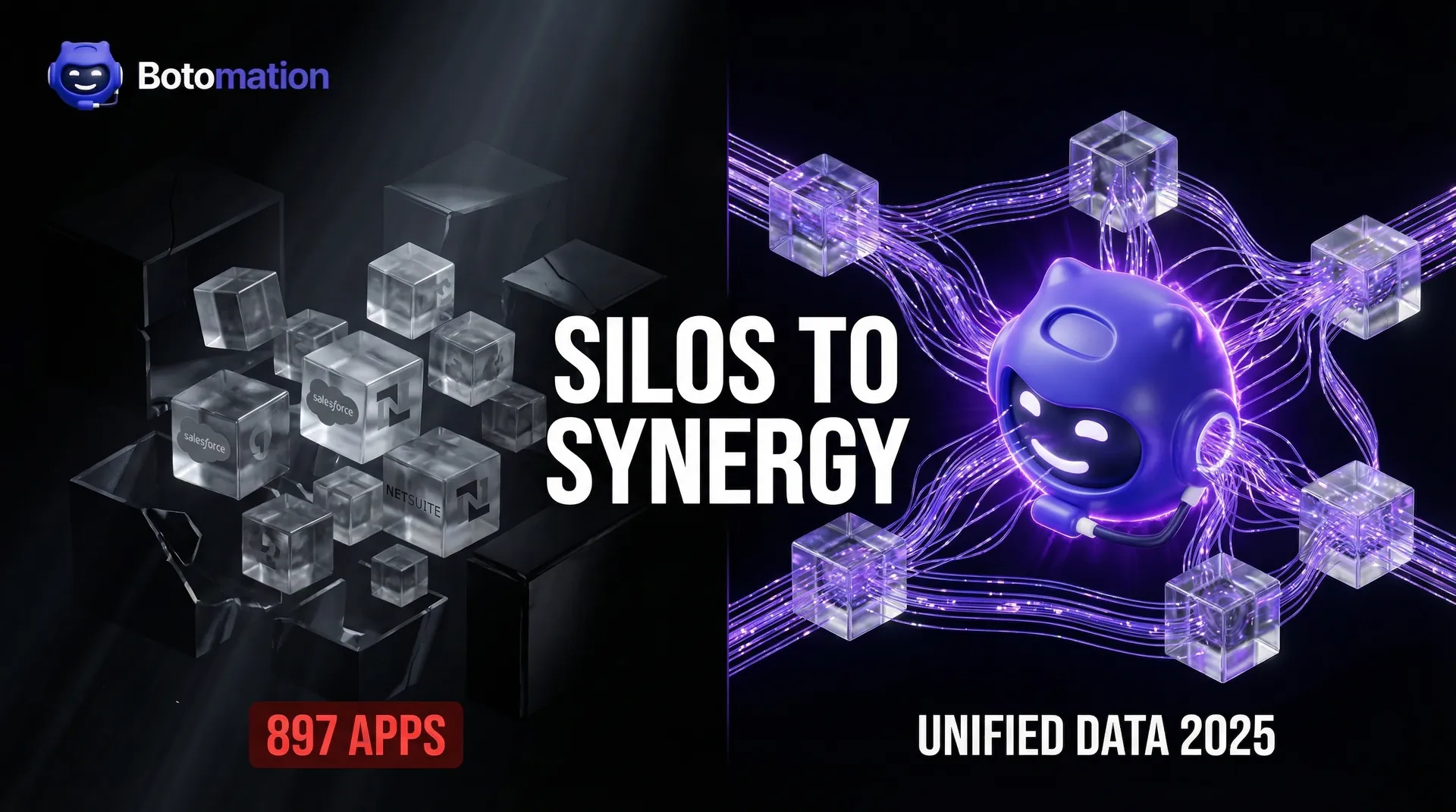
In late 2026, the most significant obstacle to enterprise growth is the fragmentation of information. To maintain a competitive edge, organizations must learn how to eliminate data silos between business applications to ensure a seamless data flow business-wide. The modern enterprise is currently navigating a complex sea of specialized applications. While the promise of the "best-of-breed" software movement was to provide teams with precise tools to excel, the unintended consequence has been the proliferation of digital fortresses. These data silos—isolated pockets of information that remain inaccessible to other departments or systems—have become the silent inhibitors of operational efficiency.
By late 2026, the saturation of business applications has reached an all-time high. Recent industry data suggests that the average mid-market company now manages nearly 900 distinct applications across various departments. Each tool generates unique data, utilizes proprietary formats, and often requires manual intervention to share insights across the organization. This fragmentation leads to a "Silo Tax"—a hidden cost paid in wasted labor, missed opportunities, and strategic blindness. To remain competitive, businesses must move beyond simple software adoption and focus on creating a unified data ecosystem where information flows as freely as the electricity powering the servers.
Eliminating data silos between business applications is no longer an optional IT project; it is a fundamental requirement for any organization aiming to scale. This transition requires a shift from viewing software as a collection of independent tools to seeing it as a singular, interconnected nervous system. Our team at Botomation specializes in building this connective tissue, ensuring that your data serves your business goals rather than acting as a barrier to them.
Why Should You Eliminate Data Silos Between Business Applications?
A data silo is more than just a technical hurdle; it is a structural failure where information is trapped within a single department or software application. In most organizations, these silos emerge naturally. A marketing team adopts a new lead generation tool, the finance department upgrades its accounting software, and the operations team implements a custom inventory management system. Without a proactive strategy to connect these systems, they become islands of information.
The 2026 Data Landscape
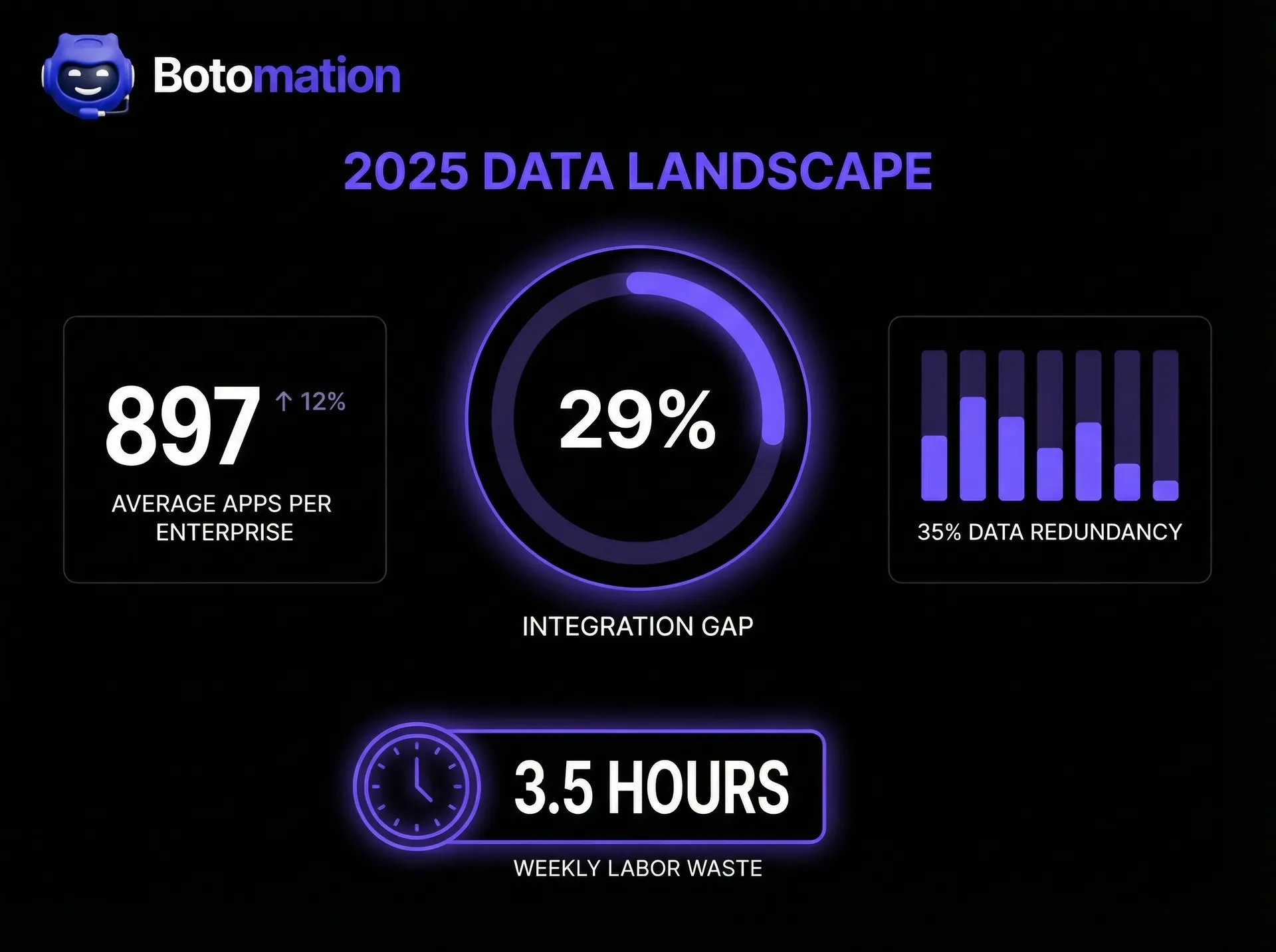
- Average Apps per Enterprise: 897 (up 12% from 2023)
- Data Duplication Rate: 35% of all enterprise data is redundant or conflicting
- Labor Waste: Employees spend an average of 3.5 hours per week manually moving data between tools
- Integration Gap: Only 29% of business applications are currently integrated with one another
The business consequences of these silos are profound. When data is locked away, productivity plummets because employees must spend time performing "data janitor" work—manually exporting CSV files from one tool and importing them into another. This manual process is the primary entry point for human error. Modern organizations are discovering how AI agents replace manual data entry work to prevent a single typo in a customer’s shipping address from cascading into a customer service crisis or a compliance violation.
How Do You Identify Data Silos in Your Organization?
Recognizing a silo problem is the first step toward a solution. The most obvious sign is the "manual bridge"—if your employees are frequently copy-pasting information from your CRM into a spreadsheet, you can automate data transfer between Google Sheets and business apps to eliminate the silo. Another red flag is departmental friction. When the sales team claims they hit their targets but the finance team shows different revenue figures, the discrepancy is almost always rooted in disconnected data sources. You might also notice that customer inquiries take longer to resolve because support agents must log into three different systems to view a customer’s full history.
How Much Do Data Silos Cost Your Business?
To understand the true impact, we must analyze the hard numbers. Consider a mid-sized service business with 50 employees. If each employee spends just 30 minutes a day on manual data entry or searching for information across systems, that totals 125 hours of lost productivity per week. At an average loaded labor rate of $45 per hour, this "Silo Tax" costs the company $5,625 every single week, or nearly $300,000 per year.
Inconsistent information also leads to high rework costs. When an operations team builds a product or delivers a service based on outdated specifications found in a siloed document, the entire project may need to be redone. The opportunity cost is perhaps the most painful metric. In 2026, speed is a primary competitive advantage. If your competitor can process a lead and send a personalized proposal in five minutes because their systems are integrated, while your team takes five hours to manually gather data, you have already lost the deal.
What Are the Best Strategies to Eliminate Data Silos Between Business Applications?
Breaking down silos requires a dual-track approach addressing both organizational culture and technical infrastructure. Many leaders mistakenly believe that purchasing a new "all-in-one" software platform will solve the problem. In reality, these platforms rarely cover every niche need of a growing business, and you often end up creating one massive, expensive silo. The modern way of operating involves acknowledging that you will always use multiple tools while ensuring you connect disparate software tools for business automation so they are fundamentally designed to communicate with each other.
Our experts at Botomation advocate for a strategy centered on interoperability. This means moving away from a "hoarding" mindset where departments own their data, toward a "stewardship" mindset where data is a shared corporate asset. This transition is often the most challenging part of the process, requiring leadership to dismantle the territorial walls departments build around their processes.
Organizational and Cultural Changes
Data governance is the backbone of any successful integration project. This does not require a 200-page manual; it means establishing clear rules about which system is the "Source of Truth" for specific data points. For example, you might decide that your CRM is the master record for customer contact information, while your ERP is the master record for financial transactions. When everyone agrees on where primary data lives, the confusion of having multiple versions of the same record disappears.
What Are the Technical Approaches to Integration?
From a technical perspective, the focus in 2026 has shifted toward API-first architecture. When evaluating new business applications, the primary question should no longer be "What are the features?" but rather "How well does it communicate with our other tools?" Modern APIs (Application Programming Interfaces) allow different software programs to exchange data in real-time without human intervention.
Implementing robust integration platform solutions allows you to bypass the limitations of "out-of-the-box" connectors and build custom workflows that match your exact business logic. Middleware and Integration Platforms as a Service (iPaaS) have become the standard for connecting disparate systems. These tools act as a universal translator, taking data from legacy accounting software and formatting it so modern marketing automation tools can understand it.
Data Synchronization Between Business Applications
Data synchronization ensures that two or more systems contain the same up-to-date information. To master this, businesses should follow a complete guide to automated data sync for CRM and email marketing to ensure the "glue" of your business infrastructure demonstrates its value. Without reliable synchronization, you suffer from "data drift," where systems that were once in sync slowly diverge until they are no longer useful. In 2026, the standard for synchronization has moved beyond simple one-way pushes to complex, multi-directional flows that handle logic, filtering, and data transformation on the fly.
To achieve reliable synchronization, you must consider the "Three Vs" of data: Volume, Velocity, and Variety. Our approach at Botomation involves building resilient pipelines that handle spikes in data volume without breaking. We also implement "idempotency" in our integrations, ensuring that if a sync occurs twice by mistake, it will not create duplicate records or compromise your financial books.
Real-Time vs Batch Data Synchronization
The choice between real-time and batch synchronization depends entirely on the business use case. Real-time synchronization is essential for customer-facing operations. If a customer updates their email address on your website, that change should be reflected in your support desk and email marketing tool instantly. Real-time flows usually rely on webhooks—small bits of code that "fire" an update the moment an action occurs.
How to Ensure Data Quality During Synchronization?
Synchronization is only as effective as the quality of the data being moved. If you sync "garbage" data from one system to another, you are not solving a problem; you are spreading it. This is why data entry validation best practices and cleansing are critical components of the integration process. Before data enters a new system, it should be checked for completeness and accuracy.
Conflict resolution is another major hurdle. What happens if a record is updated in two different systems at the exact same time? You need a "tie-breaker" rule. Typically, we set the system with the highest level of authority (the Source of Truth) to win in the event of a conflict. Monitoring is the final piece of the puzzle. You need a dashboard that displays the health of your integrations, alerting you the moment a sync fails so it can be fixed before it impacts the business.
Business Application Consolidation and Integration
As businesses grow, they often suffer from "App Creep." Consolidation is the process of auditing your current software stack and identifying where you can simplify. This is not just about saving money on subscriptions; it is about reducing the "attack surface" for errors and security breaches. The goal of consolidation is to reach a "lean" stack where every tool serves a clear, non-redundant purpose, often requiring organizations to replace legacy systems with custom web development.
Inventory and Assessment of Business Systems
The first step in any consolidation project is a thorough inventory. You cannot fix what you cannot see. Our team starts by cataloging every application used across the organization, including "Shadow IT" that employees might be using without official approval. Mapping these data flows often reveals shocking inefficiencies. You might find that a single piece of customer information is being manually entered into four different places.
Planning Consolidation and Integration Projects
Once the assessment is complete, we move into the planning phase. We prioritize integrations based on a combination of business value and technical complexity, looking for "Quick Wins"—integrations that are relatively easy to implement but provide massive time savings. A phased approach is essential for minimizing risk. We do not recommend attempting to connect every system at once. Instead, we build, test, and deploy one workflow at a time.
How to Eliminate Data Silos: A Step-by-Step Tutorial
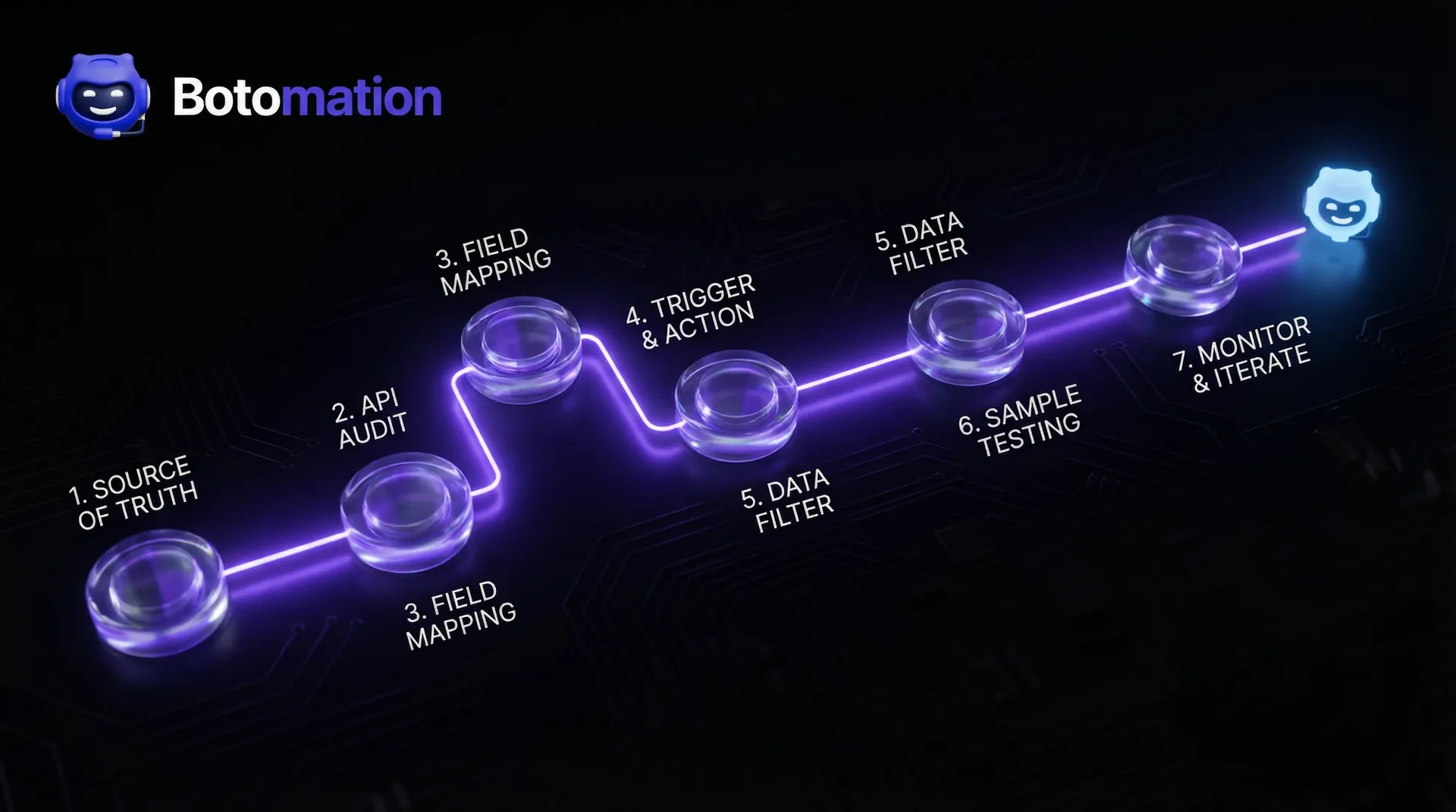
Implementing a data integration strategy can seem daunting, but it becomes manageable when broken down into a logical sequence. By adopting a workflow automation business model, you can follow this framework to begin connecting your business applications.
- Identify the Source of Truth: For every major data category (Customers, Products, Orders, Employees), designate one primary application as the master record. All other systems will be secondary.
- Audit Your API Access: Check the settings of your core business applications to ensure they have API access enabled. Some "Basic" software tiers lock this feature behind an "Enterprise" paywall.
- Map the Data Fields: Create a simple table showing how fields in System A correspond to fields in System B. For example, "First_Name" in your CRM might map to "GivenName" in your accounting software.
- Establish a Trigger and Action: Define exactly what should start the automation. A common trigger is "New Lead in Website Form," and the action is "Create Contact in CRM."
- Build a Filter Step: Do not sync everything. Add a filter to your workflow so only "Qualified Leads" move from your marketing tool to your sales CRM. This keeps your primary systems clean.
- Test with Sample Data: Never run a new integration on your entire database first. Use five test records to ensure the data lands in the right place and is formatted correctly.
- Monitor and Iterate: Once live, check your integration logs daily for the first week. Refine the logic as you observe how the data behaves in a real-world environment.
Security and Compliance Considerations When Connecting Applications
In an era of increasing cyber threats and strict data privacy regulations, connecting your applications adds a layer of complexity to your security posture. Every time data moves between systems, it is potentially vulnerable. In 2026, "security by design" is not just a buzzword; it is a legal and operational necessity.
Data Security for Integrated Systems
The gold standard for securing data in transit is end-to-end encryption. When we build integrations at Botomation, we ensure that data is encrypted using modern protocols (like TLS 1.3) as it moves between APIs. We also utilize OAuth 2.0 for authentication, which allows systems to communicate securely without ever sharing actual passwords.
Regulatory Compliance for Connected Applications
Navigating the landscape of international data laws requires a proactive approach. In 2026, many jurisdictions have updated laws to cover AI-driven data processing and automated decision-making. Documentation is the key to compliance. You need to be able to show regulators exactly how data flows through your organization and what protections are in place at each step.
Measuring Success and ROI After Eliminating Data Silos
The ultimate goal of connecting your business applications is to improve the bottom line. However, many companies fail to measure the results of their integration projects, making it difficult to justify the investment. To truly understand the value of breaking down silos, you must look at both quantitative metrics (like hours saved) and qualitative improvements (like reduced employee burnout).
Tracking Performance Metrics
Productivity is the most immediate metric to track. If your administrative team used to spend 20 hours a week on manual billing and now spends two hours, you have reclaimed 18 hours of high-value time. You should also look at "Data Latency"—the time it takes for information to travel from one system to another. In a siloed environment, latency is often measured in days. In a connected environment, it should be measured in seconds.
Calculating Financial ROI
To calculate the hard ROI, we use a simple formula: (Value of Time Saved + Value of Error Reduction + Value of Increased Revenue) - Cost of Integration = ROI.
Let's look at a real-world example. A professional services firm partners with Botomation to automate their client onboarding process.
- Time Saved: 15 hours per week across the team. At $50/hour, that’s $39,000 per year.
- Error Reduction: Elimination of 2 major billing errors per year that previously cost $5,000 each in lost revenue. That's $10,000 per year.
- Increased Revenue: Faster onboarding allows them to take on 2 extra clients per year, worth $20,000 in additional profit.
- Total Annual Value: $69,000.
If the cost of the integration project was $20,000, the firm achieves a 245% ROI in the first year alone. These numbers show why partnering with experts is an investment, not an expense.
Frequently Asked Questions
What is the biggest challenge when eliminating data silos?
The biggest challenge is rarely technical; it is cultural. Departments often feel a sense of "ownership" over their data and may be hesitant to share it. Overcoming this requires strong leadership and a clear explanation of how data transparency benefits everyone.
Do I need to replace all my current software to fix silos?
No. In fact, replacing all your software at once is often a recipe for disaster. The better approach is to use integration experts like Botomation to connect your existing, high-performing tools.
How long does it take to see results from an integration project?
While complex enterprise-wide integrations can take months, many high-impact automations can be deployed in just a few weeks. Most of our clients see a significant reduction in manual workload and data errors within the first 30 days.
Is my data safe when it’s being moved between applications?
Yes, provided the integration is built using modern security standards. We use enterprise-grade encryption and secure authentication protocols to ensure your data is protected at every step of its journey.
The Path to a Frictionless Future
Eliminating data silos between business applications is the single most effective way to future-proof your operations in 2026. The "Silo Tax" is a burden your business no longer needs to carry. By shifting from a fragmented collection of tools to a unified, automated ecosystem, you empower your team to focus on high-value strategy rather than low-value data entry.
The old way of operating—where information is trapped in departmental islands and growth is hindered by manual processes—is rapidly becoming obsolete. Achieving this level of sophistication requires more than just software; it requires the expertise of a partner who understands how to weave these technologies into the fabric of your unique business.
Our team at Botomation is dedicated to being that partner. We provide a comprehensive service that transforms your disconnected applications into a powerful, integrated engine for growth. We handle the technical complexity, the security hurdles, and the ongoing maintenance, leaving you free to lead your business into its next chapter.
Ready to automate your growth? Book a call below.
In late 2026, the most significant obstacle to enterprise growth is the fragmentation of information. To maintain a competitive edge, organizations must learn how to eliminate data silos between business applications to ensure a seamless data flow business-wide. The modern enterprise is currently navigating a complex sea of specialized applications. While the promise of the "best-of-breed" software movement was to provide teams with precise tools to excel, the unintended consequence has been the proliferation of digital fortresses. These data silos—isolated pockets of information that remain inaccessible to other departments or systems—have become the silent inhibitors of operational efficiency.
By late 2026, the saturation of business applications has reached an all-time high. Recent industry data suggests that the average mid-market company now manages nearly 900 distinct applications across various departments. Each tool generates unique data, utilizes proprietary formats, and often requires manual intervention to share insights across the organization. This fragmentation leads to a "Silo Tax"—a hidden cost paid in wasted labor, missed opportunities, and strategic blindness. To remain competitive, businesses must move beyond simple software adoption and focus on creating a unified data ecosystem where information flows as freely as the electricity powering the servers.
Eliminating data silos between business applications is no longer an optional IT project; it is a fundamental requirement for any organization aiming to scale. This transition requires a shift from viewing software as a collection of independent tools to seeing it as a singular, interconnected nervous system. Our team at Botomation specializes in building this connective tissue, ensuring that your data serves your business goals rather than acting as a barrier to them.
Why Should You Eliminate Data Silos Between Business Applications?
A data silo is more than just a technical hurdle; it is a structural failure where information is trapped within a single department or software application. In most organizations, these silos emerge naturally. A marketing team adopts a new lead generation tool, the finance department upgrades its accounting software, and the operations team implements a custom inventory management system. Without a proactive strategy to connect these systems, they become islands of information.
The 2026 Data Landscape
- Average Apps per Enterprise: 897 (up 12% from 2023)
- Data Duplication Rate: 35% of all enterprise data is redundant or conflicting
- Labor Waste: Employees spend an average of 3.5 hours per week manually moving data between tools
- Integration Gap: Only 29% of business applications are currently integrated with one another
The business consequences of these silos are profound. When data is locked away, productivity plummets because employees must spend time performing "data janitor" work—manually exporting CSV files from one tool and importing them into another. This manual process is the primary entry point for human error. Modern organizations are discovering how AI agents replace manual data entry work to prevent a single typo in a customer’s shipping address from cascading into a customer service crisis or a compliance violation.
How Do You Identify Data Silos in Your Organization?
Recognizing a silo problem is the first step toward a solution. The most obvious sign is the "manual bridge"—if your employees are frequently copy-pasting information from your CRM into a spreadsheet, you can automate data transfer between Google Sheets and business apps to eliminate the silo. Another red flag is departmental friction. When the sales team claims they hit their targets but the finance team shows different revenue figures, the discrepancy is almost always rooted in disconnected data sources. You might also notice that customer inquiries take longer to resolve because support agents must log into three different systems to view a customer’s full history.
How Much Do Data Silos Cost Your Business?
To understand the true impact, we must analyze the hard numbers. Consider a mid-sized service business with 50 employees. If each employee spends just 30 minutes a day on manual data entry or searching for information across systems, that totals 125 hours of lost productivity per week. At an average loaded labor rate of $45 per hour, this "Silo Tax" costs the company $5,625 every single week, or nearly $300,000 per year.
Inconsistent information also leads to high rework costs. When an operations team builds a product or delivers a service based on outdated specifications found in a siloed document, the entire project may need to be redone. The opportunity cost is perhaps the most painful metric. In 2026, speed is a primary competitive advantage. If your competitor can process a lead and send a personalized proposal in five minutes because their systems are integrated, while your team takes five hours to manually gather data, you have already lost the deal.
What Are the Best Strategies to Eliminate Data Silos Between Business Applications?
Breaking down silos requires a dual-track approach addressing both organizational culture and technical infrastructure. Many leaders mistakenly believe that purchasing a new "all-in-one" software platform will solve the problem. In reality, these platforms rarely cover every niche need of a growing business, and you often end up creating one massive, expensive silo. The modern way of operating involves acknowledging that you will always use multiple tools while ensuring you connect disparate software tools for business automation so they are fundamentally designed to communicate with each other.
Our experts at Botomation advocate for a strategy centered on interoperability. This means moving away from a "hoarding" mindset where departments own their data, toward a "stewardship" mindset where data is a shared corporate asset. This transition is often the most challenging part of the process, requiring leadership to dismantle the territorial walls departments build around their processes.
Organizational and Cultural Changes
Data governance is the backbone of any successful integration project. This does not require a 200-page manual; it means establishing clear rules about which system is the "Source of Truth" for specific data points. For example, you might decide that your CRM is the master record for customer contact information, while your ERP is the master record for financial transactions. When everyone agrees on where primary data lives, the confusion of having multiple versions of the same record disappears.
What Are the Technical Approaches to Integration?
From a technical perspective, the focus in 2026 has shifted toward API-first architecture. When evaluating new business applications, the primary question should no longer be "What are the features?" but rather "How well does it communicate with our other tools?" Modern APIs (Application Programming Interfaces) allow different software programs to exchange data in real-time without human intervention.
Implementing robust integration platform solutions allows you to bypass the limitations of "out-of-the-box" connectors and build custom workflows that match your exact business logic. Middleware and Integration Platforms as a Service (iPaaS) have become the standard for connecting disparate systems. These tools act as a universal translator, taking data from legacy accounting software and formatting it so modern marketing automation tools can understand it.
Data Synchronization Between Business Applications
Data synchronization ensures that two or more systems contain the same up-to-date information. To master this, businesses should follow a complete guide to automated data sync for CRM and email marketing to ensure the "glue" of your business infrastructure demonstrates its value. Without reliable synchronization, you suffer from "data drift," where systems that were once in sync slowly diverge until they are no longer useful. In 2026, the standard for synchronization has moved beyond simple one-way pushes to complex, multi-directional flows that handle logic, filtering, and data transformation on the fly.
To achieve reliable synchronization, you must consider the "Three Vs" of data: Volume, Velocity, and Variety. Our approach at Botomation involves building resilient pipelines that handle spikes in data volume without breaking. We also implement "idempotency" in our integrations, ensuring that if a sync occurs twice by mistake, it will not create duplicate records or compromise your financial books.
Real-Time vs Batch Data Synchronization
The choice between real-time and batch synchronization depends entirely on the business use case. Real-time synchronization is essential for customer-facing operations. If a customer updates their email address on your website, that change should be reflected in your support desk and email marketing tool instantly. Real-time flows usually rely on webhooks—small bits of code that "fire" an update the moment an action occurs.
How to Ensure Data Quality During Synchronization?
Synchronization is only as effective as the quality of the data being moved. If you sync "garbage" data from one system to another, you are not solving a problem; you are spreading it. This is why data entry validation best practices and cleansing are critical components of the integration process. Before data enters a new system, it should be checked for completeness and accuracy.
Conflict resolution is another major hurdle. What happens if a record is updated in two different systems at the exact same time? You need a "tie-breaker" rule. Typically, we set the system with the highest level of authority (the Source of Truth) to win in the event of a conflict. Monitoring is the final piece of the puzzle. You need a dashboard that displays the health of your integrations, alerting you the moment a sync fails so it can be fixed before it impacts the business.
Business Application Consolidation and Integration
As businesses grow, they often suffer from "App Creep." Consolidation is the process of auditing your current software stack and identifying where you can simplify. This is not just about saving money on subscriptions; it is about reducing the "attack surface" for errors and security breaches. The goal of consolidation is to reach a "lean" stack where every tool serves a clear, non-redundant purpose, often requiring organizations to replace legacy systems with custom web development.
Inventory and Assessment of Business Systems
The first step in any consolidation project is a thorough inventory. You cannot fix what you cannot see. Our team starts by cataloging every application used across the organization, including "Shadow IT" that employees might be using without official approval. Mapping these data flows often reveals shocking inefficiencies. You might find that a single piece of customer information is being manually entered into four different places.
Planning Consolidation and Integration Projects
Once the assessment is complete, we move into the planning phase. We prioritize integrations based on a combination of business value and technical complexity, looking for "Quick Wins"—integrations that are relatively easy to implement but provide massive time savings. A phased approach is essential for minimizing risk. We do not recommend attempting to connect every system at once. Instead, we build, test, and deploy one workflow at a time.
How to Eliminate Data Silos: A Step-by-Step Tutorial
Implementing a data integration strategy can seem daunting, but it becomes manageable when broken down into a logical sequence. By adopting a workflow automation business model, you can follow this framework to begin connecting your business applications.
- Identify the Source of Truth: For every major data category (Customers, Products, Orders, Employees), designate one primary application as the master record. All other systems will be secondary.
- Audit Your API Access: Check the settings of your core business applications to ensure they have API access enabled. Some "Basic" software tiers lock this feature behind an "Enterprise" paywall.
- Map the Data Fields: Create a simple table showing how fields in System A correspond to fields in System B. For example, "First_Name" in your CRM might map to "GivenName" in your accounting software.
- Establish a Trigger and Action: Define exactly what should start the automation. A common trigger is "New Lead in Website Form," and the action is "Create Contact in CRM."
- Build a Filter Step: Do not sync everything. Add a filter to your workflow so only "Qualified Leads" move from your marketing tool to your sales CRM. This keeps your primary systems clean.
- Test with Sample Data: Never run a new integration on your entire database first. Use five test records to ensure the data lands in the right place and is formatted correctly.
- Monitor and Iterate: Once live, check your integration logs daily for the first week. Refine the logic as you observe how the data behaves in a real-world environment.
Security and Compliance Considerations When Connecting Applications
In an era of increasing cyber threats and strict data privacy regulations, connecting your applications adds a layer of complexity to your security posture. Every time data moves between systems, it is potentially vulnerable. In 2026, "security by design" is not just a buzzword; it is a legal and operational necessity.
Data Security for Integrated Systems
The gold standard for securing data in transit is end-to-end encryption. When we build integrations at Botomation, we ensure that data is encrypted using modern protocols (like TLS 1.3) as it moves between APIs. We also utilize OAuth 2.0 for authentication, which allows systems to communicate securely without ever sharing actual passwords.
Regulatory Compliance for Connected Applications
Navigating the landscape of international data laws requires a proactive approach. In 2026, many jurisdictions have updated laws to cover AI-driven data processing and automated decision-making. Documentation is the key to compliance. You need to be able to show regulators exactly how data flows through your organization and what protections are in place at each step.
Measuring Success and ROI After Eliminating Data Silos
The ultimate goal of connecting your business applications is to improve the bottom line. However, many companies fail to measure the results of their integration projects, making it difficult to justify the investment. To truly understand the value of breaking down silos, you must look at both quantitative metrics (like hours saved) and qualitative improvements (like reduced employee burnout).
Tracking Performance Metrics
Productivity is the most immediate metric to track. If your administrative team used to spend 20 hours a week on manual billing and now spends two hours, you have reclaimed 18 hours of high-value time. You should also look at "Data Latency"—the time it takes for information to travel from one system to another. In a siloed environment, latency is often measured in days. In a connected environment, it should be measured in seconds.
Calculating Financial ROI
To calculate the hard ROI, we use a simple formula: (Value of Time Saved + Value of Error Reduction + Value of Increased Revenue) - Cost of Integration = ROI.
Let's look at a real-world example. A professional services firm partners with Botomation to automate their client onboarding process.
- Time Saved: 15 hours per week across the team. At $50/hour, that’s $39,000 per year.
- Error Reduction: Elimination of 2 major billing errors per year that previously cost $5,000 each in lost revenue. That's $10,000 per year.
- Increased Revenue: Faster onboarding allows them to take on 2 extra clients per year, worth $20,000 in additional profit.
- Total Annual Value: $69,000.
If the cost of the integration project was $20,000, the firm achieves a 245% ROI in the first year alone. These numbers show why partnering with experts is an investment, not an expense.
Frequently Asked Questions
What is the biggest challenge when eliminating data silos?
The biggest challenge is rarely technical; it is cultural. Departments often feel a sense of "ownership" over their data and may be hesitant to share it. Overcoming this requires strong leadership and a clear explanation of how data transparency benefits everyone.
Do I need to replace all my current software to fix silos?
No. In fact, replacing all your software at once is often a recipe for disaster. The better approach is to use integration experts like Botomation to connect your existing, high-performing tools.
How long does it take to see results from an integration project?
While complex enterprise-wide integrations can take months, many high-impact automations can be deployed in just a few weeks. Most of our clients see a significant reduction in manual workload and data errors within the first 30 days.
Is my data safe when it’s being moved between applications?
Yes, provided the integration is built using modern security standards. We use enterprise-grade encryption and secure authentication protocols to ensure your data is protected at every step of its journey.
The Path to a Frictionless Future
Eliminating data silos between business applications is the single most effective way to future-proof your operations in 2026. The "Silo Tax" is a burden your business no longer needs to carry. By shifting from a fragmented collection of tools to a unified, automated ecosystem, you empower your team to focus on high-value strategy rather than low-value data entry.
The old way of operating—where information is trapped in departmental islands and growth is hindered by manual processes—is rapidly becoming obsolete. Achieving this level of sophistication requires more than just software; it requires the expertise of a partner who understands how to weave these technologies into the fabric of your unique business.
Our team at Botomation is dedicated to being that partner. We provide a comprehensive service that transforms your disconnected applications into a powerful, integrated engine for growth. We handle the technical complexity, the security hurdles, and the ongoing maintenance, leaving you free to lead your business into its next chapter.
Ready to automate your growth? Book a call below.
Get Started
Book a FREE Consultation Right NOW!
Schedule a Call with Our Team To Make Your Business More Efficient with AI Instantly.
Read More
How to Eliminate Data Silos Between Business Applications in 2026
Learn how to eliminate data silos between business applications in 2026. Optimize your seamless data flow business with workflow automation business strategies.
Top Integration Platforms for Business Software 2026 Guide
Learn how WhatsApp AI slashes support costs for e-commerce & SaaS. Proven strategies to boost sales, recover carts, and scale 24/7 service.